Showing posts with label Iceberg. Show all posts

Thursday, July 19, 2012

NASA - Petermann Glacier, Greenland

The Petermann Glacier grinds and slides toward the sea along the northwestern coast of Greenland, terminating in a giant floating ice tongue.

Like other glaciers that end in the ocean, Petermann periodically calves icebergs.

A massive iceberg, or ice island, broke off of the Petermann Glacier in 2010. Now, nearly two years later, another chunk of ice has broken free.

The Moderate Resolution Imaging Spectroradiometer, or MODIS, on NASA’s Aqua satellite observed the new iceberg calving and drifting downstream on July 16–17, 2012. Because Aqua is a polar-orbiting satellite, it makes multiple passes over the polar regions each day.

Image Credit: NASA

Huge Iceberg, Twice The Size Of Manhattan, Breaks Off Petermann Glacier In Greenland


An iceberg twice the size of Manhattan has reportedly broken free of one of Greenland's largest glaciers.

Scientists are reporting the separation to be an indication of another dramatic change to the warming island.

According to the Associated Press, scientists had been keeping a close eye on a specific "long crack" near the tip of the northerly Petermann Glacier. Concerns were eventually raised to a higher level on Monday, July 16, after the 46 square mile iceberg completely separated from the glacier.

University of Delaware professor Andreas Muenchow was one of the first researchers to notice the break.

"It's dramatic. It's disturbing . . . we have data for 150 years and we see changes that we have not seen before," Muenchow told AP. "It's one of the manifestations that Greenland is changing very fast."

In a development that does not seem to come off as a coincidence, AP also notes that the same glacier spawned an iceberg twice that size two years ago.

Those paying close attention to the issue suspect global warming to be the reason for the break, but have yet to be able to come up with conclusive evidence.

And while Glaciers do give way to icebergs naturally, scientists are looking at the rapid rate of break-offs from Petermann as unprecedented.

"This is not part of natural variations anymore," NASA glaciologist Eric Rignot, who camped on Petermann 10 years ago, told the AP.

Ohio State University ice scientist Ian Howat has said that "If it continues, and more of the Petermann is lost, the melting would push up sea levels."
The new huge iceberg is likely to follow the path of the one in 2010, which broke apart into smaller icebergs headed north, then west and last year started landing in Newfoundland according to Muenchow.

Tuesday, March 13, 2012

Exploding iceberg in Antarctica! - YouTube


The terrifying scene of a collapsing Antarctic iceberg has been captured by tourists.

Seeing icebergs in the Antarctic region is a common phenomenon, but seeing a huge iceberg self-destruct, with icy chunks flying out close to passengers in an inflatable boat, has left them shaken and horrified.

Some of the passengers, who saw the last moment of the iceberg with the flying debris of ice, screamed out with fear.

Dutch video editor Lex Coppoolse, who captured the footage in Wihelmina Bay, Antarctica: "The thing just exploded very close to our boat - or I should say imploded! It spat big chunks of thousands year old ice to our heads."

Seeing the video, some people left comments saying, "It is a natural occurring event", or "It must be warning of 'global warming'."

Friday, January 20, 2012

An iceberg floating in Neko Harbour, Antarctica

An underwater/above-water split picture of an iceberg floating in Neko Harbour in the Antarctic. 

Brazilian photographer, Daniel Botelho, captured not only the tip of the iceberg but the massive hunks of underwater ice as well.

Picture: Daniel Botelho / Barcroft USA

Friday, March 5, 2010

ESA ENVISAT: Animation of Antartica Mertz Glacier Breaking up


Click on the picture to run the animation

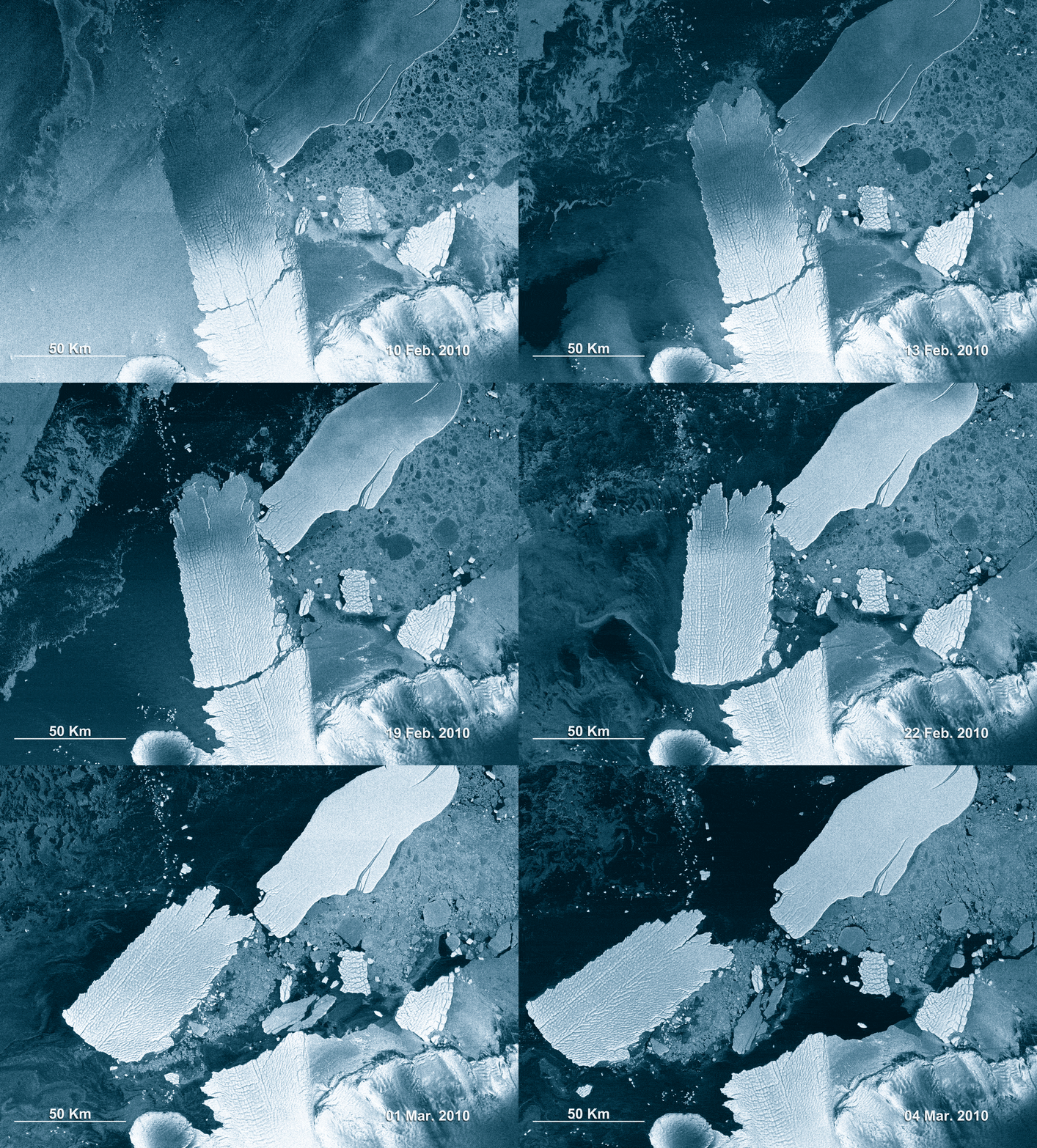
This animation, made up of eight Envisat radar images, shows the 97-km long B-9B iceberg (right) ramming into the Mertz Glacier Tongue in Eastern Antarctica in early February 2010.

The collision caused a chunk of the glacier’s tongue to snap off, giving birth to another iceberg nearly as large as B-9B. The new iceberg, named C-28, is roughly 78-km long and 39-km wide, with a surface area of 2500 sq km (the size of Luxembourg).

Envisat’s Advanced Synthetic Aperture Radar (ASAR) acquired these images from 10 February to 4 March in Wide Swath Mode, providing spatial resolution of 150 m. ASAR can pierce through clouds and local darkness and is capable of differentiating between different types of ice.

Credits: ESA

Monday, March 1, 2010

DLR Capture Iceberg collides on ice shelf in the Antarctica

Looking like a needle of ice and snow, iceberg B-15K was caught in the act by the German Aerospace Center's (Deutsches Zentrum für Luft- und Raumfahrt; DLR) TerraSAR-X satellite as it collided with an ice shelf in Atka Bay, Antarctica. Scientists had long been observing as the 54-kilometre long and 5-kilometre wide iceberg was driven around Antarctica by ocean currents. Then, on 11 February 2010, it crashed into the edge of the ice shelf in Atka Bay.


Like a needle of ice and snow, the iceberg B-15K was caught in the act by the German Aerospace Center's (Deutsches Zentrum für Luft- und Raumfahrt; DLR) TerraSAR-X satellite as it collided with an ice shelf. Scientists had long been watching as the 54-kilometre long and 5-kilometre wide iceberg was being driven around Antarctica by ocean currents. Then, on 11 February 2010, it crashed into the edge of the ice shelf in Atka Bay.


The Neumayer station, visible as a bright spot in this TerraSAR-X image, was not affected by the collision. This image, taken on 10 February 2008, shows the station as well as the transport routes to the ice shelf.

To read the full article on the DLR website, click here

Friday, February 26, 2010

Mammoth iceberg could alter ocean circulation: study


Mammoth iceberg could alter ocean circulation: study

An iceberg the size of Luxembourg knocked loose from the Antarctic continent earlier this month could disrupt the ocean currents driving weather patterns around the globe, researchers said Thursday.

While the impact would not be felt for decades or longer, a slowdown in the production of colder, dense water could result in less temperate winters in the north Atlantic, they said.

The 2550 square-kilometre (985 square-mile) block broke off on February 12 or 13 from the Mertz Glacier Tongue, a 160-kilometer spit of floating ice protruding into the Southern Ocean from East Antarctica due south of Melbourne, researchers said.

Some 400 metres (1300 feet) thick, the iceberg could fill Sydney Harbour more than 100 times over.

It could also disturb the area's exceptionally rich biodiversity, including a major colony of emperor penguins near Dumont d'Urville, site of a French scientific station, according to the scientists.

"The ice tongue was almost broken already. It was hanging like a loose tooth," said Benoit Legresy, a French glaciologist who has been monitoring the Metz Glacier via satellite images and on the ground for a decade in cooperation with Australian scientists.

The billion-tonne mass was dislodged by another, older iceberg, known as B9B, which split off in 1987.

Jammed against the Antarctic continent for more than 20 years, B9B smashed into the Metz tongue like a slow-motion battering ram after it began to drift.

Both natural cycles and manmade climate change contribute to the collapse ice shelves and glaciers.

Tide and ocean currents constantly beat against exposed areas, while longer summers and rising temperatures also take a toll.

"Obviously when there is warmer water, these ice tongues will become more fragile," said Legresy, who works at the Laboratory for Geophysics and Oceanographic Space Research in Toulouse, southern France.

Tuesday, November 24, 2009

100 Icebergs heading towards New Zealand: Threat to shipping

More than 100, and possibly hundreds, of Antarctic icebergs are floating towards New Zealand in a rare event which has prompted a shipping warning, officials said on Monday.
An Australian Antarctic Division glaciologist said the ice chunks, spotted by satellite photography, had passed the Auckland Islands and were heading towards the main South Island, about 450 kilometres (280 miles) northeast.

Scientist Neal Young said more than 100 icebergs -- some measuring more than 200 metres (650 feet) across -- were seen in just one cluster, indicating there could be hundreds more.

He said they were the remains of a massive ice floe which split from the Antarctic as sea and air temperatures rise due to global warming.

"All of these have come from a larger one that was probably 30 square kilometres (11.6 square miles) in size when it left Antarctica," Young told AFP.

"It's done a long circuit around Antarctica and now the bigger parts of it are breaking up and producing smaller ones."

He said large numbers of icebergs had not floated this close to New Zealand since 2006, when a number came within 25 kilometres of the coastline -- the first such sighting since 1931.

"They're following the same tracks now up towards New Zealand. Whether they make it up to the South Island or not is difficult to tell," Young said.

New Zealand has already issued coastal navigation warnings for the area in the Southern Ocean where the icebergs have been seen.

"It's really just a general warning for shipping in that area to be on the alert for icebergs," said Maritime New Zealand spokesman Ross Henderson.

The icebergs are smaller remnants of the giant chunks seen off Australia's Macquarie Island this month, including one estimated at two kilometres (1.2 miles) and another twice the size of Beijing's "Bird's Nest" Olympic Stadium.

Young earlier told AFP he expected to see more icebergs in the area if the Earth's temperature continues to increase.

"If the current trends in global warming were to continue I would anticipate seeing more icebergs and the large ice shelves breaking up," he said.

When icebergs last neared New Zealand in 2006, a sheep was helicoptered out to be shorn on one of the floes in a publicity stunt by the country's wool industry.