Showing posts with label detected. Show all posts

Wednesday, July 2, 2014

Mysterious signal detected in galaxy 240 million light years away


Astronomers have detected a mysterious signal 240 million light years away from Earth. The unidentified signal is a 'spike of intensity at a very specific wavelength of x-ray light', but scientists don't yet know what the origin is.

Picked up in the Perseus Cluster, one of the biggest objects in the universe, the discovery is said to be the best evidence of dark matter yet.

Astronomers believe dark matter constitutes 85 per cent of the matter in the universe, but doesn't emit or absorb light like normal matter such as protons or electrons, which are known to make up the familiar elements seen in planets, stars, and galaxies.

Researchers suggest intensity coming from the Perseus Cluster could be a signature from the decay of a 'sterile neutrino,' which are a hypothetical type of neutrino thought to interact with normal matter via gravity but while holding exciting potential, the results must be confirmed with additional data to rule out other explanations and to see whether it is plausible that dark matter has been observed.

Monday, June 23, 2014

Remarkable white dwarf star; coldest, dimmest ever detected

This is an artist impression of a white dwarf star in orbit with pulsar PSR J2222-0137. 

It may be the coolest and dimmest white dwarf ever identified. 

Credit: B. Saxton (NRAO /AUI /NSF)

A team of astronomers has identified possibly the coldest, faintest white dwarf star ever detected.

This ancient stellar remnant is so cool that its carbon has crystallized, forming an Earth-size diamond in space.

David Kaplan
"It's a really remarkable object," said David Kaplan, a professor at the University of Wisconsin-Milwaukee. "These things should be out there, but because they are so dim they are very hard to find."

Kaplan and his colleagues found this stellar gem using the National Radio Astronomy Observatory's (NRAO) Green Bank Telescope (GBT) and Very Long Baseline Array (VLBA), as well as other observatories.

White dwarfs are the extremely dense end-states of stars like our Sun that have collapsed to form an object approximately the size of the Earth.

Composed mostly of carbon and oxygen, white dwarfs slowly cool and fade over billions of years. The object in this new study is likely the same age as the Milky Way, approximately 11 billion years old.

Pulsars are rapidly spinning neutron stars, the superdense remains of massive stars that have exploded as supernovas.

As neutron stars spin, lighthouse-like beams of radio waves, streaming from the poles of its powerful magnetic field, sweep through space.

When one of these beams sweeps across the Earth, radio telescopes can capture the pulse of radio waves.

The pulsar companion to this white dwarf, dubbed PSR J2222-0137, was the first object in this system to be detected.

Jason Boyles
It was found using the GBT by Jason Boyles, then a graduate student at West Virginia University in Morgantown.

These first observations revealed that the pulsar was spinning more than 30 times each second and was gravitationally bound to a companion star, which was initially identified as either another neutron star or, more likely, an uncommonly cool white dwarf. The two were calculated to orbit each other once every 2.45 days.

The pulsar was then observed over a two-year period with the VLBA by Adam Deller, an astronomer at the Netherlands Institute for Radio Astronomy (ASTRON).

These observations pinpointed its location and distance from the Earth, approximately 900 light-years away in the direction of the constellation Aquarius.

This information was critical in refining the model used to time the arrival of the pulses at the Earth with the GBT.

By applying Einstein's theory of relatively, the researchers studied how the gravity of the companion warped space, causing delays in the radio signal as the pulsar passed behind it.

These delayed travel times helped the researchers determine the orientation of their orbit and the individual masses of the two stars.

The pulsar has a mass 1.2 times that of the Sun and the companion a mass 1.05 times that of the Sun.

These data strongly indicated that the pulsar companion could not have been a second neutron star; the orbits were too orderly for a second supernova to have taken place.

Knowing its location with such high precision and how bright a white dwarf should appear at that distance, the astronomers believed they should have been able to observe it in optical and infrared light.

Remarkably, neither the Southern Astrophysical Research (SOAR) telescope in Chile nor the 10-meter Keck telescope in Hawaii was able to detect it.

"Our final image should show us a companion 100 times fainter than any other white dwarf orbiting a neutron star and about 10 times fainter than any known white dwarf, but we don't see a thing," said Bart Dunlap, a graduate student at the University of North Carolina at Chapel Hill and one of the team members.

"If there's a white dwarf there, and there almost certainly is, it must be extremely cold."

The researchers calculated that the white dwarf would be no more than a comparatively cool 3,000 degrees Kelvin (2,700 degrees Celsius).

Astronomers believe that such a cool, collapsed star would be largely crystallized carbon, not unlike a diamond.

Other such stars have been identified and they are theoretically not that rare, but with a low intrinsic brightness, they can be deucedly difficult to detect.

Its fortuitous location in a binary system with a neutron star enabled the team to identify this one.

Saturday, April 5, 2014

NASA Cassini: Ocean inside Saturn's Icy Moon, Enceladus

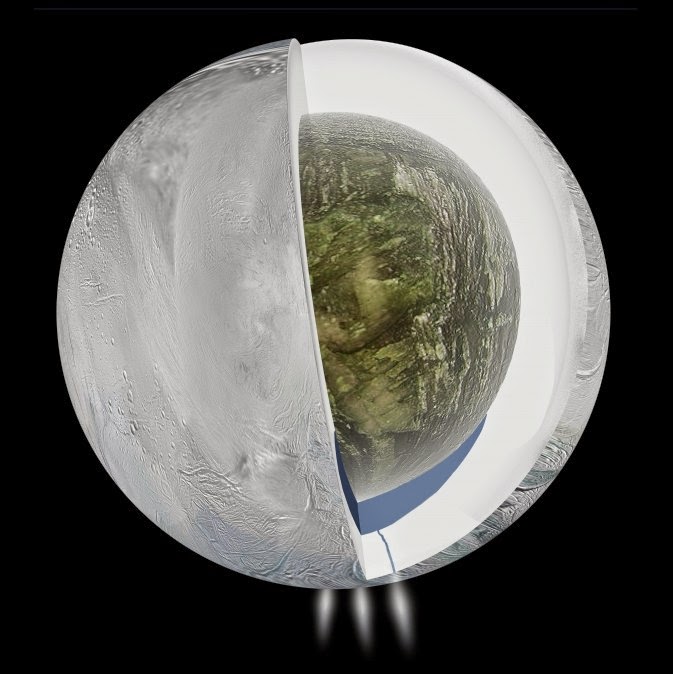
Gravity measurements by NASA's Cassini spacecraft and Deep Space Network suggest that Saturn's moon Enceladus, which has jets of water vapor and ice gushing from its south pole, also harbours a large interior ocean beneath an ice shell, as this illustration depicts.

Image Credit: NASA/JPL-Caltech

NASA's Cassini spacecraft and Deep Space Network have uncovered evidence Saturn's moon Enceladus harbors a large underground ocean of liquid water, furthering scientific interest in the moon as a potential home to extraterrestrial microbes.

Researchers theorized the presence of an interior reservoir of water in 2005 when Cassini discovered water vapor and ice spewing from vents near the moon's south pole.

The new data provide the first geophysical measurements of the internal structure of Enceladus, consistent with the existence of a hidden ocean inside the moon.

Findings from the gravity measurements are in the Friday April 4 edition of the journal Science.

"The way we deduce gravity variations is a concept in physics called the Doppler Effect, the same principle used with a speed-measuring radar gun," said Sami Asmar of NASA's Jet Propulsion Laboratory (JPL) in Pasadena, Calif., a coauthor of the paper.

"As the spacecraft flies by Enceladus, its velocity is perturbed by an amount that depends on variations in the gravity field that we're trying to measure. We see the change in velocity as a change in radio frequency, received at our ground stations here all the way across the solar system."

The gravity measurements suggest a large, possibly regional, ocean about 6 miles (10 kilometers) deep, beneath an ice shell about 19 to 25 miles (30 to 40 kilometers) thick.

The subsurface ocean evidence supports the inclusion of Enceladus among the most likely places in our solar system to host microbial life.

Before Cassini reached Saturn in July 2004, no version of that short list included this icy moon, barely 300 miles (500 kilometers) in diameter.

"This then provides one possible story to explain why water is gushing out of these fractures we see at the south pole," said David Stevenson of the California Institute of Technology, Pasadena, one of the paper's co-authors.

Cassini has flown near Enceladus 19 times. Three flybys, from 2010 to 2012, yielded precise trajectory measurements.

The gravitational tug of a planetary body, such as Enceladus, alters a spacecraft's flight path.

Variations in the gravity field, such as those caused by mountains on the surface or differences in underground composition, can be detected as changes in the spacecraft's velocity, measured from Earth.

The technique of analyzing a radio signal between Cassini and the Deep Space Network can detect changes in velocity as small as less than one foot per hour (90 microns per second).

With this precision, the flyby data yielded evidence of a zone inside the southern end of the moon with higher density than other portions of the interior.

The south pole area has a surface depression that causes a dip in the local tug of gravity. However, the magnitude of the dip is less than expected given the size of the depression, leading researchers to conclude the depression's effect is partially offset by a high-density feature in the region, beneath the surface.

"The Cassini gravity measurements show a negative gravity anomaly at the south pole that however is not as large as expected from the deep depression detected by the onboard camera," said the paper's lead author, Luciano Iess of Sapienza University of Rome.

"Hence the conclusion that there must be a denser material at depth that compensates the missing mass: very likely liquid water, which is seven percent denser than ice. The magnitude of the anomaly gave us the size of the water reservoir."

There is no certainty the subsurface ocean supplies the water plume spraying out of surface fractures near the south pole of Enceladus, however, scientists reason it is a real possibility.

The fractures may lead down to a part of the moon that is tidally heated by the moon's repeated flexing, as it follows an eccentric orbit around Saturn.

Much of the excitement about the Cassini mission's discovery of the Enceladus water plume stems from the possibility that it originates from a wet environment that could be a favorable environment for microbial life.

"Material from Enceladus’ south polar jets contains salty water and organic molecules, the basic chemical ingredients for life," said Linda Spilker, Cassini's project scientist at JPL.

"Their discovery expanded our view of the 'habitable zone' within our solar system and in planetary systems of other stars. This new validation that an ocean of water underlies the jets furthers understanding about this intriguing environment."

The Cassini-Huygens mission is a cooperative project of NASA, the European Space Agency and the Italian Space Agency.

Monday, March 17, 2014

Rumours that Gravitational waves have been detected

This detailed map of the Cosmic Microwave Background (CMB) is created from seven years worth of data. 

The colour variations correspond to temperature variations in the young universe: the seeds for stars and galaxies observed today. 

Credit: NASA

Last week the Harvard-Smithsonian Center for Astrophysics (CfA) stated rather nonchalantly that they will be hosting a press conference on Monday, March 17th, to announce a "major discovery."

Without a potential topic for journalists to muse on, this was as melodramatic as it got but then the Guardian posted an article on the subject and the rumours went into overdrive.

The speculation is this: a U.S. team is on the verge of confirming they have detected primordial gravitational waves—ripples in the fabric of spacetime that carry echoes of the big bang nearly 14 billion years ago.

If there is evidence for gravitational waves, it will be a landmark discovery, ultimately changing the face of physics.

Not only are gravitational waves the last untested prediction of Albert Einstein's General Theory of Relativity, but primordial gravitational waves will allow astronomers to glimpse the universe in its infancy.

"It's been called the Holy Grail of cosmology," Hiranya Peiris, a cosmologist from University College London, told reporters.

"It would be a real major, major, major discovery." Any convincing evidence would almost certainly lead to a Nobel prize.

The signal is rumoured to have been found by a telescope known as BICEP (Background Imaging of Cosmic Extragalactic Polarization), which scans the sky from the south pole, looking for a subtle effect in the Cosmic Microwave Background (CMB): the radiation released 380,000 years after the big bang when space became transparent to light and photons were allowed to travel freely across the universe.

The South Pole Telescope (left) and BICEP (right). Credit: Dana Hrubes

While the CMB has been mapped in exquisite detail, astronomers think that hidden within the map is a second fingerprint, which would reveal gravitational waves.

Its radiation was scattered toward us from the universe's earliest atoms, similar to the way blue light is scattered toward us from the atoms in the sky and just as the sky is slightly polarized, the waves have a preferred orientation, so is the CMB (on the level of a few percent).

Cosmologists are digging through the data, searching for a subtle twist in the polarized light, known as B-modes.

If a gravitational wave moves through the fabric of spacetime, it will squeeze spacetime in one direction (the universe will look a little hotter) and stretch it in another (the universe will look a little cooler).

The photons will scatter with a preferred direction, leaving a slightly polarized imprint on the CMB, due to the passing gravitational wave.

Andrew Jaffe
"If a detection has been made, it is extraordinarily exciting," Andrew Jaffe, a cosmologist from Imperial College, London, told reporters.

"This is the real big tick-box that we have been waiting for. It will tell us something incredibly fundamental about what was happening when the universe was only 10-34 seconds old."

Monday, September 30, 2013

Plastic Moon: Propylene Detected On Titan | Video


The main ingredient in industrial plastic number 5, has been detected in the atmosphere of the Saturn moon. 

The propylene molecule was missing in Voyager 1's probe of the moon in 1980, and had baffled scientists until now.

Credit: NASA / GSFC

Thursday, May 16, 2013

IceCube Detector under Antarctic ice may have seen first cosmic neutrinos

IceCube, the giant experiment buried beneath the South Pole's ice has recorded the first neutrinos ever detected originating outside our solar system, researchers say.

Neutrinos are produced in our atmosphere but the IceCube experiment -- a cubic kilometer of sensitive detectors sunk into the Antarctic ice -- has seen the first "cosmic neutrinos," they said.

IceCube consists of 86 strings, each with 60 sensitive light detectors strung along it like "fairy lights," sunk deep into the ice.

Rare collisions of neutrinos with the nuclei of atoms in the ice produce a brief flash that the detectors can catch.

With more than 5,000 detectors catching the flashes the direction of the neutrinos' arrival on Earth can be determined, the researchers said.

Neutrinos can be produced in the Earth's atmosphere -- IceCube picks up about 100,000 of that variety a year -- but previous attempts to isolate neutrinos created in far-flung cosmic processes had all failed.

However, in April the IceCube research team reported detecting two neutrinos -- nicknamed Bert and Ernie -- with energy levels high enough to suggest a cosmic rather than atmospheric origin.

The team has now reported 26 more events of similar energy that they expect will also be confirmed as cosmic in origin.

Francis Halzen
Detection is just a first step and "of course, there's much more to do," IceCube principle investigator Francis Halzen told reporters.

"It's after you find them that the work starts; these events are very difficult to analyze."

The study results were presented Wednesday at the IceCube Particle Astrophysics Symposium in Madison, Wis.

Tuesday, March 5, 2013

Stomach cancer 'spotted by breath test'

A quick and simple breath test can diagnose stomach cancer, study findings reveal.

Scientists from Israel found the test was 90% accurate at detecting and distinguishing cancers from other stomach complaints in 130 patients.

The British Journal of Cancer says the test could revolutionise and speed up the way this cancer is diagnosed.

About 7,000 UK people develop stomach cancer each year and most have an advanced stage of the disease.

Two-fifths of patients survive for at least a year, but only a fifth are still alive after five years, despite treatment.

Currently doctors diagnose stomach cancer by taking a biopsy of the stomach lining using a probe and a flexible camera passed via mouth and down the gullet.

The new test looks for chemical profiles in exhaled breath that are unique to patients with stomach cancer.

Volatile organic compounds 
Cancer appears to give off a signature smell of volatile organic compounds that can be detected using the right technical medical kit - and also dogs. It has already been found that dogs have an ability to detect cancer in humans.

The science behind the test itself is not new - many researchers have been working on the possibility of breath tests for a number of cancers, including lung.

But the work by Prof Hossam Haick, of the Israel Institute of Technology, suggests it is a good way to spot stomach cancer.

In the study, 37 of the patients had stomach cancer, 32 had stomach ulcers and 61 had other stomach complaints.

As well as accurately distinguishing between these conditions 90% of the time, the breath test could tell the difference between early and late-stage stomach cancers.

The team are now running a bigger study in more patients to validate their test.

Kate Law, director of clinical research at Cancer Research UK, said: "The results of this latest study are promising - although large scale trials will now be needed to confirm these findings.

"Only one in five people are able to have surgery as part of their treatment as most stomach cancers are diagnosed at stages that are too advanced for surgery. Any test that could help diagnose stomach cancers earlier would make a difference to patients' long-term survival."

Cancer Research UK has always rejected the use of dogs to detect cancers in humans because they are 'unreliable.' They prefer the use of electronics and black boxes.