Showing posts with label Enceladus. Show all posts

Monday, December 1, 2014

Nasa Cassini: Enceladus a small speck before enormous Saturn


Enceladus (visible in the lower-left corner) is but a speck before enormous Saturn 

Credit: Nasa Cassini

Enceladus (visible in the lower-left corner of the image) is but a speck before enormous Saturn, but even a small moon can generate big waves of excitement throughout the scientific community.

Enceladus, only 313 miles (504 kilometers) across, spurts vapour jets from its south pole.

The presence of these jets from Enceladus has been the subject of intense study since they were discovered by NASA's Cassini. Their presence may point to a sub-surface water reservoir.

This view looks toward the unilluminated side of the rings from about 2 degrees below the ringplane.

The image was taken with the Cassini spacecraft wide-angle camera on Oct. 20, 2014 using a spectral filter which preferentially admits wavelengths of near-infrared light centered at 752 nanometers.

The view was obtained at a distance of approximately 589,000 miles (948,000 kilometers) from Saturn and at a Sun-Saturn-spacecraft, or phase, angle of 26 degrees. Image scale is 35 miles (57 kilometers) per pixel.

The Cassini-Huygens mission is a cooperative project of NASA, the European Space Agency and the Italian Space Agency.

The Jet Propulsion Laboratory, a division of the California Institute of Technology in Pasadena, manages the mission for NASA's Science Mission Directorate, Washington, D.C.

The Cassini orbiter and its two onboard cameras were designed, developed and assembled at JPL.

The imaging operations center is based at the Space Science Institute in Boulder, Colo.

The Cassini imaging team homepage is at ciclops.org .

Credit: NASA /JPL-Caltech /Space Science Institute 

Friday, August 15, 2014

NASA Cassini: Hydrocarbon Clouds Move On Saturn's Huge Moon Titan


Clouds cruise through the skies of Saturn's largest moon, Titan, in striking new imagery captured by NASA's Cassini spacecraft.

In a rare sight for scientists, Cassini captured views of methane clouds drifting across Ligeia Mare, a big hydrocarbon sea near Titan's north pole, from July 20 through July 22.

Few clouds had been seen on Titan since the dissipation of a major storm in 2010, so researchers are trying to gauge the significance of the new observations.

"We're eager to find out if the clouds' appearance signals the beginning of summer weather patterns, or if it is an isolated occurrence," Cassini imaging team associate Elizabeth Turtle, of the Johns Hopkins University Applied Physics Lab in Laurel, Maryland, said in a statement.

"Also, how are the clouds related to the seas? Did Cassini just happen catch them over the seas, or do they form there preferentially?"

NASA's Cassini spacecraft viewed renewed cloud activity in Titan's northern polar region. Image taken on July 21, 2014. 

Credit: NASA /JPL-Caltech /Space Science Institute

The clouds' motion suggests wind speeds of about 7 to 10 mph (11 to 16 km/h), researchers said.

Saturn and its many moons take 30 years to complete one lap around the sun, so seasons in the Saturn system each last a little more than seven years.

It is now summer in Titan's northern hemisphere; the moon's summer solstice, which marks the midpoint of the season, comes in 2017. Titan, at 3,200 miles (5,150 kilometers) across, is about 50 percent larger than Earth's moon.

Modeling work had suggested that cloud formation should have increased in Titan's northern regions as summer took hold and temperatures rose, but such predictions have not been borne out to date, researchers said.

Titan is the only body in the solar system besides Earth known to possess stable bodies of liquid on its surface. Unlike Earth, however, Titan's climate system is hydrocarbon-based, with methane rain flowing into seas and lakes on the frigid moon's surface.

The $3.2 billion Cassini mission launched in 1997 and began orbiting Saturn in 2004, at the height of the gas giant's northern winter.

Cassini's long life is allowing researchers to track seasonal changes in the Saturn system; the probe is currently scheduled to operate through September 2017, when it will make an intentional death plunge into the ringed planet's thick atmosphere.

That final, fatal maneuver will ensure that Cassini does not contaminate Titan or Enceladus, two Saturn moons that may be capable of supporting life.

Cassini imaged the Titan clouds last month as it sped away from the satellite after a close flyby. Another encounter with Titan is planned for Aug. 21.

Tuesday, July 29, 2014

NASA Cassini: The geyser basin of Saturn's moon Enceladus

This view looks across the geyser basin of Saturn's moon Enceladus, along fractures spewing water vapour and ice particles into space. 

Cassini scientists have pinpointed the source locations of about 100 geysers and gained new insights into what powers them. 

Credit: NASA/JPL-Caltech/SSI

Scientists using mission data from NASA's Cassini spacecraft have identified 101 distinct geysers erupting on Saturn's icy moon Enceladus.

Their analysis suggests it is possible for liquid water to reach from the moon's underground sea all the way to its surface.

These findings, and clues to what powers the geyser eruptions, are presented in two articles published in the current online edition of the Astronomical Journal.

Over a period of almost seven years, Cassini's cameras surveyed the south polar terrain of the small moon, a unique geological basin renowned for its four prominent "tiger stripe" fractures and the geysers of tiny icy particles and water vapour first sighted there nearly 10 years ago.

The result of the survey is a map of 101 geysers, each erupting from one of the tiger stripe fractures, and the discovery that individual geysers are coincident with small hot spots.

These relationships pointed the way to the geysers' origin.

After the first sighting of the geysers in 2005, scientists suspected that repeated flexing of Enceladus by Saturn's tides as the moon orbits the planet had something to do with their behaviour.

One suggestion included the back-and-forth rubbing of opposing walls of the fractures generating frictional heat that turned ice into geyser-forming vapour and liquid.

Alternate views held that the opening and closing of the fractures allowed water vapor from below to reach the surface.

This artist's rendering shows a cross-section of the ice shell immediately beneath one of Enceladus' geyser-active fractures, illustrating the physical and thermal structure and the processes ongoing below and at the surface.

Image Credit: NASA/JPL-Caltech/Space Science Institute

Before this new study, it was not clear which process was the dominating influence.

Nor was it certain whether excess heat emitted by Enceladus was everywhere correlated with geyser activity.

To determine the surface locations of the geysers, researchers employed the same process of triangulation used historically to survey geological features on Earth, such as mountains.

When the researchers compared the geysers' locations with low-resolution maps of thermal emission, it became apparent the greatest geyser activity coincided with the greatest thermal radiation.

Comparisons between the geysers and tidal stresses revealed similar connections. However, these correlations alone were insufficient to answer the question, "What produces what?"

The answer to this mystery came from comparison of the survey results with high-resolution data collected in 2010 by Cassini's heat-sensing instruments.

Individual geysers were found to coincide with small-scale hot spots, only a few dozen feet (or tens of meters) across, which were too small to be produced by frictional heating, but the right size to be the result of condensation of vapor on the near-surface walls of the fractures.

This immediately implicated the hot spots as the signature of the geysering process.

"Once we had these results in hand, we knew right away heat was not causing the geysers, but vice versa," said Carolyn Porco, leader of the Cassini imaging team from the Space Science Institute in Boulder, Colorado, and lead author of the first paper.

"It also told us the geysers are not a near-surface phenomenon, but have much deeper roots."

Thanks to recent analysis of Cassini gravity data, the researchers concluded the only plausible source of the material forming the geysers is the sea now known to exist beneath the ice shell.

They also found that narrow pathways through the ice shell can remain open from the sea all the way to the surface, if filled with liquid water.

In the companion paper, the authors report the brightness of the plume formed by all the geysers, as seen with Cassini's high-resolution cameras, changes periodically as Enceladus orbits Saturn.

Armed with the conclusion that the opening and closing of the fractures modulates the venting, the authors compared the observations with the expected venting schedule due to tides.

They found the simplest model of tidal flexing provides a good match for the brightness variations Cassini observes, but it does not predict the time when the plume begins to brighten.

Some other important effect is present and the authors considered several in the course of their work.

More information: "Tidally Modulated Eruptions on Enceladus: Cassini ISS Observations and Models." Francis Nimmo et al. 2014, Astronomical Journal 148 46. DOI: 10.1088/0004-6256/148/3/46

Tuesday, July 1, 2014

NASA Cassini Probe Celebrates 10 Years orbiting Saturn - Video

A photo taken of Saturn by the Cassini spacecraft, which has been exploring the Saturn system for 10 years. Image uploaded June 30, 2014.

Credit: NASA/JPL

NASA spacecraft Cassini passes a big milestone, a decade exploring Saturn and its many moons.

Since arriving in orbit around Saturn 10 years ago today, the Cassini probe has made a number of unprecedented observations and discoveries.

Although the spacecraft was originally approved for a four-year mission, it has been granted three mission extensions, allowing it to continue roaming the gas giant’s system.

Linda Spilker
"Having a healthy, long-lived spacecraft at Saturn has afforded us a precious opportunity," Linda Spilker, Cassini project scientist at NASA’s Jet Propulsion Laboratory in Pasadena, California, said in a statement.

"By having a decade there with Cassini, we have been privileged to witness never-before-seen events that are changing our understanding of how planetary systems form and what conditions might lead to habitats for life."

For example, Cassini has helped scientists learn more about what kinds of molecules populate our solar system.

The spacecraft discovered plumes containing water-ice shooting out into space from the south polar region of Saturn’s moon Enceladus.


The Enceladus discovery is one of Cassini’s most remarkable findings because it marked an extension of the search for life in the solar system, NASA officials said.

Researchers know that life as we understand it relies on water, so finding the substance on a moon or planet could be a sign that life might be able to exist there.

Scientists now think that Enceldus harbors an underground ocean.

Enceladus wasn’t the only mysterious moon Cassini helped reveal. Saturn’s huge satellite Titan has also been studied by the long-lasting orbiter.

Cassini’s measurements have shown that Titan has rain, lakes, seas and rivers like Earth, NASA officials said. Unlike Earth, however, Titan is a cold world with seas of liquid methane rather than water.

The Titan-exploring Huygens probe also launched to the Saturn system with Cassini in October 1997.

The European Space Agency’s Huygens robot landed on Titan in 2005 and became the first manmade craft to land on a moon in the outer solar system.

It measured the atmosphere and beamed images of the moon back to Earth.

“The probe’s 2 hour and 27 minute descent revealed Titan to be remarkably like Earth before life evolved, with methane rain, erosion and drainage channels and dry lake beds,” NASA officials said.

“A soup of complex hydrocarbons, including benzene, was found in Titan's atmosphere.”

Saturn's moon Tethys with its prominent Odysseus Crater silently slips behind Saturn's largest moon Titan.

Cassini has also unveiled how Saturn’s rings change over time, and because of its long tenure in the planetary system, the probe has observed seasonal changes taking place on the planet and its moons, according to NASA.

Cassini will continue to beam back data to Earth for a few more years, until 2017 when it is scheduled to intentionally plunge into Saturn’s atmosphere, ending its mission.

Hydrocarbon Lakes on Titan

Tuesday, April 15, 2014

NASA Cassini image: Birth of a Saturn moon

The disturbance visible at the outer edge of Saturn's A ring in this image from NASA's Cassini spacecraft could be caused by an object replaying the birth process of icy moons. 

Credit: JPL/NASA

NASA's Cassini spacecraft has documented the formation of a small icy object within the rings of Saturn that may be a new moon, and may also provide clues to the formation of the planet's known moons.

Images taken with Cassini's narrow angle camera on April 15, 2013, show disturbances at the very edge of Saturn's A ring, the outermost of the planet's large, bright rings.

One of these disturbances is an arc about 20 percent brighter than its surroundings, 750 miles (1,200 kilometers) long and 6 miles (10 kilometers) wide.

Scientists also found unusual protuberances in the usually smooth profile at the ring's edge.

Scientists believe the arc and protuberances are caused by the gravitational effects of a nearby object. Details of the observations were published online today by the journal Icarus.

The object is not expected to grow any larger, and may even be falling apart but the process of its formation and outward movement aids in our understanding of how Saturn's icy moons, including the cloud-wrapped Titan and ocean-holding Enceladus, may have formed in more massive rings long ago.

It also provides insight into how Earth and other planets in our solar system may have formed and migrated away from our star, the sun.

Carl Murray
"We have not seen anything like this before," said Carl Murray of Queen Mary University of London, the report's lead author.

"We may be looking at the act of birth, where this object is just leaving the rings and heading off to be a moon in its own right."

The object, informally named Peggy, is too small to be seen in images so far. Scientists estimate it is probably no more than about a half mile (about a kilometer) in diameter.

Saturn's icy moons range in size depending on their proximity to the planet—the farther from the planet, the larger, and many of Saturn's moons are composed primarily of ice, as are the particles that form Saturn's rings.

Based on these facts, and other indicators, researchers recently proposed that the icy moons formed from ring particles and then moved outward, away from the planet, merging with other moons on the way.

"Witnessing the possible birth of a tiny moon is an exciting, unexpected event," said Cassini Project Scientist Linda Spilker, of NASA's Jet Propulsion Laboratory in Pasadena, Calif.

According to Spilker, Cassini's orbit will move closer to the outer edge of the A ring in late 2016 and provide an opportunity to study Peggy in more detail and perhaps even image it.

It is possible the process of moon formation in Saturn's rings has ended with Peggy, as Saturn's rings now are, in all likelihood, too depleted to make more moons.

Because they may not observe this process again, Murray and his colleagues are wringing from the observations all they can learn.

"The theory holds that Saturn long ago had a much more massive ring system capable of giving birth to larger moons," Murray said.

"As the moons formed near the edge, they depleted the rings and evolved, so the ones that formed earliest are the largest and the farthest out."

More information: Carl D. Murray, Nicholas J. Cooper, Gareth A. Williams, Nicholas O. Attree, Jeffrey S. Boyer, The discovery and dynamical evolution of an object at the outer edge of Saturn's A ring, Icarus, Available online 28 March 2014, ISSN 0019-1035, dx.doi.org/10.1016/j.icarus.2014.03.024.

Saturday, April 5, 2014

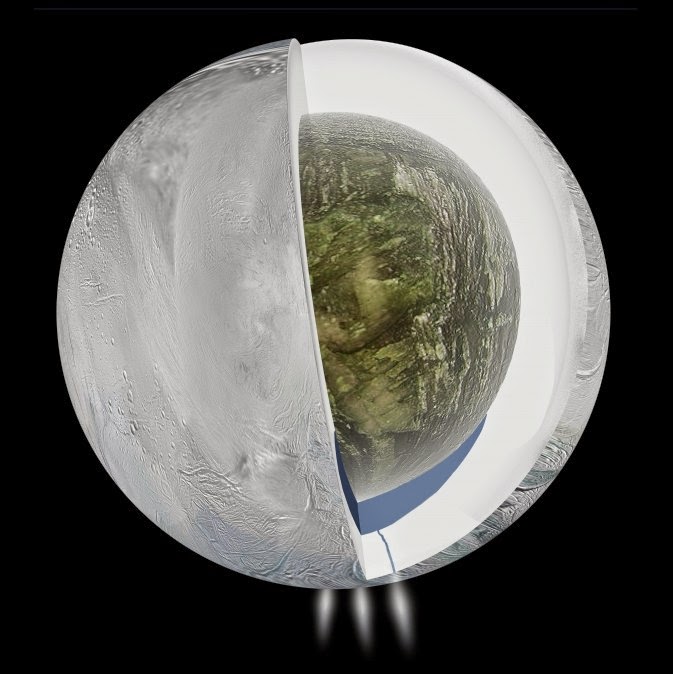
NASA Cassini: Ocean inside Saturn's Icy Moon, Enceladus

Gravity measurements by NASA's Cassini spacecraft and Deep Space Network suggest that Saturn's moon Enceladus, which has jets of water vapor and ice gushing from its south pole, also harbours a large interior ocean beneath an ice shell, as this illustration depicts.

Image Credit: NASA/JPL-Caltech

NASA's Cassini spacecraft and Deep Space Network have uncovered evidence Saturn's moon Enceladus harbors a large underground ocean of liquid water, furthering scientific interest in the moon as a potential home to extraterrestrial microbes.

Researchers theorized the presence of an interior reservoir of water in 2005 when Cassini discovered water vapor and ice spewing from vents near the moon's south pole.

The new data provide the first geophysical measurements of the internal structure of Enceladus, consistent with the existence of a hidden ocean inside the moon.

Findings from the gravity measurements are in the Friday April 4 edition of the journal Science.

"The way we deduce gravity variations is a concept in physics called the Doppler Effect, the same principle used with a speed-measuring radar gun," said Sami Asmar of NASA's Jet Propulsion Laboratory (JPL) in Pasadena, Calif., a coauthor of the paper.

"As the spacecraft flies by Enceladus, its velocity is perturbed by an amount that depends on variations in the gravity field that we're trying to measure. We see the change in velocity as a change in radio frequency, received at our ground stations here all the way across the solar system."

The gravity measurements suggest a large, possibly regional, ocean about 6 miles (10 kilometers) deep, beneath an ice shell about 19 to 25 miles (30 to 40 kilometers) thick.

The subsurface ocean evidence supports the inclusion of Enceladus among the most likely places in our solar system to host microbial life.

Before Cassini reached Saturn in July 2004, no version of that short list included this icy moon, barely 300 miles (500 kilometers) in diameter.

"This then provides one possible story to explain why water is gushing out of these fractures we see at the south pole," said David Stevenson of the California Institute of Technology, Pasadena, one of the paper's co-authors.

Cassini has flown near Enceladus 19 times. Three flybys, from 2010 to 2012, yielded precise trajectory measurements.

The gravitational tug of a planetary body, such as Enceladus, alters a spacecraft's flight path.

Variations in the gravity field, such as those caused by mountains on the surface or differences in underground composition, can be detected as changes in the spacecraft's velocity, measured from Earth.

The technique of analyzing a radio signal between Cassini and the Deep Space Network can detect changes in velocity as small as less than one foot per hour (90 microns per second).

With this precision, the flyby data yielded evidence of a zone inside the southern end of the moon with higher density than other portions of the interior.

The south pole area has a surface depression that causes a dip in the local tug of gravity. However, the magnitude of the dip is less than expected given the size of the depression, leading researchers to conclude the depression's effect is partially offset by a high-density feature in the region, beneath the surface.

"The Cassini gravity measurements show a negative gravity anomaly at the south pole that however is not as large as expected from the deep depression detected by the onboard camera," said the paper's lead author, Luciano Iess of Sapienza University of Rome.

"Hence the conclusion that there must be a denser material at depth that compensates the missing mass: very likely liquid water, which is seven percent denser than ice. The magnitude of the anomaly gave us the size of the water reservoir."

There is no certainty the subsurface ocean supplies the water plume spraying out of surface fractures near the south pole of Enceladus, however, scientists reason it is a real possibility.

The fractures may lead down to a part of the moon that is tidally heated by the moon's repeated flexing, as it follows an eccentric orbit around Saturn.

Much of the excitement about the Cassini mission's discovery of the Enceladus water plume stems from the possibility that it originates from a wet environment that could be a favorable environment for microbial life.

"Material from Enceladus’ south polar jets contains salty water and organic molecules, the basic chemical ingredients for life," said Linda Spilker, Cassini's project scientist at JPL.

"Their discovery expanded our view of the 'habitable zone' within our solar system and in planetary systems of other stars. This new validation that an ocean of water underlies the jets furthers understanding about this intriguing environment."

The Cassini-Huygens mission is a cooperative project of NASA, the European Space Agency and the Italian Space Agency.

Ocean Discovery On Enceladus Spur Life-Hunting Missions to Icy Moons

Saturn's moon Enceladus, covered in snow and ice, resembles a perfectly packed snowball in this image from NASA's Cassini mission released on Dec. 23, 2013.

This view was taken by Cassini on March 10, 2012. It shows the leading side of Enceladus

North on Enceladus is up and rotated 6 degrees to the left.

Credit: NASA/JPL-Caltech/Space Science Institute

Astronomers are hoping that the existence of a subsurface ocean on Saturn's icy moon Enceladus will build momentum for life-hunting missions to the outer solar system.

Researchers announced their discovery of the deep watery ocean on Enceladus on Thursday (April 3) in the journal Science, confirming suspicions held by many scientists since 2005, when NASA's Cassini spacecraft spied geysers of ice and water vapor erupting from Enceladus' south pole.

The discovery vaults Enceladus into the top tier of life-hosting candidates along with Europa, an ice-sheathed moon of Jupiter that also hosts a subterranean ocean. Both frigid satellites bear much closer investigation, researchers say.


"I don't know which of the two is going to be more likely to have life. It might be both; it could be neither," study co-author Jonathan Lunine of Cornell University told reporters yesterday (April 2).

Jonathan Lunine
"I think what this discovery tells us is that we just need to be more aggressive in getting the next generation of spacecraft both to Europa and to the Saturn system once the Cassini mission is over."

Cassini arrived in orbit around Saturn in 2004 and is currently scheduled to go out in a blaze of glory in September 2017, when it will dive headlong into the giant planet's thick atmosphere.

Enceladus' geysers blast material hundreds of miles into space, offering a way to sample the moon's subsurface ocean from afar.

(Researchers think the ocean is feeding the geysers, though they can't be sure of this at the moment.)

Tuesday, February 11, 2014

NASA's Cassini: Auroras over Saturn's north and south poles

Ultraviolet and infrared images from NASA's Cassini spacecraft and Hubble Space Telescope show active and quiet auroras at Saturn's north and south poles. 

Credit: NASA /JPL-Caltech /University of Colorado/Central Arizona College /ESA /University of Leicester /JPL-Caltech /University of Arizona /Lancaster University

NASA trained several pairs of eyes on Saturn as the planet put on a dancing light show at its poles.

While NASA's Hubble Space Telescope, orbiting around Earth, was able to observe the northern auroras in ultraviolet wavelengths, NASA's Cassini spacecraft, orbiting around Saturn, got complementary close-up views in infrared, visible-light and ultraviolet wavelengths.

Cassini could also see northern and southern parts of Saturn that don't face Earth.

The result is a kind of step-by-step choreography detailing how the auroras move, showing the complexity of these auroras and how scientists can connect an outburst from the Sun and its effect on the magnetic environment at Saturn.

Jonathan Nichols
"Saturn's auroras can be fickle—you may see fireworks, you may see nothing," said Jonathan Nichols of the University of Leicester in England, who led the work on the Hubble images.

"In 2013, we were treated to a veritable smorgasbord of dancing auroras, from steadily shining rings to super-fast bursts of light shooting across the pole."

The Hubble and Cassini images were focused on April and May of 2013.

Images from Cassini's ultraviolet imaging spectrometer (UVIS), obtained from an unusually close range of about six Saturn radii, provided a look at the changing patterns of faint emissions on scales of a few hundred miles (kilometers) and tied the changes in the auroras to the fluctuating wind of charged particles blowing off the Sun and flowing past Saturn.

"This is our best look yet at the rapidly changing patterns of auroral emission," said Wayne Pryor, a Cassini co-investigator at Central Arizona College in Coolidge, Ariz.

"Some bright spots come and go from image to image. Other bright features persist and rotate around the pole, but at a rate slower than Saturn's rotation."


Aikaterini Radioti 
The UVIS images, which are also being analyzed by team associate Aikaterini Radioti at the University of Liege, Belgium, also suggest that one way the bright auroral storms may be produced is by the formation of new connections between magnetic field lines.

That process causes storms in the magnetic bubble around Earth.

The movie also shows one persistent bright patch of the aurora rotating in lockstep with the orbital position of Saturn's moon Mimas.

While previous UVIS images had shown an intermittent auroral bright spot magnetically linked to the moon Enceladus, the new movie suggests another Saturn moon can influence the light show as well.

The new data also give scientists clues to a long-standing mystery about the atmospheres of giant outer planets.

More Information: NASA Cassini Saturn Aurora Campaign

Tuesday, December 24, 2013

NASA Cassini Saturn Image: Saturn and moons in holiday dress

The globe of Saturn, seen here in natural color, is reminiscent of a holiday ornament in this wide-angle view from NASA's Cassini spacecraft

Credit: NASA/JPL-Caltech/Space Science Institute
This holiday season, feast your eyes on images of Saturn and two of its most fascinating moons, Titan and Enceladus, in a care package from NASA's Cassini spacecraft.

All three bodies are dressed and dazzling in this special package assembled by Cassini's imaging team.

"During this, our tenth holiday season at Saturn, we hope that these images from Cassini remind everyone the world over of the significance of our discoveries in exploring such a remote and beautiful planetary system," said Carolyn Porco, Cassini imaging team leader, based at the Space Science Institute, Boulder, Colo. "Happy holidays from all of us on Cassini."

Two views of Enceladus are included in the package and highlight the many fissures, fractures and ridges that decorate the icy moon's surface.

Enceladus is a white, glittering snowball of a moon, now famous for the nearly 100 geysers that are spread across its south polar region and spout tiny icy particles into space.

Most of these particles fall back to the surface as snow. Some small fraction escapes the gravity of Enceladus and makes its way into orbit around Saturn, forming the planet's extensive and diffuse E ring.

Because scientists believe these geysers are directly connected to a subsurface, salty, organic-rich, liquid-water reservoir, Enceladus is home to one of the most accessible extraterrestrial habitable zones in the solar system.

A dynamical interplay between Saturn's largest moon, Titan, and its rings is captured in this view from NASA's Cassini spacecraft. 

Image Credit: NASA/JPL-Caltech/Space Science Institute

Packaged along with Saturn and Enceladus is a group of natural-colour images of Saturn's largest moon, Titan, highlighting two of Titan's most outstanding features.

Peering through the moon's hazy, orange atmosphere, the Cassini narrow-angle camera spots dark, splotchy features in the polar regions of the moon.

These features are the lakes and seas of liquid methane and ethane for which the moon is renowned.

Titan is the only other place in the solar system that we know has stable liquids on its surface, though in Titan's case, the liquids are ethane and methane rather than water.

At Titan's south pole, a swirling high-altitude vortex stands out distinctly against the darkness of the moon's un-illuminated atmosphere.

Titan's hazy atmosphere and surface environment are believed to be similar in certain respects to the early atmosphere of Earth.

More information: The new images are available online at: www.nasa.gov/cassini , saturn.jpl.nasa.gov and ciclops.org .

Thursday, August 1, 2013

Saturn Icy Moon Enceladus: Geysers Tied to Orbit

This photo of water geysers spouting from Saturn's moon Enceladus was taken by NASA's Cassini orbiter in October 2007

Credit: Cassini Imaging Team, SSI, JPL, ESA, NASA

Steady geysers of water ice on one of Saturn's icy moons appear to erupt more strongly when the moon is farthest from its ringed parent planet, scientists say.

The warm vents at the south pole of Saturn's moon Enceladus emit vast plumes of water vapor and ice out into space.

While these plumes have been studied for some time, scientists have now observed a correlation between the intensity of the plume and the location of the moon in its orbit around Saturn.

Using data from the Cassini spacecraft, Cornell University research associate Matthew Hedman and a team of scientists found that when the 314-mile (505 kilometers) moon nears its farthest point from Saturn, the plumes seen in the Cassini data appear brighter.

This suggests that the vents in the southern portion of Enceladus are expanding, allowing more dust to escape the fissures at that point in the moon's orbit.

As the moon nears its home planet, however, the vents contract, making the plumes less pronounced.

Saturday, June 1, 2013

NASA Cassini Image: Tiger Stripes of Enceladus

Pictured here is a high resolution Cassini image of Enceladus' Tiger Stripes, from a close flyby. 

Do underground oceans vent through the tiger stripes (in false-colour blue) on Saturn's moon Enceladus?

The long features, dubbed tiger stripes, are known to spew ice from the moon's icy interior into space, creating a cloud of fine ice particles over the moon's south pole and creating Saturn's mysterious E-ring.

Why Enceladus is active remains a mystery, as the neighbouring moon Mimas, approximately the same size, appears to be quite dead.

An analysis of dust captured by Cassini found evidence of sodium, as expected in a deep salty ocean.

Such research is particularly interesting since such an ocean would be a candidate to contain life.

Conversely however, recent Earth-based observations of ice ejected by Enceladus into Saturn's E-Ring showed no evidence of the expected sodium.

Image: Cassini Imaging Team, SSI, JPL, ESA, NASA

Thursday, May 30, 2013

NASA Cassini Finds Hints of Geological Activity on Saturn Moon Dione

The NASA Cassini spacecraft swooped in for a close-up of the cratered, fractured surface of Saturn's moon Dione in this image taken during the spacecraft's Jan. 27, 2010, non-targeted flyby.

Image credit: NASA /JPL-Caltech /Space Science Institute.

From a distance, most of the Saturnian moon Dione resembles a bland cueball.

Thanks to close-up images of a 500-mile-long (800-kilometer-long) mountain on the moon from NASA's Cassini spacecraft, scientists have found more evidence for the idea that Dione was likely active in the past. It could still be active now.

Bonnie Buratti
"A picture is emerging that suggests Dione could be a fossil of the wondrous activity Cassini discovered spraying from Saturn's geyser moon Enceladus or perhaps a weaker copycat Enceladus," said Bonnie Buratti of NASA's Jet Propulsion Laboratory in Pasadena, Calif., who leads the Cassini science team that studies icy satellites.

"There may turn out to be many more active worlds with water out there than we previously thought."

Other bodies in the solar system thought to have a subsurface ocean - including Saturn's moons Enceladus and Titan and Jupiter's moon Europa - are among the most geologically active worlds in our solar system.

They have been intriguing targets for geologists and scientists looking for the building blocks of life elsewhere in the solar system.

The presence of a subsurface ocean at Dione would boost the astrobiological potential of this once-boring iceball.

Hints of Dione's activity have recently come from Cassini, which has been exploring the Saturn system since 2004.

This image, which is composed of data obtained by NASA's Cassini spacecraft, shows the topography of a mountain known as Janiculum Dorsa on the Saturnian moon Dione. 

Image credit: NASA/JPL-Caltech/SSI/Brown

The spacecraft's magnetometer has detected a faint particle stream coming from the moon, and images showed evidence for a possible liquid or slushy layer under its rock-hard ice crust.

Other Cassini images have also revealed ancient, inactive fractures at Dione similar to those seen at Enceladus that currently spray water ice and organic particles.

The mountain examined in the latest paper -- published in March in the journal Icarus -- is called Janiculum Dorsa and ranges in height from about 0.6 to 1.2 miles (1 to 2 kilometers).

The moon's crust appears to pucker under this mountain as much as about 0.3 mile (0.5 kilometer).

Noah Hammond
"The bending of the crust under Janiculum Dorsa suggests the icy crust was warm, and the best way to get that heat is if Dione had a subsurface ocean when the ridge formed," said Noah Hammond, the paper's lead author, who is based at Brown University, Providence, R.I.

Dione gets heated up by being stretched and squeezed as it gets closer to and farther from Saturn in its orbit.

With an icy crust that can slide around independently of the moon's core, the gravitational pulls of Saturn get exaggerated and create 10 times more heat, Hammond explained.

Other possible explanations, such as a local hotspot or a wild orbit, seemed unlikely.

Scientists are still trying to figure out why Enceladus became so active while Dione just seems to have sputtered along.

Perhaps the tidal forces were stronger on Enceladus, or maybe the larger fraction of rock in the core of Enceladus provided more radioactive heating from heavy elements.

Read more here

Thursday, May 2, 2013

NASA Cassini Image captures Enceladus' Plume

Credit: NASA/JPL-Caltech/Space Science Institute

Like a proud peacock displaying its tail, Enceladus shows off its beautiful plume to the Cassini spacecraft's cameras.

Enceladus (313 miles, or 504 kilometers across) is seen here illuminated by light reflected off Saturn.

This view looks toward the Saturn-facing side of Enceladus.

North on Enceladus is up and rotated 45 degrees to the right.

The image was taken in visible light with the Cassini spacecraft narrow-angle camera on Jan. 18, 2013.

The view was acquired at a distance of approximately 483,000 miles (777,000 kilometers) from Enceladus and at a Sun-Enceladus-spacecraft, or phase, angle of 173 degrees. Image scale is 3 miles (5 kilometers) per pixel.

The Cassini-Huygens mission is a cooperative project of NASA, the European Space Agency and the Italian Space Agency (ISA)

Friday, June 1, 2012

Nasa Cassini Image: Geyser on Saturn's Moon Enceladus

A geyser is seen on Saturn's moon Enceladus in this image by NASA's Cassini mission. 

Scientists used views like this to help them identify the source locations for individual jets spurting ice particles, water vapour and trace organic compounds from the surface of Enceladus.

Picture: REUTERS/NASA/JPL/Space Science Institute

Wednesday, April 18, 2012

NASA Cassini Successfully Flies over Enceladus


 This image was taken by NASA's Cassini spacecraft on April 14, 2012. The camera was pointing toward TETHYS at approximately 10,875 miles (17,502 kilometers) away. Image Credit: NASA/JPL/Space Science Institute.

These raw, unprocessed images of Saturn's moons Enceladus and Tethys were taken on April 14, 2012, by NASA's Cassini spacecraft.

Cassini flew by Enceladus at an altitude of about 46 miles (74 kilometers).

This flyby was designed primarily for the ion and neutral mass spectrometer to analyze, or "taste," the composition of the moon's south polar plume as the spacecraft flew through it.

These raw, unprocessed images of Saturn's moons Enceladus and Tethys were taken on April 14, 2012, by NASA's Cassini spacecraft.

Cassini flew by Enceladus at an altitude of about 46 miles (74 kilometers). This flyby was designed primarily for the ion and neutral mass spectrometer to analyze, or "taste," the composition of the moon's south polar plume as the spacecraft flew through it.

Cassini's path took it along the length of Baghdad Sulcus, one of Enceladus' "tiger stripe" fractures from which jets of water ice, water vapor and organic compounds spray into space. At this time, Baghdad Sulcus is in darkness, but that was not an obstacle for another instrument, the composite infrared spectrometer, which can see features by their surface temperatures and which also took measurements during this flyby.

As soon as daylight passed into the spacecraft's remote sensing instruments' line of sight, Cassini's cameras acquired images of the surface.

The wide-angle-camera image included in the new batch, taken from around the time of closest approach, has some smearing from the movement of the spacecraft during the exposure, but still shows the surface in vivid detail.

Cassini's cameras also imaged Enceladus' south polar plume at a high phase angle as the satellite appeared as a thin crescent and the plume was backlit.

After the Enceladus encounter, Cassini passed the moon Tethys with a closest approach distance of about 5,700 miles (9,100 kilometers). This was Cassini's best imaging encounter with Tethys since a targeted encounter in September 2005.

The 2005 encounter, with a closest approach distance of about 930 miles (1,500 kilometers), provided the images of Tethys with the best resolution and captured views of the side of Tethys that faces Saturn in its orbit.

This new encounter examined the opposite side of Tethys, providing some of the highest-resolution images of the side that faces away from Saturn. Cassini acquired a 22-frame mosaic of this side, which features the large impact basin named Odysseus.

Scientists will use these new data in conjunction with images from previous encounters to create digital elevation maps of the moon's surface.

Tuesday, March 20, 2012

NASA Cassini sees Saturn stressing out Enceladus

These images, based on ones obtained by NASA's Cassini spacecraft, show how the pull of Saturn's gravity can deform the surface of Saturn's moon Enceladus in the south polar region crisscrossed by fissures known as "tiger stripes." Credit: NASA/JPL-Caltech/SSI/LPI/GSFC

These images from NASA's Cassini spacecraft have, for the first time, enabled scientists to correlate the spraying of jets of water vapour from fissures on Saturn's moon Enceladus with the way Saturn's gravity stretches and stresses the fissures.

The result is among the Cassini findings presented today at the Lunar and Planetary Science Conference at The Woodlands, Texas.

"This new work gives scientists insight into the mechanics of these picturesque jets at Enceladus and shows that Saturn really stresses Enceladus," said Terry Hurford, a Cassini associate based at NASA Goddard Space Flight Center in Greenbelt, Md.

Enceladus is unique in the Saturn system in having jets of water vapor and organic particles spray from long fissures in its south polar region. The long fissures have been nicknamed the "tiger stripes."

Hurford and colleagues suggested a few years ago that tidal pulls from Saturn's gravity could explain the existence of the jets, but they had not been able to correlate specific jets with calculated stresses until now.

They studied the jets emerging from the warmest regions within the tiger stripes Baghdad Sulcus and Damascus Sulcus.

The scientists found that the greatest stresses pulling apart the tiger stripes, occurred right after Enceladus made its closest approach to Saturn in its orbit.

The scientists found that Saturn's gravitational pull could also deform the fissure by making one side move relative to the other side.

That kind of deformation seemed to occur quite often during Enceladus' orbit around the planet, even when Enceladus was very far away.

The finding suggests that a large reservoir of liquid water - a global or local ocean - would be necessary to allow Enceladus to flex enough to generate stresses great enough to deform the surface, Hurford said.

That process would control the timing of the jet eruptions. The finding also suggests that Saturn's tides create an enormous amount of heat in the area.

Friday, March 16, 2012

NASA CASSINI Image: Saturn's Moon Enceladus - Plume of Water Ice

Below a darkened Enceladus, a plume of water ice is backlit in this view of one of Saturn's most dramatic moons.

Dramatic plumes, both large and small, spray water ice from many locations along the moon's famed "tiger stripes" near the south pole of Enceladus. 

The tiger stripes are fissures that spray icy particles, water vapour and organic compounds.

The terrain seen here is on the leading hemisphere of Enceladus (313 miles, or 504 kilometers across). North is up.

The image was taken in visible light with the Cassini spacecraft narrow-angle camera on Feb. 20, 2012. 

The view was acquired at a distance of approximately 83,000 miles (134,000 kilometers) from Enceladus and at a Sun-Enceladus-spacecraft, or phase, angle of 165 degrees. Image scale is 2,628 feet (801 meters) per pixel.

Image credit: NASA/JPL-Caltech/Space Science Institute

Thursday, December 29, 2011

NASA CAssini: Snaps Amazing Photos of Saturn Moon - Titan, Enceladus & Dione

Saturn's largest moon, Titan, passes in front of the planet and its rings in this true colour snapshot from NASA's Cassini spacecraft. 

This view looks toward the northern, sunlit side of the rings from just above the ring plane. 

It was taken on May 21, 2011, when Cassini was about 1.4 million miles (2.3 million kilometers) from Titan.
CREDIT: NASA/JPL-Caltech/Space Science Institute
 
TITAN
Titan has a thick, nitrogen-rich atmosphere that shrouds the frigid body in a soupy brown haze. Complex organic molecules — the carbon-containing building blocks of life as we know it — swirl about in this atmosphere. 

The huge moon also has a hydrocarbon-based weather system, with methane rain falling from the sky and pooling in liquid-methane lakes. Astrobiologists speculate that Titan may be one of the best places in the solar system to search for life beyond Earth.

Cassini
NASA's Cassini spacecraft has captured stunning shots of three of Saturn's moons, showcasing the diversity and beauty of the ringed planet's natural satellites.

The Cassini probe recently beamed home photos of Titan, Dione and Enceladus, three of Saturn's six largest moons. The giant planet has 62 known satellites, but most of them are small, rocky moonlets too small to be rounded by their own gravity.

One of the newly released photos shows Titan passing in front of Saturn and its rings. Titan is the ringed planet's largest satellite; at 3,200 miles (5,150 kilometers) wide, it's nearly 1.5 times bigger than Earth's moon.

NASA's Cassini spacecraft obtained this unprocessed image on Dec. 12, 2011. The camera was pointing toward Saturn's moon Dione from approximately 69,989 miles (112,636 kilometers) away.
CREDIT: NASA/JPL/Space Science Institute


DIONE
Another of Cassini's new photos shows Dione, an icy, pockmarked globe 698 miles (1,123 km) across. The moon's leading hemisphere is heavily cratered, while its trailing one sports an intricate web of ice cliffs


This photo shows the leading hemisphere of Saturn's moon Enceladus. 

The image was captured on Nov. 6, 2011 by NASA's Cassini spacecraft, when the probe was about 67,700 miles (109,000 kilometers) from the icy moon.
CREDIT: NASA/JPL-Caltech/Space Science Institute

ENCELADUS
At 319 miles (513 km) across, Enceladus is Saturn's sixth-largest moon — but it may be the gas giant's most intriguing satellite.

Icy geysers erupt from Enceladus' south polar region, fueled by a powerful interior heat source of mysterious origin and scientists think an ocean of salty, liquid water lurks beneath the moon's icy crust, making Enceladus another key target in the search for alien life in our solar system.

Wednesday, December 14, 2011

NASA Cassini Fly-by - Saturn's moon Dione

NASA's Cassini spacecraft obtained this unprocessed image on Dec. 12, 2011.

The camera was pointing toward Saturn's moon Dione from approximately 69,989 miles (112,636 kilometers) away.
The camera was pointing toward Saturn's moon Dione from approximately 76,344 miles (122,864 kilometers) away.

Images credit: NASA/JPL/Space Science Institute

 
NASA's Cassini spacecraft successfully completed its closest-ever pass over Saturn's moon Dione on Monday, Dec. 12, slaloming its way through the Saturn system on its way to tomorrow's close flyby of Titan.

Cassini is expected to glide about 2,200 miles (3,600 kilometers) over the Titan surface on Dec. 13.

In the selection of the raw images obtained during the Cassini Dione flyby, Dione is sometimes joined by other moons. Mimas appears just beyond the dark side of Dione in one view.

In another view, Epimetheus and Pandora appear together, along with Saturn's rings.

This Dione encounter was intended primarily for Cassini's composite infrared spectrometer and radio science subsystem.

However, the imaging team did capture views of the distinctive, wispy fractures on the side of Dione that always trails in its orbit around Saturn.

It also obtained images of a ridge called Janiculum Dorsa on the hemisphere of Dione that always leads in its orbit around Saturn.

While other flybys produced more detailed views of the surface, the best resolved images from this flyby have scales ranging from about 1,100 feet (350 meters) to about 1,600 feet (500 meters) per pixel.

Janiculum Dorsa will be imaged by Cassini at higher resolution in May 2012