Showing posts with label Saturn. Show all posts

Monday, December 1, 2014

Nasa Cassini: Enceladus a small speck before enormous Saturn


Enceladus (visible in the lower-left corner) is but a speck before enormous Saturn 

Credit: Nasa Cassini

Enceladus (visible in the lower-left corner of the image) is but a speck before enormous Saturn, but even a small moon can generate big waves of excitement throughout the scientific community.

Enceladus, only 313 miles (504 kilometers) across, spurts vapour jets from its south pole.

The presence of these jets from Enceladus has been the subject of intense study since they were discovered by NASA's Cassini. Their presence may point to a sub-surface water reservoir.

This view looks toward the unilluminated side of the rings from about 2 degrees below the ringplane.

The image was taken with the Cassini spacecraft wide-angle camera on Oct. 20, 2014 using a spectral filter which preferentially admits wavelengths of near-infrared light centered at 752 nanometers.

The view was obtained at a distance of approximately 589,000 miles (948,000 kilometers) from Saturn and at a Sun-Saturn-spacecraft, or phase, angle of 26 degrees. Image scale is 35 miles (57 kilometers) per pixel.

The Cassini-Huygens mission is a cooperative project of NASA, the European Space Agency and the Italian Space Agency.

The Jet Propulsion Laboratory, a division of the California Institute of Technology in Pasadena, manages the mission for NASA's Science Mission Directorate, Washington, D.C.

The Cassini orbiter and its two onboard cameras were designed, developed and assembled at JPL.

The imaging operations center is based at the Space Science Institute in Boulder, Colo.

The Cassini imaging team homepage is at ciclops.org .

Credit: NASA /JPL-Caltech /Space Science Institute 

Monday, November 17, 2014

NASA Cassini image of the swirling clouds on Saturn

Nature is an artist, and this time she seems to have let her paints swirl together a bit.

What the viewer might perceive to be Saturn's surface is really just the tops of its uppermost cloud layers.

Everything we see is the result of fluid dynamics.

Astronomers study Saturn's cloud dynamics in part to test and improve our understanding of fluid flows.

Hopefully, what we learn will be useful for understanding our own atmosphere and that of other planetary bodies.

This view looks toward the sunlit side of the rings from about 25 degrees above the ringplane.

The image was taken in red light with the NAC (Narrow Angle Camera) Cassini spacecraft on Aug. 23, 2014.

The view was acquired at a distance of approximately 1.1 million miles (1.8 million kilometers) from Saturn and at a Sun-Saturn-spacecraft, or phase, angle of 127 degrees. Image scale is 7 miles (11 kilometers) per pixel.

Monday, November 3, 2014

Methane Ice Cloud Floats High Above Saturn's Moon Titan

NASA's Cassini probe imaged a cloud in the stratosphere over the north pole of Saturn's moon Titan during a flyby in December 2006.

Credit: NASA /JPL /University of Arizona /LPGNantes

In a celestial surprise, NASA's Cassini spacecraft has identified a cloud of methane ice high in the stratosphere of Saturn's huge moon Titan.

"The idea that methane clouds could form this high on Titan is completely new," study lead author Carrie Anderson, a Cassini participating scientist at NASA's Goddard Space Flight Center in Greenbelt, Maryland, said in a statement. "Nobody considered that possible before."

Anderson and her colleagues spotted the methane cloud hovering over Titan's north pole in images taken by Cassini in December 2006, when it was winter in the moon's northern hemisphere. (The north is now shifting from spring into summer.)

Researchers had seen methane clouds on Titan before, but in the troposphere, the lowest part of the moon's thick, nitrogen-rich atmosphere.

While wispy clouds of ethane and several other materials have been observed in the stratosphere, this region had been regarded as not quite cold enough to support the existence of methane clouds.

NB: Cloud formation requires colder temperatures at higher altitudes, because the air higher up contains less moisture, researchers said.

This view was based on previous measurements taken just south of Titan's equator, which returned stratospheric temperatures of around minus 333 degrees Fahrenheit (minus 203 degrees Celsius).

But more recent Cassini data show that the stratosphere is patchy, with temperatures as low as minus 344 F (minus 209 C) in places, researchers said. And those frigid patches are cold enough for methane ice particles to form.

The methane cloud likely formed when relatively warm air rose to the stratosphere from the surface of Titan's southern hemisphere, where it was summer in December 2006, and then circulated up to the north polar region and sank back down, cooling as it went.

Such a mechanism could produce methane clouds at altitudes ranging from 19 to 31 miles (30 to 50 kilometers), researchers said.

"Cassini has been steadily gathering evidence of this global circulation pattern, and the identification of this new methane cloud is another strong indicator that the process works the way we think it does," said Michael Flasar, also of NASA Goddard, principal investigator for Cassini's Composite Infrared Spectrometer instrument, in the statement.

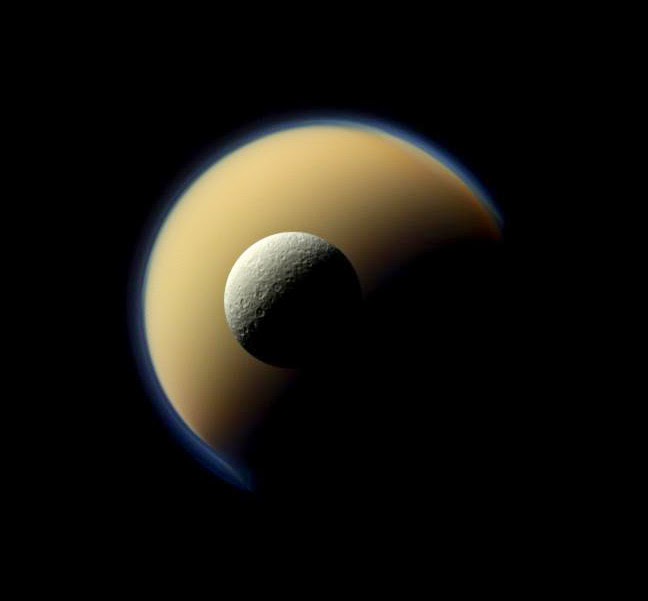
NASA Cassini: Icy rocks around Saturn - Titan and Rhea

Credit: NASA/JPL-Caltech/Space Science Institute

Earth is the only planet in our Solar System to have a single solitary moon.

While others, such as Mercury and Venus, have none, the gas giants have accumulated crowds of orbiting bodies, Saturn, for example, boasts an impressive 62 moons!

This image, taken by the Cassini orbiter, shows its two biggest: Rhea and its larger companion Titan.

Titan's diameter, at 5150 km, is 50% larger than that of our Moon, while Rhea is somewhat smaller at 1528 km across.

Although Rhea's pitted and cratered appearance contrasts sharply with the faint golden glow of Titan, the moons are quite similar in composition, containing a mixture of rock and water ice.

Rhea is thought to comprise three quarters ice and one quarter rock.

Observations with Cassini have determined that Rhea does not contain a distinct rocky core, instead, it is made up of rock and ice mixed together, giving it its 'dirty snowball' appearance.

Titan's orange hue is a result of its atmosphere. It is the only body in the Solar System other than Earth to have a thick, nitrogen-rich atmosphere, which in Titan's case also contains substances like methane, hydrogen and hydrocarbons.

These molecules form via reactions with sunlight high up in Titan's atmosphere, eventually settling to lower altitudes to form an orange-hued smog.

In some images Titan's upper atmosphere takes on a layered appearance, with 'stripes' of haze stacked on top of one another in an onion-like fashion.

This Cassini image shows one such layer, a hazy band of blue encircling Titan.

This haze runs all the way around the moon, and brightens in two crescent-shaped areas over the polar regions to form 'polar hoods'.

These hoods are swirling, high-altitude areas of denser gas. Titan's north polar hood can be seen towards the upper right of the image, and its corresponding southern hood lies towards the lower left of the moon.

These polar hoods are seasonal, growing and dissipating with the changing seasons. Seasons on Saturn and its accompanying moons last for around seven years.

When Cassini arrived in the Saturn system in 2004 Titan already had a thick hood above its north pole, which was experiencing winter.

After the Saturnian equinox in August 2009, Titan's northern hemisphere began moving into spring, and its southern latitudes headed into autumn.

Accompanying this seasonal shift was the appearance of a polar vortex above Titan's south pole. In 2012 Cassini snapped multiple images of this vortex as it swirled round furiously, completing a full rotation in just nine hours.

While the Cassini mission has spent much time studying Titan, it has also performed numerous flybys of Rhea, passing close to the moon four times to probe its interior structure, gravitational pull and surface characteristics.

These encounters showed Rhea to be an ancient and heavily cratered body, bearing numerous pocks and scars from past impacts.

This is something that astronomers want to explore by studying Rhea; measuring the dusty debris flying up from Rhea's surface may help us to understand more about the rate of meteoroid bombardments and amount of cosmic debris raining down on the Saturnian system.

This true-colour image is made with exposures taken on 16 June 2011 using red, green and blue filters on Cassini's narrow-angle camera.

Friday, October 17, 2014

Wobbling of a Saturn moon hints at what lies beneath

Using instruments aboard the Cassini spacecraft to measure the wobbles of Mimas, the closest of Saturn's regular moons, a Cornell University astronomer publishing in Science, Oct. 17, has inferred that this small moon's icy surface cloaks either a rugby ball-shaped rocky core or a sloshing sub-surface ocean.

"After carefully examining Mimas, we found it librates, that is to say, it subtly wobbles, around the moon's polar axis," Radwan Tajeddine, Cornell research associate in astronomy and lead author of the article.

"In physical terms, the back-and-forth wobble should produce about 3 kilometers of surface displacement."

"Instead we observed an unexpected 6 kilometers of surface displacement," he said.

"We're very excited about this measurement because it may indicate much about the satellite's insides."

"Nature is essentially allowing us to do the same thing that a child does when she shakes a wrapped gift in hopes of figuring out what's hidden inside," Tajeddine said.

The astronomy team used a technique called stereo-photogrammetry to interpret images taken by the Cassini Imaging Science Subsystem to measure the libration.

In this technique, astronomers employ Cassini photographs of Mimas taken at different times and from various vantage points to build precise 3-D computer models of the locations of hundreds of surface reference points.

From these, the researchers determined the moon's shape and were able to notice that the satellite didn't rotate smoothly but rocked back and forth a bit as well.

The amount of the to-and-fro motion indicates that Mimas' interior is not uniform. These wobbles can be produced if the moon contains a weirdly shaped, rocky core or if a sub-surface ocean exists beneath its icy shell.

Mimas is about 400 kilometers in diameter, and its possible internal global ocean is located under an icy crust ranging in thickness between 25 and 30 kilometers.

The moon itself is thought to have been formed either by the slow agglomeration of ring particles (a gradual buildup of matter) or direct growth within the primordial planetary gas nebula.

The odd-shaped core would favor gravitational flattening by nearby Saturn, Tajeddine said. The moon's relatively smooth and roughly spherical icy surface covers up whatever is underneath.

More information: Science. DOI: 10.1126/science.1255299

NASA Cassini caught in Hyperion's particle beam inside Saturn's Magnetosphere

This stunning false-colour view of Saturn's moon Hyperion reveals crisp details across the strange, tumbling moon's surface. 

Differences in colour could represent differences in the composition of surface materials. 

The view was obtained during Cassini's close flyby on Sept. 26, 2005. 

Hyperion has a notably reddish tint when viewed in natural colour. 

The red color was toned down in this false-colour view, and the other hues were enhanced, in order to make more subtle colour variations across Hyperion's surface more apparent. 

Credit: NASA /JPL /Space Science Institute

Static electricity is known to play an important role on Earth's airless, dusty moon, but evidence of static charge building up on other objects in the solar system has been elusive until now.

A new analysis of data from NASA's Cassini mission has revealed that, during a 2005 flyby of Saturn's moon Hyperion, the spacecraft was briefly bathed in a beam of electrons coming from the moon's electrostatically charged surface.

The finding represents the first confirmed detection of a charged surface on an object other than our moon, although it is predicted to occur on many different bodies, including asteroids and comets.

The new analysis was led by Tom Nordheim, a doctoral candidate at Mullard Space Science Laboratory (MSSL), University College London, and was published recently in the journal Geophysical Research Letters.

Hyperion is porous and icy, with a bizarre, sponge-like appearance. Its surface is continuously bombarded by ultraviolet light from the sun and exposed to a rain of charged particles, electrons and ions, within the invisible bubble generated by Saturn's magnetic field, called the magnetosphere.

The researchers think Hyperion's exposure to this hostile space environment is the source of the particle beam that struck Cassini.

Measurements made by several of Cassini's instruments during a close encounter with Hyperion on September 26, 2005, indicate that something unexpected took place in the charged particle environment around the spacecraft.

Among those instruments, the Cassini Plasma Spectrometer (CAPS) detected that the spacecraft was magnetically connected to the surface of Hyperion for a brief period, allowing electrons to escape from the moon toward the robotic probe.

Most people are familiar with the electrostatic charge buildup that occurs when a balloon is rubbed against hair or a sweater.

Objects in space can also become electrostatically charged by exposure to solar ultraviolet light and incoming charged particles.

The Cassini data show that a similar process can take place on Hyperion.

The finding is surprising, as the small but odd-looking moon was thought to be a simple inert object, which would not undergo any strong interactions with the Saturnian magnetosphere.

Nevertheless, the team's analysis indicates that Cassini remotely detected a strongly negative voltage on Hyperion.

"It was rather like Cassini receiving a 200-volt electric shock from Hyperion, even though they were over 2,000 kilometers [1,200 miles] apart at the time," said Nordheim.

Scientists had previously suggested that surface features observed on the asteroid Eros and several of Saturn's moons are due to the motion of charged dust across their surfaces.

On small objects with low gravity, dust grains might even be able to overcome the force of gravity and escape into space.

Although mission controllers have detected no signs that the Hyperion electron beam caused damage to Cassini, strong electric charging effects could prove to be a hazard to future robotic and human explorers at planetary objects without atmospheres, including Earth's moon, where they could create the potential for powerful electrostatic discharges.

"Our observations show that this is also an important effect at outer planet moons and that we need to take this into account when studying how these moons interact with their environment," said Geraint Jones of MSSL, a member of the Cassini CAPS team who helped supervise the study.

Cassini's CAPS instrument was powered off in 2012, when the instrument began to draw excess current.

The team is based at Southwest Research Institute, San Antonio. Part of the CAPS instrument that made the detection discussed in this research, the CAPS electron spectrometer, was built by MSSL.

Nordheim and colleagues also utilized data from three other Cassini instruments in their analysis: the Radio and Plasma Wave Science instrument (RPWS), the Magnetospheric Imaging Instrument and the Magnetometer (MIMI).

Monday, September 22, 2014

Gas Giant Saturn: A cosmic hurricane

The giant planet Saturn is mostly a gigantic ball of rotating gas, completely unlike our solid home planet, but Earth and Saturn do have something in common: weather, although the gas giant is home to some of the most bizarre weather in our Solar System, such as the swirling storm shown in this Cassini view.

Credit: NASA

Known as “the hexagon”, this weather feature is an intense, six-sided jet stream at Saturn’s north pole.

Spanning some 30 000 km across, it hosts howling 320 km/h winds that spiral around a massive storm rotating anticlockwise at the heart of the region.

Numerous small vortices rotate in the opposite direction to the central storm and are dragged around with the jet stream, creating a terrifically turbulent region.

While a hurricane on Earth may last a week or more, the hexagon has been raging for decades, and shows no signs of letting up.

This false-colour image of the hexagon was made using ultraviolet, visible and infrared filters to highlight different regions.

The dark centre of the image shows the large central storm and its eye, which is up to 50 times bigger than a terrestrial hurricane eye.

The small vortices show up as pink-red clumps. Towards the lower right of the frame is a white-tinted oval storm that is bigger than any of the others, this is the largest of the vortices at some 3500 km across, twice the size of the largest hurricane ever recorded on Earth.

The darker blue region within the hexagon is filled with small haze particles, whereas the paler blue region is dominated by larger particles.

This divide is caused by the hexagonal jet stream acting as a shepherding barrier, large particles cannot enter the hexagon from the outside.

These large particles are created when sunlight shines onto Saturn’s atmosphere, something that only started relatively recently in the northern hemisphere with the beginning of northern spring in August 2009.

Cassini will continue to track changes in the hexagon, monitoring its contents, shape and behaviour as summer reaches Saturn’s northern hemisphere in 2017.

Monday, September 8, 2014

Solar system simulation reveals planetary mystery

A snapshot of weather patterns around Mars, including blue-white ice clouds that are visible above the Red Planet’s Tharsis volcanoes. 

Credit: NASA/JPL-Caltech/MSSS

When we look at the Solar System, what clues show us how it formed?

We can see pieces of its formation in asteroids, comets and other small bodies that cluster on the fringes of our neighbourhood (and sometimes, fly closer to Earth.)

Are the orbits and sizes of the planets a natural byproduct of the formation, or are there features that happened because of rare events?

Scientists are focused on answering these questions to better understand how the Earth formed, and what this means for Earth-like planets around other stars.

For example, a new set of simulations showed that Mars is a rare planet. It can happen, but only in certain situations, at least, if the parameters of the simulations are correct.

Are these assumptions correct, or do other initial conditions need to be explored?

Finding the answers to these questions not only helps us understand where Mars comes from, but also our own planet.

This is interesting to astrobiologists because the Red Planet has extensive evidence of past water.

Results from the Opportunity, Spirit and Curiosity rovers on the Martian surface came across features that form in the presence of water, such as mineralised iron oxide known as hematite, or"blueberries," because of its shape.

"The formation of Mars is a long-standing problem. Most previous studies like this have not been able to reproduce an object with Mars' mass," said Rebecca Fischer, a doctoral candidate in geophysical sciences at the University of Chicago, who led the research.

"It is possible to reproduce Mars, but it only happens 5 percent of the time. If you only ran four simulations, you wouldn't see it happen," she says.

Fischer's work, called "Dynamics of the terrestrial planets from a large number of N-body simulations," appeared in the journal Earth and Planetary Science Letters in April.

More information: Rebecca A. Fischer, Fred J. Ciesla, "Dynamics of the terrestrial planets from a large number of N-body simulations," Earth and Planetary Science Letters, Volume 392, 15 April 2014, Pages 28-38, ISSN 0012-821X, dx.doi.org/10.1016/j.epsl.2014.02.011.

"Building the Terrestrial Planets: Constrained Accretion in the Inner Solar System." Sean N. Raymond, David P. O'Brien, Alessandro Morbidelli, Nathan A. Kaib arXiv:0905.3750 [astro-ph.EP] arxiv.org/abs/0905.3750

Friday, August 22, 2014

Amazing raw Cassini images of Saturn's rings from this week

Sunlight and shadow combine in this photo of Saturn and its rings taken Aug. 19, 2014. 

Credit: NASA/ JPL/ Space Science Institute

When Saturn is at its closest to Earth, it's three-quarters of a billion miles away, or more than a billion kilometers!

That makes these raw images from the ringed planet all the more remarkable.

Nearly every day, the Cassini spacecraft beams back what it sees at Saturn and the images are put up on this NASA website.

This week, for example, it was checking out Saturn's rings. We have a few of the pictures below, plus an older picture of the entire planet for reference.

Saturn's rings are believed to be about 4.4 billion years old, that's close to the age of the Solar System itself.

Astronomers, however, have only known about them since the 1600s, when Galileo Galilei was trying to make sense of some funny-looking shapes on either side of the planet in his telescope.

According to NASA, the particles in the rings range from dust-sized to mountain-sized. Some of Saturn's dozens of moons act as shepherds to the rings, keeping gaps open.

You can read more about what we know about their origins here.

Saturn and its rings, as seen from above the planet by the Cassini spacecraft. 

Credit: NASA/ JPL/ Space Science Institute. Assembled by Gordan Ugarkovic.

Different shades shine in this raw image of Saturn’s rings taken by the Cassini spacecraft taken Aug. 19, 2014. 

Credit: NASA/ JPL/ Space Science Institute

Bands prominently feature in this raw picture of Saturn taken by the Cassini spacecraft Aug. 17, 2014. 

Credit: NASA/JPL/Space Science Institute

The Cassini spacecraft looks to the side of Saturn’s rings in this picture from Aug. 19, 2014. 

Credit: NASA/JPL/Space Science Institute

Tuesday, August 12, 2014

NASA Cassini Tracks Clouds Developing Over a Titan Sea

This animated sequence of Cassini images shows methane clouds moving above the large methane sea on Saturn's moon Titan known as Ligeia Mare.

Image Credit: NASA /JPL-Caltech /Space Science Institute

As NASA's Cassini spacecraft sped away from Titan following a relatively close flyby, its cameras monitored the moon's northern polar region, capturing signs of renewed cloud activity.

Image Credit: NASA /JPL-Caltech /Space Science Institute

NASA's Cassini spacecraft recently captured images of clouds moving across the northern hydrocarbon seas of Saturn's moon Titan.

This renewed weather activity, considered overdue by researchers, could finally signal the onset of summer storms that atmospheric models have long predicted.

The Cassini spacecraft obtained the new views in late July, as it receded from Titan after a close flyby. Cassini tracked the system of clouds developing and dissipating over the large methane sea known as Ligeia Mare for more than two days.

Measurements of cloud motions indicate wind speeds of around 7 to 10 mph (3 to 4.5 meters per second).

For several years after Cassini's 2004 arrival in the Saturn system, scientists frequently observed cloud activity near Titan's south pole, which was experiencing late summer at the time.

Clouds continued to be observed as spring came to Titan's northern hemisphere. But since a huge storm swept across the icy moon's low latitudes in late 2010, only a few small clouds have been observed anywhere on the icy moon.

The lack of cloud activity has surprised researchers, as computer simulations of Titan's atmospheric circulation predicted that clouds would increase in the north as summer approached, bringing increasingly warm temperatures to the atmosphere there.

"We're eager to find out if the clouds' appearance signals the beginning of summer weather patterns, or if it is an isolated occurrence," said Elizabeth Turtle, a Cassini imaging team associate at the Johns Hopkins University Applied Physics Lab in Laurel, Maryland.

"Also, how are the clouds related to the seas? Did Cassini just happen catch them over the seas, or do they form there preferentially?"

A year on Titan lasts about 30 Earth years, with each season lasting about seven years. Observing seasonal changes on Titan will continue to be a major goal for the Cassini mission as summer comes to Titan's north and the southern latitudes fall into winter darkness.

Saturday, August 9, 2014

NASA Cassini prepares for its biggest remaining burn

This is an artists concept of Cassini during the Saturn Orbit Insertion (SOI) maneuver, just after the main engine has begun firing. 

Credit: NASA/JPL

NASA's Cassini spacecraft will execute the largest planned maneuver of the spacecraft's remaining mission on Saturday, Aug. 9.

The maneuver will target Cassini toward an Aug. 21 encounter with Saturn's largest moon, Titan.

The main engine firing will last about a minute and will provide a change in velocity of 41 feet per second (12.5 meters per second).

This is the largest maneuver by Cassini in five years. No other remaining maneuver comes close, in the amount of propellant it will consume and the amount by which it will change the spacecraft's velocity.

By contrast, the smallest maneuvers Cassini routinely executes are about 0.4 inches (10 millimeters) per second.

The large size of the Aug. 9 burn is needed to begin the process of "cranking down" Cassini's orbit, so that the spacecraft circles Saturn nearer to the plane of the rings and moons.

Previously, with each Titan flyby, mission controllers adjusted the spacecraft's orbit to be increasingly inclined, carrying Cassini high above Saturn's polar regions.

The upcoming maneuver starts reversing that trend, making the orbit increasingly close to the equator.

Although Cassini has occasionally performed similar large propulsive maneuvers during its decade in the Saturn system, Titan itself has proven to be the workhorse for steering Cassini around Saturn.

It is not uncommon for the spacecraft to receive a gravitational assist, or boost, from Titan that rivals or exceeds the 96-minute engine burn Cassini performed in 2004 to insert itself into Saturn orbit.

The Cassini mission recently celebrated a decade studying Saturn, its rings, moons and magnetosphere.

Tuesday, July 29, 2014

NASA Cassini: The geyser basin of Saturn's moon Enceladus

This view looks across the geyser basin of Saturn's moon Enceladus, along fractures spewing water vapour and ice particles into space. 

Cassini scientists have pinpointed the source locations of about 100 geysers and gained new insights into what powers them. 

Credit: NASA/JPL-Caltech/SSI

Scientists using mission data from NASA's Cassini spacecraft have identified 101 distinct geysers erupting on Saturn's icy moon Enceladus.

Their analysis suggests it is possible for liquid water to reach from the moon's underground sea all the way to its surface.

These findings, and clues to what powers the geyser eruptions, are presented in two articles published in the current online edition of the Astronomical Journal.

Over a period of almost seven years, Cassini's cameras surveyed the south polar terrain of the small moon, a unique geological basin renowned for its four prominent "tiger stripe" fractures and the geysers of tiny icy particles and water vapour first sighted there nearly 10 years ago.

The result of the survey is a map of 101 geysers, each erupting from one of the tiger stripe fractures, and the discovery that individual geysers are coincident with small hot spots.

These relationships pointed the way to the geysers' origin.

After the first sighting of the geysers in 2005, scientists suspected that repeated flexing of Enceladus by Saturn's tides as the moon orbits the planet had something to do with their behaviour.

One suggestion included the back-and-forth rubbing of opposing walls of the fractures generating frictional heat that turned ice into geyser-forming vapour and liquid.

Alternate views held that the opening and closing of the fractures allowed water vapor from below to reach the surface.

This artist's rendering shows a cross-section of the ice shell immediately beneath one of Enceladus' geyser-active fractures, illustrating the physical and thermal structure and the processes ongoing below and at the surface.

Image Credit: NASA/JPL-Caltech/Space Science Institute

Before this new study, it was not clear which process was the dominating influence.

Nor was it certain whether excess heat emitted by Enceladus was everywhere correlated with geyser activity.

To determine the surface locations of the geysers, researchers employed the same process of triangulation used historically to survey geological features on Earth, such as mountains.

When the researchers compared the geysers' locations with low-resolution maps of thermal emission, it became apparent the greatest geyser activity coincided with the greatest thermal radiation.

Comparisons between the geysers and tidal stresses revealed similar connections. However, these correlations alone were insufficient to answer the question, "What produces what?"

The answer to this mystery came from comparison of the survey results with high-resolution data collected in 2010 by Cassini's heat-sensing instruments.

Individual geysers were found to coincide with small-scale hot spots, only a few dozen feet (or tens of meters) across, which were too small to be produced by frictional heating, but the right size to be the result of condensation of vapor on the near-surface walls of the fractures.

This immediately implicated the hot spots as the signature of the geysering process.

"Once we had these results in hand, we knew right away heat was not causing the geysers, but vice versa," said Carolyn Porco, leader of the Cassini imaging team from the Space Science Institute in Boulder, Colorado, and lead author of the first paper.

"It also told us the geysers are not a near-surface phenomenon, but have much deeper roots."

Thanks to recent analysis of Cassini gravity data, the researchers concluded the only plausible source of the material forming the geysers is the sea now known to exist beneath the ice shell.

They also found that narrow pathways through the ice shell can remain open from the sea all the way to the surface, if filled with liquid water.

In the companion paper, the authors report the brightness of the plume formed by all the geysers, as seen with Cassini's high-resolution cameras, changes periodically as Enceladus orbits Saturn.

Armed with the conclusion that the opening and closing of the fractures modulates the venting, the authors compared the observations with the expected venting schedule due to tides.

They found the simplest model of tidal flexing provides a good match for the brightness variations Cassini observes, but it does not predict the time when the plume begins to brighten.

Some other important effect is present and the authors considered several in the course of their work.

More information: "Tidally Modulated Eruptions on Enceladus: Cassini ISS Observations and Models." Francis Nimmo et al. 2014, Astronomical Journal 148 46. DOI: 10.1088/0004-6256/148/3/46

Thursday, July 24, 2014

NASA Cassini: MIPT researcher models Titan's atmosphere

Titan’s atmosphere. Image from the Cassini orbiter.

Credit: Nasa

A researcher from Moscow Institute of Physics and Technology (MIPT), Prof. Vladimir Krasnopolsky, who heads the Laboratory of High Resolution Infrared Spectroscopy of Planetary Atmospheres, has published the results of the comparison of his model of Titan's atmosphere with the latest data.

Vladimir Krasnopolsky
The article in the journal Icarus compares the chemical composition of Titan's atmosphere with parameters predicted by a mathematical model.

The atmosphere of Saturn's largest moon, Titan, was described by a model that took into account the presence of 83 neutral molecules, 33 ions and 420 different chemical reactions between them.

Despite the fact that Titan is located much further from the Sun than the Earth and that radiation flux coming from the Sun to the moon is 100 times lower, the intensity of UV rays is enough to spur photochemical reactions in the upper layers of Titan's atmosphere.

Cassini orbiter
The data regarding the composition of Titan's atmosphere, which is 1.6 times denser near the surface than the Earth's air, was obtained from several sources, mainly the Cassini orbiter.

It was equipped with a number of gauges, including ultraviolet and infrared spectrometers and equipment for studying the ions that were drawn into space.

Within ten years in Saturn's orbit, a plasma complex and a mass spectrometer designed specifically for this research project gathered enough data to compare it with mathematical models.

IRAM ground submillimeter telescope
In addition to Cassini, part of the data was obtained using the IRAM ground submillimeter telescope and the Hershel infrared space observatory.

Data on the distribution of aerosol particles in Titan's atmosphere was received from a unique space capsule, Huygens, which landed on Titan for the first time in the history of mankind and sent the first photos of its surface.

Comparing this data with the previously developed model, Krasnopolsky showed that the theoretical description of Titan's atmosphere matches the reality quite accurately.

There are discrepancies, however, but they are caused by inevitable measurement errors – so far, the concentrations of many substances are approximate.

The most important thing is not the absolute matching of specific parameters but the correctness of the general model of chemical processes.

"The coherence of the model with reality means that we can correctly tell where different substances go from Titan's ionosphere and where they come from," Krasnopolsky said.

Krasnopolsky is considered a leading global expert on the atmosphere of celestial bodies of the solar system.

He has participated in the creation of spectrometers for a variety of spacecraft, including the legendary Voyagers and the first Soviet interplanetary probes.

Tuesday, July 8, 2014

NASA ESA Cassini Image: Saturn's Vortex and rings

Credit: NASA/JPL-Caltech/Space Science Institute

The Cassini spacecraft captures three magnificent sights at once: Saturn's north polar vortex and hexagon along with its expansive rings.

The hexagon, which is wider than two Earths, owes its appearance to the jet stream that forms its perimeter.

The jet stream forms a six-lobed, stationary wave which wraps around the north polar regions at a latitude of roughly 77 degrees North.

This view looks toward the sunlit side of the rings from about 37 degrees above the ringplane.

The image was taken with the Cassini spacecraft wide-angle camera on April 2, 2014 using a spectral filter which preferentially admits wavelengths of near-infrared light centered at 752 nanometers.

The view was obtained at a distance of approximately 1.4 million miles (2.2 million kilometers) from Saturn and at a Sun-Saturn-spacecraft, or phase, angle of 43 degrees. Image scale is 81 miles (131 kilometers) per pixel.

The Cassini-Huygens mission is a cooperative project of NASA, the European Space Agency and the Italian Space Agency.

The Cassini orbiter and its two onboard cameras were designed, developed and assembled at JPL. The imaging operations center is based at the Space Science Institute in Boulder, Colo.

For more information about the Cassini-Huygens mission or the Cassini imaging team homepage.

Saturday, July 5, 2014

NASA's Cassini: Final Mission Phase to be named 'Grand Finale'

With help from the public, members of NASA's Cassini mission have chosen to call the spacecraft's final orbits the "Cassini Grand Finale." 

Image courtesy NASA/JPL-Caltech.

With input from more than 2,000 members of the public, team members on NASA's Cassini mission to Saturn have chosen a name for the final phase of the mission: the Cassini Grand Finale.

Starting in late 2016, the Cassini spacecraft will begin a daring set of orbits that is, in some ways, like a whole new mission.

The spacecraft will repeatedly climb high above Saturn's north pole, flying just outside its narrow F ring.

Cassini will probe the water-rich plume of the active geysers on the planet's intriguing moon Enceladus, and then will hop the rings and dive between the planet and innermost ring 22 times.

Because the spacecraft will be in close proximity to Saturn, the team had been calling this phase "the proximal orbits," but they felt the public could help decide on a more exciting moniker.

In early April, the Cassini mission invited the public to vote on a list of alternative names provided by team members or to suggest ideas of their own.

"We chose a name for this mission phase that would reflect the exciting journey ahead while acknowledging that it's a big finish for what has been a truly great show," said Earl Maize, Cassini project manager at NASA's Jet Propulsion Laboratory in Pasadena, California.

Tuesday, July 1, 2014

NASA Cassini Probe Celebrates 10 Years orbiting Saturn - Video

A photo taken of Saturn by the Cassini spacecraft, which has been exploring the Saturn system for 10 years. Image uploaded June 30, 2014.

Credit: NASA/JPL

NASA spacecraft Cassini passes a big milestone, a decade exploring Saturn and its many moons.

Since arriving in orbit around Saturn 10 years ago today, the Cassini probe has made a number of unprecedented observations and discoveries.

Although the spacecraft was originally approved for a four-year mission, it has been granted three mission extensions, allowing it to continue roaming the gas giant’s system.

Linda Spilker
"Having a healthy, long-lived spacecraft at Saturn has afforded us a precious opportunity," Linda Spilker, Cassini project scientist at NASA’s Jet Propulsion Laboratory in Pasadena, California, said in a statement.

"By having a decade there with Cassini, we have been privileged to witness never-before-seen events that are changing our understanding of how planetary systems form and what conditions might lead to habitats for life."

For example, Cassini has helped scientists learn more about what kinds of molecules populate our solar system.

The spacecraft discovered plumes containing water-ice shooting out into space from the south polar region of Saturn’s moon Enceladus.


The Enceladus discovery is one of Cassini’s most remarkable findings because it marked an extension of the search for life in the solar system, NASA officials said.

Researchers know that life as we understand it relies on water, so finding the substance on a moon or planet could be a sign that life might be able to exist there.

Scientists now think that Enceldus harbors an underground ocean.

Enceladus wasn’t the only mysterious moon Cassini helped reveal. Saturn’s huge satellite Titan has also been studied by the long-lasting orbiter.

Cassini’s measurements have shown that Titan has rain, lakes, seas and rivers like Earth, NASA officials said. Unlike Earth, however, Titan is a cold world with seas of liquid methane rather than water.

The Titan-exploring Huygens probe also launched to the Saturn system with Cassini in October 1997.

The European Space Agency’s Huygens robot landed on Titan in 2005 and became the first manmade craft to land on a moon in the outer solar system.

It measured the atmosphere and beamed images of the moon back to Earth.

“The probe’s 2 hour and 27 minute descent revealed Titan to be remarkably like Earth before life evolved, with methane rain, erosion and drainage channels and dry lake beds,” NASA officials said.

“A soup of complex hydrocarbons, including benzene, was found in Titan's atmosphere.”

Saturn's moon Tethys with its prominent Odysseus Crater silently slips behind Saturn's largest moon Titan.

Cassini has also unveiled how Saturn’s rings change over time, and because of its long tenure in the planetary system, the probe has observed seasonal changes taking place on the planet and its moons, according to NASA.

Cassini will continue to beam back data to Earth for a few more years, until 2017 when it is scheduled to intentionally plunge into Saturn’s atmosphere, ending its mission.

Hydrocarbon Lakes on Titan

Wednesday, June 18, 2014

NASA’s Cassini Team: Titan Flybys Test their Talents

Cassini will attempt to bounce signals off of Saturn's moon Titan once more during a flyby on June 18, 2014, revealing important details about the moon's surface.

Image Credit: NASA/JPL-Caltech

As NASA’s Cassini spacecraft zooms toward Saturn’s smoggy moon Titan for a targeted flyby on June 18, mission scientists are excitedly hoping to repeat a scientific tour de force that will provide valuable new insights into the nature of the moon's surface and atmosphere.

For Cassini’s radio science team, the last flyby of Titan, on May 17, was one of the most scientifically valuable encounters of the spacecraft’s current extended mission.

The focus of that flyby, designated “T-101,” was on using radio signals to explore the physical nature of Titan’s vast northern seas and probe the high northern regions of its substantial atmosphere.

The Cassini team hopes to replicate the technical success of that flyby during the T-102 encounter, slated for June 18, during which the spacecraft will attempt similar measurements of Titan.

During closest approach, the spacecraft will be just 2,274 miles (3,659 kilometers) above the surface of the moon while travelling at 13,000 miles per hour (5.6 kilometers per second).

During the upcoming flyby, if all goes well as before, Cassini’s radio science subsystem will bounce signals off the surface of Titan, toward Earth, where they will be received by the ground stations of NASA’s Deep Space Network.

This sort of observation is known as a bistatic scattering experiment and its results can yield clues to help answer a variety of questions about large areas of Titan’s surface: Are they solid, slushy or liquid? Are they reflective? What might they be made of?

During the May encounter, Cassini beamed radio signals over the two largest bodies of liquid on Titan, seas named Ligeia Mare and Kraken Mare.

During that first attempt, scientists could not be certain the signals would successfully bounce off the lakes to be received on Earth.

They were thrilled when ground stations received specular reflections, essentially the glint, of the radio frequencies as they ricocheted off Titan.

Cassini team members react with excitement to the successful receipt of radio signals bounced off of Titan during a flyby on May 17, 2014. Image Credit: NASA/JPL-Caltech

Read the full story here.