Showing posts with label Saturn's Rings. Show all posts

Friday, August 22, 2014

Amazing raw Cassini images of Saturn's rings from this week

Sunlight and shadow combine in this photo of Saturn and its rings taken Aug. 19, 2014. 

Credit: NASA/ JPL/ Space Science Institute

When Saturn is at its closest to Earth, it's three-quarters of a billion miles away, or more than a billion kilometers!

That makes these raw images from the ringed planet all the more remarkable.

Nearly every day, the Cassini spacecraft beams back what it sees at Saturn and the images are put up on this NASA website.

This week, for example, it was checking out Saturn's rings. We have a few of the pictures below, plus an older picture of the entire planet for reference.

Saturn's rings are believed to be about 4.4 billion years old, that's close to the age of the Solar System itself.

Astronomers, however, have only known about them since the 1600s, when Galileo Galilei was trying to make sense of some funny-looking shapes on either side of the planet in his telescope.

According to NASA, the particles in the rings range from dust-sized to mountain-sized. Some of Saturn's dozens of moons act as shepherds to the rings, keeping gaps open.

You can read more about what we know about their origins here.

Saturn and its rings, as seen from above the planet by the Cassini spacecraft. 

Credit: NASA/ JPL/ Space Science Institute. Assembled by Gordan Ugarkovic.

Different shades shine in this raw image of Saturn’s rings taken by the Cassini spacecraft taken Aug. 19, 2014. 

Credit: NASA/ JPL/ Space Science Institute

Bands prominently feature in this raw picture of Saturn taken by the Cassini spacecraft Aug. 17, 2014. 

Credit: NASA/JPL/Space Science Institute

The Cassini spacecraft looks to the side of Saturn’s rings in this picture from Aug. 19, 2014. 

Credit: NASA/JPL/Space Science Institute

Tuesday, July 8, 2014

NASA ESA Cassini Image: Saturn's Vortex and rings

Credit: NASA/JPL-Caltech/Space Science Institute

The Cassini spacecraft captures three magnificent sights at once: Saturn's north polar vortex and hexagon along with its expansive rings.

The hexagon, which is wider than two Earths, owes its appearance to the jet stream that forms its perimeter.

The jet stream forms a six-lobed, stationary wave which wraps around the north polar regions at a latitude of roughly 77 degrees North.

This view looks toward the sunlit side of the rings from about 37 degrees above the ringplane.

The image was taken with the Cassini spacecraft wide-angle camera on April 2, 2014 using a spectral filter which preferentially admits wavelengths of near-infrared light centered at 752 nanometers.

The view was obtained at a distance of approximately 1.4 million miles (2.2 million kilometers) from Saturn and at a Sun-Saturn-spacecraft, or phase, angle of 43 degrees. Image scale is 81 miles (131 kilometers) per pixel.

The Cassini-Huygens mission is a cooperative project of NASA, the European Space Agency and the Italian Space Agency.

The Cassini orbiter and its two onboard cameras were designed, developed and assembled at JPL. The imaging operations center is based at the Space Science Institute in Boulder, Colo.

For more information about the Cassini-Huygens mission or the Cassini imaging team homepage.

Tuesday, May 6, 2014

NASA Cassini image: Saturn's rainbow rings

Credit: NASA/JPL/University of Colorado

This colourful cosmic rainbow portrays a section of Saturn's beautiful rings, four centuries after they were discovered by Galileo Galilei.

Saturn's rings were first observed in 1610. Despite using his newly created telescope, Galileo was confounded by what he saw: he referred to the peculiar shapes surrounding the planet as "Saturn's children".

Only later did Christiaan Huygens propose that the mysterious shapes were actually rings orbiting the planet.

These were named in the order in which they were discovered, using the first seven letters of the alphabet: the D-ring is closest to the planet, followed by C, B, A, F, G and E.

The data for this image, which shows the portion of the C-ring closest to Saturn on the left, with the B-ring beginning just right of centre, were acquired by Cassini's Ultraviolet Imaging Spectrograph, (UVIS), as the spacecraft entered into orbit around Saturn on 30 June 2004.

Cassini's Ultraviolet Imaging Spectrograph, (UVIS)
UVIS, as its name suggests, carries out observations in ultraviolet wavelengths.

During the Saturn orbit insertion manoeuvre, when Cassini flew closest to the rings, UVIS could resolve features up to 97 km across.

The region shown in this image spans about 10 000 km.

The variation in the colour of the rings arises from the differences in their composition.

Turquoise-hued rings contain particles of nearly pure water ice, whereas reddish rings contain ice particles with more contaminants.

Ultraviolet Imaging Spectrograph, (UVIS)
Saturn's prominent and complex ensemble of rings is the best studied in the Solar System, but it is still not known how the rings formed.

One suggestion is that they formed at the same time as the planet and that they are as old as the Solar System.

Another idea is that they formed when icy material was pulled from another body into Saturn's gravitational field, in which case the rings could be younger than the planet.

One thing is sure: as Cassini searches for answers it is providing amazing images of these rainbow rings.

Friday, May 2, 2014

NASA Cassini Image: Looking beyond Saturn to view Uranus

This view from NASA's Cassini spacecraft features a blue planet, but unlike the view from July 19, 2013 (PIA17172 The Day the Earth Smiled) that featured our home planet, this blue orb is Uranus, imaged by Cassini for the first time.

Credit: NASA /JPL-Caltech /Space Science Institute

Uranus is a pale blue in this natural colour image because its visible atmosphere contains methane gas and few aerosols or clouds.

Methane on Uranus and its sapphire-coloured sibling, Neptune, absorbs red wavelengths of incoming sunlight, but allows blue wavelengths to escape back into space, resulting in the predominantly bluish color seen here.

Cassini imaging scientists combined red, green and blue spectral filter images to create a final image that represents what human eyes might see from the vantage point of the spacecraft.

Uranus
Uranus has been brightened by a factor of 4.5 to make it more easily visible. The outer portion of Saturn's A ring, seen at bottom right, has been brightened by a factor of two.

The bright ring cutting across the image center is Saturn's narrow F ring.

Uranus was approximately 28.6 astronomical units from Cassini and Saturn when this view was obtained.

An astronomical unit is the average distance from Earth to the sun, equal to 93,000,000 miles (150,000,000 kilometers).

Neptune
The view was acquired by the Cassini narrow-angle camera at a distance of approximately 614,300 miles (988,600 kilometers) from Saturn on April 11, 2014.

Image scale at Uranus is approximately 16,000 miles (25,700 kilometers) per pixel.

Image scale at Saturn's rings is approximately 4 miles (6 kilometers) per pixel.

In the image, the disk of Uranus is just barely resolved.

The solar phase angle at Uranus, seen from Cassini, is 11.9 degrees.

Monday, April 21, 2014

Nasa Cassini: Saturn's moon Pan in the Encke gap in Saturn's rings

Credit: NASA /JPL-Caltech /Space Science Institute

Saturn's moon Pan, named for the Greek god of shepherds, rules over quite a different domain: the Encke gap in Saturn's rings.

Pan (17 miles, or 28 kilometers across) keeps the Encke gap open through its gravitational influence on the ring particles nearby.

This view looks toward the sunlit side of the rings from about 48 degrees above the ringplane.

The image was taken in visible light with the Cassini spacecraft narrow-angle camera on Dec. 25, 2013.

The view was obtained at a distance of approximately 1.4 million miles (2.3 million kilometers) from Pan and at a Sun-Pan-spacecraft, or phase, angle of 87 degrees. Image scale is 9 miles (14 kilometers) per pixel.

The Cassini-Huygens mission is a cooperative project of NASA, the European Space Agency and the Italian Space Agency.

The Jet Propulsion Laboratory, a division of the California Institute of Technology in Pasadena, manages the mission for NASA's Science Mission Directorate, Washington, D.C.

The Cassini orbiter and its two onboard cameras were designed, developed and assembled at JPL.

The imaging operations center is based at the Space Science Institute in Boulder, Colo.

Monday, February 10, 2014

NASA Cassini Image: Prometheus practices its pull

NASA Cassini Image shows Shepherd moon Prometheus hovering just inside the reflective F ring. 

Credit: NASA /JPL-Caltech /Space Science Institute.

Lit by eerie, reflected light from Saturn's F ring (and a casting a faint shadow through a haze of icy "mist") Saturn's moon Prometheus can be seen in the raw image above, captured by Cassini's narrow-angle camera on Feb. 5 from a distance of 667,596 miles (1,074,392 km).

It's also receiving some light reflected off Saturn, which is off frame at the top (where the outermost edge of the A ring and the Keeler gap can be seen.)

As the potato-shaped Prometheus approaches the ring it yanks fine, icy material in towards itself, temporarily stretching the bright particles into long streamers and gaps and even kicking up bright clumps in the ring. It's a visual demonstration of gravity at work.

At its longest Prometheus is about 92 miles (148 km) across, but only 42 miles (68 km) in width.

It circles Saturn in a wave-shaped, scalloping orbit once every 14.7 hours.

Tuesday, January 21, 2014

NASA Cassini: Infrared Image of Saturn's Rings

Although it may look to our eyes like other images of the rings, this infrared image of Saturn's rings was taken by the Cassini spacecraft using a special filter that will only admit light polarised in one direction. 

Scientists can use these images to learn more about the nature of the particles that make up Saturn's rings.

The bright spot in the rings is the "opposition surge" where the Sun-Ring-Spacecraft angle passes through zero degrees. 

Ring scientists can also use the size and magnitude of this bright spot to learn more about the surface properties of the ring particles.

This view looks toward the sunlit side of the rings from about 19 degrees above the ringplane. 

The image was taken with the Cassini spacecraft wide-angle camera on Aug. 18, 2013 using a spectral filter sensitive to wavelengths of near-infrared light centered at 705 nanometers.

The view was acquired at a distance of approximately 712,000 miles (1.1 million kilometers) from Saturn and at a Sun-rings-spacecraft, or phase, angle of 7 degrees. 

Image scale is 43 miles (68 kilometers) per pixel.

Image Credit: NASA /JPL-Caltech /Space Science Institute (SSI)

Monday, December 30, 2013

NASA's Cassini Spacecraft: Saturn's rings cast shadows on the planet

The spectacular rings of Saturn cast dark shadows on the ringed planet as the winter season approaches in Saturn's southern hemisphere in this view from the Cassini spacecraft

With the cold season comes a blue hue on Saturn that is likely caused by a drop in ultraviolet sunlight and haze it produces. This image was taken on July 29, 2013 and released on Dec. 23.

Credit: NASA /JPL-Caltech /Space Science Institute

NASA's Cassini spacecraft has capped 2013 with a spectacular new collection of Saturn photos showcasing the planet's beauty, as well with its trademark rings and strange moons.

The newly released Saturn photos by Cassini include two views of Enceladus, Saturn's sixth-largest moon. Enceladus is a winter-appropriate ice world.

Geysers at its poles shoot ice particles into space, some of which make it into orbit around Saturn. Some of this space "snow" becomes part of Saturn's E ring, Saturn's second outermost ring that is made of microscopic particles.

Other images highlight Saturn's largest moon, Titan. There are no jolly elves at Titan's north pole; liquid methane and ethane seas appear as splotchy features near the moon's poles.

At the south pole, a high-altitude vortex swirls. The hazy orange atmosphere of Titan is thought to resemble the atmosphere of early Earth.

Thursday, September 12, 2013

Nasa Cassini Image: Saturn's rings form a majestic arc over the planet

Saturn's rings appear to form a majestic arc over the planet in this image from NASA's Cassini spacecraft.

This view looks toward the sunlit side of the rings from about 17 degrees above the ringplane. 

The image was taken with the Cassini spacecraft wide-angle camera on June 15, 2013 using a spectral filter sensitive to wavelengths of near-infrared light centered at 705 nanometers.

The view was acquired at a distance of approximately 657,000 miles (1.1 million kilometers) from Saturn and at a Sun-Saturn-spacecraft, or phase, angle of 2 degrees. Image scale is 37 miles (60 kilometers) per pixel.

The Cassini-Huygens mission is a cooperative project of NASA, the European Space Agency and the Italian Space Agency. 

The Jet Propulsion Laboratory (JPL), a division of the California Institute of Technology (CalTech) in Pasadena, manages the mission for NASA's Science Mission Directorate, Washington, D.C.

The Cassini orbiter and its two onboard cameras were designed, developed and assembled at JPL. The imaging operations center is based at the Space Science Institute in Boulder, Colo.

Image Credit: NASA/JPL-Caltech/Space Science Institute

Sunday, April 28, 2013

NASA Cassini and Saturn's Rings: A Splendour Seldom Seen

Image scale at Saturn is about 30 miles per pixel (50 kilometers per pixel).

Credit: NASA Cassini

NASA's Cassini spacecraft has delivered a glorious view of Saturn, taken while the spacecraft was in Saturn's shadow.

The cameras were turned toward Saturn and our Sun, so that the planet and rings are back-lit.

In this image the sun is behind the planet, which is shielding the cameras from direct sunlight.

In addition to the visual splendour, this special, very-high-phase viewing geometry lets scientists study ring and atmosphere phenomena not easily seen at a lower phase.

Since images like this can only be taken while the sun is behind the planet, this beautiful view is all the more precious for its rarity.

The last time Cassini captured a view like this was in Sept. 2006, when it captured a mosaic processed to look like natural color, entitled "In Saturn's Shadow."

Inside the Cassini Spacecraft
In that mosaic, planet Earth put in a special appearance, making "In Saturn's Shadow" one of the most popular Cassini images to date.

Earth does not appear in this mosaic as it is hidden behind the planet.

Also captured in this image are two of Saturn's moons: Enceladus and Tethys.

Both appear on the left side of the planet, below the rings. Enceladus is closer to the rings; Tethys is below and to the left.

This view looks toward the non-illuminated side of the rings from about 19 degrees below the ring plane.

Images taken using infrared, red and violet spectral filters were combined to create this enhanced-colour view.

The images were obtained with the Cassini spacecraft wide-angle camera on Oct. 17, 2012 at a distance of approximately 500,000 miles (800,000 kilometers) from Saturn.

Thursday, April 25, 2013

NASA Casini Observes Meteors Colliding With Saturn's Rings

Five images of Saturn's rings, taken by NASA's Cassini spacecraft between 2009 and 2012, show clouds of material ejected from impacts of small objects into the rings. 

Image credit: NASA/JPL-Caltech /Space Science Institute/Cornell

NASA's Cassini spacecraft has provided the first direct evidence of small meteoroids breaking into streams of rubble and crashing into Saturn's rings.

These observations make Saturn's rings the only location besides Earth, the moon and Jupiter where scientists and amateur astronomers have been able to observe impacts as they occur.

Studying the impact rate of meteoroids from outside the Saturnian system helps scientists understand how different planet systems in our solar system formed.

The solar system is full of small, speeding objects. These objects frequently pummel planetary bodies. The meteoroids at Saturn are estimated to range from about one-half inch to several yards (1 centimeter to several meters) in size.

It took scientists years to distinguish tracks left by nine meteoroids in 2005, 2009 and 2012.

Details of the observations appear in a paper in the Thursday, April 25 edition of Science.

Results from Cassini have already shown Saturn's rings act as very effective detectors of many kinds of surrounding phenomena, including the interior structure of the planet and the orbits of its moons.

Linda Spilker
For example, a subtle but extensive corrugation that ripples 12,000 miles (19,000 kilometers) across the innermost rings tells of a very large meteoroid impact in 1983.

"These new results imply the current-day impact rates for small particles at Saturn are about the same as those at Earth -- two very different neighborhoods in our solar system -- and this is exciting to see," said Linda Spilker, Cassini project scientist at NASA's Jet Propulsion Laboratory in Pasadena, Calif.

"It took Saturn's rings acting like a giant meteoroid detector -- 100 times the surface area of the Earth -- and Cassini's long-term tour of the Saturn system to address this question."

The Saturnian equinox in summer 2009 was an especially good time to see the debris left by meteoroid impacts.

Matt Tiscareno
The very shallow sun angle on the rings caused the clouds of debris to look bright against the darkened rings in pictures from Cassini's imaging science subsystem.

"We knew these little impacts were constantly occurring, but we didn't know how big or how frequent they might be, and we didn't necessarily expect them to take the form of spectacular shearing clouds," said Matt Tiscareno, lead author of the paper and a Cassini participating scientist at Cornell University in Ithaca, N.Y.

"The sunlight shining edge-on to the rings at the Saturnian equinox acted like an anti-cloaking device, so these usually invisible features became plain to see."

Read the full article here

Thursday, April 11, 2013

Saturn's Rings: Charged Water Particles Falling like Rain

This artist's concept illustrates how charged water particles flow into the Saturnian atmosphere from the planet's rings, causing a reduction in atmospheric brightness. 

The observations were made with the W.M. Keck Observatory on Mauna Kea, Hawaii, with NASA funding

The analysis was led by the University of Leicester, England. 

Credit: NASA /JPL-Caltech /Space Science Institute /University of Leicester

A new study tracks the "rain" of charged water particles into the atmosphere of Saturn and finds there is more of it and it falls across larger areas of the planet than previously thought.

The study, whose observations were funded by NASA and whose analysis was led by the University of Leicester, in the UK, reveals that the rain influences the composition and temperature structure of parts of Saturn's upper atmosphere.

The paper appears in this week's issue of the journal Nature.

"Saturn is the first planet to show significant interaction between its atmosphere and ring system," said James O'Donoghue, the paper's lead author and a postgraduate researcher at Leicester.

"The main effect of ring rain is that it acts to 'quench' the ionosphere of Saturn. In other words, this rain severely reduces the electron densities in regions in which it falls."

O'Donoghue explains that the ring's effect on electron densities is important because it explains why, for many decades, observations have shown those densities to be unusually low at certain latitudes on Saturn.

The study also helps scientists better understand the origin and evolution of Saturn's ring system and changes in the planet's atmosphere.

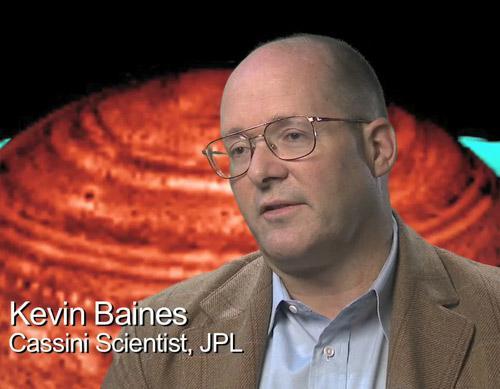
"It turns out that a major driver of Saturn's ionospheric environment and climate across vast reaches of the planet are ring particles located some 36,000 miles [60,000 kilometers] overhead," said Kevin Baines, a co-author on the paper, based at NASA's Jet Propulsion Laboratory, Pasadena, Calif.

"The ring particles affect both what species of particles are in this part of the atmosphere and where it is warm or cool."

In the early 1980s, images from NASA's Voyager spacecraft showed two to three dark bands on Saturn, and scientists theorized that water could have been showering down into those bands from the rings.

Those bands were not seen again until this team observed the planet in near-infrared wavelengths with the W.M Keck Observatory on Mauna Kea, in Hawaii, in April 2011.

The effect was difficult to discern because it involves looking for a subtle emission from bright parts of Saturn.

It required an instrument like that on Keck, which can split up a large range of light.

The ring rain's effect occurs in Saturn's ionosphere, where charged particles are produced when the otherwise neutral atmosphere is exposed to a flow of energetic particles or solar radiation.

When the scientists tracked the pattern of emissions of a particular hydrogen ion with three protons (triatomic hydrogen), they expected to see a uniform planet-wide infrared glow.

What they observed instead was a series of light and dark bands -- with areas of reduced emission corresponding to water-dense portions of Saturn's rings and areas of high emission corresponding to gaps in the rings.

They surmised that charged water particles from the planet's rings were being drawn towards the planet along Saturn's magnetic field lines and were neutralising the glowing triatomic hydrogen ions.

This leaves large "shadows" in what would otherwise be a planet-wide infrared glow. These shadows cover some 30 to 43 percent of the planet's upper atmosphere surface from around 25 to 55 degrees latitude.

This is a significantly larger area than suggested by images from NASA's Voyager mission.

Both Earth and Jupiter have an equatorial region that glows very uniformly. Scientists expected this pattern at Saturn, too, but they instead saw dramatic differences at different latitudes.

Journal Reference:
J. O’Donoghue, T. S. Stallard, H. Melin, G. H. Jones, S. W. H. Cowley, S. Miller, K. H. Baines, J. S. D. Blake. The domination of Saturn’s low-latitude ionosphere by ring ‘rain’. Nature, 2013; 496 (7444): 193 DOI: 10.1038/nature12049

Saturday, December 1, 2012

Saturn's rings may double up as a moon factory


Many of the moons in the solar system could have been spawned from giant rings around planets. According to a new model, Saturn, Uranus, Neptune and even the Earth may have once had ring systems that gave rise to satellites.

We used to think that moons form around planets in the same way as planets form around stars: coalescing from a gaseous disc that surrounded the planet as it formed. That model still applies to some moons, like those of Jupiter.

But Saturn's moons follow a peculiar pattern. Their orbits bunch near the edge of the rings, and the moons get more spread out and more massive as they get further away.

The rings mark Saturn's Roche limit: the distance from the planet beyond which its gravitational tidal forces are weak enough to let moons there survive.

Inside the Roche limit, however, Saturn's gravity would pull moons apart and add them to its rings. Some astronomers think this is how the planet gained its rings in the first place.

But theory says that such rings do not remain static. The constituent fragments that lie near the inner, planetary side of the ring should constantly exchange angular momentum with fragments further out. This means the inner fragments lose energy and fall towards Saturn while the outer ones gain energy and retreat from the planet.

Aurélien Crida at the Observatory of the Cote d'Azur in Nice, France, and Sébastien Charnoz at the Denis Diderot University in Paris have now run simulations of this effect. They showed that material leaving the outer edge of the ring would pool into a small moon, which then gradually migrates away from the planet.

When enough material is left in the rings, a second moon would grow where the first moon formed. This moon, too, would gradually move away, allowing a third moon to grow, and so on.

The earlier moons would probably be larger, because they had a bigger ring to draw material from than the later moons.

The early moons also have more time to collide with each other, fusing into larger satellites. "We see that for Saturn's moons, it fits quite well," Crida says.

Smoking gun Neither Uranus nor Neptune has a massive ring system today, but the distribution of moons around both planets is similar enough to the Saturn pattern to suggest that they once did – and that the rings gave rise to both of the ice giants' satellites.

"We think this is a smoking gun of this process," Crida says. Uranus and Neptune clearly lack big rings today, though, so we would need a better understanding of the ring-forming process to establish whether they might have done in the past.

Surprisingly, even the Earth could have had a ring once. Earth's moon probably formed when a large body collided with the young planet and sent hot mantle material flying into space.

"The process through which this material would eventually form the moon was not investigated in detail so far," Crida says. If the material settled into a massive ring, it could have spread and congealed into a single moon in as little time as a month, he says.

Journal: Science, doi.org/jvw

Sunday, September 16, 2012

New Space App: NASA Cassini HD by Thinx - Saturn

Cassini HD by Thinx is an App, available from the App Store, which takes you on a voyage of discovery to the mysterious ringed planet of Saturn.

It features more than 840 images sent back to Earth by the Cassini orbiter that capture in stunning detail this alien environment in our celestial backyard.

The Cassini HD photo collection was selected from thousands of images available courtesy NASA/JPL-Caltech.

Includes informative captions about Saturn, its beautiful rings, and many of its exotic moons.

Click on the picture to go to the Thinx page or follow this link: Cassini HD by Thinx

Monday, August 20, 2012

Voyager 1 & 2: The Interstellar Mission

The twin Voyager 1 and 2 spacecraft continue exploring where nothing from Earth has flown before.

In the 34th year after their 1977 launches, they each are much farther away from Earth and the Sun than Pluto.

Voyager 1 and 2 are now in the "Heliosheath" - the outermost layer of the heliosphere where the solar wind is slowed by the pressure of interstellar gas.

Both spacecraft are still sending scientific information about their surroundings through the Deep Space Network (DSN).


The primary mission was the exploration of Jupiter and Saturn.

After making a string of discoveries there, such as recording active volcanoes on Jupiter's moon Io and intricacies of Saturn's rings, the mission was extended.

Voyager 2 went on to explore Uranus and Neptune, and is still the only spacecraft to have visited those outer planets.

The adventurers' current mission, the Voyager Interstellar Mission (VIM), will explore the outermost edge of the Sun's domain and beyond.

Mission Objective
The mission objective of the Voyager Interstellar Mission (VIM) is to extend the NASA exploration of the solar system beyond the neighbourhood of the outer planets to the outer limits of the Sun's sphere of influence, and possibly beyond.

This extended mission is continuing to characterize the outer solar system environment and search for the heliopause boundary, the outer limits of the Sun's magnetic field and outward flow of the solar wind.

Penetration of the heliopause boundary between the solar wind and the interstellar medium will allow measurements to be made of the interstellar fields, particles and waves unaffected by the solar wind.

Friday, August 10, 2012

NASA Cassini Image: Saturn

Flying over the unlit side of Saturn's rings, the Cassini spacecraft captures Saturn's glow, represented in brilliant shades of electric blue, sapphire and mint green, while the planet's shadow casts a wide net on the rings.

Monday, June 25, 2012

NASA Cassini: Revealed Why Jet Streams Cross-Cut Saturn

Turbulent jet streams, regions where winds blow faster than in other places, churn east and west across Saturn.

Scientists have been trying to understand for years the mechanism that drives these wavy structures in Saturn's atmosphere and the source from which the jets derive their energy.

In a new study appearing in the June edition of the journal Icarus, scientists used images collected over several years by NASA's Cassini spacecraft to discover that the heat from within the planet powers the jet streams.

Condensation of water from Saturn's internal heating led to temperature differences in the atmosphere.

The temperature differences created eddies, or disturbances that move air back and forth at the same latitude, and those eddies, in turn, accelerated the jet streams like rotating gears driving a conveyor belt.

A competing theory had assumed that the energy for the temperature differences came from the sun. That is how it works in the Earth's atmosphere.

"We know the atmospheres of planets such as Saturn and Jupiter can get their energy from only two places: the sun or the internal heating.

The challenge has been coming up with ways to use the data so that we can tell the difference," said Tony Del Genio of NASA's Goddard Institute for Space Studies, N.Y., the lead author of the paper and a member of the Cassini imaging team.

The new study was possible in part because Cassini has been in orbit around Saturn long enough to obtain the large number of observations required to see subtle patterns emerge from the day-to-day variations in weather.

"Understanding what drives the meteorology on Saturn, and in general on gaseous planets, has been one of our cardinal goals since the inception of the Cassini mission," said Carolyn Porco, imaging team lead, based at the Space Science Institute, Boulder, Colo.

"It is very gratifying to see that we're finally coming to understand those atmospheric processes that make Earth similar to, and also different from, other planets."

Rather than having a thin atmosphere and solid-and-liquid surface like Earth, Saturn is a gas giant whose deep atmosphere is layered with multiple cloud decks at high altitudes.

A series of jet streams slice across the face of Saturn visible to the human eye and also at altitudes detectable to the near- infrared filters of Cassini's cameras.

While most blow eastward, some blow westward. Jet streams occur on Saturn in places where the temperature varies significantly from one latitude to another.

Thanks to the filters on Cassini's cameras, which can see near-infrared light reflected to space, scientists now have observed the Saturn jet stream process for the first time at two different, low altitudes.

One filtered view shows the upper part of the troposphere, a high layer of the atmosphere where Cassini sees thick, high-altitude hazes and where heating by the sun is strong.

Views through another filter capture images deeper down, at the tops of ammonia ice clouds, where solar heating is weak but closer to where weather originates.

This is where water condenses and makes clouds and rain.

Monday, June 18, 2012

ESA Cassini Image: In the shadows of Saturn’s rings

Titan appears to be strung like a bead on Saturn’s rings, which cast shadows onto the southern hemisphere of the gas giant in this beautiful image from Cassini.

Faint but exquisite detail in the gas giant’s upper atmosphere paints a tranquil scene.

A thin band of bright white ammonia ice clouds is etched into the planet’s disc towards the top of the image while clouds dotted below are faded scars of a huge storm that raged across the planet through much of 2011.

Shadows cast by Saturn’s iconic rings appear painted onto the planet’s southern hemisphere in two thick bands broken by thin, lighter stripes, reflecting the intricacies of the individual rings.

As Saturn’s seasons progress towards northern hemisphere summer, the rings will appear to grow wider and wider.

Meanwhile Titan, Saturn’s largest moon, appears to hang on the planet’s rings like a bead on a necklace. The effect is a result of the line-of-sight viewing position; Titan orbits Saturn at an average distance of 1, 221, 870 km.

The moon is an enigma in itself – cloaked in a thick nitrogen-rich atmosphere, it is the only moon in the Solar System that has a dense atmosphere. Lakes of liquid hydrocarbons pool on its surface, and an active methane cycle plays a similar role to Earth’s water cycle, complete with clouds and methane rain.

Cassini has been in orbit around Saturn since 2004 and is now in its second extended mission phase, the Cassini Solstice Mission, which will continue until 2017.

Thursday, April 26, 2012

NASA Cassini: Snowballs caught crashing into Saturn's weirdest ring


Saturn's weirdest ring is known for its sparkling displays, but now it's been caught in the act. NASA's Cassini spacecraft has captured the first video of snowballs crashing into the planet's distant F-ring, creating a mini-jet of sparkling ice crystals.

The event was captured while Cassini was filming Saturn's moon Prometheus approaching the ring. The moon, which orbits just inside the F-ring, following an elliptical path, brushes up against it every 17 years. During its approach, it's thought to create a ripple in the icy ring's geometry which causes snowball-like pieces to break off. These icy fragments are then thought to quickly crash back into it causing a sparkling mini-jet.

Based on the video, researchers were able to calculate the orbital direction and speed of the snowballs. Results indicate that they followed a very similar orbit to Prometheus and hit at a slow speed of about one meter per second. This points to the culprit being small snowballs created during the moon's previous approach, which survived and went on to strike through the F-ring itself.

"We had seen these mini-jets right from day one but, like most things with the F-ring, it's trying to understand what you're seeing," says Carl Murray, a Cassini imaging team member based at University of London in the UK. The group has found 500 such mini-jets after looking through 25 images of the F-ring. They now plan to examine them more closely to see if they fit the same description as the one caught on film.

Tuesday, February 28, 2012

NASA Cassini Image: Saturn's Moon Mimas - Cut-Off Rings

Image credit: NASA/JPL-Caltech/Space Science Institute

One of Saturn's moons, Mimas joins the planet's rings which appear truncated by the planet's shadow in this Cassini spacecraft image.

Saturn is off to the left, out of view here.

The inner rings are just visible there but the planet's shadow covers part of the rings across the middle of the image.

Mimas (246 miles, or 396 kilometers across) is closer to Cassini than the rings are here.

The bright speck above the rings is a star.

To increase visibility, the rings have been brightened by a factor of two relative to Mimas. This view looks toward the southern, un-illuminated side of the rings from just below the ring-plane.

The image was taken in visible light with the Cassini spacecraft narrow-angle camera on Dec. 21, 2011.

The view was obtained at a distance of approximately 1.7 million miles (2.7 million kilometers) from Mimas. Image scale is 10 miles (16 kilometers) per pixel on Mimas.


The Cassini-Huygens mission is a cooperative project of NASA, the European Space Agency and the Italian Space Agency.

The Jet Propulsion Laboratory, a division of the California Institute of Technology in Pasadena, manages the mission for NASA's Science Mission Directorate, Washington, D.C.

The Cassini orbiter and its two onboard cameras were designed, developed and assembled at JPL. The imaging operations center is based at the Space Science Institute in Boulder, Colo.

For more information about the Cassini-Huygens mission visit www.nasa.gov/cassini and saturn.jpl.nasa.gov . The Cassini imaging team homepage is at ciclops.org