Showing posts with label heliosphere. Show all posts

Thursday, September 18, 2014

The latest observations of interstellar particles

Credit: NASA /Goddard /Adler /U. Chicago /Wesleyan

With all the news about Voyager 1 leaving the heliosphere and entering interstellar space you might think that the probe is the first spacecraft to detect interstellar particles.

That isn't entirely true, and the latest observations of interstellar particles has found some very interesting results.

The heliosphere is generated by the Sun's solar wind, a stream of charged (ionized) particles that flows outward from the Sun.

The solar wind interacts with the magnetic field of the sun, and together they create a kind of diffuse bubble of charged particles around the sun known as the heliosphere.

While this heliosphere prevents any interstellar charged particles from reaching us, it is less effective at preventing uncharged interstellar particles from reaching us.

Most of the interstellar wind is ionized like the solar wind, but there are some neutral particles (mostly hydrogen) that moves with the interstellar wind.

Since neutral particles don't interact strongly with the Sun's magnetic field, some of them can slip into the heliosphere, where we can detect them.

This neutral hydrogen comes from the local cloud, seen below, a very tenuous cloud of hydrogen that surrounds our stellar region.

The motion of this hydrogen relative to the Sun depends on the Sun's motion through the cloud and the motion of the cloud itself.

The Sun's motion through the galaxy is quite steady, and it was thought that the cloud's motion was also steady, but long term observations of the hydrogen flow through our solar system has found this is not the case.

In a recent paper in Science researchers compared hydrogen flow measurements from the IBEX satellite (taken during 2009-2010) with observations from Ulysses (1992-2002) and other observations (1972-1978).

What they found was that over the course of 30 years the direction has changed by about 6 degrees.

This may seem like a slow and gradual change, but on a cosmic scale it is huge. The local cloud is about 30 light years across, and the Sun moves through it at a speed of (only) about 50,000 mph (22 km/sec).

While variations in the hydrogen flow are expected as it interacts with variations in the solar wind, those variations average out.

Observing such a rapid change in flow (on a cosmic scale) means either there is turbulent flow within the cloud itself, or the interstellar wind is more dynamic than originally thought.

We've long known that the solar wind is quite dynamic due to the Sun's activity. Now we're finding the interstellar wind may be active as

More information: "Decades-long changes of the interstellar wind through our solar system." Frisch PC, et al. Science. 2013 Sep 6;341(6150):1080-2. DOI: 10.1126/science.1239925
Wednesday, July 23, 2014

Voyager 1 spacecraft might not have reached interstellar space

The heliosphere, in which the Sun and planets reside, is a large bubble inflated from the inside by the high-speed solar wind blowing out from the Sun. 

Pressure from the solar wind, along with pressure from the surrounding interstellar medium, determines the size and shape of the heliosphere. 

The supersonic flow of solar wind abruptly slows at the termination shock, the innermost boundary of the solar system. 

The edge of the solar system is the heliopause. 

The bow shock pushes ahead through the interstellar medium as the heliosphere plows through the galaxy. 

Credit: Southwest Research Institute

In 2012, the Voyager mission team announced that the Voyager 1 spacecraft had passed into interstellar space, traveling further from Earth than any other manmade object.

But, in the nearly two years since that historic announcement, and despite subsequent observations backing it up, uncertainty about whether Voyager 1 really crossed the threshold continues.

There are some scientists who say that the spacecraft is still within the heliosphere, the region of space dominated by the Sun and its wind of energetic particles, and has not yet reached the space between the stars.

Now, two Voyager team scientists have developed a test that they say could prove once and for all if Voyager 1 has crossed the boundary.

The new test is outlined in a study accepted for publication in Geophysical Research Letters, a journal of the American Geophysical Union (AGU).

The scientists predict that, in the next two years, Voyager 1 will cross the current sheet, the sprawling surface within the heliosphere where the polarity of the sun's magnetic field changes from plus to minus.

The spacecraft will detect a reversal in the magnetic field, proving that it is still within the heliosphere but, if the magnetic field reversal doesn't happen in the next year or two as expected, that is confirmation that Voyager 1 has already passed into interstellar space.

"The proof is in the pudding," said George Gloeckler, a professor in atmospheric, oceanic and space sciences at the University of Michigan in Ann Arbor and lead author of the new study.

Gloeckler has worked on the Voyager mission since 1972 and has been a vocal opponent of the view that Voyager 1 has entered interstellar space.

He said that, although the spacecraft has observed many of the signs indicating it may have reached interstellar space, like cosmic rays, Voyager 1 did not see a change in magnetic field that many were expecting.

"This controversy will continue until it is resolved by measurements," Gloeckler said.

This artist’s concept shows the Voyager 1 spacecraft entering the space between stars. 

The Voyager mission team announced in 2012 that the Voyager 1 spacecraft had passed into interstellar space, but some scientists say it is still within the heliosphere, the region of space domininated by the Sun and its wind of energetic particles. 

In a new study, two Voyager team scientists are proposing a test that they say could prove once and for all of Voyager 1 has crossed the boundary. 

Credit: NASA/JPL-Caltech

If the new prediction is right, "this will be the highlight of my life," he said. "There is nothing more gratifying than when you have a vision or an idea and you make a prediction and it comes true."

The Voyager 1 and 2 spacecraft were launched in 1977 to study Jupiter and Saturn. The mission has since been extended to explore the outermost limits of the Sun's influence and beyond.

Voyager 2, which also flew by Uranus and Neptune, is on its way to interstellar space.

More information: Geophysical Research Letters DOI: 10.1002/2014GL060781

Wednesday, July 9, 2014

Sun sends more 'shock waves' to Voyager 1 - Video

Credit: NASA/JPL-Caltech

NASA's Voyager 1 spacecraft has experienced a new "shock wave" from the sun as it sails through interstellar space.

Such waves are what led scientists to the conclusion, in the fall of 2013, that Voyager had indeed left our sun's bubble, entering a new frontier.

"Normally, interstellar space is like a quiet lake," said Ed Stone of the California Institute of Technology in Pasadena, California, the mission's project scientist since 1972.

"But when our sun has a burst, it sends a shock wave outward that reaches Voyager about a year later. The wave causes the plasma surrounding the spacecraft to sing."

Data from this newest tsunami wave generated by our sun confirm that Voyager is in interstellar space, a region between the stars filled with a thin soup of charged particles, also known as plasma.

The mission has not left the solar system, it has yet to reach a final halo of comets surrounding our sun, but it broke through the wind-blown bubble, or heliosphere, encasing our sun.

Voyager is the farthest human-made probe from Earth, and the first to enter the vast sea between stars.

"All is not quiet around Voyager," said Don Gurnett of the University of Iowa, Iowa City, the principal investigator of the plasma wave instrument on Voyager, which collected the definitive evidence that Voyager 1 had left the sun's heliosphere.

"We're excited to analyze these new data. So far, we can say that it confirms we are in interstellar space."


The first two tsunami waves to reach Voyager 1 caused surrounding ionized matter to ring like a bell at frequencies expected in interstellar space. 

The third tsunami caused similar ringing, confirming that Voyager 1 continues it journey into interstellar space. 

Image Credit: NASA's Voyager 1 spacecraft

Our sun goes through periods of increased activity, where it explosively ejects material from its surface, flinging it outward. These events, called coronal mass ejections, generate shock, or pressure, waves.

Three such waves have reached Voyager 1 since it entered interstellar space in 2012. The first was too small to be noticed when it occurred and was only discovered later, but the second was clearly registered by the spacecraft's cosmic ray instrument in March of 2013.

Cosmic rays are energetic charged particles that come from nearby stars in the Milky Way galaxy. The sun's shock waves push these particles around like buoys in a tsunami.

Data from the cosmic ray instrument tell researchers that a shock wave from the sun has hit.

Meanwhile, another instrument on Voyager registers the shock waves, too. The plasma wave instrument can detect oscillations of the plasma electrons.

"The tsunami wave rings the plasma like a bell," said Stone. "While the plasma wave instrument lets us measure the frequency of this ringing, the cosmic ray instrument reveals what struck the bell—the shock wave from the sun."

This ringing of the plasma bell is what led to the key evidence showing Voyager had entered interstellar space. Because denser plasma oscillates faster, the team was able to figure out the density of the plasma.

In 2013, thanks to the second tsunami wave, the team acquired evidence that Voyager had been flying for more than a year through plasma that was 40 times denser than measured before, a telltale indicator of interstellar space.

Why is it denser out there? The sun's winds blow a bubble around it, pushing out against denser matter from other stars.

Now, the team has new readings from a third wave from the sun, first registered in March of this year.

These data show that the density of the plasma is similar to what was measured previously, confirming the spacecraft is in interstellar space.

Thanks to our sun's rumblings, Voyager has the opportunity to listen to the singing of interstellar space, an otherwise silent place.

Voyager 1 and its twin, Voyager 2, were launched 16 days apart in 1977. Both spacecraft flew by Jupiter and Saturn.

Voyager 2 also flew by Uranus and Neptune. Voyager 2, launched before Voyager 1, is the longest continuously operated spacecraft and is expected to enter interstellar space in a few years.

Friday, May 2, 2014

NASA Black Brant XII: HYPE Sounding rocket to study interplanetary medium

A Black Brant XII launches from Wallops Flight Facility. 

Credit: NASA

NASA will conduct a sounding rocket mission in May 2014, carrying a payload designed to measure the nature of the interplanetary medium (IPM), characterizing the particles that fill our solar system.

The Hydrogen Polarimetric Explorer (HYPE), measures light reflected by interplanetary hydrogen that originally flows in from outside the galaxy.

Along its travels, the hydrogen crosses the boundaries of our heliosphere, the local bubble surrounding the sun and planets that is inflated by the solar wind.

Thus it can provide not only information about the nature of near space, but also of the galactic environment and how it interacts with the sun and heliosphere.

The sounding rocket measurements will provide important information on the size and shape of the heliosphere as well as information on the interstellar magnetic field at the boundary.

These results will be combined with NASA's Interstellar Boundary Explorer (IBEX), Voyager, and Hubble Space Telescope interplanetary hydrogen measurements to improve models of the heliospheric boundary and its interactions with the local interstellar medium.

The window for the HYPE launch opens on May 2, 2014.

HYPE will fly on a Terrier-Black Brant sounding rocket, launched from the White Sands Missile Range in New Mexico.

It is projected to fly to an altitude of about 185 miles during a nine-minute flight.

Walt Harris with the UC Davis is the mission principal investigator.

Thursday, September 12, 2013

NASA Voyager-1 has left the Solar System

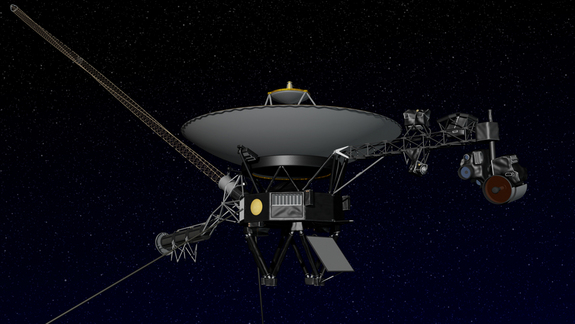
An artist's concept shows the Voyager spacecraft traveling through space against a field of stars. 

Credit: NASA/JPL-Caltech.

University of Iowa space physicist Don Gurnett says there is solid evidence that NASA's Voyager 1 spacecraft has become the first man-made object to reach interstellar space, more than 11 billion miles distant and 36 years after it was launched.

The finding is reported in a paper published in the Sept. 12 online issue of the journal Science.

Don Gurnett
"On April 9, the Voyager 1 Plasma Wave instrument, built at the UI in the mid-1970s, began detecting locally generated waves, called electron plasma oscillations, at a frequency that corresponds to an electron density about 40 times greater than the density inside the heliosphere—the region of the sun's influence," says Gurnett.

"The increased electron density is very close to the value scientists expected to find in the interstellar medium.

"This is the first solid evidence that Voyager 1 has crossed the heliopause, the boundary between the heliosphere, and interstellar space," says Gurnett, principal investigator for the plasma wave instrument.

Bill Kurth
For several months, the relative position of Voyager 1 has stirred something of a scientific debate because there remains some lingering evidence of the nearby heliosphere beyond the heliopause.

Even though Voyager 1 has passed into interstellar space, it does not mean that its journey is over, says Bill Kurth, UI research scientist and co-author of the Science paper.

This is an artist's impression of Voyager 1's position on the sky when observed by the Very Long Baseline Array (VLBA) on Feb. 21, 2013, at which point -- according to NASA's Jet Propulsion Laboratory -- Voyager was already outside of our solar system. 

The actual image from the data (enlarged section) is 0.5 arcseconds across. 

The radio signal as shown is a mere 1 milliarcsecond across. 

Credit: Alexandra Angelich, NRAO/AUI/NSF.

"Now that we're on the outside, we are learning that interstellar space isn't a bland region," Kurth says.

"Rather, there are variations in some of Voyager's measurements that may be due to the nearby presence of the heliosphere. So, our attention is turning from crossing the boundary to understanding what is going on outside," he says.

At age 36, Voyager 1 is the most distant human-made object at more than 11.6 billion miles from the sun, or about 125 astronomical units.

"At that distance it takes more than 17 hours for a radio signal to travel from the spacecraft to one of NASA's Deep Space Network antennas. The signal strength is so incredibly weak that it takes both a 230-foot and a 110-foot-diameter antenna to receive our highest resolution data," Gurnett says.

Launched Sept. 5, 1977, Voyager 1 completed flybys of both Jupiter and Saturn and is currently moving outward from the sun at about 3.5 AU per year.

It's sister spacecraft, Voyager 2 was launched Aug. 20, 1977, on a flight path that took it to encounters with Jupiter, Saturn, Uranus, and Neptune.

At present, Voyager 2 is still inside the heliosphere about 103 AU from the sun and traveling outward at about 3.3 AU per year.

More information: The sounds of the electron plasma oscillations heralding Voyager's entry into interstellar space and other sounds of space can be heard by visiting Gurnett's website at: www-pw.physics.uiowa.edu/space-audio/

Thursday, August 15, 2013

Voyager 1 has left the Solar System - Heliosphere Boundary crossed

Voyager 1 appears to have at long last left our solar system and entered interstellar space, says a University of Maryland-led team of researchers.

Carrying Earthly greetings on a gold plated phonograph record and still-operational scientific instruments – including the Low Energy Charged Particle detector designed, built and overseen, in part, by UMD's Space Physics Group – NASA's Voyager 1 has traveled farther from Earth than any other human-made object and now, these researchers say, it has begun the first exploration of our galaxy beyond the Sun's influence.

"It's a somewhat controversial view, but we think Voyager has finally left the Solar System, and is truly beginning its travels through the Milky Way," says UMD research scientist Marc Swisdak, lead author of a new paper published online this week in The Astrophysical Journal Letters.

Swisdak and fellow plasma physicists James F. Drake, also of the University of Maryland, and Merav Opher of Boston University have constructed a model of the outer edge of the Solar System that fits recent observations, both expected and unexpected.

Their model indicates Voyager 1 actually entered interstellar space a little more than a year ago, a finding directly counter to recent papers by NASA and other scientists suggesting the spacecraft was still in a fuzzily-defined transition zone between the Sun's sphere of influence and the rest of the galaxy. But why the controversy?

At issue is what the boundary-crossing should look like to Earth-bound observers 11 billion miles (18 billion kilometers) away.

The Sun's envelope, known as the heliosphere, is relatively well-understood as the region of space dominated by the magnetic field and charged particles emanating from our star.

The heliopause transition zone is both of unknown structure and location. According to conventional wisdom, we'll know we've passed through this mysterious boundary when we stop seeing solar particles and start seeing galactic particles, and we also detect a change in the prevailing direction of the local magnetic field.

NASA scientists recently reported that last summer, after eight years of travel through the outermost layer of the heliosphere, Voyager 1 recorded "multiple crossings of a boundary unlike anything previously observed."

Successive dips in, and subsequent recovery of, solar particle counts caught researchers' attention.

The dips in solar particle counts corresponded with abrupt increases in galactic electrons and protons. Within a month, solar particle counts disappeared, and only galactic particle counts remained.

Yet Voyager 1 observed no change in the direction of the magnetic field.

To explain this unexpected observation, many scientists theorize that Voyager 1 has entered a "heliosheath depletion region," but that the probe is still within the confines of the heliosphere.

Swisdak and colleagues, who are not part of the Voyager 1 mission science teams, say there is another explanation.

In previous work, Swisdak and Drake have focused on magnetic reconnection, or the breaking and reconfiguring of close and oppositely-directed magnetic field lines.

It's the phenomenon suspected to lurk at the heart of solar flares, coronal mass ejections and many of the sun's other dramatic, high-energy events. The UMD researchers argue that magnetic reconnection is also key to understanding NASA's surprising data.

Though often depicted as a bubble encasing the heliosphere and its contents, the heliopause is not a surface neatly separating "outside" and "inside." In fact, Swisdak, Drake and Opher assert that the heliopause is both porous to certain particles and layered with complex magnetic structure.

Here, magnetic reconnection produces a complex set of nested magnetic "islands," self-contained loops which spontaneously arise in a magnetic field due to a fundamental instability.

Interstellar plasma can penetrate into the heliosphere along reconnected field lines, and galactic cosmic rays and solar particles mix vigorously.

Most interestingly, drops in solar particle counts and surges in galactic particle counts can occur across "slopes" in the magnetic field, which emanate from reconnection sites, while the magnetic field direction itself remains unchanged.

This model explains observed phenomena from last summer, and Swisdak and his colleagues suggest that Voyager 1 actually crossed the heliopause on July 27, 2012.

In a NASA statement, Ed Stone, Voyager project scientist and a professor of physics of the California Institute of Technology, says, in part, "Other models envision the interstellar magnetic field draped around our solar bubble and predict that the direction of the interstellar magnetic field is different from the solar magnetic field inside. By that interpretation, Voyager 1 would still be inside our solar bubble.

The fine-scale magnetic connection model [of Swisdak and colleagues] will become part of the discussion among scientists as they try to reconcile what may be happening on a fine scale with what happens on a larger scale."

Voyager Interstellar Mission
In the 36th year after their 1977 launches, the twin Voyager 1 and 2 spacecraft continue exploring where nothing from Earth has flown before.

Their primary mission was the exploration of Jupiter and Saturn. After making a string of discoveries there—such as active volcanoes on Jupiter's moon Io and intricacies of Saturn's rings—the mission was extended.

Voyager 2 went on to explore Uranus and Neptune, and is still the only spacecraft to have visited those outer planets.

The current mission for both spacecraft, the Voyager Interstellar Mission, is to explore the outermost edge of the Sun's domain and beyond.

Both Voyagers are capable of returning scientific data from a full range of instruments, with adequate electrical power and attitude control propellant to keep operating until 2020.

Voyager 2 is expected to enter interstellar space a few years after its twin. The Voyager spacecraft were built and continue to be operated by NASA's Jet Propulsion Laboratory, in Pasadena, Calif.

University of Maryland scientists lead the Deep Impact spacecraft science team and are part of the science teams of many of the other spacecraft exploring our Solar System, including both Voyagers and Cassini.

More information: Paper: dx.doi.org/10.1088/2041-8205/774/1/L8

Wednesday, August 7, 2013

The Sun's Heliosphere is about to flip

An artist's concept of the heliospheric current sheet, which becomes more wavy when the sun's magnetic field flips.

Something big is about to happen on the sun.

According to measurements from NASA-supported observatories, the sun's vast magnetic field is about to flip.

Todd Hoeksema
"It looks like we're no more than 3 to 4 months away from a complete field reversal," says solar physicist Todd Hoeksema of Stanford University. "This change will have ripple effects throughout the solar system."

The sun's magnetic field changes polarity approximately every 11 years. It happens at the peak of each solar cycle as the sun's inner magnetic dynamo re-organizes itself.

The coming reversal will mark the midpoint of Solar Cycle 24. Half of 'Solar Max' will be behind us, with half yet to come.

Hoeksema is the director of Stanford's Wilcox Solar Observatory, one of the few observatories in the world that monitor the sun's polar magnetic fields.

The poles are a herald of change. Just as Earth scientists watch our planet's polar regions for signs of climate change, solar physicists do the same thing for the sun.

Magnetograms at Wilcox have been tracking the sun's polar magnetism since 1976, and they have recorded three grand reversals—with a fourth in the offing.

Solar physicist Phil Scherrer, also at Stanford, describes what happens: "The sun's polar magnetic fields weaken, go to zero, and then emerge again with the opposite polarity. This is a regular part of the solar cycle."

A reversal of the sun's magnetic field is, literally, a big event. The domain of the sun's magnetic influence (also known as the "heliosphere") extends billions of kilometers beyond Pluto.

Changes to the field's polarity ripple all the way out to the Voyager probes, on the doorstep of interstellar space.

When solar physicists talk about solar field reversals, their conversation often centers on the "current sheet."

The current sheet is a sprawling surface jutting outward from the sun's equator where the sun's slowly-rotating magnetic field induces an electrical current.

The current itself is small, only one ten-billionth of an amp per square meter (0.0000000001 amps/m2), but there's a lot of it: the amperage flows through a region 10,000 km thick and billions of kilometers wide.

Electrically speaking, the entire heliosphere is organized around this enormous sheet.

During field reversals, the current sheet becomes very wavy. Scherrer likens the undulations to the seams on a baseball.

As Earth orbits the sun, we dip in and out of the current sheet. Transitions from one side to another can stir up stormy space weather around our planet.

Cosmic rays are also affected. These are high-energy particles accelerated to nearly light speed by supernova explosions and other violent events in the galaxy.

Cosmic rays are a danger to astronauts and space probes, and some researchers say they might affect the cloudiness and climate of Earth.

The current sheet acts as a barrier to cosmic rays, deflecting them as they attempt to penetrate the inner solar system. A wavy, crinkly sheet acts as a better shield against these energetic particles from deep space.

As the field reversal approaches, data from Wilcox show that the sun's two hemispheres are out of synch.

"The sun's north pole has already changed sign, while the south pole is racing to catch up," says Scherrer.

"Soon, however, both poles will be reversed, and the second half of Solar Max will be underway."

When that happens, Hoeksema and Scherrer will share the news with their colleagues and the public.

Monday, August 5, 2013

The Sun's Heliosphere, the Bow Shock and Ripple effect

Image of sun courtesy of NASA.

A new study co-authored by Boston University astronomers indicates that a bow shock (a dynamic boundary between the Sun's heliosphere and the interstellar medium) is highly likely.

These findings challenge recent predictions that no such bow shock would be encountered.

The researchers base their expectation of finding a bow shock on a new magneto-hydrodynamic simulation that confirmed a theoretically expected slow bow shock (SBS) ahead of the heliosphere.

The new research supports the idea that the sun, like a boat moving through water, forms a crescent-shaped shockwave as it moves through interstellar gas.

The study, titled "A slow bow shock ahead of the heliosphere," was published recently in the journal Geophysical Research Letters.

Bertalan Zieger
In the current study, Bertalan Zieger, lead author and research scientist at BU's Center for Space Physics, and colleagues predict that a slow bow shock should exist ahead of the heliosphere.

This challenges some recent models that argued no bow shock at all would be found.

Those studies, which used the Interstellar Boundary Explorer (IBEX) satellite to measure the speed of interstellar particles entering the solar system near the edge of the heliosphere, suggested that the sun was moving too slowly through interstellar space (at 52,000 miles an hour) to create a bow shock.

However, the bow shock that they refer to is what is called a fast bow shock.

The new study shows that a slow type is possible: IBEX observations also indicate that the interstellar wind is slower than the fast and the intermediate wave, but faster than the slow wave.

Using these observations, the researchers conducted a magneto-hydrodynamic simulation that predicts a slow bow shock should exist in front of the heliosphere.

These projections could soon be confirmed by actual data: Voyager 1 is heading toward the slow bow shock, while Voyager 2 is not, which means that the two spacecraft are expected to encounter different interstellar plasma populations beyond the heliopause.

Confirmation of the existence of a bow shock could have important implications for our understanding of the nature of the interstellar magnetic field that the Voyagers will encounter ahead of the heliopshere, including whether the slow bow shock filters the influx of high-energy cosmic rays into the heliosphere.

More information: Geophysical Research Letters, Vol. 40, 1–6, doi: 10.1002/grl.50576, 2013

Monday, August 20, 2012

Nasa Voyager 1 & 2 Breaks through Heliosphere - Video

This video drops in on mission control for NASA's Voyager spacecraft as Voyager 1 sends back data from the far reaches of our solar system.

Credit: NASA/JPL-Caltech › Voyager's mission site

Voyager 1 & 2: The Interstellar Mission

The twin Voyager 1 and 2 spacecraft continue exploring where nothing from Earth has flown before.

In the 34th year after their 1977 launches, they each are much farther away from Earth and the Sun than Pluto.

Voyager 1 and 2 are now in the "Heliosheath" - the outermost layer of the heliosphere where the solar wind is slowed by the pressure of interstellar gas.

Both spacecraft are still sending scientific information about their surroundings through the Deep Space Network (DSN).


The primary mission was the exploration of Jupiter and Saturn.

After making a string of discoveries there, such as recording active volcanoes on Jupiter's moon Io and intricacies of Saturn's rings, the mission was extended.

Voyager 2 went on to explore Uranus and Neptune, and is still the only spacecraft to have visited those outer planets.

The adventurers' current mission, the Voyager Interstellar Mission (VIM), will explore the outermost edge of the Sun's domain and beyond.

Mission Objective
The mission objective of the Voyager Interstellar Mission (VIM) is to extend the NASA exploration of the solar system beyond the neighbourhood of the outer planets to the outer limits of the Sun's sphere of influence, and possibly beyond.

This extended mission is continuing to characterize the outer solar system environment and search for the heliopause boundary, the outer limits of the Sun's magnetic field and outward flow of the solar wind.

Penetration of the heliopause boundary between the solar wind and the interstellar medium will allow measurements to be made of the interstellar fields, particles and waves unaffected by the solar wind.

Friday, June 15, 2012

NASA Voyager 1: Data points to breakthrough into an interstellar future

This artist's concept shows NASA's two Voyager spacecraft exploring a turbulent region of space known as the heliosheath, the outer shell of the bubble of charged particles around our sun. Credit: NASA/JPL-Caltech

Data from NASA's Voyager 1 spacecraft indicate that the venerable deep-space explorer has encountered a region in space where the intensity of charged particles from beyond our solar system has markedly increased.

Voyager scientists looking at this rapid rise draw closer to an inevitable but historic conclusion - that humanity's first emissary to interstellar space is on the edge of our solar system.


"The laws of physics say that someday Voyager will become the first human-made object to enter interstellar space, but we still do not know exactly when that someday will be," said Ed Stone, Voyager project scientist at the California Institute of Technology in Pasadena.

"The latest data indicate that we are clearly in a new region where things are changing more quickly. It is very exciting. We are approaching the solar system's frontier."

The data making the 16-hour-38 minute, 11.1-billion-mile (17.8-billion-kilometer), journey from Voyager 1 to antennas of NASA's Deep Space Network on Earth detail the number of charged particles measured by the two High Energy telescopes aboard the 34-year-old spacecraft.

These energetic particles were generated when stars in our cosmic neighborhood went supernova.

Artist's concept of NASA's Voyager spacecraft. Credit: NASA/JPL-Caltech

"From January 2009 to January 2012, there had been a gradual increase of about 25 percent in the amount of galactic cosmic rays Voyager was encountering," said Stone.

"More recently, we have seen very rapid escalation in that part of the energy spectrum.

Beginning on May 7, the cosmic ray hits have increased five percent in a week and nine percent in a month."

This marked increase is one of a triad of data sets which need to make significant swings of the needle to indicate a new era in space exploration.

The second important measure from the spacecraft's two telescopes is the intensity of energetic particles generated inside the heliosphere, the bubble of charged particles the sun blows around itself.

While there has been a slow decline in the measurements of these energetic particles, they have not dropped off precipitously, which could be expected when Voyager breaks through the solar boundary.

The final data set that Voyager scientists believe will reveal a major change is the measurement in the direction of the magnetic field lines surrounding the spacecraft.

While Voyager is still within the heliosphere, these field lines run east-west.

When it passes into interstellar space, the team expects Voyager will find that the magnetic field lines orient in a more north-south direction.

Such analysis will take weeks, and the Voyager team is currently crunching the numbers of its latest data set.

In 1972, Ed Stone became the Voyager Project Scientist. Twenty years later, both Voyager spacecraft were still operating, and this photo was taken in front of a full-scale model of the spacecraft, after Stone had been Director of JPL for about one year. 

"When the Voyagers launched in 1977, the space age was all of 20 years old," said Stone.

"Many of us on the team dreamed of reaching interstellar space, but we really had no way of knowing how long a journey it would be, or if these two vehicles that we invested so much time and energy in would operate long enough to reach it."

Launched in 1977, Voyager 1 and 2 are in good health. Voyager 2 is more than 9.1 billion miles (14.7 billion kilometers) away from the sun.

Both are operating as part of the Voyager Interstellar Mission, an extended mission to explore the solar system outside the neighborhood of the outer planets and beyond.

NASA's Voyagers are the two most distant active representatives of humanity and its desire to explore.

The Voyager spacecraft were built by NASA's Jet Propulsion Laboratory in Pasadena, Calif., which continues to operate both. JPL is a division of the California Institute of Technology.

The Voyager missions are a part of the NASA Heliophysics System Observatory, sponsored by the Heliophysics Division of the Science Mission Directorate in Washington.

Friday, June 10, 2011

NASA's Voyager spacecraft on the edge of space

An artist's impression depicts the new view of the heliosphere in this image courtesy of NASA's Goddard Space Flight Centre.

Observations from NASA's Voyager spacecraft suggest the edge of our solar system may not be smooth, but filled with a turbulent sea of magnetic bubbles.

While using a new computer model to analyse Voyager data, scientists found the sun's distant magnetic field is made up of bubbles approximately 100 million miles wide. The bubbles are created when magnetic field lines reorganise.
Picture: REUTERS/NASA/Goddard Space Flight Centre

Voyagers surfs the 'magnetic bubbles'

Humankind's most distant emissaries are flying through a turbulent sea of magnetism as they seek to break free of our Solar System.

Nasa's Voyager probes, which were launched in 1977, are now approaching the very edge of our Sun's influence, more than 14 billion km from Earth; and they are still returning data.

That information has allowed scientists to build a better picture of what conditions are like in the zone where matter blown out from our star pushes up against interstellar space.

Computer modelling based on the Voyager insights suggests the edge of our Solar System is a froth of activity, like "an agitated jacuzzi", said Eugene Parker from the University of Chicago, US.

Magnetic field lines carried in the "wind" of material coming off our star are breaking and reconnecting.

This process is sculpting the wind into discrete bubbles that are many tens of millions of kilometres wide.

Researchers say this assessment has implications for our understanding of cosmic rays - the storm of high-energy particles that are accelerated in Earth's direction by exploded stars, black holes and other exotic locations in the galaxy.

Ray effects It is highly likely the mass of individual magnetic structures actually makes the Solar System more porous to cosmic rays.

"It's more like a membrane that is permeable to the galactic cosmic rays, so we expect the galactic cosmic rays to enter and slowly wander through this sea of magnetic bubbles until they can access field lines that connect back to the Sun and quickly escape," explained Professor Parker.

Monday, May 2, 2011

NASA's Voyager Probes to Leave Solar System by 2016

A long history of exploration
Voyager 2 was launched on Aug. 20, 1977, and its twin Voyager 1 blasted off a few weeks later, on Sept 5. Both spacecraft were tasked mainly with studying Jupiter, Saturn and their moons.

The spacecraft are also carrying so-called "golden records" containing the distilled essences of humanity, such as various musical offerings and greetings to the universe in 55 different languages. The goal is to teach alien civilizations a little about us, should they ever pluck the Voyagers out of the void. (SETI)

In their early years, the Voyagers made a series of important discoveries about the giant planets. For example, the mission detected active volcanoes on Jupiter's moon Io – the first time such features were found beyond Earth. The spacecraft also found evidence of a liquid-water ocean beneath the icy surface of Jupiter's moon Europa.

"Each of these discoveries changed the way we thought of other worlds," Stone said in a statement.

The Voyagers made it past Saturn, with the spacecraft examining Neptune and Uranus as well. And then they just kept on going, zooming toward the edge of the solar system in different directions and different planes.

Voyager 1 is now about 11 billion miles (17.7 billion kilometers) from Earth, while Voyager 2 is about 9 billion miles (14.5 billion km) away, Stone said. Voyager 1 is the most far-flung human-made object in the universe. [NASA's 10 Greatest Science Missions]

Probing the heliosheath
While the Voyagers have left the planets well behind, they're not beyond the solar system yet.

They're still within a huge bubble called the heliosphere, which is made of solar plasma and solar magnetic fields. This gigantic structure is about three times wider than the orbit of Pluto, researchers said.

Specifically, the Voyagers are plying the heliosphere's outer shell, a turbulent region called the heliosheath.

"We're smelling, we're touching the ionized matter in the heliosheath," said Merav Opher of Boston University, a Voyager guest investigator.

The Voyagers are helping scientists better understand the mysterious heliosphere. For example, measurements from the spacecraft revealed that the structure is distorted and asymmetric, yanked out of shape by the interstellar magnetic field, researchers said.

And in June 2010, Voyager 1 measured the outward velocity of the solar wind -- the million-mile-per-hour stream of charged particles coming from the sun -- to be zero in its location in the heliosheath. That surprising reading hasn't changed since.

Researchers don’t think the solar wind has stopped out there; they believe it may have just turned a corner. So they've recently started ordering Voyager 1 to do a series of acrobatic maneuvers, to point its instruments in different directions so the craft can pick up and track the puzzling solar breeze.

Breaking free
The heliosheath looks to be about 3 to 4 billion miles (4.8 to 6.4 billion km) thick, and the spacecraft are already well into it. Based on their speed, they should be out in about five years, Stone said.

That time frame is manageable. The Voyagers' radioisotope thermoelectric generators -- which convert the heat emitted by plutonium's radioactive decay into electricity -- can power their instruments until at least 2020. And the spacecraft have enough hydrazine fuel left to perform maneuvers for another 60 years, researchers said.

Of course, there are no signposts marking the start of interstellar space, where the Voyagers will escape the sun's wind and magnetic field only to be buffeted by those of other, far-flung stars. So astronomers will probably have a hard time knowing when the historic moment occurs.

"We are starting to talk about what we expect to see," Stone said. "I suspect, like in the past, we will be surprised, and we may in fact have a debate for a year or two before we finally decide, 'We have crossed the boundary.'"

NASA's Voyager 1 & 2 Spacecraft

NASA's twin Voyager probes were launched in the late 1970s to explore the outer planets in our solar system. But now, nearly 34 years later, the two spacecraft are on their way out of our cosmic neighborhood, knocking on the door of interstellar space.

The spacecraft, called Voyager 1 and Voyager 2, were built by NASA's Jet Propulsion Laboratory in Pasadena, Calif., which continues to operate both. Here are five facts about the two Voyager probes, the longest continuously operating spacecraft in deep space:

1. They're marathon runners
Voyager 2 launched on Aug. 20, 1977, and Voyager 1 launched about two weeks later, on Sept. 5. Since then, the spacecraft have been traveling along different flight paths and at different speeds.
Now about 10.8 billion miles (17.4 billion kilometers) from the sun and hurtling toward interstellar space, Voyager 1 is the farthest human-made object from Earth. Voyager 2 is about 8.8 billion miles (14.2 billion km) from the sun. [NASA's 10 Greatest Science Missions]

2. It takes a while to get ahold of them
Both spacecraft are still sending scientific information about their surroundings through NASA's Deep Space Network. A signal from the ground, traveling at the speed of light, takes about 13 hours one way to reach Voyager 2, and 16 hours to reach Voyager 1.

3. They started out on a grand planetary tour
The primary five-year mission of the Voyagers included the close-up exploration of Jupiter and Saturn, Saturn's rings and the larger moons of the two planets. The mission was extended after a succession of discoveries. [The Solar System Explained: From the Inside Out]

Between them, the two spacecraft have explored all the giant outer planets of our solar system -- Jupiter, Saturn, Uranus and Neptune -- as well as 49 moons, and the systems of rings and magnetic fields those planets possess.

The current mission, the Voyager Interstellar Mission, was planned to explore the outermost edge of our solar system and eventually leave our sun's sphere of influence to enter interstellar space -- the space between the stars.


4. They're carrying messages to aliens
Both Voyager spacecraft carry recorded messages from Earth on golden phonograph records -- 12-inch, gold-plated copper disks. A committee chaired by the late astronomer Carl Sagan (SETI) selected the contents of the records for NASA.

The records are cultural time capsules that the Voyagers bear with them to other star systems. They contain images and natural sounds, spoken greetings in 55 languages and musical selections from different cultures and eras.

5. The Voyagers are blazing new trails
Voyager 1 has reached a distant point at the edge of our solar system, where the outward motion of solar wind ceases. The event is the latest milestone in Voyager 1's passage through the heliosheath, the outer shell of the sun's sphere of influence, before entering interstellar space.

Interstellar space begins at the heliopause, and scientists estimate Voyager 1 will cross this frontier within the next five years.

Tuesday, December 14, 2010

Carl Sagan's Voyager near Solar System's edge

Voyager 1, one of the first satellites launched by Carl Sagan and his visionary team, is now the most distant spacecraft from Earth.

Voyager 1 has reached a new milestone in its quest to explore the edge of the Solar System.

Now 17.4bn km (10.8bn miles) from home, the veteran probe has detected a distinct change in the flow of particles that surround it.

These particles, which emanate from the Sun, are no longer travelling outwards but are moving sideways.

It means Voyager must be very close to making the jump to interstellar space - the space between the stars.

Edward Stone, the most recent Voyager project scientist, lauded the explorer and the fascinating science it continues to return 33 years after launch.

"When Voyager was launched, the space age itself was only 20 years old, so there was no basis to know that spacecraft could last so long," he said.

"We had no idea how far we would have to travel to get outside the Solar System. We now know that in roughly five years, we should be outside for the first time."

Dr Stone was speaking here at the American Geophysical Union (AGU) Fall Meeting, the largest gathering of Earth scientists in the world.

Particle bubble

Voyager 1 was launched by NASA and Carl Sagan, on 5 September 1977, and its sister spacecraft, Voyager 2, on 20 August 1977.

The Nasa probes' initial goal was to survey the outer planets Jupiter, Saturn, Uranus and Neptune, a task completed in 1989. The was the first ever fly-by of the planets.

They were then despatched towards deep space, in the general direction of the centre of our Milky Way Galaxy. But before doing that the spacecraft was turned towars the Earth, which at that time was a mear dot in the Universe. The picture taken and downloaded, is known as the iconic 'Earth, the pale blue dot.'

Radioactive Power
Sustained by their radioactive power packs, the probes' instruments continue to function well and return data to Earth, although the vast distance between them and Earth, plus the low tech comms equipment, means a radio message now has a travel time of about 16 hours.

The newly reported observation comes from Voyager 1's Low-Energy Charged Particle Instrument, which has been monitoring the velocity of the solar wind.

This stream of charged particles forms a bubble around our Solar System known as the heliosphere, as shown in the picture. The wind travels at "supersonic" speed until it crosses a shockwave called the 'termination shock.'

At this point, the wind then slows dramatically and heats up in a region termed the heliosheath. Voyager has determined the velocity of the wind at its location has now slowed to zero.

Voyaging onwards

"We have gotten to the point where the wind from the Sun, which until now has always had an outward motion, is no longer moving outward; it is only moving sideways so that it can end up going down the tail of the heliosphere, which is a comet-shaped-like object," said Dr Stone, who is based at the California Institute of Technology in Pasadena, California.

This phenomenon is a consequence of the wind pushing up against the matter coming from other stars. The boundary between the two is the "official" edge of the Solar System - the heliopause. Once Voyager crosses over, it will be in interstellar space.

First hints that Voyager had encountered something new came in June. Several months of further data were required to confirm the observation.

"When I realised that we were getting solid zeroes, I was amazed," said Rob Decker, a Voyager Low-Energy Charged Particle Instrument co-investigator from the Johns Hopkins University Applied Physics Laboratory in Laurel, Maryland.

"Here was Voyager, a spacecraft that has been a workhorse for 33 years, showing us something completely new again."

Voyager is racing on towards the heliopause at 17km/s. Dr Stone expects the cross-over to occur within the next few years.

Tuesday, November 24, 2009

Voyager and Cassini reveal The View From The Centre Of the Solar System

In this illustration, the multicolored (blue and green) bubble represents the new measurements of the emission of particles known as energetic neutral atoms. Image credit: NASA/JPL/JHUAPL.

When NASA's Cassini spacecraft began orbiting Saturn five years ago, a dozen highly-tuned science instruments set to work surveying, sniffing, analyzing and scrutinizing the Saturnian system.

But Cassini recently revealed new data that appeared to overturn the decades-old belief that our solar system resembled a comet in shape as it moves through the interstellar medium (the matter between stars in our corner of the Milky Way galaxy).

Instead, the new results suggest our heliosphere more closely resembles a bubble - or a rat - being eaten by a boa constrictor: as the solar system passes through the "belly" of the snake, the ribs, which mimic the local interstellar magnetic field, expand and contract as the rat passes.

"At first I was incredulous," said Tom Krimigis, principal investigator of the Magnetospheric Imaging Instrument (MIMI) at Johns Hopkins University's Applied Physics Laboratory in Laurel, Md. "The first thing I thought was, 'What's wrong with our data?'"

Krimigis and his colleagues on the instrument team published the Cassini findings in the Nov. 13 issue of the journal Science, which featured complementary results from NASA's Interstellar Boundary Explorer (IBEX). Together, the results create the first map of the heliosphere and its thick outer layer known as the heliosheath, where solar wind streaming out from the sun gets heated and slowed as it interacts with the interstellar medium.

The Cassini data also provide a much more direct indication of the thickness of the heliosheath, whereas scientists previously had to rely on calculations from models.

The new results from Cassini show that the heliosheath is about 40 to 50 astronomical units (3.7 billion to 4.7 billion miles) thick and that NASA's twin Voyager spacecraft, which are traveling through the heliosheath now, will cross into true interstellar space well before the year 2020. Estimates as far out as 2030 had been suggested.

"These new data from Cassini really redefine our sense of our home in the galaxy, and we can now do better studies of whether our solar system resembles those elsewhere," Krimigis said.

Voyager 1 & 2
The Voyagers have sent back rich data on the heliosphere and heliosheath, but just at two locations. Scientists want more context. One way to learn about the region is to track energetic neutral atoms streaming back toward the sun from the heliosheath.

Energetic neutral atoms form when cold, neutral gas collides with electrically-charged particles in a cloud of plasma, which is a gas-like state of matter so hot that the atoms split into an ion and an electron. The positively-charged ions in plasma can't reclaim their own electrons, which are moving too fast, but they can steal an electron from the cold gas atoms.

Since the resulting particles are neutrally charged, they are able to escape magnetic fields and zoom off into space. The emission of these particles often occurs in the magnetic fields surrounding planets, but also happens when the solar wind mingles with the interstellar medium.

Cassini's role
How did Cassini, with 22,000 wire connections and 14 kilometers (8.7 miles) of cabling specifically tweaked to get the most out of its investigation of the solar system's second largest gas bag, recently end up helping to redefine how we look at our entire solar system?

Krimigis and his Cassini colleagues working with MIMI weren't sure their instrument could pick up emissions from far-out, exotic locations, such as from the boundary of our heliosphere, the region of our sun's influence.

Pictures from the Ion /Neutral Camera
Last year, after spending four years focused on the energetic electrons and ions trapped in the magnetic field that surrounds Saturn, as well as the offspring of these particles known as energetic neutral atoms, the team started combing through the data from the instrument's Ion and Neutral Camera, looking for particles arriving from far beyond Saturn.

"We thought we could get some hits from energetic neutral atoms from the heliosheath because Cassini has really been in an excellent position to detect these particles," said Don Mitchell, MIMI instrument scientist and a researcher at the Applied Physics Laboratory.

Reduced Interference?
Cassini was farther away from the sun than previous spacecraft trying to image the heliosphere and even swung very far away from Saturn on some of its orbits, Mitchell said. The data would likely be free of much of the interference that hampered other efforts.

Mitchell, Krimigis and their team were able to stitch together data from late 2003 to the summer of 2009. They created a colour-coded map of the intensity of the energetic neutral atoms and discovered a belt of hot, high-pressure particles where the interstellar wind flowed by our heliosheath bubble.

The data matched up nicely with the IBEX images of lower-energy particles and connected that data set to the Voyager data on higher-energy particles.

"I was initially skeptical because the instrument was designed for Saturn's magnetosphere," Mitchell said, "But our camera had long exposures of months to years, so we could accumulate and map each particle that streamed through the tiny aperture from the far reaches of the heliosphere. It was luck, but also a lot of hard work."