Showing posts with label Magnetic Fields. Show all posts

Saturday, October 18, 2014

NASA SDO: IRIS captures New information about sun's atmosphere

NASA’s Solar Dynamics Observatory provided the outer image of a coronal mass ejection on May 9, 2014. 

The IRIS mission views the interface region that lies between the sun’s photosphere and corona in unprecedented detail for researchers to study.

Credit: NASA, Lockheed Martin Solar & Astrophysics Laboratory

NASA's Interface Region Imaging Spectrograph (IRIS) has provided scientists with five new findings into how the sun's atmosphere, or corona, is heated far hotter than its surface, what causes the sun's constant outflow of particles called the solar wind, and what mechanisms accelerate particles that power solar flares.

The new information will help researchers better understand how our nearest star transfers energy through its atmosphere and track the dynamic solar activity that can impact technological infrastructure in space and on Earth.

Details of the findings appear in the current edition of Science "On the prevalence of small-scale twist in the solar chromosphere and transition region"DOI: 10.1126/science.1255732

"These findings reveal a region of the sun more complicated than previously thought," said Jeff Newmark, interim director for the Heliophysics Division at NASA Headquarters in Washington.

"Combining IRIS data with observations from other Heliophysics missions is enabling breakthroughs in our understanding of the sun and its interactions with the solar system."

The first result identified heat pockets of 200,000 degrees Fahrenheit, lower in the solar atmosphere than ever observed by previous spacecraft.

Scientists refer to the pockets as solar heat bombs because of the amount of energy they release in such a short time.

Identifying such sources of unexpected heat can offer deeper understanding of the heating mechanisms throughout the solar atmosphere.

For its second finding, IRIS observed numerous, small, low lying loops of solar material in the interface region for the first time.

The unprecedented resolution provided by IRIS will enable scientists to better understand how the solar atmosphere is energized.

A surprise to researchers was the third finding of IRIS observations showing structures resembling mini-tornadoes occurring in solar active regions for the first time.

These tornadoes move at speeds as fast as 12 miles per second and are scattered throughout the chromosphere, or the layer of the sun in the interface region just above the surface.

These tornados provide a mechanism for transferring energy to power the million-degree temperatures in the corona.

Another finding uncovers evidence of high-speed jets at the root of the solar wind. The jets are fountains of plasma that shoot out of coronal holes, areas of less dense material in the solar atmosphere and are typically thought to be a source of the solar wind.

The final result highlights the effects of nanoflares throughout the corona. Large solar flares are initiated by a mechanism called magnetic reconnection, whereby magnetic field lines cross and explosively realign.

These often send particles out into space at nearly the speed of light. Nanoflares are smaller versions that have long been thought to drive coronal heating.

IRIS observations show high energy particles generated by individual nanoflare events impacting the chromosphere for the first time.

"This research really delivers on the promise of IRIS, which has been looking at a region of the sun with a level of detail that has never been done before," said De Pontieu, IRIS science lead at Lockheed Martin in Palo Alto, California.

"The results focus on a lot of things that have been puzzling for a long time and they also offer some complete surprises."

More Information
Science "On the prevalence of small-scale twist in the solar chromosphere and transition region"DOI: 10.1126/science.1255732

Friday, October 17, 2014

HZDR Research: Cosmic jets of young stars formed by magnetic fields

This is an artist's rendering showing the birth of a star: A dust and gas cloud is forming a spiraling disk around a massive baby star while jets of material shoot from its core. 

Credit: ESO/L. Calada

Astrophysical jets are counted among our Universe's most spectacular phenomena: From the centers of black holes, quasars, or protostars, these rays of matter sometimes protrude several light years into space.

Now, for the first time ever, an international team of researchers has successfully tested a new model that explains how magnetic fields form these emissions in young stars.

Scientists at the Helmholtz-Zentrum Dresden-Rossendorf (HZDR) were part of this research.

Their findings have been published in the journal Science. The insights gleaned from this research may even apply to cancer therapy.

Whenever an object in space forms a rotating disc of matter, chances are that it gives rise to a "jet" – a thin, straight emission of matter which emanates from the disc's center and that looks like a spintop.

These structures can be observed especially during the formation of new stars, but understanding how such thin beams are able to form within the disc is something that continues to elude scientists.

Now, HZDR researchers, along with their European, American, and Asian colleagues, have investigated this process in the lab.

At the Laboratoire pour l'Utilisation des Lasers Intenses (LULI), in France, scientists hit a plastic sample with laser light which set the electrons at the target's core in motion, transforming the solid plastic object into conductive plasma.

"Think of it as a sort of rapidly expanding hot cloud of electrons and ions. On a small scale, the plasma represents a young star's accumulation of matter," explains Professor Thomas Cowan, the study's co-author and Director of the HZDR Institute of Radiation Physics.

Miniature versions of young stars for the lab
What made the experiment special was the fact that the plasma was exposed to a very powerful pulsed magnetic field.

The idea behind it: under a magnetic field's influence, the normally widely scattered plasma begins to focus, forming a hollow center.

This ultimately produces a shockwave, from which a very thin beam starts to project, a jet.

The experiment was set up in such a way as to allow for extrapolation to conditions as they would be encountered in the Universe: within as little as 20 nanoseconds, over 100,000 times faster than a fly flapping its wings, the lab plasma forms structures similar to a young star's jet in approximately six years.

This allowed the researchers to test their model with astronomical observations, which were made possible through space telescopes, in the last two decades.

The data were in good agreement. In a jet, for instance, a crossing over of particle streams can occur, which in turn results in the formation of very hot spots.

"X-ray measurements of actual jets show these features at the exact same points as our true-to-scale plasma model in the lab," says Cowan.

With its help, the researchers were able to offer a model that, for the first time ever, is capable of explaining the formation of jets solely by way of magnetic fields.

Previous approaches had considered the rotation of matter about the young star another influencing factor.

The realisation that plasma can be focused in this way may prove a real practical boon in the field of medical engineering.

According to Cowan, it's conceivable that with the help of pulsed magnetic fields, a particularly thin proton beam could be produced for use in radiation therapy.

It's what Florian Kroll, Ph.D. student at the HZDR and one of the study's co-authors, is investigating.

Special pulse generator designed at the Dresden High Magnetic Field Lab

To produce strong pulsed magnetic fields for the experiment, the researchers drew on the expertise at the HZDR's Dresden High Magnetic Field Lab: "We developed a special pulse generator which allowed our French colleagues to set up powerful magnetic fields within a small, enclosed lab space," says Dr. Thomas Herrmannsdörfer, head of division at the High Magnetic Field Lab.

The generator, just about the size of a wardrobe, is capable of generating currents of up to 300 kiloampere.

According to Herrmannsdörfer, building such a compact facility was a real technical challenge: "Our electrical engineers came up with some very innovative solutions."

"This is also helping us now with developing these types of generators for application in industry and medical technology."

Currently, the pulse generator is still located at the French laser lab at Palaiseau near Paris, because beginning in December the Dresden scientists are planning on once again working together with their LULI colleagues.

More information: Science DOI: 10.1126/science.1259694

Wednesday, June 4, 2014

Very Strong magnetic fields challenge the pull of supermassive black holes

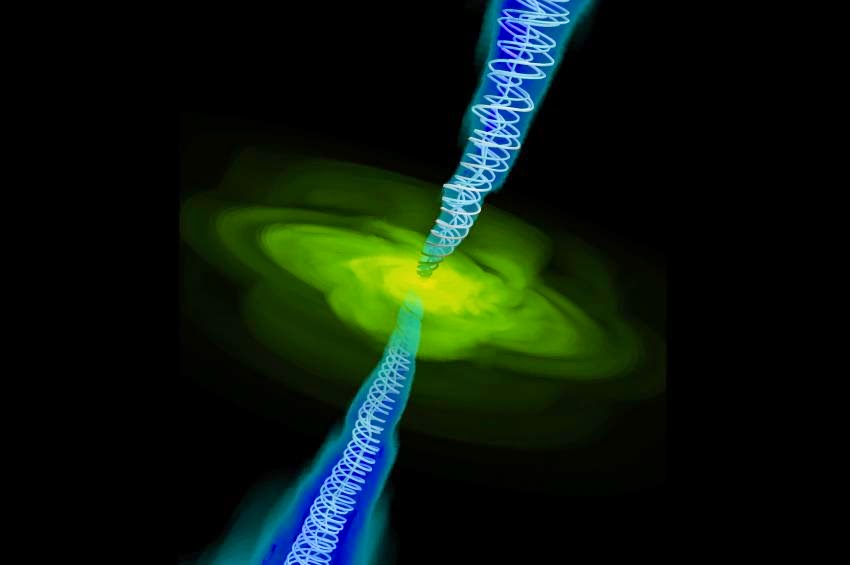
This is a computer simulation of gas (in yellow) falling into a black hole (too small to be seen). 

Twin jets are also shown with magnetic field lines. 

Credit: Alexander Tchekhovskoy, Berkeley Lab

A new study of supermassive black holes at the centers of galaxies has found magnetic fields play an impressive role in the systems' dynamics.

In fact, in dozens of black holes surveyed, the magnetic field strength matched the force produced by the black holes' powerful gravitational pull, says a team of scientists from the U.S. Department of Energy's Lawrence Berkeley National Laboratory (LBNL) and Max Planck Institute for Radio Astronomy (MPIfR) in Bonn, Germany.

The findings "Dynamically important magnetic fields near accreting supermassive black holesare published in this week's issue of Nature.

"This paper for the first time systematically measures the strength of magnetic fields near black holes," says Alexander Tchekhovskoy, the Berkeley Lab researcher who helped interpret the observational data within the context of existing computational models.

"This is important because we had no idea, and now we have evidence from not just one, not just two, but from 76 black holes."

Previously, Tchekhovskoy, who is also a postdoctoral fellow at the University of California, Berkeley, had developed computational models of black holes that included magnetic fields.

His models suggested a black hole could sustain a magnetic field that was as strong as its gravity, but there was not yet observational evidence to support this prediction.

With the two forces balancing out, a cloud of gas caught on top of the magnetic field would be spared the pull of gravity and instead levitate in place.

The magnetic field strength was confirmed by evidence from jets of gas that shoot away from supermassive black holes.

Formed by magnetic fields, these jets produce a radio emission. "We realized that the radio emission from black holes' jets can be used to measure the magnetic field strength near the black hold itself," says Mohammad Zamaninasab, the lead author of the study, who did the work while at MPIfR.

Other research teams had previously collected radio-emission data from "radio-loud" galaxies using the Very Long Baseline Array, a vast network of radio telescopes in the United States.

The researchers analyzed this pre-existing data to create radio-emission maps at different wavelengths. Shifts in jet features between different maps let them calculate the field strength near the black hole.

Based on the results, the team found not only that the measured magnetic fields can be as strong as a black hole's gravity, but that they are also comparable in strength to those produced inside MRI machines found in hospitals, roughly 10,000 times greater than the field of the Earth itself.

Tchekhovskoy says the new results mean theorists must re-evaluate their understanding of black-hole behaviour.

"The magnetic fields are strong enough to dramatically alter how gas falls into black holes and how gas produces outflows that we do observe, much stronger than what has usually been assumed," he says. "We need to go back and look at our models once again."

More information: Paper: Dynamically important magnetic fields near accreting supermassive black holes, DOI: 10.1038/nature13399

Friday, May 2, 2014

Evidence of Toroidal Magnetic field surrounding Magnetar

Credit: L. Calçada/ESO

Space researchers in Japan working at the JAXA Suzaku observatory have found possible evidence of the existence of a toroidal magnetic field surrounding the magnetar 4U 0142+61.

In their paper published in the journal Physical Review Letters, the research team describe their observation of inconsistent pulses coming from 4U 0142+61, suggesting the presence of an external magnetic field.

Magnetars are a class of neutron star, both trace their origins to a supernova. What sets them apart is the strength of their magnetic fields, magnetars, as their name implies, are very strongly magnetic, with some measured at 1011 Tesla, approximately a billion times stronger than anything found on Earth.

They are also extremely dense, of course, and somewhat small—generally no more than 20 kilometers in diameter.

JAXA Suzaku observatory
For some time, space scientists have theorized that magnetars also have a second doughnut-shaped (torus) magnetic field surrounding their equator, perhaps even stronger than the one measured at their surface.

In this new effort, the researchers appear to have found evidence for just such a magnetic field surrounding 4U 0142+61.

In studying the magnetar, the researchers were analyzing the strong x-ray emissions that come from its poles—pulsating every 8.7 seconds. But then they noticed something else, the pulse was not consistent.

Sometimes the pulse came slightly early, sometimes slightly late, a far cry from pulsars which are as consistent as an atomic clock.

The researchers suggest the inconsistency is due to a toroidal magnetic field over the magnetar's equator.

They believe such a field, with a strength of up to 1012 Tesla would squeeze the magnetar into the shape of a football, and like a football, it could conceivably wobble as it spins, in this case with a period just a fraction of the spin period. That, the researchers suggest, would explain the inconsistent pulse.

If this new theory by the team in Japan proves to be true, than the wobbling of 4U 0142+61 should be causing gravity waves to be generated, and if that is the case, than future gravity wave detectors should be able to prove that magnetars due indeed have extremely strong gravity fields hovering over their equators.

More information: Possible Evidence for Free Precession of a Strongly Magnetized Neutron Star in the Magnetar 4U 0142+61, Phys. Rev. Lett. 112, 171102 – Published 30 April 2014 arxiv.org/abs/1404.3705

Friday, February 7, 2014

ESA SWARM: Trio Heading for new heights - Video

The magnetic field and electric currents in and around Earth generate complex forces that have immeasurable impact on every day life. 

The field can be thought of as a huge bubble, protecting us from cosmic radiation and charged particles that bombard Earth in solar winds. 

Credit: ESA/ATG medialab

Some tricky manoeuvres are now under way to steer ESA's trio of Swarm satellites into their respective orbits so that they can start delivering the best-ever survey of our magnetic field.
Since the Swarm constellation was launched last November, engineers have been busy putting the satellites through their paces to make sure that the craft and instruments are working correctly.

This commissioning phase is an essential part of the mission before it starts providing data to further our understanding of the complex and constantly changing magnetic field.

Essential to life, the magnetic field protects us from cosmic radiation and charged particles that bombard Earth in solar winds.

Since the intensity of solar activity is currently lower than anticipated, the original plan of where to place the satellites at the beginning of science operations has been reviewed recently by the scientific community and experts in ESA.

Low solar activity means the satellites experience lower atmospheric drag, as clearly demonstrated by ESA's GOCE mission.

Swarm is tasked with measuring and untangling the different magnetic signals that stem from Earth's core, mantle, crust, oceans, ionosphere and magnetosphere.

Launched together, the three identical Swarm satellites were released into adjacent orbits at an altitude of 490 km.

The satellites may be identical, but to optimise sampling in space and time their orbits are different – a key aspect of the mission.

The data acquired from different locations can be used to distinguish between the changes in the magnetic field caused by the Sun's activity and those signals that originate from inside Earth.

The result for Swarm is a slightly different orbit configuration that will save satellite fuel at the beginning of the mission and offer a better return for science at a later stage.

Two satellites are now being lowered to an altitude of about 462 km and an inclination of 87.35°. They will orbit almost side by side, about 150 km apart as they pass over the equator. Over the life of the mission they will both descend to about 300 km.

The third satellite is being placed in a higher orbit of 510 km and at a different inclination of 87.75°, slightly closer to the pole.

Swarm is ESA’s first Earth observation constellation of satellites. 

The trio of identical satellites are designed to identify and measure precisely the different magnetic signals that make up Earth's magnetic field. 

The electrical field instrument, positioned at the front of each satellite, measures plasma density, drift and acceleration in high resolution to characterise the electric field around Earth. 

Credit: ESA/ATG medialab

Ralf Bock
The mission's System Engineer, Ralf Bock, said, "We are taking the satellites to their new heights through careful thrust and aim to achieve the constellation for science operations around mid-April."

Karim Bouridah, the System Manager, added, "We are also continuing to fine-tune the satellite sensors, such as the new electric field instrument."

Each satellite carries a novel instrument to measures the velocity, direction and temperature of incoming ions.

This information will be used to calculate the electric field near the satellite, an important counterpart to the magnetic field for studying processes in the upper atmosphere.

In fact, Swarm is the first mission to make these global, multipoint measurements.

Johnathan Burchill from the University of Calgary explains, "Spanning more than an orbit, the images in this movie demonstrate the capability of the instrument to operate under a wide range of plasma conditions."

Monday, December 9, 2013

The Sun reverses its magnetic poles - Video


This visualization shows the position of the sun's magnetic fields from January 1997 to December 2013. The field lines swarm with activity:

The magenta lines show where the sun's overall field is negative and the green lines show where it is positive.

A region with more electrons is negative, the region with less is labeled positive. Additional gray lines represent areas of local magnetic variation.

The entire sun's magnetic polarity, flips approximately every 11 years—though sometimes it takes quite a bit longer—and defines what's known as the solar cycle.

The visualization shows how in 1997, the sun shows the positive polarity on the top, and the negative polarity on the bottom.

Over the next 12 years, each set of lines is seen to creep toward the opposite pole eventually showing a complete flip.

By the end of the movie, each set of lines are working their way back to show a positive polarity on the top to complete the full 22 year magnetic solar cycle.

At the height of each magnetic flip, the sun goes through periods of more solar activity, during which there are more sunspots, and more eruptive events such as solar flares and coronal mass ejections, or CMEs.

The point in time with the most sunspots is called solar maximum.

Image showing the sun's magnetic fields on Jan. 1, 1997, June 1, 2003, and Dec. 1, 2013. Green indicates postive polarity. Purple is negative.

Learn more about the sun's activity from Dr Alex Young.


Alex Young is interviewed about the current solar cycle and what a magnetic flip means for the earth and NASA's study of magnetic fields

Thursday, August 15, 2013

ESA XMM-Newton: Mysterious magnetar boasts one of strongest magnetic fields in Universe

Artist's impression of a magnetar Credit: ESA /ATG Medialab

A team of astronomers including two researchers from UCL's Mullard Space Science Laboratory has made the first ever measurement of the magnetic field at a specific spot on the surface of a magnetar.

Magnetars are a type of neutron star, the dense and compact core of a giant star which has blasted away its outer layers in a supernova explosion.

Magnetars have among the strongest magnetic fields in the Universe. Until now, only their large scale magnetic field had been measured.

However, using a new technique and observations of a magnetar in X-rays, the astronomers have now revealed a strong, localised surface magnetic field on one.

Magnetars are very puzzling neutron stars. Astronomers discovered them through their unusual behaviour when observed in X-ray wavelengths, including sudden outbursts of radiation and occasional giant flares.

These peculiar features of magnetars are caused by the evolution, dissipation and decay of their super-strong magnetic fields, which are hundreds or thousands of times more intense than those of the more common type of neutron stars, the radio pulsars.

The magnetic field of a magnetar can have a complex structure. The most obvious, and easy-to-measure, component is the large scale external magnetic field, which is shaped (and behaves) much like a regular bar magnet's. This is known as the dipolar field.

The study was carried out on a magnetar called SGR 0418+5729. A few years ago, this star was discovered to have a relatively gentle dipolar magnetic field compared to other magnetars.

However, the star was showing the typical flaring and bursting activities seen in other magnetars, leading scientists to suggest that the star's magnetic activity might be caused by a field hidden beneath its surface.

Sometimes, the surface breaks and the hidden magnetic field leaks out (artist's impression) Credit: ESA/ATG Medialab

This new study, based on observations from ESA's XMM-Newton X-ray space telescope, has finally found evidence that SGR 0418+5729 is indeed concealing a very strong magnetic field in its interior.

"This magnetar has a strong magnetic field inside it, but it is hidden beneath the surface. The only way you can detect that is to find a flaw on the surface, where the concealed magnetic field can leak out," says Silvia Zane (UCL Mullard Space Science Laboratory), one of the co-authors of the study.

More information: "A variable absorption feature in the X-ray spectrum of a magnetar," by A. Tiengo et al is published in Nature, 15 August 2013.

Monday, April 15, 2013

Windows Into Jupiter's moon Europa's Interior

This graphic of Jupiter's moon Europa maps a relationship between the amount of energy deposited onto the moon from charged-particle bombardment and the chemical contents of ice deposits on the surface in five areas of the moon (labeled A through E). 

Credit: NASA/JPL-Caltech/Univ. of Ariz./JHUAPL/Univ. of Colo.

The surface of Jupiter's moon Europa exposes material churned up from inside the moon and also material resulting from matter and energy coming from above.

If you want to learn about the deep saltwater ocean beneath this unusual world's icy shell -- as many people do, certainly those who are interested in possible extraterrestrial life -- you might target your investigation of the surface.

New analysis of observations made more than a decade ago by NASA's Galileo mission to Jupiter helps identify the deposits that have emanated from 'below' the surface rather than those deposited 'on' the surface.

In particular the report examines Sulphuric Acid Hydrate production on Europa's surface.

J. Brad Dalton
"We have found the regions where charged electrons and ions striking the surface would have done the most, and the least, chemical processing of materials emplaced at the surface from the interior ocean," said J. Brad Dalton of NASA's Jet Propulsion Laboratory, Pasadena, Calif., lead author of the report published recently in the journal Planetary and Space Science.

"That tells us where to look for materials representing the most pristine ocean composition, which would be the best places to target with a lander or study with an orbiter."

Europa is about the size of Earth's moon and, like our moon, keeps the same side toward the planet it orbits.

Picture a car driving in circles around a mountain with its left-side windows always facing the mountain.

Europa's orbit around Jupiter is filled with charged, energetic particles tied to Jupiter's powerful magnetic field.

Jupiter's Moon Io
Besides electrons, these particles include ions of sulphur and oxygen originating from volcanic eruptions on Io, a neighbouring Jupiter moon.

The magnetic field carrying these energetic particles sweeps around Jupiter faster than Europa orbits Jupiter, in the same direction: about 10 hours per circuit for the magnetic field versus about 3.6 days for Europa's orbit.

So, instead of our mountain-circling car getting bugs on the front windshield, the bugs are plastered on the back of the car by a "wind" from behind going nearly nine times faster than the car.

Europa has a "leading hemisphere" in front and a "trailing hemisphere" in back.

NASA's Galileo Satellite
Earlier studies had found more sulphuric acid hydrate being produced towards the center of the trailing hemisphere than elsewhere on Europa's surface, interpreted as resulting from chemistry driven by sulphur ions bombarding the icy surface.

Surface deposits in these areas are most likely to preserve the original chemical compounds that erupted from the interior.

Dalton suggests that any future spacecraft missions to Europa should target these deposits for study from orbit, or even attempt to land there.

Dalton stated "While investigating the products of surface chemistry driven by charged particles is still interesting from a scientific standpoint, there is a strong push within the community to characterize the contents of the ocean and determine whether it could support life. These kinds of places just might be the windows that allow us to do that."

Friday, August 17, 2012

Observing Sunrise: Solar scientists review Hinode findings

Japan has a long tradition in solar physics and in 2006 launched one of the major space observatories – Hinode, which means 'sunrise' in Japanese.

For almost six years this satellite has been constantly monitoring our local star with a suite of three telescopes: the Solar Optical Telescope, X-ray Telescope and Extreme Ultraviolet Imaging Spectrometer (EIS).

Solar Optical Telecope
Together, they enable the study of how magnetic energy is generated and released in the atmosphere of our Sun.

This week in St. Andrews over 150 scientists from around the world gathered for the "Hinode 6" conference to celebrate what has been learnt using the Hinode satellite.

Although launched and led by Japan, the satellite has major contributions from the UK, the USA and Norway.

Extreme Ultraviolet Imaging Spectrometer (EIS)
Unexpectedly, St. Andrews has a connection to Hinode’s modern observing methods that dates back to the late 1600s.

The Scottish mathematician James Gregory upon walking along the beach in St. Andrews, Scotland, picked up a feather and wondered what would happen if a beam of light were shone through it.

Isaac Newton was conducting similar experiments with glass prisms in Cambridge.

Back in his lab, Gregory saw that the feather split the light into its component colours in a process now known as diffraction – a simple technique that is used today in many solar telescopes as it allows us to measure the properties of sunlight and in turn learn about the star that emitted it.

The Solar Science department at UCL led the development of the EIS telescope - a modern equivalent to the bird’s feather - which splits the ultraviolet light emitted from atmospheric gases into the component colours.

A major topic for discussion at the conference has been how magnetic fields that emanate up from the Sun’s surface into the atmosphere, create structures that glow in ultraviolet and X-rays and produce activity such as solar flares and coronal mass ejections (CME).

A large X-class flare captured by the X-ray telescope on Hinode. Image credit: JAXA/Hinode

High-speed gas flows associated to solar flares have been observed, helping scientists understand the processes that convert energy stored in the magnetic fields into energy of gas motions.

Computer models have been combined with observations to understand how currents surge along the magnetic structures, supported by the charged particles of the atmospheric gases, heating the atmospheric gases to very high temperatures.

Read the full article here at SEN: Solar scientists review Hinode findings

Tuesday, July 17, 2012

The Earth's Magnetic Field Is Wonky

The solution to a long-standing puzzle, why magnetic north sits off the coast of Canada, rather than at the North Pole, may have been found in the strange, lopsided nature of Earth's inner core.

The inner core is a ball of solid iron about 760 miles (1,220 kilometers) wide.

It is surrounded by a liquid outer core (mostly iron and nickel), a rocky, viscous mantle layer and a thin, solid crust.

As the inner core cools, crystallizing iron releases impurities, sending lighter molten material into the liquid outer core.

This upwelling, combined with the Earth's rotation, drives convection, forcing the molten metal into whirling vortices.

These vortices stretch and twist magnetic field lines, creating Earth’s magnetic field. Currently, the center of the field, called an axis, emerges in the Arctic Ocean west of Ellesmere Island, about 300 miles (500 kilometers) from the geographic North Pole.

In the last decade, seismic waves from earthquakes revealed the inner core looks like a navel orange, bulging slightly more on its western half.

Geoscientists recently explainedthe asymmetry by proposing a convective loop: The inner core might be crystallizing on one half and melting on the other.

Peter Olson and Renaud Deguen, geophysicists at Johns Hopkins University, set out to test this theory, called translational instability.

They ran numerical models simulating the forces that generate Earth’s magnetic field, and included a lopsided inner core.

Olson and Deguen found that adding inner-core asymmetry shifted magnetic north away from the center of the Earth, into the cooling hemisphere. Convection was stronger there, as was the magnetic field.

"The lopsided growth of the inner core makes convection in the outer core a little bit lopsided, and that then induces the geomagnetic field to have this lopsided or eccentric character too," Olson stated.

Olson and Deguen's research was detailed online July 1 in the journal Nature Geoscience.

Geophysicist Bruce Buffett said Olson and Deguen’s research is intriguing, but there are still questions about the underlying theory. "It's an interesting result, but we don't know for sure the inner core is translating.

The model does a good job at explaining some but not all of the features of the inner core," said Buffett, a professor at the University of California, Berkeley, who was not involved with the research.

Olson points out that his numerical model offers a real-world proof of the theory. Magnetic particles trapped and aligned in rocks reveal that the magnetic north pole wandered around the Western Hemisphere over the past 10,000 years, and circled the Eastern Hemisphere before that — a result mirrored by the numerical test.

Gathering a longer, more detailed record of the magnetic field's behavior, Olson said, could reveal whether the inner core acts as researchers predict.

"The key question for interesting ideas like translational instability is, 'Can we test it?'" Olson said. "What we're doing is proposing a test, and we think it's a good test because people can go out and look for eccentricity in the rock record and that will either confirm or shoot down this idea."

Monday, July 16, 2012

ESA XMM-Newton X-ray Image: A magnetic monster’s dual personality

Click on the Image to watch an animation.

Is it a magnetar or is it a pulsar? A second member of a rare breed of dead, spinning star has been identified thanks to an armada of space-based X-ray telescopes, including ESA’s XMM-Newton.


Magnetars are a type of neutron star, the dead cores of massive stars that have collapsed in on themselves after burning up all their fuel and exploding as dramatic supernovas.

They typically display bright, persistent X-ray emission and the most intense magnetic fields known in the Universe.

Pulsars meanwhile are spinning neutron stars with much lower magnetic fields than magnetars that appear to pulse radio waves as they rotate rapidly.

The pulses are seen when beams of radiation rotate through our line of sight from Earth, rather like the sweeping beam of a lighthouse.

The recently discovered star appears to be a hybrid of these two stellar breeds: the spinning stellar skeleton appears as a pulsar while hiding an intense internal magnetic field much like a magnetar.

The internal field is many times stronger than its external magnetic field, leading to its entry into the new class of ‘low-field magnetars’.

As this animation illustrates, the turbulent interior arises as a result of twisted magnetic field lines.

As the field lines unwind, energy is released as a steady burst of X-rays through fractures in the star’s ‘crust’.

Only two examples of low-field magnetars are known. The first was discovered in 2010 and the second in July 2011, given away by short X-ray bursts that were detected by NASA’s Swift space telescope.

NASA’s Rossi X-Ray Timing Explorer and Chandra X-ray Observatory, ESA’s XMM-Newton and Japan’s Suzaku satellite, as well as the ground-based Gran Telescopio Canarias and the Green Bank Telescope, were alerted and the star’s activity was monitored until April 2012, during which time the outburst began to decay.

The discovery of a second member of this rare family of star strengthens the idea that magnetar-like behaviour may be much more widespread than believed in the past.

Sunday, April 15, 2012

Solar Activity Teamwork: IBEX and TWINS Observe a Solar Storm

The highly elliptical orbit of TWINS offers a good view of the ring current - a hula hoop of charged particles that encircles Earth.

Credit: J. Goldstein/SWRI.

On April 5, 2010, the sun spewed a two million-mile-per-hour stream of charged particles toward the invisible magnetic fields surrounding Earth, known as the magnetosphere.

As the particles interacted with the magnetic fields, the incoming stream of energy caused stormy conditions near Earth.

Some scientists believe that it was this solar storm that interfered with commands to a communications satellite, Galaxy-15, which subsequently foundered and drifted, taking almost a year to return to its station.

To better understand how to protect satellites from intense bursts of energy from the sun, scientists study the full chain of space weather events from first eruptions on the sun to how the magnetic fields around Earth compress and change shape in response.

During the April 5 storm, two NASA Heliophysics System Observatory missions - the Interstellar Boundary Explorer (IBEX) and two spacecraft called the Two Wide-Angle Imaging Neutral-Atom Spectrometers (TWINS) - were perfectly positioned to view the storm from complementary viewpoints.

The three sets of instruments have been used together to paint a more complete picture of what happens during a solar storm, from initial impact of solar energy through to the particles that ultimately slide down into Earth's atmosphere near the poles.

These results were published online on March 27, 2012 in the Journal of Geophysical Research.

"One spacecraft can only take recurring measurements along its own flight path," says Natalia Buzulukova, one of the authors on this paper and a geospace scientist at NASA's Goddard Space Flight Center in Greenbelt, Md. and at the University of Maryland in College Park.

"But this is not always enough to understand the whole event. With several spacecraft at once we have a unique opportunity to observe more of the magnetosphere simultaneously."

The two TWINS spacecraft and IBEX orbit Earth in very different paths. TWINS travels along a highly elliptical orbit around Earth through the magnetosphere. IBEX, too, circles Earth, but generally lies outside the magnetosphere allowing it to map the very edges of the solar system.

Together, they offer glimpses from the inside and outside of the magnetosphere, including the side that faces the sun, the side that extends long away from the sun - the magnetotail - and an electric current that sometimes appears around Earth like a giant hula hoop called the ring current.

"This imaging gives us a better global picture of the evolution of the magnetosphere - especially of the processes by which the sun injects energy into the magnetosphere - than has ever been available before," says David McComas, a space scientist at Southwest Research Institute in San Antonio, Texas, who is first author on this paper and also the principal investigator for the IBEX and TWINS missions.

IBEX and TWINS both have instruments to study what's called energetic neutral atoms or ENAs. These fast moving particles are produced during particle collisions between charged and neutral particles.

Crucially, they move in a straight line from their point of origin, unmolested by the magnetic fields that would constrain charged particles in their travels. Thus they can provide an "image" to decode and map out the structure of a far away charged particle system, such as occurs in the magnetosphere and ring current.

The ENA images from IBEX were taken from a distance of around 180,000 miles above the magnetosphere. They show that the magnetosphere immediately compressed under the impact of the charged particles from the solar wind.

Minutes later, one of the TWINS spacecraft observed changes in the inner magnetosphere from a much-closer 28,000 miles: the ring current began to trap incoming charged particles.

About 15 minutes after impact, these trapped particles gyrated down magnetic field lines into Earth's atmosphere, a process known as "precipitation."

The time delay between the onset of trapped particles and losing them to the atmosphere points to a fairly slow set of internal processes carrying the region from storm impact through compression to precipitation.

"The solar storm directly causes the ring current activity, but the other effects, including particles precipitating down toward the atmosphere, are triggered by something called a substorm, a process that releases energy form the magnetotail," says Buzulukova.

"These two triggers have different physics and different manifestations. This analysis opens the door to understanding how these different effects are connected."

The paper also paves the way to more sophisticated modeling techniques of the entire magnetosphere. To produce the new images, the team developed a series of techniques to process the imaging data, including improved procedures for differential background subtraction, "statistical smoothing" of images, and comprehensive modeling of the ring current.

"Understanding how solar events develop and impact satellites is like understanding the processes that cause extreme weather events on Earth to develop and destroy homes and businesses," says McComas.

"Engineers use weather data to know where and how they need to strengthen buildings against various types of weather threats. The more we know about the processes occurring in space, the better engineers can design satellites to protect them from space weather hazards, which is increasingly important in our highly technological world."

Friday, March 9, 2012

Startram the Maglev train: Destination low earth orbit (LEO)

Getting into space is one of the harder tasks to be taken on by humanity.

The present cost of inserting a kilogram (2.2 lb) of cargo by rocket into Low Earth Orbit (LEO) is about US$10,000.

A manned launch to LEO costs about $100,000 per kilogram of passenger (except in China) but who says we have to reach orbit by means of rocket propulsion alone?

Instead, imagine sitting back in a comfortable magnetic levitation (maglev) train and taking a train ride into orbit.

Dr George Maise invented the Startram orbital launch system along with Dr James Powell, who is one of the inventors of superconducting maglev - for which he won the 2002 Franklin Medal in engineering. Startram is in essence a superconducting maglev launch system.


The system would see a spacecraft magnetically levitated to avoid friction, while the same magnetic system is used to accelerate the spacecraft to orbital velocities, just under 9 km/sec (5.6 miles/s).

Maglev passenger trains have carried passengers at nearly 600 kilometers per hour (373 mph) - spacecraft have to be some 50 times faster, but the physics and much of the engineering is the same.

The scope of the project is challenging.

A launch system design for routine passenger flight into LEO should have rather low acceleration - perhaps about 3 g's maximum, which then requires 5 minutes of acceleration to reach LEO transfer velocities. In that period, the spacecraft will have traveled 1,000 miles (1,609 km).

The maglev track must be 1,000 miles in length - similar in size to maglev train tracks being considered for cross-country transportation.

Read more of this article here

Thursday, January 26, 2012

Laser first: Solves the puzzle of how the Universe got its magnetism

Scientists have demonstrated for the very first time how a laser can be used to stimulate the formation of magnetic fields, similar to those thought to be involved in the formation of the very first galaxies.

The findings published in Nature (26 January 2012) could help solve the riddle of how the Universe originally got its magnetism.

Magnetic fields exist throughout galactic and intergalactic space and in the stars and planets.

The magnetic fields in our solar system are important, since they shield us from the harmful effects of cosmic rays allowing life to thrive.

What is puzzling is how they were originally created. A way of creating magnetic fields without a magnet has long been theorised, but never before has the process been demonstrated.

A team, led by Oxford University physicists, have used a high-power laser to explode a rod of carbon, similar to pencil lead, in helium gas.

The explosion was designed to mimic the cauldron of plasma – an ionized gas containing free electrons and positive ions – out of which the first galaxies formed.

It was designed to prove a theory, known as the ‘Biermann battery effect’ that demonstrated how magnetic fields could form where none had existed before.

The team found that within a microsecond of the explosion strong electron currents and magnetic fields formed around a shock wave.

Scientists including Bob Bingham and Alex Robinson at the Central Laser Facility at STFC’s Rutherford Appleton laboratory took these results and compared them to existing planetary data.

Using computational resources from STFC’s e-science department, they scaled them through 22 orders-of-magnitude.

They found that their measurements closely matched theories which predict that tiny magnetic fields - ‘magnetic seeds’ – precede the formation of galaxies.

These fields can be amplified by turbulent motions and can strongly affect the evolution of the galactic medium.

Professor Bingham said: “The advantage of using lasers to simulate the early processes in the formation of magnetic fields is that you can create, with a burst of laser light just a billionth of a second long, an effect that in space would take years to develop on an incomprehensible scale”.

Dr Gianluca Gregori from Oxford University, who led the work said: “Our experiment recreates what was happening in the early Universe and shows how galactic magnetic fields might have first appeared.

It opens up the exciting prospect that we will be able to explore the physics of the cosmos, stretching back billions of years, in a laser laboratory here on Earth”.

The experiments were conducted at the Laboratoire pour l’Utilisation de Lasers Intenses laser facility in France.

For further details see the Oxford University press release

Friday, December 23, 2011

NASA Messenger: Mercury's magnetic field counteracted by Solar wind

The Messenger space probe - which took this image - has confirmed that the innermost planet has a magnetic field 150 times weaker than that of Earth. Researchers have now found an explanation for this. 

Credit: NASA/Johns Hopkins University Applied Physics Laboratory/Carnegie Institution of Washington

Mercury, the smallest of the eight planets with a diameter of 4900 kilometres and the closest to the Sun, looks more like the Moon than the Earth from the outside.

It is the only rocky planet that has a global magnetic field like Earth. But why is its magnetic field so much weaker than Earth’s?

Scientists at the Technische Universität Braunschweig and the Max Planck Institute for Solar System Research have now presented a new explanation: the solar wind counteracts Mercury’s internal dynamo and thus weakens its magnetic field.

Planetary magnetic fields are generated by flows in the hot, liquid iron cores of the .

Measurements made by Mariner 10 in 1974/75 showed that Mercury also has a magnetic field. According to the standard models, the dynamo effect in its metal core should generate similar field strengths to those on .

Mercury’s magnetic field is 150 times weaker than that of our planet, however. This has recently been confirmed by the Nasa space probe Messenger.

How can the large discrepancy in the field strength be explained? This question has now been answered by a group headed by Karl-Heinz Glassmeier at the Technische Universität Braunschweig.

The solar wind – a constant stream of charged particles – plays a significant role. At an average distance from the Sun of only 58 million kilometres – around one third of the distance of the Earth – Mercury is much more exposed to these particles.

“We must keep in mind that Mercury stongly interacts with the surrounding solar wind,” says Daniel Heyner, lead author of the article published in Science and doctoral student at the International Max Planck Research School (IMPRS) in Katlenburg-Lindau.

This interaction drives strong electrical currents in the magnetosphere of the planet, whose magnetic fields counteract the internal dynamo effect.

The team’s new computer models show that a dynamo with this type of feedback is actually possible.

“These types of simulation of the dynamo process are the only possibility to sort of look into the iron core and to predict the strength and structure of the magnetic field,” says Johannes Wicht from the Max Planck Institute for Solar System Research, whose model made a significant contribution to the study.

The results show unambiguously that the feedback ultimately causes the weak magnetic field. “The dynamo process in Mercury’s interior is almost nipped in the bud by the interaction,” explains Glassmeier.

The researchers at the TU Braunschweig and the Max Planck Institute for Research are eagerly awaiting the next magnetic field measurements from the Messenger space probe and the observations of the two satellites of the European-Japanese mission BepiColombo.

The mission will carry an instrument developed by the TU Braunschweig. Starting in 2020 the researchers want to measure ’s with great precision.

The new data should allow the confirmation of this fascinating new idea of a dynamo weakened by the .


More information: Daniel Heyner, Johannes Wicht, Natalia Gómez-Pérez, Dieter Schmitt, Hans-Ulrich Auster, Karl-Heinz Glassmeier, Evidence from Numerical Experiments for a Feedback Dynamo Generating Mercury’s Magnetic Field, Science, 23 December 2011. DOI: 10.1126/science.120729

Saturday, December 17, 2011

NASA ARES: Aerial Regional-scale Environmental Survey Aircraft proposed for MARS

The Aerial Regional-scale Environmental Survey (ARES) was a proposal by NASA's Langley Research Center to build a powered aircraft that would fly on Mars.

The ARES team sought to be selected and funded as a NASA Mars Scout Mission for a 2011 or 2013 launch window. However, the MAVEN mission was chosen instead.


ARES would have travelled to Mars compactly folded into a protective aeroshell; upon entry in the thin atmosphere, the capsule would have deployed a parachute to decelerate, followed by ARES release at altitude.

Among other things, the aircraft would have investigated the atmosphere and weak magnetic field.

Propulsion
Propulsion remained undetermined. The two main criteria used to evaluate the propulsion system were flight range and implementation risk.

Possible propulsion technologies were electrical motors, internal combustion and rocket systems. The aircraft was intended to fly for about one hour.

See also
Mars Scout Program

Tuesday, December 13, 2011

Milky Way's Magnetic Fields Mapped with Highest Precision

The sky map of the Faraday effect caused by the magnetic fields of the Milky Way. Red and blue colors indicate regions of the sky where the magnetic field points toward and away from the observer, respectively.

The band of the Milky Way (the plane of the galactic disk) extends horizontally in this panoramic view. The center of the Milky Way lies in the middle of the image. The North celestial pole is at the top left and the South Pole is at the bottom right.

With a unique new all-sky map, scientists at MPA have made significant progress toward measuring the magnetic field structure of the Milky Way in unprecedented detail.

Specifically, the map is of a quantity known as Faraday depth, which among other things, depends strongly on the magnetic fields along a particular line of sight.

To produce the map, data were combined from more than 41,000 individual measurements using a novel image reconstruction technique.

The work was a collaboration between scientists at the Max Planck Institute for Astrophysics (MPA), who are specialists in the new discipline of information field theory, and a large international team of radio astronomers.

The new map not only reveals the structure of the galactic magnetic field on large scales, but also small-scale features that provide information about turbulence in the galactic gas.

All galaxies are permeated by magnetic fields, including our own Milky Way galaxy. Despite intensive research, the origin of galactic magnetic fields is still unknown.

One assumes, however, that they are built up by dynamo processes in which mechanical energy is converted into magnetic energy.

Similar processes occur in the interior of the earth, the Sun, and - in the broadest sense - in the gadgets that power bicycle lights through peddling.

By revealing the magnetic field structure throughout the Milky Way, the new map provides important insights into the machinery of galactic dynamos.

One way to measure cosmic magnetic fields, which has been known for over 150 years, makes use of an effect known as Faraday rotation.

When polarized light passes through a magnetized medium, the plane of polarization rotates. The amount of rotation depends, among other things, on the strength and direction of the magnetic field.

Therefore, observing such rotation allows one to investigate the properties of the intervening magnetic fields.

To measure the magnetic field of our own galaxy, radio astronomers observe the polarized light from distant radio sources, which passes through the Milky Way on its way to the Earth.

The amount of rotation due to the Faraday effect can be deduced by measuring the polarization of the source at several frequencies.

Each such measurement can only provide information about a single path through the Galaxy. To get a complete picture of the magnetic fields in the Milky Way from Faraday rotation measurements, one must observe many sources distributed across the entire sky.

A large international collaboration of radio astronomers have provided data from 26 different projects to give a total of 41,330 individual measurements. On average, the complete catalogue contains approximately one radio source per square degree of sky.

Thursday, November 10, 2011

Mystery of Moon's Lost Magnetism

This illustration shows one suggested mechanism for creating an ancient magnetic field on the moon. In this scenario, impacting space rocks on the moon would create instability in the moon's core that could lead to a dynamo that creates a magnetic field.

CREDIT: M.-H. Deproost, ORB, Belgique

One of the abiding mysteries of our moon is why it apparently once had a magnetic field.

Now two teams of scientists have offered two separate, but potentially complementary, explanations.

When Apollo astronauts brought back samples of moon rocks from their lunar landing missions in the 1960s and '70s, some of them shocked scientists by being magnetic.

That means that individual rocks might have a magnetic north and south pole and a small magnetic field of their own.

This can happen to rocks with the right minerals inside them, if they cool in the presence of a magnetic field.

The problem is, scientists had no idea that the moon had ever had a magnetic field, and were at a loss to explain how that might have happened.

A magnetic field is generated by what's called a dynamo, which is caused by the fluid motion of a conducting material, such as liquid iron.

In the case of the Earth's magnetic field, this motion occurs in the planet's outer core, and is caused by the convection of heat.

Tuesday, October 25, 2011

PPPL scientists bring mysterious magnetic process down to earth

Scientists believe that magnetic reconnection is behind the extraordinary bursts of radiation that have emerged from the center of the Crab nebula, the remains of an exploded star. 

Astrophysicists from Princeton and other institutions are paying close attention to the efforts of the MRX research team, hoping to better understand some of the mysteries surrounding the phenomenon. 

(Image courtesy of NASA; the European Space Agency; and Jeff Hester and Allison Loll, Arizona State University)

With the click of a computer mouse, a scientist at the U.S. Department of Energy's Princeton Plasma Physics Laboratory (PPPL) sends 10,000 volts of electricity into a chamber filled with hydrogen gas. The charge heats the gas to 100,000 degrees Celsius.

In an instant - one-thousandth of a second, to be precise - a process called "magnetic reconnection," a powerful force that can light up the skies, takes place in a device roughly the size of a sport utility vehicle.

PPPL researchers have run this and similar carefully controlled experiments - called "shots" - more than 100,000 times since 1995, and amassed volumes of data and numerous scientific papers.

The shots recreate one of the most common but least understood phenomena in the universe - one that gives rise to the northern lights, solar flares and geomagnetic storms, and that can disrupt cell phone service, black out power grids and damage orbiting satellites.

Researchers at PPPL have brought this basic process down to earth in miniature to be studied under laboratory conditions in the Magnetic Reconnection Experiment (MRX), the leading project of its kind in the world in terms of the quantity and quality of the data it has collected.

"Here we can actually recreate reconnection," said Masaaki Yamada, a PPPL physicist and principal investigator for MRX, "This is not theory or a computer simulation." Hantao Ji, principal research physicist at PPPL for MRX, concurred: "This provides a chance to see what's really going on in reconnection."

The experiments seek to unravel the secrets of magnetic reconnection and ultimately provide benefits including improved prediction of solar outbursts and dangerous geomagnetic storms; increased understanding of the formation of the sun and stars; and greater control of the nuclear fusion reactions that PPPL researchers are studying as a clean fuel for generating electric power.

Magnetic reconnection takes place when magnetic lines of force - or field lines - break apart and reconnect with a violent burst of energy that, in huge bodies such as the sun and stars, has the explosive power of millions of tons of TNT.

This occurs when superheated and electrically charged gases called plasmas converge.