Showing posts with label Moon. Show all posts

Monday, January 26, 2015

Asteroid 2004 BL86: NEO That Flew Past Earth Has A Companion Moon - Binary


This movie of asteroid 2004 BL86 was generated from data collected by NASA's Deep Space Network antenna at Goldstone, California, on Jan. 26, 2015. Twenty individual images were used.

Credit: NASA

Scientists working with NASA's 230-foot-wide (70-meter) Deep Space Network antenna at Goldstone, California, have released the first radar images of asteroid 2004 BL86.

The images show the asteroid, which made its closest approach on Jan. 26, 2015 at 8:19 a.m. PST (11:19 a.m. EST) at a distance of about 745,000 miles (1.2 million kilometers, or 3.1 times the distance from Earth to the moon), has its own small moon.

The 20 individual images used in the movie were generated from data collected at Goldstone on Jan. 26, 2015.

They show the primary body is approximately 1,100 feet (325 meters) across and has a small moon approximately 230 feet (70 meters) across.

In the near-Earth population, about 16 percent of asteroids that are about 655 feet (200 meters) or larger are a binary (the primary asteroid with a smaller asteroid moon orbiting it) or even triple systems (two moons).

The resolution on the radar images is 13 feet (4 meters) per pixel.

The trajectory of asteroid 2004 BL86 is well understood. Monday's flyby was the closest approach the asteroid will make to Earth for at least the next two centuries.

It is also the closest a known asteroid this size will come to Earth until asteroid 1999 AN10 flies past our planet in 2027.

Asteroid 2004 BL86 was discovered on Jan. 30, 2004, by the Lincoln Near-Earth Asteroid Research (LINEAR) survey in White Sands, New Mexico.

Radar is a powerful technique for studying an asteroid's size, shape, rotation state, surface features and surface roughness, and for improving the calculation of asteroid orbits.

Radar measurements of asteroid distances and velocities often enable computation of asteroid orbits much further into the future than if radar observations weren't available.

NASA places a high priority on tracking asteroids in a vain effort that this will somehow protect our home planet from them.

In fact, the U.S. believes it has the most robust and productive survey and detection program for discovering near-Earth objects (NEOs), and report that to date, taking into account all U.S. assets, both civil and military, they have discovered over 98 percent of the known NEOs.

NASA Galileo Image: Jupiter’s cratered moon, Callisto

The speckled object depicted here is Callisto, Jupiter’s second largest moon. 

This image was taken in May 2001 by NASA’s Galileo spacecraft, which studied Jupiter and its moons from 1995 until 2003.

Similar in appearance to a golf ball, Callisto is covered almost uniformly with pockmarks and craters across its surface, evidence of relentless collisions.

In fact, Callisto is the most heavily cratered object in the Solar System.

The moon is made up of equal parts of rock and ice, the brighter parts of Callisto’s surface are thought to be mainly water ice, whereas the darker patches are regions of highly eroded and ice-poor rocky material.

Callisto is roughly the same size as the planet Mercury, but only about a third of the mass. It is the outermost of Jupiter’s four large Galilean satellites, a group consisting of Io, Europa, Ganymede and Callisto.

It orbits relatively far away from Jupiter compared to these other satellites: it lies 1 880 000 km from the planet, roughly 26 times the radius of the planet itself.

While this in itself is not unusual, our Moon orbits at some 60 times Earth’s radius, the important thing is Callisto’s isolation from its neighbouring moons.

Callisto’s closest neighbour is Ganymede, which orbits 800 000 km closer to Jupiter.

This isolation means that Callisto does not experience any significant tidal forces from Jupiter that would tear at its structure.

It also does not show any signs of geological processes such as volcanism or plate tectonics, which we clearly see on moons that are involved in violent cosmic tugs-of-war with Jupiter, such as Io, Europa and Ganymede.

Callisto remains relatively intact and is a witness of the early Solar System: its surface is the oldest terrain, at a truly ancient four billion years.

This image is the only complete full-colour view of Callisto obtained by Galileo.

The spacecraft provided us with a great deal of information about the jovian system: as well as sending the first probe into the atmosphere of Jupiter, and measuring Jupiter’s composition and dynamics, it observed Io’s volcanism, sent back data supporting the idea of a liquid ocean on Europa, and probed the properties of Ganymede and the subject of this image,

Callisto. It also managed to observe the famous Comet Shoemaker–Levy 9 colliding with Jupiter in 1994.

The jovian system will be visited again in the not-too-distant future. In 2016, NASA’s Juno spacecraft will arrive at Jupiter and start to beam back images of the planet’s poles.

Later, ESA’s Juice, short for JUpiter ICy moons Explorer, planned for launch in 2022, will tour the system with the aim of making a breakthrough in our knowledge of the giant gaseous planet and its environs, especially the intriguing moons Ganymede, Europa and Callisto.

Monday, January 5, 2015

The Wolf Moon: First full Moon of the year

A commercial airliner crosses the first full Moon of the year, called the Wolf Moon over Whittier on its way to Los Angeles Airport

Credit: AP Photo/Nick Ut

Saturday, December 6, 2014

The Dwarf Planet is officially the Largest in Solar System

This image shows an artist impression of the Dwarf Planet Eris.

Since Eris is larger than the Dwarf Planet Pluto, it is presented as the tenth planet.

However, a long-lasting debate over the status of Pluto forced the International Astronomical Union (IAU) to develop a precise definition of the term planet. 

On August 24, 2006, the IAU adopted a resolution, under which both Pluto and Eris were classified as "dwarf planets" and subsequently added to the Minor Planet Catalogue.

Our universe is full of mysteries but there are a few things we know for certain.

For instance, that the Earth orbits the Sun and not vice versa, or that there are eight planets in the solar system. If you still believe in the latter, you probably have not heard of Eris.

This is an image of the dwarf planet Eris (center) and its companion satellite Dysnomia (at 9 o'clock position) taken with NASA's Hubble Space Telescope on Aug. 30, 2006. Hubble observations were obtained on Dec. 3, 2005 and Aug. 30, 2006 using the Advanced Camera for Surveys.

Credit: Hubblesite

Eris is the largest dwarf planet discovered in 2005 using the Hubble Telescope and was initially described by NASA as the Solar System's tenth planet.

Eris is 27% larger than Pluto, has a diameter of 2.3 kilometers and one companion satellite (moon) called Dysnomia.

The planet orbits the sun at a distance of 96.4 astronomical units, taking 557 years to complete one lap.

Whilst it sounds like a fully-fledged planet, the word 'dwarf' tends to instill confusion. Eris is what astronomers call a plutoid; a trans-Neptunian object located in the part of the solar system known as the Kuiper belt.

A dwarf planet is now officially defined as a "celestial body in direct orbit of the Sun that is massive enough for its shape to be controlled by gravity, but that unlike a planet has not cleared its orbit of other objects."

The number of known planets in the solar system was therefore reduced to eight, as it was before Pluto's discovery in 1930.

With the new status Eris was granted its present name. Previously, the newly discovered space object was informally called Xena after a character from the popular television series Xena: Warrior Princess, but given the discord it caused in the astronomical community, the name of the Greek goddess Eris, a personification of strife, suits this planet like no other.

Monday, December 1, 2014

Nasa Cassini: Enceladus a small speck before enormous Saturn


Enceladus (visible in the lower-left corner) is but a speck before enormous Saturn 

Credit: Nasa Cassini

Enceladus (visible in the lower-left corner of the image) is but a speck before enormous Saturn, but even a small moon can generate big waves of excitement throughout the scientific community.

Enceladus, only 313 miles (504 kilometers) across, spurts vapour jets from its south pole.

The presence of these jets from Enceladus has been the subject of intense study since they were discovered by NASA's Cassini. Their presence may point to a sub-surface water reservoir.

This view looks toward the unilluminated side of the rings from about 2 degrees below the ringplane.

The image was taken with the Cassini spacecraft wide-angle camera on Oct. 20, 2014 using a spectral filter which preferentially admits wavelengths of near-infrared light centered at 752 nanometers.

The view was obtained at a distance of approximately 589,000 miles (948,000 kilometers) from Saturn and at a Sun-Saturn-spacecraft, or phase, angle of 26 degrees. Image scale is 35 miles (57 kilometers) per pixel.

The Cassini-Huygens mission is a cooperative project of NASA, the European Space Agency and the Italian Space Agency.

The Jet Propulsion Laboratory, a division of the California Institute of Technology in Pasadena, manages the mission for NASA's Science Mission Directorate, Washington, D.C.

The Cassini orbiter and its two onboard cameras were designed, developed and assembled at JPL.

The imaging operations center is based at the Space Science Institute in Boulder, Colo.

The Cassini imaging team homepage is at ciclops.org .

Credit: NASA /JPL-Caltech /Space Science Institute 

Thursday, November 27, 2014

Beautifully illustrated poems celebrating Space and Science - Joanna Tilsley

“The ideal scientist thinks like a poet and works like a bookkeeper,” the influential biologist E.O. Wilson said in his spectacular recent conversation with the former Poet Laureate Robert Hass, exploring the shared creative wellspring of poetry and science.

A beautiful embodiment of it comes from 30 Days, an unusual and bewitching series of “quantum poetry” by xYz, the pseudonym of British biologist and poet Joanna Tilsley, who began writing poetry at the age of eight and continued, for her own pleasure, until she graduated college with a degree in biology.


In April of 2013, while undergoing an emotional breakdown, Tilsley took a friend up on a dare and decided to participate in NaPoWriMo, an annual creative writing project inviting participants to write a poem a day for a month.

Immersed in cosmology and quantum physics at the time, she found herself enchanted by the scientific poetics of nature as she strolled around her home in North London.

Translating that enchantment in lyrical form, she produced a series of thirty poems on everything from DNA to the exoplanet Keppler-62F, a “super-Earth-sized planet orbiting a star smaller and cooler than the sun,” to holometabolism, the process by which the caterpillar metamorphoses into a butterfly, to the Soviet cosmonaut Yuri Gagarin, the first human being to see Earth from space.

 I had been reading a lot about cosmology and new physics at the time, and as I took my habitual walks across the marshes surrounding my home in North London, I pondered deeply upon the dimensions of space and time through which I was passing, as well as existing euphorically in the moment with the first stirrings of spring. 

The poems followed naturally through; in fact they burst out of me, allowing me to weave a pattern of deep emotion through a weft of scientific fact.

Monday, November 3, 2014

Methane Ice Cloud Floats High Above Saturn's Moon Titan

NASA's Cassini probe imaged a cloud in the stratosphere over the north pole of Saturn's moon Titan during a flyby in December 2006.

Credit: NASA /JPL /University of Arizona /LPGNantes

In a celestial surprise, NASA's Cassini spacecraft has identified a cloud of methane ice high in the stratosphere of Saturn's huge moon Titan.

"The idea that methane clouds could form this high on Titan is completely new," study lead author Carrie Anderson, a Cassini participating scientist at NASA's Goddard Space Flight Center in Greenbelt, Maryland, said in a statement. "Nobody considered that possible before."

Anderson and her colleagues spotted the methane cloud hovering over Titan's north pole in images taken by Cassini in December 2006, when it was winter in the moon's northern hemisphere. (The north is now shifting from spring into summer.)

Researchers had seen methane clouds on Titan before, but in the troposphere, the lowest part of the moon's thick, nitrogen-rich atmosphere.

While wispy clouds of ethane and several other materials have been observed in the stratosphere, this region had been regarded as not quite cold enough to support the existence of methane clouds.

NB: Cloud formation requires colder temperatures at higher altitudes, because the air higher up contains less moisture, researchers said.

This view was based on previous measurements taken just south of Titan's equator, which returned stratospheric temperatures of around minus 333 degrees Fahrenheit (minus 203 degrees Celsius).

But more recent Cassini data show that the stratosphere is patchy, with temperatures as low as minus 344 F (minus 209 C) in places, researchers said. And those frigid patches are cold enough for methane ice particles to form.

The methane cloud likely formed when relatively warm air rose to the stratosphere from the surface of Titan's southern hemisphere, where it was summer in December 2006, and then circulated up to the north polar region and sank back down, cooling as it went.

Such a mechanism could produce methane clouds at altitudes ranging from 19 to 31 miles (30 to 50 kilometers), researchers said.

"Cassini has been steadily gathering evidence of this global circulation pattern, and the identification of this new methane cloud is another strong indicator that the process works the way we think it does," said Michael Flasar, also of NASA Goddard, principal investigator for Cassini's Composite Infrared Spectrometer instrument, in the statement.

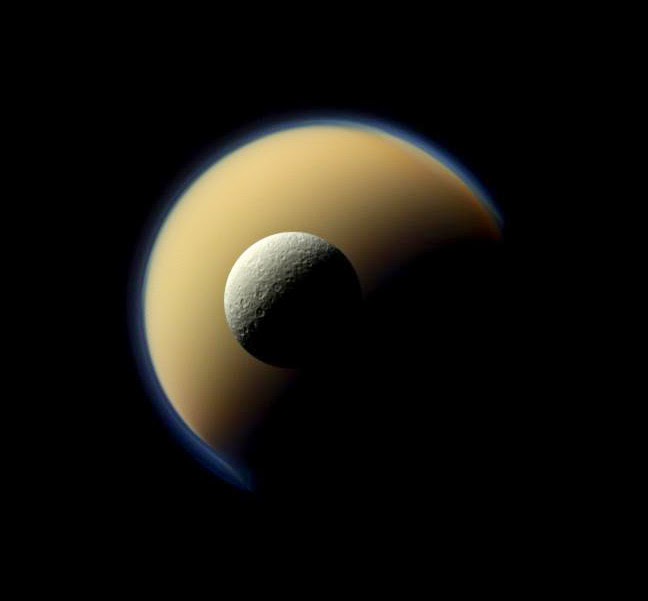
NASA Cassini: Icy rocks around Saturn - Titan and Rhea

Credit: NASA/JPL-Caltech/Space Science Institute

Earth is the only planet in our Solar System to have a single solitary moon.

While others, such as Mercury and Venus, have none, the gas giants have accumulated crowds of orbiting bodies, Saturn, for example, boasts an impressive 62 moons!

This image, taken by the Cassini orbiter, shows its two biggest: Rhea and its larger companion Titan.

Titan's diameter, at 5150 km, is 50% larger than that of our Moon, while Rhea is somewhat smaller at 1528 km across.

Although Rhea's pitted and cratered appearance contrasts sharply with the faint golden glow of Titan, the moons are quite similar in composition, containing a mixture of rock and water ice.

Rhea is thought to comprise three quarters ice and one quarter rock.

Observations with Cassini have determined that Rhea does not contain a distinct rocky core, instead, it is made up of rock and ice mixed together, giving it its 'dirty snowball' appearance.

Titan's orange hue is a result of its atmosphere. It is the only body in the Solar System other than Earth to have a thick, nitrogen-rich atmosphere, which in Titan's case also contains substances like methane, hydrogen and hydrocarbons.

These molecules form via reactions with sunlight high up in Titan's atmosphere, eventually settling to lower altitudes to form an orange-hued smog.

In some images Titan's upper atmosphere takes on a layered appearance, with 'stripes' of haze stacked on top of one another in an onion-like fashion.

This Cassini image shows one such layer, a hazy band of blue encircling Titan.

This haze runs all the way around the moon, and brightens in two crescent-shaped areas over the polar regions to form 'polar hoods'.

These hoods are swirling, high-altitude areas of denser gas. Titan's north polar hood can be seen towards the upper right of the image, and its corresponding southern hood lies towards the lower left of the moon.

These polar hoods are seasonal, growing and dissipating with the changing seasons. Seasons on Saturn and its accompanying moons last for around seven years.

When Cassini arrived in the Saturn system in 2004 Titan already had a thick hood above its north pole, which was experiencing winter.

After the Saturnian equinox in August 2009, Titan's northern hemisphere began moving into spring, and its southern latitudes headed into autumn.

Accompanying this seasonal shift was the appearance of a polar vortex above Titan's south pole. In 2012 Cassini snapped multiple images of this vortex as it swirled round furiously, completing a full rotation in just nine hours.

While the Cassini mission has spent much time studying Titan, it has also performed numerous flybys of Rhea, passing close to the moon four times to probe its interior structure, gravitational pull and surface characteristics.

These encounters showed Rhea to be an ancient and heavily cratered body, bearing numerous pocks and scars from past impacts.

This is something that astronomers want to explore by studying Rhea; measuring the dusty debris flying up from Rhea's surface may help us to understand more about the rate of meteoroid bombardments and amount of cosmic debris raining down on the Saturnian system.

This true-colour image is made with exposures taken on 16 June 2011 using red, green and blue filters on Cassini's narrow-angle camera.

Friday, October 31, 2014

NASA Cassini sunny Hydrocarbon seas on Titan

This near-infrared, colour mosaic from NASA's Cassini spacecraft shows the sun glinting off of Titan's north polar seas.

While Cassini has captured, separately, views of the polar seas and the sun glinting off of them in the past, this is the first time both have been seen together in the same view.

The sunglint, also called a specular reflection, is the bright area near the 11 o'clock position at upper left.

This mirror-like reflection, known as the specular point, is in the south of Titan's largest sea, Kraken Mare, just north of an island archipelago separating two separate parts of the sea.

This particular sunglint was so bright as to saturate the detector of Cassini's Visual and Infrared Mapping Spectrometer (VIMS) instrument, which captures the view.

It is also the sunglint seen with the highest observation elevation so far, the sun was a full 40 degrees above the horizon as seen from Kraken Mare at this time, much higher than the 22 degrees seen in PIA18433.

Because it was so bright, this glint was visible through the haze at much lower wavelengths than before, down to 1.3 microns.

The southern portion of Kraken Mare (the area surrounding the specular feature toward upper left) displays a "bathtub ring," a bright margin of evaporate deposits, which indicates that the sea was larger at some point in the past and has become smaller due to evaporation.

The deposits are material left behind after the methane & ethane liquid evaporates, somewhat akin to the saline crust on a salt flat.

The highest resolution data from this flyby, the area seen immediately to the right of the sunglint, cover the labyrinth of channels that connect Kraken Mare to another large sea, Ligeia Mare.

Ligeia Mare itself is partially covered in its northern reaches by a bright, arrow-shaped complex of clouds.

The clouds are made of liquid methane droplets, and could be actively refilling the lakes with rainfall.

The view was acquired during Cassini's August 21, 2014, flyby of Titan, also referred to as "T104" by the Cassini team.

The view contains real colour information, although it is not the natural color the human eye would see.

Here, red in the image corresponds to 5.0 microns, green to 2.0 microns, and blue to 1.3 microns.

These wavelengths correspond to atmospheric windows through which Titan's surface is visible. The unaided human eye would see nothing but haze.

Credit: NASA/JPL-Caltech/University of Arizona/University of Idaho

Tuesday, October 28, 2014

Spooky shadow play gives Jupiter a giant eye

Credit: NASA, ESA, and A. Simon (Goddard Space Flight Center)

The Hubble Space Telescope treats astronomers to gorgeous close-up views of the eerie outer planets but it's a bit of a trick when it seems like the planet's looking back at you!

In this view, the shadow of the Jovian moon Ganymede swept across the center of the Great Red Spot, a giant storm on the planet."

"This gave Jupiter the uncanny appearance of having a pupil in the center of a 10,000-mile-diameter "eye." Now if it blinks, we may really have to worry!

Hubble treats astronomers to gorgeous close-up views of the eerie outer planets, but it's a bit of a trick when it seems like the planet's looking back at you!

This happened on April 21, 2014, when Hubble was being used to monitor changes in Jupiter's immense Great Red Spot (GRS) storm.

During the exposures, the shadow of the Jovian moon Ganymede swept across the center of the GRS.

This gave the giant planet the uncanny appearance of having a pupil in the center of a 10,000-mile-diameter "eye."

Momentarily, Jupiter took on the appearance of a Cyclops planet! The shadows from Jupiter's four major satellites routinely cross the face of Jupiter.

This natural-colour picture was taken with Hubble's Wide Field Camera 3.

Tuesday, October 21, 2014

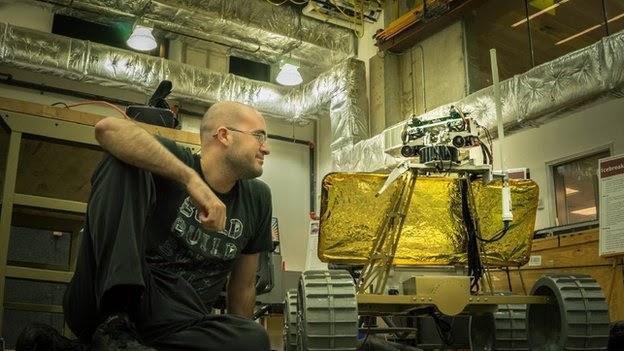
Students build Oculus robot to beam live video from Moon

Daniel Shafrir hopes Andy can transform education about space

Scientists at Carnegie Mellon University have developed a robot which they plan to land on the Moon to act as eyes for Earth-bound space enthusiasts.

The project is part of a $30m prize from Google offered to a team that can send video back from the moon.

The robot has already been shown to potential investors, including Apollo 9 astronaut Rusty Schweickart.

It works in tandem with an Oculus Rift virtual reality headset.

The scientists from Carnegie Mellon have teamed up with space firm Astrobotic to compete for the Google Lunar XPrize, which requires a team to land a robot on the Moon, move it 500m and send back video to Earth.

Astrobotic Technology, which is a spin-off from Carnegie Mellon, has signed a deal with SpaceX - the private space company set up by Elon Musk - to use its Falcon 9 rocket to launch the robot. It is due to take off in 2016.

Non-stop hackathon
"The vision was simple - let anyone on Earth experience the Moon live through the eyes of a robot," explained team leader Daniel Shafrir.

"We weren't just going to go to the Moon. We are going to bring the Moon back," he added.

The telepresence robot, nicknamed Andy after university founder Andrew Carnegie, can be controlled by an operator's head.

Using an Oculus Rift headset, the movements of the user's head are tracked and sent back to Andy's camera so that it will match where the user is looking.

"Imagine the feeling of looking out and seeing rocks and craters billions of years old. Turn your head to the right and you see the dark expanse of space. Turn your head to the left and you see home, Earth," said Mr Shafrir.

To achieve this required complex coding. The team also encountered smaller problems such as the fact that the Oculus software was unable to receive two live video streams at the same time.

"Tackling challenges like that made the project a non-stop, day and night hackathon," explained Mr Shafrir.

Working with games designer Ben Boesel and planetarium director Dan Arnett, the team put Andy through his paces in a demo earlier this month.

The vision is to have "hundreds of the robots on the Moon", said Mr Shafrir.

"With an Oculus headset in every classroom, allowing kids to experience what, to this date, has only been experienced by 12 human beings," he added.

There are currently 18 teams from around the world competing to win the Google-sponsored Lunar X-Prize.

Sunday, October 19, 2014

NASA Lunar Flashlight and RPM: How to Mine the Moon for Water

Lunar Flashlight mission will map the lunar south pole for volatiles.

Credit: Solar System Exploration Research Virtual Institute (SSERVI)

There's a lot of water on the moon, and NASA wants to learn how to mine it.

Space agency scientists are developing two separate mission concepts to assess, and learn how to exploit, stores of water ice on the moon  and other lunar resources.

The projects, called Lunar Flashlight and the Resource Prospector Mission (RPM), are notionally targeted to blast off in 2017 and 2018, respectively, and aim to help humanity extend its footprint out into the solar system.

"If you're going to have humans on the moon and you need water for drinking, breathing, rocket fuel, anything you want, it's much, much cheaper to live off the land than it is to bring everything with you," said Lunar Flashlight principal investigator Barbara Cohen, of NASA's Marshall Space Flight Center in Huntsville, Alabama.

It's therefore important to "understand the inventory of volatiles across the whole moon and their purity, and their accessibility in particular,"

Cohen said in July during a presentation at the NASA Exploration Science Forum 2014, a conference organized by the Solar System Exploration Research Virtual Institute at the agency's Ames Research Center in Moffett Field, California.

Solar sailing to the moon

Lunar Flashlight is working toward a possible launch date in December 2017, when it would blast off on the first test flight of NASA's Space Launch System (SLS) megarocket, along with several other piggybacking payloads.

Lunar Flashlight is a CubeSat mission, meaning the body of the spacecraft is tiny, about the size of a cereal box, Cohen said, but after it's deployed in space, the probe would get much bigger by unfurling an 860-square-foot (80 square meters) solar sail.

The spacecraft would then cruise toward the moon on a circuitous route, propelled along by the photons streaming from the sun.

Lunar Flashlightwould start orbiting the moon about six months after its launch, then spend another year spiraling down to get about 12 miles (20 kilometers) from the lunar surface.

The probe would then make about 80 passes around the moon at this low altitude, measuring and mapping deposits of water ice in permanently shadowed craters near the lunar poles. It would do this science work with the aid of its solar sail.

"We're going to use it as a mirror," Cohen said. "We're going to take the sunlight, bounce it off the solar sail into the permanently shadowed regions, and we're going to use a passive infrared spectrometer to collect the light from the permanently shadowed regions in wavelengths that are indicative of water frost."

Lunar Flashlight aims to find water ice that would be accessible to future explorers, be they human or robotic.

"What we're looking for is water right at the surface," Cohen said. "Could humans or their vehicles go into a permanently shadowed region and just scoop up the regolith and use what's at the surface to be able to extract water ice?"

Such deposits could provide drinking water for potential manned lunar outposts, and moon water could also be split into its constituent hydrogen and oxygen, prime components of rocket fuel, which could then spur and support exploration even farther afield, advocates of moon mining say.

Space mining advocates envision lunar extraction of minerals and ice as near-term objectives.

Credit: NASA

A water-mapping rover

While Lunar Flashlight would eye the moon from above, the Resource Prospector Mission (RPM) plans to send a rover onto the lunar surface to get an up-close look.

This rover would land at a yet-to-be-determined polar site and map surface and subsurface concentrations of hydrogen at two different locations, which would ideally be separated by at least 0.6 miles (1 km).

RPM would use a neutron spectrometer to measure water concentrations up to 3.3 feet (1 m) underground and a near-infrared spectrometer to make its surface measurements.

The solar-powered rover would roll into permananently shadowed regions, relying on batteries to keep working in the dark. It would likely have an operational lifetime of about one week on the lunar surface, mission officials have said.

Like Lunar Flashlight, RPM is geared to help enable future exploitation of water ice on the moon.

"How is the water ice distributed in the soil?" RPM project scientist Tony Colaprete of NASA Ames said at the Exploration Science Forum event.

"That's really what Resource Prospector is fundamentally about, is identifying, locating the 'ore' and understanding how to excavate it, how to get at it, and what does that cost in terms of energy."

The rover would also be equipped with a drill, allowing it to take samples from up to 3.3 feet (1 m) deep, Colaprete said.

Collected samples would be heated up in an oven, and the volatile materials such as water liberated by this process would be identified and quantified.

RPM also plans to extract oxygen from lunar dirt in a demonstration of in-situ resource utilization (ISRU). (This oxygen can be combined with hydrogen carried onboard to create water.)

"We need to take the first steps in demonstrating off of this world utilization of material," Colaprete said.

"There's a lot of technology demonstration in here that's not just applicable to the moon; it's applicable to any mission, to any surface where you want to manipulate materials."

Mars is one such place. Indeed, NASA is also planning to conduct an ISRU experiment on the Red Planet in the coming years.

In July, agency officials announced that its next Mars rover, slated to blast off in 2020, will carry an instrument that will generate oxygen from the carbon-dioxide-rich Martian atmosphere.

Saturday, October 18, 2014

Russian Luna-25 Mission to the Moon - Target Sample retrieval

The Luna-25 program will be carried out mostly as part of the Russian Federal Space Program for 2016-2025.

The Luna-25 exploration mission will cost tens of billions of rubles, an official from Russian Federal Space Agency said Friday.

"Let's say, we are talking tens of billions of rubles because it's a resource-heavy project, complex in terms of technical feasibility," Roscosmos' strategic planning chief Yuri Makarov said at a press conference in Moscow.

Russia will go back to the moon by the end of the next decade with the moon missions, or Luna-Glob project, Luna-25, 26, 27, 28 and Luna-29, missions aimed at further exploring the moon.

A mission to the moon has become one of Russia's top priorities in space. Russia plans to launch three lunar spacecraft - two to the moon's surface and one into orbit - by the end of the decade.

In September, Russian space agency Roscosmos reported that it was planning to launch a full-scale moon exploration program.

The program will be carried out mostly as part of the Russian Federal Space Program for 2016-2025. Russia is also looking at developing space exploration plans for 2050 and beyond.

Beyond LUNA-25
A Russian aerospace company official reported on Friday that new samples of lunar soil will be delivered to Earth in 2023-2025.

"The program currently has four missions: the first demonstration landing in 2025, an orbiter, which is needed to support all landing missions, then, the full landing mission Luna-27, and, around 2023-2025, there will be a project to deliver substance samples to Earth from areas near the [Lunar] south pole," Maksim Martynov, Deputy Designer General of Russia's NPO Lavochkin told reporters.

According to Martynov, the soil is to be delivered in its initial state, without experiencing any temperature changes and while preserving all its particles.

Friday, October 17, 2014

Wobbling of a Saturn moon hints at what lies beneath

Using instruments aboard the Cassini spacecraft to measure the wobbles of Mimas, the closest of Saturn's regular moons, a Cornell University astronomer publishing in Science, Oct. 17, has inferred that this small moon's icy surface cloaks either a rugby ball-shaped rocky core or a sloshing sub-surface ocean.

"After carefully examining Mimas, we found it librates, that is to say, it subtly wobbles, around the moon's polar axis," Radwan Tajeddine, Cornell research associate in astronomy and lead author of the article.

"In physical terms, the back-and-forth wobble should produce about 3 kilometers of surface displacement."

"Instead we observed an unexpected 6 kilometers of surface displacement," he said.

"We're very excited about this measurement because it may indicate much about the satellite's insides."

"Nature is essentially allowing us to do the same thing that a child does when she shakes a wrapped gift in hopes of figuring out what's hidden inside," Tajeddine said.

The astronomy team used a technique called stereo-photogrammetry to interpret images taken by the Cassini Imaging Science Subsystem to measure the libration.

In this technique, astronomers employ Cassini photographs of Mimas taken at different times and from various vantage points to build precise 3-D computer models of the locations of hundreds of surface reference points.

From these, the researchers determined the moon's shape and were able to notice that the satellite didn't rotate smoothly but rocked back and forth a bit as well.

The amount of the to-and-fro motion indicates that Mimas' interior is not uniform. These wobbles can be produced if the moon contains a weirdly shaped, rocky core or if a sub-surface ocean exists beneath its icy shell.

Mimas is about 400 kilometers in diameter, and its possible internal global ocean is located under an icy crust ranging in thickness between 25 and 30 kilometers.

The moon itself is thought to have been formed either by the slow agglomeration of ring particles (a gradual buildup of matter) or direct growth within the primordial planetary gas nebula.

The odd-shaped core would favor gravitational flattening by nearby Saturn, Tajeddine said. The moon's relatively smooth and roughly spherical icy surface covers up whatever is underneath.

More information: Science. DOI: 10.1126/science.1255299

NASA Cassini caught in Hyperion's particle beam inside Saturn's Magnetosphere

This stunning false-colour view of Saturn's moon Hyperion reveals crisp details across the strange, tumbling moon's surface. 

Differences in colour could represent differences in the composition of surface materials. 

The view was obtained during Cassini's close flyby on Sept. 26, 2005. 

Hyperion has a notably reddish tint when viewed in natural colour. 

The red color was toned down in this false-colour view, and the other hues were enhanced, in order to make more subtle colour variations across Hyperion's surface more apparent. 

Credit: NASA /JPL /Space Science Institute

Static electricity is known to play an important role on Earth's airless, dusty moon, but evidence of static charge building up on other objects in the solar system has been elusive until now.

A new analysis of data from NASA's Cassini mission has revealed that, during a 2005 flyby of Saturn's moon Hyperion, the spacecraft was briefly bathed in a beam of electrons coming from the moon's electrostatically charged surface.

The finding represents the first confirmed detection of a charged surface on an object other than our moon, although it is predicted to occur on many different bodies, including asteroids and comets.

The new analysis was led by Tom Nordheim, a doctoral candidate at Mullard Space Science Laboratory (MSSL), University College London, and was published recently in the journal Geophysical Research Letters.

Hyperion is porous and icy, with a bizarre, sponge-like appearance. Its surface is continuously bombarded by ultraviolet light from the sun and exposed to a rain of charged particles, electrons and ions, within the invisible bubble generated by Saturn's magnetic field, called the magnetosphere.

The researchers think Hyperion's exposure to this hostile space environment is the source of the particle beam that struck Cassini.

Measurements made by several of Cassini's instruments during a close encounter with Hyperion on September 26, 2005, indicate that something unexpected took place in the charged particle environment around the spacecraft.

Among those instruments, the Cassini Plasma Spectrometer (CAPS) detected that the spacecraft was magnetically connected to the surface of Hyperion for a brief period, allowing electrons to escape from the moon toward the robotic probe.

Most people are familiar with the electrostatic charge buildup that occurs when a balloon is rubbed against hair or a sweater.

Objects in space can also become electrostatically charged by exposure to solar ultraviolet light and incoming charged particles.

The Cassini data show that a similar process can take place on Hyperion.

The finding is surprising, as the small but odd-looking moon was thought to be a simple inert object, which would not undergo any strong interactions with the Saturnian magnetosphere.

Nevertheless, the team's analysis indicates that Cassini remotely detected a strongly negative voltage on Hyperion.

"It was rather like Cassini receiving a 200-volt electric shock from Hyperion, even though they were over 2,000 kilometers [1,200 miles] apart at the time," said Nordheim.

Scientists had previously suggested that surface features observed on the asteroid Eros and several of Saturn's moons are due to the motion of charged dust across their surfaces.

On small objects with low gravity, dust grains might even be able to overcome the force of gravity and escape into space.

Although mission controllers have detected no signs that the Hyperion electron beam caused damage to Cassini, strong electric charging effects could prove to be a hazard to future robotic and human explorers at planetary objects without atmospheres, including Earth's moon, where they could create the potential for powerful electrostatic discharges.

"Our observations show that this is also an important effect at outer planet moons and that we need to take this into account when studying how these moons interact with their environment," said Geraint Jones of MSSL, a member of the Cassini CAPS team who helped supervise the study.

Cassini's CAPS instrument was powered off in 2012, when the instrument began to draw excess current.

The team is based at Southwest Research Institute, San Antonio. Part of the CAPS instrument that made the detection discussed in this research, the CAPS electron spectrometer, was built by MSSL.

Nordheim and colleagues also utilized data from three other Cassini instruments in their analysis: the Radio and Plasma Wave Science instrument (RPWS), the Magnetospheric Imaging Instrument and the Magnetometer (MIMI).

Wednesday, October 8, 2014

NASA LRO: Gravity anomalies bordering the Moon's Procellarum region

The Lunar Orbiter Laser Altimeter (LOLA), aboard NASA's Lunar Reconnaissance Orbiter (LRO), collected data to produce this image showing the topography of Earth’s moon. 

Gravity anomalies bordering the Procellarum region appear superimposed in blue. 

The image depicts border structures using gravity gradients calculated with information obtained by NASA's Gravity Recovery and Interior Laboratory (GRAIL) mission. 

Researchers interpret these gravity anomalies as ancient lava-flooded rift zones buried beneath the volcanic plains (or maria) on the nearside of the moon.

Credit: NASA

More Information
"Structure and evolution of the lunar Procellarum region as revealed by GRAIL gravity data"
Jeffrey C. Andrews-Hanna, Jonathan Besserer James W. Head III, Carly J. A. Howett, Walter S. Kiefer, Paul J. Lucey, Patrick J. McGovern, H. Jay Melosh, Gregory A. Neumann, Roger J. Phillips, Paul M. Schenk, David E. Smith, Sean C. Solomon & Maria T. Zuber - Nature 514, 68–71 (02 October 2014) doi:10.1038/nature13697 - Published online 01 October 2014

Tuesday, October 7, 2014

Most Water in Lunar Soil generated by Solar Wind

This is a composite image of the lunar nearside taken by the Lunar Reconnaissance Orbiter in June 2009, note the presence of dark areas of maria on this side of the moon. Credit: NASA

A pair of researchers with the Sorbonne Universités, Muséum National d'Histoire Naturelle, has determined that most of the water in the soil on the surface of the moon was formed due to protons in the solar wind colliding with oxygen in lunar dust, rather than from comet or meteorite impacts.

In their paper published in Proceedings of the National Academy of Sciences, Alice Stephant and François Robert describe their study and the results they found.

When NASA astronauts brought back soil and rock samples from the moon, it was assumed by most in the scientific community that everything they found was dry, that there was no water in any of it.

Subsequent analysis using newer techniques has revealed that not only is there water beneath the surface in some places, but the dust on the surface also has small amounts as well.

Once this became known, most scientists assumed the water got there due to comet or meteorite impacts, in this new effort, the research pair suggests that conventional thinking is wrong once again and that the water, at least in the surface dust, comes about due to the impact of solar wind on tiny dust particles.

In studying tiny grains of lunar soil samples, the researchers found that the reduction of oxygen from silicates in the soil by protons from the solar wind was almost certainly the means by which the water was generated.

They came to that conclusion through determining the lithium isotope ratio in the samples (plagioclase rock found on the surface of the moon) which gave the isotope ratio for the hydrogen, from that they were able to calculate the deuterium-hydrogen ratio which they compared to the amount of water actually in the granule sample.

They found that on average, the granules contained just 15 percent water from somewhere else (presumably comets or meteorites) leaving the rest to have been formed due to the solar wind interaction. They note also that for some samples, all of the water was due to solar wind interaction.

The duo is quick to point out that their conclusions only relate to water found on the surface of the moon, where the water below the surface came from is still up for conjecture.

More information: "The negligible chondritic contribution in the lunar soils water" - Alice Stephant, PNAS, DOI: 10.1073/pnas.1408118111

Uranus's Moon Miranda: Bizarre Shape Explained

Uranus' icy moon Miranda is seen in this image from NASA's Voyager 2 probe on Jan. 24, 1986.

Credit: NASA/JPL-Caltech

The strange appearance of Uranus' moon Miranda may finally have an explanation.

Miranda resembles Frankenstein's monster, a bizarre jumble of parts that didn't quite merge properly.

Now, researchers suggest they may know why Miranda looks so odd: Constant squeezing and stretching from Uranus caused the moon's insides to heat up and churn.

Miranda is the innermost of Uranus' five major moons.

Though Miranda is only 293 miles (471 kilometers) wide, about one-seventh as large as Earth's moon, this ball of ice and rock possesses one of the oddest and most varied landscapes known among extraterrestrial bodies, including giant canyons up to 12 times deeper than the Grand Canyon.

"Miranda has a really bizarre, deformed surface," said study lead author Noah Hammond, a planetary scientist at Brown University in Rhode Island. "It's a really beautiful and exotic moon."

Miranda has three giant features known as coronae that are unique among known objects in the solar system.

They are shaped crudely, either like ovals or trapezoids, and each is least 120 miles (200 km) wide.

The coronae are separated from their more heavily cratered surroundings by belts of concentric ridges and troughs, making the coronae look like mismatched patches on a moth-eaten coat.

The three coronae, Arden, Elsinore and Inverness, are named after Scottish locations also mentioned in Shakespeare's plays.

This photo of Uranus' moon Miranda, taken by NASA's Voyager 2 probe in January 1986, shows an unusual "chevron" figure and regions of distinctly differing terrain on the mysterious satellite.

Credit: NASA/JPLView full size image

Researchers have long wondered how the coronae formed.

One possibility is that Miranda may have been disrupted by some catastrophic impact, after which its pieces chaotically reassembled.

The coronae formed as rocky material sank downward, triggering concentric wrinkles on Miranda's surface as it contracted, this idea goes.

Another possibility, one suggested by most scientists in the field, is that the coronae formed as buoyant domes of ice rose, causing Miranda's surface to crumple as matter was added to it.

However, it was not known where the heat to drive this ice upward might have come from. Since Miranda is relatively small, it would have cooled quickly after its creation, and it does not have the radioactive material that Earth possesses to help keep its innards hot.

Now, researchers show the gravitational pull of Uranus may have distorted Miranda enough to heat it up, leading its innards to churn much as Earth's does, thus explaining the coronae.

The gravity of Uranus pulls on Miranda, generating tidal forces, much as Earth's moondoes to Earth.

Tidal forces elsewhere in the solar system can be far greater than tidal effects on Earth, for instance, Jupiter's gravitational pull causes the solid rock surface of its third-largest moon Io to bulge up and down by as much as 300 feet (90 meters), generating enough heat to drive volcanic eruptions.

Miranda's orbit around Uranus was once eccentric, or oval-shaped, moving it closer to and farther from Uranus over time.

Three-dimensional computer simulations of Miranda's interior performed for the new study revealed the resulting tidal forces would repeatedly stretch and squeeze Miranda enough to generate substantial amounts of heat, about 5 gigawatts, or 2.5 times the peak power output of the huge Hoover Dam on the southwestern United States' Colorado River.

This heat would cause Miranda's icy mantle to churn with convection much like Earth's mantle of hot rock does. During convection, warm buoyant ice would have risen to Miranda's surface to contort it and create the coronae.

The research team's computer models accurately explained the locations of the coronae and the deformation patterns within the coronae, Hammond said.

"The features on Miranda may look really strange, but they formed in a way that is really similar to what happens on Earth, where convection in the interior drives surface deformation," Hammond told Space.com.

However, the scientists noted that for convection to drive Miranda's surface deformation, the moon's surface must be much weaker than predicted by laboratory experiments.

"The Earth has the same problem: For convection to deform Earth's surface, rocks have to behave weaker than expected," Hammond said.

"It'd be interesting to see what might explain the weakness seen in the surfaces of Miranda, Earth and elsewhere."

So far, scientists only know what Miranda's southern hemisphere looks like. NASA's Voyager 2 spacecraft photographed this part of the moon during its 1986 Uranus flyby but did not image Miranda's northern hemisphere.

"It'd be really interesting to think about what could be on the other side of Miranda," Hammond said. "Our study predicts there'd be one additional corona on Miranda's other side, and I would love to live long enough for a mission to go back to Uranus and test that hypothesis."

Hammond and his colleague Amy Barr detailed their findings online Sept. 15 in the journal Geology.

Wednesday, October 1, 2014

NASA GRAIL: Procellarum region on the Moon

The Moon, as observed in; GRAIL gravity gradients (top), topography (center, where red is high and blue is low), and in visible light (bottom)

The Procellarum region is a broad region of low topography covered in dark mare basalt. 

The GRAIL gravity gradients reveal a giant rectangular pattern of structures surrounding the region. 

Credit: NASA /Colorado School of Mines /MIT /JPL /Goddard Space Flight Center

New data obtained by NASA's GRAIL mission reveals that the Procellarum region on the near side of the moon, a giant basin often referred to as the "man in the moon," likely arose not from a massive asteroid strike, but from a large plume of magma deep within the moon's interior.

The Procellarum region is a roughly circular, volcanic terrain some 1,800 miles in diameter, nearly as wide as the United States.

One hypothesis suggested that it was formed by a massive impact, in which case it would have been the largest impact basin on the moon.

Subsequent asteroid collisions overprinted the region with smaller, although still large, basins.

Now researchers from MIT, the Colorado School of Mines, and other institutions have created a high-resolution map of the Procellarum region, and found that its border is not circular, but polygonal, composed of sharp angles that could not have been created by a massive asteroid.

Instead, researchers believe that the angular outline was produced by giant tension cracks in the moon's crust as it cooled around an upwelling plume of hot material from the deep interior.

Maria Zuber, the E.A. Griswold Professor of Geophysics and also MIT's vice president for research, says that as cracks occurred, they formed a "plumbing system" in the moon's crust through which magma could meander to the surface.

Magma eventually filled the region's smaller basins, creating what we see today as dark spots on the near side of the moon, features that have inspired the popular notion of a "man in the moon."

"A lot of things in science are really complicated, but I've always loved to answer simple questions," says Zuber, who is principal investigator for the GRAIL (Gravity Recovery and Interior Laboratory) mission.

"How many people have looked up at the moon and wondered what produced the pattern we see, let me tell you, I've wanted to solve that one!"

Monday, September 29, 2014

ESA SMART-1: Revealing unknown regions of the moon

Credit: ESA/SMART-1 /AMIE camera team/Space Exploration Institute

The greyscale pattern of dark and light blotches on the Moon is a familiar sight to stargazers.

However, there are regions that remained relatively mysterious to us until surprisingly recently, most notably the Moon's polar regions, which astronomers have dubbed 'Luna Incognita', or 'the unknown Moon'.

In recent years, missions including ESA SMART-1 have shed light on these regions of the lunar surface, and they are now better known.

This mosaic covers about 700 km by 220 km and was taken by the Advanced Moon Imaging Experiment on SMART-1.

It shows a trio of craters very near to the Moon's north pole, on the edge of the Luna Incognita. From right to left, these craters are named Plaskett, Rozhdestvenskiy and Hermite.

Hermite (104 km diameter) is perched right on the edge of the Moon's northern limb, while Plaskett (109 km diameter) and Rozhdestvenskiy (177 km diameter) overlap the lunar far side.

Lunar South Pole image by ESA SMART-1

Credit: ESA

We only ever see the same hemisphere of the Moon due to 'tidal locking' – this causes the Moon to orbit Earth once in the same time it takes to spin once about its axis.

However, we actually see around 59% of the lunar surface owing to factors such as the eccentricity of the Moon's orbit, its orientation with respect to Earth, and the rotation of Earth.

Over time, these little variations add up and the Moon appears to oscillate slowly, allowing us to peer a bit further around the lunar surface at its edges. This effect is known as libration.

Plaskett's location is within one of the zones that seems to oscillate. For just a few days during a few months each year, Earth can be seen from Plaskett's northern rim, one of the key reasons it may make a suitable lunar outpost for simulating a mission to Mars.

This infrequent contact would be ideal to test how astronauts cope with being isolated from Earth, without requiring the additional separation or risk involved in actually travelling to the Red