Showing posts with label Around. Show all posts

Monday, November 3, 2014

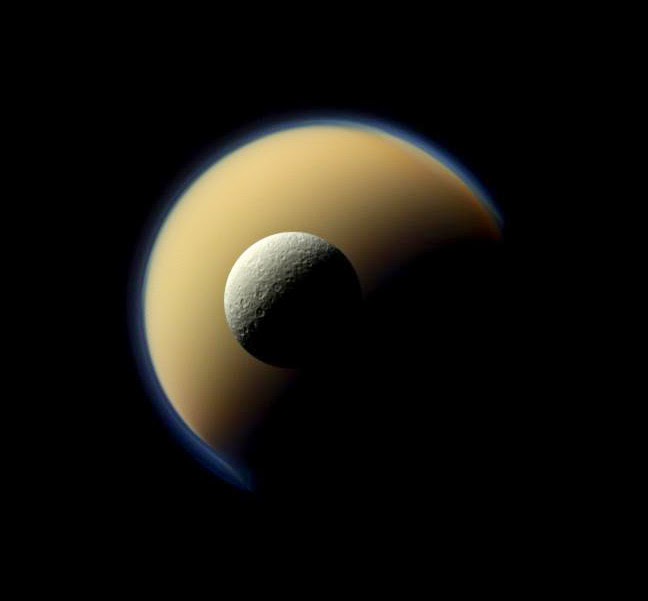
NASA Cassini: Icy rocks around Saturn - Titan and Rhea

Credit: NASA/JPL-Caltech/Space Science Institute

Earth is the only planet in our Solar System to have a single solitary moon.

While others, such as Mercury and Venus, have none, the gas giants have accumulated crowds of orbiting bodies, Saturn, for example, boasts an impressive 62 moons!

This image, taken by the Cassini orbiter, shows its two biggest: Rhea and its larger companion Titan.

Titan's diameter, at 5150 km, is 50% larger than that of our Moon, while Rhea is somewhat smaller at 1528 km across.

Although Rhea's pitted and cratered appearance contrasts sharply with the faint golden glow of Titan, the moons are quite similar in composition, containing a mixture of rock and water ice.

Rhea is thought to comprise three quarters ice and one quarter rock.

Observations with Cassini have determined that Rhea does not contain a distinct rocky core, instead, it is made up of rock and ice mixed together, giving it its 'dirty snowball' appearance.

Titan's orange hue is a result of its atmosphere. It is the only body in the Solar System other than Earth to have a thick, nitrogen-rich atmosphere, which in Titan's case also contains substances like methane, hydrogen and hydrocarbons.

These molecules form via reactions with sunlight high up in Titan's atmosphere, eventually settling to lower altitudes to form an orange-hued smog.

In some images Titan's upper atmosphere takes on a layered appearance, with 'stripes' of haze stacked on top of one another in an onion-like fashion.

This Cassini image shows one such layer, a hazy band of blue encircling Titan.

This haze runs all the way around the moon, and brightens in two crescent-shaped areas over the polar regions to form 'polar hoods'.

These hoods are swirling, high-altitude areas of denser gas. Titan's north polar hood can be seen towards the upper right of the image, and its corresponding southern hood lies towards the lower left of the moon.

These polar hoods are seasonal, growing and dissipating with the changing seasons. Seasons on Saturn and its accompanying moons last for around seven years.

When Cassini arrived in the Saturn system in 2004 Titan already had a thick hood above its north pole, which was experiencing winter.

After the Saturnian equinox in August 2009, Titan's northern hemisphere began moving into spring, and its southern latitudes headed into autumn.

Accompanying this seasonal shift was the appearance of a polar vortex above Titan's south pole. In 2012 Cassini snapped multiple images of this vortex as it swirled round furiously, completing a full rotation in just nine hours.

While the Cassini mission has spent much time studying Titan, it has also performed numerous flybys of Rhea, passing close to the moon four times to probe its interior structure, gravitational pull and surface characteristics.

These encounters showed Rhea to be an ancient and heavily cratered body, bearing numerous pocks and scars from past impacts.

This is something that astronomers want to explore by studying Rhea; measuring the dusty debris flying up from Rhea's surface may help us to understand more about the rate of meteoroid bombardments and amount of cosmic debris raining down on the Saturnian system.

This true-colour image is made with exposures taken on 16 June 2011 using red, green and blue filters on Cassini's narrow-angle camera.

Wednesday, June 18, 2014

ESA Herschel mission examines New molecules around old stars

ESA Herschel image of the Helix Nebula using the SPIRE instrument at wavelengths around 250 micrometres, superimposed on Hubble image of the nebula. 

The spectrum corresponds to the outer region of the Helix Nebula outlined on the SPIRE image. 

It identifies the OH+ molecular ion, which is needed for the formation of water.

ESA’s Herschel space observatory is the first to detect this molecule in planetary nebulas, the product of dying Sun-like stars. 

Credit: Hubble image: NASA/ESA/C.R. O’Dell (Vanderbilt University), M. Meixner & P. McCullough (STScI); Herschel image: ESA/Herschel/SPIRE/MESS Consortium/M. Etxaluze et al.

Using ESA’s Herschel space observatory, astronomers have discovered that a molecule vital for creating water exists in the burning embers of dying Sun-like stars.

When low- to middleweight stars like our Sun approach the end of their lives, they eventually become dense, white dwarf stars.

In doing so, they cast off their outer layers of dust and gas into space, creating a kaleidoscope of intricate patterns known as planetary nebulas.

These actually have nothing to do with planets, but were named in the late 18th century by astronomer William Herschel, because they appeared as fuzzy circular objects through his telescope, somewhat like the planets in our Solar System.

Over two centuries later, planetary nebulas studied with William Herschel's namesake, the Herschel space observatory, have yielded a surprising discovery.

Like the dramatic supernova explosions of weightier stars, the death cries of the stars responsible for planetary nebulas also enrich the local interstellar environment with elements from which the next generations of stars are born.

While supernovas are capable of forging the heaviest elements, planetary nebulas contain a large proportion of the lighter 'elements of life' such as carbon, nitrogen, and oxygen, made by nuclear fusion in the parent star.

A star like the Sun steadily burns hydrogen in its core for billions of years but once the fuel begins to run out, the central star swells into a red giant, becoming unstable and shedding its outer layers to form a planetary nebula.

The remaining core of the star eventually becomes a hot white dwarf pouring out ultraviolet radiation into its surroundings.

This intense radiation may destroy molecules that had previously been ejected by the star and that are bound up in the clumps or rings of material seen in the periphery of planetary nebulas.

The Ring Nebula at optical wavelengths as seen by the Hubble Space Telescope, with Herschel data acquired with SPIRE and PACS over a wavelength range of 51–672 micrometres for the region identified. 

The spectra have been cropped and the scales stretched in order to show the OH+ emission, a molecular ion important for the formation of water. 

ESA’s Herschel space observatory is the first to detect this molecule in planetary nebulas, the product of dying Sun-like stars.

Credit: Hubble image: NASA/ESA/C. Robert O’Dell (Vanderbilt University) Herschel data: ESA/Herschel/PACS & SPIRE/ HerPlaNS survey/I. Aleman et al. 

The harsh radiation was also assumed to restrict the formation of new molecules in those regions.

But in two separate studies using Herschel astronomers have discovered that a molecule vital to the formation of water seems to rather like this harsh environment, and perhaps even depends upon it to form.

The molecule, known as OH+, is a positively charged combination of single oxygen and hydrogen atoms.

The two studies are the first to identify in planetary nebulas this critical molecule needed for the formation of water, although it remains to be seen if the conditions would actually allow water formation to proceed.

"The proximity of the Helix Nebula means we have a natural laboratory on our cosmic doorstep to study in more detail the chemistry of these objects and their role in recycling molecules through the interstellar medium," says Dr M. Etxaluze.

"Herschel has traced water across the Universe, from star-forming clouds to the asteroid belt in our own Solar System," says Göran Pilbratt, ESA's Herschel project scientist.

"Now we have even found that stars like our Sun could contribute to the formation of water in the Universe, even as they are in their death throes."

More information: "Herschel planetary nebula survey (HerPlaNS). First detection of OH+ in planetary nebulae," by I. Aleman et al., and "Herschel spectral-mapping of the Helix Nebula (NGC 7293): extended CO photodissociation and OH+ emission," by M. Etxaluze et al., are published in Astronomy & Astrophysics.

Monday, February 17, 2014

Space Station SPHERES run circles around ordinary satellites

NASA astronaut Thomas Marshburn tests the SPHERES-Vertigo investigation hardware, which resembles eye goggles, as it flies aboard the International Space Station. 

Credit: NASA

These are, in fact, the droids that NASA and its research partners are looking for.

Inspired by a floating droid battling Luke Skywalker in the film Star Wars, the free-flying satellites known as Synchronized Position Hold, Engage, Reorient, Experimental Satellites (SPHERES) have been flying aboard the International Space Station since Expedition 8 in 2003.

Although there have been numerous SPHERES investigations held on the orbiting laboratory, four current and upcoming SPHERES projects are of particular significance to robotics engineers, rocket launch companies, NASA exploration and anyone who uses communications systems on Earth.

The SPHERES-Vertigo, Department of Defense (DOD) SPHERES-Rings, SPHERES-Slosh and SPHERES-Inspire II investigations all use the existing SPHERES space station facility of these self-contained satellites.

Powered not by an astronaut's use of the Force, but by AA batteries, the satellites act as free-flying platforms that can accommodate various mounting features and mechanisms in order to test and examine the physical or mechanical properties of materials in microgravity.

Each satellite is an 18-sided polyhedron and is roughly the size of a soccer ball.

NASA's Ames Research Center in Moffett Field, Calif., operates and maintains the SPHERES research facility aboard the space station, which is funded by the Human Exploration and Operations Mission Directorate at NASA Headquarters in Washington.

SPHERES provide a unique low risk, low-cost, long-term microgravity research facility that supports quick-reaction testing of technologies that can be repeated numerous times.

Alvar Saenz Otero, Ph.D., associate director and SPHERES lead scientist at the Massachusetts Institute of Technology (MIT) Space Systems Laboratory describes the reusability of SPHERES for multiple microgravity investigations by saying, "if anything goes wrong, reset and try again!"

Operating intermittently since February 2013, the SPHERES Visual Estimation and Relative Tracking for Inspection of Generic Objects (SPHERES-Vertigo) investigation uses what looks like eye goggles and other new hardware and software on multiple satellites during testing.

The purpose of the study is to build 3-D models of a target using mapping algorithms and computer vision-based navigation.

These additions to the satellites help researchers create 3-D maps of a previously unknown object for navigation by flying the SPHERES in a path around that object while taking photos.

Brent Tweddle, a postdoctoral associate with the MIT Space Systems Laboratory, said the SPHERES-Vertigo project differs from previous SPHERES experiments by "adding a pair of stereo cameras, which see, perceive and understand their world visually and can communicate with satellites using Vertigo goggles."

The goggles act "like their own little intelligence block that sticks on the front end of the SPHERES and allows them to see the rest of the world that they want to navigate through," explained Tweddle.

Read the full article here

Wednesday, December 11, 2013

Earth and Venus: Exoplanet Habitable Zone Around Sunlike Stars Bigger

The Earth and Venus, although not very different in size, have had a very different climate history. 

In the future, the Earth may look like Venus. 

Credit: Jeremy Leconte

Earth's place in the solar system is just right.

It's not too hot, like Venus, and it's not too cold, like Mars, and this "Goldilocks zone" of habitability around other stars like the sun just might be bigger than thought, scientists say.

A new study, unveiled today (Dec. 11), expands the habitable zone — the sweet spot in a solar system where liquid water and therefore life could potentially exist — surrounding stars like the sun.

Previous studies on the habitability zone around sunlike stars have placed the innermost edge of so-called Goldilocks zoneat about 0.99 AU (1 AU, or astronomical unit, is the average distance from Earth to the sun, about 93 million miles, or 150 million kilometers).

But a new computer model study pushes that border closer to its parent star, to a distance of about 0.95 AU (about 88 million miles, or 142 million kilometers).

The study in the journal Nature, led by Jeremy Leconte, now a postdoc at the Canadian Institute for Theoretical Astrophysics of the University of Toronto, used 3D computer modeling to find that the runaway greenhouse effect isn't an issue unless the planet is less than 0.95 AU from its star.

The new inner boundary for habitable zones might not make a big difference for scientists trying to determine if an alien planet is habitable, but it does make a big difference for future life on Earth, Leconte said.

Eventually, the sun will become brighter, heating the Earth and potentially creating a runaway greenhouse effect — a feedback loop that eventually causes a planet's oceans to boil away. But that eventuality is long way off, and it may now actually be farther off than previously expected, Leconte suggests.

"For example, if we believe that the limit is at 0.99, it means that Earth would start losing oceans around 150 million years from now," Leconte told reporters.

"Now, with our new estimate, it's not 150 million years, but it's actually 1 billion years, so almost an order of magnitude bigger."


More Information: 
Increased insolation threshold for runaway greenhouse processes on Earth-like planets doi:10.1038/nature12827

Friday, August 23, 2013

A fluffy disk around a baby star

Artist’s rendition of the "fluffy" layer associated with the protoplanetary disk of RY Tau, including jets coming from the star. 

Although typical young stars like RY Tau are often associated with jets, they are not visible in the HiCIAO observations at this time. 

Credit: NAOJ

An international team of astronomers that are members of the Strategic Exploration of Exoplanets and Disks with Subaru Telescope (SEEDS) Project has used Subaru Telescope's High Contrast Instrument for the Subaru Next Generation Adaptive Optics (HiCIAO) to observe a disk around the young star RY Tau (Tauri).

The team's analysis of the disk shows that a "fluffy" layer above it is responsible for the scattered light observed in the infrared image.

Detailed comparisons with computer simulations of scattered light from the disk reveal that this layer appears to be a remnant of material from an earlier phase of stellar and disk development, when dust and gas were falling onto the disk.

Since 2009, the five-year SEEDS Project has focused on direct imaging of exoplanets, i.e., planets orbiting stars outside of our Solar System, and disks around a targeted total of 500 stars.

Planet formation, an exciting and active area for astronomical research, has long fascinated many scientists.

Disks of dust and gas that rotate around young stars are of particular interest, because astronomers think that these are the sites where planets form—in these so-called "protoplanetary disks."

Since young stars and disks are born in molecular clouds, giant clouds of dust and gas, the role of dust becomes an important feature of understanding planet formation; it relates not only to the formation of rocky, Earth-like planets and the cores of giant Jupiter-like planets but also to that of moons, planetary rings, comets, and asteroids.

As a part of the SEEDS Project, the current team of researchers used HiCIAO mounted on the Subaru Telescope to observe a possible planet-forming disk around the young star RY Tau.

This star is about 460 light years away from Earth in the constellation Taurus and is around half a million years old.

The disk has a radius of about 70 AU (10 billion kilometers), which is a few times larger than the orbit of Neptune in our own Solar System.

More information: Takami, M. et al, 2013, High-Contrast Near-Infrared Imaging Polarimetry of the Protoplanetary Disk around RY Tau, Astrophysical Journal, Vol. 772, paper 145.

Monday, June 24, 2013

ESO VLT Reveals Dust ring around Supermassive black hole in NGC 3783

This artist’s impression shows the surroundings of the supermassive black hole at the heart of the active galaxy NGC 3783 in the southern constellation of Centaurus (The Centaur). 

New observations using the Very Large Telescope Interferometer at ESO’s Paranal Observatory in Chile have revealed not only the torus of hot dust around the black hole but also a wind of cool material in the polar regions.

Credit: ESO/M. Kornmesser

ESO's Very Large Telescope Interferometer has gathered the most detailed observations ever of the dust around the huge black hole at the centre of an active galaxy.

Rather than finding all of the glowing dust in a doughnut-shaped torus around the black hole, as expected, the astronomers find that much of it is located above and below the torus.

These observations show that dust is being pushed away from the black hole as a cool wind - a surprising finding that challenges current theories and tells us how supermassive black holes evolve and interact with their surroundings.

Over the last twenty years, astronomers have found that almost all galaxies have a huge black hole at their centre.

Some of these black holes are growing by drawing in matter from their surroundings, creating in the process the most energetic objects in the Universe: active galactic nuclei (AGN).

The central regions of these brilliant powerhouses are ringed by doughnuts of cosmic dust dragged from the surrounding space, similar to how water forms a small whirlpool around the plughole of a sink.

It was thought that most of the strong infrared radiation coming from AGN originated in these doughnuts.

But new observations of a nearby active galaxy called NGC 3783, harnessing the power of the Very Large Telescope Interferometer (VLTI) at ESO's Paranal Observatory in Chile, have given a team of astronomers a surprise.

Although the hot dust - at some 700 to 1000 degrees Celsius - is indeed in a torus as expected, they found huge amounts of cooler dust above and below this main torus.

As Sebastian Honig (University of California Santa Barbara, USA and Christian-Albrechts-Universitat zu Kiel, Germany), lead author of the paper presenting the new results, explains, "This is the first time we've been able to combine detailed mid-infrared observations of the cool, room-temperature dust around an AGN with similarly detailed observations of the very hot dust. This also represents the largest set of infrared interferometry for an AGN published yet."

The newly-discovered dust forms a cool wind streaming outwards from the black hole. This wind must play an important role in the complex relationship between the black hole and its environment.

The black hole feeds its insatiable appetite from the surrounding material, but the intense radiation this produces also seems to be blowing the material away.

It is still unclear how these two processes work together and allow supermassive black holes to grow and evolve within galaxies, but the presence of a dusty wind adds a new piece to this picture.

More Information: ESO Research Paper

Tuesday, June 4, 2013

Hubble maps 3-D structure of ejected material around erupting star

Hubble's Wide Field Camera 3 imaged the double-star system T Pyxidis, or T Pyx, over a four-month period. 

T Pyx is a recurrent nova, erupting every 12 to 50 years. 

T Pyx's latest outburst was in April 2011. The star is the white blob in the middle of each image. 

Credit: NASA, ESA, A. Crotts, J. Sokoloski, and H. Uthas (Columbia University), and S. Lawrence (Hofstra University)

A flash of light from a stellar outburst has provided a rare look at the 3-D structure of material ejected by an erupting nova.

Astronomers used NASA's Hubble Space Telescope to observe the light emitted by the close double-star system T Pyxidis, or T Pyx, a recurring nova, during its latest outburst in April 2011.

A nova erupts when a white dwarf, the burned-out core of a sun-like star, has siphoned off enough hydrogen from a companion star to trigger a thermonuclear runaway.

As hydrogen builds up on the surface of the white dwarf, it becomes hotter and denser until it detonates like a colossal hydrogen bomb, leading to a 10,000-fold increase in brightness in a little more than one day.

Nova explosions are extremely powerful, equal to a blast of one million billion tons of dynamite. T Pyx erupts every 12 to 50 years.

Contrary to some predictions, the astronomers were surprised to find the ejecta from earlier outbursts stayed in the vicinity of the star and formed a disk of debris around the nova.

The discovery suggests material continues expanding outward along the system's orbital plane, but it does not escape the system.

Arlin Crotts
"We fully expected this to be a spherical shell," says Arlin Crotts of Columbia University, a member of the research team.

"This observation shows it is a disk, and it is populated with fast-moving ejecta from previous outbursts."

Team member Stephen Lawrence of Hofstra University in Hempstead, N.Y., will present the results Tuesday at the American Astronomical Society meeting in Indianapolis.

Team member Jennifer Sokoloski, also of Columbia University and co-investigator on the project, suggests these data indicate the companion star plays an important role in shaping how material is ejected, presumably along the system's orbital plane, creating the pancake-shaped disk.

The disk is tilted about 30 degrees from face-on toward Earth.

Stephen Lawrence
Using Hubble's Wide Field Camera 3, the team took advantage of the blast of light emitted by the erupting nova to trace the light's path as it lit up the disk and material from previous ejecta.

The disk is so vast, about a light-year across, that the nova's light cannot illuminate all of the material at once.

Instead, the light sweeps across the material, sequentially illuminating parts of the disk, a phenomenon called a light echo.

The light reveals which parts of the disk are nearer to Earth and which sections are farther away. By tracing the light, the team assembled a 3-D map of the structure around the nova.

"We've all seen how light from fireworks shells during the grand finale will light up the smoke and soot from shells earlier in the show," Lawrence said.

"In an analogous way, we're using light from T Pyx's latest outburst and its propagation at the speed of light to dissect its fireworks displays from decades past."

Although astronomers have witnessed light propagating through material surrounding other novae, this is the first time the immediate environment around an erupting star has been studied in three dimensions.

The team's results will appear online June 5 and will be published in the June 20, 2013, issue of the Astrophysical Journal Letters

Friday, March 1, 2013

NASA Discovers New Radiation Belt Around Earth

Two giant swaths of radiation, known as the Van Allen Belts, surrounding Earth were discovered in 1958. 

In 2012, observations from the Van Allen Probes showed that a third belt can sometimes appear.

The radiation is shown here in yellow, with green representing the spaces between the belts.

CREDIT: NASA/Van Allen Probes/Goddard Space Flight Center

A ring of radiation previously unknown to science fleetingly surrounded Earth last year before being virtually annihilated by a powerful interplanetary shock wave, scientists say.

NASA's twin Van Allen space probes, which are studying the Earth's radiation belts, made the cosmic find. The surprising discovery — a new, albeit temporary, radiation belt around Earth — reveals how much remains unknown about outer space, even those regions closest to the planet, researchers added.


After humanity began exploring space, the first major find made there were the Van Allen radiation belts, zones of magnetically trapped, highly energetic charged particles first discovered in 1958.

"They were something we thought we mostly understood by now, the first discovery of the Space Age," said lead study author Daniel Baker, a space scientist at the University of Colorado.

These belts were believed to consist of two rings: an inner zone made up of both high-energy electrons and very energetic positive ions that remains stable in intensity over the course of years to decades; and an outer zone comprised mostly of high-energy electrons whose intensity swings over the course of hours to days depending primarily on the influence from the solar wind, the flood of radiation streaming from the sun.

The discovery of a temporary new radiation belt now has scientists reviewing the Van Allen radiation belt models to understand how it occurred.

On Aug. 31, 2012, a giant prominence on the sun erupted, sending out particles and a shock wave that traveled near Earth. 

This event may have been one of the causes of a third radiation belt that appeared around Earth a few days later, a phenomenon that was observed for the very first time by the newly-launched Van Allen Probes. 

This image of the prominence before it erupted was captured by NASA's Solar Dynamics Observatory. 

CREDIT: NASA/SDO/AIA/Goddard Space Flight Center

The giant amounts of radiation the Van Allen belts generate can pose serious risks for satellites. To learn more about them, NASA launched twin spacecraft (RBSP), the Van Allen probes, in the summer of 2012.

The RBSP satellites were armed with a host of sensors to thoroughly analyze the plasma, energetic particles, magnetic fields and plasma waves in these belts with unprecedented sensitivity and resolution.


The identical Radiation Belt Storm Probes (RBSP) will follow similar orbits that will take them through both the inner and outer radiation belts. 

The highly elliptical orbits range from a minimum altitude of approximately 373 miles (600 kilometers) to a maximum altitude of approximately 23,000 miles (37,000 kilometers). 

CREDIT: JHU/APL, NASA

It remains uncertain how this temporary radiation belt arose. Van Allen mission scientists suspect it was likely created by the solar wind tearing away the outer Van Allen belt.

"It looks like its existence may have been bookended by solar disturbances," Baker said.

Future study of the Van Allen belts can reveal if such temporary rings of radiation are common or rare.

"Do these occur frequently, or did we get lucky and see a very rare circumstance that happens only once in a while?" Baker said. "And what other unusual revelations might come now that we are really looking at these radiation belts with new, modern tools?"

The scientists detailed their findings online Feb. 28 in the journal Science.

Wednesday, January 16, 2013

Astronomers Discovery: Massive supply of fresh gas around modern galaxies

Galaxies have a voracious appetite for fuel - in this case, fresh gas - but astronomers have had difficulty finding the pristine gas that should be falling onto galaxies.

Now, scientists have provided direct empirical evidence for these gas flows using new observations from the Hubble Space Telescope.

The team led by Nicolas Lehner, research associate professor at the University of Notre Dame, is presenting its work at the meeting of the American Astronomical Society in Long Beach, Calif.

The team's observations using Hubble's two ultraviolet spectrographs, the Cosmic Origins Spectrograph and the Space Telescope Imaging Spectrograph, show large quantities of cool gas with very low quantities of heavy elements in the gaseous cocoons surrounding modern galaxies.

The lack of heavy elements indicates this gas in the circumgalactic medium of the galaxies has not been strongly processed through stars.

The members' work, "The Bimodal Metallicity Distribution of the Cool Circumgalactic Medium at z<1 font="font">" has been submitted to the Astrophysical Journal.

Led by Lehner, the team of astronomers identified gaseous streams near galaxies through the absorption they imprint on the spectra of distant, bright background quasars.

The atoms in the gas remove small amounts of the light, and as the light from the quasars passes through the gas around galaxies, the chemical elements leave characteristic spectral "fingerprints" that allow astronomers to study the physical and chemical properties of the gas.

Lehner and collaborators searched for the signature of gas within about 100,000-300,000 light-years of galaxies, identifying this gas due to its strong hydrogen absorption, a known signature of circumgalactic gas.

Wednesday, September 15, 2010

Herschel Finds Hot Water Vapour Around a Carbon Star


The red giant pulsating carbon star CW Leonis as seen by the PACS and SPIRE cameras and spectrometers on board Herschel.

The star itself is too bright to be seen well but it is releasing material in a violent stellar wind, some of which is seen in a 'bow shock' to the left of the star in this image.

Observations have shown that water vapor is being formed deep down near the surface of the star; a place where it was previously thought to be impossible to appear.

This means that the stellar wind must be much more 'clumpy' than previously foreseen, with some regions having a much weaker wind than others.

This allows ultraviolet light from interstellar space to reach the deeper, warmer regions and trigger the creation of water vapor. Credit: ESA / KU Leuven / LUTH / Observatoire de Paris

Friday, December 11, 2009

Song Pitch Of Blue Whale Songs Is Declining Around The World

The sound level of songs blue whales sing across the vast expanses of the ocean to attract potential mates has been steadily creeping downward for the past few decades, and a scientist at Scripps Institution of Oceanography at UC San Diego and his colleagues believe the trend may be good news for the population of the endangered marine mammal.

Mark McDonald of WhaleAcoustics in Bellvue, Colo., along with John Hildebrand of Scripps Oceanography and Sarah Mesnick of NOAA Fisheries Southwest Fisheries Science Center studied blue whale song data from around the world and discovered a downward curve in the pitch, or frequency, of the songs.

The decline was tracked in blue whales across the globe, from off the Southern California coast to the Indian and Southern Oceans.

"The basic style of singing is the same, the tones are there, but the animal is shifting the frequency down over time. The more recent it is, the lower the frequency the animal is singing in, and we have found that in every song we have data for," said Hildebrand, a professor of oceanography in the Marine Physical Laboratory at Scripps.

The study's results are published in the most recent issue of the journal Endangered Species Research.

The researchers examined a list of possible causes for the frequency drop-from climate change to a rise in human-produced ocean noise-and believe it may be explained by the increase of blue whale numbers following bans on commercial whaling activities.

While the function of blue whale songs is not known and scientists have much more to learn, they do know that all singers have been determined to be males and that the high-intensity, or loud, and low-frequency songs propagate long distances across the ocean. Blue whales are widely dispersed during the breeding season and it is likely that songs function to advertise which species is singing and the location of the singing whale.

In the heyday of commercial whaling, as blue whale numbers plummeted, it may have been advantageous for males to sing higher frequency songs, the researchers believe, in order to maximize their transmission distance and their ability to locate potential mates (females) or competitors (other males).

"It may be that when (blue whale) densities go up, it's not so far to get to the closest female, whereas back when they were depleted it may have been that the closest female was a long way away," said Hildebrand.

In the 1960s, when blue whale numbers were substantially reduced and recordings of the animals were first made, there may have been a tradeoff in which the male suitors chose to sing higher frequencies that were louder and heard over greater distances, Hildebrand said. In more recent years, as population sizes have increased, it may now be more advantageous for males to sing songs that are lower in frequency rather than louder.

"When they make these songs they need to use most of the air in their lungs," said Hildebrand. "It's like an opera singer that sees how long he can hold a note. The (male) songs are made to impress the females and/or other males, so I think that's how the boy blue whales are impressing the girls, or are showing off to other boys: by making a loud and long song."

The scientists say the same downward pitch phenomenon may be true in other whales such as fin and humpbacks, but the blue whale song, with a comparatively easier song to analyze, is a good springboard to study other species. Hildebrand says such knowledge about whale songs could be important in monitoring whale populations and recovery efforts.

During the study the researchers analyzed thousands of blue whale songs divided into at least 10 worldwide regions. These include the Northeast, Southwest and Northwest Pacific Ocean; the North Atlantic; the Southern Ocean near Antarctica; and the North and Southeast Indian Ocean.

Blue whale songs have been recorded for the last 45 years through scientific and military applications by seafloor seismometers tracking regional earthquakes and dedicated whale acoustic recording packages.

In addition to NOAA National Marine Fisheries Service's Southwest Fisheries Science Center, Mesnick is affiliated with Scripps' Center for Marine Biodiversity and Conservation.

This research was funded by the U.S. Navy, NOAA and the National Science Foundation.

Tuesday, December 1, 2009

GOES-14 (O) Moving Into On-Orbit Storage Around Earth

The Geostationary Operational Environmental Satellite named GOES-14, is being placed in on-orbit storage this month to await its call to duty. Since it was launched, scientists and engineers on the ground have been monitoring the instruments on GOES-14, formerly known as GOES-O, and it is operating well.

"The GOES-14 Post Launch Test phase continues with the specification testing of the Image Navigation and Registration (INR) System and performance is excellent," said Andre' Dress, GOES N-P Deputy Project Manager at NASA's Goddard Space Flight Center in Greenbelt, Md.

"The fall eclipse season has come to an end and the power and thermal performance was exactly what we expected."

Twice a year, around the spring and fall equinoxes the GOES spacecraft experience a period by which the sunlight is blocked by the Earth's shadow (eclipse). The maximum shadow duration is approximately 72 min out of the spacecraft's 24 hour orbit period. The shadow (or eclipse season) lasts for approximately 45 days, twice a year.

The GOES-14 team worked the satellite through a successful North/South station keeping maneuver at the end of October. Maneuvers are necessary to maintain the spacecraft's orbit.

GOES-14 is currently being moved at the rate of 1 degree per day from 90 West longitude to its storage location at 105 West longitude over the central United States and is expected to be there on November 20, 2009.

Once in the storage mode the spacecraft will be turned over to the National Oceanic and Atmospheric Administration (NOAA) around December 14, 2009, where they will continue to operate the spacecraft for the remainder of its mission.

GOES-14 will remain in on-orbit storage until it is needed to replace GOES-EAST or GOES-WEST.

If GOES-14 were stored on the Earth, it would have to be to be called out of deep storage to replace an on-orbit failure. There would be 9 to 12 months of preparation between call-up and launch, followed by 3 months of post-launch deployment and testing before it could become operational.

On-orbit storage reduces this delay from one year to less than one week, and avoids the chance of a launch failure when you can least afford it.

NOAA's GOES-O satellite is the second in the GOES-N Series that will improve weather forecasting and monitor environmental events around the world. On June 27, 2009, GOES-O, soared into space during a spectacular launch from the Cape Canaveral Air Force Station in Florida. GOES-O was renamed GOES-14 when it reached orbit.

NASA contracted with Boeing to build and launch the GOES-14 spacecraft. NASA's Launch Services Program at NASA's Kennedy Space Center in Florida supported the launch in an advisory role.

NOAA manages the GOES program, establishes requirements, provides all funding and distributes environmental satellite data for the United States. Goddard procures and manages the design, development and launch of the satellites for NOAA.