Showing posts with label titan. Show all posts

Monday, January 12, 2015

ESA: Cassini Huygens’ fish-eye view of Titan

At first glance, this scene may look like a reptilian eye or a textured splash of orange paint, but it is actually a fish-eye view of Saturn’s moon Titan.

This image was taken as ESA’s Huygens probe, part of the international Cassini–Huygens mission, descended through Titan’s atmosphere before landing on the moon’s surface.

This was the first landing ever performed in the outer Solar System, and it is still the most distant landing accomplished by any spacecraft or probe.

This landing took place 10 years ago this week, on 14 January 2005.

At the moment this image was taken, Huygens was roughly five km above Titan’s surface.

The probe’s planned landing site looked a lot like a shoreline, so scientists were unsure whether it would touch down on solid ground or splash into a liquid sea.

Rather than a splashdown or crash landing, it actually landed with more of a ‘splat’ in Titan’s mud, a sand-like material made up of grains of ice.

The images sent back by Huygens also showed rounded cobbles of ice strewn across the area.

These cobbles are likely made of hydrocarbon and water ice and are thought to be smoothed by flowing liquids.

Observations from the Cassini orbiter have identified several large seas and hundreds of liquid hydrocarbon lakes speckled across Titan’s polar regions.

Scientists believe that Titan experiences a seasonal ebbing and flowing of liquid on its surface with intense bursts of torrential rainfall and flash floods, composed of methane and organic compounds, cut by drier periods during which this liquid evaporates.

The lakes around the moon’s polar regions reflect this cycle, shrinking and growing depending on the season.

The Cassini–Huygens mission, launched in 1997 as a joint endeavour of ESA, NASA and Italy’s ASI space agency, is named after Giovanni Cassini and Christiaan Huygens, two prominent astronomers of the 17th century.

Huygens observed the rings of Saturn and discovered Titan, which is the planet’s largest moon, in 1655. Cassini discovered four of Saturn’s moons, Iapetus, Rhea, Tethys, and Dione, between 1671 and 1684, extensively studied Saturn’s surface markings, and discovered the wide, dark gap in the planet’s rings that is now dubbed the Cassini Division.

This image is a stereographic (fish-eye) projection taken with the descent imager/spectral radiometer on Huygens.

Monday, November 10, 2014

NASA Cassini Sails into New Ocean Adventures on Titan

Cassini radar data reveal the depth of a liquid methane/ethane sea on Saturn's moon Titan near the mouth of a large, flooded river valley.

Image Credit: NASA/JPL-Caltech/ASI/Cornell

Cassini's radar instrument images show that a bright feature appeared in Kraken Mare, Titan's largest sea.

Image Credit: NASA/JPL-Caltech/ASI/Cornell

NASA's Cassini mission continues its adventures in extraterrestrial oceanography with new findings about the hydrocarbon seas on Saturn's moon Titan.

During a flyby in August, the spacecraft sounded the depths near the mouth of a flooded river valley and observed new, bright features in the seas that might be related to the mysterious feature that researchers dubbed the "magic island."

The findings are being presented this week at the Division for Planetary Sciences Meeting of the American Astronomical Society held in Tucson, Arizona.

To the delight of Cassini scientists, two new bright features appeared in Titan’s largest sea, Kraken Mare, during the August 21 flyby.

In contrast to a previously reported bright, mystery feature in another of Titan's large seas, Ligeia Mare, the new features in Kraken Mare were observed in both radar data and images from Cassini's Visible and Infrared Mapping Spectrometer (VIMS).

Having observations at two different wavelengths provides researchers with important clues to the nature of these enigmatic objects.

The VIMS data suggest the new features might have similarities to places in and around the seas that the Cassini team has interpreted as waves or wet ground.

The observations support two of the possible explanations the team thinks are most likely, that the features might be waves or floating debris.

Unfortunately for mystery lovers, the August Titan flyby marked the final opportunity for Cassini's radar to observe Kraken Mare.

However, the spacecraft is scheduled to observe the original "magic island" feature in Ligeia Mare once more, in January 2015.

The August Titan flyby also included a segment designed to collect altimetry (or height) data, using the spacecraft's radar instrument along a 120-mile (200-kilometer) shore-to-shore track of Kraken Mare.

For a 25-mile (40-kilometer) segment of this data along the sea's eastern shoreline, Cassini's radar beam bounced off the sea bottom and back to the spacecraft, revealing the sea's depth in that area.

This region, which is near the mouth of a large, flooded river valley, showed depths of 66 to 115 feet (20 to 35 meters).

Cassini will perform this experiment one last time in January 2015, to try to measure the depth of Punga Mare.

Punga Mare is the smallest of three large seas in Titan's far north, and the only sea whose depth has not been observed by Cassini.

Scientists think that, for the areas in which Cassini did not observe a radar echo from the seafloor, Kraken Mare might be too deep for the radar beam to penetrate.

Alternatively, the signal over this region might simply have been absorbed by the liquid, which is mostly methane and ethane.

The altimetry data for the area in and around Kraken Mare also showed relatively steep slopes leading down to the sea, which also suggests the Kraken Mare might indeed be quite deep.

Monday, November 3, 2014

Methane Ice Cloud Floats High Above Saturn's Moon Titan

NASA's Cassini probe imaged a cloud in the stratosphere over the north pole of Saturn's moon Titan during a flyby in December 2006.

Credit: NASA /JPL /University of Arizona /LPGNantes

In a celestial surprise, NASA's Cassini spacecraft has identified a cloud of methane ice high in the stratosphere of Saturn's huge moon Titan.

"The idea that methane clouds could form this high on Titan is completely new," study lead author Carrie Anderson, a Cassini participating scientist at NASA's Goddard Space Flight Center in Greenbelt, Maryland, said in a statement. "Nobody considered that possible before."

Anderson and her colleagues spotted the methane cloud hovering over Titan's north pole in images taken by Cassini in December 2006, when it was winter in the moon's northern hemisphere. (The north is now shifting from spring into summer.)

Researchers had seen methane clouds on Titan before, but in the troposphere, the lowest part of the moon's thick, nitrogen-rich atmosphere.

While wispy clouds of ethane and several other materials have been observed in the stratosphere, this region had been regarded as not quite cold enough to support the existence of methane clouds.

NB: Cloud formation requires colder temperatures at higher altitudes, because the air higher up contains less moisture, researchers said.

This view was based on previous measurements taken just south of Titan's equator, which returned stratospheric temperatures of around minus 333 degrees Fahrenheit (minus 203 degrees Celsius).

But more recent Cassini data show that the stratosphere is patchy, with temperatures as low as minus 344 F (minus 209 C) in places, researchers said. And those frigid patches are cold enough for methane ice particles to form.

The methane cloud likely formed when relatively warm air rose to the stratosphere from the surface of Titan's southern hemisphere, where it was summer in December 2006, and then circulated up to the north polar region and sank back down, cooling as it went.

Such a mechanism could produce methane clouds at altitudes ranging from 19 to 31 miles (30 to 50 kilometers), researchers said.

"Cassini has been steadily gathering evidence of this global circulation pattern, and the identification of this new methane cloud is another strong indicator that the process works the way we think it does," said Michael Flasar, also of NASA Goddard, principal investigator for Cassini's Composite Infrared Spectrometer instrument, in the statement.

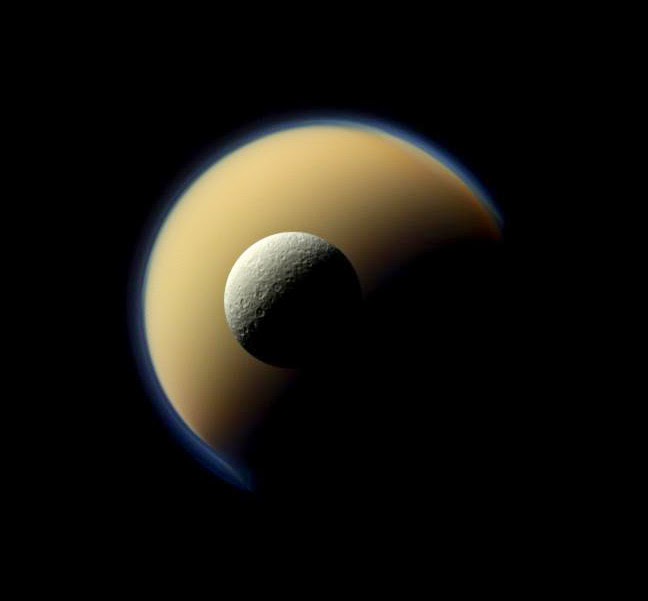
NASA Cassini: Icy rocks around Saturn - Titan and Rhea

Credit: NASA/JPL-Caltech/Space Science Institute

Earth is the only planet in our Solar System to have a single solitary moon.

While others, such as Mercury and Venus, have none, the gas giants have accumulated crowds of orbiting bodies, Saturn, for example, boasts an impressive 62 moons!

This image, taken by the Cassini orbiter, shows its two biggest: Rhea and its larger companion Titan.

Titan's diameter, at 5150 km, is 50% larger than that of our Moon, while Rhea is somewhat smaller at 1528 km across.

Although Rhea's pitted and cratered appearance contrasts sharply with the faint golden glow of Titan, the moons are quite similar in composition, containing a mixture of rock and water ice.

Rhea is thought to comprise three quarters ice and one quarter rock.

Observations with Cassini have determined that Rhea does not contain a distinct rocky core, instead, it is made up of rock and ice mixed together, giving it its 'dirty snowball' appearance.

Titan's orange hue is a result of its atmosphere. It is the only body in the Solar System other than Earth to have a thick, nitrogen-rich atmosphere, which in Titan's case also contains substances like methane, hydrogen and hydrocarbons.

These molecules form via reactions with sunlight high up in Titan's atmosphere, eventually settling to lower altitudes to form an orange-hued smog.

In some images Titan's upper atmosphere takes on a layered appearance, with 'stripes' of haze stacked on top of one another in an onion-like fashion.

This Cassini image shows one such layer, a hazy band of blue encircling Titan.

This haze runs all the way around the moon, and brightens in two crescent-shaped areas over the polar regions to form 'polar hoods'.

These hoods are swirling, high-altitude areas of denser gas. Titan's north polar hood can be seen towards the upper right of the image, and its corresponding southern hood lies towards the lower left of the moon.

These polar hoods are seasonal, growing and dissipating with the changing seasons. Seasons on Saturn and its accompanying moons last for around seven years.

When Cassini arrived in the Saturn system in 2004 Titan already had a thick hood above its north pole, which was experiencing winter.

After the Saturnian equinox in August 2009, Titan's northern hemisphere began moving into spring, and its southern latitudes headed into autumn.

Accompanying this seasonal shift was the appearance of a polar vortex above Titan's south pole. In 2012 Cassini snapped multiple images of this vortex as it swirled round furiously, completing a full rotation in just nine hours.

While the Cassini mission has spent much time studying Titan, it has also performed numerous flybys of Rhea, passing close to the moon four times to probe its interior structure, gravitational pull and surface characteristics.

These encounters showed Rhea to be an ancient and heavily cratered body, bearing numerous pocks and scars from past impacts.

This is something that astronomers want to explore by studying Rhea; measuring the dusty debris flying up from Rhea's surface may help us to understand more about the rate of meteoroid bombardments and amount of cosmic debris raining down on the Saturnian system.

This true-colour image is made with exposures taken on 16 June 2011 using red, green and blue filters on Cassini's narrow-angle camera.

Friday, October 31, 2014

NASA Cassini sunny Hydrocarbon seas on Titan

This near-infrared, colour mosaic from NASA's Cassini spacecraft shows the sun glinting off of Titan's north polar seas.

While Cassini has captured, separately, views of the polar seas and the sun glinting off of them in the past, this is the first time both have been seen together in the same view.

The sunglint, also called a specular reflection, is the bright area near the 11 o'clock position at upper left.

This mirror-like reflection, known as the specular point, is in the south of Titan's largest sea, Kraken Mare, just north of an island archipelago separating two separate parts of the sea.

This particular sunglint was so bright as to saturate the detector of Cassini's Visual and Infrared Mapping Spectrometer (VIMS) instrument, which captures the view.

It is also the sunglint seen with the highest observation elevation so far, the sun was a full 40 degrees above the horizon as seen from Kraken Mare at this time, much higher than the 22 degrees seen in PIA18433.

Because it was so bright, this glint was visible through the haze at much lower wavelengths than before, down to 1.3 microns.

The southern portion of Kraken Mare (the area surrounding the specular feature toward upper left) displays a "bathtub ring," a bright margin of evaporate deposits, which indicates that the sea was larger at some point in the past and has become smaller due to evaporation.

The deposits are material left behind after the methane & ethane liquid evaporates, somewhat akin to the saline crust on a salt flat.

The highest resolution data from this flyby, the area seen immediately to the right of the sunglint, cover the labyrinth of channels that connect Kraken Mare to another large sea, Ligeia Mare.

Ligeia Mare itself is partially covered in its northern reaches by a bright, arrow-shaped complex of clouds.

The clouds are made of liquid methane droplets, and could be actively refilling the lakes with rainfall.

The view was acquired during Cassini's August 21, 2014, flyby of Titan, also referred to as "T104" by the Cassini team.

The view contains real colour information, although it is not the natural color the human eye would see.

Here, red in the image corresponds to 5.0 microns, green to 2.0 microns, and blue to 1.3 microns.

These wavelengths correspond to atmospheric windows through which Titan's surface is visible. The unaided human eye would see nothing but haze.

Credit: NASA/JPL-Caltech/University of Arizona/University of Idaho

Wednesday, October 1, 2014

NASA Cassini: Titan's Gigantic polar clouds of hydrogen cyanide

Titan's hazy orange globe hangs before the Cassini spacecraft. 

Image credit NASA/JPL/Space Science Institute.

Gigantic polar clouds of hydrogen cyanide roughly four times the area of the UK are part of the impressive atmospheric diversity of Titan, the largest moon of Saturn, a new study led by Leiden Observatory, the Netherlands Institute for Space Research and the University of Bristol has found.

The research is published today in Nature.

Titan is unique in our solar system because of its dense nitrogen-methane atmosphere, which is very similar to Earth's in some ways, but very different in others.

For example, air temperatures are around 200 degrees colder and, in contrast to the warm salt water seas of Earth, frigid hydrocarbon lakes populate Titan's surface.

Titan has seasons just like Earth, only each season lasts over seven years instead of three months due to its ponderous orbit around the Sun.

After equinox in 2009, Titan's south pole entered the perpetual darkness of polar winter. Soon after, instruments on NASA's Cassini spacecraft observed the development of a gigantic polar cloud covering over one million square kilometres, roughly four times the area of the UK.

Bristol researcher and co-author Dr Nick Teanby said: "The cloud was first seen in images from Cassini's cameras taken in 2012."

"It started off quite small but soon grew to cover the entire south polar region. This was totally unexpected and set us puzzling over what the cloud could be made of."

"Unfortunately, while the images showed that the cloud was very high up, at over 250km above the surface, they did not allow us to figure out what the cloud was actually made of or why it was there."

For the next two years Cassini gathered more data including infrared spectra of the cloudy region.

Lead author Remco de Kok said: "When we looked at the spectra, we saw two large peaks that weren't present in spectra of other places on Titan."

"These peaks coincided exactly with the peaks you'd expect from ice particles of hydrogen cyanide, or 'blauwzuur' (blue acid) as it's known in the Netherlands, which is highly toxic."

"This was very surprising to us, since we did not expect HCN ice to be able to form so high in Titan's atmosphere."

This new research suggests that Titan's south pole must be extremely cold to allow hydrogen cyanide to condense.

In fact, the upper atmosphere must have cooled by over 50 degrees in less than a year to reach a blisteringly cold -150C.

Remco de Kok concluded: "This is a very rapid change given Titan's long annual cycle and is much colder than previously thought possible."

"It suggests that once the pole is in shadow the upper atmosphere acts as a very efficient radiator of heat, perhaps due to the high abundance of exotic hydrocarbon and nitrogen based compounds, which emit strongly in the infrared."

"Cassini is set to continue observing Titan until it takes a dive into Saturn at the end of its mission in 2017. It will be fascinating to see how the cloud will develop."

More information: HCN ice in Titan's high-altitude southern polar cloud, Nature, dx.doi.org/10.1038/nature13789

Monday, September 29, 2014

Cassini captures evolution of mysterious feature in Titan sea - Video

These three images, created from Cassini Synthetic Aperture Radar (SAR) data, show the appearance and evolution of a mysterious feature in Ligeia Mare, one of the largest hydrocarbon seas on Saturn's moon Titan. 

Credit: NASA/JPL-Caltech/ASI/Cornell


NASA's Cassini spacecraft is monitoring the evolution of a mysterious feature in a large hydrocarbon sea on Saturn's moon Titan.

The feature covers an area of about 100 square miles (260 square kilometers) in Ligeia Mare, one of the largest seas on Titan.

It has now been observed twice by Cassinis radar experiment, but its appearance changed between the two apparitions.

The mysterious feature, which appears bright in radar images against the dark background of the liquid sea, was first spotted during Cassini's July 2013 Titan flyby.

Ligeia Mare on Titan. 

Credit: NASA Cassini

Previous observations showed no sign of bright features in that part of Ligeia Mare.

Scientists were perplexed to find the feature had vanished when they looked again, over several months, with low-resolution radar and Cassini's infrared imager (VIMS).

This led some team members to suggest it might have been a transient feature, but during Cassini's flyby on August 21, 2014, the feature was again visible, and its appearance had changed during the 11 months since it was last seen.

Scientists on the radar team are confident that the feature is not an artifact, or flaw, in their data, which would have been one of the simplest explanations.

They also do not see evidence that its appearance results from evaporation in the sea, as the overall shoreline of Ligeia Mare has not changed noticeably.

The team has suggested the feature could be surface waves, rising bubbles, floating solids, solids suspended just below the surface, or perhaps something more exotic.

The researchers suspect that the appearance of this feature could be related to changing seasons on Titan, as summer draws near in the moon's northern hemisphere.

Monitoring such changes is a major goal for Cassini's current extended mission.

"Science loves a mystery, and with this enigmatic feature, we have a thrilling example of ongoing change on Titan," said Stephen Wall, the deputy team lead of Cassini's radar team, based at NASA's Jet Propulsion Laboratory in Pasadena, California.

"We're hopeful that we'll be able to continue watching the changes unfold and gain insights about what's going on in that alien sea."

More information: Images of the feature taken during the Cassini flybys are available at: photojournal.jpl.nasa.gov/catalog/PIA18430

Thursday, September 18, 2014

On Titan, Methane Rain Transforms Into Icy Reservoirs

An artist's cross-section of the surface and subsurface of Titan.

The porous icy crust would allow the creation of a new reservoir formed by compounds known as clathrates

The two would interact, changing the composition of the surface body. 

Credit: ESA/ATG medialab


Compounds in the icy crust of Saturn's moon Titan may be slowly changing the composition of the liquid methane lakes and seas at its surface.

According to a new study, clathratescrystal structures in the icy crust of Titan, could mix with liquid from underground reservoirs, changing the makeup of the bodies of liquid created by hydrocarbon rainfall.

The shifting composition could allow scientists to understand more about processes going on deep underground by studying the surface.

"We knew that a significant fraction of the lakes on Titan's surface might possibly be connected with hidden bodies of liquid beneath Titan's crust, but we just didn't know how they would interact," lead author of the study Oliver Mousis, of the University of Franche-Comte in France, said in a statement.

"Now, we have a better idea of what these hidden lakes or oceans could be like."


Not long after it reached Saturn in 2004, NASA and the European Space Agency's Cassini spacecraft spotted the first of the known lakes and seas on the planet's large moon Titan.

Instead of water, these bodies of liquid are filled with organic compounds known as hydrocarbons, which include methane.

Other reservoirs are thought to house icy material beneath the surface. Most of the hundreds of lakes and seas known today are found in the moon's north polar region.

Rainfall from clouds in Titan's atmosphere seems to feed the lakes and seas, but scientists aren't certain how the liquids move through the crust and atmosphere.

Working with colleagues from Cornell University in New York and NASA's Jet Propulsion Laboratory in California, Mousis modeled how liquid hydrocarbons in a reservoir beneath the surface might spread through the moon's icy crust.

They determined that the formation of materials known as clathrates could change the composition of the rainfall runoffs that charge the reservoirs.

Crystal-like structures with small cages that trap other molecules, clathrates on Titan form as liquid hydrocarbons come into contact with the water ice that dominates the moon's crust.

On Earth, clathrites are found in some polar and ocean sediments, often capturing frozen methane.

On Titan, the lattice-like clathrates could capture substances such as methane and ethane, and should remain stable up to several miles beneath the moon's surface.

Tuesday, September 2, 2014

Titan's subsurface reservoirs modify methane rainfall

Titan's subsurface reservoirs. Credit: ESA/ATG medialab

The international Cassini mission has revealed hundreds of lakes and seas spread across the icy surface of Saturn's moon Titan, mostly in its polar regions.

These lakes are filled not with water but with hydrocarbons, a form of organic compound that is also found naturally on Earth and includes methane.

While most of the liquid in the lakes is thought to be replenished by rainfall from clouds in the moon's atmosphere, the cycling of liquid throughout Titan's crust and atmosphere is still not well understood.

A recent study led by Olivier Mousis at the Université de Franche-Comté, France, and involving colleagues at Cornell University and NASA's Jet Propulsion Laboratory in the USA, probed the hydrological cycle of Titan by examining how Titan's methane rainfall would interact with icy materials within underground reservoirs.

They found that the formation of materials called clathrates changes the chemical composition of the rainfall runoff that fills these hydrocarbon reservoirs, leading to the formation of reservoirs of propane and ethane that may feed into some rivers and lakes.

"We knew that a significant fraction of the lakes on Titan's surface might be connected with hidden bodies of liquid beneath Titan's crust, but we just didn't know how they would interact", says Mousis.

"Now, we've modelled the moon's interior in great detail, and have a better idea of what these hidden lakes or oceans could be like."

Mousis and colleagues modelled how a subsurface reservoir of liquid hydrocarbons would diffuse throughout Titan's porous icy crust.

They found that this diffusion could cause a new reservoir – formed from clathrates - to form where the bottom of the original reservoir meets layers of non-porous ice.

Clathrates are compounds in which water forms a crystal structure with small cages that trap other substances like methane and ethane. On Earth, clathrates that contain methane are found in some polar and ocean sediments.

On Titan, the surface pressure and temperature allow clathrates to form when liquid hydrocarbons come into contact with water ice, a main component of the moon's crust. These clathrates could remain stable as far down as several kilometres below the surface of Titan.

Lakes on Titan. Credit: NASA/JPL/USGS

"One of the interesting properties of clathrates is that they cause fractionation, in this case, they trap and split molecules into a mix of liquid and solid phases," adds Mousis.

Because of this, astronomers have suggested that clathrates may be responsible for many unusual phenomena on Titan, including the depletion of the heavy noble gases in the moon's atmosphere, and variations in the moon's polar radius.

Monday, August 11, 2014

NASA Cassini: Saturn's moon Rhea, Epimetheus transiting

This image was taken by NASA Cassini’s narrow-angle camera on 24 March 2010, and processed by amateur astronomer Gordan Ugarković. 

A monochrome version was previously released by NASA as PIA12638: Big and Small Before Rings.

Saturn has a great many more moons than our planet, a whopping 62.

A single moon, Titan, accounts for an overwhelming 96% of all the material orbit the planet, with a group of six other smaller moons dominating the rest.

The other 55 small satellites whizzing around Saturn make up the tiny remainder along with the gas giant’s famous rings. One of the subjects of this Cassini image, Rhea, belongs to that group of six.

Set against a backdrop showing Saturn and its intricate system of icy rings, Rhea dominates the scene and dwarfs its tiny companion, one of the 55 small satellites known as Epimetheus.

Although they appear to be close to one another, this is a trick of perspective – this view was obtained when Cassini was some 1.2 million km from Rhea, and 1.6 million km from Epimetheus, meaning the moons themselves had a hefty separation of 400 000 km.

However, even if they were nearer to each other, Rhea would still loom large over Epimetheus: at 1528 km across and just under half the size of our own Moon, Rhea is well over 10 times the size of Epimetheus, which is a modest 113 km across.

As is traditional for the earliest discovered moons of Saturn, both are named after figures from Greek mythology: the Titan Rhea (“mother of the gods”) and Prometheus’ brother Epimetheus (“after thinker” or “hindsight”).

Saturday, August 9, 2014

NASA Cassini prepares for its biggest remaining burn

This is an artists concept of Cassini during the Saturn Orbit Insertion (SOI) maneuver, just after the main engine has begun firing. 

Credit: NASA/JPL

NASA's Cassini spacecraft will execute the largest planned maneuver of the spacecraft's remaining mission on Saturday, Aug. 9.

The maneuver will target Cassini toward an Aug. 21 encounter with Saturn's largest moon, Titan.

The main engine firing will last about a minute and will provide a change in velocity of 41 feet per second (12.5 meters per second).

This is the largest maneuver by Cassini in five years. No other remaining maneuver comes close, in the amount of propellant it will consume and the amount by which it will change the spacecraft's velocity.

By contrast, the smallest maneuvers Cassini routinely executes are about 0.4 inches (10 millimeters) per second.

The large size of the Aug. 9 burn is needed to begin the process of "cranking down" Cassini's orbit, so that the spacecraft circles Saturn nearer to the plane of the rings and moons.

Previously, with each Titan flyby, mission controllers adjusted the spacecraft's orbit to be increasingly inclined, carrying Cassini high above Saturn's polar regions.

The upcoming maneuver starts reversing that trend, making the orbit increasingly close to the equator.

Although Cassini has occasionally performed similar large propulsive maneuvers during its decade in the Saturn system, Titan itself has proven to be the workhorse for steering Cassini around Saturn.

It is not uncommon for the spacecraft to receive a gravitational assist, or boost, from Titan that rivals or exceeds the 96-minute engine burn Cassini performed in 2004 to insert itself into Saturn orbit.

The Cassini mission recently celebrated a decade studying Saturn, its rings, moons and magnetosphere.

Thursday, July 3, 2014

NASA Cassini: Titan's Icy Ocean has extra high salt content

Researchers found that Titan's ice shell, which overlies a very salty ocean, varies in thickness around the moon, suggesting the crust is in the process of becoming rigid. 

Credit: NASA /JPL /SSI /Univ. of Arizona /G. Mitri /University of Nantes

Scientists analyzing data from NASA Cassini mission have firm evidence the ocean inside Saturn's largest moon, Titan, might be as salty as the Earth's Dead Sea.

The new results come from a study of gravity and topography data collected during Cassini's repeated flybys of Titan during the past 10 years.

Using the Cassini data, researchers presented a model structure for Titan, resulting in an improved understanding of the structure of the moon's outer ice shell.

The findings are published in this week's edition of the journal Icarus.

"Titan continues to prove itself as an endlessly fascinating world, and with our long-lived Cassini spacecraft, we're unlocking new mysteries as fast as we solve old ones," said Linda Spilker, Cassini project scientist at NASA's Jet Propulsion Laboratory (JPL) in Pasadena, California, who was not involved in the study.

Additional findings support previous indications the moon's icy shell is rigid and in the process of freezing solid.

Researchers found that a relatively high density was required for Titan's ocean in order to explain the gravity data.

This indicates the ocean is probably an extremely salty brine of water mixed with dissolved salts likely composed of sulphur, sodium and potassium.

The density indicated for this brine would give the ocean a salt content roughly equal to the saltiest bodies of water on Earth.

"This is an extremely salty ocean by Earth standards," said the paper's lead author, Giuseppe Mitri of the University of Nantes in France.

"Knowing this may change the way we view this ocean as a possible abode for present-day life, but conditions might have been very different there in the past."

Cassini data also indicate the thickness of Titan's ice crust varies slightly from place to place.

The researchers said this can best be explained if the moon's outer shell is stiff, as would be the case if the ocean were slowly crystalizing, and turning to ice.

Otherwise, the moon's shape would tend to even itself out over time, like warm candle wax.

This freezing process would have important implications for the habitability of Titan's ocean, as it would limit the ability of materials to exchange between the surface and the ocean.

A further consequence of a rigid ice shell, according to the study, is any outgassing of methane into Titan's atmosphere must happen at scattered "hot spots," like the hot spot on Earth that gave rise to the Hawaiian Island chain.

Titan's methane does not appear to result from convection or plate tectonics recycling its ice shell.

How methane gets into the moon's atmosphere has long been of great interest to researchers, as molecules of this gas are broken apart by sunlight on short geological timescales.

Titan's present atmosphere contains about five percent methane. This means some process, thought to be geological in nature, must be replenishing the gas.

The study indicates that whatever process is responsible, the restoration of Titan's methane is localized and intermittent.

"Our work suggests looking for signs of methane outgassing will be difficult with Cassini, and may require a future mission that can find localized methane sources," said Jonathan Lunine, a scientist on the Cassini mission at Cornell University, Ithaca, New York, and one of the paper's co-authors. "As on Mars, this is a challenging task."

More information: Icarus, www.sciencedirect.com/science/… ii/S0019103514001444

Tuesday, July 1, 2014

NASA Cassini Probe Celebrates 10 Years orbiting Saturn - Video

A photo taken of Saturn by the Cassini spacecraft, which has been exploring the Saturn system for 10 years. Image uploaded June 30, 2014.

Credit: NASA/JPL

NASA spacecraft Cassini passes a big milestone, a decade exploring Saturn and its many moons.

Since arriving in orbit around Saturn 10 years ago today, the Cassini probe has made a number of unprecedented observations and discoveries.

Although the spacecraft was originally approved for a four-year mission, it has been granted three mission extensions, allowing it to continue roaming the gas giant’s system.

Linda Spilker
"Having a healthy, long-lived spacecraft at Saturn has afforded us a precious opportunity," Linda Spilker, Cassini project scientist at NASA’s Jet Propulsion Laboratory in Pasadena, California, said in a statement.

"By having a decade there with Cassini, we have been privileged to witness never-before-seen events that are changing our understanding of how planetary systems form and what conditions might lead to habitats for life."

For example, Cassini has helped scientists learn more about what kinds of molecules populate our solar system.

The spacecraft discovered plumes containing water-ice shooting out into space from the south polar region of Saturn’s moon Enceladus.


The Enceladus discovery is one of Cassini’s most remarkable findings because it marked an extension of the search for life in the solar system, NASA officials said.

Researchers know that life as we understand it relies on water, so finding the substance on a moon or planet could be a sign that life might be able to exist there.

Scientists now think that Enceldus harbors an underground ocean.

Enceladus wasn’t the only mysterious moon Cassini helped reveal. Saturn’s huge satellite Titan has also been studied by the long-lasting orbiter.

Cassini’s measurements have shown that Titan has rain, lakes, seas and rivers like Earth, NASA officials said. Unlike Earth, however, Titan is a cold world with seas of liquid methane rather than water.

The Titan-exploring Huygens probe also launched to the Saturn system with Cassini in October 1997.

The European Space Agency’s Huygens robot landed on Titan in 2005 and became the first manmade craft to land on a moon in the outer solar system.

It measured the atmosphere and beamed images of the moon back to Earth.

“The probe’s 2 hour and 27 minute descent revealed Titan to be remarkably like Earth before life evolved, with methane rain, erosion and drainage channels and dry lake beds,” NASA officials said.

“A soup of complex hydrocarbons, including benzene, was found in Titan's atmosphere.”

Saturn's moon Tethys with its prominent Odysseus Crater silently slips behind Saturn's largest moon Titan.

Cassini has also unveiled how Saturn’s rings change over time, and because of its long tenure in the planetary system, the probe has observed seasonal changes taking place on the planet and its moons, according to NASA.

Cassini will continue to beam back data to Earth for a few more years, until 2017 when it is scheduled to intentionally plunge into Saturn’s atmosphere, ending its mission.

Hydrocarbon Lakes on Titan

Tuesday, June 24, 2014

NASA JPL mission to send quadcopter drone to search for life on Titan

Although Titan's landscape presents one of the more intriguing potential habitats for life in our solar system, there are plenty of reasons to be skeptical.

The moon's seas are comprised of liquid ethane or methane, while the atmosphere is much colder than Earth's and made up of hydrogen cyanide.

While NASA Cassini probe whizzes by Saturn's moon Titan on Thursday to analyze its atmosphere, the American space agency is also considering a plan to send a quadcopter drone capable of searching for life.

The ambitious idea was outlined by Larry Matthies, a research scientist and supervisor at NASA's Jet Propulsion Lab in California, and involves a drone that would be capable of flying out of a lander or balloon.

The drone would explore the moon's landscape and seas, collect samples, and return to the "mothership" to recharge its batteries and submit whatever it collects for analysis.

If successful, the new plan could drastically change the way humans explore space.

Current rovers on Mars are akin to moving laboratories, but their grounded nature means they can be rather limited when it comes to exploring terrain.

The 22-pound drone conceived by Matthies would eliminate that barrier with flight capability, allegedly at much lower costs than other options.

As quoted by Gizmodo, he described the plan as follows: "We propose a mission study of a small (10 kg) rotorcraft that can deploy from a balloon or lander to acquire close-up, high resolution imagery and mapping data of the surface, land at multiple locations to acquire microscopic imagery and samples of solid and liquid material, return the samples to the mothership for analysis, and recharge from an RTG on the mothership to enable multiple sorties."

Matthies also noted that while this kind of plan would not have been feasible even just a few years ago, advancements in drone technology and other robotics have "revolutionized" older mission concepts, meaning sending a drone capable of exploring Titan is now a real possibility.

Options are also available regarding exactly what form the mission takes. NASA could either have the drone operate out of an airborne balloon-like mothership or out of a land-based vehicle.

"For a lander mission, it enables detailed studies of a large area around the lander, providing context for the micro-images and samples; with precision landing near a lake, it potentially enables sampling solid and liquid material from one lander," he said.

"For a balloon mission, it enables surface investigation and sampling with global reach without requiring a separate lander or that the balloon be brought to the surface, which has potential for major cost savings and risk reduction."

According to the Huffington Post, NASA has awarded Matthies' team $100,000 to continue working on designs for the unmanned concept, which includes a mothership outfitted with a nuclear reactor.

Still, any lift-off dates are still a long ways into the future. Although technology has gotten to the point where such a plan can be planned, it still needs to be developed further. The agency is hoping a launch sometime in the 2040s would be possible.


Meanwhile, NASA's Cassini probe is scheduled to fly by Titan on Thursday and bounce radio signals off its surface for the second time in two months.

The mission is intended to reveal more information about the moon's atmosphere and lakes, which could come in handy for future missions and determining whether life could exist in its hydrocarbon seas.

"We held our breath as Cassini turned to beam its radio signals at the lakes," Cassini radio science team member Essam Marouf said, referring to the May mission.

"We knew we were getting good quality data when we saw clear echoes from Titan's surface. It was thrilling."

Although Titan's landscape presents one of the more intriguing potential habitats for life in our solar system, there are plenty of reasons to be skeptical.

The moon's seas are comprised of liquid ethane or methane, while the atmosphere is much colder than Earth's and made up of hydrogen cyanide.

Cassini has, however, revealed the possibility that liquid water may exist under the moon's icy shell, and there's speculation other forms of life could be present.

Sunday, June 22, 2014

Titan: Clue to 'Magic Island' mystery on Saturn moon

The bright feature shown in the image was spotted in images from July last year, but a few days later it had vanished

Scientists have outlined their best explanations for a mysterious feature dubbed the "magic island", which has been spotted on Saturn's moon Titan.

The Cassini spacecraft captured the "island" during a flyby, but it had vanished by the time of the next pass.

The bright splodge is seen in Ligeia Mare, one of the seas of methane and ethane found at Titan's north pole.

Icebergs, waves and gas bubbling up from the sea bed are all possibilities, the scientists say.

The study by an international team has been published in the journal Nature Geoscience.

Ligeia Mare is the second largest body of liquid on the saturnian moon

Saturn's largest moon shares much in common with Earth, such as a substantial atmosphere and a seasonal cycle. Wind and rain shape the surface to form river channels, seas, dunes and shorelines.

Titan's mountains and dune fields are made of ice, rather than rock or sand, and liquid hydrocarbons take many of the roles played by water on Earth.

The seas and lakes peppering the moon's north polar region are filled with methane and ethane. These are gases on Earth, but at typical Titan temperatures of -180C, they exist in a liquid state.

Titan, seen here with Tethys in the background, is shrouded in an orange haze of organic chemicals


  • Titan is Saturn's largest moon and the second biggest in the Solar System
  • It is the only moon in the Solar System with clouds and a substantial atmosphere
  • Wind and rain create similar features to those found on Earth, such as dunes, lakes and rivers
  • But on Titan it rains liquid methane, filling the rivers, lakes and seas with hydrocarbons


The bright feature was spotted in pictures from a Cassini flyby of Titan on 10 July 2013. The "island" is absent in imagery of Ligeia Mare taken on three previous flybys.

By the time of the next pass of Titan, on 26 July, the feature had vanished, and was not visible in two subsequent flybys.

"'Magic island' is a colloquial term that we use within the team to refer to this. But we don't actually think it's an island," co-author Jason Hofgartner told reporters.

The feature appears and disappears too quickly to be a volcanic islet. So the team were left with a handful of potential explanations.

Titan's lakes and seas are thought to be filled with a mixture of liquid methane and ethane

Mr Hofgartner, who is based at Cornell University in New York, explained: "We have four different hypotheses that are all equally preferred. In no particular order they are: waves, rising bubbles, floating solids and suspended solids."

Titan operates on a 30-year seasonal cycle, and the moon's northern region is expected to become a more dynamic place as Titan approaches its summer solstice in May 2017.

"Right now, Titan is basically half way between the vernal equinox (August 2009) - at the beginning of spring - and the summer solstice, the start of summer. It's roughly equivalent to what we would consider the beginning of May," said Mr Hofgartner.

"As Titan approaches its summer, more of the Sun's energy is being deposited in the northern hemisphere."

Winds will get stronger, causing an increase in waves, which are one potential explanation for the "magic island". Researchers have already seen possible evidence for small waves on another Titan sea.

Wednesday, June 18, 2014

NASA’s Cassini Team: Titan Flybys Test their Talents

Cassini will attempt to bounce signals off of Saturn's moon Titan once more during a flyby on June 18, 2014, revealing important details about the moon's surface.

Image Credit: NASA/JPL-Caltech

As NASA’s Cassini spacecraft zooms toward Saturn’s smoggy moon Titan for a targeted flyby on June 18, mission scientists are excitedly hoping to repeat a scientific tour de force that will provide valuable new insights into the nature of the moon's surface and atmosphere.

For Cassini’s radio science team, the last flyby of Titan, on May 17, was one of the most scientifically valuable encounters of the spacecraft’s current extended mission.

The focus of that flyby, designated “T-101,” was on using radio signals to explore the physical nature of Titan’s vast northern seas and probe the high northern regions of its substantial atmosphere.

The Cassini team hopes to replicate the technical success of that flyby during the T-102 encounter, slated for June 18, during which the spacecraft will attempt similar measurements of Titan.

During closest approach, the spacecraft will be just 2,274 miles (3,659 kilometers) above the surface of the moon while travelling at 13,000 miles per hour (5.6 kilometers per second).

During the upcoming flyby, if all goes well as before, Cassini’s radio science subsystem will bounce signals off the surface of Titan, toward Earth, where they will be received by the ground stations of NASA’s Deep Space Network.

This sort of observation is known as a bistatic scattering experiment and its results can yield clues to help answer a variety of questions about large areas of Titan’s surface: Are they solid, slushy or liquid? Are they reflective? What might they be made of?

During the May encounter, Cassini beamed radio signals over the two largest bodies of liquid on Titan, seas named Ligeia Mare and Kraken Mare.

During that first attempt, scientists could not be certain the signals would successfully bounce off the lakes to be received on Earth.

They were thrilled when ground stations received specular reflections, essentially the glint, of the radio frequencies as they ricocheted off Titan.

Cassini team members react with excitement to the successful receipt of radio signals bounced off of Titan during a flyby on May 17, 2014. Image Credit: NASA/JPL-Caltech

Read the full story here.

Wednesday, May 28, 2014

NASA Cassini: Sunsets on Titan reveal the complexity of hazy exoplanets - Video

Using data collected by Cassini's Visual and Infrared Mapping Spectrometer (VIMS) while observing Titan's sunsets, researchers created simulated spectra of Titan as if it were a planet transiting across the face of a distant star. 

The research helps scientists to better understand observations of exoplanets with hazy atmospheres. 

The Cassini-Huygens mission is a cooperative project of NASA, the European Space Agency and the Italian Space Agency. 

JPL manages the mission for NASA's Science Mission Directorate, Washington. 

The California Institute of Technology (CalTech) in Pasadena manages JPL for NASA. The VIMS team is based at the University of Arizona in Tucson. 

Credit: NASA/JPL-Caltech

Scientists working with data from NASA's Cassini-Huygens mission have developed a new way to understand the atmospheres of exoplanets by using Saturn's smog-enshrouded moon Titan as a stand-in.

The new technique shows the dramatic influence that hazy skies could have on our ability to learn about these alien worlds orbiting distant stars.

Tyler Robinson
The work was performed by a team of researchers led by Tyler Robinson, a NASA Postdoctoral Research Fellow at NASA's Ames Research Center in Moffett Field, California.

The findings were published May 26 in the Proceedings of the National Academy of Sciences.

"It turns out there's a lot you can learn from looking at a sunset," Robinson said.

Light from sunsets, stars and planets can be separated into its component colors to create spectra, as prisms do with sunlight, in order to obtain hidden information.

Despite the staggering distances to other planetary systems, in recent years researchers have begun to develop techniques for collecting spectra of exoplanets.

When one of these worlds transits, or passes in front of its host star as seen from Earth, some of the star's light travels through the exoplanet's atmosphere, where it is changed in subtle, but measurable, ways.

This process imprints information about the planet that can be collected by telescopes. The resulting spectra are a record of that imprint.

Spectra enable scientists to tease out details about what exoplanets are like, such as aspects of the temperature, composition and structure of their atmospheres.

Tyler Robinson and his colleagues exploited a similarity between exoplanet transits and sunsets witnessed by the Cassini spacecraft at Titan.

These observations, called solar occultations, effectively allowed the scientists to observe Titan as a transiting exoplanet without having to leave the solar system. In the process, Titan's sunsets revealed just how dramatic the effects of hazes can be.

Multiple worlds in our own solar system, including Titan, are blanketed by clouds and high-altitude hazes. Scientists expect that many exoplanets would be similarly obscured.

Clouds and hazes create a variety of complicated effects that researchers must work to disentangle from the signature of these alien atmospheres, and thus present a major obstacle for understanding transit observations.

Due to the complexity and computing power required to address hazes, models used to understand exoplanet spectra usually simplify their effects.

"Previously, it was unclear exactly how hazes were affecting observations of transiting exoplanets," said Robinson. "So we turned to Titan, a hazy world in our own solar system that has been extensively studied by Cassini."

With Titan as their example, Robinson and colleagues found that hazes high above some transiting exoplanets might strictly limit what their spectra can reveal to planet transit observers.

The observations might be able to glean information only from a planet's upper atmosphere. On Titan, that corresponds to about 90 to 190 miles (150 to 300 kilometers) above the moon's surface, high above the bulk of its dense and complex atmosphere.

An additional finding from the study is that Titan's hazes more strongly affect shorter wavelengths, or bluer, colors of light.

Studies of exoplanet spectra have commonly assumed that hazes would affect all colours of light in similar ways. Studying sunsets through Titan's hazes has revealed that this is not the case.

Mark Marley
"People had dreamed up rules for how planets would behave when seen in transit, but Titan didn't get the memo," said Mark Marley, a co-author of the study at NASA Ames.

"It looks nothing like some of the previous suggestions, and it's because of the haze."

The team's technique applies equally well to similar observations taken from orbit around any world, not just Titan.

This means that researchers could study the atmospheres of planets like Mars and Saturn in the context of exoplanet atmospheres as well.

Curt Niebur
"It's rewarding to see that Cassini's study of the solar system is helping us to better understand other solar systems as well," said Curt Niebur, Cassini program scientist at NASA Headquarters in Washington.

More information: Titan solar-occultation observations reveal transit spectra of a hazy world, PNAS, www.pnas.org/cgi/doi/10.1073/pnas.1403473111