Showing posts with label mystery. Show all posts

Wednesday, February 11, 2015

Geologists unlock mysteries of our Earth's inner core

A research team from the University of Illinois and colleagues in China found earth's inner core has an inner core of its own, with crystals aligned in a different direction. 

Image courtesy Lachina Publishing Services.

Seismic waves are helping scientists to plumb the world's deepest mystery: the planet's inner core.

Thanks to a novel application of earthquake-reading technology, a research team at the University of Illinois and colleagues at Nanjing University in China have found that the Earth's inner core has an inner core of its own, which has surprising properties that could reveal information about our planet.

Xiaodong Song
Led by Xiaodong Song, a professor of geology at the U. of I., and visiting postdoctoral researcher Tao Wang, the team published its work in the journal Nature Geoscience on Feb. 9.

"Even though the inner core is small - smaller than the moon - it has some really interesting features," said Song.

"It may tell us about how our planet formed, its history, and other dynamic processes of the Earth. It shapes our understanding of what's going on deep inside the Earth."

Researchers use seismic waves from earthquakes to scan below the planet's surface, much like doctors use ultrasound to see inside patients.

The team used a technology that gathers data not from the initial shock of an earthquake, but from the waves that resonate in the earthquake's aftermath.

The earthquake is like a hammer striking a bell; much like a listener hears the clear tone that resonates after the bell strike, seismic sensors collect a coherent signal in the earthquake's coda.

(NB: CODA, on a recorded earthquake seismogram refers to the total length of the seismic wavetrain)

"It turns out the coherent signal enhanced by the technology is clearer than the ring itself," said Song.

"The basic idea of the method has been around for a while, and people have used it for other kinds of studies near the surface, but we are looking all the way through the center of the Earth."

Looking through the core revealed a surprise at the center of the planet, though not of the type envisioned by novelist Jules Verne.

The inner core, once thought to be a solid ball of iron, has some complex structural properties. 

The team found a distinct inner-inner core, about half the diameter of the whole inner core. 

The iron crystals in the outer layer of the inner core are aligned directionally, north-south. However, in the inner-inner core, the iron crystals point roughly east-west.

Not only are the iron crystals in the inner-inner core aligned differently, they behave differently from their counterparts in the outer-inner core.

This means that the inner-inner core could be made of a different type of crystal, or a different phase.

"The fact that we have two regions that are distinctly different may tell us something about how the inner core has been evolving," Song said.

"For example, over the history of the Earth, the inner core might have had a very dramatic change in its deformation regime. It might hold the key to how the planet has evolved. We are right in the center, literally, the center of the Earth."

Monday, January 19, 2015

Mystery radio signals recorded live from 5.5 billion light years

The mystery radio signals were observed with the Parkes radio telescope.

Credit: Swinburne Astronomy Productions

Mysterious radio signals coming from an unknown source 5.5 billion light years away have been observed live for the first time.

The fast radio bursts last just a few milliseconds, and just seven of these bright flashes have been discovered before – the first was found in 2007.

All were found retroactively by looking through old data from the Parkes radio telescope in eastern Australia and the Arecibo telescope in Puerto Rico.

However, an international team of astronomers, led by Emily Petroff from the Swinburne University of Technology, have seen a radio burst in real time.

John Mulchaey, acting director of the Carnegie Observatories, said: "These events are one of the biggest mysteries in the Universe. Until now, astronomers were not able to catch one of these events in the act."

Petroff added: "These bursts were generally discovered weeks or months or even more than a decade after they happened! We're the first to catch one in real time."

The intensity profile of the fast radio burst, showing how quickly it evolved in time, last only a few milliseconds. Before and after the burst, only noise from the sky was detected.

Credit: Swinburne Astronomy Productions

Published in the Monthly Notices of the Royal Astronomical Society, the scientists mobilised 12 telescopes around the world and in space to capture the burst.

After working out the burst location with the Parkes telescope, the others were used to make follow up observations on different wavelengths.

Daniele Malesani, astrophysicist at the University of Copenhagen, said: "Using the Swift space telescope we can observe light in the X-ray region and we saw two X-ray sources at that position."

"Then the two X-ray sources were observed using the Nordic Optical Telescope on La Palma."

Findings showed the source of the burst was located up to 5.5 billion light years from Earth.

However, the source of the radio bursts remain a mystery, the authors said. "We found out what it wasn't. The burst could have hurled out as much energy in a few milliseconds as the Sun does in an entire day," Malesani explained.

"But the fact that we did not see light in other wavelengths eliminates a number of astronomical phenomena that are associated with violent events such as gamma-ray bursts from exploding stars and supernovae, which were otherwise candidates for the burst."

Findings also suggest that the burst came from an area where there is a magnetic field because of the polarisation of light observed.

"The theories are now that the radio wave burst might be linked to a very compact type of object - such as neutron stars or black holes and the bursts could be connected to collisions or 'star quakes'. Now we know more about what we should be looking for," Malesani said.

More Information
"A real-time fast radio burst: polarization detection and multiwavelength follow-up" Monthly Notices of the Royal Astronomical Society - http://mnras.oxfordjournals.org/content/447/1/246.abstract

Thursday, November 20, 2014

Russian Mystery Space Object 2014-28E an Orbital Weapon

Orbits of debris generated one month after a 2007 Chinese anti-satellite test; the white orbit represents the International Space Station. 

In May 2014, Russia launched a mystery object that some experts say could be an anti-satellite weapon.

Credit: NASA Orbital Debris Program Office

The orbital maneuvers of a mysterious object Russia launched earlier this year have raised concerns that the satellite may be a space weapon of some sort.

The speculation centers on "Object 2014-28E," which Russia lofted along with three military communications satellites in May.

The object was originally thought to be space junk, but satellite trackers have watched it perform a number of interesting maneuvers over the past few weeks, the Financial Times reported Monday (Nov. 17).

Last weekend, for example, 2014-28E apparently met up with the remnants of a rocket stage that helped the object reach orbit.

As a result, some space analysts wonder if Object 2014-28E could be part of an anti-satellite program, perhaps a revived version of the Cold War-era "Istrebitel Sputnikov" ("satellite killer") project, which Russian officials have said was retired when the Soviet Union collapsed in the early 1990s.

Military officials have long regarded the ability to destroy or disable another country's satellites as a key national-security capability.

The Soviet Union is not the only nation known to have worked on developing such technology; China destroyed one of its own weather satellites in a 2007 test that spawned a huge cloud of orbital debris, and the United States blew up one of its own defunct spacecraft in 2008.

The concern about Object 2014-28E is legitimate, said Joan Johnson-Freese, a professor of national security affairs at the U.S. Naval War College in Newport, Rhode Island, but she cautioned against jumping to conclusions, saying that Russia could have a number of purposes in mind for the technology that 2014-28E may be testing out.

"Any satellite with the capability to maneuver has the potential to be a weapon," Johnson-Freese told reporters. "But does that mean necessarily that all maneuverable satellites are weapons? No."

The United States has also worked to develop maneuverable-satellite technology, she noted, citing the Air Force's Experimental Satellite System-11 (XSS-11) and NASA's DART (Demonstration for Autonomous Rendezvous Technology) spacecraft, both of which launched in 2005.

Further, the Defense Advanced Research Projects Agency (DARPA) managed a mission called Orbital Express, which launched in 2007 to test out satellite-servicing tech.

"When we did DART and XSS-11, other countries went into panic mode — you know, 'The U.S. has space weapons,'" Johnson-Freese said.

"The first thing we did was assuage those concerns and say, 'No, no. That's not what it is. It's just a maneuverable satellite.' But any time you have dual-use technology, there are going to be concerns."

And pretty much all space technology is dual-use, said Brian Weeden, a technical adviser with the Secure World Foundation (a nonprofit organization dedicated to space sustainability) and a former orbital analyst with the Air Force.

For example, spacecraft capable of orbital rendezvous operations could help a nation inspect, service and refuel its satellites, or de-orbit defunct craft to help mitigate the growing space-junk problem.

Weeden thinks it's unlikely that Object 2014-28E is up to anything nefarious.

"The activities are much more in line with an inspection mission than with any sort of destruction mission," he told reporters.

The secrecy surrounding the spacecraft helps fuel speculation about its mission, as does the fact that U.S.-Russian relations have deteriorated in the wake of Russia's military intervention in Ukraine this year, Weeden said.

"I think if this had happened in a different context, the speculation would be different," Weeden said.

"But because it's occurring in the context of heightened tensions, there's more of a proclivity to assume the worst."


Russia likely regards Object 2014-28E's mission as a national-security activity in space, he added. The secrecy is thus unsurprising, as Russia tends to keep a tight lid on such missions as a matter of policy.

And Russian officials may be happy to keep quiet and let the mystery and speculation continue to build, Johnson-Freese said.

"I think that anything the Russians can do to provoke the United States right now, their government is supportive of," she said. "If this can cause concern in the United States, they're all for it."

Wednesday, October 8, 2014

NRAO Radio telescopes unravel mystery of nova gamma rays

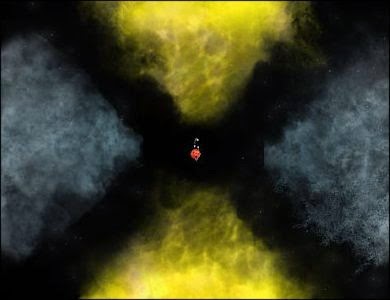
A nova does not explode like an expanding ball, but instead throws out gas in different directions at different times and different speeds. 

When this gas inevitably crashes together, it produces shocks and high-energy gamma-ray photons. 
The complex explosion and gas collisions in nova V959 Mon is illustrated here. 

In the first days of the nova explosion, dense, relatively slow-moving material is expelled along the binary star system's equator (yellow material in left panel). 

Over the next several weeks, fast winds pick up and are blown off the binary, but they are funneled along the binary star system's poles (blue material in central panel). 

The equatorial and polar material crashes together at their intersection, producing shocks and gamma-ray emission (red regions in central panel). 

Finally, at later times, the nova stops blowing a wind, and the material drifts off into space, the fireworks finished (right panel). 

Credit: Bill Saxton, NRAO/AUI/NSF

Highly-detailed radio-telescope images have pinpointed the locations where a stellar explosion called a nova emitted gamma rays, the most energetic form of electromagnetic waves.

The discovery revealed a probable mechanism for the gamma-ray emissions, which mystified astronomers when first observed in 2012.

"We not only found where the gamma rays came from, but also got a look at a previously-unseen scenario that may be common in other nova explosions," said Laura Chomiuk, of Michigan State University.

A nova occurs when a dense white dwarf star pulls material onto itself from a companion star, triggering a thermonuclear explosion that blows debris into interstellar space.

Astronomers did not expect this scenario to produce high-energy gamma rays.

However, in June of 2012, NASA's Fermi spacecraft detected gamma rays coming from a nova called V959 Mon, some 6500 light-years from Earth.

At the same time, observations with the Karl G. Jansky Very Large Array (VLA) indicated that radio waves coming from the nova probably were caused by subatomic particles moving at nearly the speed of light interacting with magnetic fields.

The high-energy gamma-ray emission, the astronomers noted, also required such fast-moving particles.

Later observations with the extremely-sharp radio "vision" of the Very Long Baseline Array (VLBA) and the European VLBI network revealed two distinct knots of radio emission. These knots then were seen to move away from each other.

This observation, along with studies made with e-MERLIN in the UK, and another round of VLA observations in 2014, provided the scientists with information that allowed them to put together a picture of how the radio knots, and the gamma rays, were produced.

In the first stage of this scenario, the white dwarf and its companion give up some of their orbital energy to boost some of the explosion material, making the ejected material move outward faster in the plane of their orbit.

Later, the white dwarf blows off a faster wind of particles moving mostly outward along the poles of the orbital plane.

When the faster-moving polar flow hits the slower-moving material, the shock accelerates particles to the speeds needed to produce the gamma rays, and the knots of radio emission.

"By watching this system over time and seeing how the pattern of radio emission changed, then tracing the movements of the knots, we saw the exact behavior expected from this scenario," Chomiuk said.

Since the 2012 outburst of V959 Mon, Fermi has detected gamma rays from three additional nova explosions.

"This mechanism may be common to such systems. The reason the gamma rays were first seen in V959 Mon is because it's close," Chomiuk said.

Because the type of ejection seen in V959 Mon also is seen in other binary-star systems, the new insights may help astronomers understand how those systems develop.

This "common envelope" phase occurs in all close binary stars, and is poorly understood.

"We may be able to use novae as a 'testbed' for improving our understanding of this critical stage of binary evolution," Chomiuk said.

Chomiuk worked with an international team of astronomers. The researchers reported their findings in the scientific journal Nature.

More information: Binary orbits as the driver of gamma-ray emission and mass ejection in classical novae , Nature, DOI: 10.1038/nature13773

Wednesday, July 2, 2014

ESA Herschel: Young sun's violent history solves meteorite mystery

An illustration of the wind blown by a newborn star. 

When the energetic particles hit the surrounding material, they may collide with atoms that are present in the star's environment, break them apart and produce new elements. 

Credit: ESA/ATG medialab

Astronomers using ESA's Herschel space observatory to probe the turbulent beginnings of a Sun-like star have found evidence of mighty stellar winds that could solve a puzzling meteorite mystery in our own back yard.

In spite of their tranquil appearance in the night sky, stars are scorching furnaces that spring to life through tumultuous processes, and our 4.5 billion-year-old Sun is no exception.

To glimpse its harsh early days, astronomers gather clues not only in the Solar System but also by studying young stars elsewhere in our Galaxy.

Using Herschel to survey the chemical composition of regions where stars are being born today, a team of astronomers has noticed that one object in particular is different.

The unusual source is a prolific stellar nursery called OMC2 FIR4, a clump of new stars embedded in a gaseous and dusty cloud near to the famous Orion Nebula.

"To our great surprise, we found that the proportion of two chemical species, one based on carbon and oxygen and the other on nitrogen, is much smaller in this object than in any other protostar we know," says Dr Cecilia Ceccarelli, of the Institute de Planétologie et d'Astrophysique de Grenoble, France, who lead the study with Dr Carsten Dominik of the University of Amsterdam in the Netherlands.

In an extremely cold environment, the measured proportion could arise by one of the two compounds freezing onto dust grains and becoming undetectable.

However, at the relatively 'high' temperature of about –200°C found in star-forming regions like OMC2 FIR4, this should not occur.

"The most likely cause in this environment is a violent wind of very energetic particles, released by at least one of the embryonic stars taking shape in this proto-stellar cocoon," Dr Ceccarelli adds.

Orion A, a star-forming nebula lying about 1500 light-years from Earth, as viewed by ESA’s Herschel space observatory.

Orion A is located within the ‘sword of Orion,’ below the three main stars that form the belt of the Orion constellation. 

Embedded in the gaseous and dusty environment of this molecular cloud is the prolific stellar nursery called OMC2 FIR4 (highlighted with a red circle). 

Astronomers studying OMC2 FIR4 with Herschel have discovered that at least one of the embryo stars that are taking shape in this protostellar cocoon is gusting a powerful wind of very energetic particles. 

The inset shows an illustration of the wind blown by this newborn star. 

When the energetic particles hit the surrounding material, they may collide with atoms that are present in the star's environment, break them apart and produce new elements. 

Our Sun likely gusted a similar wind of particles in its early days; this could explain the origin of a puzzling isotope of beryllium, whose traces are found in meteorites. 

Credit: Herschel image: ESA/Herschel/Ph. André, D. Polychroni, A. Roy, V. Könyves, N. Schneider for the Gould Belt survey Key Programme; inset and layout: ESA/ATG medialab

The most abundant molecule in star-forming clouds, hydrogen, can be broken apart by cosmic rays, energetic particles that permeate the entire Galaxy.

The hydrogen ions then combine with other elements that are present – albeit only in trace amounts – in these clouds: carbon and oxygen, or nitrogen.

Normally, the nitrogen compound is also quickly destroyed, yielding more hydrogen for the carbon and oxygen compound. As a result, the latter is far more abundant in all known stellar nurseries.

Strangely enough, though, this was not the case for OMC2 FIR4, suggesting that an additional wind of energetic particles is destroying both chemical species, keeping their abundances more similar.

Astronomers think that a similarly violent wind of particles also gusted through the early Solar System, and this discovery might finally point to an explanation for the origin of a particular chemical element seen in meteorites.

Meteorites are the remains of interplanetary debris that survived the trip through our planet's atmosphere.

These cosmic messengers are one of the few tools we have to directly probe the elements in our Solar System.

"Some elements detected in meteorites reveal that, long ago, these rocks contained a form of beryllium: this is quite puzzling, as we can't quite understand how it got there," explains Dr Dominik.

Isotope Beryllium-10 formation
The formation of the isotope Beryllium-10 in the Universe is an intricate puzzle of its own.

Astronomers know that it is not produced in the interior of stars, like some other elements, nor in the supernova explosion that happens at the end of a massive star's life.

The majority of beryllium-10 was formed in collisions of very energetic particles with heavier elements like oxygen, but since this isotope decays very quickly into other elements, it must have been produced just before it was incorporated in the rocks that would later appear on Earth as meteorites.

To trigger these reactions and produce an amount of beryllium matching that recorded in meteorites, our own Sun must have blown a violent wind in its youth.

These new observations of OMC2 FIR4 give a very strong hint that it is possible for a young star to do this.

"Observing star-forming regions with Herschel not only provides us with a view on what happens beyond our cosmic neighbourhood, but it's also a crucial way to piece together the past of our own Sun and Solar System," says Göran Pilbratt, ESA's Herschel project scientist.

More information: "Herschel finds evidence for stellar wind particles in a protostellar envelope: is this what happened to the young Sun?" by C. Ceccarelli et al. is published in The Astrophysical Journal Letters, July 2014. iopscience.iop.org/2041-8205/790/1/L1/article

Sunday, June 22, 2014

Titan: Clue to 'Magic Island' mystery on Saturn moon

The bright feature shown in the image was spotted in images from July last year, but a few days later it had vanished

Scientists have outlined their best explanations for a mysterious feature dubbed the "magic island", which has been spotted on Saturn's moon Titan.

The Cassini spacecraft captured the "island" during a flyby, but it had vanished by the time of the next pass.

The bright splodge is seen in Ligeia Mare, one of the seas of methane and ethane found at Titan's north pole.

Icebergs, waves and gas bubbling up from the sea bed are all possibilities, the scientists say.

The study by an international team has been published in the journal Nature Geoscience.

Ligeia Mare is the second largest body of liquid on the saturnian moon

Saturn's largest moon shares much in common with Earth, such as a substantial atmosphere and a seasonal cycle. Wind and rain shape the surface to form river channels, seas, dunes and shorelines.

Titan's mountains and dune fields are made of ice, rather than rock or sand, and liquid hydrocarbons take many of the roles played by water on Earth.

The seas and lakes peppering the moon's north polar region are filled with methane and ethane. These are gases on Earth, but at typical Titan temperatures of -180C, they exist in a liquid state.

Titan, seen here with Tethys in the background, is shrouded in an orange haze of organic chemicals


  • Titan is Saturn's largest moon and the second biggest in the Solar System
  • It is the only moon in the Solar System with clouds and a substantial atmosphere
  • Wind and rain create similar features to those found on Earth, such as dunes, lakes and rivers
  • But on Titan it rains liquid methane, filling the rivers, lakes and seas with hydrocarbons


The bright feature was spotted in pictures from a Cassini flyby of Titan on 10 July 2013. The "island" is absent in imagery of Ligeia Mare taken on three previous flybys.

By the time of the next pass of Titan, on 26 July, the feature had vanished, and was not visible in two subsequent flybys.

"'Magic island' is a colloquial term that we use within the team to refer to this. But we don't actually think it's an island," co-author Jason Hofgartner told reporters.

The feature appears and disappears too quickly to be a volcanic islet. So the team were left with a handful of potential explanations.

Titan's lakes and seas are thought to be filled with a mixture of liquid methane and ethane

Mr Hofgartner, who is based at Cornell University in New York, explained: "We have four different hypotheses that are all equally preferred. In no particular order they are: waves, rising bubbles, floating solids and suspended solids."

Titan operates on a 30-year seasonal cycle, and the moon's northern region is expected to become a more dynamic place as Titan approaches its summer solstice in May 2017.

"Right now, Titan is basically half way between the vernal equinox (August 2009) - at the beginning of spring - and the summer solstice, the start of summer. It's roughly equivalent to what we would consider the beginning of May," said Mr Hofgartner.

"As Titan approaches its summer, more of the Sun's energy is being deposited in the northern hemisphere."

Winds will get stronger, causing an increase in waves, which are one potential explanation for the "magic island". Researchers have already seen possible evidence for small waves on another Titan sea.

Sunday, February 16, 2014

NASA MSL: Apparent Mystery of Mars 'doughnut' rock solved

NASA image shows before-and-after of the same patch of ground in front of NASA's Mars Exploration Rover Opportunity 13 days apart documenting the arrival of a bright rock onto the scene, on January 22, 2014

NASA scientists were finally able to explain the origin of the mysterious rock shaped like a jelly doughnut that appeared near the rover Opportunity in early January.

The small, round object suddenly popped up in pictures taken 12 days apart by the US space agency's decade-old Opportunity rover.

On December 26, 2013, it was not there. On January 8, it was. But what is it?

The explanation is somewhat prosaic: the 1.5 inches (four centimeters) wide, white-rimmed, red-centered rock, dubbed Pinnacle Island, is a piece of a larger rock that was broken and moved by Opportunity's wheel in early January.

"Once we moved Opportunity a short distance, after inspecting Pinnacle Island, we could see directly uphill an overturned rock that has the same unusual appearance," said Opportunity Deputy Principal Investigator Ray Arvidson of Washington University in St. Louis on Friday.

"We drove over it. We can see the track. That's where Pinnacle Island came from."

However, the rock is unusual and scientifically significant.

A close examination with Opportunity's spectrometer showed "high levels of elements such as manganese and sulphur, suggesting these water-soluble ingredients were concentrated in the rock by the action of water," NASA said.

This image taken by the panoramic camera on Opportunity shows the rover's Moessbauer spectrometer (circular device in center).

"This may have happened just beneath the surface relatively recently," Arvidson said, "or it may have happened deeper below ground longer ago and then, by serendipity, erosion stripped away material above it and made it accessible to our wheels."

Opportunity is one of two Mars Exploration Rovers. Its companion, Spirit, stopped communicating with Earth in 2010.

Both have lived long beyond their planned 90-day missions and have made important discoveries about water on Mars and environments that might have supported microbial life in the distant past.

Sunday, February 9, 2014

Hubble: Astronomers Solve Mystery of Universe's Massive Galactic Burnouts

From telescope observations, astronomers have pieced together how massive elliptical galaxies grow over 13 billion years. 

Credit: NASA, ESA, S. Toft (Niels Bohr Institute), and A. Feild (STScl)

Using data from the Hubble Space Telescope and other observatories, astronomers are learning why some massive galaxies hit their peak young and quit making stars when the universe was less than a quarter of its current age.

Scientists have been puzzled by compact, elliptical-shaped galaxies that seem to have burned out when the universe was 3 billion years old.

For comparison, our Milky Way galaxy is 12 billion years old and still making stars.

These burnouts are sometimes nicknamed "red and dead" galaxies because of their reddish color, compared to the blue hues of star-making galaxies, according to NASA.

Strangely, these dead galaxies are just as massive as today's large spiral galaxies, but with stars squeezed into an area three times smaller.

"This means that the density of stars was 10 times greater," Sune Toft, an astrophysics and cosmology professor at the Niels Bohr Institute in Copenhagen, explained in a statement.

Sune Toft
"Furthermore, the galaxies were already dead, so they were no longer forming new stars. It was a great mystery."

These burnouts appear to have started out as intense starburst galaxies in the very early universe, quickly gobbling up all the gas around them before fading, Toft and colleagues found.

To piece together a life history of the "red and dead" galaxies, the scientists looked at infrared data from space-based telescopes and ground-based telescopes, as well as two Hubble surveys;


The burnouts shared characteristics with dust-shrouded galaxies that were rife with violent starburst activity and 1 billion to 2 billion years older, the scientists found.

These live-fast-die-young galaxies seem to quickly use up available gas for star formation and burn out.

Through merging, they eventually grow into giant elliptical galaxies in our local universe.

"We at last show how these compact galaxies can form, how it happened, and when it happened," Toft said.

"This basically is the missing piece in the understanding of how the most massive galaxies formed, and how they evolved into the giant ellipticals of today."

More Information: 'Submillimeter Galaxies as Progenitors of Compact Quiescent Galaxies' Astrophysical Journal; S. Toft et al. 2014 ApJ 782 68. doi:10.1088/0004-637X/782/2/68

Monday, January 6, 2014

Supervolcano eruption mystery solved

Supervolcanoes like Yellowstone can explode without an earthquake or other external trigger, experts have found.

The sheer volume of liquid magma is enough to cause a catastrophic super-eruption, according to an experiment at the European Synchrotron Radiation Facility (ESRF) in Grenoble.

Simulating the intense heat and pressure inside these "sleeping giants" could help predict a future disaster.

The study by a Swiss team from ETH Zurich appears in Nature Geoscience.

Lead author Wim Malfait, of ETH Zurich said: "We knew the clock was ticking but we didn't know how fast: what would it take to trigger a super-eruption?

"Now we know you don't need any extra factor - a supervolcano can erupt due to its enormous size alone.

"Once you get enough melt, you can start an eruption just like that."

There are about 20 known supervolcanoes on Earth - including Lake Toba in Indonesia, Lake Taupo in New Zealand, and the somewhat smaller Phlegraean Fields near Naples, Italy.

Super-eruptions occur rarely - only once every 100,000 years on average. But when they do occur, they have a devastating impact on Earth's climate and ecology.

When a supervolcano erupted 600,000 years ago in Wyoming, in what today is Yellowstone National Park, it ejected more than 1,000 cubic km of ash and lava into the atmosphere - enough to bury a large city to a depth of a few kilometres.

Lake Toba in Sumatra was formed during the eruption of a supervolcano 74,000 years ago

This ejection was 100 times bigger than Mount Pinatubo in the Philippines in 1992 and dwarfs even historic eruptions like Krakatoa (1883).

"This is something that, as a species, we will eventually have to deal with. It will happen in future," said Dr Malfait.

"You could compare it to an asteroid impact - the risk at any given time is small, but when it happens the consequences will be catastrophic."

Being able to predict such a catastrophe is obviously critical. But the trigger has remained elusive - because the process is different from conventional volcanoes like Pinatubo and Mount St Helens.

One possible mechanism was thought to be the overpressure in the magma chamber generated by differences between the less dense molten magma and more dense rock surrounding it.

"The effect is comparable to holding a football under water. When you release it, the air-filled ball is forced upwards by the denser water around it," said Wim Malfait, of ETH Zurich.

But whether this buoyancy effect alone was enough was not known. It could be that an an additional trigger - such as a sudden injection of magma, an infusion of water vapour, or an earthquake - was required.

More Information: dx.doi.org/10.1038/ngeo2042

Sunday, November 17, 2013

NASA MAVEN Spacecraft Launching Monday Will Probe Mars Atmosphere Mystery

Inside the Payload Hazardous Servicing Facility at NASA's Kennedy Space Center in Florida, engineers and technicians prepare the MAVEN spacecraft for encapsulation inside its payload fairing.

Credit: NASA/Kim Shiflett

MAVEN, NASA's newest Mars probe is set to launch Monday (Nov. 18), on a mission to help figure out how the Red Planet shifted from a warm and wet world long ago to the cold, dry place we know today.

The Mars Atmosphere and Volatile EvolutioN spacecraft, (MAVEN) is scheduled to lift off atop an Atlas 5 rocket from Florida's Cape Canaveral Air Force Station on Monday at 1:28 p.m. EST (1828 GMT).

After a 10-month cruise through deep space, MAVEN will start studying the Red Planet from orbit, seeking clues about how Mars lost most of its atmosphere in the ancient past. You can watch the launch live on SPACE.com via NASA TV beginning at 11 a.m. EST (1400 GMT).

"MAVEN will begin to look at those processes that tell us what happened to Mars' atmosphere, and why Mars perhaps underwent a major climate change in its past," Jim Green, head of NASA's planetary science division, told reporters in a pre-launch briefing late last month.

Tuesday, September 10, 2013

Astronomers unravel 20-year dark matter mystery with new computer models

The Fornax dwarf galaxy is one of our Milky Way’s neighbouring dwarf galaxies. 

The Milky Way is, like all large galaxies, thought to have formed from smaller galaxies in the early days of the Universe.

These small galaxies should also contain many very old stars, just as the Milky Way does, and a team of astronomers has now shown that this is indeed the case.

This image was composed from data from the Digitized Sky Survey 2. 

Credit: ESO /Digitized Sky Survey 2

Astronomers at the University of Texas at Austin believe they have discovered the answer to a 20-year debate over how the mysterious cosmic "dark matter" is distributed in small galaxies.

John Jardel 
Graduate student John Jardel and his advisor Karl Gebhardt found that the distribution, on average, follows a simple law of decreasing density from the galaxy's center, although the exact distribution often varies from galaxy to galaxy.

The findings are published today in The Astrophysical Journal Letters.

Dark matter is matter that gives off no light, but that astronomers detect by seeing its gravitational tug on other objects (like stars).

Theories abound on what dark matter might be made of—unseen particles, dead stars, and more—but nobody knows for sure.

Though mysterious, understanding the nature of dark matter is important, because it makes up most of the matter in the universe.

The only way to understand how the cosmos evolved to its present state is to decode dark matter's role.

For that reason, astronomers study the distribution of dark matter within galaxies and on even larger scales.

The Lonestar supercomputer is a resource of the Texas Advanced Computing Center (TACC) at The University of Texas at Austin. 

It is a Dell Linux cluster with 5,840 processing cores, and a peak performance of 62 teraflops (62 trillion floating-point operations per second). 

Since its launch in 2006, Lonestar has provided more than 85 million computing hours to approximately 1,100 researchers across the nation. Credit: TACC/UT-Austin

Dwarf galaxies, in particular, make great laboratories to study dark matter, Jardel says, because they contain up to 1,000 times more dark matter than normal matter.

Normal galaxies like the Milky Way, on the other hand, contain only 10 times more dark matter than normal matter.

For the past 20 years, observational astronomers and theorists have debated how dark matter is distributed in galaxies.

Observational astronomers, through their studies of telescope data, have argued that galaxies have a fairly uniform distribution of dark matter throughout.

Theorists, backed by computer simulations from the 1990s, have argued that dark matter density decreases steadily from a galaxy's core to its hinterlands. The disagreement is known as the "core/cusp debate."

Jardel's work set out to study the question using both data from telescopes and newly developed computer modeling. The project started out "not assuming core or cusp theory is right," he says, "but just asking 'what is it?.' These new models allowed us to take this approach."

Jardel used telescope observations of several of the satellite galaxies orbiting the Milky Way, including the Carina, Draco, Fornax, Sculptor, and Sextans dwarf galaxies.

The work involved running many supercomputer models for each galaxy to determine the distribution of dark matter within it, using the university's Texas Advanced Computing Center (TACC).

More information: dx.doi.org/10.1088/2041-8205/775/1/L30

Tuesday, July 23, 2013

NASA Cassini: Mystery of the missing waves on Titan

This image shows the first flash of sunlight reflected off a lake on Saturn's moon Titan. Credit: NASA/JPL/University of Arizona/DLR

One of the most shocking discoveries of the past 10 years is how much the landscape of Saturn's moon Titan resembles Earth.

Like our own blue planet, the surface of Titan is dotted with lakes and seas; it has river channels, islands, mud, rain clouds and maybe even rainbows. The giant moon is undeniably wet.

The "water" on Titan is not, however, H2O. With a surface temperature dipping 290 degrees F below zero, Titan is far too cold for liquid water.

Instead, researchers believe the fluid that sculpts Titan is an unknown mixture of methane, ethane, and other hard-to-freeze hydrocarbons.

The idea that Titan is a wet world with its own alien waters is widely accepted by planetary scientists.

Nothing else can account for the observations: NASA's Cassini spacecraft has flown by Titan more than 90 times since 2004, pinging the Moon with radar and mapping its lakes and seas.

ESA's Huygens probe parachuted to the surface of Titan in 2005, descending through humid clouds and actually landing in moist soil.

Yet something has been bothering Alex Hayes, a planetary scientist on the Cassini radar team at Cornell University.

If Titan is really so wet, he wonders, "Where are all the waves?"

Here on Earth, bodies of water are rarely still. Breezes blowing across the surface cause waves to ripple and break; raindrops striking sea surfaces also provide some roughness.

Yet on Titan, the lakes are eerily smooth, with no discernable wave action down to the millimeter scale, according to radar data from Cassini.


"We know there is wind on Titan," says Hayes. "The moon's magnificent sand dunes [prove] it."

Add to that the low gravity of Titan-only 1/7th that of Earth-which offers so little resistance to wave motion, and you have a real puzzle.

Monday, June 24, 2013

The Great White Spot: The mystery of the gigantic storm on Saturn

Above: The Great White Spot of Saturn was observed by the Cassini space probe orbiting the planet on the 26th of February 2011 and compared with the Earth in size. 

The head of the storm is amplified in the right hand part of the picture. 

Below: Map of the winds at the head of the storm, where the arrows represent the typical intensity of the wind at up to 500 km/h, is reaching maximum values of 600 km/h in certain zones. 

Credit: UPV/EHU

We now understand the nature of the giant storms on Saturn.

Through the analysis of images sent from the Cassini space probe belonging to the North American and European space agencies (NASA and ESA respectively), as well as the computer models of the storms and the examination of the clouds therein, the Planetary Sciences Group of the University of the Basque Country has managed to explain the behaviour of these storms for the very first time.

The article explaining the discovery, the lead author being Enrique García Melendo, researcher at the Fundació Observatori Esteve Duran – Institut de Ciències de l'Espai, of Catalonia, was published in Nature Geoscience.

Approximately once every Saturnian year - equivalent to 30 Earth years - an enormous storm is produced on the ringed planet and which affects the aspect of its atmosphere on a global scale.

These gigantic storms are known as Great White Spots, due to the appearance they have on the atmosphere of the planet.

The first observation of one of these was made in 1876; the Great White Spot of 2010 was the sixth one to be observed.

On this occasion the Cassini space vehicle was able to obtain very high resolution images of this great meteorological structure.

The storm initiated as a small brilliant white cloud in the middle latitudes of the northern hemisphere of the planet, and grew rapidly and remained active for more than seven months.

Over this time an amalgam of white clouds was generated which expanded to form a cloudy and turbulent ring with a surface area of thousands of millions of square kilometres.

Two year age the Planetary Sciences Group presented a first study of the storm and which was published on the front cover of Nature on the 7th of July, 2011.

Now, with this new research, the hidden secrets of the phenomenon have been revealed, studying in detail the "head" and the "focus" of the Great White Spot.

The team of astronomers analysed the images taken from the Cassini probe in order to measure the winds in the "head" of the storm, the focus where the activity originated.

In this region the storm interacts with the circulating atmosphere, forming very intense sustained winds, typically of 500 kilometres an hour.

"We did not expect to find such violent circulation in the region of the development of the storm, which is a symptom of the particularly violent interaction between the storm and the planet's atmosphere", commented Enrique García.

They were also able to determine that these storm clouds are at 40 km above the planet's own clouds.

In the upper part, a detailed image in false colour of the storm on Saturn is shown. 

The lower part is a computer simulation of the storm. 

The white clouds superimposed on the real background of the planet's clouds represent the result of the evolution in the storm's aspect on its interaction with Saturn's winds. Credit: UPV/EHU

The research revealed the mechanism that produces this phenomenology.

The team of scientists designed mathematical models capable of reproducing the storm on a computer, providing a physical explanation for the behaviour of this giant storm and for its lengthy duration.

The calculations show that the focus of the storm is deeply embedded, some 300 km above the visible clouds.

The storm transports enormous quantities of moist gas in water vapour to the highest levels of the planet, forming visible clouds and liberating enormous quantities of energy.

This injection of energy interacts violently with the dominant wind of Saturn to produce wind storms of 500 km/h.

The research also showed that, despite the enormous activity of the storm, this was not able to substantially modify the prevailing winds which blow permanently in the same direction as the Earth's parallels, but they did interact violently with them.

An important part of the computer's calculations were made thanks to the Centre de Serveis Científics i Acadèmics de Catalunya (CESCA), and the computer services at the Institut de Ciències de l'Espai (ICE), also based in the Catalan capital of Barcelona.

Apart from the curiosity of knowing the physical processes underlying the formation of these giant storms on Saturn, the study of these phenomena enable us to enhance our knowledge of the models employed in research into meteorology and the behaviour of the Earth's atmosphere, in a very different environment and impossible to simulate in a laboratory.

"The storms on Saturn are, in a way, a test bank of the physical mechanisms underlying the generation of similar meteorological phenomena on Earth", commented Agustín Sánchez Lavega, Director of the Planetary Sciences Group at the UPV/EHU.

More information: E. García-Melendo, R. Hueso, A. Sánchez-Lavega, J. Legarreta, T. del Río-Gaztelurrutia, S. Pérez-Hoyos, J. F. Sanz-Requena. Atmospheric Dynamics of Saturn's 2010 giant storm. Nature Geoscience, 2013, DOI 10.1038/ngeo1860

Thursday, May 30, 2013

Team solves the origin of the Moon's 'mascons' mystery

Free-air gravitational acceleration anomalies over the 420-km-diameter Freundlich-Sharonov impact basin on the far side of the Moon. The color scale ranges between -300 and 300 mgal.

The image is 1,000 km wide. 

Credit: H. J. Melosh, Purdue University and the NASA GRAIL team

A mystery of the moon that imperiled astronauts and spacecraft on lunar missions has been solved by a Purdue University-led team of scientists as part of NASA's GRAIL mission.

Large concentrations of mass lurk on the lunar surface hidden like coral reefs beneath the ocean waves - an unseen and devastating hazard.

These concentrations change the gravity field and can either pull a spacecraft in or push it off course, sealing its fate to a crash on the face of the moon.

Jay Melosh
"In 1968 these mass concentrations were an unwelcome discovery as scientists prepared for the Apollo landings, and they have remained a mystery ever since," said Jay Melosh, a member of the Gravity Recovery and Interior Laboratory, or GRAIL, science team who led the research.

"GRAIL has now mapped where they lay, and we have a much better understanding of how they developed. If we return to the moon, we can now navigate with great precision."

A better understanding of these features also adds clues to the moon's origin and evolution and will be useful in studying other planets where mass concentrations also are known to exist including Mars and Mercury, said Melosh, who is a distinguished professor of earth, atmospheric and planetary sciences and physics.

"We now know the ancient moon must have been much hotter than it is now and the crust thinner than we thought," he said.

"For the first time we can figure out what size asteroids hit the moon by looking at the basins left behind and the gravity signature of the areas. We now have tools to figure out more about the heavy asteroid bombardment and what the ancient Earth may have faced."

The team confirmed the standing theory that the concentrations of mass were caused by massive asteroid impacts billions of years ago and determined how these impacts changed the density of material on the moon's surface and, in turn, its gravity field.

A paper detailing the results will be published online by the journal Science on Thursday (May 30).

In addition to Melosh, Purdue team members include Andrew Freed, associate professor of earth, atmospheric and planetary sciences, and graduate students Brandon Johnson and David Blair.

Additional team members include Maria Zuber, GRAIL principal investigator and professor at the Massachusetts Institute of Technology; J. Andrews-Hanna of the Colorado School of Mines; S. Solomon of Columbia University; and the GRAIL Science Team.

"The explanation of mascons has eluded scientists for decades," Zuber said. "Since their initial discovery they have also been observed on Mars and Mercury, and by understanding their formation on the moon we have greatly advanced knowledge of how major impacts modified planetary crusts."

The mass concentrations form a target pattern with a gravity surplus at the bulls-eye surrounded by a ring of gravity deficit and an outer ring of gravity surplus.

The team found that this pattern arises as a natural consequence of crater excavation, collapse and cooling following an impact.

The team determined that the increase in density and gravitational pull at the bulls-eye was caused by lunar material melted from the heat of the asteroid impact.

The melting causes the material to become more concentrated, stronger and denser, and pulls in additional material from the surrounding areas, Melosh said.

The large asteroid impacts also caused big holes into which the surrounding lunar material collapsed.

As the cool, strong lunar crust slid into the holes it bent downward, forming a rigid, curved edge that held down the material beneath it and prevented it from fully rebounding to its original surface height.

This causes a ring with less gravitational pull because the mass is held farther below the surface, the top of which is what most influences the gravitational signature, he said.

More information: "The Origin of Lunar Mascon Basins," by H.J. Melosh et al. Science, 2013.

Monday, April 22, 2013

Boeing 787 Dreamliner Battery Problem Remains a Mystery

Boeing has admitted that it may never know what caused the battery malfunctions that resulted in all its 787 Dreamliner aircraft being grounded.

The admission came from Boeing's Larry Loftis  the general manager of the company's 787 division.

Replacement battery systems are now being fitted to all 50 Dreamliners that had been in operation with airlines around the world.

Boeing expects the planes to resume service in the coming weeks.

Boeing's Larry Loftis
'Best practice'
On Friday, US aircraft regulators approved a revamped battery design for the aircraft, paving the way for the fleet to return to the skies.

Speaking at a media briefing in London, Mr Loftis said: "It is possible we will never know the root cause.

"It is not uncommon not to have found the single root cause. So industry best practice is to look at all the potential causes and address all of them."

The groundings of all Dreamliners in January followed two major incidents concerning the plane's two lithium-ion batteries.

Firstly, on 7 January, a battery overheated and started a fire on a Japan JAL Airlines 787 at Boston's Logan International Airport.

Nine days later, an All Nippon Airways 787 had to make an emergency landing in Japan after a battery started to give off smoke.

Japan Permission
Japan's Civil Aviation Authority said final permission to resume Boeing Co's grounded Dreamliner flights may come as early as Thursday.

Boeing engineers on Monday began installing reinforced lithium-ion battery systems on the Boeing 787 jets in Japan, starting with launch customer All Nippon Airways.

That should make the first 787 ready to restart flights in about a week.

Friday, March 1, 2013

Black Hole's Mystery 'Wave' Surprises Scientists

This image is a simulation of the X-ray binary system Swift J1357.2-0933, a black hole and star system, in which the effect of a strange, vertical mystery structure are at their maximum.

CREDIT: Gabriel Perez Diaz, Instituto de Astrofisica de Canarias (Servicio MultiMedia)

Astronomers studying an unusual black hole system have spotted a never-before-seen structure in the disk of matter encircling the system.

Swift J1357.2, an X-ray binary system that regularly emits outbursts of high energy, consists of a black hole slowly consuming its companion star. Matter from the doomed star falls into the accretion disk, which surrounds the black hole, feeding it dust and gas.

While observing the system, a team of scientists noticed an unusual vertical feature traveling through the material.

"It's the first time we can resolve such [a] structure in an accretion disk, and it might be ubiquitous in X-ray binaries during the outburst state," Jesus Corral-Santana, of the Astrophysical Institute of the Canary Islands in Spain, reported.

A hidden structure
The black hole contained in Swift J1357.2 is one of the millions of stellar black holes that dot the Milky Way galaxy.

About three times as massive as the sun, the behemoth likely formed when a single star collapsed inward on itself. The resulting, city-sized body packed a great deal of mass into a tiny package, creating a strong gravitational pull on nearby dust and gas.

Located in the Virgo constellation, approximately 4,900 light-years from Earth, Swift J1357.2 also contains a small companion star, which has only a quarter the mass of the sun.

This companion star orbits the pair's center of mass every 2.8 hours, one of the shortest known orbital periods for such systems.

The black hole pulls material from the companion star into its accretion disk, occasionally emitting the X-ray bursts that enabled scientists to find this otherwise hard-to-spot system, researchers said.

Corral-Santana and his team took hundreds of optical images of the system using the Isaac Newton and the William Herschel Telescopes, both of which are in the Canary Islands.

Studying the light produced by the accretion disk, the researchers noticed a periodic dimming in the system, sometimes occurring over the course of only a few seconds.

"Since the orbital period of the system is 2.8 hours, those dips cannot be produced by eclipses of the companion star. They are much faster," Corral-Santana said.

"Therefore, they must be produced by a hidden structure placed very close to the black hole, in the inner accretion disk."

The new find can only been seen in the outer, optical portion of the accretion disk, not on the inside, where X-ray bursts originate.

The X-ray emission, which shows no periodic variation, unlike its optical counterpart, indicated a vertical structure was hiding the black hole, Corral-Santana said.

Rather than appearing at a set, predictable time, the structure shows up over a steadily increasing period, indicating a wave-like movement through the accretion disk.

"It is a wave produced in the accretion disk, moving outward," Corral-Santana said, "like the wave produced when a stone is dropped in calm water."

The wave-like feature also provides information about the orientation of the black hole.

Objects in space face Earth at a variety of angles, or inclinations. They can be seen edge-on, face-on or somewhere in between. Swift J1357.2 is the only one of 50 suspected similar black-hole systems found with an edge-on accretion disk — what scientists call a high inclination.

However, astronomers think approximately 20 percent of these systems should provide such a perspective.

In order to see the wave-like structure in the accretion disk, scientists must have such an edge-on view of the disk, or one close to it.

A view from a lower inclination, closer to face-on, would not reveal the sudden rises and falls in the total light coming from the system.

"Swift J1357.2 is the prototype of the hitherto missing population of high-inclination black holes in transient X-ray binaries," Corral-Santana said.

Because Swift J1357.2 is the first such system to allow such an edge-on view, the presence of the vertical structure takes on an added significance.

No signs of such structures appear in other similar systems, but that could result simply from their unfortunate angles.

Such structures could in fact exist in other, previously discovered transient X-ray binary systems, hidden only by their observational angles.

The findings were published online today (Feb 28) in the journal Science.