Showing posts with label Karl G. Jansky Very Large Array. Show all posts

Wednesday, October 8, 2014

NRAO Radio telescopes unravel mystery of nova gamma rays

A nova does not explode like an expanding ball, but instead throws out gas in different directions at different times and different speeds. 

When this gas inevitably crashes together, it produces shocks and high-energy gamma-ray photons. 
The complex explosion and gas collisions in nova V959 Mon is illustrated here. 

In the first days of the nova explosion, dense, relatively slow-moving material is expelled along the binary star system's equator (yellow material in left panel). 
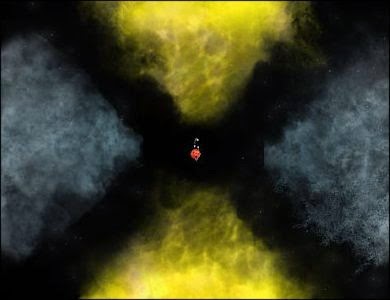
Over the next several weeks, fast winds pick up and are blown off the binary, but they are funneled along the binary star system's poles (blue material in central panel). 

The equatorial and polar material crashes together at their intersection, producing shocks and gamma-ray emission (red regions in central panel). 

Finally, at later times, the nova stops blowing a wind, and the material drifts off into space, the fireworks finished (right panel). 

Credit: Bill Saxton, NRAO/AUI/NSF

Highly-detailed radio-telescope images have pinpointed the locations where a stellar explosion called a nova emitted gamma rays, the most energetic form of electromagnetic waves.

The discovery revealed a probable mechanism for the gamma-ray emissions, which mystified astronomers when first observed in 2012.

"We not only found where the gamma rays came from, but also got a look at a previously-unseen scenario that may be common in other nova explosions," said Laura Chomiuk, of Michigan State University.

A nova occurs when a dense white dwarf star pulls material onto itself from a companion star, triggering a thermonuclear explosion that blows debris into interstellar space.

Astronomers did not expect this scenario to produce high-energy gamma rays.

However, in June of 2012, NASA's Fermi spacecraft detected gamma rays coming from a nova called V959 Mon, some 6500 light-years from Earth.

At the same time, observations with the Karl G. Jansky Very Large Array (VLA) indicated that radio waves coming from the nova probably were caused by subatomic particles moving at nearly the speed of light interacting with magnetic fields.

The high-energy gamma-ray emission, the astronomers noted, also required such fast-moving particles.

Later observations with the extremely-sharp radio "vision" of the Very Long Baseline Array (VLBA) and the European VLBI network revealed two distinct knots of radio emission. These knots then were seen to move away from each other.

This observation, along with studies made with e-MERLIN in the UK, and another round of VLA observations in 2014, provided the scientists with information that allowed them to put together a picture of how the radio knots, and the gamma rays, were produced.

In the first stage of this scenario, the white dwarf and its companion give up some of their orbital energy to boost some of the explosion material, making the ejected material move outward faster in the plane of their orbit.

Later, the white dwarf blows off a faster wind of particles moving mostly outward along the poles of the orbital plane.

When the faster-moving polar flow hits the slower-moving material, the shock accelerates particles to the speeds needed to produce the gamma rays, and the knots of radio emission.

"By watching this system over time and seeing how the pattern of radio emission changed, then tracing the movements of the knots, we saw the exact behavior expected from this scenario," Chomiuk said.

Since the 2012 outburst of V959 Mon, Fermi has detected gamma rays from three additional nova explosions.

"This mechanism may be common to such systems. The reason the gamma rays were first seen in V959 Mon is because it's close," Chomiuk said.

Because the type of ejection seen in V959 Mon also is seen in other binary-star systems, the new insights may help astronomers understand how those systems develop.

This "common envelope" phase occurs in all close binary stars, and is poorly understood.

"We may be able to use novae as a 'testbed' for improving our understanding of this critical stage of binary evolution," Chomiuk said.

Chomiuk worked with an international team of astronomers. The researchers reported their findings in the scientific journal Nature.

More information: Binary orbits as the driver of gamma-ray emission and mass ejection in classical novae , Nature, DOI: 10.1038/nature13773

Tuesday, June 3, 2014

A violent, complex scene of colliding galaxy clusters

Colliding galaxy clusters MACS J0717+3745, more than 5 billion light-years from Earth. Background is Hubble Space Telescope image; blue is X-ray image from Chandra, and red is VLA radio image. 

Credit: Van Weeren, et al.; Bill Saxton, NRAO /AUI /NSF; NASA.

Astronomers using the Karl G. Jansky Very Large Array (VLA) and the Chandra X-Ray Observatory have produced a spectacular image revealing new details of violent collisions involving at least four clusters of galaxies.

Combined with an earlier image from NASA's Hubble Space Telescope (HST), the new observations show a complex region more than 5 billion light-years from Earth where the collisions are triggering a host of phenomena that scientists still are working to understand.

The HST image forms the background of this composite, with the X-ray emission detected by Chandra in blue and radio emission seen by the VLA in red.

The X-rays indicate hot, tenuous gas that pervades the region containing the galaxy clusters.

The large, oddly-shaped red feature at the center probably is a region where shocks caused by the collisions are accelerating particles that then interact with magnetic fields and emit the radio waves.

"The complex shape of this region is unique; we've never spotted anything like this before," said Reinout van Weeren, an Einstein Fellow at the Harvard-Smithsonian Center for Astrophysics (CfA).

"The shape probably is the result of the multiple ongoing collisions," he added.

The new radio and X-ray observations are much more sensitive than previous ones, the scientists said. The combination of these images will make this region one of the best-studied examples of cluster-cluster collisions yet known, and can yield new insights on the complex interactions during cluster mergers.

Together, the merging clusters are called MACS J0717+3745, which also is one of the HST Frontier Fields for which HST will produce the deepest observations ever.

The scientists presented their findings to the American Astronomical Society's meeting in Boston, Mass.

The straight, elongated radio-emitting object is a foreground galaxy whose central black hole is accelerating jets of particles in two directions. The red object at bottom-left is a radio galaxy that probably is falling into the cluster.

Saturday, May 31, 2014

Elliptical galaxies: Chandra helps explain 'red and dead galaxies'

Credit: X-ray: NASA /Chandra CXC /Stanford Univ /N.Werner et al.

NASA's Chandra X-ray Observatory has shed new light on the mystery of why giant elliptical galaxies have few, if any, young stars.

This new evidence highlights the important role that supermassive black holes play in the evolution of their host galaxies.

Because star-forming activity in many giant elliptical galaxies has shut down to very low levels, these galaxies mostly house long-lived stars with low masses and red optical colours.

Astronomers have therefore called these galaxies "red and dead."

Previously it was thought that these red and dead galaxies do not contain large amounts of cold gas—the fuel for star formation, helping to explain the lack of young stars.

ESA's Herschel Space Observatory
However, astronomers have used ESA's Herschel Space Observatory to find surprisingly large amounts of cold gas in some giant elliptical galaxies.

In a sample of eight galaxies, six contain large reservoirs of cold gas.

This is the first time that astronomers have seen large quantities of cold gas in giant elliptical galaxies that are not located at the center of a massive galaxy cluster.

With lots of cold gas, astronomers would expect many stars to be forming in these galaxies, contrary to what is observed.

To try to understand this inconsistency, astronomers studied the galaxies at other wavelengths, including X-rays and radio waves.

The Chandra observations map the temperature and density of hot gas in these galaxies.

For the six galaxies containing abundant cold gas, including NGC 4636 and NGC 5044 shown here, the X-ray data provide evidence that the hot gas is cooling, providing a source for the cold gas observed with Herschel.

However, the cooling process stops before the cold gas condenses to form stars. What prevents the stars from forming?

A strong clue comes from the Chandra images. The hot gas in the center of the six galaxies containing cold gas appears to be much more disturbed than in the cold gas-free systems.

This is a sign that material has been ejected from regions close to the central black hole. These outbursts are possibly driven, in part, by clumpy, cold gas that has been pulled onto the black hole.

The outbursts dump most of their energy into the center of the galaxy, where the cold gas is located, preventing the cold gas from cooling sufficiently to form stars.

The other galaxies in the sample, NGC 1399 and NGC 4472, are also forming few if any stars, but they have a very different appearance. No cold gas was detected in these galaxies, and the hot gas in their central regions is much smoother.

Additionally, they have powerful jets of highly energetic particles, as shown in radio images from the National Science Foundation's Karl G. Jansky Very Large Array.

These jets are likely driven by hot gas falling towards the central supermassive black holes.

By pushing against the hot gas, the jets create enormous cavities that are observed in the Chandra images, and they may heat the hot, X-ray emitting gas, preventing it from cooling and forming cold gas and stars.

The centers of NGC 1399 and NGC 4472 look smoother in X-rays than the other galaxies, likely because their more powerful jets produce cavities further away from the center, where the X-ray emission is fainter, leaving their bright cores undisturbed.

More information: A paper describing these results was published on 24 February 2014 in Monthly Notices of the Royal Astronomical Society: mnras.oxfordjournals.org/content/439/3/2291 , Preprint: arxiv.org/abs/1310.5450

Monday, February 3, 2014

Hubble Image: Starbursting in the galaxy M82

Credit: Josh Marvil (NM Tech/NRAO), Bill Saxton (NRAO/AUI/NSF), NASA

Messier 82 (M82), the galaxy in which the nearest supernova in decades recently exploded, also is the closest galaxy that is undergoing a rapid burst of star formation, known as a starburst.

About 12 million light-years away, it is seen nearly edge-on, as shown in the larger, visible-light image from the Hubble Space Telescope.

The inset is a new radio image, made with the Karl G. Jansky Very Large Array (VLA), that reveals fresh information about the central 5,200 light-years of the galaxy.

The radio emission seen here is produced by ionized gas and by fast-moving electrons interacting with the interstellar magnetic field.

The bright dots are a mix of star-forming regions and supernova remnants, the debris from stellar explosions; analysis of the VLA data tells scientists which of these are which.

Scientists also are studying the faint, wispy features, many of which were previously unseen, to investigate their relationship with this galaxy's starburst-driven superwind.

Supernova 2014J is located outside the inset, to the right. VLA observations to date show that, like all other supernovae of its particular type, SN 2014J has not yet been found to be emitting radio waves.

Friday, October 5, 2012

Karl G. Jansky Very Large Array (VLA): Black-Hole Discovery Changes Picture of Messier 22

An unexpected discovery by astronomers using the National Science Foundation's Karl G. Jansky Very Large Array (VLA) is forcing scientists to rethink their understanding of the environment in globular star clusters, tight-knit collections containing hundreds of thousands of stars.

The astronomers used the VLA to study a globular cluster called Messier 22 (M22), a group of stars more than 10,000 light-years from Earth.

They hoped to find evidence for a rare type of black hole in the cluster's center.

They wanted to find what scientists call an intermediate-mass black hole, more massive than those a few or more times the Sun's mass, but smaller than the supermassive black holes found at the cores of galaxies.

"We didn't find what we were looking for, but instead found something very surprising -- two smaller black holes," said Laura Chomiuk, of Michigan State University and the National Radio Astronomy Observatory.

"That's surprising because most theorists said there should be at most one black hole in the cluster," she added.

Laura Chomiuk
Black holes, concentrations of mass so dense that not even light can escape them, are left over after very massive stars have exploded as supernovae.

In a globular cluster, many of these stellar-mass black holes probably were produced early in the cluster's 12-billion-year history as massive stars rapidly passed through their life cycles.

Simulations have indicated that these black holes would fall toward the center of the cluster, then begin a violent gravitational dance with each other, in which all of them or perhaps all but a single one would be thrown completely out of the cluster.

"There is supposed to be only one survivor possible," said Jay Strader, of Michigan State University and the Harvard-Smithsonian Center for Astrophysics.

Jay Strader
"Finding two black holes, instead of one, in this globular cluster definitely changes the picture," he said.

The astronomers suggest some possible explanations. First, the black holes themselves may gradually work to puff up the central parts of the cluster, reducing the density and thus the rate at which black holes eject each other through their gravitational dance.

Alternatively, the cluster may not be as far along in the process of contracting as previously thought, again reducing the density of the core.

"Future VLA observations will help us learn about the ultimate fate of black holes in globular clusters," Chomiuk said.

The two black holes discovered with the VLA were the first stellar-mass black holes to be found in any globular cluster in our own Milky Way Galaxy, and also are the first found by radio, instead of X-ray, observations.