Showing posts with label elliptical galaxies. Show all posts

Monday, January 12, 2015

ESA /NASA Hubble: The third way of galaxies - lenticular

Credit: ESA/Hubble & NASA

The subject of this image is NGC 6861, a galaxy discovered in 1826 by the famed Scottish astronomer James Dunlop.

Almost two centuries later we now know that NGC 6861 is the second brightest member of a group of at least a dozen galaxies called the Telescopium Group, otherwise known as the NGC 6868 Group, in the small constellation of Telescopium (The Telescope).

The famed Scottish astronomer James Dunlop Credit: Wiki

This NASA/ESA Hubble Space Telescope view shows some important details of NGC 6861. One of the most prominent features is the disc of dark bands circling the centre of the galaxy.

These dust lanes are a result of large clouds of dust particles obscuring the light emitted by the stars behind them.

Dust lanes are very useful for working out whether we are seeing the galaxy disc edge-on, face-on or, as is the case for NGC 6861, somewhat in the middle. Dust lanes like these are typical of a spiral galaxy.

The dust lanes are embedded in a white oval shape, which is made up of huge numbers of stars orbiting the centre of the galaxy. This oval is, rather puzzlingly, typical of an elliptical galaxy.

So which is it, spiral or elliptical? The answer is neither! NGC 6861 does not belong to either the spiral or the elliptical family of galaxies.

It is a lenticular galaxy, a family which has features of both spirals and ellipticals.

The relationships between these three kinds of galaxies are not yet well understood. A lenticular galaxy could be a faded spiral that has run out of gas and lost its arms, or the result of two galaxies merging.

Being part of a group increases the chances for galactic mergers, so this could be the case for NGC 6861.

Wednesday, September 17, 2014

ESO ALMA: Violent origins of disc galaxies probed

Each of the colourful objects in this image illustrates one of 30 merging galaxies. 

The contours in the individual galaxies indicate the dispersion of carbon monoxide while the color represents the motion of gas. 

Gas that is moving away from us appears red while the blue colour shows gas that is approaching. 

The contours together with the transition from red to blue indicate a gaseous disc that is rotating about the center of the galaxy. Credit: ALMA (ESO /NAOJ /NRAO) /SMA /CARMA /IRAM /J. Ueda et al.

For decades scientists have believed that galaxy mergers usually result in the formation of elliptical galaxies.

Now, for the the first time, researchers using the Atacama Large Millimeter/sub-millimeter Array (ALMA) and a host of other radio telescopes have found direct evidence that merging galaxies can instead form disc galaxies, and that this outcome is in fact quite common.

This surprising result could explain why there are so many spiral galaxies like the Milky Way in the Universe.

An international research group led by Junko Ueda, a Japan Society for the Promotion of Science postdoctoral fellow, has made surprising observations that most galaxy collisions in the nearby Universe, within 40 million light-years from Earth, result in so-called disc galaxies.

Disc galaxies, including spiral galaxies like the Milky Way and lenticular galaxies, are defined by pancake-shaped regions of dust and gas, and are distinct from the category of elliptical galaxies.

It has, for some time, been widely accepted that merging disc galaxies would eventually form an elliptically shaped galaxy.

During these violent interactions the galaxies do not only gain mass as they merge or cannibalise each-other, but they are also changing their shape throughout cosmic time, and therefore changing type along the way.

Computer simulations from the 1970s predicted that mergers between two comparable disc galaxies would result in an elliptical galaxy.

The simulations predict that most galaxies today are elliptical, clashing with observations that over 70% of galaxies are in fact disc galaxies.

However, more recent simulations have suggested that collisions could also form disc galaxies.


This artist’s impression shows the merger between two galaxies leading to the formation of a disc galaxy. 

Upon merging, the shape of the galaxies is disturbed by their mutual gravitational interaction and results in a galaxy with a disc structure.

Gas that is moving away from us appears red while the blue colour shows gas that is approaching. 

The contours together with the transition from red to blue indicate a gaseous disc that is rotating about the centre of the galaxy.

The movie shows the collision of two disc galaxies, but the actual shape of galaxies prior to the collision in this study is not known. Credit: NAOJ

To identify the final shapes of galaxies after mergers observationally, the group studied the distribution of gas in 37 galaxies that are in their final stages of merging.

The Atacama Large Millimeter/sub-millimeter Array (ALMA) and several other radio telescopes were used to observe emission from carbon monoxide (CO), an indicator of molecular gas.

The team's research is the largest study of molecular gas in galaxies to date and provides unique insight into how the Milky Way might have formed.

Their study revealed that almost all of the mergers show pancake-shaped areas of molecular gas, and hence are disc galaxies in the making.

Ueda explains: "For the first time there is observational evidence for merging galaxies that could result in disc galaxies. This is a large and unexpected step towards understanding the mystery of the birth of disc galaxies."

Nonetheless, there is a lot more to discover. Ueda added: "We have to start focusing on the formation of stars in these gas discs."

"Furthermore, we need to look farther out in the more distant Universe. We know that the majority of galaxies in the more distant Universe also have discs."

"We however do not yet know whether galaxy mergers are also responsible for these, or whether they are formed by cold gas gradually falling into the galaxy."

"Maybe we have found a general mechanism that applies throughout the history of the Universe."

More information: Research paper on Astro-Ph: arxiv.org/abs/1407.6873

Saturday, May 31, 2014

Elliptical galaxies: Chandra helps explain 'red and dead galaxies'

Credit: X-ray: NASA /Chandra CXC /Stanford Univ /N.Werner et al.

NASA's Chandra X-ray Observatory has shed new light on the mystery of why giant elliptical galaxies have few, if any, young stars.

This new evidence highlights the important role that supermassive black holes play in the evolution of their host galaxies.

Because star-forming activity in many giant elliptical galaxies has shut down to very low levels, these galaxies mostly house long-lived stars with low masses and red optical colours.

Astronomers have therefore called these galaxies "red and dead."

Previously it was thought that these red and dead galaxies do not contain large amounts of cold gas—the fuel for star formation, helping to explain the lack of young stars.

ESA's Herschel Space Observatory
However, astronomers have used ESA's Herschel Space Observatory to find surprisingly large amounts of cold gas in some giant elliptical galaxies.

In a sample of eight galaxies, six contain large reservoirs of cold gas.

This is the first time that astronomers have seen large quantities of cold gas in giant elliptical galaxies that are not located at the center of a massive galaxy cluster.

With lots of cold gas, astronomers would expect many stars to be forming in these galaxies, contrary to what is observed.

To try to understand this inconsistency, astronomers studied the galaxies at other wavelengths, including X-rays and radio waves.

The Chandra observations map the temperature and density of hot gas in these galaxies.

For the six galaxies containing abundant cold gas, including NGC 4636 and NGC 5044 shown here, the X-ray data provide evidence that the hot gas is cooling, providing a source for the cold gas observed with Herschel.

However, the cooling process stops before the cold gas condenses to form stars. What prevents the stars from forming?

A strong clue comes from the Chandra images. The hot gas in the center of the six galaxies containing cold gas appears to be much more disturbed than in the cold gas-free systems.

This is a sign that material has been ejected from regions close to the central black hole. These outbursts are possibly driven, in part, by clumpy, cold gas that has been pulled onto the black hole.

The outbursts dump most of their energy into the center of the galaxy, where the cold gas is located, preventing the cold gas from cooling sufficiently to form stars.

The other galaxies in the sample, NGC 1399 and NGC 4472, are also forming few if any stars, but they have a very different appearance. No cold gas was detected in these galaxies, and the hot gas in their central regions is much smoother.

Additionally, they have powerful jets of highly energetic particles, as shown in radio images from the National Science Foundation's Karl G. Jansky Very Large Array.

These jets are likely driven by hot gas falling towards the central supermassive black holes.

By pushing against the hot gas, the jets create enormous cavities that are observed in the Chandra images, and they may heat the hot, X-ray emitting gas, preventing it from cooling and forming cold gas and stars.

The centers of NGC 1399 and NGC 4472 look smoother in X-rays than the other galaxies, likely because their more powerful jets produce cavities further away from the center, where the X-ray emission is fainter, leaving their bright cores undisturbed.

More information: A paper describing these results was published on 24 February 2014 in Monthly Notices of the Royal Astronomical Society: mnras.oxfordjournals.org/content/439/3/2291 , Preprint: arxiv.org/abs/1310.5450

Tuesday, March 11, 2014

Council of Giants: Astronomers map out Earth's place in the universe

This is a diagram showing the brightest galaxies within 20 million light years of the Milky Way, as seen from above. 

The largest galaxies, here shown in yellow at different points around the dotted line, make up the "Council of Giants." 

Credit: Marshall McCall / York University

We live in a galaxy known as the Milky Way – a vast conglomeration of 300 billion stars, planets whizzing around them, and clouds of gas and dust floating in between.

Though it has long been known that the Milky Way and its orbiting companion Andromeda are the dominant members of a small group of galaxies, the Local Group, which is about 3 million light years across, much less was known about our immediate neighbourhood in the universe.

Marshall McCall
Now, a new paper by York University Physics & Astronomy Professor Marshall McCall, published today in the Monthly Notices of the Royal Astronomical Society, maps out bright galaxies within 35-million light years of the Earth, offering up an expanded picture of what lies beyond our doorstep.

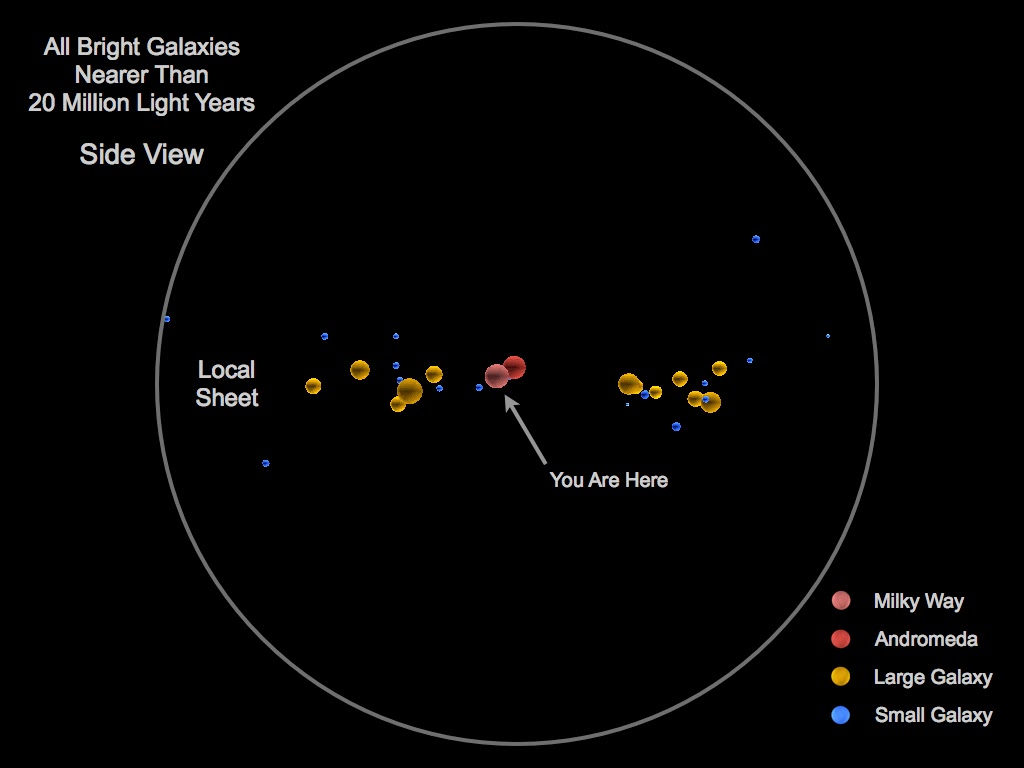
"All bright galaxies within 20 million light years, including us, are organized in a 'Local Sheet' 34-million light years across and only 1.5-million light years thick," says McCall.

"The Milky Way and Andromeda are encircled by twelve large galaxies arranged in a ring about 24-million light years across – this 'Council of Giants' stands in gravitational judgment of the Local Group by restricting its range of influence."

This is a diagram showing the brightest galaxies within 20 million light years of the Milky Way, this time viewed from the side. 

Credit: Marshall McCall / York University

McCall says twelve of the fourteen giants in the Local Sheet, including the Milky Way and Andromeda, are "spiral galaxies" which have highly flattened disks in which stars are forming.

The remaining two are more puffy "elliptical galaxies", whose stellar bulks were laid down long ago.

This movie illustrates the positions of the nearby galaxies, including those in the ‘Council of Giants’, in three dimensions. Credit: Marshall McCall / York University

Intriguingly, the two ellipticals sit on opposite sides of the Council. Winds expelled in the earliest phases of their development might have shepherded gas towards the Local Group, thereby helping to build the disks of the Milky Way and Andromeda.

McCall also examined how galaxies in the Council are spinning. He comments: "Thinking of a galaxy as a screw in a piece of wood, the direction of spin can be described as the direction the screw would move (in or out) if it were turned the same way as the galaxy rotates."

"Unexpectedly, the spin directions of Council giants are arranged around a small circle on the sky. This unusual alignment might have been set up by gravitational torques imposed by the Milky Way and Andromeda when the universe was smaller."

More Information: A Council of Giants - M.McCall, mnras.stu199

Wednesday, February 26, 2014

Pushy black holes stop elliptical galaxies from forming stars

Multi-wavelength view of the elliptical galaxy NGC 5044. Credit: Digitised Sky Survey /NASA Chandra /Southern Observatory for Astrophysical Research/Very Large Array. 

Contradicting past theories, cold gas has been found in abundance in some elliptical galaxies—showing that there must be some other explanation why these types of galaxies don't form new stars.

Astronomers believe that the jets from supermassive black holes in these galaxies' center must push around the gas and prevent stars from forming.

Researchers spotted the gas for the first time using old data from the recently retired Herschel space observatory, which was able to peer well into the infrared—where it spotted carbon ions and oxygen atoms.

This find stands against the previous belief that these galaxies were "red and dead", referring to their physical appearance and the fact that they form no new stars.

"We looked at eight giant elliptical galaxies that nobody had looked at with Herschel before and we were delighted to find that, contrary to previous belief, six out of eight abound with cold gas", stated Norbert Werner, a researcher at Stanford University in California who led the study.

"These galaxies are red, but with the giant black holes pumping in their hearts, they are definitely not dead," added Werner.

Previously, scientists thought that the galaxies got rid of their cold gas or had used it all up during a burst of earlier star formation.

With cold gas found in the majority of the sample, researchers then used other observatories to try to find warmer gas up to tens of millions of Kelvin (or Fahrenheit or Celsius).

NGC 1399, an elliptical galaxy about 65 million light years from Earth. Credit: NASA, Chandra

X-ray information from NASA's Chandra X-ray Observatory revealed that there is hot gas cooling in six of the eight galaxies, but not in the remaining two of the sample.

"This is consistent with theoretical expectations: once cooled, the hot gas would become the warm and cold gas that are observed at longer wavelengths.

However, in these galaxies the cooling process somehow stopped, and the cold gas failed to condense and form stars," the European Space Agency stated.

"While the six galaxies with plenty of cold gas harbour moderately active black holes at their centres," ESA added, "the other two show a marked difference."

"In the two galaxies without cold gas, the central black holes are accreting matter at frenzied pace, as confirmed by radio observations showing powerful jets of highly energetic particles that stem from their cores."

More information: N. Werner, J. B. R. Oonk, M. Sun, P. E. J. Nulsen, S. W. Allen, R. E. A. Canning, A. Simionescu, A. Hoffer, T. Connor, M. Donahue, A. C. Edge, A. C. Fabian, A. von der Linden, C. S. Reynolds, and M. Ruszkowski. "The origin of cold gas in giant elliptical galaxies and its role in fuelling radio-mode AGN feedback." MNRAS first published online February 24, 2014 DOI: 10.1093/mnras/stu006