Showing posts with label ESO. Show all posts

Thursday, November 6, 2014

Animation of Star's Protoplanetary Disc - Video


Artists from the European Southern Observatory (ESO) and the National Science Foundation have created impressions of a planet forming disc around a stars.

Best-Ever View of Alien Planet Birth Caught by Giant Radio Telescope


Saturday, November 1, 2014

ESO ALMA: Planet-forming Lifeline Discovered in a Binary Star System

This artist's impression shows the dust and gas around the double star system GG Tauri-A

Researchers using ALMA have detected gas in the region between two discs in this binary system. 

This may allow planets to form in the gravitationally perturbed environment of the binary. 

Half of Sun-like stars are born in binary systems, meaning that these findings will have major consequences for the hunt for exoplanets. 

Image courtesy ESO/L. Calcada

For the first time, researchers using ALMA have detected a streamer of gas flowing from a massive outer disc toward the inner reaches of a binary star system.

This never-before-seen feature may be responsible for sustaining a second, smaller disc of planet-forming material that otherwise would have disappeared long ago.

Half of Sun-like stars are born in binary systems, meaning that these findings will have major consequences for the hunt for exoplanets.

The results are published in the journal Nature on 30 October 2014.

Anne Dutrey
A research group led by Anne Dutrey from the Laboratory of Astrophysics of Bordeaux, France and CNRS used the Atacama Large Millimeter/submillimeter Array (ALMA) to observe the distribution of dust and gas in a multiple-star system called GG Tau-A.

This object is only a few million years old and lies about 450 light-years from Earth in the constellation of Taurus (The Bull).

Like a wheel in a wheel, GG Tau-A contains a large, outer disc encircling the entire system as well as an inner disc around the main central star.

This second inner disc has a mass roughly equivalent to that of Jupiter.

Its presence has been an intriguing mystery for astronomers since it is losing material to its central star at a rate that should have depleted it long ago.

While observing these structures with ALMA, the team made the exciting discovery of gas clumps in the region between the two discs.

The new observations suggest that material is being transferred from the outer to the inner disc, creating a sustaining lifeline between the two.

"Material flowing through the cavity was predicted by computer simulations but has not been imaged before. Detecting these clumps indicates that material is moving between the discs, allowing one to feed off the other," explains Dutrey.

"These observations demonstrate that material from the outer disc can sustain the inner disc for a long time. This has major consequences for potential planet formation."

Planets are born from the material left over from star birth. This is a slow process, meaning that an enduring disc is a prerequisite for planet formation.

If the feeding process into the inner disc now seen with ALMA occurs in other multiple-star systems the findings introduce a vast number of new potential locations to find exoplanets in the future.

The first phase of exoplanet searches was directed at single-host stars like the Sun. More recently it has been shown that a large fraction of giant planets orbit binary-star systems.

Now, researchers have begun to take an even closer look and investigate the possibility of planets orbiting the individual stars of multiple-star systems.

The new discovery supports the possible existence of such planets, giving exoplanet discoverers new happy hunting grounds.

Emmanuel Di Folco, co-author of the paper, concludes: "Almost half the Sun-like stars were born in binary systems. This means that we have found a mechanism to sustain planet formation that applies to a significant number of stars in the Milky Way. Our observations are a big step forward in truly understanding planet formation."

Monday, September 29, 2014

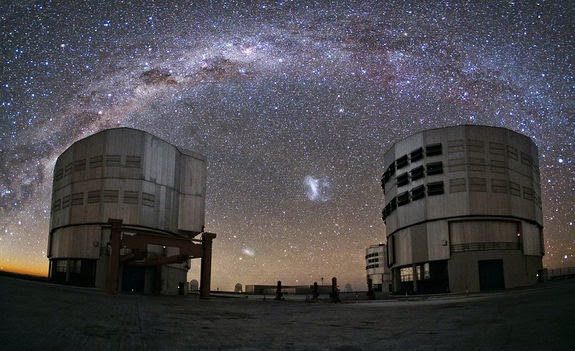
The Milky Way glitters over ESO Paranal Observatory

The Milky Way glitters over Paranal Observatory atop Cerro Paranal in Chile's high Atacama Desert in this amazing image by ESO photo ambassador Yuri Beletsky

Here, two unit telescopes with Paranal's Very Large Telescope (VLT) take center stage.

Between the two telescopes are the Large Magellanic Cloud and Small Magellenic Cloud, dwarf galaxies near our own Milky Way.

Meanwhile, the Coalsack Nebula can be spotted as a dark mark obscuring part of the Milky Way at upper left.

To see more amazing photos from the observatory, visit: Spectacular Cosmic Visions from ESO's Paranal Observatory 

Friday, September 26, 2014

ESO ALMA: Detection of organic molecule iso-propyl cyanide in interstellar clouds

The image shows dust and molecules in the central region of our galaxy. 

The background image shows the dust emission in a combination of data obtained with the APEX telescope and the Planck space observatory at a wavelength around 860 micrometers. 

The organic molecule iso-propyl cyanide with a branched carbon backbone (i-C3H7CN, left) as well as its straight-chain isomer normal-propyl cyanide (n-C3H7CN, right) were both detected with the Atacama large millimeter/submillimeter array in the star-forming region Sgr B2, about 300 light years away from the Galactic center Sgr A*. 

Credit: MPIfR/A. Weiss (background image), University of Cologne/M. Koerber (molecular models), MPIfR/A. Belloche (montage)

Scientists from the Max Planck Institute for Radio Astronomy, Cornell University, and the University of Cologne have for the first time detected a carbon-bearing molecule with a "branched" structure in interstellar space.

The molecule, iso-propyl cyanide (i-C3H7CN), was discovered in a giant gas cloud called Sagittarius B2, a region of ongoing star formation close to the center of our galaxy that is a hot-spot for molecule-hunting astronomers.

The branched structure of the carbon atoms within the iso-propyl cyanide molecule is unlike the straight-chain carbon backbone of other molecules that have been detected so far, including its sister molecule normal-propyl cyanide.

The discovery of iso-propyl cyanide opens a new frontier in the complexity of molecules found in regions of star formation, and bodes well for the presence of amino acids, for which this branched structure is a key characteristic.

The results are published in this week's issue of Science.

While various types of molecules have been detected in space, the kind of hydrogen-rich, carbon-bearing (organic) molecules that are most closely related to the ones necessary for life on Earth appear to be most plentiful in the gas clouds from which new stars are being formed.

"Understanding the production of organic material at the early stages of star formation is critical to piecing together the gradual progression from simple molecules to potentially life-bearing chemistry," says Arnaud Belloche from the Max Planck Institute for Radio Astronomy, the lead author of the paper.

The search for molecules in interstellar space began in the 1960's, and around 180 different molecular species have been discovered so far.

Each type of molecule emits light at particular wavelengths, in its own characteristic pattern, or spectrum, acting like a fingerprint that allows it to be detected in space using radio telescopes.

Until now, the organic molecules discovered in star-forming regions have shared one major structural characteristic: they each consist of a "backbone" of carbon atoms that are arranged in a single and more or less straight chain.

The new molecule discovered by the team, iso-propyl cyanide, is unique in that its underlying carbon structure branches off in a separate strand.

"This is the first ever interstellar detection of a molecule with a branched carbon backbone," says Holger Müller, a spectroscopist at the University of Cologne and co-author on the paper, who measured the spectral fingerprint of the molecule in the laboratory, allowing it to be detected in space.

But it is not just the structure of the molecule that surprised the team, it is also plentiful, at almost half the abundance of its straight-chain sister molecule, normal-propyl cyanide (n-C3H7CN), which the team had already detected using the single-dish radio telescope of the Institut de Radioastronomie Millimétrique (IRAM) a few years ago.

"The enormous abundance of iso-propyl cyanide suggests that branched molecules may in fact be the rule, rather than the exception, in the interstellar medium," says Robin Garrod, an astrochemist at Cornell University and a co-author of the paper.

The central region of the Milky Way above the antennas of the ALMA observatory

The direction to the Galactic center is halfway between Antares, the brightest star visible in the picture and the tip of an ALMA antenna in the foreground (second from right). 

Credit: Y. Beletsky (LCO)/ESO

The team used the Atacama Large Millimeter/submillimeter Array (ALMA), in Chile, to probe the molecular content of the star-forming region Sagittarius B2 (Sgr B2).

This region is located close to the Galactic Center, at a distance of about 27,000 light years from the Sun, and is uniquely rich in emission from complex interstellar organic molecules.

"Thanks to the new capabilities offered by ALMA, we were able to perform a full spectral survey toward Sgr B2 at wavelengths between 2.7 and 3.6 mm, with sensitivity and spatial resolution ten times greater than our previous survey," explains Belloche.

"But this took only a tenth of the time." The team used this spectral survey to search systematically for the fingerprints of new interstellar molecules.

"By employing predictions from the Cologne Database for Molecular Spectroscopy (CDMS), we could identify emission features from both varieties of propyl cyanide," says Müller.

As many as 50 individual features for i-propyl cyanide and even 120 for n-propyl cyanide were unambiguously identified in the ALMA spectrum of Sgr B2.

The two molecules, each consisting of 12 atoms, are also the joint-largest molecules yet detected in any star-forming region.

Journal Reference:
Arnaud Belloche, Robin T. Garrod, Holger S. P. Müller, and Karl M. Menten. "Detection of a branched alkyl molecule in the interstellar medium: iso-propyl cyanide." Science, 26 September 2014: 1584-1587 DOI: 10.1126/science.1256678

Wednesday, September 17, 2014

ESO ALMA: Violent origins of disc galaxies probed

Each of the colourful objects in this image illustrates one of 30 merging galaxies. 

The contours in the individual galaxies indicate the dispersion of carbon monoxide while the color represents the motion of gas. 

Gas that is moving away from us appears red while the blue colour shows gas that is approaching. 

The contours together with the transition from red to blue indicate a gaseous disc that is rotating about the center of the galaxy. Credit: ALMA (ESO /NAOJ /NRAO) /SMA /CARMA /IRAM /J. Ueda et al.

For decades scientists have believed that galaxy mergers usually result in the formation of elliptical galaxies.

Now, for the the first time, researchers using the Atacama Large Millimeter/sub-millimeter Array (ALMAand a host of other radio telescopes have found direct evidence that merging galaxies can instead form disc galaxies, and that this outcome is in fact quite common.

This surprising result could explain why there are so many spiral galaxies like the Milky Way in the Universe.

An international research group led by Junko Ueda, a Japan Society for the Promotion of Science postdoctoral fellow, has made surprising observations that most galaxy collisions in the nearby Universe, within 40 million light-years from Earth, result in so-called disc galaxies.

Disc galaxies, including spiral galaxies like the Milky Way and lenticular galaxies, are defined by pancake-shaped regions of dust and gas, and are distinct from the category of elliptical galaxies.

It has, for some time, been widely accepted that merging disc galaxies would eventually form an elliptically shaped galaxy.

During these violent interactions the galaxies do not only gain mass as they merge or cannibalise each-other, but they are also changing their shape throughout cosmic time, and therefore changing type along the way.

Computer simulations from the 1970s predicted that mergers between two comparable disc galaxies would result in an elliptical galaxy.

The simulations predict that most galaxies today are elliptical, clashing with observations that over 70% of galaxies are in fact disc galaxies.

However, more recent simulations have suggested that collisions could also form disc galaxies.


This artist’s impression shows the merger between two galaxies leading to the formation of a disc galaxy. 

Upon merging, the shape of the galaxies is disturbed by their mutual gravitational interaction and results in a galaxy with a disc structure.

Gas that is moving away from us appears red while the blue colour shows gas that is approaching. 

The contours together with the transition from red to blue indicate a gaseous disc that is rotating about the centre of the galaxy.

The movie shows the collision of two disc galaxies, but the actual shape of galaxies prior to the collision in this study is not known. Credit: NAOJ

To identify the final shapes of galaxies after mergers observationally, the group studied the distribution of gas in 37 galaxies that are in their final stages of merging.

The Atacama Large Millimeter/sub-millimeter Array (ALMA) and several other radio telescopes were used to observe emission from carbon monoxide (CO), an indicator of molecular gas.

The team's research is the largest study of molecular gas in galaxies to date and provides unique insight into how the Milky Way might have formed.

Their study revealed that almost all of the mergers show pancake-shaped areas of molecular gas, and hence are disc galaxies in the making.

Ueda explains: "For the first time there is observational evidence for merging galaxies that could result in disc galaxies. This is a large and unexpected step towards understanding the mystery of the birth of disc galaxies."

Nonetheless, there is a lot more to discover. Ueda added: "We have to start focusing on the formation of stars in these gas discs."

"Furthermore, we need to look farther out in the more distant Universe. We know that the majority of galaxies in the more distant Universe also have discs."

"We however do not yet know whether galaxy mergers are also responsible for these, or whether they are formed by cold gas gradually falling into the galaxy."

"Maybe we have found a general mechanism that applies throughout the history of the Universe."

More information: Research paper on Astro-Ph: arxiv.org/abs/1407.6873

Friday, September 12, 2014

Three Telescopes track laws of Nature 10 billion years ago

Astronomers have focused the three most powerful optical telescopes in the world on a single point in the sky to test one of Nature's fundamental laws.

An international team, led by researchers from Swinburne University of Technology, observed a quasar, the extremely bright surroundings of a supermassive black hole, using the ESO's Very Large Telescope (VLT) in Chile and the W M Keck Observatory and Subaru Telescope, both in Hawaii.

The quasar light passed through three different galaxies, some 10, 9 and 8 billion years ago, on its way to Earth.

These galaxies absorbed a characteristic pattern of colours out of the quasar light, revealing the strength of electromagnetism, one of Nature's four fundamental forces, in the early and distant Universe.

"We spread the light very finely into its component colours, producing a rainbow with a `barcode' pattern of missing colours."

"We can then measure electromagnetism by `reading' this barcode," said Tyler Evans, Swinburne PhD student and lead author of the new study.

"We need to compare the barcode patterns from three telescopes to be sure they're right."

Previous studies, using a large number of quasars, had found hints that electromagnetism might be different in the distant reaches of the Universe, slightly weaker or slightly stronger than on Earth.

"If that's true, we'd need a completely new understanding of fundamental physics," Mr Evans said.

"So it's crucial to triple check whether and how the telescopes are distorting the barcodes."

By comparing the barcodes, the researchers found small differences between the telescopes.

"The beauty of our method is that we can also use the barcodes themselves to correct each telescope accurately," said Swinburne Associate Professor Michael Murphy, who co-authored the work.

"Once corrected, all three telescopes gave the same answer: electromagnetism hasn't changed, within a few parts per million, over 10 billion years. I think this is the most reliable measurement of its kind so far".

The team is now making similarly careful measurements in many other galaxies.

"With our new techniques and new quasar observations recently complete, we can make the most accurate check to see whether electromagnetism's strength really is changing or not," Associate Professor Murphy said.

More information: "The UVES Large Program for testing fundamental physics - III. Constraints on the fine-structure constant from 3 telescopes." T. M. Evans, M. T. Murphy, J. B. Whitmore, T. Misawa, M. Centurion, S. D'Odorico, S. Lopez, C. J. A. P. Martins, P. Molaro, P. Petitjean, H. Rahmani, R. Srianand, M. Wendt arXiv:1409.1923 [astro-ph.CO] arxiv.org/abs/1409.1923

Wednesday, September 3, 2014

ESO Image: Lupus 4 - Cosmic Spider Swallows Starlight


A dark, spider-shaped cloud of cosmic gas blocks out light from stars in a new image taken by a telescope in the Southern Hemisphere.

The amazing photo, taken by a telescope at the European Southern Observatory's La Silla Observatory in Chile, is filled with stars glowing brightly in a variety of colours.

Red, blue, yellow and orange stars frame the gas blob called Lupus 4, which blots out light from other, more distant stars in the center of the image. Fly through the image in a new video of the Lupus 4 space cloud from ESO.

Eventually, Lupus 4, which is located about 400 light-years from Earth, could give birth to its own stars.

A dark cloud of gas called Lupus 4 blocks out more-distant stars. Photo released Sept. 3, 2014.

Credit: ESO

"How many stars might eventually start to shine within Lupus 4? It is hard to say, as mass estimates for Lupus 4 vary," ESO representatives said in a statement today (Sept. 3).

"Two studies agree on a figure of around 250 times the mass of the sun, though another, using a different method, arrives at a figure of around 1,600 solar masses."

"Either way, the cloud contains ample material to give rise to plenty of bright new stars."

"Rather as earthly clouds make way for sunshine, so, too, shall this cosmic dark cloud eventually dissipate and give way to brilliant starlight."

Another gas cloud in the same area, called Lupus 3, already hosts about 40 young stars that formed over the course of the last 3 million years, ESO said.

The spidery cloud is part of a loose star cluster named the Scorpius-Centaurus OB association, which is a young, widely dispersed star grouping, according to ESO.

The stars in the cluster also likely come from the same huge cloud of cosmic material, representatives from the astronomy organization added.

Wednesday, July 30, 2014

ESO ALMA Observatory: Young binary star system form planets with weird and wild orbits

This is ALMA data of HK Tau shown in a composite image with Hubble infrared and optical data. 

Credit: B. Saxton (NRAO/AUI/NSF); K. Stapelfeldt et al. (NASA/ESA Hubble)

Unlike our solitary Sun, most stars form in binary pairs, two stars that orbit a common center of mass.

Though remarkably plentiful, binaries pose a number of questions, including how and where planets form in such complex environments.

While surveying a series of binary stars with the Atacama Large Millimeter/submillimeter Array (ALMA), astronomers uncovered a striking pair of wildly misaligned planet-forming disks in the young binary star system HK Tau.

These results provide the clearest picture ever of proto-planetary disks around a double star and could reveal important details about the birth and eventual orbit of planets in a multiple star system.

"ALMA has given us an unprecedented view of a main star and its binary companion sporting mutually misaligned protoplanetary disks," said Eric Jensen, an astronomer at Swarthmore College in Pennsylvania.

"In fact, we may be seeing the formation of a solar system that may never settle down."

The two stars in this system, which is located approximately 450 light-years from Earth in the constellation Taurus, are less than 5 million years old and separated by about 58 billion kilometers, or 13 times the distance of Neptune from the Sun.

This system's companion star, dubbed HK Tau, appears fainter to astronomers on Earth because its disk of dust and gas blocks out much of the starlight.

The disk itself, however, can be easily observed by the starlight that it scatters at optical and near-infrared wavelengths.

The key velocity data taken with ALMA that helped the astronomers determine that the disks in HK Tau were misaligned. 

The red areas represent material moving away from Earth and the blue indicates material moving toward us. 

Credit: NASA/JPL-Caltech/R. Hurt (IPAC); ALMA (ESO/NAOJ/NRAO)

The disk around the main star, HK Tau A, is tilted in such a way that the light from its host star shines through unobscured, making it difficult for astronomers to see the disk optically.

This is not a problem for ALMA, however, which can readily detect the millimeter-wavelength light emitted by the dust and gas that comprise the disk.

With its unprecedented resolution and sensitivity, ALMA was able to fully resolve the rotation of HK Tau A's disk for the first time.

This clearer picture enabled the astronomers to calculate that the disks were misaligned, meaning they were out of sync with the orbit of their host stars, by as much as 60 degrees or more.

Rachel Akeson
"This clear misalignment has given us a remarkable look at a young binary star system," said Rachel Akeson of the NASA Exoplanet Science Institute (NEXSCI) at the California Institute of Technology in Pasadena, California.

"Though there have been hints before that this type of misaligned system exists, this is the cleanest and most striking example."

Stars and planets form out of vast clouds of dust and gas. As material in these clouds contracts under gravity, it begins to rotate until most of the dust and gas falls into a flattened proto-planetary disk swirling around a growing central protostar.

Despite forming from a flat, regular disk, planets can end up in highly eccentric orbits, and may be misaligned with the star's equator.

One theory for how planets can migrate to these unusual orbits is that a binary companion star can influence them, but only if its orbit is initially misaligned with the planets.

This is an artist's impression of the misaligned protoplanetary disks around the binary stars in HK Tau. 

Credit: R. Hurt (NASA/JPL-Caltech/IPAC)

"Our results demonstrate that the necessary conditions exist to modify planetary orbits and that these conditions are present at the time of planet formation, apparently due to the binary formation process," noted Jensen.

"We can't rule other theories out, but we can certainly rule in that a second star will do the job."

Since ALMA can see the otherwise invisible dust and gas of protoplanetary disks, it allowed for never-before-seen views of this young binary system.

"Because we're seeing this in the early stages of formation with the protoplanetary disks still in place, we can see better how things are oriented," noted Akeson. "You can simply see gas better than you can see planets."

Looking forward, the researchers want to determine if this type of system is typical or not. They note that this is a remarkable individual case, but additional surveys are needed to determine if this sort of arrangement is common throughout our Galaxy.

More information: Nature DOI: 10.1038/nature13521

Thursday, July 3, 2014

ESO: Newborn Stars Will Rip Apart Their Stellar Nursery - Video


Massive young stars that will eventually destroy their own stellar nursery shine brightly in a dazzling new photo.

Cosmic gas cloud Gum 15, which lies 3,000 light-years from Earth, is busily giving birth to huge stars that are, in turn, shaping the cloud's weird structure.

That activity will eventually lead to the nebula's death, according to representatives of the European Southern Observatory (ESO).

The cloud consists of a collection of ionized hydrogen gas (HII), hydrogen atoms whose electrons were stripped by ultraviolet light.

It also includes one of the "culprit" stars in the future murder: HD 74804, a star visible at the center of the new image.

This chart shows the location of the star formation region Gum 15 (red circle) in the southern constellation of Vela (The Sails). 

Credit: ESO, IAU and Sky & Telescope

"Once the newly minted stars have passed through their infant stages, strong winds of particles will stream away from these large stars, sculpting and dispersing the gases around them," ESO officials wrote in a statement.

"When the most massive of these stars begin to die, Gum 15 will die with them," the researchers added.

"Some stars are so large that they will go out with a bang, exploding as supernovae and dispersing the region's last traces of HII, leaving behind just a cluster of infant stars."

Astronomers believe stars form in massive clouds of material such as this one, which are known as nebulas.

Hydrogen is the most abundant element in the cosmos, and is found in Earth's own sun (along with helium, which is produced as the sun fuses hydrogen in its core).

Gum 15 is an example of a so-called "HII region." It is one of many irregular shapes spotted by scientists around the cosmos.

The nebula's weird design comes from its irregular distribution of gas and dust, ESO stated.

This richly detailed new view from the MPG/ESO 2.2-metre telescope at the La Silla Observatory in Chile shows the star formation region Gum 15. 

 Credit: ESO

Other famous examples of HII regions are found in the Eagle Nebula (home of the famous "Pillars of Creation" captured by the Hubble Space Telescope) and the Orion Nebula.

ESO captured the new image using the Wide Field Imager on the MPG/ESO 2.2-metre telescope at the La Silla Observatory in Chile. Gum 15 is located in the southern constellation Vela (the Sails).

Gum gets its name from the late Australian astronomer Colin Gum, who created a catalogue of HII regions published in 1955.

Thursday, June 5, 2014

ESO ALMA upgrade to supercharge Event Horizon Telescope

ALMA's new hydrogen maser atomic clock arrives and is ready for installation at the ALMA high site. Supplemental oxygen is used due to the thin air at that altitude (5,000 meters, 16,500 feet).

The team includes Jay Blanchard, Univ. Concepcion (left); Christophe Jacques, NRAO (front); Jack Meadows, NRAO (back); and Enrique Garcia, ALMA Correlator Group (right, partly obscured). Credit: Carlos Padilla (NRAO/AUI/NSF)


Scientists recently upgraded the Atacama Large Millimeter/submillimeter Array (ALMA) by installing an ultraprecise atomic clock at ALMA's Array Operations Site, home to the observatory's supercomputing correlator.

This upgrade will eventually allow ALMA to synchronize with a worldwide network of radio astronomy facilities collectively known as the Event Horizon Telescope (EHT).

Once assembled, the EHT, with ALMA as the largest and most sensitive site, will form an Earth-sized telescope with the magnifying power required to see details at the edge of the supermassive black hole at the center of the Milky Way.

Before ALMA can lend its unmatched capabilities to this and similar scientific observations, however, it must first transform into a different kind of instrument known as a phased array.

This new version of ALMA will allow its 66 antennas to function as a single radio dish 85 meters in diameter. It's this unified power coupled with ultraprecise timekeeping that will allow ALMA to link with other observatories.

A major milestone along this path was achieved recently when the science team performed what could be considered a "heart transplant" on the telescope by installing a custom-built atomic clock powered by a hydrogen maser.

This new timepiece uses a process similar to a laser to amplify a single pure tone, cycles of which are counted to produce a highly accurate 'tick'.

ALMA's original time reference, a clock based on rubidium gas, will be retired and used as a spare after the maser is completely integrated with ALMA's electronics.

Shep Doeleman, the principal investigator of the ALMA Phasing Project and assistant director of the Massachusetts Institute of Technology's Haystack Observatory, participated during the maser installation via remote video link.

"Once the phasing is complete, ALMA will use the ultraprecise ticking of this new atomic clock to join the aptly named Event Horizon Telescope as the most sensitive participating site, increasing sensitivity by a factor of 10," he said.


Expanding the Frontiers of Astronomy
Supermassive black holes lurk at the center of all galaxies and contain millions or even billions of times the mass of our Sun. These space-bending behemoths are so massive that nothing, not even light, can escape their gravitational influence.

Understanding how a black hole devours matter, powers jets of particles and energy, and distorts space and time are leading challenges in astronomy and physics.

The black hole at the center of the Milky Way is a 4 million solar mass giant located approximately 26,000 light-years from Earth in the direction of the constellation Sagittarius.

It is shrouded from optical telescopes by dense clouds of dust and gas, which is why observatories like ALMA, which operate at the longer millimeter and submillimeter wavelengths, are essential to study its properties.

Supermassive black holes can be relatively tranquil or they can flare up and drive incredibly powerful jets of subatomic particles deep into intergalactic space; quasars seen in the very early Universe are an extreme example.

The fuel for these jets comes from in-falling material, which becomes superheated as it spirals inward.

Astronomers hope to capture our Galaxy's central black hole in the process of actively feeding to better understand how black holes affect the evolution of our Universe and how they shape the development of stars and galaxies.

ALMA maser installation team in front of a small portion of the ALMA antennas. Left to right: Jay Blanchard, Univ. Concepcion; Jack Meadows, NRAO; Neil Nagar, Univ. Concepcion; and Christophe Jacques, NRAO. Credit: Carlos Padilla (NRAO/AUI/NSF)

A phased ALMA will arrive just in time to observe a highly anticipated cosmic event, the collision of a giant cloud of dust and gas known as G2 with our Galaxy's central supermassive black hole.

It is speculated that this collision may awaken this sleeping giant, generating extreme energy and possibly fueling a jet of subatomic particles, a highly unusual feature in a mature spiral galaxy like the Milky Way. The collision is predicted to begin in 2014 and will likely continue for more than a year.

High resolution imaging of the event horizon also could improve our understanding of how the highly ordered Universe as described by Einstein meshes with the messy and chaotic cosmos of quantum mechanics – two systems for describing the physical world that are woefully incompatible on the smallest of scales.

Other independent research will target molecules in space to determine whether or not the fundamental constants of nature have changed over cosmic time.

Saturday, May 31, 2014

Chandra Sagittarius A*: Black holes at centre of galaxies are wormholes

Credit: X-ray: NASA /UMass /D.Wang et al., IR: NASA/STScI

Zilong Li and Cosimo Bambi with Fudan University in Shanghai have come up with a very novel idea, those black holes that are believed to exist at the center of a lot of galaxies, may instead by wormholes.

They've written a paper, uploaded to the preprint server arXiv, describing their idea and how what they've imagined could be proved right (or wrong) by a new instrument soon to be added to an observatory in Chile.

Sagittarius A*: NASA's Chandra Finds Milky Way's Black Hole may be Grazing on Asteroids

Back in 1974, space scientists discovered Sagittarius A* (SgrA ∗), a bright source of radio waves emanating from what appeared to be near the center of the Milky Way galaxy.

Subsequent study of the object led scientists to believe that it was (and is) a black hole, the behaviour of stars nearby, for example, suggested it was something massive and extremely dense.

What we're able to see when we look at SgrA ∗ are plasma gasses near the event horizon, not the object itself as light cannot escape.

That should be true for wormholes too, of course, which have also been theorized to exist by the Theory of General Relativity. Einstein even noted the possibility of their existence.

GRAVITY overview. The beam combiner instrument (bottom right) is located in the VLTI laboratory. 

The infrared wavefront-sensors (bottom left) are mounted to each of the four UTs. 

The laser metrology is launched from the beam-combiner and is detected at each UT/AT (top middle).

Unfortunately, no one has ever come close to proving the existence of wormholes, which are believed to be channels between different parts of the universe, or even between two universes in multi-universe theories.

In their paper, Li and Bambi suggest that there is compelling evidence suggesting that many of the objects we believe to be black holes at the center of galaxies, may in fact be wormholes.

Plasma gases orbiting a black hole versus a wormhole should look different to us, the pair suggest, because wormholes should be a lot smaller.

Plus, the presence of wormholes would help explain how it is that even new galaxies have what are now believed to be black holes, such large black holes would presumably take a long time to become so large, so how can they exist in a new galaxy?

They can't Li and Bambi conclude, instead those objects are actually wormholes, which theory suggests could spring up in an instant, and would have, following the Big Bang.

Making the two's speculation more exciting is the soon to be installed piece of equipment known as GRAVITY, it will be added to the European Space Observatory (ESO) in Chile, giving researchers there an unprecedented view of SgrA ∗ (and other black holes).

In just a couple of years, it should be possible to prove whether Li and Bambi's idea is correct or not, the photon capture sphere of the wormhole should be much smaller than that for a black hole, they note, if that's the case with SgrA ∗, space scientists will have to do some serious rethinking of wormholes and how they might fit in to current theories describing the universe.

More information: Distinguishing black holes and wormholes with orbiting hot spots, arXiv:1405.1883

Thursday, May 1, 2014

Gamma-ray bursts (GRB): Afterglow discovery surprises scientists

Measurements of polarized light in the afterglow of GRB 120308A by the Liverpool Telescope and its RINGO2 instrument indicate the presence of a large-scale stable magnetic field linked with a young black hole, as shown in this illustration. 

Credit: NASA's Goddard Space Flight Center /S. Wiessinger

Research from an international team of scientists led by the University of Leicester has discovered for the first time that one of the most powerful events in our universe, Gamma-Ray Bursts (GRB), behave differently than previously thought.

The study, published in the prestigious scientific journal Nature, uses evidence from observation of a GRB to rule out most of the existing theoretical predictions concerning the afterglow of the explosions.

Klaas Wiersema
For Dr Klaas Wiersema, of the University of Leicester's Department of Physics and Astronomy, it was handy that he was up in the middle of the night tending to his three-year-old son which is when he got the alert that a GRB had occurred.

He said: "When a suitable GRB is detected by a satellite, I get a text message on my phone, and then I have to very quickly tell the observatory in Chile exactly which observations I want them to take, and how.

"This is usually a rather stressed and frantic few hours of working, as fast as possible, on my laptop throughout our night-time, and I remember very well that my son, who was three at the time, was up a lot that night too, so I kept on running back and forth between my laptop, my phone to call the observatory in Chile, and my son's cot!"

The effort was worth it- and has led to scientific findings that will change theoretical understandings of the afterglows of GRBs.

Dr Wiersema explains: "About once per day, a short, very bright flash of gamma-rays (the most energetic form of light) is detected by satellites. These flashes are called gamma-ray bursts (GRBs), and take place in galaxies far away, when a massive star collapses at the end of its life.

"These GRBs are followed by a so-called "afterglow", slowly fading emission that can be seen at all wavelengths (including visible light), for a few days to weeks."

"We know that the afterglow emission is formed by a shockwave, moving at very high velocities, in which electrons are being accelerated to tremendous energies."

"These fast moving electrons then produce the afterglow light that we detect.

When a massive star dies it explodes as a supernova. 

The core of the star collapses into a black hole, and in care cases a jet is formed along the rotation axis of the newly formed black hole. 

Processes in this jet emits gamma radiation, which we observe as a so-called gamma-ray burst. 

Typically gamma-ray bursts last a few minutes. 

When the jet hits material surrounding the dying star an afterglow is formed. 

New observations of the degree of polarisation of the afterglow light has shown that the afterglow behaves differently than expected 

Credit: NASA

"However, how this acceleration process actually works is very hard to study on Earth in laboratories, or using computer simulations."

"What we do, is study the polarised light of the afterglow using large optical telescopes, and special filters, that work much like the filters in Polaroid sunglasses."

Gamma-ray burst 121024A, as seen on the day of burst by ESO's Very Large Telescope (VLT) in Chile. Only a week later the source had faded completely. 

Credit: Dr Klaas WiersemaUniversity of Leicester, UK and Dr Peter Curran, ICRAR.

Dr Wiersema says it is important to remember that light is a wave, when light is linearly polarised, it means that the wave vibrations lie in a plane; and when light is circularly polarised, it means that that this plane rotates on the sky.

He added: "Different theories for electron acceleration and light emission within the afterglow all predict different levels of linear polarisation, but theories all agreed that there should be no circular polarisation in visible light."

Peter CurranICRAR
"This is where we come in: we decided to test this by carefully measuring both the linear and circular polarisation of one afterglow, of GRB 121024A, detected by the Swift satellite."

"Using the ESO Very Large Telescope (VLT) in Chile, we measured both the linear and circular polarisation of an afterglow with high accuracy."

"Much to our surprise we clearly detected circular polarisation, while theories predicted we should not see any at all."

"We believe that the most likely explanation is that the exact way in which electrons are accelerated within the afterglow shockwave is different from what we always thought."

"It is a very nice example of observations ruling out most of the existing theoretical predictions – exactly why observers like me are in this game!

More information: Paper: Circular polarisation in the optical afterglow of GRB 121024A, Nature, DOI: 10.1038/nature13237

Wednesday, April 9, 2014

ESO VLT: Chance meeting creates celestial diamond ring

Astronomers using ESO's Very Large Telescope in Chile have captured this eye-catching image of planetary nebula Abell 33. 

Created when an aging star blew off its outer layers, this beautiful blue bubble is, by chance, aligned with a foreground star, and bears an uncanny resemblance to a diamond engagement ring. 

This cosmic gem is unusually symmetric, appearing to be almost perfectly circular on the sky. 

Credit: ESO

Most stars with masses similar to that of our Sun will end their lives as white dwarfs—small, very dense, and hot bodies that slowly cool down over billions of years.

On the way to this final phase of their lives the stars throw their atmospheres out into the space and create planetary nebulae, colourful glowing clouds of gas surrounding the small, bright stellar relics.

This image, captured by ESO's Very Large Telescope (VLT), shows the remarkably round planetary nebula Abell 33, located some 1500 light-years from Earth.

Being perfectly round is uncommon for these objects—usually something disturbs the symmetry and causes the planetary nebula to display irregular shapes.

The strikingly bright star located along the rim of the nebula creates a beautiful illusion in this VLT image.


This is just a chance alignment, the star, named HD 83535, lies in the foreground of the nebula about halfway between Earth and Abell 33, in just the right place to make this view even more beautiful.

Together, HD 83535 and Abell 33 create a sparkling diamond ring.

Spectrograph (FORS) instrument
The remnant of Abell 33's progenitor star, on its way to becoming a white dwarf, can be seen just slightly off-centre inside the nebula, visible as a tiny white pearl.

It is still bright, more luminous than our own Sun and emits enough ultraviolet radiation to make the bubble of expelled atmosphere glow.

Abell 33 is just one of the 86 objects included in astronomer George Abell's 1966 Abell Catalogue of Planetary Nebulae.

Abell also scoured the skies for galaxy clusters, compiling the Abell Catalogue of over 4000 of these clusters in both the northern and southern hemispheres of the sky.

This image uses data from the FOcal Reducer and low dispersion Spectrograph (FORS) instrument attached to the VLT, which were acquired as part of the ESO Cosmic Gems programme.

Monday, April 7, 2014

ESO: Discovery Galactic Serial Killer

This new image from the MPG/ESO 2.2-metre telescope at ESO's La Silla Observatory in Chile shows a contrasting pair of galaxies: NGC 1316, and its smaller companion NGC 1317 (right). 

Although NGC 1317 seems to have had a peaceful existence, its larger neighbour bears the scars of earlier mergers with other galaxies. 

Image courtesy ESO.

This new image from the MPG/ESO 2.2-metre telescope at ESO's La Silla Observatory in Chile shows two contrasting galaxies: NGC 1316, and its smaller neighbour NGC 1317.

These two are quite close to each other in space, but they have very different histories. The small spiral NGC 1317 has led an uneventful life, but NGC 1316 has engulfed several other galaxies in its violent history and shows the battle scars.

Several clues in the structure of NGC 1316 reveal that its past was turbulent. For instance, it has some unusual dust lanes embedded within a much larger envelope of stars, and a population of unusually small globular star clusters.

These suggest that it may have already swallowed a dust-rich spiral galaxy about three billion years ago.

Also seen around the galaxy are very faint tidal tails - wisps and shells of stars that have been torn from their original locations and flung into intergalactic space.

These features are produced by complex gravitational effects on the orbits of stars when another galaxy comes too close.

All of these signs point to a violent past during which NGC 1316 annexed other galaxies and suggest that the disruptive behaviour is continuing.

NGC 1316 is located about 60 million light-years away from Earth in the southern constellation of Fornax (The Furnace).

It also bears the name Fornax A, reflecting the fact that it is the brightest source of radio emission in the constellation - and in fact the fourth brightest radio source in the entire sky.

This radio emission is driven by material falling into the supermassive black hole at the centre of the galaxy and has probably been provided with extra fuel by the interactions with other galaxies.

This very detailed new image from the MPG/ESO 2.2-metre telescope at ESO's La Silla Observatory in Chile was created by combining many individual images in the ESO archive.

The aim of the original observations was to reveal the faintest features and study the disruption of this interesting system.

As a bonus the new picture also provides a window into the distant Universe far beyond the two bright galaxies in the foreground.

Most of the faint fuzzy spots in the picture are much more distant galaxies - and there is a particularly dense concentration just to the left of NGC 1316.