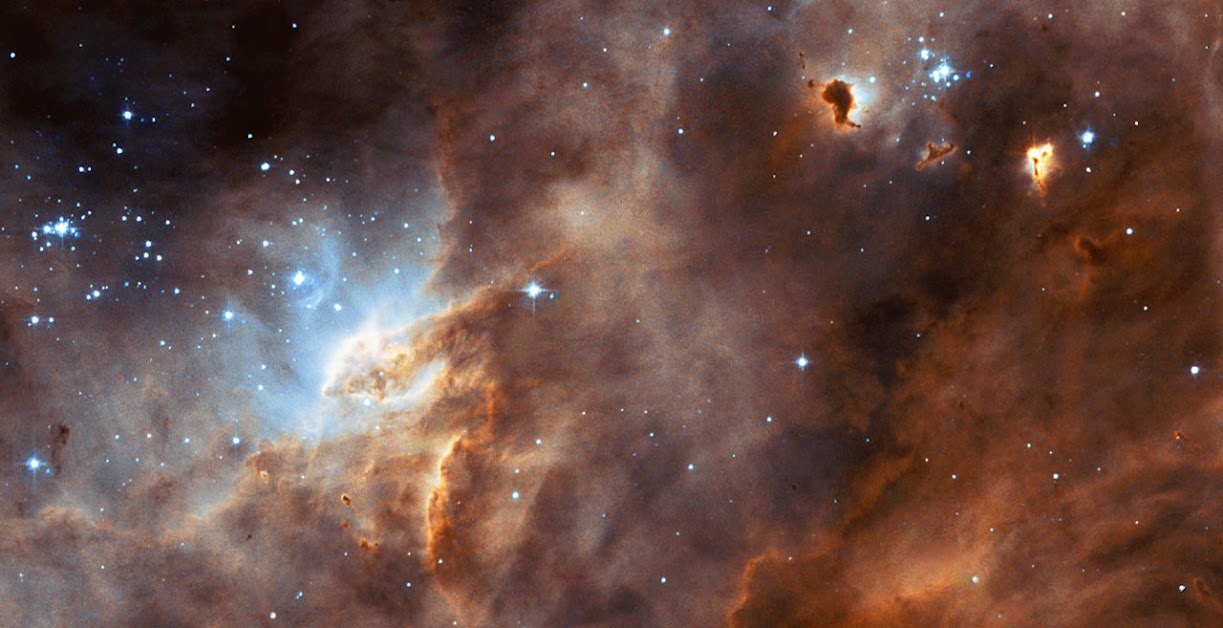
Showing posts with label Large Megallenic Cloud. Show all posts

Monday, September 29, 2014

The Milky Way glitters over ESO Paranal Observatory

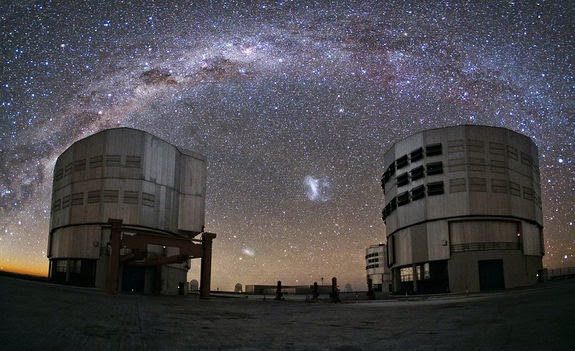
The Milky Way glitters over Paranal Observatory atop Cerro Paranal in Chile's high Atacama Desert in this amazing image by ESO photo ambassador Yuri Beletsky. 

Here, two unit telescopes with Paranal's Very Large Telescope (VLT) take center stage.

Between the two telescopes are the Large Magellanic Cloud and Small Magellenic Cloud, dwarf galaxies near our own Milky Way.

Meanwhile, the Coalsack Nebula can be spotted as a dark mark obscuring part of the Milky Way at upper left.

To see more amazing photos from the observatory, visit: Spectacular Cosmic Visions from ESO's Paranal Observatory 

Friday, June 14, 2013

Milky Way Neighbouring Galaxies Get Amazing Portraits in UV

Nearly a million ultraviolet sources appear in this mosaic of the Large Magellanic Cloud, which was assembled from 2,200 images taken by Swift's Ultraviolet/Optical Telescope.

CREDIT: NASA/Swift/S. Immler (Goddard) and M. Siegel (Penn State)

Stitching together thousands of images, astronomers have created the most detailed ultraviolet light portraits of the Milky Way's two closest neighbors: the Large and Small Magellanic Clouds.

The stunning wide-field results give scientists a peek at the hot young stars of these satellite galaxies, which hover around the Milky Way less than 200,000 light years away.

The mosaics were assembled by astronomers at NASA and Pennsylvania State University using the space agency's Swift satellite. The images were unveiled last week at the American Astronomical Society (AAS) meeting in Indianapolis.

"Prior to these images, there were relatively few UV observations of these galaxies, and none at high resolution across such wide areas, so this project fills in a major missing piece of the scientific puzzle," Michael Siegel, lead scientist for Swift's Ultraviolet/Optical Telescope (UVOT), said in a statement.

The Large Magellanic Cloud (LMC) is one-tenth the size of the Milky Way, and the Small Magellanic Cloud (SMC) is just half that size. But since both are relatively close to our own galaxy, they appear quite large — too large to fit in UVOT's field of view. That's why researchers needed thousands of images to cover both galaxies.

The portrait of LMC, cobbled together from 2,200 snapshots, has a resolution of 160 megapixels and reveals about 1 million ultraviolet sources, according to a statement from NASA.

The 57-megapixel mosaic image of the SMC, meanwhile, is made of 656 individual images and shows about 250,000 ultraviolet sources.

Ultraviolet images allow astronomers to look at the hottest young stars and star-formation regions while blocking out older stars, mostly those more than 500 years old, which don't emit as much light at such higher energies.

One particularly dazzling piece of the LMC portrait shows the Tarantula nebula, where powerful stellar winds from newborn stars create a spider-like shape.

Wednesday, April 3, 2013

NGC 602: Under the 'wing' of the Small Magellanic Cloud (SMC)

New Chandra observations have been used to make the first detection of X-ray emission from young stars with masses similar to our Sun outside our Milky Way galaxy. 

The Chandra observations of these low-mass stars were made of the region known as the "Wing" of the Small Magellanic Cloud (SMC), one of the Milky Way's closest galactic neighbors. 

In this composite image of the Wing the Chandra data is shown in purple, optical data from the Hubble Space Telescope is shown in red, green and blue and infrared data from the Spitzer Space Telescope is shown in red. 

Astronomers call all elements heavier than hydrogen and helium -- that is, with more than two protons in the atom's nucleus -- "metals." 

The Wing is a region known to have fewer metals compared to most areas within the Milky Way. 

The Chandra results imply that the young, metal-poor stars in NGC 602a produce X-rays in a manner similar to stars with much higher metal content found in the Orion cluster in our Galaxy. 

Credit: X-ray: NASA /CXC /Univ.Potsdam /L.Oskinova et al; Optical: NASA/STScI; Infrared: NASA/JPL-Caltech

The Small Magellanic Cloud (SMC) is one of the Milky Way's closest galactic neighbors. Even though it is a small, or so-called dwarf galaxy, the SMC is so bright that it is visible to the unaided eye from the Southern Hemisphere and near the equator.

Many navigators, including Ferdinand Magellan who lends his name to the SMC, used it to help find their way across the oceans.

Modern astronomers are also interested in studying the SMC (and its cousin, the Large Magellanic Cloud), but for very different reasons.

Because the SMC is so close and bright, it offers an opportunity to study phenomena that are difficult to examine in more distant galaxies.

Thursday, August 16, 2012

NASA Hubble Watches Star Clusters on a Collision Course

This is a Hubble Space Telescope image of a pair of star clusters that are believed to be in the early stages of merging.

The clusters lie in the gigantic 30 Doradus nebula, which is 170,000 light-years from Earth.

The Hubble observations, made with the Wide Field Camera 3, were taken Oct. 20-27, 2009.

The blue colour is light from the hottest, most massive stars; the green from the glow of oxygen; and the red from fluorescing hydrogen.

Image Credit: NASA, ESA, R. O'Connell (University of Virginia), and the Wide Field Camera 3 Science Oversight Committee

Astronomers using data from NASA's Hubble Space Telescope have caught two clusters full of massive stars that may be in the early stages of merging.

The clusters are 170,000 light-years away in the Large Magellanic Cloud, a small satellite galaxy to our Milky Way, a small satellite galaxy to our Milky Way.

What at first was thought to be only one cluster in the core of the massive star-forming region 30 Doradus (also known as the Tarantula Nebula) has been found to be a composite of two clusters that differ in age by about one million years.

The entire 30 Doradus complex has been an active star-forming region for 25 million years, and it is currently unknown how much longer this region can continue creating new stars. Smaller systems that merge into larger ones could help to explain the origin of some of the largest known star clusters.

Lead scientist Elena Sabbi of the Space Telescope Science Institute in Baltimore, Md., and her team began looking at the area while searching for runaway stars, fast-moving stars that have been kicked out of their stellar nurseries where they first formed.

"Stars are supposed to form in clusters, but there are many young stars outside 30 Doradus that could not have formed where they are; they may have been ejected at very high velocity from 30 Doradus itself," Sabbi said.

She then noticed something unusual about the cluster when looking at the distribution of the low-mass stars detected by Hubble.

It is not spherical, as was expected, but has features somewhat similar to the shape of two merging galaxies where their shapes are elongated by the tidal pull of gravity.

Hubble’s circumstantial evidence for the impending merger comes from seeing an elongated structure in one of the clusters, and from measuring a different age between the two clusters.

According to some models, the giant gas clouds out of which star clusters form may fragment into smaller pieces.

Once these small pieces precipitate stars, they might then interact and merge to become a bigger system. This interaction is what Sabbi and her team think they are observing in 30 Doradus.

Monday, August 13, 2012

ESA Hubble Image: The Tarantula Nebula

European Space Agency: Judy Schmidt

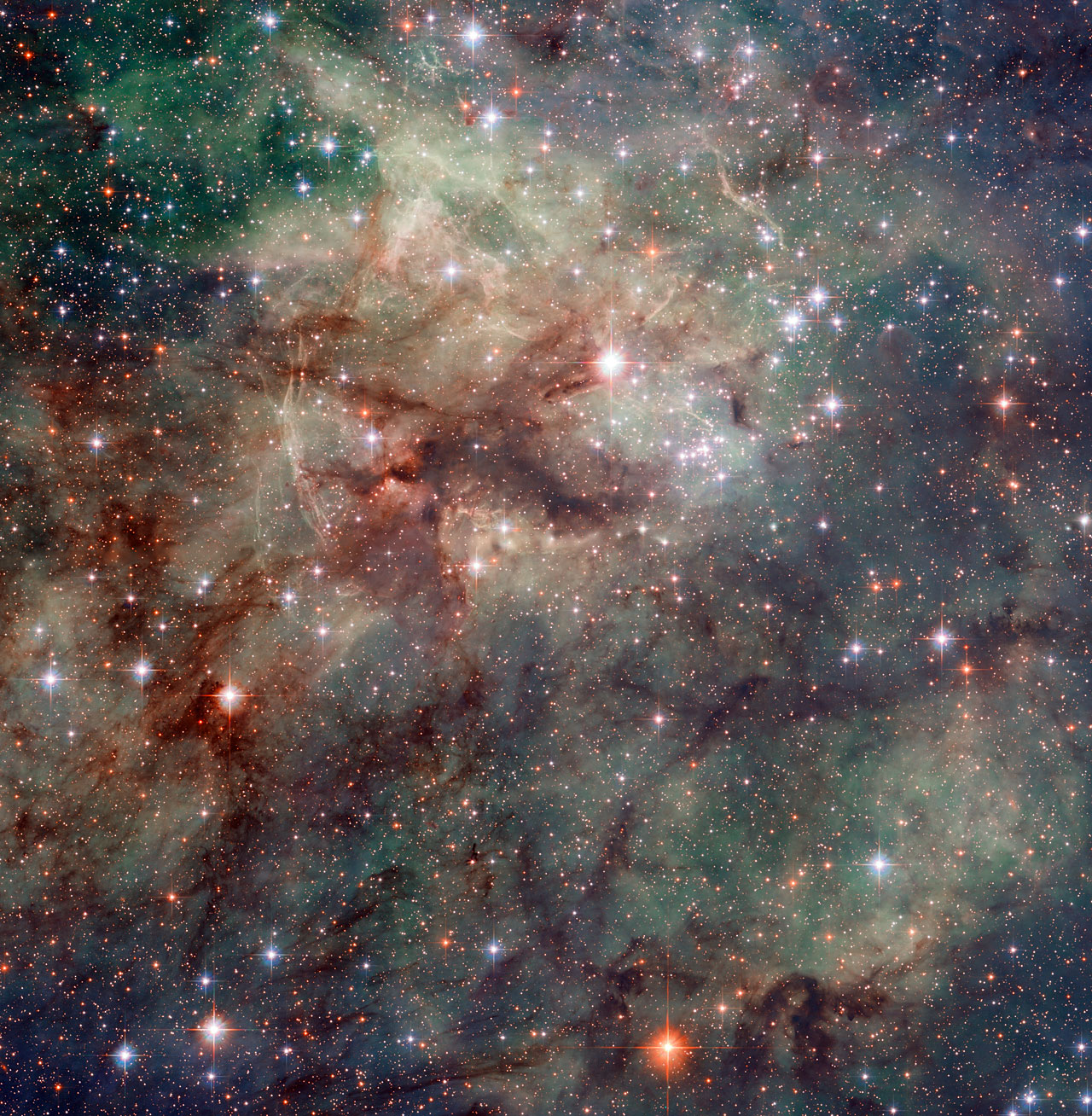
Turning its eye to the Tarantula Nebula, the NASA/ESA Hubble Space Telescope has taken this close-up of the outskirts of the main cloud of the Nebula.

The bright wispy structures are the signature of an environment rich in ionized hydrogen gas, called H II by astronomers.

In reality these appear red, but the choice of filters and colours of this image, which includes exposures both in visible and infrared light, make the gas appear green.

These regions contain recently formed stars, which emit powerful ultraviolet radiation that ionizes the gas around them.

These clouds are ephemeral as eventually the stellar winds from the newborn stars and the ionization process will blow away the clouds, leaving stellar clusters like the Pleiades.

Located in the Large Magellanic Cloud, one of our neighboring galaxies, and situated at a distance of 170,000 light-years away from Earth, the Tarantula Nebula is the brightest known nebula in the Local Group of galaxies.

It is also the largest (around 650 light-years across) and most active star-forming region known in our group of galaxies, containing numerous clouds of dust and gas and two bright star clusters.

Another recent Hubble image shows a large part of the nebula immediately adjacent to this field of view.

The cluster at the Tarantula nebula’s center is relatively young and very bright. While it is outside the field of view of this image, the energy from it is responsible for most of the brightness of the Nebula, including the part we see here.

The nebula is in fact so luminous that if it were located within 1,000 light-years from Earth, it would cast shadows on our planet.

The Tarantula Nebula was host to the closest supernova ever detected since the invention of the telescope, supernova 1987A, which was visible to the naked eye.


Sunday, August 5, 2012

ESA Hubble Image: Large Magellanic Cloud

The NASA/ESA Hubble Space Telescope captures the iridescent tapestry of star birth in a neighbouring galaxy in this panoramic view of glowing gas, dark dust clouds, and young, hot stars.

The star-forming region, catalogued as N11B lies in the Large Magellanic Cloud (LMC), located only 160,000 light-years from Earth. 

With its high resolution, the Hubble Space Telescope is able to view details of star formation in the LMC as easily as ground-based telescopes are able to observe stellar formation within our own Milky Way galaxy.

Credit: NASA/ESA and the Hubble Heritage Team (AURA/STScI/HEIC)

Friday, March 9, 2012

NASA - Hubble Views Grand Star-Forming Region

This massive, young stellar grouping, called R136, is only a few million years old and resides in the 30 Doradus Nebula, a turbulent star-birth region in the Large Magellanic Cloud, a satellite galaxy of the Milky Way.

There is no known star-forming region in the Milky Way Galaxy as large or as prolific as 30 Doradus.

Many of the diamond-like icy blue stars are among the most massive stars known. Several of them are 100 times more massive than our sun. These hefty stars are destined to pop off, like a string of firecrackers, as supernovas in a few million years.

The image, taken in ultraviolet, visible and red light by Hubble's Wide Field Camera 3, spans about 100 light-years.

The nebula is close enough to Earth that Hubble can resolve individual stars, giving astronomers important information about the stars' birth and evolution.

The brilliant stars are carving deep cavities in the surrounding material by unleashing a torrent of ultraviolet light, and hurricane-force stellar winds (streams of charged particles), which are etching away the enveloping hydrogen gas cloud in which the stars were born.

The image reveals a fantasy landscape of pillars, ridges, and valleys, as well as a dark region in the center that roughly looks like the outline of a holiday tree.

Besides sculpting the gaseous terrain, the brilliant stars can also help create a successive generation of offspring. When the winds hit dense walls of gas, they create shocks, which may be generating a new wave of star birth.

These observations were taken Oct. 20-27, 2009. The blue color is light from the hottest, most massive stars; the green from the glow of oxygen; the red from fluorescing hydrogen.

Image Credit: NASA, ESA

Monday, February 13, 2012

Canes Venatici: New Subaru Telescope images capture 'stealth merger' of dwarf galaxies

NGC 4449 is located 12.5 million light-years from Earth and is a member of a group of galaxies in the constellation Canes Venatici. In size and morphology, it is very similar to one of the Milky Way's satellite galaxies, the Large Magellanic Cloud.

New images of a nearby dwarf galaxy have revealed a dense stream of stars in its outer regions, the remains of an even smaller companion galaxy in the process of merging with its host.

The host galaxy, known as NGC 4449, is the smallest primary galaxy in which a stellar stream from an ongoing merger has been identified and studied in detail.

"This is how galaxies grow. You can see the smaller galaxy coming in and getting shredded, eventually leaving its stars scattered through the halo of the host galaxy," said Aaron Romanowsky, a research astronomer at the University of California, Santa Cruz, and coauthor of a paper on the discovery that has been accepted for publication in Astrophysical Journal Letters and is available online at arxiv.org.

The study was carried out by an international team of astronomers led by David Martinez-Delgado of the Max Planck Institute for Astronomy in Heidelberg.

Suprime-Cam captured this image of the nearby dwarf galaxy NGC 4449 (lower left) and its companion (upper right), a dwarf galaxy that has been gravitationally pulled apart into a stellar stream. It shows individual stars composing the galaxies. 

R. Jay GaBany (Blackbird Observatory) produced the composite: blue hues in the center of the larger galaxy are brought about by a burst of recent star formation, while the red in its periphery and in its satellite indicates the presence of older, red-giant stars.
 
According to modern cosmological theory, large galaxies were built up from smaller progenitors through a hierarchical process of mergers. Astronomers can see many examples of mergers involving massive galaxies, but mergers of two dwarf galaxies have been hard to find.

"We should see the same things at smaller scales, with small galaxies eating smaller ones and so on," Romanowsky said. "Now we have this beautiful image of a dwarf galaxy consuming a smaller dwarf."

NGC 4449 is located 12.5 million light-years from Earth and is a member of a group of galaxies in the constellation Canes Venatici. In size and morphology, it is very similar to one of the Milky Way's satellite galaxies, the Large Magellanic Cloud.

The stellar stream in NGC 4449 was first detected by another group of astronomers as a mysterious, faint smudge in digitized photographic plates from the Digitized Sky Survey project, and it is also visible in archival images from the Sloan Digital Sky Survey. But if it had been just a bit fainter, more diffuse, or farther from the host galaxy, it could easily have been missed.

The authors of the new study called it a "stealth merger," where an infalling satellite galaxy is nearly undetectable by conventional means, yet has a substantial influence on its host galaxy.

Read more of this article here

Tuesday, January 10, 2012

NASA Spitzer image: Large Megellanic Cloud

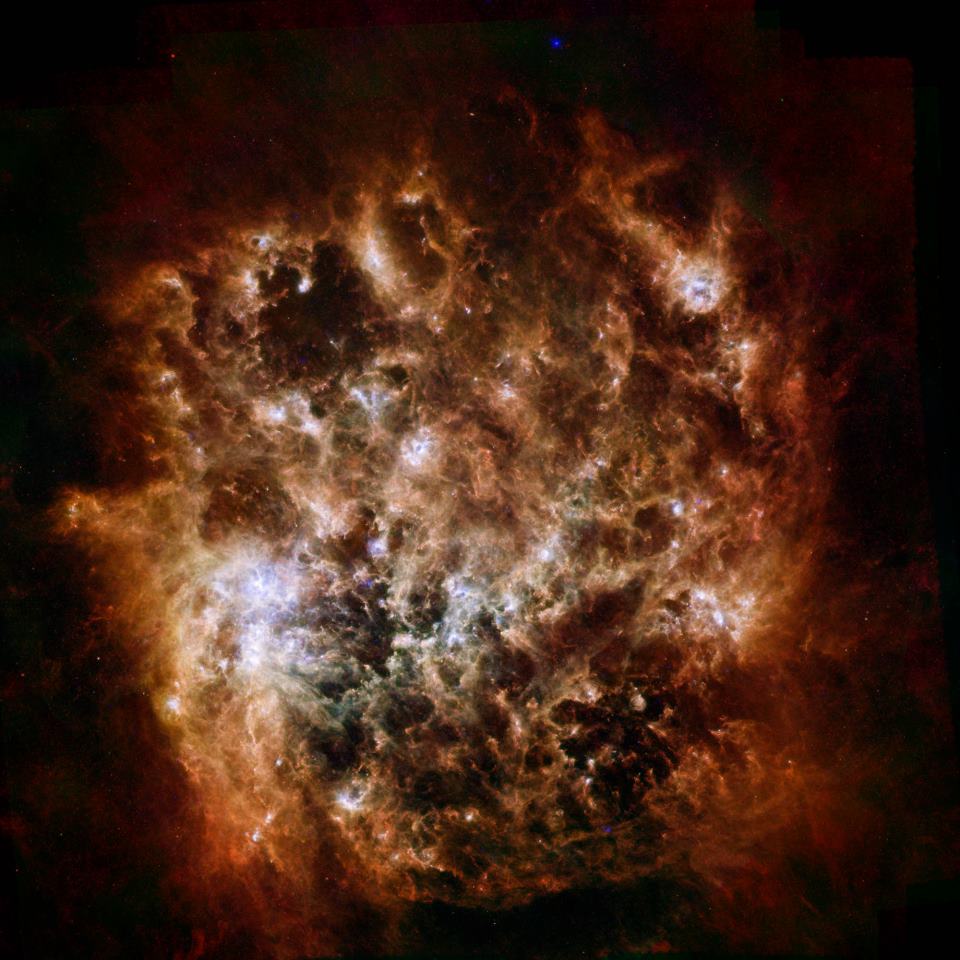
This new image shows the Large Magellanic Cloud galaxy in infrared light as seen by the Herschel Space Observatory, a European Space Agency-led mission with important NASA contributions, and NASA’s Spitzer Space Telescope.

In the instruments' combined data, this nearby dwarf galaxy looks like a fiery, circular explosion.

Rather than fire, however, those ribbons are actually giant ripples of dust spanning tens or hundreds of light-years.

Significant fields of star formation are noticeable in the center, just left of center and at right.

The brightest center-left region is called 30 Doradus, or the Tarantula Nebula, for its appearance in visible light.

The colours in this image indicate temperatures in the dust that permeates the Cloud. Colder regions show where star formation is at its earliest stages or is shut off, while warm expanses point to new stars heating surrounding dust.

The coolest areas and objects appear in red, corresponding to infrared light taken up by Herschel's Spectral and Photometric Imaging Receiver at 250 microns, or millionths of a meter.

Herschel's Photodetector Array Camera and Spectrometer fills out the mid-temperature bands, shown here in green, at 100 and 160 microns. The warmest spots appear in blue, courtesy of 24- and 70-micron data from Spitzer.

Image credit: ESA/NASA/JPL-Caltech/STScI

NASA Infra-Red: Small Magellanic Cloud

This new image shows the Small Magellanic Cloud galaxy in infrared light from the Herschel Space Observatory a European Space Agency-led mission with important NASA contributions, and NASA’s Spitzer Space Telescope.

The Large and Small Magellanic Clouds are the two biggest satellite galaxies of our home galaxy, the Milky Way, though they are still considered dwarf galaxies compared to the big spiral of the Milky Way.

In combined data from Herschel and Spitzer, the irregular distribution of dust in the Small Magellanic Cloud becomes clear. A stream of dust extends to the left in this image, known as the galaxy's "wing," and a bar of star formation appears on the right.

The colours in this image indicate temperatures in the dust that permeates the Cloud. Colder regions show where star formation is at its earliest stages or is shut off, while warm expanses point to new stars heating surrounding dust.

The coolest areas and objects appear in red, corresponding to infrared light taken up by Herschel's Spectral and Photometric Imaging Receiver at 250 microns, or millionths of a meter.

Herschel's Photodetector Array Camera and Spectrometer fills out the mid-temperature bands, shown here in green, at 100 and 160 microns. The warmest spots appear in blue, courtesy of 24- and 70-micron data from Spitzer.

Image credit: ESA/NASA/JPL-Caltech/STScI

Thursday, December 22, 2011

ESA XMM-Newton: Strangely slow X-Ray pulsar discovered

The X-ray pulsar SXP 1062 embedded in the remnant of the supernova that created it. Credit: ESA/XMM-Newton/ L.Oskinova/ M.Guerrero; CTIO/R.Gruendl/Y.H.Chu.

Astronomers have discovered a very slowly rotating X-ray pulsar still embedded in the remnant of the supernova that created it.

This unusual object was detected on the outskirts of the Small Magellanic Cloud, a satellite galaxy of the Milky Way, using data from a number of telescopes, including ESA's XMM-Newton.

A puzzling mismatch between the fairly young age of the supernova remnant and the slow rotation of the pulsar, which would normally indicate a much older object, raises interesting questions about the origin and evolution of pulsars.

The spectacular supernova explosion that marks the end of a massive star's life also has an intriguing aftermath.

On the one hand, the explosion sweeps up the surrounding interstellar material creating a supernova remnant that is often characterised by a distinctive bubble-like shape, on the other hand, the explosion also leaves behind a compact object - a neutron star or a black hole.

Since supernova remnants shine only for a few tens of thousands of years before dispersing into the interstellar medium, not many compact objects have been detected while still enclosed in their expanding shell.

An international team of astronomers has now discovered one of these rarely observed pairs, consisting of a strongly magnetised, rotating neutron star - a pulsar - surrounded by the remains of the explosion that generated it.

The newly found pulsar, named SXP 1062, is located at the outskirts of the Small Magellanic Cloud (SMC), one of the satellite galaxies of the Milky Way. SXP 1062 is an X-ray pulsar, part of a binary system in which the compact object is accreting mass from a companion star, resulting in the emission of copious amounts of X-rays.

The astronomers first detected the pulsar's X-ray emission using data from ESA's XMM-Newton as well as NASA's Chandra space-based observatories. A later study of optical images of the source and its surroundings revealed the bubble-shaped signature of the supernova remnant around the binary system.

"The most interesting aspect of this pulsar is possibly its extremely long period - 1062 seconds - which makes it one of the slowest pulsars on record," comments Lidia Oskinova from the Institute for Physics and Astronomy in Potsdam, Germany, coordinator of the team that analysed the X-ray data.

Pulsars rotate quite rapidly in their early stages, with periods of only a fraction of a second, and then slow down gradually with age. "Slowly spinning pulsars are particularly difficult to detect. Only a few with periods longer than a thousand seconds have been observed to date," she adds.

Monday, September 12, 2011

NASA Chandra X-ray telescope: New Supernova Remnant Lights Up

Using the Hubble Space Telescope, astronomers are witnessing the unprecedented transition of a supernova to a supernova remnant, where light from an exploding star in a neighboring galaxy, the Large Magellanic Cloud, reached Earth in February 1987.

Named Supernova 1987A, it was the closest supernova explosion witnessed in almost 400 years.

The supernova's close proximity to Earth allows astronomers to study it in detail as it evolves.

Now, the supernova debris, which has faded over the years, is brightening. This means that a different power source has begun to light the debris.

The debris of SN 1987A is beginning to impact the surrounding ring, creating powerful shock waves that generate X-rays observed with NASA's Chandra X-ray Observatory.

Those X-rays are illuminating the supernova debris and shock heating is making it glow in visible light. Since its launch in 1990, the Hubble telescope has provided a continuous record of the changes in SN 1987A.

Image Credit: NASA, ESA, and P. Challis (Harvard-Smithsonian Center for Astrophysics)

Friday, July 8, 2011

ESA Herschel: Exploding stars can make good dust factories

This mosaic shows the region surrounding the remnant of the famous supernova SN1987A as observed by Herschel (on the left) and the Hubble Space Telescope (on the right).

SN1987A exploded 24 years ago in the Large Magellanic Cloud, one of the dwarf galaxies orbiting the Milky Way.

At a distance of only 160,000 light years, this backyard supernova has become a 'local' laboratory for close-up studies of stellar demise.

The remnant of SN1987A is visible, in the Herschel image, as a faint dot of light indicated by the white circle; the region enclosed within the circle is shown in greater detail in the Hubble image.

The detection of SN1987A with Herschel demonstrates that this object contains an amount of dust nearly equivalent to the mass of the Sun and roughly 1000 times larger than what was previously believed.

At temperatures of 16–23 Kelvin, the newly discovered component is about 20 times colder than any dust detected in the past in this supernova remnant.

This result confirms that supernovae are able to produce significant quantities of dust over very short timescales and has profound implications on the understanding of how dust first formed in cosmic history.

Credits: ESA/Herschel/PACS/SPIRE/NASA-JPL/Caltech/UCL/STScI and the Hubble Heritage Team (AURA/STScI/NASA/ESA)

Read more here: ESA Herschel

Tuesday, March 15, 2011

Arachnophobes Beware: Hubble Snaps Close-up of the Tarantula


The NASA/ESA Hubble Space Telescope has produced an outstanding image of part of the famous Tarantula Nebula, a vast star-forming cloud of gas and dust in our neighbouring galaxy, the Large Magellanic Cloud. In this picture, we see a close-up of the Tarantula’s central region, glowing brightly with ionised gases and young stars.

The wispy arms of the Tarantula Nebula were originally thought to resemble spindly spider legs, giving the nebula its unusual name.

The part of the nebula visible in this image from Hubble’s Advanced Camera for Surveys is criss-crossed with tendrils of dust and gas churned up by recent supernovae. These supernova remnants include NGC 2060, visible above and to the left of the centre of this image, which contains the brightest known pulsar.

The tarantula’s bite goes beyond NGC 2060. Near the edge of the nebula, outside the frame, below and to the right, lie the remains of supernova SN 1987a, the closest supernova to Earth to be observed since the invention of telescopes in the 17th century.

Hubble and other telescopes have been returning to spy on this stellar explosion regularly since it blew up in 1987, and each subsequent visit shows an expanding shockwave lighting up the gas around the star, creating a pearl necklace of glowing pockets of gas around the remains of the star. SN 1987a is visible in wide field images of the nebula, such as that taken by the MPG/ESO 2.2-metre telescope.

Arachnophobes Beware: Hubble Snaps Close-up of the Tarantula | Press Releases | ESA/Hubble

Saturday, July 31, 2010

Large Megallenic Cloud - LMC

Astronomy photography competition

The Large Magellanic Cloud (LMC) is a nearby irregular galaxy, and is a satellite of the Milky Way.

It is visible as a faint "cloud" in the night sky of the southern hemisphere, straddling the border between the constellations of Dorado and Mensa.

At a distance of slightly less than 50 kiloparsecs (≈160,000 light-years), the LMC is the third closest galaxy to the Milky Way, with the Sagittarius Dwarf Spheroidal (~ 16 kiloparsecs) and Canis Major Dwarf Galaxy (~ 12.9 kiloparsecs) lying closer to the center of the Milky Way.

It has a mass equivalent to approximately 10 billion times the mass of our Sun (1010 solar masses), making it roughly 1/10 as massive as the Milky Way, and a diameter of about 14,000 light-years.

The LMC is the fourth largest galaxy in the Local Group, the first, second and third largest places being taken by Andromeda Galaxy (M31), our own Milky Way Galaxy, and the Triangulum Galaxy (M33), respectively.

While the LMC is often considered an irregular type galaxy (the NASA Extragalactic Database lists the Hubble sequence type as Irr/SB(s)m), the LMC contains a very prominent bar in its center, suggesting that it may have previously been a barred spiral galaxy.

The LMC's irregular appearance is possibly the result of tidal interactions with both the Milky Way, and the Small Magellanic Cloud (SMC).