Showing posts with label Hubble Images. Show all posts

Sunday, August 5, 2012

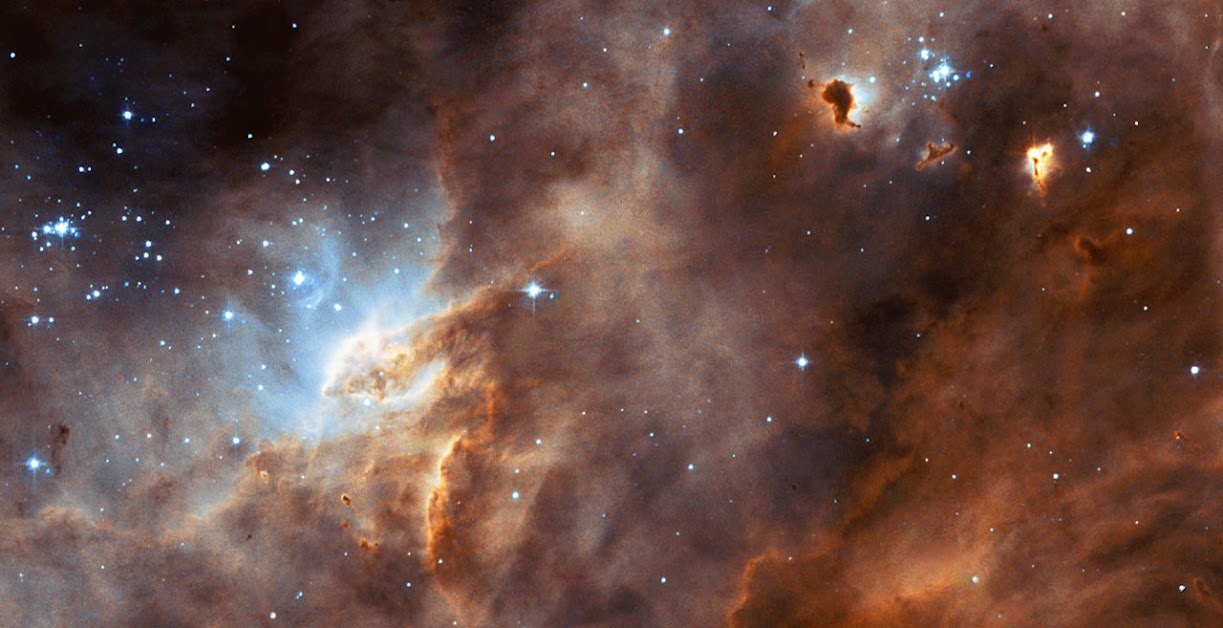
ESA Hubble Image: Large Magellanic Cloud

The NASA/ESA Hubble Space Telescope captures the iridescent tapestry of star birth in a neighbouring galaxy in this panoramic view of glowing gas, dark dust clouds, and young, hot stars.

The star-forming region, catalogued as N11B lies in the Large Magellanic Cloud (LMC), located only 160,000 light-years from Earth. 

With its high resolution, the Hubble Space Telescope is able to view details of star formation in the LMC as easily as ground-based telescopes are able to observe stellar formation within our own Milky Way galaxy.

Credit: NASA/ESA and the Hubble Heritage Team (AURA/STScI/HEIC)

Tuesday, June 12, 2012

NASA Hubble Image: Revealing the Veil Nebula

The Veil Nebula, left behind by the explosion of a massive star thousands of years ago, is one of the largest and most spectacular supernova remnants in the sky.

The image was taken with Hubble's Wide Field Planetary Camera 2 in November 1994 and August 1997.

Image Credit: NASA, ESA, and the Hubble Heritage (STScI/AURA)-ESA/Hubble Collaboration; Acknowledgment: J. Hester (Arizona State University)

Monday, May 28, 2012

ESA Hubble Image: The Swan and the Butterfly


Credit: ESA/Hubble & NASA

This image from the NASA/ESA Hubble Space Telescope shows NGC 7026, a planetary nebula. Located just beyond the tip of the tail of the constellation of Cygnus (The Swan), this butterfly-shaped cloud of glowing gas and dust is the wreckage of a star similar to the Sun.

Planetary nebulae, despite their name, have nothing to do with planets. They are in fact a relatively short-lived phenomenon that occurs at the end of the life of mid-sized stars.

As a star’s source of nuclear fuel runs out, its outer layers are puffed out, leaving only the hot core of the star behind. As the gaseous envelope heats up, the atoms in it are excited, and it lights up like a fluorescent sign.

Fluorescent lights on Earth get their bright colours from the gases they are filled with. Neon signs, famously, produce a bright red colour, while ultraviolet lights (black lights) typically contain mercury. The same goes for nebulae: their vivid colours are produced by the mix of gases present in them.

This image of NGC 7026 shows starlight in green, light from glowing nitrogen gas in red, and light from oxygen in blue (in reality, this appears green, but the colour in this image has been shifted to increase the contrast).

As well as visible light, NGC 7026 emits X-ray radiation, and has been studied by ESA’s XMM-Newton space telescope. X-rays are a result of the extremely high temperatures of the gas in NGC 7026.

This image was produced by the Wide Field and Planetary Camera 2 aboard the Hubble Space Telescope. The image is 35 by 35 arcseconds.

A version of this image was entered into the Hubble’s Hidden Treasures Competition by contestant Linda Morgan-O'Connor. Hidden Treasures is an initiative to invite astronomy enthusiasts to search the Hubble archive for stunning images that have never been seen by the general public.

Monday, March 5, 2012

ESA Hubble Image: Ghostly Ring of Dark Matter

Credit: ESA/Hubble

A ghostly ring of dark matter floating in the galaxy cluster ZwCl0024+1652, one of the strongest pieces of evidence to date for the existence of dark matter. 

Astronomers think the dark-matter ring was produced from a collision between two gigantic clusters.

Monday, September 12, 2011

NASA Chandra X-ray telescope: New Supernova Remnant Lights Up

Using the Hubble Space Telescope, astronomers are witnessing the unprecedented transition of a supernova to a supernova remnant, where light from an exploding star in a neighboring galaxy, the Large Magellanic Cloud, reached Earth in February 1987.

Named Supernova 1987A, it was the closest supernova explosion witnessed in almost 400 years.

The supernova's close proximity to Earth allows astronomers to study it in detail as it evolves.

Now, the supernova debris, which has faded over the years, is brightening. This means that a different power source has begun to light the debris.

The debris of SN 1987A is beginning to impact the surrounding ring, creating powerful shock waves that generate X-rays observed with NASA's Chandra X-ray Observatory.

Those X-rays are illuminating the supernova debris and shock heating is making it glow in visible light. Since its launch in 1990, the Hubble telescope has provided a continuous record of the changes in SN 1987A.

Image Credit: NASA, ESA, and P. Challis (Harvard-Smithsonian Center for Astrophysics)

Thursday, August 25, 2011

NASA Hubble Image: ARP 274 - A Tale of Three Galaxies

Arp 274, also known as NGC 5679, is a system of three galaxies that appear to be partially overlapping in the image, although they may be at somewhat different distances.

The spiral shapes of two of these galaxies appear mostly intact. The third galaxy (to the far left) is more compact, but shows evidence of star formation.

Two of the three galaxies are forming new stars at a high rate.

This is evident in the bright blue knots of star formation that are strung along the arms of the galaxy on the right and along the small galaxy on the left.

The largest component is located in the middle of the three. It appears as a spiral galaxy, which may be barred. The entire system resides at about 400 million light-years away from Earth in the constellation Virgo.

Hubble’s Wide Field Planetary Camera 2 was used to image Arp 274 in april 2011. Blue, visible and infrared filters were combined with a filter that isolates hydrogen emission.

The colours in this image reflect the intrinsic colour of the different stellar populations that make up the galaxies.

Yellowish older stars can be seen in the central bulge of each galaxy. A bright central cluster of stars pinpoint each nucleus.

Younger blue stars trace the spiral arms, along with pinkish nebulae that are illuminated by new star formation.

Interstellar dust is silhouetted against the starry population. A pair of foreground stars inside our own Milky Way are at far right.

Credit: NASA, ESA, and M. Livio and the Hubble Heritage Team (STScI/AURA)

Thursday, June 3, 2010

NASA - Hubble Images Suggest Rogue Asteroid Smacked Jupiter


NASA - Hubble Images Suggest Rogue Asteroid Smacked Jupiter

These NASA Hubble Space Telescope snapshots reveal an impact scar on Jupiter fading from view over several months between July 2009 and November 2009.

Credit: NASA, ESA, M. Wong, H. Hammel, I. de Pater, and the Jupiter Impact Team

Without warning, a mystery object struck Jupiter on July 19, 2009, leaving a dark bruise the size of the Pacific Ocean. The spot first caught the eye of an amateur astronomer in Australia, and soon, observatories around the world, including NASA’s Hubble Space Telescope, were zeroing in on the unexpected blemish.

Astronomers had witnessed this kind of cosmic event before. Similar scars had been left behind during the course of a week in July 1994, when more than 20 pieces of Comet P/Shoemaker-Levy 9 (SL9) plunged into Jupiter’s atmosphere. The 2009 impact occurred during the same week, 15 years later.

Astronomers who compared Hubble images of both collisions say the culprit may have been an asteroid about 1,600 feet (500 meters) wide. The images, therefore, may show for the first time the immediate aftermath of an asteroid, rather than a comet, striking another planet.

The Jupiter bombardments reveal that the solar system is a rambunctious place, where unpredictable events may occur more frequently than first thought. Jupiter impacts were expected to occur every few hundred to few thousand years. Although there are surveys to catalogue asteroids, many small bodies may still go unnoticed and show up anytime to wreak havoc.

“This solitary event caught us by surprise, and we can only see the aftermath of the impact, but fortunately we do have the 1994 Hubble observations that captured the full range of impact phenomena, including the nature of the objects from pre-impact observations” says astronomer Heidi Hammel of the Space Science Institute in Boulder, Colo., leader of the Jupiter impact study.