Showing posts with label Andromeda Galaxy. Show all posts

Tuesday, August 12, 2014

NASA Chandra: Signal from Dark Matter

An X-ray image of the hot gas in the central region of the Perseus Cluster of galaxies, taken by the Chandra X-ray Observatory

The Perseus Cluster is one of the most massive objects in the Universe with thousands of galaxies immersed in an enormous cloud of superheated gas. 

The image shows enormous bright loops, ripples, and jet-like streaks throughout the cluster. 

Astronomers may have detected an emission line from a form of dark matter, the sterile neutrino, in the spectrum of galaxy clusters like Perseus. 

Credit: Chandra/NASA/ESA

Galaxies are often found in groups or clusters, the largest known aggregations of matter and dark matter.

The Milky Way, for example, is a member of the "Local Group" of about three dozen galaxies, including the Andromeda Galaxy located about 2 million light-years away.

Very large clusters can contain thousands of galaxies, all bound together by gravity.

The closest large cluster of galaxies to us, the Virgo Cluster with about 2000 members, is about 50 million light-years away.

The space between galaxies is not empty. It is filled with hot intergalactic gas whose temperature is of order ten million kelvin, or even higher.

The gas is enriched with heavy elements that escape from the galaxies and accumulate in the intracluster medium over billions of years of galactic and stellar evolution.

These intracluster gas elements can be detected from their emission lines in X-ray, and include oxygen, neon, magnesium, silicon, sulphur, argon, calcium, iron, nickel, and even chromium and manganese.

The relative abundances of these elements contain valuable information on the rate of supernovae in the different types of galaxies in the clusters since supernovae make and/or disburse them into the gas.

Therefore it came as something of a surprise when CfA astronomers and their colleagues discovered a faint line corresponding to no known element.

Esra Bulbul, Adam Foster, Randall Smith, Scott Randall and their team were studying the averaged X-ray spectrum of a set of seventy-three clusters (including Virgo) looking for emission lines too faint to be seen in any single one when they uncovered a line with no known match in a particular spectral interval not expected to have any features.

The scientists propose a tantalizing suggestion: the line is the result of the decay of a putative, long-sought-after dark matter particle, the so-called sterile neutrino.

It had been suggested that the hot X-ray emitting gas in a galaxy cluster might be a good place to look for dark matter signatures, and if the sterile neutrino result is confirmed it would mark a breakthrough in dark matter research (it is of course possible that it is a statistical or other error).

Recent unpublished results from another group tend to support the detection of this feature; the team suggests that observations with the planned Japanese Astro-H X-ray mission in 2015 will be critical to confirm and resolve the nature of this line.

More information: "Detection of an Unidentified Emission Line in the Stacked X-Ray Spectrum of Galaxy Clusters," Esra Bulbul, Maxim Markevitch, Adam Foster, Randall K. Smith, Michael Loewenstein, and Scott W. Randall, ApJ 789, 13, 2014.

Monday, July 28, 2014

ESA Herschel Image: Our flocculent neighbour, the spiral Triangulum Galaxy (M33)

Credit: ESA /Herschel /PACS /HerM33es Key Programme /C. Kramer /M. Boquien

The spiral galaxy M33, also known as the Triangulum Galaxy, is one of our closest cosmic neighbours, just three million light-years away.

Andromeda Galaxy (M31)
Home to some forty billion stars, it is the third largest in the Local Group of galaxies after the Andromeda Galaxy (M31) and our own Milky Way.

M33 is popular with astrophotographers and from exceptionally dark sites it can even be seen with the naked eye.

Thanks to its orientation, we can enjoy a face-on view of the beautiful spiral structure of the galaxy's disc.

This image, from ESA's Herschel space observatory, shows M33 in far-infrared light, revealing the glow of cosmic dust in the interstellar medium that permeates the galaxy.

The patchy, disorganised structure of M33's spiral arms resembles a tuft of wool, leading astronomers to classify it as a flocculent spiral galaxy.

The brightest spots sprinkled along the spiral arms are dense pockets of gas and dust where massive stars are born.

The most prominent of these is NGC604, visible in the upper left spiral arm.

This is an enormous star-forming region where hundreds of thousands of stars are taking shape.

The image is a composite of the wavelengths: 70 microns (blue), 100 microns (green) and 160 microns (red).

At the shortest wavelengths, astronomers trace warmer dust, revealing individual regions of star formation and parent clouds.

At longer wavelengths, they detect emission from colder dust, outlining some of the cool dust reservoir along the galaxy's winding spiral arms. This is where stars may be born in the future.

The image spans about one degree on each side; north is up and east is to the left. The data were collected with Herschel's PACS instrument as part of the Herschel M33 extended survey (HerM33es) Key Programme to study the star formation in the Triangulum Galaxy.

Monday, July 21, 2014

Mysterious dance of dwarfs may force a cosmic rethink

This is an artist's impression of the coherent orbit of dwarf galaxies about a large galaxy. 

Credit: Geraint Lewis

The discovery that many small galaxies throughout the universe do not 'swarm' around larger ones like bees do but 'dance' in orderly disc-shaped orbits is a challenge to our understanding of how the universe formed and evolved.

The finding, by an international team of astronomers, including Professor Geraint Lewis from the University of Sydney's School of Physics, is announced today in Nature.

"Early in 2013 we announced our startling discovery that half of the dwarf galaxies surrounding the Andromeda Galaxy are orbiting it in an immense plane" said Professor Lewis.

"This plane is more than a million light years in diameter, but is very thin, with a width of only 300 000 light years."

The universe contains billions of galaxies. Some, such as the Milky Way, are immense, containing hundreds of billions of stars. Most galaxies, however, are dwarfs, much smaller and with only a few billion stars.

For decades astronomers have used computer models to predict how these dwarf galaxies should orbit large galaxies. They had always found that they should be scattered randomly.

"Our Andromeda discovery did not agree with expectations, and we felt compelled to explore if it was true of other galaxies throughout the universe," said Professor Lewis.

Using the Sloan Digital Sky Survey (SDSS), a remarkable resource of colour images and 3-D maps covering more than a third of the sky, the researchers dissected the properties of thousands of nearby galaxies.

"We were surprised to find that a large proportion of pairs of satellite galaxies have oppositely directed velocities if they are situated on opposite sides of their giant galaxy hosts", said lead author Neil Ibata of the Lycée International in Strasbourg, France.

"Everywhere we looked we saw this strangely coherent coordinated motion of dwarf galaxies. From this we can extrapolate that these circular planes of dancing dwarfs are universal, seen in about 50 percent of galaxies," said Professor Geraint Lewis.

"This is a big problem that contradicts our standard cosmological models. It challenges our understanding of how the universe works including the nature of dark matter."

The researchers believe the answer may be hidden in some currently unknown physical process that governs how gas flows in the universe, although, as yet, there is no obvious mechanism that can guide dwarf galaxies into narrow planes.

Some experts, however, have made more radical suggestions, including bending and twisting the laws of gravity and motion.

"Throwing out seemingly established laws of physics is unpalatable," said Professor Lewis, "but if our observations of nature are pointing us in this direction, we have to keep an open mind. That's what science is all about."

More information: "Velocity anti-correlation of diametrically opposed galaxy satellites in the low-redshift Universe." Neil G. Ibata, et al. Nature (2014) DOI: 10.1038/nature13481

Monday, March 3, 2014

Leiden Research: Glimmer of light in the search for dark matter

The Leiden astrophysicist Alexey Boyarsky and his fellow researchers may have identified a trace of dark matter that could signify a new particle: the sterile neutrino. 

Sterile neutrino has mass
The group reported that they have found an indirect signal from dark matter in the spectra of galaxies and clusters of galaxies.

Alexey Boyarsky
They made this discovery: A tiny spike is hidden in the X-ray spectra of the Perseus galaxy cluster, at a frequency that cannot be explained by any known atomic transition.

A Harvard group see the same spike in many other galaxy clusters, while Boyarsky also finds it in the nearby Andromeda galaxy.

The researchers put it down to the decay of a new kind of neutrino, called 'sterile' because it has no interaction with other known neutrinos.

A sterile neutrino does have mass, and so could be responsible for the missing dark matter

Minor expansion of the standard model for elementary particles
The first indications for the existence of dark matter in space were found more than eighty years ago, but there are still many questions surrounding this invisible matter.

Sterile neutrinos are a highly attractive candidate for the dark matter particle, because they only call for a minor extension of the already known and extensively tested standard model for elementary particles.

Boyarsky and his colleagues have already had this extension of the standard model ready for some time, but were waiting for the first observation of the mysterious particle.

Measurements at higher resolution will shed light on the matter, and there is reason to hope that the spectral line just discovered will finally eliminate the problem of the missing mass.


Sunday, July 7, 2013

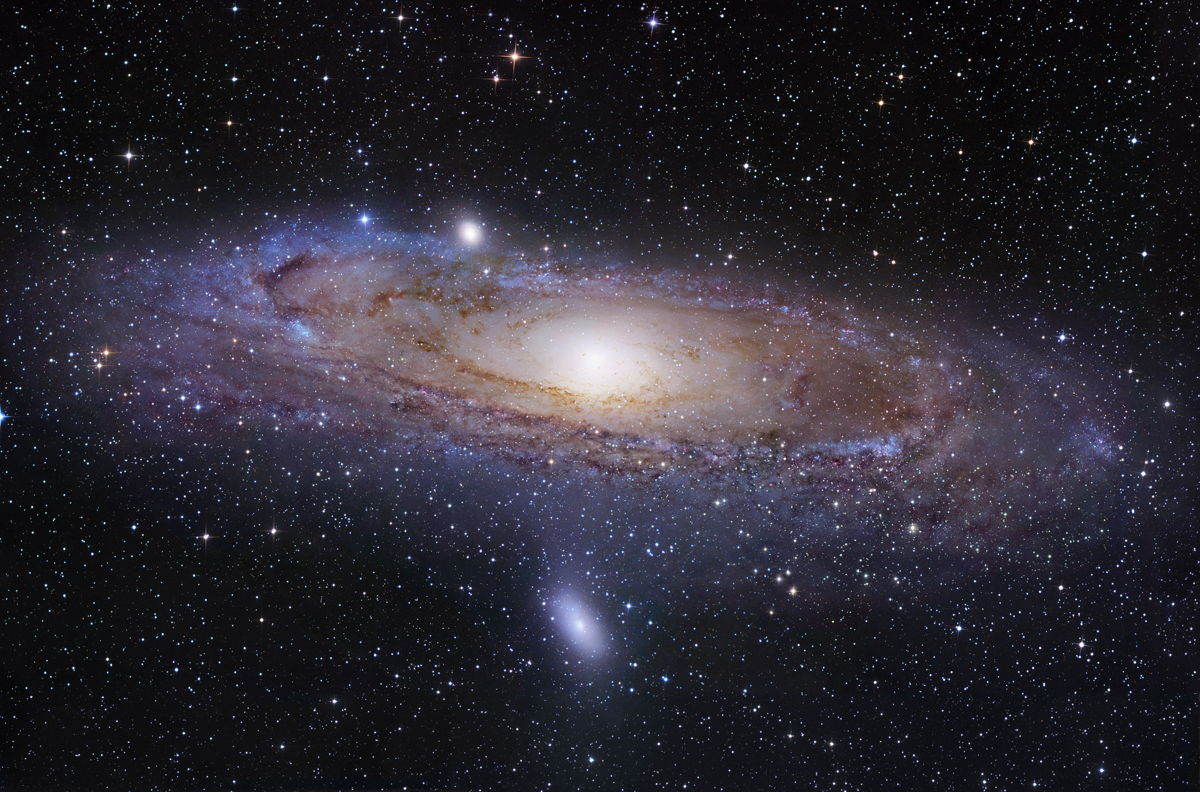
Andromeda Galaxy by Lorenzo Comolli

Credit: Lorenzo Comolli

Lorenzo Comolli took this photo of the Andromeda Galaxy on Nov. 16, 2012 from the Apennine mountain village of Bogli, Italy. 

He used a TEC 140 telescope and Canon EOS 5D with Baader filter, Gemini G-41 mount to capture the image. 

Wednesday, June 12, 2013

NASA Chandra Discovers 26 another Black Holes in Andromeda Galaxy

26 new black hole candidates have been spotted in the neighboring Andromeda galaxy.

CREDIT: X-ray (NASA/CXC/SAO/R.Barnard, Z.Lee et al.), Optical (NOAO/AURA/NSF/REU Prog./B.Schoening, V.Harvey; Descubre Fndn./CAHA/OAUV/DSA/V.Peris)

Astronomers have discovered 26 new likely black holes in the neighbouring Andromeda galaxy — the largest haul of black hole candidates ever found in a galaxy apart from our own.

Black holes, which emit almost no light themselves, can be seen only by the light given off by material falling into them.

The supermassive black holes that populate the centers of most galaxies are easy to spot because their surroundings are so bright, but much smaller stellar mass black holes are considerably harder to find.

The 26 new candidates, in combination with nine previously discovered black holes in Andromeda, bring the known tally in that galaxy to 35.


"While we are excited to find so many black holes in Andromeda, we think it's just the tip of the iceberg," Robin Barnard, an astronomer at the Harvard-Smithsonian Center for Astrophysics in Cambridge, Mass., said in a statement. "Most black holes won't have close companions and will be invisible to us."

Robin Barnard
Most of the newfound black holes have about five to 10 times the mass of our sun, and resulted from the deaths of giant stars.

Seven of the new candidates were found within 1,000 light-years of the center of the Andromeda galaxy — more than the number of black holes near the core of our own Milky Way.

"We are particularly excited to see so many black hole candidates this close to the center, because we expected to see them and have been searching for years," Barnard said.

Scientists expected more black holes at our neighbor galaxy's center because Andromeda's bulge, the dense blob of stars at its middle, is larger than the Milky Way's.

Monday, December 10, 2012

Amateur Astronomers' Help Needed to Study Andromeda Galaxy

Astronomers are asking the public to help find star clusters in Andromeda, a bright, neighbouring galaxy to our Milky Way.

CREDIT: Robert Gendler

A group of astronomers is inviting the public to join their star-hunting team in a search of the bright Andromeda Galaxy.

The project aims to identify star clusters in our neighboring galaxy, also known as M31.

All it takes to find the clusters in Andromeda is an Internet-enabled computer and a desire to help, said Anil Seth, the team's lead investigator. "No special training is required," he said.

The so-called "Andromeda Project," which began Wednesday (Dec. 5), will generate the largest sample of clusters from a single spiral galaxy when it is completed.

Scientists expect the project could identify 2,500 new star clusters when finished. This would provide useful goalposts to chart how the galaxy, which is on a collision course with the Milky Way, formed and evolved.

"The general benefit is to better understand how spiral galaxies form," said Seth, an assistant professor of physics and astronomy at the University of Utah.

"Andromeda is the nearest example of a [spiral] galaxy, except for the Milky Way," he said. "We can study in detail things we can't see in larger distances."

Friday, June 1, 2012

Image of a Very Distant Future: Milky Way Collides with Andromeda Galaxy

This Nasa illustration shows at night just before the predicted merger between our Milky Way galaxy and the neighbouring Andromeda galaxy, which is expected to happen about 3.75 billion years from now

Picture: REUTERS/NASA, ESA, Z. Levay and R. van der Marel (STScI), and A. Mellinger

Monday, February 27, 2012

Astrophysicists Discover Stellar Black Hole In Andromeda Galaxy

Astrophysicists claim to have discovered a stellar black hole in the Andromeda galaxy.

The scientists, from Clemson University and the Max Planck Institute for Extraterrestrial Physics, have discovered a stellar mass black hole in Andromeda, a spiral galaxy about 2.6 million light years from Earth.

The discovery was made with data from NASA's Chandra observatory.

The team was studying ultra-luminous X-Rays, emitted a long time ago.

The black hole was suspected when they detected an unusual X-Ray transient light source in Andromeda.

They concluded the source was emitting X-Rays because the black hole was absorbing material at very high rates.

"The brightness suggested that these X-rays belonged to the class of ultra=luminous X-ray sources, or ULXs," said Amanpreet Kaur, a graduate student in physics from the Clemson University, adding, "But ULXs are rare.

There are none at all in the Milky Way where Earth is located, and this is the first to be confirmed in Andromeda. Proving it required detailed observations." The team concluded the ULX source probably originated from a system similar to X-Ray binaries in our own galaxy.

Stellar black holes are small black holes formed by the collapse of very massive stars, each of which weighs about 10 times as much as our Sun.

"We were very lucky that we caught the ULX early enough to see most of its light curve, which showed a very similar behavior to other X-ray sources from our own galaxy," said Wolfgang Pietsch of the Max Planck Institute.

"This means that the ULX in Andromeda likely contains a normal, stellar black hole swallowing material at very high rates," he added.

Wednesday, January 11, 2012

NASA Hubble images: Rare Ultra-blue Stars Found in Neighbouring Galaxies

The image at left shows the nearby, majestic Andromeda galaxy.

The rectangular box marks the region probed by NASA’s Hubble Space Telescope (a blend of visible and ultraviolet light).

The photo (top right) is 7,900 light-years across and reveals the galaxy's crowded central region.

The bright area near the center of the image is a grouping of stars nestled around the galaxy's black hole.

The blue dots sprinkled throughout the image are ultra-blue stars whose population increases around the crowded hub. The square box shows a close-up view of an area around the core.

The detailed image, shown at bottom right, reveals a richer population of blue stars huddled around the core.

Dark dust clouds also are visible. The right-hand images, taken with Hubble, are part of a census of stars in M31 called the Panchromatic Hubble Andromeda Treasury survey.

(Credit: NASA; ESA; B. Williams and J. Dalcanton, University of Washington, Seattle)

Wednesday, November 16, 2011

Australian Astronomers: Milky Way and Andromeda On Its Way To Become Old, Stagnant Galaxies

The Milky Way and Andromeda galaxies are in transition from being young and star-forming into old and stagnant galaxies

The Australian astronomers, led by Simon Mutch, of the Swinburne University of Technology in Melbourne, sought to determine the colour the Milky Way and the nearby spiral Andromeda galaxy.

They found out that instead of the typical blue or red color which are signs of young, active galaxies, Milky Way and Andromeda are in a state of green.

"Green galaxies are commonly thought to represent galaxies which are undergoing the transition from being young, dynamic, energetic, star-forming blue galaxies to being old, lethargic red galaxies," Mutch told SPACE.com.

The astronomer added that the two galaxies will likely be unable to produce an active galactic nucleus or AGN, which is among the brightest radio signals in the universe and can be seen across great distances.

"Our finding that both the Milky Way and Andromeda are green suggests that there will be little cold gas left in both these galaxies when they merge sometime in the next 5 billion years or so," Mutch said.

The new color "provides us with an interesting open question as to what exactly is causing the Milky Way and Andromeda to be running out of fuel for producing new stars," he added.

The study was published in the Astrophysical Journal (July edition).

Wednesday, February 16, 2011

Thick Stellar Disk Isolated in Andromeda

A team of astronomers from the UK, the US and Europe have identified a thick stellar disk in the nearby Andromeda galaxy for the first time.

The discovery and properties of the thick disk will constrain the dominant physical processes involved in the formation and evolution of large spiral galaxies like our own Milky Way.


By analysing precise measurements of the velocities of individual bright stars within the Andromeda galaxy using the Keck telescope in Hawaii, the team have managed to separate out stars tracing out a thick disk from those comprising the thin disc, and assess how they differ in height, width and chemistry.

Spiral structure dominates the morphology of large galaxies at the present time, with roughly 70% of all stars contained in a flat stellar disc.

The disk structure contains the spiral arms traced by regions of active star formation, and surrounds a central bulge of old stars at the core of the galaxy.

“From observations of our own Milky Way and other nearby spirals, we know that these galaxies typically possess two stellar disks, both a ‘thin’ and a ‘thick’ disc,” explains the leader of the study, Michelle Collins, a PhD student at Cambridge’s Institute of Astronomy.


The thick disk consists of older stars whose orbits take them along a path that extends both above and below the more regular thin disk.

“The classical thin stellar discs that we typically see in Hubble imaging result from the accretion of gas towards the end of a galaxy’s formation, whereas thick discs are produced in a much earlier phase of the galaxy’s life, making them ideal tracers of the processes involved in galactic evolution.”

Currently, the formation process of the thick disc is not well understood. Previously, the best hope for comprehending this structure was by studying the thick disc of our own Galaxy, but much of this is obscured from our view.


The discovery of a similar thick disk in Andromeda presents a much cleaner view of spiral structure. Andromeda is our nearest large spiral neighbour, close enough to be visible to the unaided eye, and can be seen in its entirety from the Milky Way.


Astronomers will be able to determine the properties of the disk across the full extent of the galaxy and look for signatures of the events connected to its formation. It requires a huge amount of energy to stir up a galaxy’s stars to form a thick disk component, and theoretical models proposed include accretion of smaller satellite galaxies, or more subtle and continuous heating of stars within the galaxy by spiral arms.

Thick Stellar Disk Isolated in Andromeda

Thursday, January 6, 2011

ESA Herschel & XMM-Newton Image: The Andromeda Galaxy

The Andromeda Galaxy is our nearest large galactic neighbour, containing several hundred billion stars. Combined, these images show all stages of the stellar life cycle.

The infrared image from Herschel shows areas of cool dust that trace reservoirs of gas in which forming stars are embedded.

The optical image shows adult stars. XMM-Newton's X-ray image shows the violent endpoints of stellar evolution, in which individual stars explode or pairs of stars pull each other to pieces.

Credits: infrared: ESA/Herschel/PACS/SPIRE/J. Fritz, U. Gent; X-ray: ESA/XMM-Newton/EPIC/W. Pietsch, MPE; optical: R. Gendler

Saturday, July 31, 2010

Large Megallenic Cloud - LMC

Astronomy photography competition

The Large Magellanic Cloud (LMC) is a nearby irregular galaxy, and is a satellite of the Milky Way.

It is visible as a faint "cloud" in the night sky of the southern hemisphere, straddling the border between the constellations of Dorado and Mensa.

At a distance of slightly less than 50 kiloparsecs (≈160,000 light-years), the LMC is the third closest galaxy to the Milky Way, with the Sagittarius Dwarf Spheroidal (~ 16 kiloparsecs) and Canis Major Dwarf Galaxy (~ 12.9 kiloparsecs) lying closer to the center of the Milky Way.

It has a mass equivalent to approximately 10 billion times the mass of our Sun (1010 solar masses), making it roughly 1/10 as massive as the Milky Way, and a diameter of about 14,000 light-years.

The LMC is the fourth largest galaxy in the Local Group, the first, second and third largest places being taken by Andromeda Galaxy (M31), our own Milky Way Galaxy, and the Triangulum Galaxy (M33), respectively.

While the LMC is often considered an irregular type galaxy (the NASA Extragalactic Database lists the Hubble sequence type as Irr/SB(s)m), the LMC contains a very prominent bar in its center, suggesting that it may have previously been a barred spiral galaxy.

The LMC's irregular appearance is possibly the result of tidal interactions with both the Milky Way, and the Small Magellanic Cloud (SMC).