Showing posts with label Italy. Show all posts

Tuesday, May 6, 2014

ESA Columbus Lab: Ham video premiers on space station

Ham TV equipment. 

Credit: Kayser Italia

Astronauts on the International Space Station can now talk with people on Earth with video using simple transmitters.

'Ham TV' has been set up in ESA's Columbus laboratory and already used for talking with ground control.

Amateur radio enthusiasts have been able to poll astronauts circling our planet using standard radio equipment since the Station was inaugurated in 2000.

Radio signals easily reach the orbital outpost flying 350 km above us on sets readily available to radio enthusiasts.

The new 'Ham TV' adds a visual dimension, allowing an audience on the ground to see and hear the astronauts.

A screenshot of NASA astronaut Mike Hopkins as received through amateur video transmitters on ESA's Columbus laboratory of the International Space Station. 

Hopkins had the honour of being the first to commission the unit and broadcast over 'Ham TV'. 

He had a video chat with three ground stations at Livorno, Casale Monferrato and Matera in Italy. 

Just like standard television, the video signal is one way. 

The astronauts cannot see their audience but they hear them over the traditional amateur radio on the Station. 

Ham TV will add to ham radio for space educational purposes, offering schoolchildren the chance to talk and see astronauts in space with simple equipment. 

Anybody can still hail the Station via radio and, if an astronaut floats by the always-on receiver, they might just pick up and answer the call. 

For more information on how to get involved and organise an educational event, contact the 'Amateur Radio on the International Space Station organisation' (ARISS)

Image courtesy ESA.

Contacts are brief – the connection requires direct line of sight and the Station's 28 800 km/h means it quickly passes through the field of view of amateur stations.

Sunday, April 20, 2014

ISS Node 2: Built in Italy by ESA

Node 2 (Harmony) is a European-built module of the International Space Station that serves as and integral part of the space station structure.

It is currently functioning as a utility room, docking port and sleeping quarters. 

It was built in Italy for NASA and installed on the Space Station in 2007.

Credit: Edgar Martins

Martins shot the exterior of a Node 2 mock-up in the Erasmus centre in ESA’s scientific and technical heart at ESTEC in Noordwijk, the Netherlands.

In space the docking ports are used to connect spacecraft such as the Japanese ferry HTV, commercial supply ship Cygnus and NASA’s Space Shuttle before it retired from service.

NASA refer to Node 2 as the Harmony module and it serves as an integral part of the  space station.

It was built under a Memo of Understanding (MOU), which forms part of a portfolio of collaborative agreements between NASA and ESA.

MOUs and other collaborative agreements limit the exchange of monetary funds between nations, while at the same time advancing the exploitation and exploration of Space in a mutually beneficial manner.


Wednesday, January 1, 2014

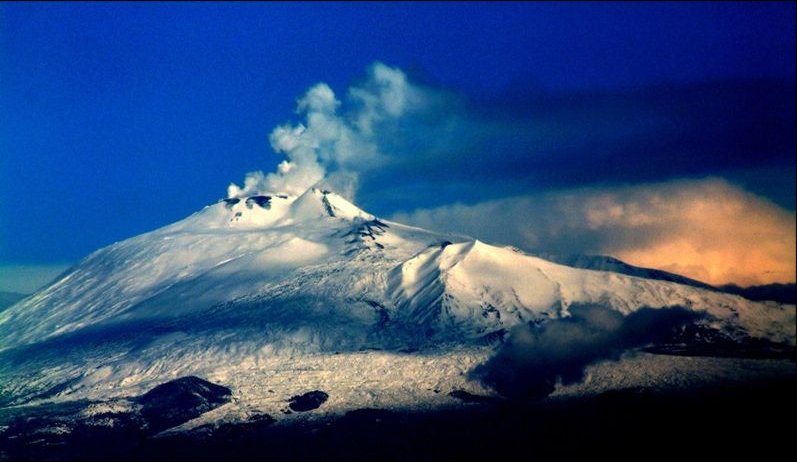
Mount Etna, Sicily: Ancient volcano continues to erupt - Video


Mount Etna on the Italian island of Sicily erupts again after exploding several times earlier this month. 

The caldera spewed out smoke and dust as lava poured from the most active volcano in Europe. 

It has been particularly active recently, after a new crater formed on the south eastern side of the mountain. 

Near-by residents were not in danger as this latest eruption continued. 

Report by Thomas Magill.


Monday, November 18, 2013

Sicily's Mount Etna blows perfect steam rings in rare phenomenon

Molten lava erupts violently into the air from a crater on the summit of Mount Etna in Sicily, Italy. 

The volcano has been quiet over the summer, but dramatically sprang into life over the past few weeks. 

The eruptions also appeared to change the volcano's vent geometry, causing it to produce a series of perfect steam rings - a rare phenomenon. 

Credit: Director / Videographer: Dr. Tom Pfeiffer, Producer: Jack Fletcher, Editor: Josh Douglas.

Sunday, November 17, 2013

Mount Etna eruption lights up the sky over Sicily


An eruption from Mount Etna lit up the night sky over much of eastern Sicily late on Saturday night and into the early hours of Sunday.

The latest lava flow did not endanger any houses, and no evacuation was ordered.

Credit: BBC Chris Eakin

Wednesday, July 10, 2013

Space Station Astronaut, Luca Parmitano Becomes Italy's 1st Spacewalker


Italy, you have a spacewalker. European Space Agency astronaut Luca Parmitano became the first Italian ever to walk in space today (July 9) outside of the International Space Station.

Parmitano, a 36-year old Italian astronaut , spent just over six hours working outside the space station alongside crewmate Chris Cassidy of NASA, and offered his thanks for an exhilarating first spacewalk.

"Thank you," Parmitano said, adding another round of thanks in his native Italian language before signing off.

Among other tasks, Parmitano and his fellow space station crewmember NASA astronaut Chris Cassidy retrieved a pair of materials science experiments, installed radiator grapple bars and successfully replaced a space-to-ground communications controller unit that failed in December 2012.

Because Parmitano and Cassidy ran ahead of schedule, the speedy spacewalkers were able to start in on tasks originally scheduled for their second spacewalk next Tuesday (July 16).

"Life is good," Cassidy said near the end of the spacewalk.

Cassidy and Parmitano also readied the station for the launch of a new Russian module later this year. They installed cables that will be used to power the new Multipurpose Laboratory Module upon its arrival at the station.

Parmitano also installed a cover that will protect a docking port where space shuttles attached to the station, according to NASA officials.

The two astronauts took some time to appreciate their unique view of Earth as the station orbited about 260 miles (418 kilometers) above the surface of the planet.

"It's amazing," Parmitano said when looking down at the Earth at the beginning of the spacewalk.

Now five-time veteran spacewalker Cassidy checked in on Parmitano periodically to see if his tasks were going smoothly.

Parmitano was perched on the tip of the Canadian Space Agency built robotic arm for much of the spacewalk. NASA's Karen Nyberg controlled the space station's 57.7 foot (17.6 meter) robotic arm from inside the International Space Station.

"It was fun working with you," Nyberg said as work with the robotic arm came to a close. "It was just like we trained."

Parmitano replied: "Even better."

Sunday, July 7, 2013

Andromeda Galaxy by Lorenzo Comolli

Credit: Lorenzo Comolli

Lorenzo Comolli took this photo of the Andromeda Galaxy on Nov. 16, 2012 from the Apennine mountain village of Bogli, Italy. 

He used a TEC 140 telescope and Canon EOS 5D with Baader filter, Gemini G-41 mount to capture the image. 

Wednesday, December 26, 2012

Volcanic eruption: Stromboli Lava Flow on Sciara del Fuoco

The activity at Stromboli has lately increased, over the holidays. Since 23 December small lava overflows occurred from the eastern crater area and produced lava flows with varying length on the upper part of the Sciara del Fuoco (360deg view).

Yesterday afternoon and evening, it looked as if the lava flow had increased and extended on a good portion of the Sciara where lava blocks detaching from the flow rolling down created a dense incandescent stream.

It is still unclear whether the flows come from a new vent at the eastern crater terrace or whether they are overflows of lava from an existing vent.

The seismic activity has increased and in addition to the tremor, explosion and rockfall, signals are elevated as well.

Such lava (over-)flows from the crater are usually relatively short-lived, but come often in phases.

All news about: Stromboli volcano

Monday, November 26, 2012

TerraSAR-X satellite: The Santorini volcano expands

Credit: DLR

British researchers have used images acquired by the German Aerospace Center (Deutsches Zentrum für Luft- und Raumfahrt; DLR) TerraSAR-X satellite to create a map showing changes in the Santorini archipelago. 

The cause of the deformation is the Santorini volcano located beneath the archipelago.

In some places, the Kameni Islands inside the flooded caldera have risen by eight to 14 centimetres. 

The breadth of the caldera as a whole has increased by about 14 centimetres since early 2011. 

In the analysis of the radar data, the red and yellow shading shows the areas where the ground has risen the most. The main island of Thira is unaffected by the deformation, thus appearing blue.

Glasses are rattling on the shelves and the ground is rumbling - since January 2011 the earth under the Santorini volcano has been stirring.

Most of the time, it is barely noticeable, but every now and then the inhabitants notice small tremors jolting the volcanic archipelago. Nearly circular, and seemingly carved from stone, the submerged caldera is located in the Aegean Sea.

"It was clear to the local people that something was happening with the volcano - but it wasn't until we saw, among other things, the images from the TerraSAR-X radar satellite that we realised that molten rock was pooling beneath the volcano," says British scientist Juliet Biggs from the University of Bristol.

Images acquired by the German Aerospace Center's (Deutsches Zentrum fur Luft- und Raumfahrt; DLR) satellite show the entire archipelago not just rising, but also expanding.

It has been 3600 years since a powerful explosion formed the large caldera. Since then, a new vent has been gradually forming in the middle of this basin, where today the Kameni islands protrude from the water.

The volcano last erupted in 1950 and then fell dormant again, so the scientists from Oxford and Bristol were all the more surprised when the inhabitants started reporting tremors.

"Tour guides, who often visit the volcano with tourists on a daily basis, told me there was an increase in the quantity of strong smelling gas being released by the summit," explains PhD student Michelle Parks. "The colour of the sea had changed as well."

Thursday, September 6, 2012

NASA ISS Image: The Italian Boot at Night

This oblique, night time panorama of much of Europe was photographed by one of the Expedition 32 crew members aboard the International Space Station flying approximately 240 miles above the Mediterranean Sea on Aug. 18, 2012.

The country of Italy is visible running diagonally southward from the horizon across the center of the frame, with the night lights of Rome and Naples being visible on the coast near the center.

Sardinia and Corsica are just above left center of the photo, and Sicily is at lower left.

The Adriatic Sea is on the other side of Italy, and beyond it to the east and north can be seen parts of several other European nations.

Image Credit: NASA

Sunday, July 29, 2012

Science fiction comes to life in Italian lab

A bionic hand at the Istitute of Biorobotic of the Italian University St. Anna School in Pisa.

At the university, a bionic arm commanded by the human brain or a limb extension that allows rescuers to lift rubble after earthquakes are just some of the futuristic innovations in the pipeline.

At Italy's Sant'Anna university, a bionic arm commanded by the human brain or a limb extension that allows rescuers to lift rubble after earthquakes are just some of the futuristic innovations in the pipeline.

"The idea is to get robots out of factories where they have shown their worth and to transform them into household machines which can live together with humans," says Professor Paolo Dario, director of the college's bio-robotics department.

The university in the historic town of Pisa in Tuscany is a veritable factory of ideas.

Researchers here are working on projects ranging from a robot that can come to your door to collect your recycling to tomatoes that slow the effects of ageing and plants that survive underwater to help flood-prone regions of the world.

A Body Extender robot at the Perceptual Robotics Laboratory at Sant'Anna University in Pisa, Italy.

The exoskeleton or "body extender", a prototype costing a million euros, meanwhile, is a kind of armour weighing 160 kilos which multiplies the strength of its human user by 20. "You can innovate here.

Whoever has a project gets help, ideas are not blocked. We are investing in individuals," the rector of Sant'Anna, Maria Chiara Carrozza, a professor of bio-robotics said in an interview.

The dustcart looks like the famous R2-D2 from Star Wars with its laser scanner and location sensors.

The idea is that it can work through phone bookings to come to your street at a fixed time to collect your waste.

"We tested it for two months with 15 families living in one of the towns near here. Everything worked well but there are still some problems to sort out," said Pericle Salvini, a member of the team behind the project.

"First of all it is slow for security reasons and it sometimes blocks the traffic. Also it cannot legally be on the road since there is no type of insurance for this type of robot in case of an accident," he said.

Researcher Pericle Salvini work on a DustClean Robot at the Institute of Biorobotic at Sant'Anna University in Pisa.

The dustcart looks like the famous R2-D2 from Star Wars with its laser scanner and location sensors.

The idea is that it can work through phone bookings to come to your street at a fixed time to collect your waste.

Professor Dario also heads up a project entitled "The Robot Companions for Citizens" which is one of six contestants for a European Union prize of one billion euros ($1.2 billion) in funding spread out over a decade.

Marco Controzzi, who is working on a bionic arm, says it will operate by using electrodes attached to the skin or implanted in your head. "It will move only according to your intentions," he said, adding that powering it would be easy as it can run on just two mobile phone batteries.

The exoskeleton or "body extender", a prototype costing a million euros, meanwhile, is a kind of armour weighing 160 kilos (353 pounds) which multiplies the strength of its human user by 20. "The idea is to use this type of instrument for emergency workers in disasters like an earthquake," said engineer Marco Fontana.

Monday, July 16, 2012

NASA Aqua /Terra Satellite Image: Sicily and Mount Etna volcanic eruption

Mount Etna is Europe's most active volcano. Aqua captured this image of Etna erupting on Oct. 28, 2002.

The view of Earth from space has transformed our understanding of, as well as our admiration for, the planet.

The data and images collected by Earth-observing satellites have been used in thousands of scientific papers, helped us better respond to natural disasters, improved weather and climate forecasts, enlightened us about our impact on Earth and captivated us with beauty.

One of the stars of NASA's fleet of satellites is Aqua. The satellite is named for its ability to measure water vapour in the atmosphere, water in the oceans, as well as ice and snow.

When it was launched on May 4, 2002, scientists expected it to work for three to five years but its six instruments have been functioning perfectly for 10 years, gathering 29 million gigabytes of data in that time.

One of the most useful and impressive instruments aboard Aqua is the Moderate Resolution Imaging Spectroradiometer, which measures visible and infrared radiation, and produces truly amazing, incredibly beautiful images of Earth.

With funding for Earth-observing satellites on the decline, let's hope Aqua keeps going for 10 more years.

Saturday, June 16, 2012

Rare Tornado Strikes Venice, Italy


Credit: Still from YouTube video.

A tornado swept across Italy's historic island city of Venice at around 11 a.m. local time yesterday (June 12), leaving a trail of twisted debris and a shaken populace in its wake.

Videos and images posted on YouTube and splashed across the websites of local media outlets showed a large and menacing twister looming above picturesque tiled roofs and the historic seascapes for which the city is famed.
Tornadoes near the northern Italian coastal city are rare, but they have wreaked havoc in Venice in the past. On Sept. 11, 1970, one or more tornadoes ripped through the region, killing as many as 50 people. In Venice, the twister lifted a boat out of the water and slammed it back down again, killing at least 21 people, according to local media reports. Although the Mediterranean coast may not be famed for its tornadoes, Carbin said twisters can spin up just about anywhere. "There are hotspots, and of course in North America, we have the largest hotspots," Carbin said, "but tornadoes have been reported in England, France, Germany, Asia, Indonesia." A combination of warm air, moisture, a thunderstorm and layers of different winds in the atmosphere sets the stage for a twister. "Anywhere you can put those ingredients together, you can get a tornado," Carbin said.

Thursday, March 15, 2012

Friday, February 10, 2012

Mount Etna Eruption, Sicily, Italy

Mount Etna spews lava on the southern Italian island of Sicily. Mount Etna is Europe's tallest and most active volcano.


Friday, January 20, 2012

Costa Concordia: Satellite image

View of the stricken cruise ship which ran aground and capsized near the island of Giglio in Italy on 13 January. The image was taken on 17 January.

Friday, January 6, 2012

ESA ISS Astronaut's Image: Italy's Mount Etna erupting


Italy’s Volvanic Mount Etna Erupts

Europe's tallest active volcano, Mount Etna, erupted for the first time this year Thursday, sending ash clouds 5,000 metres into the air. The eruption also sent lava flowing into the deserted Valle del Bove area.

Aviation authorities temporarily closed the Catania Airport in Sicily and limited air traffic. Flights at the airport were allowed to resume by midday.

Last year, the 3,329-metre volcano erupted 18 times, but there were no casualties and damage. The first eruption that spewed lava and ash cloud out of one of its craters occurred on Jan. 13, 2011 and lasted 1.5 hours.

From May 8 to 12, the volcano exploded many times and spewed a fountain of lava.

Friday, September 2, 2011

Artist's concept of the Aquarius/SAC-D spacecraft, a collaboration between NASA and Argentina's space agency, with participation from Brazil, Canada, France and Italy. 

Aquarius, the NASA-built primary instrument on the spacecraft, will take NASA's first space-based measurements of ocean surface salinity, a key missing variable in satellite observations of Earth that links ocean circulation, the global balance of freshwater and climate.

Image credit: NASA


NASA's Aquarius instrument has successfully completed its commissioning phase and is now "tasting" the saltiness of Earth's ocean surface, making measurements from its perch in near-polar orbit.

"This marks the end of the long odyssey to design, build and launch this mission, and the start of a new journey of scientific exploration," said Aquarius Principal Investigator Gary Lagerloef of Earth and Space Research, Seattle.

"Scientists from around the world are ready and waiting to study this important new satellite measurement for ocean and climate research."


Aquarius will make NASA's first space observations of the salinity, or concentration of salt, at the ocean surface, a key variable in satellite studies of Earth.

Variations in salinity influence the ocean's deep circulation, outline the path freshwater takes around our planet and help drive Earth's climate.

The Aquarius science team will spend the coming months analyzing and calibrating the measurements and releasing preliminary data.

With the Aquarius instrument commissioning now complete, the SAC-D Instruments Flight Operations Teams, together with the SAC-D Mission Flight Operations Team in Argentina, are now engaged in commissioning the other seven SAC-D instruments.

Once all the observatory instruments are commissioned, a maneuver will be conducted to place Aquarius/SAC-D in its final orbit, 408 miles (657 kilometers) above Earth.

Wednesday, August 24, 2011

ESA ERS-2: Collision Avoidance manouvre

This multi-colour ERS-2 image shows the Strait of Messina, the narrow section of water separating the Italian Peninsula (seen on the right) from Sicily. 

It is a composite of three ERS-2 radar images acquired on different dates with different colours assigned to each date: red for 13 February 2002; green for 11 August 2004; blue for 5 May 1999.

Credits: ESA

ERS-2 was launched in 1995, four years after ERS-1, the first European Remote Sensing satellite.

With 20 years of continuous measurements, the two missions paved the way for the development of many new Earth observation techniques in the areas of atmosphere, land, ocean and ice monitoring.

ERS-2 also carried the first European high-precision instrument to measure stratospheric ozone concentrations. It was crucial for observing the evolution of annual ozone depletion over Antarctica.

ERS-2 travelled 3.8 billion km during its lifetime, providing data for thousands of scientists and projects.