Showing posts with label Robotic. Show all posts

Wednesday, October 8, 2014

Toshiba develops lifelike communication android - Video


Following in the footsteps of Hiroshi Ishiguro's eerily lifelike creations, Toshiba Corporation today announced that it has developed a lifelike communication android that can move its arms and hands smoothly and use Japanese sign language.

The android is a prototype that the company will continue to develop towards achieving a service robot able to assist people in the fields of welfare and healthcare.

The android will be showcased at CEATEC JAPAN 2014, which will be held from October 7 to 11.

The android has the appearance of a friendly young woman, an impression accentuated by blinking eyes and a warm smile.

At present, the android can mimic only simple movements, such as exchanging greetings and signing in Japanese, but Toshiba will integrate its wide-ranging technologies in areas including sensing, speech synthesis, speech recognition and robotic control to realize a more sophisticated social robot by 2020.

The goal is to design a companion for the elderly and people with dementia, to offer telecounseling in natural speech, communicate through sign language and allow healthcare workers or family members to keep an eye on elderly people.

Toshiba developed the android in collaboration with aLab Inc., Osaka University, Shibaura Institute of Technology, and Shonan Institute of Technology.

Drawing on technologies and expertise built up through the development of industrial robots, Toshiba created an algorithm to coordinate the movement of 43 actuators in the android's joints.

Shibaura Institute of Technology and Shonan Institute of Technology contributed robot driving and sensor-based motion teaching technologies, and aLab Inc. and Osaka University provided the technologies required to create a body with a human-like resemblance and emulate human expressions.

As a result, the upper part of the body has a human appearance and moves fluidly.

Toshiba aims to put the android into practical use as a receptionist or as an exhibition attendant within next year.

Monday, June 30, 2014

ESA ATV-5 George Lemaitre: Robotic Resupply spacecraft set for July 24 launch

ESA ATV-5 George Lemaitre, the last of five robot resupply ships Europe was scheduled to provide for the International Space Station will be taken aloft on July 24, launch firm Arianespace said on Thursday.

Known as an Automated Transfer Vehicle (ATV), the freighter will be launched from Kourou, French Guiana, at 10:41 pm on July 24 (0141 GMT on July 25), it said in a statement in Paris.

The European Space Agency (ESA) was contracted to provide five ATVs for the first phase of manned operations by the US-led orbital platform.

The size of a double-decker bus, the cylindrical ATV modules are launched by a heavy Ariane 5 ES rocket, and use onboard motors and starlight navigation to rendezvous and dock with the ISS.

They bring water, food, fuel, oxygen, experiments and treats for the crew and provide much-appreciated additional living space.

At the end of a mission usually lasting several months, they undock from the ISS and burn up in the atmosphere in a controlled de-orbit.

The fifth ship is named the George Lemaitre, after the Belgian cosmologist who fathered the concept of the Big Bang which created the Universe.

The previous four ATVs were rated as very successful testbeds for automated space flight, and their technology is being considered for future US manned missions.

After the last ATV flight, the ISS will continue to be resupplied by the less sophisticated Russia's Progress freighter and fledgling US private contractors e.g. SpaceX

Wednesday, June 4, 2014

Exoskeletons: MIT lab designs workload-sharing robotic limbs - Video

Credit: d'Arbeloff Laboratory

Mention "robotic limbs" and one thinks of devices being developed to replace the loss of human limbs.

Mention "exoskeleton" and one thinks of a suit governing and bound to the entire body.

Researchers at the d'Arbeloff Laboratory for Information Systems and Technology at MIT, led by Professor Harry Asada, Ford Professor of Engineering, have been breaking ground in another direction.

They are working in a co-robot world, and they are developing "extras" for what the person already has.

Videos showing people performing tasks tell a story of what future work might look like when an extra set of arms or legs will be of significant help.

"Supernumerary Robotic Limbs" (SRLs) is the formal term to describe robotic limbs that, when worn, augment limbs already in place.

"Imagine that one day humans will have a third arm and a third leg attached to their body. The extra limbs will help them hold objects, support the human body, share a workload, and streamline the execution of a task.

If the movements of such supernumerary limbs are tightly coupled and coordinated with their arms, the human users may come to perceive the extra limbs as an extension of their own body," the Lab team suggest on their site.

"The goal of our work is to build a co-robot that becomes a functional extension of the human body."

In such settings, the extra arm or leg attached to the body helps to hold objects, share workloads, and streamline tasks.

Situations might include trying to open a door when you need to keep holding something with both hands or having an extra hand to keep something in place during construction.

The devices would look odd on people walking down a city street or at a mall, but the designs deliver practical relevance for a workforce.

A note from the Lab's Baldin Llorens and Prof Harry Asada, for example, said, "In the demanding manufacturing industry, Human-Robot collaboration has proved to be a strong alternative when it comes to tasks that cannot be fully automated."

To optimize productivity, the robots in their designs serve to complement, not replace, human actions. The human worker perceives the robot not as machine but as body extension.


In an aircraft assembly scenario, the Laboratory presents an example where the SRLs are coordinated with the workers to help execute specialized aircraft assembly tasks.

"We focus on the task planning process, communication and coordination between the human worker and the SRL and control implementation."

Evan Ackerman, reporting on their work in IEEE Spectrum, explained what goes into that communication between human and extra limb.

How do these robotic limbs know what to do? Ackerman said "the SRL watches what you're doing with your arms to decide how to move.

It does that by monitoring two inertial measurement units (IMUs) that the user wears on the wrists. A third IMU sits at the base of the robot's shoulder mount, to track the overall orientation and motion of the SRL."


With the gyro and accelerometer data, the limb can predict, based on a model created by demonstration learning, the helpful arm position.

If the person raises arms above the head, the SRLs go above the head too, seeing signs that the person is trying to hold something up.

"Using their SRL prototype," said Ackerman, "the researchers are testing different 'behavioural modes' to program the limbs to do what they want."

Credit: d'Arbeloff Laboratory/IEEE

One model has limbs springing from the shoulders for tasks that take place over the head.

Other constructs involve waist-mounted SRLs that can be used as two extra arms, two extra legs, or one of each.

MIT researchers were in Hong Kong at the IEEE International Conference on Robotics and Automation (ICRA) on Monday, said Ackerman, where they presented SRL prototypes.

Tuesday, May 20, 2014

HAL Hybrid Robotic Exoskeleton: Robot suit helps paraplegic patients

For most paraplegic patients, being able to walk again remains a dream.

The HAL robot suit can help them regain a certain degree of mobility and activity.

An expert team at the Centre for Neurorobotic Movement Training (ZNB) in Bochum has been testing the exoskeleton that was originally developed in Japan since 2011. With excellent results.

Paraplegia is essentially the result of damaged nerve structures in the spine.

To perform a movement, the brain sends out a signal via the spinal cord and its surrounding nerves to a muscle – e.g.one in the arm or in the leg.

Due to his injury, a paraplegic patient's muscles operate with weakened signals.

As a result, the signal does not arrive in the leg or in the arm.

This is where the HAL robot suit comes into play: it picks up the weakened signals through sensors that are attached to the patient's skin and sets the motors in the pelvic and knee-joint regions in motion.

Thus, HAL takes over locomotion on the patient's behalf by connecting directly to the patient's nervous system.

"This is how we wish to activate and foster the residual function of the muscles and, ultimately, to help the patients attain better activity levels," explains Professor Schild Hauer, Medical Director at the university hospital Berufsgenossenschaftliches Universitätsklinikum Bergmannsheil.

The expert team uses the clinical trials at the ZNB to determine, among other things, how much training is required in the best possible scenario and how long the training effects will or will not last.

They have implemented a three-month training cycle, with five sessions per week.

With excellent results: "Our patients attain activity levels which improve their ability to navigate around their everyday life and their surroundings."

"Thus, they continue to train their movement routine every day," explains Professor Schildhauer.

A patient who had been permanently confined to a wheelchair, for example, will be able to walk short distances with the aid of a walking frame after a three-month training period.
In Germany, Bergmannsheil is the only hospital where the robot suit is being tested. In Japan, similar suits are being utilised in some 200 geriatric rehab centres.

The long-term objective is to launch HAL in the German market so that it can be used as a therapy instrument to help as many people as possible.

However, insurance companies will not incorporate the therapy into their clearing system until well-founded data are available, which will only be the case once further trials have been conducted.

Sunday, May 18, 2014

SpaceX's Dragon: Robotic Capsule Undocks from Canadarm on Space Station

SpaceX's Dragon capsule was released from the International Space Station's robotic arm at 9:26 a.m. EDT (1326 GMT) on May 18, 2014.
Credit: NASA TV


SpaceX's Dragon robotic, unmanned, capsule departed the International Space Station today, putting it on a path back to Earth after about one month attached to the orbiting outpost.

The robotic spacecraft is loaded down with more than 3,500 lbs. (1,587 kg) worth of science samples and supplies which should be safely delivered to Earth once the SpaceX capsule splashes down in the Pacific Ocean later today (May 18).

Splashdown is expected to occur at about 3:02 p.m. EDT (1902 GMT) off the coast of Baja California where officials can recover the supply craft.

The SpaceX Dragon capsule orbits with the International Space Station before its release on May 18, 2014.

Credit: NASA TV

Ground controllers maneuvered the space station's robotic arm to pluck Dragon from the Harmony module and move it into position for release.

The spacecraft was let go from the station at 9:26 a.m. EDT (1326 GMT) as both flew 266 miles (428 kilometers) above the ocean south of Australia, according to NASA.

SpaceX's Dragon also performed a series of thruster burns to move a safe distance from the station before it is expected to execute its deorbit burn at about 2:12 p.m. EDT (1812 GMT).

Dragon has been attached to the space station since April 20, after its launch atop the private spaceflight company's Falcon 9 rocket on April 18 from Florida.

SpaceX successfully performed a daring reusable rocket test during the April 18 launch.

The spaceflight company brought the boost stage of the Falcon 9 rocket back to Earth, landing it upright in the ocean, after delivering Dragon to the proper orbit.

SpaceX's Dragon capsule flies above Angola while attached to the International Space Station just before its release on May 18, 2014. 

Credit: NASA TV

Thursday, March 6, 2014

NASA Robotic Refueling Mission (RRM) tests new robotic refueling technologies

A robot servicer could use autonomous rendezvous and fluid transfer technologies to extend the life of orbiting satellites (depicted, artist's concept). 

Credit: NASA

NASA has successfully concluded a remotely controlled test of new technologies that would empower future space robots to transfer hazardous oxidizer – a type of propellant – into the tanks of satellites in space today.

Concurrently on the ground, NASA is incorporating results from this test and the Robotic Refueling Mission (RRM) on the International Space Station to prepare for an upcoming ground-based test of a full-sized robotic servicer system that will perform tasks on a mock satellite client.

Collectively, these efforts are part of an ongoing and aggressive technology development campaign to equip robots and humans with the tools and capabilities needed for spacecraft maintenance and repair, the assembly of large space telescopes, and extended human exploration.

Technologies to Help Satellites That Help Earth
The Satellite Servicing Capabilities Office (SSCO) at NASA's Goddard Space Flight Center in Greenbelt, Md., checked another critical milestone off their list with the completion of their Remote Robotic Oxidizer Transfer Test (RROxiTT) in February 2014.

"This is the first time that anyone has tested this type of technology, and we've proven that it works. It's ready for the next step to flight," says Frank Cepollina, veteran leader of the five servicing missions to the Hubble Space Telescope and the associate director of SSCO.

Located at NASA's Kennedy Space Center in Florida, but commanded from NASA's Goddard Space Flight Center in Greenbelt, Md., the RROxiTT industrial robot mimicked how future space robots could transfer oxidizer to a satellite valve. 

Image Credit: NASA

"RROxiTT gives NASA, and the satellite community at large, confidence that advanced satellite refueling and maintenance technologies aren't a wild dream of the future," says Cepollina.

"They're being built and tested today – and the capabilities that they can unlock can become a reality."

Frank Cepollina
Since 2009, SSCO has been investigating human and robotic satellite servicing while developing the technologies necessary to bring on-orbit spacecraft inspection, repair, refueling, component replacement and assembly capabilities to space.

Taking lessons learned from the successful Robotic Refueling Mission (RRM), the SSCO team devised the ground-based RROxiTT to test how robots can transfer hazardous oxidizer, at flight-like pressures and flow rates, through the propellant valve and into the mock tank of a satellite.

While this capability could be applied to spacecraft in multiple orbits, SSCO focused RROxiTT specifically on technologies that could help satellites traveling the busy space highway of geosynchronous Earth orbit, or GEO.

Located about 22,000 miles above Earth, this orbital path is home to more than 400 satellites, many of which beam communications, television and weather data to customers worldwide.

RROxiTT lead roboticist Alex Janas stands with the Oxidizer Nozzle Tool as he examines the work site. 

Credit: NASA/Chris Gunn

By developing robotic capabilities to repair and refuel GEO satellites, NASA hopes to add precious years of functional life to satellites and expand options for operators who face unexpected emergencies, tougher economic demands and aging fleets.

NASA also hopes that these new technologies will help boost the commercial satellite-servicing industry that is rapidly gaining momentum.

Besides aiding the GEO satellite community, a capability to fix and relocate "ailing" satellites also could help mitigate the growing orbital debris problem that threatens continued space operations, ultimately making space greener and more sustainable.


NASA's Goddard Space Flight Center in Maryland and Kennedy Space Center in Florida joined teams and efforts to test new robotic refueling technologies that could help satellites live longer in space. 

During the test, a robotic arm with a highly specialized tool transfered satellite oxidizer -- an extremely corrosive fluid that helps propel satellites in orbit -- through the valve of a simulated spacecraft. 

Adding to the complexity, the test was operated remotely from Goddard while performed at Kennedy's Payload Hazardous Servicing Facility. 

The test simulated the refueling of a spacecraft in orbit, an extremely challenging task that the team has been tackling since they launched the successful Robotic Refueling Mission (RRM) demonstration to the International Space Station in 2011.

Robotic prosthesis turns drummer into a three-armed cyborg - Video


Georgia Tech has created a robotic drumming prosthesis with motors that power two drumsticks. 

The first stick is controlled both physically by the musicians' arms and electronically using electromyography (EMG) muscle sensors. 

The other stick "listens" to the music being played and improvises. The robot that can be attached to amputees, allowing its technology to be embedded into humans.

Gil Weinberg
Professor Gil Weinberg has already built a band of robotic musicians in his Georgia Tech lab.

Now he's created a robot that can be attached to amputees, allowing its technology to be embedded into humans.

The robotic drumming prosthesis has motors that power two drumsticks. The first stick is controlled both physically by the musicians' arms and electronically using electromyography (EMG) muscle sensors.

The other stick "listens" to the music being played and improvises.

"The second drumstick has a mind of its own," said Weinberg, founding director of the Georgia Tech Center for Music Technology.

"The drummer essentially becomes a cyborg. It's interesting to see him playing and improvising with part of his arm that he doesn't totally control."

The prosthesis was created for Jason Barnes, a drummer who was electrocuted two years ago and lost his right arm below the elbow.

The Atlanta Institute of Music and Media (AIMM) student built his own prosthetic device shortly after the accident. It wasn't very flexible.

He could bang the drums by moving his elbow up and down, but couldn't control the speed or bounce of the stick without a wrist or fingers.

That's when Weinberg stepped in to create a single-stick device with sensors that responds to Barnes' bicep muscles.

"Now I can flex and send signals to a computer that tightens or loosens the stick and controls the rebound," said Barnes.

Weinberg, who has already built a robotic percussionist and marimba player that use computer algorithms to improvise with human musicians, took the prosthesis a step further. He added the second stick and gave it a "musical brain."

"Jason can pull the robotic stick away from the drum when he wants to be fully in control," says Weinberg. "Or he can allow it to play on its own and be surprised and inspired by his own arm responding to his drumming."

Tuesday, February 18, 2014

NASA Robonaut 2: Humanoid Learning Medical Skills for Space Emergencies - Video


NASA is training Robonaut 2, a humanoid space robot to pull double duty as an emergency doctor in space — a surrogate physician that could one day be controlled by experts on Earth to help sick or injured astronauts.

The $2.5 million Robonaut 2, nicknamed R2, is designed to work alongside the astronauts and even take over some of their more tedious duties inside and outside the International Space Station.

The new NASA training is adding telemedicine skills to that mix.

In a new video of Robonaut 2's telemedicine training, the automaton performed an ultrasound scan on a mannequin and even used a syringe like it would to administer a real-life injection.

The tests were performed using a ground-based version of R2 robot, the mechanical twin of the one currently aboard the space station.

Zsolt Garami
"I would say that within an hour I trained him more than with other students I'm working for a week, so I think that he's learning really fast," Dr. Zsolt Garami, of the Houston Methodist Research Institute, says in the video.

Far from earthly hospitals, astronauts who currently live on space station, typically in six-month-long stints, must be trained in basic surgery and medical procedures in case of an emergency.

But Robonaut 2, which has a camera-equipped head, could administer care to spaceflyers, controlled by doctors on the ground.

So far, tests with Robonaut 2 have shown that human controllers can perform tasks "correctly and efficiently by using R2's dexterity to apply the appropriate level of force and can track their progress using R2's vision system," NASA officials explained in a video description.

Garami said the robot might eventually be able to learn to do some tasks on its own.

NASA's Robonaut 2 and Dr. Zsolt Garami, of the Houston Methodist Research Institute, practice telemedicine techniques during a test of the robot's bedside manner. 

This image is a still from a NASA video documenting the Robonaut 2 test. 

Credit: NASA

Friday, February 14, 2014

Self-organizing Robotic construction crew - Video

The TERMES robots can carry bricks, build staircases, and climb them to add bricks to a structure, following low-level rules to independently complete a construction project. 

Credit: Eliza Grinnell, Harvard SEAS

On the plains of Namibia, millions of tiny termites are building a mound of soil—an 8-foot-tall "lung" for their underground nest.

During a year of construction, many termites will live and die, wind and rain will erode the structure, and yet the colony's life-sustaining project will continue.


Inspired by the termites' resilience and collective intelligence, a team of computer scientists and engineers at the Harvard School of Engineering and Applied Sciences (SEAS) and the Wyss Institute for Biologically Inspired Engineering at Harvard University has created an autonomous robotic construction crew.

The system needs no supervisor, no eye in the sky, and no communication: just simple robots—any number of robots—that cooperate by modifying their environment.

Harvard's TERMES system demonstrates that collective systems of robots can build complex, three-dimensional structures without the need for any central command or prescribed roles.

The results of the four-year project were presented this week at the AAAS 2014 Annual Meeting and published in the February 14 issue of Science.


The TERMES robots can build towers, castles, and pyramids out of foam bricks, autonomously building themselves staircases to reach the higher levels and adding bricks wherever they are needed.

In the future, similar robots could lay sandbags in advance of a flood, or perform simple construction tasks on Mars.

"The key inspiration we took from termites is the idea that you can do something really complicated as a group, without a supervisor, and secondly that you can do it without everybody discussing explicitly what's going on, but just by modifying the environment," says principal investigator Radhika Nagpal, Fred Kavli Professor of Computer Science at Harvard SEAS.

She is also a core faculty member at the Wyss Institute, where she co-leads the Bioinspired Robotics platform.

The TERMES robots can build themselves staircases to reach the next construction points, and they know how to add bricks that advance construction without blocking important paths. 

Credit: Eliza Grinnell, Harvard SEAS

More information: "Designing Collective Behaviour in a Termite-Inspired Robot Construction Team," by J. Werfel et al. Science, 2014.

Monday, November 18, 2013

NASA MAVEN Launch: Robotic Mars Probe on its way

NASA's MAVEN spacecraft launched Nov. 18, 2013, from Cape Canaveral Air Force Station, beginning its 10-month journey to the Red Planet.

Credit: NASA TV

NASA launched its newest Mars probe toward the Red Planet Monday (Nov. 18) on a mission to determine how the Martian atmosphere transformed the world into the desolate wasteland it is today.

The robotic spacecraft, called the Mars Atmosphere and Volatile Evolution probe (MAVEN), launched atop an Atlas 5 rocket from the Cape Canaveral Air Force Station here at 1:28 p.m. EST (1828 GMT), beginning a 10-month journey to Mars.

"Liftoff of the Atlas 5 with MAVEN, looking for clues about the evolution of Mars through its atmosphere," NASA launch commentator George Diller said as the rocket climbed into a cloudy Florida sky.

Sunday, November 17, 2013

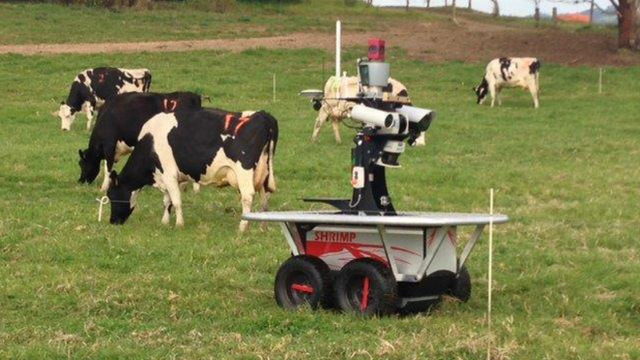
Australia: Rover the Robotic Cow Herder

A four-wheeled robot known as Rover has been successfully tested as a cattle herder in Australia, easily moving a herd from a field to a dairy, researchers say.

The cows, accepting the presence of the robot, were not disturbed by it and the herding process was calm and effective, a team from Sydney University said.

University engineers adapted Rover from a robot already being used to monitor fruit and trees on farms, modifying it so it could be put in a field with cows.

"The research is in its very early stages but robotic technologies certainly have the potential to transform dairy farming," a member of the Faculty of Veterinary Science at Sydney University, Kendra Kerrisk told reporters

Because the robot moved at a slow and steady speed it allowed cows to move at their own natural speed, which is important in avoiding lameness among cattle, she said.

While the Sydney prototype is operated by a human, it's believed future versions could be fully automated, the researchers said, bringing considerable help to dairy farmers.

"When we have discussed this concept with farmers they have been extremely excited and we have had a flurry of calls and emails asking how they can get hold of one," Kerrisk said.

Wednesday, September 4, 2013

JAXA HTV departure from ISS to test revised robotic Dextre operations plan


The JAXA HTV 4 spacecraft is pictured with the Canadian robot arm and Dextre. Credit: NASA

Japan's fourth H-2 Transfer Vehicle will leave the International Space Station on Wednesday, and the astronauts in charge of releasing the unmanned cargo carrier will use a new technique to keep the HTV steady and avoid the recurrence of a hair-trigger abort that expedited the departure of a previous mission.

Filled with trash and other unneeded gear, the HTV will be released from the space station's 58-foot robotic arm at about 12 p.m. EDT (1600 GMT) Wednesday.

Using a control panel inside the space station, astronauts will command the HTV to retreat from the complex a few minutes later, beginning a preprogrammed sequence of two separation burns with the ship's rocket thrusters.

Space station flight engineers Karen Nyberg and Luca Parmitano closed the HTV's hatches Tuesday to prepare for the departure.

The robotic cargo freighter delivered 3.6 tons of supplies and experiments to the space station Aug. 9 after a five-day transit from a Japanese launch pad to the orbiting outpost.

The astronauts unpacked food, spare parts, experiments and other equipment from the HTV's pressurized compartment, while ground controllers put two robotic arms and a two-armed robotic handyman to work outside the space station to handle the spacecraft's cache of external cargo.

The Canadian-built Dextre robot stowed a main bus switching unit, utility transfer assembly, and an experiment package sponsored by the U.S. Defense Department on platforms mounted on the space station's truss.

Dextre retrieved an older U.S. military experiment - part of the Air Force's Space Test Program - and placed it on the HTV's exposed cargo pallet, then the platform was put back inside the cargo craft Aug. 30.

The trash and experiment box packed inside the HTV will be destroyed during re-entry over the Pacific Ocean on Saturday.

Perched on the end of the station's Canadian robot arm, the HTV will be removed from its berthing port on the Harmony module early Wednesday and maneuvered to a location about 30 feet below the complex.

When astronauts get the go to release the 33-foot-long spacecraft, they will follow a new plan devised after trouble encountered when the third HTV left the space station in September 2012.

After its release from the robot arm, the HTV 3 spacecraft began to drift outside of a predetermined box. Its on-board computers sensed the unplanned movement.

"When we released it with the arm, it imparted a moment on the spacecraft, which caused the spacecraft to translate a little bit," said Mike Suffredini, NASA's space station program manager.

"The abort itself was required because of the moment put on it with the arm. The big thing about the abort was it used the main engines, which put a higher plume and heating load out there close to ISS. Both of those issues have been dealt with between then and now," Suffredini said.

Sunday, June 30, 2013

NASA AMES: ISS Astronaut Drives K10 Robotic Rovers on Earth

Credit: NASA Ames Research Center

NASA's K10 rover at the Ames Research Center in Moffett Field,Calif., performs a surface survey with its cameras and laser system, and then deployed a simulated polymide antenna while being controlled by an astronaut in space during a June 2013 test.

Friday, April 26, 2013

Russian Progress 51 cargo spacecraft successfully docked to the ISS - Antenna Fault

A Russian Progress 51 robotic spacecraft successfully docked to the International Space Station today (April 26, 2013).

CREDIT: NASA TV

An unmanned cargo-carrying spacecraft successfully docked with the International Space Station Friday morning (April 26), despite a glitch in the capsule's navigation system.

After its launch from the Baikonur Cosmodrome in Kazakhstan on Wednesday, the Russian Progress 51 spacecraft failed to deploy one of the two antennas used for the Kurs automated docking system.

Russian ground controllers were able to reposition the antenna, allowing the automated docking to go ahead as planned.

Russian cosmonauts Pavel Vinogradov and Roman Romanenko kept an eye on Progress as it moved into position.

"We have contact," one of the cosmonauts said after docking, "We have capture."

Although the cosmonauts were prepared to take over docking procedures, the automated system worked and the spacecraft fully docked to the station at 8:34 a.m. EDT (1234 GMT) while flying 251 miles (404 kilometers) over the border between China and Kazakhstan.

The approach to the space station was slower than usual because controllers on the ground and astronauts on the International Space Station were carefully monitoring Progress's position, NASA officials said.

At first the Progress was "soft-docked" and not secured in place with hooks in latches, giving the station crew and flight controllers a chance to make sure its stuck antenna posed no risk to the station's exterior.

When they saw it was safe, the Progress was slowly drawn into the port and secured.


Progress delivered 1,764 pounds (800 kg) of propellant, 57 pounds (26 kg) of air, 48 pounds (21 kg) of oxygen, 926 pounds (420 kg) of water and 3,348 pounds (1519 kg) of experiment hardware, spare parts and other supplies to the residents of the space station, NASA officials said.

Tuesday, April 2, 2013

Swiss Space Systems to Launch Robotic Mini-Shuttle in 2017

The Switzerland-based Swiss Space Systems announced plans to launch a privately built SOAR unmanned space plane from an Airbus A300 jetliner by 2017 for small satellite launches. 

CREDIT: Swiss Space Systems

A Swiss company has unveiled an ambitious plan to build a privately built robotic rocket plane by 2017 in order launch satellites into orbit.

The company Swiss Space Systems (S3) plans to loft the unmanned suborbital shuttle from the back of an Airbus A300 jetliner to serve as a commercial satellite launch platform.

The Payerne based, Switzerland firm unveiled the satellite launch concept on March 13 and is expected to reveal the supplier of its shuttle rocket engine in April.


"S3 aims to develop, build, certify and operate suborbital space shuttles dedicated to launching small satellites, enabling space access to be made more democratic thanks to an original system with launching costs up to four times less than at present," the company announced in a statement.

"The first test launches will be carried out by the end of 2017."

S3 officials said they plan to build a mock up of the unmanned mini-shuttle by 2014, then open the a commercial spaceport in Payerne in 2015.

The first flightworthy spacecraft prototype is slated to be built by in 2016, with the initial test flights following a year later. If all ges well, commercial satellite launches would begin in 2018.

Gregoire Loretan
The unmanned satellite launches may be just the beginning, S3 officials said.

"Our first priority is the launch of small satellites until 2018," Gregoire Loretan, S3's head of communications, told reporters.

"And the goal for S3 is to establish certification process and standards to help the development of manned flight afterwards."

This artist's illustration shows the Swiss Space Systems unmanned SOAR space plane gliding back to its spaceport after launching a small satellite. 

CREDIT: Swiss Space Systems A new rocket plane rises

According to S3's flight plan, the company plans to launch its robot rocket plane from an altitude of about 33,000 feet (10,000 meters). After separating from the carrier plane, the rocket plane will fire a liquid oxygen and kerosene rocket engine to reach an altitude of nearly 50 miles (80 kilometers).

S3 officials have dubbed the vehicle a space plane, though technically the rocket-powered craft will not fly high enough to cross the recognized the boundary of space, about 62 miles (100 km). But the 50-mile target altitude is high enough to launch a satellite into orbit.

At that height, the robotic shuttle will open its cargo bay doors to deploy a satellite equipped with its own rocket engine, a third stage, to launch the 550-pound (250 kilograms) satellite into an orbit about 434 miles (700 km) above Earth. The mini-shuttle should then glide back to Earth and land at its home spaceport.

The total development cost for the launch system is estimated to be about 200 million Swiss Francs, or $211 million. Another 50 million Francs ($53 million) will pay for a Swiss spaceport, S3 officials said.

"The overall budget is 250 millions [Swiss Francs], this includes one spaceport. A large part of this budget is already covered by private investors and our partners," Loretan said.

Sunday, February 10, 2013

"Robotic Exoskeleton" on show in London's Science Museum

A "bionic man" costing one million dollars went on display on Tuesday at Britain's Science Museum, complete with artificial organs, synthetic blood and robot limbs.

Named Rex, which is short for "Robotic Exoskeleton", the six foot six inch (two metre) humanoid with its uncannily life-like face was assembled by leading roboticists for a television programme.

Although cheaper than the "Six Million Dollar Man" made famous by the cult 1970s television series starring Lee Majors, the technology is far advanced from the fictional bionics on show back then.

The creation includes key advances in prosthetic technology, as well as an artificial pancreas, kidney, spleen and trachea and a functional blood circulatory system.

Welcoming Rex to the museum in London on Tuesday was Swiss social psychologist Bertolt Meyer, who was himself born without a left hand and has a sophisticated bionic replacement.

"I've looked around for new bionic technologies, out of personal interest, for a very long time and I think that until five or six years ago nothing much was happening," Meyer said.

"Then suddenly we are now at a point where we can build a body that is great and beautiful in its own special way."

The museum exhibit, which opens to the public on Thursday, will explore changing perceptions of human identity against the background of rapid progress in bionics -- although Rex is not strictly bionic as he does not include living tissue.

Below is a lengthy YouTube video, recorded in Dublin, discussing the issues that surround Prosthetics.

Bertolt Meyer
One of the panel members is Bertolt Meyer, who was born with a congenitally missing lower left arm. He was fitted with his first prosthetic device when he was only three months old.

The passive device he was fitted with at the time bears little comparison to the cutting edge 'active' prosthetic device he wears today. He is one of the first users of Touch Bionics' i-LIMB Pulse.

Between the ages of 14 and 19, Bertolt wore a body powered "split hook" device, which was attached via a harness operated by the movement of his remaining arm.

Thursday, September 6, 2012

Cheetah Robot runs at 28.3 mph - YouTube


The cheetah bot is now able to run at 28.3 mph (45.5 kph), which is 0.5 mph faster than Usain Bolt's fastest 20 meter split, noted Boston Dyanmics, the company developing the robot in conjunction with the U.S. Defense Advanced Research Projects Agency (DARPA).

Getting the mechanical cheetah up to this speed required researchers to improve the computer instructions that control its legs and back, whose flexible design are key to its speed, IEEE Spectrum reported.

A few important limitations keep this version of the Cheetah stuck in lab, for now. It uses an outside power source that it does not carry.

It relies on a tether to keep it upright. Early next year, however, Boston Dynamics plans to perform outdoor tests of an untethered version, called WildCat.

Monday, August 20, 2012

NASA InSIGHT: Second Robotic Rover drill to land on Mars in 2016

In the wake of successfully dropping the SUV-sized Curiosity rover on Mars this month, NASA will send another robot to the Red Planet in 2016 to drill into the planet’s crust and, for the first time, piece together a picture of the Martian interior.

The $425 million robotic lander, named InSIGHT, will be built and operated by the Jet Propulsion Laboratory at the California Institute of Technology, the high-flying hotbed of now-famous engineers and scientists who designed and assembled the $2.5 billion Curiosity rover and its heart-stopping “sky crane,” which lowered the Curiosity rover to the Martian surface.

Mars Atmosphere and Volatile Evolution Mission (MAVEN)

Credit: NASA/Goddard Space Flight Center artist's concept

On Monday morning, NASA officials informed JPL staff that InSIGHT had won funding over two other proposed missions.

“This is another big day for us out at JPL,” said Gregg Vane, the lab’s head of planning for solar system exploration.

Whereas Curiosity can roam the surface on six-wheels, InSIGHT will be planted in one spot after dropping onto the Martian surface — minus the sky crane — in September 2016.

A German-built drill nick-named “the mole” will pound 30 feet into the Martian crust to take the temperature of the planet, while a sensitive French-built seismometer will detect any Marsquakes.

Together, the instruments will provide vital clues to how Mars formed.

“We’ll be able to deduce the deep structure of Mars, which now is a total mystery,” said Vane. “That means all the way down to the core.”

To date, scientists have determined the deep structure of only one planet — Earth.

They know the interior of Mars must be different, because Mars has no magnetic field to shield its surface from radiation. Earth, by contrast, has a strong magnetic field generated by a spinning molten iron core.

Except for the drill and seismometer, which are new, InSIGHT will be a near-copy of the Phoenix lander NASA dropped onto Mars in 2008, which found water ice near the Martian north pole.

In choosing InSIGHT, NASA rejected two riskier missions: a robotic boat that would have floated on a methane lake on Saturn’s moon Titan, and a mission to examine a comet.

Meanwhile, Curiosity has begun shooting its laser “ChemCam” on Mars, blasting a rock Sunday in a successful test of the instrument, which can determine the composition of surface minerals by examining flashes of vaporized gas.

Wednesday, August 1, 2012

Tail Assisted Dynamic Self Righting Robot - YouTube


This video is a demonstration of two robots, the 160g Tailbot (a 4 wheeled robot) and the 8.1kg XRL (a RHex hexapedal robot), using their inertial tails to perform aerial self righting behaviours.

What a difference a tail makes. Robots with tails can fly through the air while maintaining their orientation, evidence that appendages for robots can enhance performance and effectiveness.

Past research from UC Berkeley explored what happens when you give a wheeled robot a controllable tail, as that used by the lizard.

Now an extremely adept X-RHex Lite, or XRL for short, robot shows it can stay upright no matter how challenging the attempt is to make it do otherwise.

The XRL is the result of a collaboration between UC Berkeley and the University of Pennsylvania.

The robot is based on RHex, UPenn's original hexapod robot, but the most distinguishing features of the newer version are that it is more modular, and it has an actuated tail. The common challenge has been getting mobile robots to land and stay on their feet.

This work was presented at CLAWAR 2012, and the paper can be found here: http://kodlab.seas.upenn.edu/

Sunday, July 29, 2012

Science fiction comes to life in Italian lab

A bionic hand at the Istitute of Biorobotic of the Italian University St. Anna School in Pisa.

At the university, a bionic arm commanded by the human brain or a limb extension that allows rescuers to lift rubble after earthquakes are just some of the futuristic innovations in the pipeline.

At Italy's Sant'Anna university, a bionic arm commanded by the human brain or a limb extension that allows rescuers to lift rubble after earthquakes are just some of the futuristic innovations in the pipeline.

"The idea is to get robots out of factories where they have shown their worth and to transform them into household machines which can live together with humans," says Professor Paolo Dario, director of the college's bio-robotics department.

The university in the historic town of Pisa in Tuscany is a veritable factory of ideas.

Researchers here are working on projects ranging from a robot that can come to your door to collect your recycling to tomatoes that slow the effects of ageing and plants that survive underwater to help flood-prone regions of the world.

A Body Extender robot at the Perceptual Robotics Laboratory at Sant'Anna University in Pisa, Italy.

The exoskeleton or "body extender", a prototype costing a million euros, meanwhile, is a kind of armour weighing 160 kilos which multiplies the strength of its human user by 20. "You can innovate here.

Whoever has a project gets help, ideas are not blocked. We are investing in individuals," the rector of Sant'Anna, Maria Chiara Carrozza, a professor of bio-robotics said in an interview.

The dustcart looks like the famous R2-D2 from Star Wars with its laser scanner and location sensors.

The idea is that it can work through phone bookings to come to your street at a fixed time to collect your waste.

"We tested it for two months with 15 families living in one of the towns near here. Everything worked well but there are still some problems to sort out," said Pericle Salvini, a member of the team behind the project.

"First of all it is slow for security reasons and it sometimes blocks the traffic. Also it cannot legally be on the road since there is no type of insurance for this type of robot in case of an accident," he said.

Researcher Pericle Salvini work on a DustClean Robot at the Institute of Biorobotic at Sant'Anna University in Pisa.

The dustcart looks like the famous R2-D2 from Star Wars with its laser scanner and location sensors.

The idea is that it can work through phone bookings to come to your street at a fixed time to collect your waste.

Professor Dario also heads up a project entitled "The Robot Companions for Citizens" which is one of six contestants for a European Union prize of one billion euros ($1.2 billion) in funding spread out over a decade.

Marco Controzzi, who is working on a bionic arm, says it will operate by using electrodes attached to the skin or implanted in your head. "It will move only according to your intentions," he said, adding that powering it would be easy as it can run on just two mobile phone batteries.

The exoskeleton or "body extender", a prototype costing a million euros, meanwhile, is a kind of armour weighing 160 kilos (353 pounds) which multiplies the strength of its human user by 20. "The idea is to use this type of instrument for emergency workers in disasters like an earthquake," said engineer Marco Fontana.