Showing posts with label docked. Show all posts

Sunday, April 20, 2014

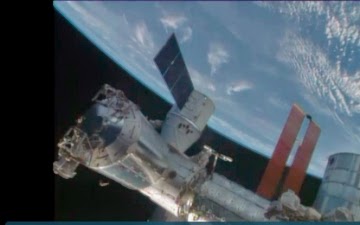
ISS Crew Grapples with SpaceX Dragon Spacecraft before Docking

The SpaceX Dragon spacecraft successfully berthed at the space station at 9:06 a.m. EDT. 

The mission is the company's third cargo delivery flight to the station.

ISS Commander Koichi Wakata of the Japan Aerospace Exploration Agency, with the assistance of NASA’s Rick Mastracchio, successfully captured the SpaceX Dragon spacecraft with the station’s robotic arm at 7:14 a.m. EDT.

Operations to berth Dragon to the space station begin at approximately 9:30 a.m.

The mission is the company's third cargo delivery flight to the station.

Dragon's cargo will support more than 150 experiments to be conducted by the crews of ISS Expeditions 39 and 40.


The SpaceX-3 Dragon spacecraft separated from the Falcon rocket as it continues on to the International Space Staton.

Liftoff took place at Cape Canaveral Air Force Station's Space Launch Complex 40 at 3:25 p.m. EDT.

Thursday, August 1, 2013

ESA ATV-4 docked to ISS Zvezda Module: Ready for Action

ATV-4 docked to Zvezda.

Albert Einstein, ESA’s unmanned cargo ferry at the International Space Station, will start pumping propellants today into the orbital outpost. 

This will be followed by air and oxygen transfers before it resumes boosting the Station’s orbit.

ATV-4 is the fourth Automated Transfer Vehicle to serve the Station; it was launched on 5 June and reached the complex nine days later. Since then, this European cargo carrier has been firmly attached to the Station, acting as an additional module.

All 2489 kg of dry cargo has now been carried into the Station and the crew has already loaded 1213 kg of waste into ATV.

Around two more tonnes of unused equipment, rubbish and other material will be packed into the vehicle before it completes its mission in spectacular fashion as a cosmic rubbish removal van in late October, burning up safely as it reenters the atmosphere.

So far, ATV’s mission has been quiet, as everything goes according to plan. “We like having this kind of mission,” says Jean-Michel Bois, Head of the ESA Operations Team at the ATV Control Centre in Toulouse, France.

“Of course, there have been small issues – there always are – but they keep us on our toes. Everything is in a great state and ATV is working beautifully.”

The 60-strong team from ESA, France’s CNES space agency and industry at the control centre constantly monitor ATV’s health and they are always ready for unscheduled actions, like avoiding orbital debris by changing the Station’s orbit with ATV’s powerful engines.

Albert Einstein has already preformed a major planned reboost, using 200 kg of propellant and raising the Station’s orbit by about 10 km.

The only significant unplanned event came last week, when one of ATV’s three computers was automatically shut down by onboard software.

Then a second computer failed on Sunday – not a problem as ATV can operate fine with just one unit.

Even so, critical activities require all computers to be working normally so some of the Toulouse centre’s key personnel cut their holidays short to tackle the problem.

With this additional help, the two computers were soon restarted. ATV was then ready to go ahead with preparations for the propellant transfer.

The ESA ATV Control Centre in Toulouse, France.

The fuel pipes were pressurised on 31 July, leaving ATV ready to pump 860 kg of fuel and oxidiser into the tanks of Zarya module on Thursday afternoon.

All of the available propellants will be transferred during the 1.5-hour operation, after which the pipes will be purged and evacuated to avoid any problems when ATV undocks.

Then air and oxygen will flow into the Station on 12 and 13 August. ATV-4 holds 66.3 kg of air and 33.3 kg of pure oxygen for the crew. It also arrived with 564 kg of water in its tanks, 23% of which has already been pumped into the Station’s tanks.

On 14 August, ATV will light up its engines for another orbit reboost, followed by another on 28 August.

According to planning, ATV will undock and head for the fiery end to its mission on 28 October.

Monday, July 29, 2013

Russian Progress M-20M Cargo Ship Docked with ISS

This image provided by NASA taken by one of the crew members aboard the International Space Station photographed this night view of storm clouds over Southern California July 21, 2013. 

Early morning lightning can be seen as a white blotch just to the right of center. 

The yellow colored area, beneath the grey clouds, which almost shines because of night lights, is part of the highly populated area of Los Angeles and San Diego. (AP Photo/NASA)

Russia's space agency says that its cargo ship has docked successfully with the International Space Station.

Roscosmos says the unmanned Progress M-20M spacecraft moored at the station Sunday about six hours after its launch from the Baikonur Cosmodrome in Kazakhstan. The docking was performed in automatic mode.

The agency says the ship has delivered about 2.4 metric tons of supplies to the space outpost, including fuel, food, water and scientific equipment.

The 2011 retirement of the U.S. shuttle fleet has left Russia's Soyuz spacecraft as the sole means to ferry crews to and from the space outpost. The unmanned cargo version of the Soyuz, the Progress, delivers the bulk of station supplies.

Saturday, June 1, 2013

Soyuz, TMA-09M docked with International Space Station

Soyuz, TMA-09M docked with International Space Station.

It brought Expedition 36 crew safely to the ISS three days ago and will remain docked until it takes crew back to earth in November.

Image: Karen Nyberg

Friday, April 26, 2013

Russian Progress 51 cargo spacecraft successfully docked to the ISS - Antenna Fault

A Russian Progress 51 robotic spacecraft successfully docked to the International Space Station today (April 26, 2013).

CREDIT: NASA TV

An unmanned cargo-carrying spacecraft successfully docked with the International Space Station Friday morning (April 26), despite a glitch in the capsule's navigation system.

After its launch from the Baikonur Cosmodrome in Kazakhstan on Wednesday, the Russian Progress 51 spacecraft failed to deploy one of the two antennas used for the Kurs automated docking system.

Russian ground controllers were able to reposition the antenna, allowing the automated docking to go ahead as planned.

Russian cosmonauts Pavel Vinogradov and Roman Romanenko kept an eye on Progress as it moved into position.

"We have contact," one of the cosmonauts said after docking, "We have capture."

Although the cosmonauts were prepared to take over docking procedures, the automated system worked and the spacecraft fully docked to the station at 8:34 a.m. EDT (1234 GMT) while flying 251 miles (404 kilometers) over the border between China and Kazakhstan.

The approach to the space station was slower than usual because controllers on the ground and astronauts on the International Space Station were carefully monitoring Progress's position, NASA officials said.

At first the Progress was "soft-docked" and not secured in place with hooks in latches, giving the station crew and flight controllers a chance to make sure its stuck antenna posed no risk to the station's exterior.

When they saw it was safe, the Progress was slowly drawn into the port and secured.


Progress delivered 1,764 pounds (800 kg) of propellant, 57 pounds (26 kg) of air, 48 pounds (21 kg) of oxygen, 926 pounds (420 kg) of water and 3,348 pounds (1519 kg) of experiment hardware, spare parts and other supplies to the residents of the space station, NASA officials said.

Tuesday, July 12, 2011

NASA Shuttle Atlantis: Inside the Cargo bay

This image of Atlantis' payload bay, focusing on the docking mechanism, was photographed by the STS-135 crew from inside the crew cabin.

The orbiter boom sensor system and a portion of the remote manipulator system's robot arm are visible in the frame, exposed during a busy third day in space for the astronauts.

The photo was made shortly before the shuttle docked with the International Space Station.

Image Credit: NASA

Thursday, May 19, 2011

NASA Space Shuttle Endeavour docked to ISS

NASA Space Shuttle Endeavour docked to the ISS and a tiny view of the Moon in shot!

Thursday, May 20, 2010

NASA Shuttle Atlantis Docked at the ISS Station

Docked at the Station

This image features the Atlantis' cabin and forward cargo bay and a section of the International Space Station while the two spacecraft remain docked, photographed during the STS-132 mission's first spacewalk.

Image Credit: NASA

Friday, October 2, 2009

NASA - Soyuz International Space Station - 3 Soyuz Wessels docked at the ISS - 1st Time ever!


Image above: The Expedition 20 and 21 crew members gathered in the Zvezda service module for a conference with family members and representatives on the ground. Credit: NASA TV

Flight Engineers Jeff Williams and Maxim Suraev along with spaceflight participant Guy Laliberte have arrived at the International Space Station. They docked their Soyuz TMA-16 to the aft end of the Zvezda service module at 4:35 a.m. EDT Friday. They launched Wednesday at 3:14 a.m. from Baikonur Cosmodrome, Kazakhstan.


The newest station crew members entered the station after opening the hatches between the two spacecraft at 6:57 a.m.

Williams and Suraev are relieving Expedition 20 Commander Gennady Padalka and Flight Engineer Michael Barratt who will depart in several days with their Canadian visitor, Laliberte. The three crew members will enter the Soyuz TMA-14 and undock from the Pirs docking compartment at 9:05 p.m. EDT on Oct. 10. They will land in Kazakhstan about three and a half hours later.

Their departure signifies the end of Expedition 20 and the start of Expedition 21. European astronaut Frank De Winne will have completed his duties as Expedition 20 Flight Engineer and assumed command of the International Space Station.

De Winne, of the European Space Agency, arrived at the station May 29, 2009. He is scheduled to return to Earth on Dec. 1, 2009 in the same vehicle in which he arrived, the Soyuz TMA-15, which is attached to Zarya's Earth-facing port. De Winn's departure in December will leave Jeff Williams in charge of the station as Expedition 22 commander.


Shared via AddThis