Showing posts with label AMS. Show all posts

Friday, September 12, 2014

Russian Observation satellite Kosmos-2495: Fireball observed over US

The Russian Defense Ministry on Tuesday denied media reports of a Russian military satellite that allegedly exploded above the United States.

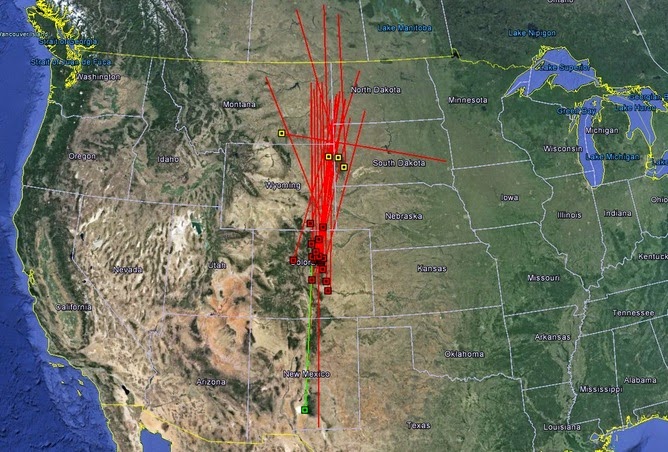
Earlier in the day, the American Meteor Society (AMS) published more than 30 reports from alleged eyewitnesses, who claimed they observed a blast of Russia's Kosmos-2495 imaging reconnaissance satellite.


"The Russian satellite group functions normally and is being constantly monitored by the Russian Aerospace Defense Forces," ministry spokesman Maj. Gen. Igor Konashenkov said.

A map showing the confirmed observations from eyewitnesses. 

Reported observations of the Fireball from New Mexico, Colorado, Wyoming, South Dakota and Montana (Final viewing directions are shown in red)

Image: Google Earth /Spaceflight101 /AMS

Kosmos-2495 was launched on May 6, 2014.

It was also known as Kobalt-M reconnaissance satellite, an operational member of the Yantar series of Russian satellites.

It weighed 6.6 tonnes, operated on Low Earth Orbit (LEO) and was equipped with a film camera.

Thursday, April 4, 2013

AMS Dark Matter: NASA Chief Speaks Out


The news today (April 3) that the International Space Station has played a pivotal role in what could be one of the biggest leaps forward for astrophysics has left the NASA Administrator with nothing but high praise.

The news stems from the station's Alpha Magnetic Spectrometer, which detected signals that just might be evidence of dark matter particles colliding and annihilating each other. (Of course, it could be something else, too.

The science team has not yet confirmed the signal is definitely from dark matter, but it is a tantalizing possibility.)

Here's what Bolden says about today's AMS announcement, which NASA sent out to reporters this afternoon:

"The AMS cosmic ray particle results announced today could help foster a new understanding of the fields of fundamental physics and astrophysics. I am confident that this is only the first of many scientific discoveries enabled by the station that will change our understanding of the universe. Multiple NASA human spaceflight centers around the country played important roles in this work, and we look forward to many more exciting results from AMS. "
"For more than 50 years, NASA has pushed the boundaries beyond Earth to unveil the underlying architecture of the cosmos, revealing new knowledge about our place within it. The International Space Station is a gateway to the universe, teaching us how humans can live, work, and thrive in space as we endeavor to venture deeper into the solar system. "
"It's a remarkable testament that the orbital laboratory could play such an important supporting role in research at the very smallest scale of the physical universe. It's proof positive the space station is humanity's greatest achievement in low-Earth orbit."

The Alpha Magnetic Spectrometer is a complicated (and expensive) instrument launched to the space station in May 2011 on one of NASA's last-ever shuttle missions. The $2 billion instrument is the result of 16 years of work by 200 scientists from 16 different countries and 56 different institutions.

Wednesday, April 3, 2013

NASA AMS Mission: The Anti-Matter Hunter on the ISS

Credit: AMS-02 Collaboration

The NASA Alpha Magnetic Spectrometer (AMS), a $2 billion experiment to hunt for cosmic rays in space, stands in the clean room at the European physics lab CERN before it is shipped to NASA to be launched on a space shuttle.

Alpha Magnetic Spectrometer - dark matter, cosmic rays and antimatter galaxies from the International Space Station
Source SPACE.com: All about our solar system, outer space and exploration

Monday, February 18, 2013

NASA MIT Alpha Magnetic Spectrometer (AMS): Prepares to release first results

The scientist leading one of the most expensive experiments ever put into space says the project is ready to come forward with its first results.

The Alpha Magnetic Spectrometer (AMS) was put on the International Space Station to survey the skies for high-energy particles, or cosmic rays.

Nobel Laureate Sam Ting said the scholarly paper to be published in a few weeks would concern dark matter.

This is the unseen material whose gravity holds galaxies together.

Researchers do not know what form this mysterious cosmic component takes, but one theory points to it being some very weakly interacting massive particle (Wimp).

Although telescopes cannot detect the Wimp, there are high hopes that AMS can confirm its existence and describe some of its properties from indirect measures.

The imminent publication in an as yet undetermined journal will detail the progress of that investigation.

The Massachusetts Institute of Technology professor said the project he first proposed back in the mid-1990s had now reached an important milestone.

"We've waited 18 years to write this paper, and we're now making the final check," he told reporters.

"I would imagine in two or three weeks, we should be able to make an announcement.

"We have six analysis groups to analyse the same results. Physicists as you know - everybody has their own interpretations, and we're now making sure everyone agrees with each other. And this is pretty much done now."

Sam Ting was speaking here in Boston at the annual meeting of the American Association for the Advancement of Science (AAAS).

His $2bn machine was taken up to the ISS in 2011 - on the final mission of Shuttle Endeavour.

The seven-tonne experiment holds a giant, specially designed magnet that bends the paths of particles that fall on it.

The way they bend reveals their charge, a fundamental property that, together with information about their mass, velocity and energy, garnered from a slew of detectors, tells scientists precisely what they are dealing with.

Prof Ting said that in its first 18 months of operation, AMS had witnessed 25 billion particle events.

Tuesday, August 28, 2012

2012 US Meteorological Society: Information Statement on Climate Change

CNN Video footage of Hurricane Isaac
There is unequivocal evidence that Earth’s lower atmosphere, ocean, and land surface are warming; sea level is rising; and snow cover, mountain glaciers, and Arctic sea ice are shrinking.

The dominant cause of the warming since the 1950s is human activities. This scientific finding is based on a large and persuasive body of research.

The observed warming will be irreversible for many years into the future, and even larger temperature increases will occur as greenhouse gases continue to accumulate in the atmosphere.

Avoiding this future warming will require a large and rapid reduction in global greenhouse gas emissions.

The ongoing warming will increase risks and stresses to human societies, economies, ecosystems, and wildlife through the 21st century and beyond, making it imperative that society respond to a changing climate.

To inform decisions on adaptation and mitigation, it is critical that we improve our understanding of the global climate system and our ability to project future climate through continued and improved monitoring and research.

This is especially true for smaller (seasonal and regional) scales and weather and climate extremes, and for important hydroclimatic variables such as precipitation and water availability.

Technological, economic, and policy choices in the near future will determine the extent of future impacts of climate change.

Science-based decisions are seldom made in a context of absolute certainty. National and international policy discussions should include consideration of the best ways to both adapt to and mitigate climate change.

Mitigation will reduce the amount of future climate change and the risk of impacts that are potentially large and dangerous. At the same time, some continued climate change is inevitable, and policy responses should include adaptation to climate change.

Prudence dictates extreme care in accounting for our relationship with the only planet known to be capable of sustaining human life.

[This statement is considered in force until August 2017 unless superseded by a new statement issued by the AMS Council before this date.]

Read the report in PDF format:  pdf version

Read the full online report here: 2012 AMS Information Statement on Climate Change

Wednesday, June 13, 2012

NASA ISS Report: AMS - The Tool to Fill the Gaps in our Senses


A close view of the Alpha Magnetic Spectrometer-2, or AMS, in the space shuttle Endeavour’s payload bay prior to being mounted to the International Space Station’s starboard truss. (NASA)


NASA International Space Station Associate Program Scientist Tara Ruttley shares her point of view on the importance of asking the big questions via station research. 

Saturday, February 11, 2012

ESA Astronaut Image: Amsterdam in snow

You can see the snow at night. Amsterdam, Utrecht and Schiphol.

Credit: ESA/NASA

Sunday, May 22, 2011

NASA AMS - Exploring the Wonders of the Universe

The newly-installed Alpha Magnetic Spectrometer-2 is visible at center of the International Space Station's starboard truss.

The Alpha Magnetic Spectrometer, or AMS, is the largest scientific collaboration to use the orbital laboratory.

This investigation is sponsored by the U.S. Department of Energy and made possible by funding from 16 nations.

Led by Nobel Laureate Samuel Ting, more than 600 physicists from around the globe will be able to participate in the data generated from this particle physics detector. The mission of the AMS is, in part, to seek answers to the mysteries of antimatter, dark matter and cosmic ray propagation in the universe.

Image Credit: NASA

Thursday, May 19, 2011

NASA Space Shuttle Endeavour docked to ISS

NASA Space Shuttle Endeavour docked to the ISS and a tiny view of the Moon in shot!

Wednesday, May 18, 2011

The Alpha Magnetic Spectrometer - AMS-02

The AMS-02 experiment is a state-of-the-art particle physics detector being constructed, tested and operated by an international team composed of 56 institutes from 16 countries and organized under United States Department of Energy (DOE) sponsorship.

The JSC project office oversees and directs the overall payload integration activities and ensures that the payload is safe and ready for launch on the Space Shuttle and deployment onto the ISS.


The AMS Experiment will use the unique environment of space to advance knowledge of the universe and lead to the understanding of the universe’s origin.

The Alpha Magnetic Spectrometer - AMS-02 Homepage

Tuesday, April 26, 2011

NASA Endeavour Shuttle: Alpha Magnetic Spectrometer (AMS) from CERN

Shuttle on launchpad

NASA's Endeavour space shuttle - Image courtesy of NASA.

On 29 April the Alpha Magnetic Spectrometer (AMS) is due to travel into space on board NASA's Endeavour shuttle.

The AMS detector will be installed as an external module to the international space station where it will study the Universe and its origin by searching for antimatter and dark matter while performing precision measurements of the composition and flux of cosmic rays.

The AMS detector was developed by an international collaboration of over 600 scientists led by Nobel laureate Samuel Ting and assembled at CERN.

You can follow a live webcast of the launch broadcast direct from CERN beginning at 9:30pm (local time, Geneva).

Saturday, March 26, 2011

NASA AMS: The Alpha Magnetic Spectrometer on Shuttle STS-134

The AMS is to launch on space shuttle Endeavour in April.

The Alpha Magnetic Spectrometer (AMS) will revolutionise what we know about invisible cosmic rays, in the same way that NASA's Hubble Space Telescope rewrote what we know about the visible universe, says the intellectual force behind the instrument.

Those expectations are not lost on the team putting the finishing touches on the AMS and packing it for launch.

"This kind of has grains of Hubble, looking at the universe in a different perspective," said Boeing's Bob Hart, the payload flow manager for the AMS. "The science, the exploration potential that will come out of this makes it very exciting to be a part of."

Professor Sam Ting, a Nobel Prize winner for his 1974 discovery of a heavy elemental particle, sees the AMS as a revolutionary observatory to measure invisible cosmic rays as they traverse the universe.

The AMS is a 2-ton ring of powerful magnets and ultrasensitive detectors built to track, but not capture, cosmic rays.

The 15,251-pound instrument will be connected to the outside of the International Space Station, braced on the orbiting laboratory's right hand truss and tilted a bit so it will not interfere with any of the station's mechanisms and storage platforms.

AMS will be operated remotely from Earth and should not require any attention from astronauts in orbit. "The astronauts on the space station have many things to do," Ting said. "We wouldn't dare bother them."

By recording the traces that cosmic rays make as they pass through, the AMS might uncover a universe that is now invisible. Although Ting is hesitant to make predictions about what the instrument will find, he said the instrument was designed with dark matter and antimatter in mind. Very little is known about dark matter although it makes up an estimated 90 percent of the mass in the universe.

Although Earth-based facilities have been built to create powerful streams of subatomic particles, Ting said their limits are more than 14 million times weaker than the power produced by cosmic rays in space.

"No matter how large an accelerator you build, you're not going to compete with space," Ting told reporters recently. Ting offered the news media a close look at the AMS before it was packed for loading into Endeavour's cargo bay for launch.

Thursday, March 10, 2011

ESA Director of Human Spaceflight, Simonetta Di Pippo, on AMS-02

Click on the picture to Play Video

Di Pippo, who has been following closely the development of this state-of-the-art particle physics detector, highlights its importance.

AMS-02 will search for signs of antimatter and dark matter in space, and represents a big step ahead in understanding the physics of our universe and a further example in the scientific utilisation of the International Space Station (ISS).

Under the leadership of Nobel Prize Laureate Professor Samuel Ting, the Principal Investigator of the experiment, AMS-02 is the result of years of collaborative work among institutions and research centres from United States, Europe and Asia.

Wednesday, November 24, 2010

London, Brussels and Amsterdam from Space

London – Brussels – Antwerp – Rotterdam – Amsterdam and seemingly countless towns and villages sing out on this peaceful night.

A nightscape that reveals familiar coastlines, prominent ports, and metropolitan areas.

The UK can see how much of the population is congregated around London and the South of UK.

They can also see the high energy useage in these areas.

Wednesday, February 17, 2010

ESA Portal - Dark matter detective arrives at ESTEC


ESA Portal - Dark matter detective arrives at ESTEC

One of the most exciting scientific instruments ever built, the Alpha Magnetic Spectrometer (AMS), arrived at ESA’s Test Centre in the Netherlands for testing before being launched on the Space Shuttle to the ISS this July.

The quest for the origins of the Universe is about to take a step further in the Large Space Simulator (LSS) at ESA’s research and technology centre, ESTEC, in Noordwijk, the Netherlands, under responsibility of Agency's Directorate of Human Spaceflight.

The LSS is used to test satellites and spacecraft before they are sent to space and has seen all kinds of space hardware, but the AMS detector is still very special. Not only is it the biggest scientific instrument to be installed on the International Space Station (ISS), but also it is the first magnetic spectrometer to be flown in space, and the largest cryogenically cooled superconducting magnet ever used in space.

The AMS will be installed on the ISS central truss
AMS will help scientists to understand better the fundamental issues on the origin and structure of the Universe by observing 'antimatter' and 'dark matter'. As a byproduct, AMS will gather a lot of other information from cosmic radiation sources such as stars and galaxies millions of light years from our home galaxy. Not only astronomers, but also particle physicists are waiting for AMS data.

The AMS project is led by Nobel laureate Samuel Ting, from the Massachusetts Institute of Technology (MIT), and involves an international team composed of 56 institutes from 16 countries. ESA is a partner in the AMS collaboration through the Directorate of Human Spaceflight. The first version of the experiment, AMS-01, was flown in June 1998 aboard the Space Shuttle Discovery and, after promising results, the bigger and more capable version was accepted to be flown on the ISS.