Showing posts with label observation. Show all posts

Tuesday, January 20, 2015

NASA SDO: Sun Monitoring Satellite captures 100 millionth image

The Atmospheric Imaging Assembly on NASA's Solar Dynamics Observatory captured its 100 millionth image of the sun on Jan. 19, 2015. 

The dark areas at the bottom and the top of the image are coronal holes, areas of less dense gas, where solar material has flowed away from the sun. 

Credit: NASA/SDO/AIA/LMSAL

On Jan. 19, 2015, at 12:49 p.m. EST, an instrument on NASA's Solar Dynamics Observatory captured its 100 millionth image of the sun.

The instrument is the Atmospheric Imaging Assembly (AIA), which uses four telescopes working parallel to gather eight images of the sun, cycling through 10 different wavelengths -- every 12 seconds.

The Atmospheric Imaging Assembly (AIAimages the solar atmosphere in multiple wavelengths to link changes in the surface to interior changes. 

Data includes images of the Sun in 10 wavelengths every 10 seconds. 

Credit: NASA SDO, Lockheed Martin Solar Astrophysics Laboratory

The Helioseismic and Magnetic Imager extends the capabilities of the SOHO/MDI instrument with continual full-disk coverage at higher spatial resolution and new vector magnetogram capabilities.

Credit: NASA SDO, Lockheed Martin Solar Astrophysics Laboratory

Between the AIA and two other instruments on board, the Helioseismic Magnetic Imager (HMI) and the Extreme Ultraviolet Variability Experiment (EVE), SDO sends down a whopping 1.5 terabytes of data a day.

The Extreme Ultraviolet Variability Experiment measures the solar extreme-ultraviolet (EUV) irradiance with unprecedented spectral resolution, temporal cadence, and precision. 

EVE measures the solar extreme ultraviolet (EUV) spectral irradiance to understand variations on the timescales which influence Earth's climate and near-Earth space.

Credit: NASA SDO, Lockheed Martin Solar Astrophysics Laboratory

AIA is responsible for about half of that. Every day it provides 57,600 detailed images of the sun that show the dance of how solar material sways and sometimes erupts in the solar atmosphere, the corona.

In the almost five years since its launch on Feb. 11, 2010, SDO has provided images of the sun to help scientists better understand how the roiling corona gets to temperatures some 1000 times hotter than the sun's surface, what causes giant eruptions such as solar flares, and why the sun's magnetic fields are constantly on the move.

Thursday, November 6, 2014

Hubble observes Jets, bubbles, and bursts of light in Taurus

The NASA/ESA Hubble Space Telescope has snapped a striking view of a multiple star system called XZ Tauri, its neighbour HL Tauri and several nearby young stellar objects. 

XZ Tauri is blowing a hot bubble of gas into the surrounding space, which is filled with bright and beautiful clumps that are emitting strong winds and jets. 

These objects illuminate the region, creating a truly dramatic scene. 

Credit: ESA/Hubble/ NASA

The NASA/ESA Hubble Space Telescope has snapped a striking view of a multiple star system called XZ Tauri, its neighbour HL Tauri, and several nearby young stellar objects.

XZ Tauri is blowing a hot bubble of gas into the surrounding space, which is filled with bright and beautiful clumps that are emitting strong winds and jets.

These objects illuminate the region, creating a truly dramatic scene.

This dark and ominous landscape is located some 450 light-years away in the constellation of Taurus (The Bull).

It lies in the north-eastern part of a large, dark cloud known as LDN 1551.

Just to the left of centre in this image, embedded within a rust-coloured cloud, lies XZ Tauri. While it appears to be a single star, this bright spot actually consists of several stars.

It has long been known to be a binary, but one of these two stars is thought also to be a binary, making a total of three stars within a single system.

This is not the first time that Hubble has observed XZ Tauri, between the years of 1995 and 2000, a hot bubble of gas was spotted expanding outwards from the system.

This bubble can be seen as the small orange lobe very close to the top left of XZ Tauri. This gas is speeding out from the star system, leaving a trail spanning tens of billions of kilometres.

As the bubble travels it hits slower moving material, triggering pulses of light and rippling shockwaves.

Above and to the right of XZ Tauri, an equally epic scene is unfolding. Wisps of deep red seem to be streaking away from the blue-tinged clumps on the right.

This bright blue patch contains a star known as HL Tauri, which is associated with Herbig-Haro object HH 150.

Herbig-Haro objects are streaks of hot gas blasted into space by newborn and newly forming stars and LDN 1551 is particularly rich in these dramatic objects.

In the bottom right of this Hubble image is another Herbig-Haro object known as HH 30, associated with the variable star V1213 Tauri.

The star itself is hidden within a flat, bright disc of dust that is split in half by a dark lane. This dust blocks direct light from V1213 Tauri, but the star is visible via its reflected light and the prominent, knotty jets it is blasting out into space.

Hubble previously viewed HH 30, alongside XZ Tauri, with its Wide Field Planetary Camera 2 between the years of 1995 and 2000.

The observations were used to image and study the changes in disc brightness and jet strength over the five-year period.

V1213 Tauri's strong magnetic field forms the jets by funnelling and shepherding gas from the disc, accelerating it along the star's magnetic poles to form two narrow beams.

ALMA image of the young star HL Tau and its protoplanetary disk. 

This best image ever of planet formation reveals multiple rings and gaps that herald the presence of emerging planets as they sweep their orbits clear of dust and gas 

Credit: ALMA (NRAO /ESO /NAOJ); C. Brogan, B. Saxton (NRAO /AUI /NSF)

In the above image released by the European Southern Observatory today, observations from the Atacama Large Millimeter /submillimeter Array (ALMA) reveal extraordinarily fine and never-before-seen detail in the planet-forming disc around HL Tauri.

The new observations are an enormous step forward in the observation of how protoplanetary discs develop and how planets form.

Friday, September 12, 2014

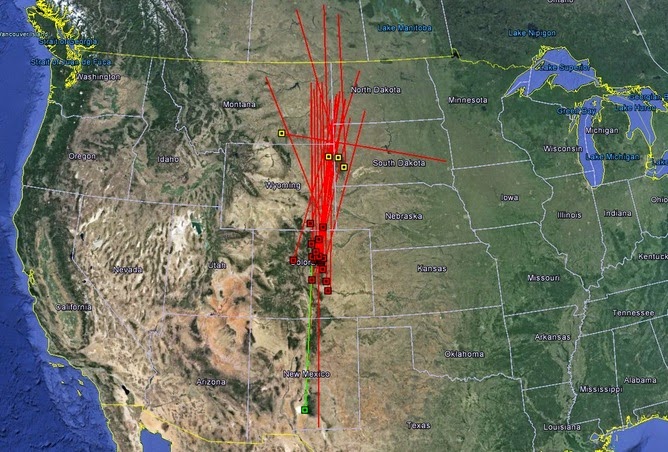
Russian Observation satellite Kosmos-2495: Fireball observed over US

The Russian Defense Ministry on Tuesday denied media reports of a Russian military satellite that allegedly exploded above the United States.

Earlier in the day, the American Meteor Society (AMS) published more than 30 reports from alleged eyewitnesses, who claimed they observed a blast of Russia's Kosmos-2495 imaging reconnaissance satellite.


"The Russian satellite group functions normally and is being constantly monitored by the Russian Aerospace Defense Forces," ministry spokesman Maj. Gen. Igor Konashenkov said.

A map showing the confirmed observations from eyewitnesses. 

Reported observations of the Fireball from New Mexico, Colorado, Wyoming, South Dakota and Montana (Final viewing directions are shown in red)

Image: Google Earth /Spaceflight101 /AMS

Kosmos-2495 was launched on May 6, 2014.

It was also known as Kobalt-M reconnaissance satellite, an operational member of the Yantar series of Russian satellites.

It weighed 6.6 tonnes, operated on Low Earth Orbit (LEO) and was equipped with a film camera.

Wednesday, July 23, 2014

ESO La Silla observes Lives and deaths of sibling stars

In this image from the Wide Field Imager on the MPG/ESO 2.2-metre telescope at ESO's La Silla Observatory in Chile young stars huddle together against a backdrop of clouds of glowing gas and lanes of dust. 

The star cluster, known as NGC 3293, would have been just a cloud of gas and dust itself about ten million years ago, but as stars began to form it became the bright group we see here. 

Clusters like this are celestial laboratories that allow astronomers to learn more about how stars evolve. 

Credit: ESO/G. Beccari

This beautiful star cluster, NGC 3293, is found 8000 light-years from Earth in the constellation of Carina (The Keel).

This cluster was first spotted by the French astronomer Nicolas-Louis de Lacaille in 1751, during his stay in what is now South Africa, using a tiny telescope with an aperture of just 12 millimetres.

It is one of the brightest clusters in the southern sky and can be easily seen with the naked eye on a dark clear night.

Star clusters like NGC 3293 contain stars that all formed at the same time, at the same distance from Earth and out of the same cloud of gas and dust, giving them the same chemical composition.

As a result clusters like this are ideal objects for testing stellar evolution theory.

Most of the stars seen here are very young, and the cluster itself is less than 10 million years old. Just babies on cosmic scales if you consider that the Sun is 4.6 billion years old and still only middle-aged.

An abundance of these bright, blue, youthful stars is common in open clusters like NGC 3293, and, for example, in the better known Kappa Crucis cluster, otherwise known as the Jewel Box (NGC 4755).

These open clusters each formed from a giant cloud of molecular gas and their stars are held together by their mutual gravitational attraction but these forces are not enough to hold a cluster together against close encounters with other clusters and clouds of gas as the cluster's own gas and dust dissipates.

So, open clusters will only last a few hundred million years, unlike their big cousins, the globular clusters, which can survive for billions of years, and hold on to far more stars.

Despite some evidence suggesting that there is still some ongoing star formation in NGC 3293, it is thought that most, if not all, of the nearly fifty stars in this cluster were born in one single event but even though these stars are all the same age, they do not all have the dazzling appearance of a star in its infancy; some of them look positively elderly, giving astronomers the chance to explore how and why stars evolve at different speeds.

Take the bright orange star at the bottom right of the cluster. This huge star, a red giant, would have been born as one of the biggest and most luminous of its litter, but bright stars burn out fast.

As the star used up the fuel at its core its internal dynamics changed and it began to swell and cool, becoming the red giant we now observe.

Red giants are reaching the end of their life cycle, but this red giant's sister stars are still in what is known as the pre-main-sequence, the period before the long, stable, middle period in a star's life.

We see these stars in the prime of their life as hot, bright and white against the red and dusty background.

Sunday, July 20, 2014

SBIRS Military Defense Satellites Observed Missile Strike on Malaysian Airlines MH17

An artist's rendering shows one of the Space Based Infrared System's missile-spotting GEO spacecraft perched high above Earth.

Credit: Lockheed Martin

U.S. President Barack Obama addressed the nation today (July 18) to share what his administration knows so far about the attack on Malaysian Airlines flight MH17, an "outrage of unspeakable proportions," he said, that killed nearly 300 innocent people.

All evidence so far indicates that the commercial jet, a Boeing 777, was shot down in eastern Ukraine by a surface-to-air missile launched from an area in controlled by Russian-backed separatists, Obama said.

The president offered scant technical details to explain how the government arrived that conclusion but it's likely that heat from the explosion was detected from space by a network of military satellites.

Since the Cold War, the U.S. Department of Defense has had a multibillion-dollar space-based system to provide early warning for intercontinental ballistic missiles.

"It is a very, very precise system that has constant coverage, especially over Russia and Ukraine," said Riki Ellison, founder of the Missile Defense Advocacy Alliance.

Starting in the 1970s, the Pentagon has launched a series of high-altitude satellites with Earth-facing infrared telescopes as part of its Defense Support Program (DSP).

That constellation has kept a continuous watch on the planet for the hot plumes of exhaust from missiles to warn the military and intelligence communities about possible strikes and battlefield threats.

In the past few years, DSP has undergone a major upgrade, becoming the Space Based Infrared System (SBIRS), with the launch of better satellites that can detect faint missiles faster.

SBIRS now includes two geosynchronous Earth orbit (GEO) satellites, built by Lockheed Martin, that are each hover above an unchanging spot on planet, more than 22,000 miles (35,400 kilometers) high.

For comparison, the International Space Station orbits at an average altitude of about 248 miles, or 400 km.

The first of those satellites, dubbed GEO-1, launched from Cape Canaveral in May 2011. Lockheed Martin recently announced that it won a $1.86 billion Air Force contract to complete the fifth and sixth GEO satellites as part of SBIRS.

It's likely that the strike on MH17 showed up as an alarming blip on screens at Buckley Air Force Base in Colorado where those data from the SBIRS is processed.

The detection is precise enough to detect where a missile was fired from and what kind of missile it was.

"Each missile has a different signature plume," Ellison said.

Ellison told reporters that other military satellites in the region probably would have been alerted to gather further information to be provided to the U.S. European Command (EUCOM).

Saturday, May 31, 2014

NASA's IRIS: Observing a gigantic CME eruption of solar material

A coronal mass ejection, or CME, surged off the side of the sun on May 9, 2014, and NASA's newest solar observatory caught it in extraordinary detail. 

This was the first CME observed by the Interface Region Imaging Spectrograph (IRIS), which launched in June 2013 to peer into the lowest levels of the sun's atmosphere with better resolution than ever before. 

IRIS must commit to pointing at certain areas of the sun at least a day in advance, so catching a CME in the act involves some educated guesses and a little bit of luck.

"We focus in on active regions to try to see a flare or a CME," said Bart De Pontieu, the IRIS science lead at Lockheed Martin Solar & Astrophysics Laboratory in Palo Alto, California. "And then we wait and hope that we'll catch something. This is the first clear CME for IRIS so the team is very excited."

The IRIS imagery focuses in on material of 30,000 kelvins at the base, or foot points, of the CME.

The line moving across the middle of the movie is the entrance slit for IRIS's spectrograph, an instrument that can split light into its many wavelengths, a technique that ultimately allows scientists to measure temperature, velocity and density of the solar material behind the slit.

The field of view for this imagery is about five Earths wide and about seven-and-a-half Earths tall.


Watch the movie to see how a curtain of solar material erupts outward at speeds of 1.5 million miles per hour.

A coronal mass ejection burst off the side of the sun on May 9, 2014. The giant sheet of solar material erupting was the first CME seen by NASA's Interface Region Imaging Spectrograph (IRIS). 

The field of view seen here is about five Earths wide and about seven-and-a-half Earths tall. Credit: NASA/LMSAL/IRIS/SDO/Goddard


Tuesday, April 29, 2014

Experiment on Earth demonstrates effect observed in space

Streaming jets of high-speed matter produce some of the most stunning objects seen in space.

Astronomers have seen them shooting out of young stars just being formed, X-ray binary stars and even the supermassive black holes at the centers of large galaxies.

Theoretical explanations for what causes those beam-like jets have been around for years, but now an experiment by French and American researchers using extremely high-powered lasers offers experimental verification of one proposed mechanism for creating them.

"This research is an example of how laboratory experiments can be used to test mechanisms that may produce what we observe in space," said Eric Blackman, professor of physics and astronomy at the University of Rochester and one of the co-authors.

Blackman explains that he and his collaborators wanted to recreate conditions in the lab that lead to jets in space becoming collimated, parallel beam-like, rather than diverging.

Theory and computational simulations had suggested the possibility that jets might be created by "shock focused inertial confinement."

Blackman adds that the experiment "confirms that this particular mechanism is viable, even though other effects are likely to also be taking place."

In their results, the researchers show evidence of the "shocks" predicted by theory, and which give the mechanism its name.

These shocks are surfaces in space where there is a sudden change in the density, speed, and direction of a flow.

According to theory, which is consistent with the new experiment, they are what cause the beam-like nature of the jets to form.

In the paper published in Physical Review Letters, and highlighted as an editor's suggestion, the researchers explain how they used the laser laboratory facility (LULI), at the Ecole Polytechnique in France, to recreate these space jets.

Collaborators at the University of Chicago supplied a sophisticated computer code FLASH that they developed and adapted to help analyze the results.

"We have focused a very energetic laser beam on a tiny iron target – a little thinner than a human hair," explains Alessandra Ravasio, who led the experiment.

"In this way we can create a supersonic plasma flow."

With nothing to prevent the resulting iron plasma from spreading out, it would flow quasi-spherically from the target. In order to see the effects of a surrounding wind, the researchers generated another lighter, supersonic plasma from a plastic ring surrounding the central target.

"The novelty of this experiment is in the way we spatially distribute the laser energy, with a central dot generating the iron flow and a outer ring incident on the plastic," adds Ravasio.

"In this way we could create a nested geometry and study the interaction between the two flows."

The researchers found that the interaction of the two plasmas sharply collimates the iron plasma flow. That is, rather than spreading out in all directions, the iron flow emanates primarily along a single direction.

The experimental data showed that a shock wave is generated in this interaction, which helps the momentum and inertia of the plastic outer wind to collimate the inner iron flow into a jet.

The experiment is an example of laboratory astrophysics, a rapidly growing area of high energy density physics that requires the collaboration of astrophysicists, experimental plasma physicists and computational physicists.

More information: Paper: journals.aps.org/prl/abstract/10.1103/PhysRevLett.112.155001

Monday, March 17, 2014

BICEP2 Post Big Bang Discovery: Evidence spotted for universe's early expansion

In this 2007 photo provided by Steffen Richter, the sun sets behind the BICEP2 telescope, foreground, and the South Pole Telescope in Antarctica

In the faint glowing remains of the Big Bang, scientists found "smoking gun" evidence that the universe began with a split-second of astonishingly rapid growth from a seed far smaller than an atom. 

To find a pattern of polarization in the faint light left over from the Big Bang, astronomers scanned about 2 percent of the sky for three years with the BICEP2 at the south pole, chosen for its very dry air to aid in the observations, said the leader of the collaboration, John Kovac of Harvard. 

Credit: AP Photo/Steffen Richter

The universe was born almost 14 billion years ago, exploding into existence in an event called the Big Bang.

Now researchers say they've spotted evidence that a split-second later, the expansion of the cosmos began with a powerful jump-start.

Experts called the discovery a major advance if confirmed by others. Although many scientists already believed that initial, extremely rapid growth spurt happened, finding this evidence has been a key goal in the study of the universe.

Researchers reported Monday that they did it by peering into the faint light that remains from the Big Bang.

Lawrence Krauss
If verified, the discovery "gives us a window on the universe at the very beginning," when it was far less than one-trillionth of a second old, said theoretical physicist Lawrence Krauss of Arizona State University, who was not involved in the work.

"It's just amazing," he said. "You can see back to the beginning of time."

Alan Guth
Another outside expert, physicist Alan Guth of the Massachusetts Institute of Technology (MIT), said the finding already suggests that some ideas about the rapid expansion of the universe can be ruled out.

Right after the Big Bang, the universe was a hot soup of particles.

It took about 380,000 years to cool enough that the particles could form atoms, then stars and galaxies.

Billions of years later, planets formed from gas and dust that were orbiting stars. The universe has continued to spread out.

This image provided by the BICEP2 Collaboration shows slight temperature fluctuations, indicated by variations in colour, of the Cosmic Microwave Background (CMB) of a small patch of sky and the orientation of its polarisation, shown as short black lines.

Researchers say since the CMB is a form of light, it exhibits all the properties of light, including polarisation. 

The changes in a particular type of polarisation, indicated here, are theorised to be caused by gravitational waves. 

These waves are signals of an extremely rapid inflation of the universe in its first moments. 

Credit: AP Photo/BICEP2 Collaboration

Krauss said he thinks the new finding could rank with the greatest discoveries about the universe over the last 25 years, such as the Nobel prize-winning discovery that the universe's expansion is accelerating.

The new results were announced by a collaboration that includes researchers from the Harvard-Smithsonian Center for Astrophysics (CfA), the University of Minnesota, Stanford University, the California Institute of Technology (CalTech) and NASA's Jet Propulsion Laboratory.

The team plans to submit its results to a scientific journal this week, said its leader, John Kovac of Harvard.

Read the full article here

Thursday, March 13, 2014

NASA SDO: Mid-level M9.3 solar flare observed

NASA's Solar Dynamics Observatory (SDO) captures images of the sun in many wavelengths of light at the same time, each of which is typically in a different color. 

Each wavelength shows different aspects of the same event, as seen in these three images of a solar flare on March 12, 2014. 

Credit: NASA /SDO /Goddard Space Flight Center

The sun emitted a mid-level solar flare, peaking at 6:34 p.m. EDT on March 12, 2014, and NASA's Solar Dynamics Observatory (SDO), captured an image of it. Solar flares are powerful bursts of radiation.

Harmful radiation from a flare cannot pass through Earth's atmosphere to physically affect humans on the ground, however, when intense enough, they can disturb the atmosphere in the layer where GPS and communications signals travel.

To see how this event may impact Earth, please visit NOAA's Space Weather Prediction Center, the U.S. government's official source for space weather forecasts, alerts, watches and warnings.

This flare is classified as an M9.3 flare, just slightly weaker than the most intense flares, which are labeled X-class.

The letters denote broad categories of strength, while the numbers provide more information. An M2 is twice as intense as an M1, an M3 is three times as intense, etc.

This M9.3 flare was emitted by an active region, a magnetically strong and complex region on the sun's surface, labeled AR 11996.

Updates will be provided as they are available on the flare and whether there was an associated coronal mass ejection, or CME, another solar phenomenon that can send solar particles into space and affect electronic systems in satellites and on Earth.

Wednesday, March 12, 2014

ESO VLT Atacama: Largest yellow hypergiant star observed

HR 5171, the brightest star just below the centre of this wide-field image, is a yellow hypergiant, a very rare type of stars with only a dozen known in our galaxy. 

Its size is over 1,300 times that of the Sun -- one of the 10 largest stars found so far. 

Observations with ESO's Very Large Telescope Interferometer have shown that it is actually a double star, with the companion in contact with the main star. 

Credit: ESO/Digitized Sky Survey 2

ESO's Very Large Telescope has revealed the largest yellow star—and one of the 10 largest stars found so far.

This hypergiant has been found to measure more than 1,300 times the diameter of the Sun, and to be part of a double star system, with the second component so close that it is in contact with the main star.

Observations spanning over 60 years also indicate that this remarkable object is changing very rapidly.

Olivier Chesneau
Using ESO's Very Large Telescope Interferometer (VLTI), Olivier Chesneau (Observatoire de la Côte d'Azur, Nice, France) and an international team of collaborators have found that the yellow hypergiant star HR 5171 A is absolutely huge—1300 times the diameter of the Sun and much bigger than was expected.

This makes it the largest yellow star known. It is also in the top ten of the largest stars known, 50% larger than the famous red supergiant Betelgeuse and about one million times brighter than the Sun.

"The new observations also showed that this star has a very close binary partner, which was a real surprise," says Chesneau.

"The two stars are so close that they touch and the whole system resembles a gigantic peanut."

The astronomers made good use of interferometry to combine the light collected from multiple individual telescopes, effectively creating a giant telescope up to 140 metres in size.

The new results prompted the team to thoroughly investigate older observations of the star spanning more than sixty years, to see how it had behaved in the past.

Chesneau concludes "The companion we have found is very significant as it can have an influence on the fate of HR 5171 A, for example, stripping off its outer layers and modifying its evolution."

This new discovery highlights the importance of studying these huge and short-lived yellow hypergiants, and could provide a means of understanding the evolutionary processes of massive stars in general.

More information: This research was presented in a paper "The yellow hypergiant HR 5171 A: Resolving a massive interacting binary in the common envelope phase", by Chesneau et al., to appear in the journal Astronomy & Astrophysics. arxiv.org/pdf/1401.2628v2.pdf

Monday, March 3, 2014

NASA NEOWISE Image: First Comet observed

Comet NEOWISE was first observed by NASA's Near-Earth Object Wide-field Infrared Survey Explorer (NEOWISE) spacecraft on Valentine's Day, 2014.

NASA's Near-Earth Object Wide-field Infrared Survey Explorer (NEOWISE) spacecraft has spotted a never-before-seen comet—its first such discovery since coming out of hibernation late last year.

"We are so pleased to have discovered this frozen visitor from the outermost reaches of our solar system," said Amy Mainzer, the mission's principal investigator from NASA's Jet Propulsion Laboratory in Pasadena, Calif.

"This comet is a weirdo - it is in a retrograde orbit, meaning that it orbits the sun in the opposite sense from Earth and the other planets."

Officially named "C/2014 C3 (NEOWISE)", the first comet discovery of the renewed mission came on Feb. 14 when the comet was about 143 million miles (230 million kilometers) from Earth.

Although the comet's orbit is still a bit uncertain, it appears to have arrived from its most distant point in the region of the outer planets.

The mission's sophisticated software picked out the moving object against a background of stationary stars.

As NEOWISE circled Earth, scanning the sky, it observed the comet six times over half a day before the object moved out of its view.

The discovery was confirmed by the Minor Planet Center, Cambridge, Mass., when follow-up observations were received three days later from the Near Earth Object Observation project Spacewatch, Tucson, Ariz.

Other follow-up observations were then quickly received. While this is the first comet NEOWISE has discovered since coming out of hibernation, the spacecraft is credited with the discovery of 21 other comets during its primary mission.

Originally called the Wide-field Infrared Survey Explorer (WISE), the spacecraft was shut down in 2011 after its primary mission was completed.

In September 2013, it was reactivated, renamed NEOWISE and assigned a new mission to assist NASA's efforts to identify the population of potentially hazardous near-Earth objects.

NEOWISE will also characterize previously known asteroids and comets to better understand their sizes and compositions.

Wednesday, February 19, 2014

NuSTAR telescope takes observes core of supernova

Cassiopeia A is among the best-studied supernova remnants. 

This image blends data from NASA's Spitzer (red), Hubble (yellow), and Chandra (green and blue) observatories. 

Credit: NASA /JPL-Caltech /STScI /CXC /SAO

Astronomers have peered for the first time into the heart of an exploding star in the final minutes of its existence.

The feat by the high-energy X-ray satellite NuSTAR provides details of the physics of the core explosion inaccessible until now, says team member Steven Boggs of UC Berkeley.

NuSTAR mapped radioactive titanium in the Cassiopeia A supernova remnant, which has expanded outward and become visible from Earth since the central star exploded in 1671.

Astronomers for the first time have peered into the heart of an exploding star in the final minutes of its existence.

The feat is one of the primary goals of NASA's NuSTAR mission, launched in June 2012 to measure high-energy X-ray emissions from exploding stars, or supernovae, and black holes, including the massive black hole at the center of our Milky Way Galaxy.

The NuSTAR team reported in this week's issue of the journal Nature the first map of titanium thrown out from the core of a star that exploded in 1671.

That explosion produced the beautiful supernova remnant known as Cassiopeia A (Cas A).

The well-known supernova remnant has been photographed by many optical, infrared and X-ray telescopes in the past, but these revealed only how the star's debris collided in a shock wave with the surrounding gas and dust and heated it up.

NuSTAR has produced the first map of high-energy X-ray emissions from material created in the actual core of the exploding star: the radioactive isotope titanium-44, which was produced in the star's core as it collapsed to a neutron star or black hole.

The energy released in the core collapse supernova blew off the star's outer layers, and the debris from this explosion has been expanding outward ever since at 5,000 kilometers per second.

Steven Boggs
"This has been a holy grail observation for high energy astrophysics for decades," said coauthor and NuSTAR investigator Steven Boggs, UC Berkeley professor and chair of physics.

"For the first time we are able to image the radioactive emission in a supernova remnant, which lets us probe the fundamental physics of the nuclear explosion at the heart of the supernova like we have never been able to do before."

"Supernovae produce and eject into the cosmos most of the elements are important to life as we know it," said UC Berkeley professor of astronomy Alex Filippenko, who was not part of the NuSTAR team.

Alex Filippenko
"These results are exciting because for the first time we are getting information about the innards of these explosions, where the elements are actually produced."

Boggs says that the information will help astronomers build three-dimensional computer models of exploding stars, and eventually understand some of the mysterious characteristics of supernovae, such as jets of material ejected by some.

Previous observations of Cas A by the Chandra X-ray telescope, for example, showed jets of silicon emerging from the star.

Fiona Harrison
"Stars are spherical balls of gas, and so you might think that when they end their lives and explode, that explosion would look like a uniform ball expanding out with great power," said Fiona Harrison, the principal investigator of NuSTAR at the California Institute of Technology.

"Our new results show how the explosion's heart, or engine, is distorted, possibly because the inner regions literally slosh around before detonating."

More information: Study paper: dx.doi.org/10.1038/nature12997

Monday, February 3, 2014

Structure of 'Baby Milky Way' Galaxy Seen for the First Time

Hydrogen emission shows the structure of a young Milky Way-type galaxy, early in the stages of its formation. 

Credit: R. Jorgenson

Astronomers have gotten their first clear look at galaxy in the very early universe that could have evolved into a structure somewhat like the Milky Way.

Made up predominantly of gas when spotted while the Milky Way was only about 3 billion years old, the galaxy, DLA2222-0946, should one day evolve into a common spiral galaxy like the Milky Way.

Yet its commonness is what makes it so important, as it should provide insights into the formation of the bulk of galaxies early in the life of the universe.

"It's sort of extraordinary for being ordinary," Regina Jorgenson, of the University of Hawaii, said in early January at a press conference at the American Astronomical Society meeting in Washington, D.C.

Jorgenson and her team used the Keck Telescope in Hawaii to obtain the first spatially resolved images of these young, normal galaxies.

Although their existence has been known for decades, they have been a challenge to clearly resolve.

Regina Jorgenson
"It's equivalent to detecting a 50-watt light bulb on Mars," Jorgenson said. Early galaxies contained primarily dust, the food for star formation.

Jorgenson compared the process of galaxy formation to baking a cake, which requires a lot of different ingredients, the most of important of which is flour.

In a galactic cake, the flour is equivalent to neutral gas, the prime fuel for star formation.

Gas doesn't shine like stars, so astronomers had to get creative to find it in distant space. Enter a quasar, a very bright and distant astronomical source.

As light from a quasar passes through these kinds of galactic systems known as DLAs, scientists can take measurements of the clouds of gas that make them up.

"These DLAs contain most of the neutral gas in the universe at the time," Jorgenson said. "They contain most of the flour."

But the single line of sight provided by the quasar limits how much of the galaxy can be seen. Jorgenson compared it to a single car headlight in a cloudbank.

Adding to the challenge, the quasar whose bright light illuminates the galaxy also outshines it, making other emissions from the young group difficult to detect.

The team utilized used the advanced technologies of the Keck telescope to resolve the image and spectra, the measure of its separated energy wavelengths, of DLA2222-0946.

Keck allowed for a significant improvement in resolution.

The results will be published in an upcoming edition of the Astrophysical Journal.

Sunday, October 6, 2013

Astronomers observe distant galaxy powered by primordial cosmic fuel

Image of a galaxy (center) with incoming cold gas flow, produced by rendering the gas distribution in a supercomputer simulation of a forming galaxy.

A stream of primordial inflowing gas is illuminated from behind by a distant background quasar (lower left; quasar added by an artist, along with the starry background).

Using data collected from the W. M. Keck Observatory, the largest optical telescopes in the world, researchers led by Neil Crighton (MPIA and Swinburne University of Technology) have now made the first unambiguous detection of this accretion of pristine gas onto a star-forming galaxy, that was previously theorized to exist based on cosmological simulations of galaxy formation.

This simulation shown here was run by the Making Galaxies in a Cosmological Context (MaGICC) project in the theory group at MPIA. Credit: MPIA (G. STINSON / A. V. MACCIÃ’)

Astronomers have detected cold streams of primordial hydrogen, vestigial matter left over from the Big Bang, fueling a distant star-forming galaxy in the early Universe.

Profuse flows of gas onto galaxies are believed to be crucial for explaining an era 10 billion years ago, when galaxies were copiously forming stars.

To make this discovery, the astronomers – led by Neil Crighton of the Max Planck Institute for Astronomy and Swinburne University – made use of a cosmic coincidence: a bright, distant quasar acting as a "cosmic lighthouse" illuminates the gas flow from behind.

The results were published October 2 in the Astrophysical Journal Letters.

More information: dx.doi.org/10.1088/2041-8205/776/2/L18

Wednesday, September 11, 2013

ESA’s CryoSat mission observes continuing Arctic winter ice decline


Offering new insights into our fragile polar regions, ESA’s CryoSat mission has provided three consecutive years of Arctic sea-ice thickness measurements, which show that the ice continues to thin.

Although satellites have witnessed a downward trend in the extent of sea ice over the last two decades, it is essential to have accurate information on the mass or volume of ice being lost. This is a more accurate measure of the changes taking place.

Along with observations of ice extent, CryoSat’s measurements of thickness now span from October 2010 to April 2013, allowing scientists to work out the real loss of ice, monitor seasonal change and identify trends.

Speaking today at the Living Planet Symposium in Edinburgh, UK, Prof. Andrew Shepherd from the University of Leeds, UK, said, “CryoSat continues to provide clear evidence of diminishing Arctic sea ice.

“From the satellite’s measurements we can see that some parts of the ice pack ice have thinned more rapidly than others, but there has been a decrease in the volume of winter and summer ice over the past three years.

“The volume of the sea ice at the end of last winter was less than 15 000 cubic km, which is lower than any other year going into summer and indicates less winter growth than usual.”

While it seems unlikely that a record minimum of sea-ice extent will be set this September, the thinner ice at the start of summer could mean that the actual volume of ice may reach a new low.

Rachel Tilling, PhD student at University College London, who is working with the CryoSat data stated, “Readings from CryoSat in October, when the ice starts to refreeze, will confirm this either way.”

Moreover, scientists can look forward to a continued stream of this vital information from CryoSat for some time.

“CryoSat has been in orbit since 2010 and with the satellite still in excellent health it is now set to continue providing precision measurements until 2017,” said ESA’s Tommaso Parrinello, who is responsible for the mission.

Much of the success in the way the mission’s radar height measurements are exploited to understand ice change is thanks to Prof. Seymour Laxon from University College London who passed away in January as the result of an accident.

Wednesday, July 24, 2013

NASA's Spitzer observes gas emission from comet ISON

These images from NASA's Spitzer Space Telescope of C/2012 S1 (Comet ISON) were taken on June 13, when ISON was 310 million miles (about 500 million kilometers) from the sun.

Credit: NASA/JPL-Caltech/JHUAPL/UCF

Astronomers using NASA's Spitzer Space Telescope have observed what most likely are strong carbon dioxide emissions from Comet ISON ahead of its anticipated pass through the inner solar system later this year.

Spitzer's Infrared Array Camera
Images captured June 13 with Spitzer's Infrared Array Camera indicate carbon dioxide is slowly and steadily "fizzing" away from the so-called "soda-pop comet," along with dust, in a tail about 186,400 miles (300,000 kilometers) long.

"We estimate ISON is emitting about 2.2 million pounds (1 million kilograms) of what is most likely carbon dioxide gas and about 120 million pounds (54.4 million kilograms) of dust every day," said Carey Lisse, leader of NASA's Comet ISON Observation Campaign and a senior research scientist at the Johns Hopkins University Applied Physics Laboratory in Laurel, Md.

"Previous observations made by NASA's Hubble Space Telescope and the Swift Gamma-Ray Burst Mission and Deep Impact spacecraft gave us only upper limits for any gas emission from ISON.

Carey Lisse
Thanks to Spitzer, we now know for sure the comet's distant activity has been powered by gas."

Comet ISON was about 312 million miles (502 million kilometers) from the sun, 3.35 times farther than Earth, when the observations were made.

"These fabulous observations of ISON are unique and set the stage for more observations and discoveries to follow as part of a comprehensive NASA campaign to observe the comet," said James L. Green, NASA's director of planetary science in Washington. "ISON is very exciting.

We believe that data collected from this comet can help explain how and when the solar system first formed."

Comet ISON (officially known as C/2012 S1) is less than 3 miles (4.8 kilometers) in diameter, about the size of a small mountain, and weighs between 7 billion and 7 trillion pounds (3.2 billion and 3.2 trillion kilograms).

Because the comet is still very far away, its true size and density have not been determined accurately.

Like all comets, ISON is a dirty snowball made up of dust and frozen gases such as water, ammonia, methane and carbon dioxide. These are some of the fundamental building blocks, which scientists believe led to the formation of the planets 4.5 billion years ago.

Comet ISON is believed to be inbound on its first passage from the distant Oort Cloud, a roughly spherical collection of comets and comet-like structures that exists in a space between one-tenth light-year and 1 light-year from the sun. The comet will pass within 724,000 miles (1.16 million kilometers) of the sun on Nov. 28.

It is warming up gradually as it gets closer to the sun. In the process, different gases are heating up to the point of evaporation, revealing themselves to instruments in space and on the ground. Carbon dioxide is thought to be the gas that powers emission for most comets between the orbits of Saturn and the asteroids.

The comet was discovered Sept. 21, roughly between Jupiter and Saturn, by Vitali Nevski and Artyom Novichonok at the International Scientific Optical Network (ISON) near Kislovodsk, Russia.

This counts as an early detection of a comet, and the strong carbon dioxide emissions may have made the detection possible.

"This observation gives us a good picture of part of the composition of ISON, and, by extension, of the proto-planetary disk from which the planets were formed," said Lisse.

"Much of the carbon in the comet appears to be locked up in carbon dioxide ice. We will know even more in late July and August, when the comet begins to warm up near the water-ice line outside of the orbit of Mars, and we can detect the most abundant frozen gas, which is water, as it boils away from the comet."

Friday, May 3, 2013

Smartphone Photos From Earth Orbit

These images of Earth were reconstructed from photos taken by three smartphones in orbit, or "PhoneSats." 

The trio of PhoneSats launched on April 21, 2013, aboard the Antares rocket from NASA's Wallops Flight Facility and ended a successful mission on April 27. 

The ultimate goal of the PhoneSat mission was to determine whether a consumer-grade smartphone can be used as the main flight avionics for a satellite in space.

During their time in orbit, the three miniature satellites used their smartphone cameras to take pictures of Earth and transmitted these "image-data packets" to multiple ground stations. 

Every packet held a small piece of the big picture. As the data became available, the PhoneSat Team and multiple amateur radio operators around the world collaborated to piece together photographs from the tiny data packets.

The PhoneSat project is a technology demonstration mission funded by NASA's Space Technology Mission Directorate at NASA Headquarters and the Engineering Directorate at NASA Ames Research Center. 

The project started in summer 2009 as a student-led collaborative project between Ames and the International Space University, Strasbourg.

Read more

Images Credit: NASA Ames

Wednesday, January 23, 2013

NASA Scientists Observe the Sun in Different Wavelengths

This collage of solar images from NASA's Solar Dynamics Observatory (SDO) shows how observations of the sun in different wavelengths helps highlight different aspects of the sun's surface and atmosphere. 

The collage also includes images from other SDO instruments that display magnetic and Doppler information. 

Credit: NASA/SDO/Goddard Space Flight Center.

Taking a photo of the sun with a standard camera will provide a familiar image: a yellowish, featureless disk, perhaps coloured a bit more red when near the horizon since the light must travel through more of Earth's atmosphere and consequently loses blue wavelengths before getting to the camera's lens.

The sun, in fact, emits light in all coluors, but since yellow is the brightest wavelength from the sun, that is the colour we see with our naked eye -- which the camera represents, since one should never look directly at the sun. When all the visible colours are summed together, scientists call this "white light."

Specialist instruments, either in ground-based or space-based telescopes, however, can observe light far beyond the ranges visible to the naked eye.

Different wavelengths convey information about different components of the sun's surface and atmosphere, so scientists use them to paint a full picture of our constantly changing and varying star.

Yellow light of 5800 Angstroms, for example, generally emanates from material of about 10,000 degrees F (5700 degrees C), which represents the surface of the sun.

Extreme ultraviolet light of 94 Angstroms, on the other hand, comes from atoms that are about 11 million degrees F (6,300,000 degrees C) and is a good wavelength for looking at solar flares, which can reach such high temperatures.

By examining pictures of the sun in a variety of wavelengths - as is done through such telescopes as NASA's Solar Dynamics Observatory (SDO), NASA's Solar Terrestrial Relations Observatory (STEREO) and the ESA/NASA Solar and Heliospheric Observatory (SOHO) - scientists can track how particles and heat move through the sun's atmosphere.

We see the visible spectrum of light simply because the sun is made up of a hot gas - heat produces light just as it does in an incandescent light bulb but, when it comes to the shorter wavelengths, the sun sends out extreme ultraviolet light and x-rays because it is filled with many kinds of atoms, each of which give off light of a certain wavelength when they reach a certain temperature.

Not only does the sun contain many different atoms - helium, hydrogen, iron, for example -- but also different kinds of each atom with different electrical charges, known as ions.

Each ion can emit light at specific wavelengths when it reaches a particular temperature. Scientists have catalogued which atoms produce which wavelengths since the early 1900s, and the associations are well documented in lists that can take up hundreds of pages.

Solar telescopes make use of this wavelength information in two ways. For one, certain instruments, known as spectrometers, observe many wavelengths of light simultaneously and can measure how much of each wavelength of light is present.

This helps create a composite understanding of what temperature ranges are exhibited in the material around the sun. Spectrographs don't look like a typical picture, but instead are graphs that categorise the amount of each kind of light.