The Almahata Sitta meteorite number 15 in-situ on the desert floor during its find on 2008 December 8, much as it fell on October 7 earlier that year. Credit: P. Jenniskens, SETI Institute
Examination of one of the Almahata Sitta meteorites (aka, ALM-A, found in Sudan in 2008) by a team of space scientists working in Germany has revealed a volcanic past.
In their paper published in Proceedings of the National Academy of Sciences (PNAS), the team describes how they dated the meteorite to just a few million years after our solar system was born and uncovered evidence that it suggests it was produced by volcanic activity.
The meteorite is but one of a collection that came from 2008 TC3, the first asteroid to ever have its collision with Earth tracked by scientists.
When it exploded over the Nubian Desert, debris was scattered over many kilometers, over 600 meteorites from it have been found thus far.
In this latest effort, the researchers focused on ALM-A, studying it using optical and electron microscopy, they found the rock contained minerals that were rich in a kind of silica that to date has been found to only be producible by certain types of explosions or volcanic action.
The rapid crystallization, the researchers claim, could only have come about due to an explosion (not the kind that happens when an asteroid enters an atmosphere) or because of the sort of rapid cooling that occurs when extremely hot lava seeps out of the ground.
Because it is unlikely that conditions would have ever existed on the asteroid that could have led to the type of explosion capable of producing such crystallized silica, the only option is that the asteroid from which the meteorite came, had at least one volcano on it, at some point.
If so, that would mean that volcanic activity existed in our solar system much earlier than scientists have thought.
But that's not the whole story, the researchers believe the asteroid that broke apart when it collided with Earth's atmosphere was part of a different asteroid that was nearly destroyed close to six and a half million years ago when it collided with another asteroid.
After that there were likely other collisions, some of which resulted in melding with other asteroids, which would explain the uniqueness of the Almahata Sitta meteorites, they host a variety of minerals not ordinarily found on just one specimen.
More information: Trachyandesitic volcanism in the early Solar System, Addi Bischoff, PNAS, DOI: 10.1073/pnas.1404799111
Asteroids and comets that repeatedly smashed into the early Earth covered the planet's surface with molten rock during its earliest days, but still may have left oases of water that could have supported the evolution of life, scientists say.
The new study reveals that during the planet's infancy, the surface of the Earth was a hellish environment, but perhaps not as hellish as often thought, scientists added.
Earth formed about 4.5 billion years ago. The first 500 million years of its life are known as the Hadean Eon.
Although this time amounts to more than 10 percent of Earth's history, little is known about it, since few rocks are known that are older than 3.8 billion years old.
An artistic conception of the early Earth-moon system showing the Earth's surface after being bombarded with large impacts, causing magma extrusion on the surface, though some liquid water was retained. Image released on July 30, 2014. Credit: Simone Marchi
Earth's violent youth
For much of the Hadean, Earth and its sister worlds in the inner solar system were pummeled with an extraordinary number of cosmic impacts.
"It was thought that because of these asteroids and comets flying around colliding with Earth, conditions on early Earth may have been hellish," said lead study author Simone Marchi, a planetary scientist at the Southwest Research Institute in Boulder, Colorado.
This imagined hellishness gave the eon its name, Hadean comes from the word Hades, the lord of the underworld in Greek mythology.
However, in the past dozen years or so, a radically different picture of the Hadean began to emerge.
Analysis of minerals trapped within microscopic zircon crystals dating from this eon "suggested there was liquid water on the surface of the Earth back then, clashing with the previous picture that the Hadean was hellish," Marchi said.
This could explain why the evidence of the earliest life on Earth appears during the Hadean, maybe the planet was less inhospitable during that eon than previously thought.
This artist's illustration shows a close-up of the early Earth, revealing magma extrusion on the surface and the scars from severe cosmic bombardment. Image released on July 30, 2014. Credit: Simone Marchi
Cosmic bombardment history
The exact timing and magnitude of the impacts that smashed Earth during the Hadean are unknown.
To get an idea of the effects of this bombardment, Marchi and his colleagues looked at the moon, whose heavily cratered surface helped model the battering that its close neighbour Earth must have experienced back then.
"We also looked at highly siderophile elements (elements that bind tightly to iron), such as gold, delivered to Earth as a result of these early collisions, and the amounts of these elements tells us the total mass accreted by Earth as the result of these collisions," Marchi said.
Prior research suggests these impacts probably contributed less than 0.5 percent of the Earth's present-day mass.
The researchers discovered that "the surface of the Earth during the Hadean was heavily affected by very large collisions, by impactors larger than 100 kilometers (60 miles) or so, really, really big impactors," Marchi said.
"When Earth has a collision with an object that big, that melts a large volume of the Earth's crust and mantle, covering a large fraction of the surface," Marchi added.
These findings suggest that Earth's surface was buried over and over again by large volumes of molten rock, enough to cover the surface of the Earth several times. This helps explain why so few rocks survive from the Hadean, the researchers said.
However, although these findings might suggest that the Hadean was a hellish eon, the researchers found that "there were time gaps between these large collisions," Marchi said.
"Generally speaking, there may have been something on the order of 20 or 30 impactors larger than 200 km (120 miles) across during the 500 million years of the Hadean, so the time between such impactors was relatively long," Marchi said.
Any water vapourised near these impacts "would rain down again," Marchi said, and "there may have been quiet tranquil times between collisions, there could have been liquid water on the surface."
The researchers suggested that life emerging during the Hadean was probably resistant to the high temperatures of the time.
Marchi and his colleagues detailed their findings in the July 31 issue of the journal Nature.
More Information: Widespread mixing and burial of Earth’s Hadean crust by asteroid impacts. - Authors: S. Marchi, W. F. Bottke, L. T. Elkins-Tanton, M. Bierhaus, K. Wuennemann, A. Morbidelli & D. A. Kring - doi:10.1038/nature13539
New simulations show that Mercury and other unusually metal-rich objects in the solar system may be relics left behind by hit-and-run collisions in the early solar system. Image courtesy NASA/JPL/Caltech.
Planet Mercury's unusual metal-rich composition has been a longstanding puzzle in planetary science.
According to a study published online in Nature Geoscience July 6, Mercury and other unusually metal-rich objects in the solar system may be relics left behind by collisions in the early solar system that built the other planets.
The origin of planet Mercury has been a difficult question in planetary science because its composition is very different from that of the other terrestrial planets and the moon.
This small, innermost planet has more than twice the fraction of metallic iron of any other terrestrial planet. Its iron core makes up about 65 percent of Mercury's total mass; Earth's core, by comparison, is just 32 percent of its mass.
How do we get Venus, Earth and Mars to be mostly "chondritic" (having a more-or-less Earth-like bulk composition) while Mercury is such an anomaly?
For Arizona State University professor Erik Asphaug, understanding how such a planet accumulated from the dust, ice and gas in the early solar nebula is a key science question.
There have been a number of failed hypotheses for Mercury's formation.
None of them until now has been able to explain how Mercury lost its mantle while retaining significant levels of volatiles (easily vaporized elements or compounds, such as water, lead and sulphur).
Mercury has substantially more volatiles than the moon does, leading scientists to think its formation could have had nothing to do with a giant impact ripping off the mantle, which has been a common popular explanation.
To explain the mystery of Mercury's metal-rich composition, ASU's Asphaug and Andreas Reufer of the University of Bern have developed a new hypothesis involving hit-and-run collisions, where proto-Mercury loses half its mantle in a grazing blow into a larger planet (proto-Venus or proto-Earth).
One or more hit-and-run collisions could have potentially stripped away proto-Mercury's mantle without an intense shock, leaving behind a mostly-iron body and satisfying a number of the major puzzles of planetary formation, including the retention of volatiles, in a process that can also explain the absence of shock features in many of the mantle-stripped meteorites.
Asphaug and Reufer have developed a statistical scenario for how planets merge and grow based on the common notion that Mars and Mercury are the last two relics of an original population of maybe 20 bodies that mostly accreted to form Venus and Earth. These last two planets lucked out.
"How did they luck out? Mars, by missing out on most of the action, not colliding into any larger body since its formation, and Mercury, by hitting the larger planets in a glancing blow each time, failing to accrete," explains Asphaug, who is a professor in ASU's School of Earth and Space Exploration (SESE).
"It's like landing heads two or three times in a row - lucky, but not crazy lucky. In fact, about one in 10 lucky."
"The surprising result we have shown is that hit-and-run relics not only can exist in rare cases, but that survivors of repeated hit-and-run incidents can dominate the surviving population."
"That is, the average unaccreted body will have been subject to more than one hit-and-run collision," explains Asphaug.
"We propose one or two of these hit-and-run collisions can explain Mercury's massive metallic core and very thin rocky mantle."
According to Reufer, who performed the computer modeling for the study, "Giant collisions put the final touches on our planets."
"Only recently have we started to understand how profound and deep those final touches can be."
"The implication of the dynamical scenario explains, at long last, where the 'missing mantle' of Mercury is - it's on Venus or the Earth, the hit-and-run targets that won the sweep-up," says Asphaug.
More Information: Mercury and other iron-rich planetary bodies as relics of inefficient accretion: Authors: E. Asphaug & A. Reufer - Nature Geoscience (2014) doi:10.1038/ngeo2189:
In this 2007 photo provided by Steffen Richter, the sun sets behind the BICEP2 telescope, foreground, and the South Pole Telescope in Antarctica. In the faint glowing remains of the Big Bang, scientists found "smoking gun" evidence that the universe began with a split-second of astonishingly rapid growth from a seed far smaller than an atom. To find a pattern of polarization in the faint light left over from the Big Bang, astronomers scanned about 2 percent of the sky for three years with the BICEP2 at the south pole, chosen for its very dry air to aid in the observations, said the leader of the collaboration, John Kovac of Harvard. Credit: AP Photo/Steffen Richter
The universe was born almost 14 billion years ago, exploding into existence in an event called the Big Bang.
Now researchers say they've spotted evidence that a split-second later, the expansion of the cosmos began with a powerful jump-start.
Experts called the discovery a major advance if confirmed by others. Although many scientists already believed that initial, extremely rapid growth spurt happened, finding this evidence has been a key goal in the study of the universe.
Researchers reported Monday that they did it by peering into the faint light that remains from the Big Bang.
If verified, the discovery "gives us a window on the universe at the very beginning," when it was far less than one-trillionth of a second old, said theoretical physicistLawrence Krauss of Arizona State University, who was not involved in the work.
"It's just amazing," he said. "You can see back to the beginning of time."
Right after the Big Bang, the universe was a hot soup of particles.
It took about 380,000 years to cool enough that the particles could form atoms, then stars and galaxies.
Billions of years later, planets formed from gas and dust that were orbiting stars. The universe has continued to spread out.
This image provided by the BICEP2 Collaboration shows slight temperature fluctuations, indicated by variations in colour, of the Cosmic Microwave Background (CMB) of a small patch of sky and the orientation of its polarisation, shown as short black lines. Researchers say since the CMB is a form of light, it exhibits all the properties of light, including polarisation. The changes in a particular type of polarisation, indicated here, are theorised to be caused by gravitational waves. These waves are signals of an extremely rapid inflation of the universe in its first moments. Credit: AP Photo/BICEP2 Collaboration
Krauss said he thinks the new finding could rank with the greatest discoveries about the universe over the last 25 years, such as the Nobel prize-winning discovery that the universe's expansion is accelerating.
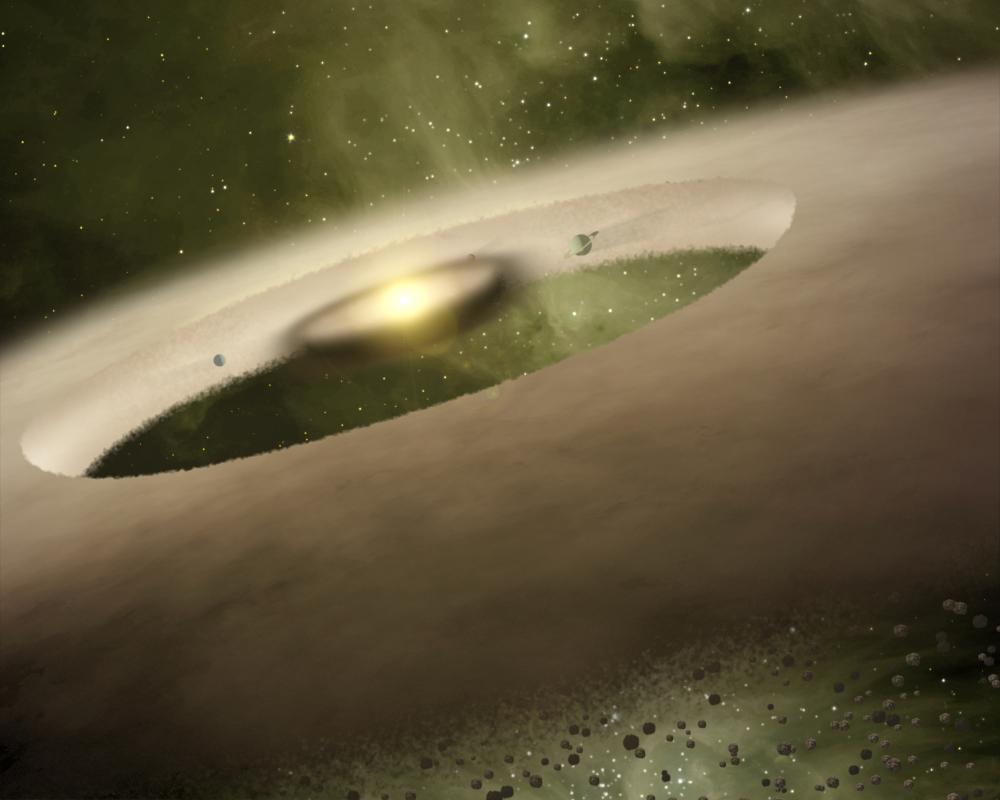
This is an artist's rendition of a sun-like star as it might have looked at one million years of age. As a cosmochemist, the University of Chicago's Lawrence Grossman reconstructs the sequence of minerals that condensed from the solar nebula, the primordial gas cloud that eventually formed the sun and planets. Credit: NASA /JPL-Caltech /T. Pyle, SSC
A normally staid University of Chicago scientist has stunned many of his colleagues with his radical solution to a 135-year-old mystery in cosmochemistry.
"I'm a fairly sober guy. People didn't know what to think all of a sudden," said Lawrence Grossman, professor in geophysical sciences.
Lawrence Grossman
At issue is how numerous small, glassy spherules had become embedded within specimens of the largest class of meteorites—the chondrites. British mineralogist Henry Sorby first described these spherules, called chondrules, in 1877.
Sorby suggested that they might be "droplets of fiery rain" which somehow condensed out of the cloud of gas and dust that formed the solar system 4.5 billion years ago.
Researchers have continued to regard chondrules as liquid droplets that had been floating in space before becoming quickly cooled, but how did the liquid form? "There's a lot of data that have been puzzling to people," Grossman said.
Grossman's research reconstructs the sequence of minerals that condensed from the solar nebula, the primordial gas cloud that eventually formed the sun and planets.
He has concluded that a condensation process cannot account for chondrules. His favorite theory involves collisions between planetesimals, bodies that gravitationally coalesced early in the history of the solar system.
"That's what my colleagues found so shocking, because they had considered the idea so 'kooky,'" he said.
Cosmochemists know for sure that many types of chondrules, and probably all of them, had solid precursors. "The idea is that chondrules formed by melting these pre-existing solids," Grossman said.
One problem concerns the processes needed to obtain the high, post-condensation temperatures necessary to heat the previously condensed solid silicates into chondrule droplets.
Various astonishing but unsubstantiated origin theories have emerged. Maybe collisions between dust particles in the evolving solar system heated and melted the grains into droplets. Or maybe they formed in strikes of cosmic lightning bolts, or condensed in the atmosphere of a newly forming Jupiter.
"Impacts on icy planetesimals could have generated rapidly heated, relatively high-pressure, water-rich vapour plumes containing high concentrations of dust and droplets, environments favorable for formation of chondrules," Grossman said.
Grossman and his UChicago co-author, research scientist Alexei Fedkin, published their findings in the July issue of Geochimica et Cosmochimica Acta.
This video zooms in on some of the galaxies. The large red blobs are the earlier APEX observations and the much sharper views are from ALMA. Whereas the APEX images were not sharp enough to identify the emitting galaxies unambiguously the much sharper ALMA images can pin down the emitting galaxies much more precisely. The ALMA and APEX observations, at submillimetre wavelengths, are overlaid on an infrared view of the region as seen by the IRAC camera on the Spitzer Space Telescope (coloured blue). Credit: ALMA (ESO/NAOJ/NRAO), APEX (MPIfR/ESO/OSO), J. Hodge et al., A. Weiss et al., NASA Spitzer Science Center.
A team of astronomers has used ALMA (the Atacama Large Millimeter/submillimeter Array) to pinpoint the locations of over 100 of the most fertile star-forming galaxies in the early Universe. This image shows close-ups of a selection of these galaxies. The ALMA observations, at submillimetre wavelengths, are shown in orange/red and are overlaid on an infrared view of the region as seen by the IRAC camera on the Spitzer Space Telescope. The best map so far of these distant dusty galaxies was made using the Atacama Pathfinder Experiment (APEX), but the observations were not sharp enough to unambiguously identify these galaxies in images at other wavelengths. ALMA needed just two minutes per galaxy to pinpoint each one within a comparatively tiny region 200 times smaller than the broad APEX blobs, and with three times the sensitivity. Credit: ALMA (ESO/NAOJ/NRAO), APEX (MPIfR/ESO/OSO), J. Hodge et al., A. Weiss et al., NASA Spitzer Science Center
ALMA is so powerful that, in just a few hours, it captured as many observations of these galaxies as have been made by all similar telescopes worldwide over a span of more than a decade.
The most fertile bursts of star birth in the early Universe took place in distant galaxies containing lots of cosmic dust.
These galaxies are of key importance to our understanding of galaxy formation and evolution over the history of the Universe, but the dust obscures them and makes them difficult to identify with visible-light telescopes.
To pick them out, astronomers must use telescopes that observe light at longer wavelengths, around one millimetre, such as ALMA.
"Astronomers have waited for data like this for over a decade. ALMA is so powerful that it has revolutionised the way that we can observe these galaxies, even though the telescope was not fully completed at the time of the observations," said Jacqueline Hodge (Max-Planck-Institut fur Astronomie, Germany), lead author of the paper presenting the ALMA observations.
It surveyed a patch of the sky about the size of the full Moon, and detected 126 such galaxies but, in the APEX images, each burst of star formation appeared as a relatively fuzzy blob, which may be so broad that it covered more than one galaxy in sharper images made at other wavelengths.
Without knowing exactly which of the galaxies are forming the stars, astronomers were hampered in their study of star formation in the early Universe.
"The McLaughlin crater is an ideal place for scientists to examine the structure of Mars's soil," Russian scientist Evgeny Chernyakov says.
Scientists believe that a large crater, which has been discovered on Mars, might have been a lake several billion years ago.
A space vehicle, which NASA sent to explore Mars, has discovered layers of clay and carbonate minerals in the walls of this crater.
These substances may form in the ground only after the contact with water.
This crater, which has received the name of McLaughlin, is one of Mars's largest craters. It is 92 kms wide and 2 kms deep.
The space vehicle discovered no traces of washouts on the crater's walls, which means that, most likely, no water has ever come into the crater from outside.
If the crater really was once full of water, this water has most likely penetrated from underground.
Mars is smaller than the Earth, and the gravity power on Mars is three times weaker than on the Earth.
Thus, scientists suppose that if underground waters have once existed on Mars, the soil layers that contained water were thicker and more clay-like than they were on the Earth.
These conditions are ideal for bacteria to appear, scientists say. It is not ruled out that there is still water under the crater's bottom and that bacteria still live there.
"The McLaughlin crater is an ideal place for scientists to examine the structure of Mars's soil," Russian scientist Evgeny Chernyakov says.
"The fact that there exists such a deep natural hollow on Mars allows scientists to examine Mars's soil without drilling artificial holes," Mr. Chernyakov says.
"This makes delivering the relevant equipment to Mars (which would have been very difficult and costly) unnecessary.
Now, all that we need is to send a small device to Mars, which would "look" into this crater and take photographs or samples of the soil.
From the ribs of the crater, we can rather easily take samples of the ground that would otherwise have been very hard to extract."


 Because it is unlikely that conditions would have ever existed on the asteroid that could have led to the type of explosion capable of producing such crystallized silica, the only option is that the asteroid from which the meteorite came, had at least one volcano on it, at some point.







 Posts


