Showing posts with label asteroids. Show all posts

Wednesday, December 10, 2014

ESA Rosetta: Earth's Water Came from Asteroids, Not Comets

ESA Rosetta’s navigation camera obtained the four images in this mosaic on Dec. 7, 2014, from a distance of 12.2 miles (19.7 km) from the center of Comet 67P/Churyumov-Gerasimenko.

Credit: ESA/Rosetta/NAVCAM – CC BY-SA IGO 3.0

Asteroids, not comets, may have delivered most of Earth's water to the planet when the solar system was young, new data from the ESA Rosetta probe orbiting comet 67/P suggests.

Comets are some of the solar system's most primitive building blocks, with many dating to soon after its formation.

Scientists think that these dirty snowballs probably helped seed Earth with key ingredients for life, such as organic compounds.

The European Space Agency's (ESA) Rosetta spacecraft is helping scientists learn more about the role these icy nomads have played in the evolution of the solar system and life on Earth by analyzing the composition of Comet 67P/Churyumov–Gerasimenko.

In August, Rosetta became the first spacecraft to orbit a comet, and in November, its Philae lander became the first probe to make a soft touchdown on a comet's surface.

Rosetta is also the first mission to escort a comet as it travels around the sun.

Now, Rosetta has helped solve a mystery about how Earth became the watery world it is today.

Before Rosetta began orbiting Comet 67P/C-G in August, it was using an instrument known as ROSINA (short for Rosetta Orbiter Spectrometer for Ion and Neutral Analysis) to analyze the chemical fingerprint of gases in the comet's fuzzy envelope.

Scientists focused on data from the instrument regarding water to help uncover whether asteroids or comets delivered the water in Earth's oceans.

Rosetta has provided data from Comet 67P/C-G, another Kuiper Belt comet.

However, Rosetta has discovered that this comet possesses an even higher deuterium-to-hydrogen ratio than seen in Oort Cloud comets, three times the amount of heavy water compared to normal water as Earth has.

If Earth's water had come from Kuiper Belt objects, even if most of them were like comet 103P/Hartley 2, and if only a small fraction were like Comet 67P/C-G, Earth's deuterium-to-hydrogen ratio would be significantly higher than it is today.

"This probably rules out Kuiper Belt comets from bringing water to Earth," Altwegg said. Instead, most of Earth's water was probably delivered by asteroids, Altwegg said.

"Today's asteroids have very little water, that's clear," Altwegg added. "But that was probably not always the case. During the Late Heavy Bombardment 3.8 billion years ago, at that time, asteroids could have had much more water than they could now."

The asteroids seen now "have stayed in the vicinity of the sun for 4.6 billion years," Altwegg said.

"They've lost water due to the sun, due to heat. But to start with, they might have had much more water than they have now."

Future analysis of ice-rich bodies in the asteroid belt could shed light on whether Earth's water really did come from there, Altwegg said.

Friday, October 31, 2014

Earth's Water Existed 135 Million Years Earlier

An illustration of the early solar system shows proto-Earth, proto-Mars, Vesta within the asteroid belt, and proto-Jupiter. 

The dashed white line represents the "snow line" boundary for water ice in the solar system. 

Credit: Jack Cook, Woods Hole Oceanographic Institution

The water that supports life on Earth may have been on the planet much earlier than scientists previously thought, new research suggests.

While the environmental conditions in Earth's early years made it impossible for water to remain on the planet's surface, scientists have found evidence that the ingredients for water were protectively stored inside rocky bodies near our planet, and maybe inside Earth itself.

The new findings suggest that there was water in the inner solar system 135 million years earlier than previous evidence had shown.

"Our findings show the earliest evidence of water in the inner solar system," said Adam Sarafian, a Ph.D. student at the Woods Hole Research Center in Massachusetts and lead author of the new study.

This image of the giant asteroid Vesta was captured by NASA's Dawn spacecraft on Sept. 5, 2012.

Credit: NASA

Meteorites from an asteroid
The smoking gun appears inside meteorites that once belonged to the asteroid Vesta, one of the largest members of the asteroid belt that sits between Jupiter and Mars. Meteorites from Vesta, dark chunks of cooled magma often as big as grapefruits, continue to be found in Antarctica.

Previous analysis found no water or water-forming ingredients in those meteorites, but Sarafian and his colleagues zoomed in on the molecular contents of the meteorites, and found trace amounts of hydrogen-oxygen molecules.

More than 4.5 billion years ago, or about 15 million years after solid bodies began to form around the young sun, water existed in the outer, cooler parts of the solar system, previous studies have shown.

But in the inner solar system, where Vesta and a young Earth resided, temperatures were far too hot and solar winds would send any water vapor to the outer regions of the solar system.

While the Earth grew and changed over the next 4 billion years or so, Vesta remained frozen in time, according to Sarafian.

"Vesta gives us a snapshot of what Earth maybe looked like when it was first forming," Sarafian said.

Wednesday, September 3, 2014

Scientists' research supports discovery mission into Asteroid cores

Dr. Richard S. Miller’s research could influence future asteroid mining operations and how we might deal with an impending strike.

Future asteroid mining operations and how we deal with an impending strike could be influenced by research on a potential NASA mission that's being done by team that includes a University of Alabama in Huntsville (UAH) scientist.

"If you identify an asteroid coming toward us, how you deal with it could depend on its density and structure," says Dr. Richard S. Miller, a UAH physics professor.

"Likewise, if this technique pans out, you could imagine sending out a specialized telescope to determine what the densities and interior structure of various asteroids are, then decide on the basis of that information what ones to mine."

Little is now known about asteroid interior density and composition. Are they uniform or are they what astrophysicists call differentiated bodies, having denser and less-dense areas?

"Asteroids are time capsules of the early solar system," Dr. Miller says.

"We know about their surface properties and we can also infer the mass of some asteroids. But what we want to do is actually probe the interior of asteroids and determine information about their structure, are there interior density gradients, what is the composition, is it solid or like Swiss cheese, and do they have cores or not? Is it a pile of rubble?

It turns out this structure can tell us a great deal about the conditions present during the early epochs of solar system formation and its evolution."

To find that out, the team's scientists will be borrowing imaging technology concepts developed for medicine and high-energy physics.

They are developing a mission concept to probe asteroids using a technique similar to human computerized tomography (CT) scans.

Dr. Miller is a co-investigator in a collaborative effort with the Planetary Science Institute (PSI), NASA's Johnson Space Center, the Universities Space Research Association's Arecibo Observatory (Arecibo/USRA) and the University of Houston to do the fundamental research and design that could lead to such a mission.

Led by principal investigator Dr. Tom Prettyman, senior scientist at PSI, the group has $500,000 in funding from the NASA Innovative Advanced Concepts (NIAC) Phase II program.

The team's two-year proposal, "Deep Mapping of Small Solar System Bodies with Galactic Cosmic Ray Secondary Particle Showers," is one of only five projects selected for funding.

Other funded collaborators include Dr. Steven Koontz, NASA Johnson Space Center; Dr. Michael Nolan, Arecibo/USRA; Dr. Lawrence Pinsky, University of Houston; and Dr. Mark Sykes, PSI.

By detecting the number of muons that pass through the object at left, scientists can discover and measure the size of its core, shown reconstructed at right. 

Credit: Richard S. Miller / UAH

The team proposes using ever-present cosmic rays to perform its measurements.

All objects in space are constantly bombarded by these particles, which are thought to be the remnants of massive supernovas and are primarily protons. On Earth, the atmosphere breaks them up and shields us from direct hits.

"In space, on contact with dense matter like the moon's surface or other airless planetary bodies, they interact within the first few centimeters of depth and create a shower of particles," Dr. Miller says.

Studying those interactions has provided us surface knowledge of asteroids. "But cosmic rays also contain muons, which are particles similar to electrons, but which can go a lot farther into the asteroid, in some cases up to one kilometer."

The idea is to position a telescope to orbit the asteroid and measure the number and trajectories of the muons passing through it.

"Muons are like an SUV," says Dr. Miller. "Once they are moving it is not easy to knock them off their course."

An asteroid composed of varying densities of material would return a different pattern than one with a single density, just as a CT scan differentiates between densities of structures in the body.

Likewise, if an asteroid has a denser core, it will stop muons from passing through and the telescope will detect the change.

That process is called muon tomography and is well understood. Developed in the 1950s, it was even used in the 1960s by Luis Alvarez to map the Pyramid of Chephren.

"What's different about a CT scan is that instead of using cosmic rays and muons to determine densities, a CT scan uses x-rays," Dr. Miller says.

To mature the concept, the scientists must first solve a number of fundamental challenges. They'll be using computer modeling to work on:
  • Detailed estimates of the particle signatures, including muons and other radiations that will be present in deep space and in the neighbourhood of any asteroids;
  • Doing the initial work on the muon telescope's design and operation. There are competing ideas, and the team will evaluate a variety of performance tradeoffs; 
  • The development and implementation of advanced algorithms for asteroid structure reconstruction;
  • Establishing the preliminary outlines of how a proposed NASA mission would be conducted, its feasibility and making predictions of the ultimate science return. 
"What it has to do is detect those muons and give us a direction they are coming from," Dr. Miller says of the telescope, but getting to that goal involves tradeoffs.

For example, the bigger the area the telescope can scan as it orbits, the less time it will take to get results encompassing an entire asteroid being studied.

But the greater the telescope's size, the more resources will be involved to launch the mission. Also, to tell where the muons are coming from, the telescope will have to be able to tell directional "up" from "down."

Dr. Miller says he was already exploring using muons to probe asteroids when he attended a conference and found that PSI's Dr. Prettyman was working on the same thing.

"This is a good story of how you had two independent groups who were both looking at the same idea," Dr. Miller says, "and we have joined forces to make a stronger project."

Thursday, August 21, 2014

Almahata Sitta meteorite study: Volcanic activity on early small asteroids

The Almahata Sitta meteorite number 15 in-situ on the desert floor during its find on 2008 December 8, much as it fell on October 7 earlier that year. Credit: P. Jenniskens, SETI Institute

Examination of one of the Almahata Sitta meteorites (aka, ALM-A, found in Sudan in 2008) by a team of space scientists working in Germany has revealed a volcanic past.

In their paper published in Proceedings of the National Academy of Sciences (PNAS), the team describes how they dated the meteorite to just a few million years after our solar system was born and uncovered evidence that it suggests it was produced by volcanic activity.

The meteorite is but one of a collection that came from 2008 TC3, the first asteroid to ever have its collision with Earth tracked by scientists.

When it exploded over the Nubian Desert, debris was scattered over many kilometers, over 600 meteorites from it have been found thus far.

In this latest effort, the researchers focused on ALM-A, studying it using optical and electron microscopy, they found the rock contained minerals that were rich in a kind of silica that to date has been found to only be producible by certain types of explosions or volcanic action.

The rapid crystallization, the researchers claim, could only have come about due to an explosion (not the kind that happens when an asteroid enters an atmosphere) or because of the sort of rapid cooling that occurs when extremely hot lava seeps out of the ground.

Because it is unlikely that conditions would have ever existed on the asteroid that could have led to the type of explosion capable of producing such crystallized silica, the only option is that the asteroid from which the meteorite came, had at least one volcano on it, at some point.

If so, that would mean that volcanic activity existed in our solar system much earlier than scientists have thought.

But that's not the whole story, the researchers believe the asteroid that broke apart when it collided with Earth's atmosphere was part of a different asteroid that was nearly destroyed close to six and a half million years ago when it collided with another asteroid.

After that there were likely other collisions, some of which resulted in melding with other asteroids, which would explain the uniqueness of the Almahata Sitta meteorites, they host a variety of minerals not ordinarily found on just one specimen.

More information: Trachyandesitic volcanism in the early Solar System, Addi Bischoff, PNAS, DOI: 10.1073/pnas.1404799111

Wednesday, July 30, 2014

Early Earth: A Battered, Hellish World with Water Oases for Life


Asteroids and comets that repeatedly smashed into the early Earth covered the planet's surface with molten rock during its earliest days, but still may have left oases of water that could have supported the evolution of life, scientists say.

The new study reveals that during the planet's infancy, the surface of the Earth was a hellish environment, but perhaps not as hellish as often thought, scientists added.

Earth formed about 4.5 billion years ago. The first 500 million years of its life are known as the Hadean Eon.

Although this time amounts to more than 10 percent of Earth's history, little is known about it, since few rocks are known that are older than 3.8 billion years old.

An artistic conception of the early Earth-moon system showing the Earth's surface after being bombarded with large impacts, causing magma extrusion on the surface, though some liquid water was retained. Image released on July 30, 2014. 

Credit: Simone Marchi

Earth's violent youth
For much of the Hadean, Earth and its sister worlds in the inner solar system were pummeled with an extraordinary number of cosmic impacts.

"It was thought that because of these asteroids and comets flying around colliding with Earth, conditions on early Earth may have been hellish," said lead study author Simone Marchi, a planetary scientist at the Southwest Research Institute in Boulder, Colorado.

Simone Marchi
This imagined hellishness gave the eon its name, Hadean comes from the word Hades, the lord of the underworld in Greek mythology.

However, in the past dozen years or so, a radically different picture of the Hadean began to emerge.

Analysis of minerals trapped within microscopic zircon crystals dating from this eon "suggested there was liquid water on the surface of the Earth back then, clashing with the previous picture that the Hadean was hellish," Marchi said.

This could explain why the evidence of the earliest life on Earth appears during the Hadean, maybe the planet was less inhospitable during that eon than previously thought.

This artist's illustration shows a close-up of the early Earth, revealing magma extrusion on the surface and the scars from severe cosmic bombardment. Image released on July 30, 2014.

Credit: Simone Marchi

Cosmic bombardment history
The exact timing and magnitude of the impacts that smashed Earth during the Hadean are unknown.

To get an idea of the effects of this bombardment, Marchi and his colleagues looked at the moon, whose heavily cratered surface helped model the battering that its close neighbour Earth must have experienced back then.

"We also looked at highly siderophile elements (elements that bind tightly to iron), such as gold, delivered to Earth as a result of these early collisions, and the amounts of these elements tells us the total mass accreted by Earth as the result of these collisions," Marchi said.

Prior research suggests these impacts probably contributed less than 0.5 percent of the Earth's present-day mass.

The researchers discovered that "the surface of the Earth during the Hadean was heavily affected by very large collisions, by impactors larger than 100 kilometers (60 miles) or so, really, really big impactors," Marchi said.

"When Earth has a collision with an object that big, that melts a large volume of the Earth's crust and mantle, covering a large fraction of the surface," Marchi added.

These findings suggest that Earth's surface was buried over and over again by large volumes of molten rock, enough to cover the surface of the Earth several times. This helps explain why so few rocks survive from the Hadean, the researchers said.

However, although these findings might suggest that the Hadean was a hellish eon, the researchers found that "there were time gaps between these large collisions," Marchi said.

"Generally speaking, there may have been something on the order of 20 or 30 impactors larger than 200 km (120 miles) across during the 500 million years of the Hadean, so the time between such impactors was relatively long," Marchi said.

Any water vapourised near these impacts "would rain down again," Marchi said, and "there may have been quiet tranquil times between collisions, there could have been liquid water on the surface."

The researchers suggested that life emerging during the Hadean was probably resistant to the high temperatures of the time.

Marchi and his colleagues detailed their findings in the July 31 issue of the journal Nature.

More Information: Widespread mixing and burial of Earth’s Hadean crust by asteroid impacts. - Authors: S. Marchi, W. F. Bottke, L. T. Elkins-Tanton, M. Bierhaus, K. Wuennemann, A. Morbidelli & D. A. Kring - doi:10.1038/nature13539

Thursday, July 3, 2014

Calculating paths to Asteroids reveals future exploration opportunities

This image of asteroid 433 Eros is a mosaic of images from NASA's Near Earth Asteroid Rendezvous (NEAR-Shoemaker) spacecraft, which visited the asteroid in 2000. 

The images were combined with elevation data from the spacecraft's laser rangefinder to build a 3D representation of the asteroid. 

Credit: NEAR Project, NLR, JHUAPL, Goddard SVS, NASA

As left over building blocks of the solar system's formation, asteroids are of significant interest to scientists.

Resources, especially water, embedded within asteroids could be of use to astronauts traveling through deep space.

Likewise, asteroids could continue to be destinations for robotic and human missions as NASA pioneers deeper into the solar system, to Mars and beyond.

NASA is developing the capabilities needed for astronauts to reach Mars in the 2030s.

To test these new technologies, the agency is planning a mission to identify, capture and redirect an asteroid to a stable orbit around the moon in the 2020s, which astronauts will visit.

Asteroid Redirect Mission (ARM) EVA
NASA is studying candidate asteroids for the Asteroid Redirect Mission (ARM). One of the systems that helps to identify such an asteroid is the Near-Earth Object Human Space Flight Accessible Targets Study (NHATS) developed and maintained at NASA's Goddard Space Flight Center in Greenbelt, Maryland.

NHATS is an automated system that uses specialized computer algorithms to compute spacecraft trajectories for possible round-trip mission opportunities to visit a Near-Earth Asteroid (NEA).

It is the first study to perform a thorough investigation of NEA accessibility for human space flight and the only automated accessibility monitoring system of its kind in the world.

After two years of operation, NHATS has identified more than 1,000 NEAs that could be destinations for future robotic or human missions, enabled by future technology.

In the near-term, some of them could be potential candidates for the ARM mission.

"We didn't know what the NEA-accessibility landscape for human spaceflight really looked like until the NHATS was created," said Brent Barbee of NASA Goddard, NHATS project lead.

"As of 1 July, 2014, there are now 1,217 NEAs identified by our project that require less flight time and energy to visit and return from than does a Mars mission."

Asteroids have a wide range of sizes, from about the size of a car to objects resembling small moons hundreds of miles across.

Their gravity is relatively weak, making them interesting targets for exploration missions.

Most asteroids are found in the Main Asteroid Belt between the orbits of Mars and Jupiter, but there is a substantial population whose orbits come close to Earth's.

Small asteroids are much more numerous than big ones, astronomers estimate near-Earth space likely contains millions of NEAs a few yards (meters) across, nearly 16,000 NEAs between 100 and 300 yards across, and nearly 5,000 NEAs between 300 and 1,000 yards in size.

To be classified as a NEA, the asteroid's orbit must come within 1.3 times the average distance of Earth's orbit about the Sun.

This conceptual image shows NASA’s Orion spacecraft (right) approaching the robotic asteroid capture vehicle, which has an asteroid in its capture bag (left). 

Credit: NASA

Because their orbits take them close to Earth's orbit, some NEAs are potential Earth impact threats.

NASA has a program to detect NEAs, estimate their orbits, and assess whether they pose an impact risk.

The automated Sentry system identifies potentially hazardous Near-Earth Objects (NEOs: "objects" includes comets as well as asteroids) using observations from telescopes at observatories around the world and in space.

Sentry was designed and implemented, and is managed, by NASA's NEO Program Office at the Jet Propulsion Laboratory (JPL) in Pasadena, California.

All telescopic observations of NEOs (professional and amateur) to determine their position and orbit are transmitted to the Minor Planet Center (MPC), which is the International Astronomical Union (IAU) sanctioned global clearinghouse for all such observational data.

Once an initial orbit is determined, the MPC delivers the observational data for NEOs to JPL, which then computes a higher precision orbit for the NEOs based on the observational data.

The orbit data for each NEO can be accessed through JPL's Small-Body Database , and the JPL Horizons system provides an interface through which ephemeris data (position and velocity versus time) can be accessed for each of the NEOs.

Barbee developed the NHATS system to find easily accessible asteroid mission opportunities based on the JPL/Horizons data.

"In a sense, the NHATS system complements hazard tracking," said Barbee. "The NHATS system monitors the opportunities offered by NEAs, while the JPL Sentry system monitors the hazards NEAs may pose to Earth."

Each day the NHATS system downloads the list of the known NEAs, figures out which ones are newly discovered and which ones have updated orbit data available, and then downloads the orbit data files for those NEAs from Horizons.

The NHATS system then applies the NHATS algorithms to each of those NEA orbit data files to compute all the possible round-trip trajectories to those NEAs using a method of embedded trajectory grids that Barbee developed.

Embedded trajectory grids are used to calculate the various possible spacecraft paths, or trajectories, to a target NEA based on mission criteria.

For an NEA to be identified as a potential human mission destination, it must meet several criteria.

"The NHATS criteria were developed by a human exploration committee in September of 2010," said Barbee.

"The idea was for the criteria to mean that round-trip missions to the NHATS-compliant NEAs would be less demanding than even the least demanding round-trip missions to Mars."

The criteria include departure dates not too far in the future (no later than 2040), a reasonable amount of time at the asteroid to explore (at least 8 days), a round-trip flight time of 450 days or less, and a lower fuel requirement than a Mars mission.

Barbee maintains a mailing list to which the GSFC NHATS computer automatically transmits each day's processing results.

This chart shows the human-crewed mission opportunities to NEAs that have been identified as of June 7, 2014. 

Blue and green asterisks are missions that require less time (horizontal axis) and energy (vertical axis) than a Mars mission. 

This chart is updated every few months. Credit: Brent Barbee

"Anyone can sign up for the mailing list, but the intent is for astronomers and NEO scientists to sign up so that they receive rapid notification when a NEA is discovered that is particularly accessible. This helps ensure that follow-up observations are obtained in a timely manner," said Barbee.

This diagram shows various NEA orbits. 

The yellow dot is the Sun, the blue-green dot is Earth, and the thick black line is Earth's orbit. 

The thin black line is the NEA's orbit. 

AU is Astronomical Unit, Earth's approximate distance from the Sun, about 93 million miles (almost 150 million km). 

Credit: Brent Barbee

"I check the daily NHATS results message as soon as it arrives to see what 'the night's catch' brought in for newly discovered and updated NEAs," said Lindley Johnson, NASA's NEO Programs Executive.

"The information is crucial because it's our first look at opportunities to observe smaller NEAs when they are very close to Earth."

"Most often we have only a few days after discovery to make follow-up observations, so rapid notification is critical."

"Follow-up observations are important because they allow us to establish the NEA's orbit around the Sun more accurately, and to learn about the NEO's spin state, size, and composition. All of that information is vital for mission planning."

NHATS began in September of 2010 but was not fully automated until March 20, 2012. Barbee expects the project to continue indefinitely, as there are many more mission opportunities to be found.

"At present we have discovered 11,180 NEOs of all sizes, and we estimate that there are at least 10,000 NEOs larger than 100 yards in size that we haven't found yet," said Barbee.

Many will also provide opportunities for longer-duration robotic spacecraft missions.

This diagram illustrates the parts of a conceptual human-crewed mission to an asteroid. 

The blue oval represents Earth's orbit, the green oval is the asteroid's orbit, and the red arcs are the spacecraft's trajectory to and from the asteroid. 

Credit: Brent Barbee 

An example of a long-duration robotic asteroid sample return mission is the Origins Spectral Interpretation Resource Identification Security, Regolith Explorer (OSIRIS-REx) mission managed by NASA's Goddard Space Flight Center, which will investigate and return a sample from a NEA named Bennu. Scheduled for launch in late 2016, the spacecraft will reach Bennu in 2018 and return a sample to Earth in 2023.

This artist's concept shows the instrument deck of the OSIRIS-REx asteroid sample and return mission. 

The spacecraft also has instruments that will measure anomalies in the astroid's movement and gravity. 

Image Credit: NASA

NASA's asteroid initiative is underway to support the agency's efforts to understand the population of potentially hazardous NEOs and characterize a subset of interest, including those suitable for future asteroid exploration missions.

The initiative brings together the best of NASA's science, technology and human exploration efforts to achieve President Obama's goal of sending humans to an asteroid by 2025.

Sunday, April 27, 2014

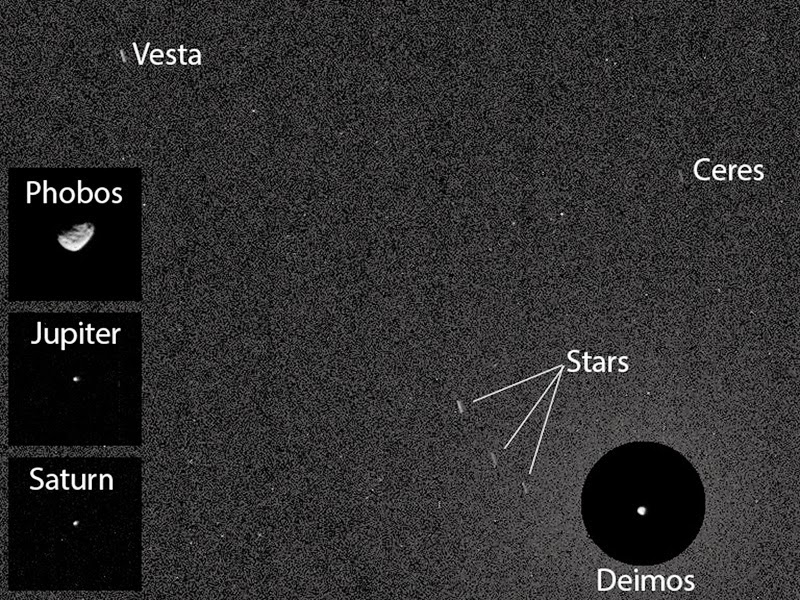
NASA's Curiosity rover captures images of asteroids Ceres and Vesta

For the first time, NASA's Curiosity rover has captured images of an asteroid from the surface of Mars -- two of them, in fact.

The imagery recorded by Curiosity and beamed back to Earth feature Ceres and Vesta, two of the largest asteroids in the asteroid belt that runs between between Mars and Jupiter.

This Curiosity first was also a bit of a coincidence, as the SUV-sized rover had aimed its cameras at the Martian sky in order to snap shots of the Red Planet's two moons, not hunt for asteroids whizzing by.

"This imaging was part of an experiment checking the opacity of the atmosphere at night in Curiosity's location on Mars, where water-ice clouds and hazes develop during this season," camera team member Mark Lemmon, of Texas A&M University, explained in a statement.

"The two Martian moons were the main targets that night, but we chose a time when one of the moons was near Ceres and Vesta in the sky."

Mark Lemmon
NASA is currently on its way to get an even closer look at this two giant space rocks.

NASA's Dawn spacecraft orbited the 350-mile-wide Vesta asteroid in 2011 and 2012, and it is preparing to orbit the 590-mile-wide Ceres in 2015.

Monday, February 24, 2014

Painted Stones video: Asteroids observed by the Sloan Digital Sky Survey


Alex Parker is an astronomer at UC Berkeley, where he researches minor planets—asteroids, Kuiper Belt Objects (giant iceballs orbiting past Neptune), and more.

He took the asteroids in the solar system observed by the Sloan Digital Sky Survey (over 100,000 of them) and created an animation showing their orbits, their relative sizes, and even their colors in the survey. 

The resulting video, “Painted Stones”, has been called 'simply wondrous.'

Space 'Harpoons' Could Snatch Samples of Asteroids and Moons

Artist's concept of a tethered "penetrator" heading toward a celestial body to take a sample. 

Credit: Chad Truitt, University of Washington

Why bother landing softly on an alien world to collect samples if you can just snag material with a harpoon from afar?

Using a set of long-lined, hard-hitting harpoons would allow a mission to grab large samples from multiple locations on an asteroid or moon — and to get them from beneath the surface, where some of the most interesting material lies, say researchers developing the idea.

Robert Winglee
"This technology will be able for the first time to pull samples of the order of a few kilograms from depths of a few meters, which could greatly enhance our knowledge of solar system objects and the resources therein," Robert Winglee of the University of Washington and his colleagues wrote in a NASA report detailing their project.

"Moreover, it offers the opportunity to take multiple samples (from either multiple objects or from multiple areas of a few objects) at little extra cost so that it will provide much greater flexibility and greatly enhance the science return for any given mission," they added.


The team's concept currently calls for a sample-return spacecraft to carry six lightweight, rocket-shaped "penetrators," which would be swung down at the target object(s) from orbit or during a flyby using a miles-long space tether.

The penetrators would hit at high speed — up to 2,240 mph (3,605 km/h, or 1 km/sec) or so — and go deep beneath the surface.

During the impact, they would collect several kilograms of material, which would be reeled back to the parent probe by the tether for eventual return to Earth.

The six-shooter approach enables the collection of multiple samples — an enticing prospect for scientists, Winglee said.

Thursday, February 20, 2014

CSIRO: Asteroids bombard tiny star

An artist's impression of an asteroid breaking up. 

Credit: NASA/JPL-Caltech

Scientists, using CSIRO's Parkes telescope and the South Africa Large Telescope, have found evidence that a tiny star called PSR J0738-4042 is being pounded by asteroids—large lumps of rock from space.

"One of these rocks seems to have had a mass of about a billion tonnes," CSIRO astronomer and member of the research team Dr Ryan Shannon said.

PSR J0738-4042 lies 37,000 light-years from Earth in the constellation of Puppis.

The environment around this star is especially harsh, full of radiation and violent winds of particles.

"If a large rocky object can form here, planets could form around any star. That's exciting," Dr Shannon said.

The star is a special one, a 'pulsar' that emits a beam of radio waves.

As the star spins, its radio beam flashes over Earth again and again with the regularity of a clock.

In 2008 Dr Shannon and a colleague predicted how an infalling asteroid would affect a pulsar. It would, they said, alter the slowing of the pulsar's spin rate and the shape of the radio pulse that we see on Earth.

"That is exactly what we see in this case," Dr Shannon said.

"We think the pulsar's radio beam zaps the asteroid, vapourising it. But the vapourised particles are electrically charged and they slightly alter the process that creates the pulsar's beam."

Asteroids around a pulsar could be created by the exploding star that formed the pulsar itself, the scientists say.

The material blasted out from the explosion could fall back towards the forming pulsar, forming a disk of debris.

Astronomers have found a dust disk around another pulsar called J0146+61.

Paul Brook
"This sort of dust disk could provide the 'seeds' that grow into larger asteroids," said Mr Paul Brook, a PhD student co-supervised by the University of Oxford and CSIRO who led the study of PSR J0738-4042.

In 1992 two planet-sized objects were found around a pulsar called PSR 1257+12. But these were probably formed by a different mechanism, the astronomers say.

The new study has been published as a paper in the Astrophysical Journal Letters, a leading journal of astronomical research: Evidence of an asteroid encountering a pulsar.

More information: "Evidence of an Asteroid Encountering a Pulsar," P. R. Brook et al., 2014 ApJ, 780, L31. dx.doi.org/10.1088/2041-8205/780/2/L31

Wednesday, January 29, 2014

The Grand Tack model: 'Rogue' asteroids may be normal

Credit: NASA/JPL-Caltech

To get an idea of how the early solar system may have formed, scientists often look to asteroids.

These relics of rock and dust represent what today's planets may have been before they differentiated into bodies of core, mantle, and crust.

In the 1980s, scientists' view of the solar system's asteroids was essentially static: Asteroids that formed near the sun remained near the sun; those that formed farther out stayed on the outskirts.

But in the last decade, astronomers have detected asteroids with compositions unexpected for their locations in space: Those that looked like they formed in warmer environments were found further out in the solar system, and vice versa. Scientists considered these objects to be anomalous "rogue" asteroids.

But now, a new map developed by researchers from MIT and the Paris Observatory charts the size, composition, and location of more than 100,000 asteroids throughout the solar system, and shows that rogue asteroids are actually more common than previously thought.

Particularly in the solar system's main asteroid belt—between Mars and Jupiter—the researchers found a compositionally diverse mix of asteroids.

The new asteroid map suggests that the early solar system may have undergone dramatic changes before the planets assumed their current alignment.

For instance, Jupiter may have drifted closer to the sun, dragging with it a host of asteroids that originally formed in the colder edges of the solar system, before moving back out to its current position.

Jupiter's migration may have simultaneously knocked around more close-in asteroids, scattering them outward.

Francesca DeMeo
"It's like Jupiter bowled a strike through the asteroid belt," says Francesca DeMeo, who did much of the mapping as a postdoc in MIT's Department of Earth, Atmospheric and Planetary Sciences.

"Everything that was there moves, so you have this melting pot of material coming from all over the solar system."

DeMeo says the new map will help theorists flesh out such theories of how the solar system evolved early in its history.

She and Benoit Carry of the Paris Observatory have published details of the map in Nature.

The compositional diversity seen in this new asteroid map may add weight to a theory of planetary migration called the Grand Tack model.

This model lays out a scenario in which Jupiter, within the first few million years of the solar system's creation, migrated as close to the sun as Mars is today.

During its migration, Jupiter may have moved right through the asteroid belt, scattering its contents and repopulating it with asteroids from both the inner and outer solar system before moving back out to its current position—a picture that is very different from the traditional, static view of a solar system that formed and stayed essentially in place for the past 4.5 billion years.

"That [theory] has been completely turned on its head," DeMeo says. "Today we think the absolute opposite: Everything's been moved around a lot and the solar system has been very dynamic."

DeMeo adds that the early pinballing of asteroids around the solar system may have had big impacts on Earth.

For instance, colder asteroids that formed further out likely contained ice. When they were brought closer in by planetary migrations, they may have collided with Earth, leaving remnants of ice that eventually melted into water.

"The story of what the asteroid belt is telling us also relates to how Earth developed water, and how it stayed in this Goldilocks region of habitability today," DeMeo says.

More information: Paper: dx.doi.org/10.1038/nature12908

Tuesday, January 14, 2014

Few asteroids are worth mining, suggests Harvard study

A new study might contain some bad news for companies hoping to mine asteroids for their valuable ores.

In the last couple of years, start-ups - including one backed by Sir Richard Branson - have announced plans to extract resources from space rocks.

But calculations by Dr Martin Elvis suggest our cosmic neighbourhood might not be such a treasure trove after all.

The Harvard astrophysicist argues just 10 near-Earth asteroids might be suitable for commercial-scale mining.

But Eric Anderson, co-founder of asteroid mining company Planetary Resources, told reporters that the values quoted in the study were off - conservatively - by a factor of 100.

Dr Martin Elvis
Dr Elvis, from the Harvard-Smithsonian Center for Astrophysics in Cambridge, US, has developed an equation to estimate the number of asteroids in the Solar System that could be exploited in a cost-effective way.

His research paper is in press at the journal Planetary and Space Science, and has been posted on the pre-print server Arxiv.org.

In 2012, Planetary Resources, backed by billionaire investors including Hollywood director James Cameron as well as Google executives Larry Page and Eric Schmidt, unveiled their vision of using robotic spacecraft to squeeze the chemical components of fuel as well as minerals out of asteroid rocks.

Several months later, the company was joined by a competitor - Deep Space Industries - which plans to use low-cost spacecraft called Fireflies and Dragonflies to reconnoitre and return samples from near-Earth asteroids.

Advocates of asteroid mining say it could turn into a trillion-dollar business, but some experts have been sceptical of the idea.

Concentrating efforts
In the latest study, Dr Elvis worked out the factors that would make an asteroid commercially viable to mine and what fraction of known space rocks met these requirements.

He emphasised there were large uncertainties in the values and called for more thorough surveys of what's out there.

He assumed that mining operations would want to focus on iron-nickel asteroids (known as M-type), considered the most promising targets for finding so-called platinum-group metals.

These include platinum, along with iridium, palladium and others.

These are rare in the Earth's crust because they dissolve in molten iron, instead being mainly concentrated in the planet's core.

Platinum and palladium are the most economically important, having a wide range of uses in industry. But according to the analysis, just 1% of near-Earth asteroids are rich in these elements.

Suitable asteroids also need to be relatively easy to reach, further narrowing the pool by ruling out all but the nearest objects to Earth.

The operative parameter here is delta-v - the change in velocity needed to send mining equipment to the target and return with a larger mass of ore.

The size of the target is also a factor; the paper suggests it wouldn't be worth mining asteroids smaller than about 100m because the total value of the ore they would produce wouldn't be enough to cover the costs of a space mission.

However, Dr Elvis points out that the ore values in his analysis range from a low of $800m to a high of $8.8bn.

"Such a large range of values could greatly change the profitability of a venture, making more accurate assays necessary," he explained.

More Information: How Many Ore-Bearing Asteroids? Arxiv.org

Thursday, December 5, 2013

NASA DAWN: Ice on Ceres is an 'Interesting Paradox'

Hubble Space Telescope imaged the asteroid Vesta and the dwarf planet Ceres in 2007, both targets of NASA's Dawn mission

Credit: NASA, ESA, J. Parker (SwRI), L. McFadden (U Maryland)

As NASA's Dawn mission draws closer to its encounter with the dwarf planet Ceres in early 2015, excitement continues to mount for scientists looking forward to what the satellite might observe.

Britney Schmidt
Britney Schmidt, of the George Institute of Technology, and Nicole Gugliucci of CosmoQuest, recently hosted a Google+ Hangout titled 'Ceres: Great Expectations' to discuss the upcoming visit to the nearest dwarf planet in the solar system.

Orbiting in the asteroid belt, a little more than three times as far from the Sun as Earth, Ceres is thought to contain an icy mantle that makes up approximately a third of its mass.

"Ceres is very different and very exciting in a lot of ways, totally different from any place that we've been," Schmidt said in the broadcast. "It may be the only primarily icy planet that's out there, at least within reach."

Scratching the surface
Seen through a telescope, Ceres may not appear very exciting.

Scientists can use the light reflected off of a body to find out information about its composition.

"Ceres, to the eye, would appear basically pretty black because it's reflecting most colours more or less the same, and reflecting very little light at all," said Andy Rivkin of the Johns Hopkins University Applied Physics Lab.

Andy Rivkin
Even the infrared spectrum, which tends to reveal more information about asteroids such as Vesta—Dawn's first stop—provided very little information about its composition.

By utilizing instruments such as the SpeX instrument on the NASA Infrared Telescope Facility (IRTF) on Mauna Kea in Hawaii, scientists were able to catch hints about the dwarf planet's surface.

These observations revealed suggestions of brucite, hydroxyls, and two other features Rivkin says are thought to be due to carbonate minerals.

"[This] makes Ceres one of only a few places where we've found carbonates," Rivkin said. "I think other than Earth and Mars, it's Ceres."

He went on to explain that scientists think water interacting with the minerals formed the brucite and the carbonates.

The layers of Ceres. Scientists think that the dwarf planet contains a rocky inner core surrounded by a thick mantle of water-ice. 

A thin outer crust covers the surface, with carbonates and other signs that water lay on the planet's skin at some point. 

Credit: NASA, ESA, and A. Feild (STScI)

"For Ceres, we think it is much more consistent with a body that had a lot of water available to interact with."

But water, considered a potential habitat for life to start, can't exist on the surface of the dwarf planet in either solid or liquid form.

"We see no real evidence for ice at the surface of Ceres," Rivkin said, noting that the dwarf planet is too warm. "However, conditions beneath Ceres' surface should allow buried ice to remain there."

At the same time, observations from the Hubble Space Telescope, as well as theoretical data such as the planet's density, suggest that a large amount of ice exists.

"That creates this interesting paradox. We think there's a lot of ice there, (but) we don't see any at the surface," Rivkin said.

"How that's going to translate into what we find when we show up there is still very much an open question."

Thursday, October 24, 2013

Japan JAXA Hayabusa-2 Mission: Commercial Exploitation of Space rocks and Asteroids

In 2013 the Japanese Aerospace Exploration Agency (JAXA) are sending the space probe, Hayabusa 2, on a long journey to an asteroid named 1999 JU3 (Image by Japan Aerospace Exploration Agency).

A unique space cannon developed for Japan's Hayabusa 2 spacecraft has successfully test-fired on Earth in preparation for a 2014 mission.

During its upcoming journey into space, the cannon will blast an asteroid and mine samples of its soil.

The test took place in the Japanese prefecture of Gifu, paving the way for the Hayabusa 2 spacecraft to extract soil samples from the asteroid, the Japan Aerospace Exploration Agency (JAXA) announced on Monday.

During the mission of Hayabusa 2, scheduled to begin in December 2014, the space probe will extract soil from inside the asteroid.

To do this, it will be equipped with a collision device designed to shoot at the surface of the asteroid from a distance of 100 meters with metal shell ammunition moving at a speed of two kilometers per second.

JAXA hopes to create a small (a few meters in diameter), artificial crater from which Japanese scientists can extract valuable samples capable of revealing the history of the formation of cosmic bodies of this type.

"A new function, [a] 'collision device,' is considered to be [on board] to create a crater artificially," JAXA explained on its website, adding that collecting samples from the surface that is exposed by a collision will ensure acquiring "fresh samples that are less weathered by the space environment or heat."

In order to calibrate the precision of the cannon, JAXA engineers had to overcome a number of challenges. However, the agency assures that all problems have already been solved.

"We were able to solve several problems associated with the development of the device. During the tests, the projectile hit right on target, and with the expected speed," JAXA engineer Takanao Saiki said.

Japanese scientists actively began exploring asteroids with the Hayabusa mission, which returned to earth in June 2010 after exploring a 500-meter-long rock-rich S-type Itokawa asteroid.

Hayabusa 2 is a successor of the first spacecraft and is scheduled to be launched in 2014 to conduct research of a C-type asteroid temporally called '1999 JU3.'

It is believed to contain a higher concentration of organic matters and water.

"Minerals and seawater which form the Earth as well as materials for life are believed to be strongly connected in the primitive solar nebula in the early solar system"

"Thus, we expect to clarify the origin of life by analyzing samples acquired from a primordial celestial body, such as a C-type asteroid, to study organic matter and water in the solar system and how they coexist while affecting each other," JAXA posted on its website.

So far, research into '1999 JU3' revealed that it is a sphere approximately 920 meters in diameter with an albedo on the surface of about 0.06. The rotation period of the celestial object is approximately 7.6 hours.

Hayabusa 2 is expected to reach its target in the middle of 2018 before departing back to Earth in 2019.

Sunday, September 8, 2013

NASA WISE Spacecraft Reactivated to Hunt for Asteroids

This artist's concept shows the Wide-field Infrared Survey Explorer, or WISE spacecraft, in its orbit around Earth. 

In September of 2013, engineers will attempt to bring the mission out of hibernation to hunt for more asteroids and comets in a project called NEOWISE. 

Image Credit: NASA/JPL-Caltech

A NASA spacecraft that discovered and characterized tens of thousands of asteroids throughout the solar system before being placed in hibernation will return to service for three more years starting in September, assisting the agency in its effort to identify the population of potentially hazardous near-Earth objects, as well as those suitable for asteroid exploration missions.

The Wide-field Infrared Survey Explorer (WISE) will be revived next month with the goal of discovering and characterizing near-Earth objects (NEOs), space rocks that can be found orbiting within 28 million miles (45 million kilometers) from Earth's path around the sun.

NASA anticipates WISE will use its 16-inch (40-centimeter) telescope and infrared cameras to discover about 150 previously unknown NEOs and characterize the size, albedo and thermal properties of about 2,000 others -- including some which could be candidates for the agency's recently announced asteroid initiative.

"The WISE mission achieved its mission's goals and as NEOWISE extended the science even further in its survey of asteroids. NASA is now extending that record of success, which will enhance our ability to find potentially hazardous asteroids, and support the new asteroid initiative," said John Grunsfeld, NASA's associate administrator for science in Washington.

"Reactivating WISE is an excellent example of how we are leveraging existing capabilities across the agency to achieve our goal."

NASA's asteroid initiative will be the first mission to identify, capture and relocate an asteroid. It represents an unprecedented technological feat that will lead to new scientific discoveries and technological capabilities that will help protect our home planet.

The asteroid initiative brings together the best of NASA's science, technology and human exploration efforts to achieve President Obama's goal of sending humans to an asteroid by 2025.

Launched in December 2009 to look for the glow of celestial heat sources from asteroids, stars and galaxies, WISE made about 7,500 images every day during its primary mission, from January 2010 to February 2011.

As part of a project called NEOWISE, the spacecraft made the most accurate survey to date of NEOs. NASA turned most of WISE's electronics off when it completed its primary mission.