Showing posts with label CSIRO. Show all posts

Thursday, February 20, 2014

CSIRO: Asteroids bombard tiny star

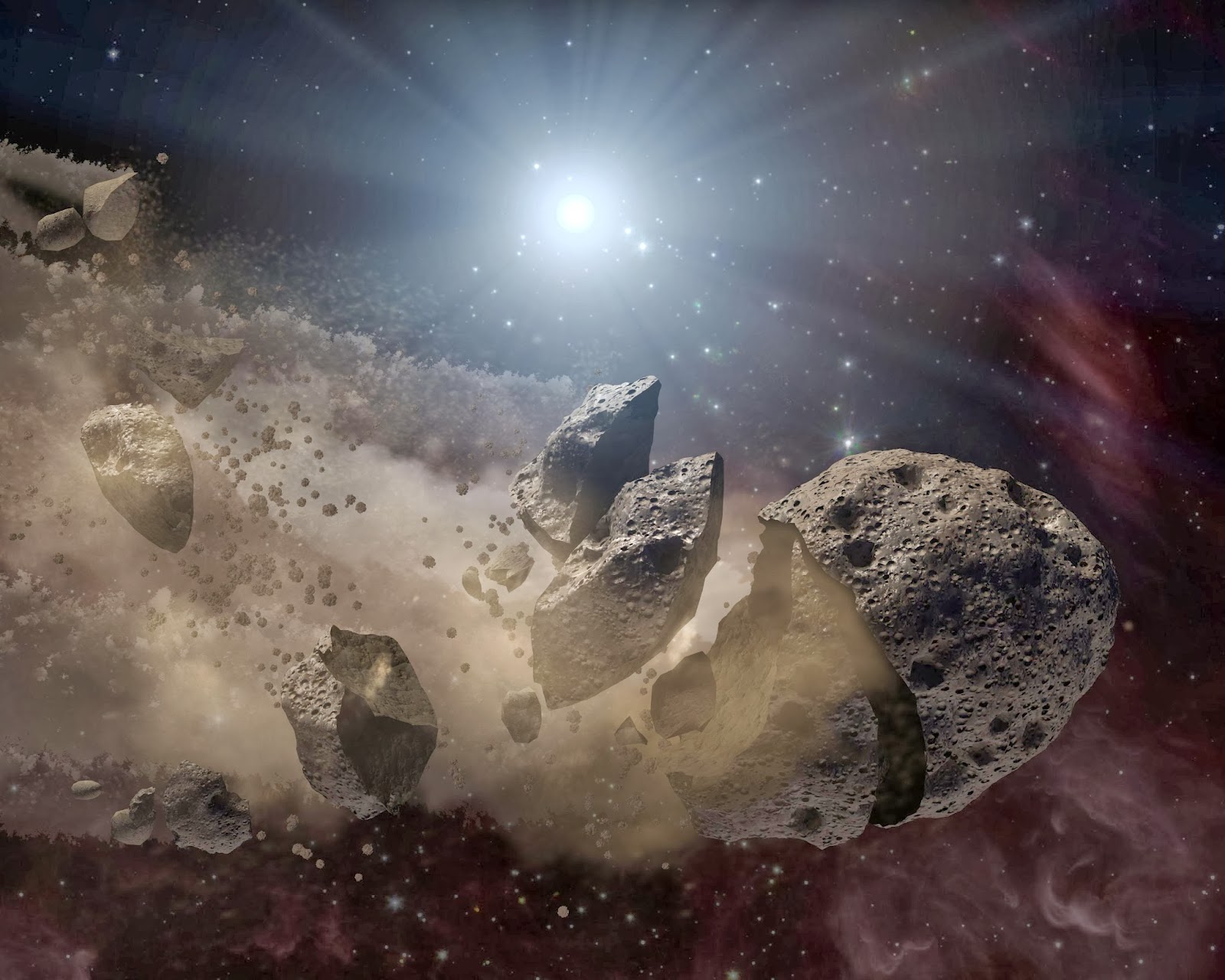
An artist's impression of an asteroid breaking up. 

Credit: NASA/JPL-Caltech

Scientists, using CSIRO's Parkes telescope and the South Africa Large Telescope, have found evidence that a tiny star called PSR J0738-4042 is being pounded by asteroids—large lumps of rock from space.

"One of these rocks seems to have had a mass of about a billion tonnes," CSIRO astronomer and member of the research team Dr Ryan Shannon said.

PSR J0738-4042 lies 37,000 light-years from Earth in the constellation of Puppis.

The environment around this star is especially harsh, full of radiation and violent winds of particles.

"If a large rocky object can form here, planets could form around any star. That's exciting," Dr Shannon said.

The star is a special one, a 'pulsar' that emits a beam of radio waves.

As the star spins, its radio beam flashes over Earth again and again with the regularity of a clock.

In 2008 Dr Shannon and a colleague predicted how an infalling asteroid would affect a pulsar. It would, they said, alter the slowing of the pulsar's spin rate and the shape of the radio pulse that we see on Earth.

"That is exactly what we see in this case," Dr Shannon said.

"We think the pulsar's radio beam zaps the asteroid, vapourising it. But the vapourised particles are electrically charged and they slightly alter the process that creates the pulsar's beam."

Asteroids around a pulsar could be created by the exploding star that formed the pulsar itself, the scientists say.

The material blasted out from the explosion could fall back towards the forming pulsar, forming a disk of debris.

Astronomers have found a dust disk around another pulsar called J0146+61.

Paul Brook
"This sort of dust disk could provide the 'seeds' that grow into larger asteroids," said Mr Paul Brook, a PhD student co-supervised by the University of Oxford and CSIRO who led the study of PSR J0738-4042.

In 1992 two planet-sized objects were found around a pulsar called PSR 1257+12. But these were probably formed by a different mechanism, the astronomers say.

The new study has been published as a paper in the Astrophysical Journal Letters, a leading journal of astronomical research: Evidence of an asteroid encountering a pulsar.

More information: "Evidence of an Asteroid Encountering a Pulsar," P. R. Brook et al., 2014 ApJ, 780, L31. dx.doi.org/10.1088/2041-8205/780/2/L31

Monday, June 24, 2013

CSIRO Astronomers spy on galaxies in the raw

Antennas of CSIRO's Compact Array telescope. Photo: David Smyth

A CSIRO radio telescope has detected the raw material for making the first stars in galaxies that formed when the Universe was just three billion years old—less than a quarter of its current age.

This opens the way to studying how these early galaxies make their first stars.

The telescope is CSIRO's Australia Telescope Compact Array telescope near Narrabri, NSW.

"It one of very few telescopes in the world that can do such difficult work, because it is both extremely sensitive and can receive radio waves of the right wavelengths," says CSIRO astronomer Professor Ron Ekers.

The raw material for making stars is cold molecular hydrogen gas, H2. It can't be detected directly but its presence is revealed by a 'tracer' gas, carbon monoxide (CO), which emits radio waves.

In one project, astronomer Dr Bjorn Emonts (CSIRO Astronomy and Space Science) and his colleagues used the Compact Array to study a massive, distant conglomerate of star-forming 'clumps' or 'proto-galaxies' that are in the process of coming together as a single massive galaxy.

This structure, called the Spiderweb, lies more than ten thousand million light-years away [at a redshift of 2.16].

Dr Emonts' team found that the Spiderweb contains at least sixty thousand million [6 x 10¹⁰] times the mass of the Sun in molecular hydrogen gas, spread over a distance of almost a quarter of a million light-years.

This must be the fuel for the star-formation that has been seen across the Spiderweb. "Indeed, it is enough to keep stars forming for at least another 40 million years," says Emonts.

In a second set of studies, Dr Manuel Aravena (European Southern Observatory) and colleagues measured CO, and therefore H2, in two very distant galaxies [at a redshift of 2.7].

The faint radio waves from these galaxies were amplified by the gravitational fields of other galaxies—ones that lie between us and the distant galaxies. This process, called gravitational lensing, "acts like a magnifying lens and allows us to see even more distant objects than the Spiderweb," says Dr Aravena.

More information: Emonts BHC and 15 co-authors. CO(1-0) detection of molecular gas in the massive Spiderweb Galaxy (z=2). Monthly Notices of the Royal Astronomical Society 430, 3465 (2013). Online at arxiv.org/abs/1301.6012

Aravena M and 28 co-authors. Large gas reservoirs and free-free emission in two lensed star-forming galaxies at z = 2.7. Accepted for publication in Monthly Notices of the Royal Astronomical Society. Online at arxiv.org/abs/1305.0614

Monday, January 7, 2013

CSIRO's 64-m Parkes: Detects Enormous Outflow of Energy

Enormous outflows of charged particles from the centre of our Galaxy, stretching more than halfway across the sky and moving at supersonic speeds, have been detected and mapped with CSIRO's 64-m Parkes radio telescope.

Corresponding to the "Fermi Bubbles" found in 2010, the recent observations of the phenomenon were made by a team of astronomers from Australia, the USA, Italy and The Netherlands, with the findings reported in Nature.

"There is an incredible amount of energy in the outflows," said co-author Professor Lister-Staveley-Smith from The University of Western Australia node of the International Centre for Radio Astronomy Research in Perth and Deputy Director of the ARC Centre of Excellence for All-sky Astrophysics (CAASTRO).

"The source of the energy has been somewhat of a mystery, but we know there is a lot there, about a million times as much energy as a supernova explosion (a dying star)."

CSIRO's 64-m Parkes radio telescope
From top to bottom the outflows extend 50,000 light-years [five hundred thousand million million kilometres] out of the Galactic Plane. That's equal to half the diameter of our Galaxy (which is 100,000 light-years-a million million million kilometres-across).

"Our Solar System is located approximately 30,000 light-years from the centre of the Milky Way Galaxy, but we're perfectly safe as the jets are moving in a different direction to us," said Professor Staveley-Smith.

Seen from Earth, but invisible to the human eye, the outflows stretch about two-thirds across the sky from horizon to horizon.

They match previously identified regions of gamma-ray emission detected with NASA's Fermi Space Telescope (then-called "Fermi Bubbles") and the "haze" of microwave emission spotted by the Wilkinson Microwave Anisotropy Probe (WMAP) and Planck Space Telescope.

"Adding observations by the ground-based Parkes radio telescope to those made in the past by space telescopes finally allows us to understand how these enormous outflows are powered," said Professor Staveley-Smith.

Previously it was unclear whether it was quasar-like activity of our Galaxy's central super-massive black hole or star formation that kept injecting energy into the outflows.

The recent findings, reported in Nature today, show that the phenomenon is driven by many generations of stars forming and exploding in the Galactic Centre over the last hundred million years.

Friday, October 5, 2012

Australia Square Kilometre Array Pathfinder (ASKAP): Fastest Radio Telescope on Earth

Australia is now home to the world's fastest radio telescope with the launch Friday of the $152 million Australia Square Kilometre Array Pathfinder (ASKAP), which experts said would allow a more expansive survey of the universe - both known and what remains for scientists to discover s.

The new scientific research site is located in the Shire of Murchison, a sparsely populated area in Western Australia that astronomers have picked out because of the virtual absence of man-made radio signals.

The location is ideal because it is 'radio quiet', or lacks man-made radio signals that would interfere with the antennas picking up astronomical radio signals.

The ASKAP telescope is projected to improve on the previous achievements of similar facilities, giving researchers and scientists more universe space to cover with less time required.

Putting into perspective the speed and efficiency that comes with the ASKAP, scientists said only five minutes will be spent to fully observe Milky Way's neighbouring galaxy, Centaurus A.

Earlier works on the Centaurus A were achieved after two years of careful observations that were aided by thousands of hours of computer analysis and the poring over of hundreds of images, the news agency added.

Now with use of phased array feeds coming from 36 antennas spread over an area of about 50,000 square kilometres, future scientific researchers and observations have become more specific and accurate, scientists said.

Australia will host both the low frequency component of the SKA – which will image the birth of the first stars in the universe - and a world leading survey facility based on CSIRO’s revolutionary Phased Array Feed technology.

Both of these components of the telescope are right at the cutting-edge of radio astronomy technology and data management and will attract some of the best technological brains in the world to Australia.

These well-coordinated radio waves will provide clear snap shots of what man aims to discover out there to better comprehend the universe, National Scientific Research Organisation (NSRO) project director Brian Boyle said in a news briefing held earlier this week.

"Radio waves tell us unique things about the cosmos, about the gas from which stars were formed, and about exotic objects, pulsars and quasars, that really push the boundaries of our knowledge of the physical laws in the universe," Mr Boyle said.

What the new facility has delivered is for astronomers to better understand our own universe and the 'others' on its outer realms, he added.

Over the next few years, the NSRO is gunning to gain more information on the force that led to the creation of Milky Way and its constant expansion, decode the mystery-laden black holes and investigate further on pulsars.

It could be that the new ASKAP telescope would eventually prove that 'man is not alone' after all, Mr Boyle suggested.