Showing posts with label particles. Show all posts

Friday, January 17, 2014

DarkSide: Project aims to find particles of dark matter

The DarkSide-50 research team is made up of faculty, students and researchers from dozens of institutions around the world,

From left, Luca Grandi, an assistant professor at the University of Chicago, Richard Saldanha, an associate fellow in the Kavli Institute for Cosmological Physics at the University of Chicago, and Hanguo Wang, a researcher at the University of California-Los Angeles

While wearing protective clothing to keep the environment clean, they are working to assemble the core of the dark matter detector, an argon-filled tank with photodetectors at the top and bottom to spot the light from collisions, and copper coils to help determine where the collisions occur. 

Credit: Peter Meyers

In a laboratory under a mountain 80 miles east of Rome this fall, a Princeton-led international team switched on a new experiment aimed at finding a mysterious substance that makes up a quarter of the universe but has never been seen.

The experiment, known as DarkSide-50, is searching for particles of dark matter. For the last several decades, researchers have known that visible matter—the stuff we can see—makes up only 4 percent of the universe, while dark energy is thought to make up about 73 percent.

Dark matter is thought to make up the remaining 23 percent, and finding it, researchers say, will solidify our understanding of how the universe formed and shed light on its ultimate fate.

Peter Meyers
"This is like the search for the Higgs boson was 10 years ago," said Peter Meyers, a professor of physics at Princeton University and one of the lead scientists on the project.

"We have a good idea of what to look for, but we don't know exactly where or when we will find it."

Housed inside a cavernous chamber in Italy's Gran Sasso National Laboratory, the DarkSide-50 collaboration involves 17 American institutions as well the Italian Institute for Nuclear Physics (INFN) and other institutions in Italy, France, Poland, Ukraine, Russia and China.

The research team includes postdocs, staff researchers and several graduate and undergraduate students from Princeton.

The researchers spent last summer assembling the detector, which consists of three fluid-filled chambers nested one inside the other like Russian dolls.

Now that the experiment is up and running, the waiting begins. Unlike the massive Large Hadron Collider that discovered the Higgs, DarkSide-50 doesn't smash anything. Instead, it is designed to detect dark matter particles that drift through its chambers.

Looking for WIMPs 
The evidence for dark matter dates to the 1930s, when astronomers realized that the amount of matter we can see—as planets, stars and galaxies—falls far short of what must be out there to give galaxies their characteristic spiral shapes and clustering patterns.

Without this missing matter, the galaxies should have flown apart long ago. Matter provides the gravity that keeps the stars in rotation around the galaxy's center.

Unless our theories of gravity are wrong—and a minority of physicists think that is a possibility—dark matter must exist.

Cristiano Galbiati
"Finding dark matter particles would help confirm our understanding of the universe," said Cristiano Galbiati, an associate professor of physics at Princeton.

"And, whether or not we find it, we will have learned a great deal about how to go about looking for it. This is as exciting a moment in the search for dark matter as there has ever been."

Although no one knows for sure what dark matter is made of, the DarkSide-50 team and many other scientists think the most likely candidate is a particle so weak that it is called a WIMP, which is short for "weakly interacting massive particle."

As the name suggests, WIMPs barely interact with their surroundings. They simply drift through walls like ghosts.

If you cup your hands together, you will surround—but never trap—a few of these ethereal beings. Scientists suggest that a WIMP can be detected when it smacks into the nucleus of an atom such as argon, which is found in air.

When this happens in a chamber of densely packed argon atoms, the stricken atom recoils and creates a track of excited argon atoms in its wake.

This track appears as a fleeting trail of light, which can be detected by devices called photodetectors. But these collisions are rare—just a few WIMPs are detected each year.

Because other particles also give off light when they collide with argon, DarkSide-50 is located nearly a mile beneath Gran Sasso mountain ("gran sasso" is Italian for "great stone").

The rock shields out cosmic-ray particles that routinely bombard the Earth.

To read the full article go here

Sunday, December 1, 2013

Van Allen Probes: Giant Electric Fields Supercharge Particles In Radiation Belts


Huge electric fields in the radiation belts around Earth may help explain how electrons surrounding the planet can be accelerated to speeds near that of light, researchers have found in a new study.

These findings, detailed Dec. 2 in the journal Physical Review Letters, could help shed light on the radiation belts of planets such as Jupiter, Saturn, Uranus and Neptune, as well as the behaviour of the sun during flares and of bodies beyond the solar system, such as stellar nurseries, neutron stars and incredibly energetic black holes known as quasars.

After humanity began exploring space, the first major find made there were the Van Allen radiation belts, zones of magnetically trapped, highly energetic charged particles discovered in 1958.

The Van Allen Probes aka Radiation Belt Storm Probes (RBSP) Mission, part of NASA's Living With a Star program, will provide unprecedented insight into the physical dynamics of the radiation belts. 

Credit: NASA

These belts generally consist of two rings: 
  • an inner zone with both high-energy electrons and very energetic positive ions that remains stable in intensity over the course of years to decades; and
  • an outer zone made up mostly of high-energy electrons whose intensity swings over the course of hours to days, primarily depending on the influence from the solar wind, the deluge of radiation streaming from the sun. 

Earlier this year, scientists also detected a third radiation belt temporarily surrounding Earth.

The gigantic amounts of radiation the Van Allen belts generate can pose serious risks for satellites. To learn more about them, NASA launched twin spacecraft, the Van Allen probes, in the summer of 2012.

The satellites are armed with a host of sensors to comprehensively analyze the plasma, energetic particles, magnetic fields and plasma waves in these belts with unprecedented sensitivity and resolution.

Two giant swaths of radiation, known as the Van Allen Belts, surrounding Earth were discovered in 1958. In 2012, observations from the Van Allen Probes showed that a third belt can sometimes appear. 

The radiation is shown here in yellow, with green representing the spaces between the belts. 

Credit: NASA/Van Allen Probes/Goddard Space Flight Center.

Now, using the Van Allen probes, scientists have detected structures that pop in and out of existence in the outer belt that could help explain the high-energy electrons seen in that zone.

The structures in question are known as "double layers." They are each made up of a pair of parallel layers of particles with opposite electrical charge that move along Earth's magnetic field.

The probes saw huge numbers of double layers in the outer belt —7,000 in the course of a minute, each lasting on the order of seconds.

These double layers were discovered "sort of by accident as the Van Allen probes passed through this region of space, and only captured a snapshot," said study lead author Forrest Mozer, a physicist at the University of California, Berkeley.

"The spacecraft will get back to this region maybe eight months, maybe 10 months from now, and we're setting up our instruments to do what we now know they should — to collect data at that site then with a continuous view, to really get definitive information on what is going on there."

Thursday, November 28, 2013

CERN ATLAS experiment: Higgs boson decays to two tau particles

The ATLAS detector, open during a recent technical stop. 

Credit: Maximilien Brice /CERN

The ATLAS experiment at CERN has released preliminary results that show evidence that the Higgs boson decays to two tau particles.

Taus belong to a group of subatomic particles called the fermions, which make up matter.

This result – measured at 4.1 sigma on the 5-point scale particle physicists use to determine the certainty of a result – is the first evidence for a Higgs decay to fermions.

On 4 July 2012, the ATLAS and CMS experiments at CERN announced the discovery of a new particle, which was later confirmed to be a Higgs boson.

For physicists, the discovery meant the beginning of a quest to find out what the new particle was, if it fit in the Standard Model, our current model of nature in particle physics, or if its properties could point to new physics beyond that model.

An important property of the Higgs boson that ATLAS physicists are trying to measure is how it decays.

The Higgs boson lives only for a short time and disintegrates into other particles. The various possibilities of the final states are called decay modes.

So far, ATLAS physicists had found evidence that the Higgs boson decays into different types of gauge bosons - the kind of elementary particles that carry forces.

The other family of fundamental particles, the fermions, make up matter. The tau is a fermion and behaves like a very massive electron.

Graphical representation of a Higgs boson decaying to two tau particles in the ATLAS detector. 

The taus decay into an electron (blue line) and a muon (red line) 

Credit: ATLAS

The Brout-Englert-Higgs mechanism was first proposed to describe how gauge bosons acquire mass but the Standard Model predicts that fermions also acquire mass in this manner, so the Higgs boson could decay directly to either bosons or fermions.

The new preliminary result from ATLAS shows clear evidence that the Higgs boson indeed does decay to fermions, consistent with the rate predicted by the Standard Model.

This important finding was made possible through careful analysis of data produced by the LHC during its first run.

Only with new data will physicists be able to determine if the compatibility remains or if other new models become viable.

Fortunately, the next LHC run, which begins in 2015, is expected to produce several times the existing data sample. In addition, the proton collisions will be at higher energies, producing Higgs bosons at higher rates.

Thursday, April 11, 2013

Saturn's Rings: Charged Water Particles Falling like Rain

This artist's concept illustrates how charged water particles flow into the Saturnian atmosphere from the planet's rings, causing a reduction in atmospheric brightness. 

The observations were made with the W.M. Keck Observatory on Mauna Kea, Hawaii, with NASA funding

The analysis was led by the University of Leicester, England. 

Credit: NASA /JPL-Caltech /Space Science Institute /University of Leicester

A new study tracks the "rain" of charged water particles into the atmosphere of Saturn and finds there is more of it and it falls across larger areas of the planet than previously thought.

The study, whose observations were funded by NASA and whose analysis was led by the University of Leicester, in the UK, reveals that the rain influences the composition and temperature structure of parts of Saturn's upper atmosphere.

The paper appears in this week's issue of the journal Nature.

"Saturn is the first planet to show significant interaction between its atmosphere and ring system," said James O'Donoghue, the paper's lead author and a postgraduate researcher at Leicester.

"The main effect of ring rain is that it acts to 'quench' the ionosphere of Saturn. In other words, this rain severely reduces the electron densities in regions in which it falls."

O'Donoghue explains that the ring's effect on electron densities is important because it explains why, for many decades, observations have shown those densities to be unusually low at certain latitudes on Saturn.

The study also helps scientists better understand the origin and evolution of Saturn's ring system and changes in the planet's atmosphere.

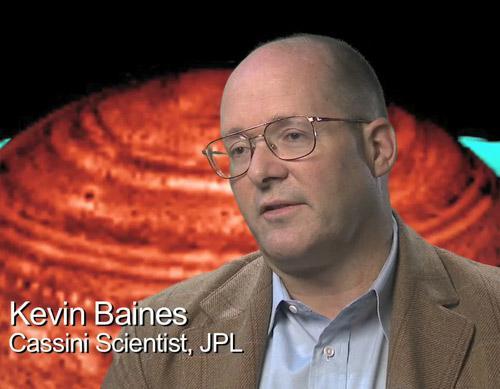
"It turns out that a major driver of Saturn's ionospheric environment and climate across vast reaches of the planet are ring particles located some 36,000 miles [60,000 kilometers] overhead," said Kevin Baines, a co-author on the paper, based at NASA's Jet Propulsion Laboratory, Pasadena, Calif.

"The ring particles affect both what species of particles are in this part of the atmosphere and where it is warm or cool."

In the early 1980s, images from NASA's Voyager spacecraft showed two to three dark bands on Saturn, and scientists theorized that water could have been showering down into those bands from the rings.

Those bands were not seen again until this team observed the planet in near-infrared wavelengths with the W.M Keck Observatory on Mauna Kea, in Hawaii, in April 2011.

The effect was difficult to discern because it involves looking for a subtle emission from bright parts of Saturn.

It required an instrument like that on Keck, which can split up a large range of light.

The ring rain's effect occurs in Saturn's ionosphere, where charged particles are produced when the otherwise neutral atmosphere is exposed to a flow of energetic particles or solar radiation.

When the scientists tracked the pattern of emissions of a particular hydrogen ion with three protons (triatomic hydrogen), they expected to see a uniform planet-wide infrared glow.

What they observed instead was a series of light and dark bands -- with areas of reduced emission corresponding to water-dense portions of Saturn's rings and areas of high emission corresponding to gaps in the rings.

They surmised that charged water particles from the planet's rings were being drawn towards the planet along Saturn's magnetic field lines and were neutralising the glowing triatomic hydrogen ions.

This leaves large "shadows" in what would otherwise be a planet-wide infrared glow. These shadows cover some 30 to 43 percent of the planet's upper atmosphere surface from around 25 to 55 degrees latitude.

This is a significantly larger area than suggested by images from NASA's Voyager mission.

Both Earth and Jupiter have an equatorial region that glows very uniformly. Scientists expected this pattern at Saturn, too, but they instead saw dramatic differences at different latitudes.

Journal Reference:
J. O’Donoghue, T. S. Stallard, H. Melin, G. H. Jones, S. W. H. Cowley, S. Miller, K. H. Baines, J. S. D. Blake. The domination of Saturn’s low-latitude ionosphere by ring ‘rain’. Nature, 2013; 496 (7444): 193 DOI: 10.1038/nature12049

Monday, January 7, 2013

CSIRO's 64-m Parkes: Detects Enormous Outflow of Energy

Enormous outflows of charged particles from the centre of our Galaxy, stretching more than halfway across the sky and moving at supersonic speeds, have been detected and mapped with CSIRO's 64-m Parkes radio telescope.

Corresponding to the "Fermi Bubbles" found in 2010, the recent observations of the phenomenon were made by a team of astronomers from Australia, the USA, Italy and The Netherlands, with the findings reported in Nature.

"There is an incredible amount of energy in the outflows," said co-author Professor Lister-Staveley-Smith from The University of Western Australia node of the International Centre for Radio Astronomy Research in Perth and Deputy Director of the ARC Centre of Excellence for All-sky Astrophysics (CAASTRO).

"The source of the energy has been somewhat of a mystery, but we know there is a lot there, about a million times as much energy as a supernova explosion (a dying star)."

CSIRO's 64-m Parkes radio telescope
From top to bottom the outflows extend 50,000 light-years [five hundred thousand million million kilometres] out of the Galactic Plane. That's equal to half the diameter of our Galaxy (which is 100,000 light-years-a million million million kilometres-across).

"Our Solar System is located approximately 30,000 light-years from the centre of the Milky Way Galaxy, but we're perfectly safe as the jets are moving in a different direction to us," said Professor Staveley-Smith.

Seen from Earth, but invisible to the human eye, the outflows stretch about two-thirds across the sky from horizon to horizon.

They match previously identified regions of gamma-ray emission detected with NASA's Fermi Space Telescope (then-called "Fermi Bubbles") and the "haze" of microwave emission spotted by the Wilkinson Microwave Anisotropy Probe (WMAP) and Planck Space Telescope.

"Adding observations by the ground-based Parkes radio telescope to those made in the past by space telescopes finally allows us to understand how these enormous outflows are powered," said Professor Staveley-Smith.

Previously it was unclear whether it was quasar-like activity of our Galaxy's central super-massive black hole or star formation that kept injecting energy into the outflows.

The recent findings, reported in Nature today, show that the phenomenon is driven by many generations of stars forming and exploding in the Galactic Centre over the last hundred million years.

Monday, December 10, 2012

Hubble Image Hercules A: Huge black hole emits two beams of matter into space.

Hercules A, a galaxy which contains a massive black hole blasting out energy and matter.

This picture is a combination of visible light seen by the Hubble Space Telescope and radio waves, coloured pink in the image, detected by the Karl G. Jansky Very Large Array.

Image credit: NASA, ESA, S. Baum and C. O'Dea (RIT), R. Perley and W. Cotton (NRAO/AUI/NSF), and the Hubble Heritage Team (STScI/AURA)

In the heart of the galaxy Hercules A is a monster black hole: It’s about 600 times as massive as the black hole in the center of our Milky Way, making it about 2.5 billion times the Sun’s mass.

Material is actively funneling down into this black hole, forming a huge disk and blasting out the jets of material seen in the picture.

Focused tightly, those jets shoot across space at very high speed, slamming into material around them.

Eventually they lose energy and slow down, causing them to spread outward, forming the twin lobes shown.

Also when this happens, the material emits light in the radio part of the electromagnetic spectrum. The lobes of Herc A make it one of the brightest sources of radio waves in the entire sky.


The scale of this event is incredible.
Those lobes are well over 1.5 million light years across from edge to edge, 15 times the size of our entire galaxy, and they’re powerful, emitting a billion times the energy our Sun does at radio wavelengths.

The energy flowing out of Hercules A is beyond belief. The black hole blasts out 100 billion times as much energy in X-rays, as our Sun does in all wavelengths of light.

The black hole at the heart of Hercules A emits enough X-ray energy to easily vapourise our entire Earth and most of the Solar System.

Monday, August 13, 2012

Antartic Neutron Detectors Offer Predictions of Damaging Solar Radiation

Credit: Peter Rejcek, Antarctic Sun

One of the most frigid places on the planet appears to be an ideal location to help protect humans living and working in the cold of outer space against radiation bursts from the sun.

Scientists recently reported in the journal Space Weather and Space Climate that neutron detectors at the U.S. Antarctic Program's South Pole Station appear to offer a reasonably reliable early-warning system to detect damaging radiation associated with high-energy particles that sometimes accompany what's called coronal mass ejections (CMEs), a massive blast of low-energy plasma from the sun.

The high-energy protons and other subatomic particles ejected during such events blast through space near the speed of light. The particles that hit the Earth, called primary cosmic rays, are destroyed when they hit the atmosphere, producing a cascade of secondary subatomic particles.
Neutron detectors at the South Pole are particularly sensitive to the highest and rarest of the high-energy particles, which arrive before a slower but more intense "wave" of high-energy particles capable of delivering hazardous doses of radiation to humans in space.

The researchers used the measurements from a pair of ground-based detectors at the South Pole to predict the peak intensity at different particle energies.

"What we're predicting is a particle storm, which is a high-energy, high-intensity burst of particle radiation," explained Paul Evenson , a co-author on the study with the Bartol Research Institute at the University of Delaware .

"By using our comparatively simple technique -- measuring the energy spectrum of these particles -- we actually can make a prediction that's worth something for the lower-energy and more damaging particles."

The solar storm that produces such a blast of high-energy particles usually arrives about two days later, with the potential to disrupt satellites and the planet's energy grid.

Such an event crashed into Earth's magnetic field in mid-July, doing no damage but producing some of the most intense auroral displays seen in years, including at the South Pole.

These sorts of sun-generated storms are outside the scope of the South Pole early-warning system.

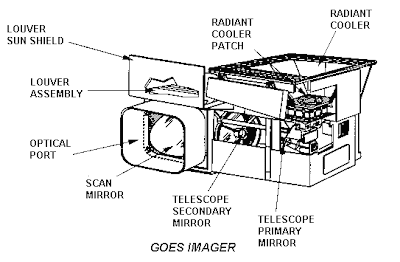
GOES GImager
The team validated its method against data collected from satellites that are part of the NOAA Geostationary Operational Environmental Satellite System (GOES).

However, the instruments aboard the satellites aren't capable of detecting particles much higher in energy than those associated with the peak radiation dose, according to Evenson.

"The instruments on the spacecraft are just too small to detect the faster, high-energy particles. They are set up to detect the particles that are most damaging," he explained.

Read more at the Antartic Sun

Friday, June 15, 2012

Dark Matter Explained - Animation video

NASA Voyager 1: Data points to breakthrough into an interstellar future

This artist's concept shows NASA's two Voyager spacecraft exploring a turbulent region of space known as the heliosheath, the outer shell of the bubble of charged particles around our sun. Credit: NASA/JPL-Caltech

Data from NASA's Voyager 1 spacecraft indicate that the venerable deep-space explorer has encountered a region in space where the intensity of charged particles from beyond our solar system has markedly increased.

Voyager scientists looking at this rapid rise draw closer to an inevitable but historic conclusion - that humanity's first emissary to interstellar space is on the edge of our solar system.


"The laws of physics say that someday Voyager will become the first human-made object to enter interstellar space, but we still do not know exactly when that someday will be," said Ed Stone, Voyager project scientist at the California Institute of Technology in Pasadena.

"The latest data indicate that we are clearly in a new region where things are changing more quickly. It is very exciting. We are approaching the solar system's frontier."

The data making the 16-hour-38 minute, 11.1-billion-mile (17.8-billion-kilometer), journey from Voyager 1 to antennas of NASA's Deep Space Network on Earth detail the number of charged particles measured by the two High Energy telescopes aboard the 34-year-old spacecraft.

These energetic particles were generated when stars in our cosmic neighborhood went supernova.

Artist's concept of NASA's Voyager spacecraft. Credit: NASA/JPL-Caltech

"From January 2009 to January 2012, there had been a gradual increase of about 25 percent in the amount of galactic cosmic rays Voyager was encountering," said Stone.

"More recently, we have seen very rapid escalation in that part of the energy spectrum.

Beginning on May 7, the cosmic ray hits have increased five percent in a week and nine percent in a month."

This marked increase is one of a triad of data sets which need to make significant swings of the needle to indicate a new era in space exploration.

The second important measure from the spacecraft's two telescopes is the intensity of energetic particles generated inside the heliosphere, the bubble of charged particles the sun blows around itself.

While there has been a slow decline in the measurements of these energetic particles, they have not dropped off precipitously, which could be expected when Voyager breaks through the solar boundary.

The final data set that Voyager scientists believe will reveal a major change is the measurement in the direction of the magnetic field lines surrounding the spacecraft.

While Voyager is still within the heliosphere, these field lines run east-west.

When it passes into interstellar space, the team expects Voyager will find that the magnetic field lines orient in a more north-south direction.

Such analysis will take weeks, and the Voyager team is currently crunching the numbers of its latest data set.

In 1972, Ed Stone became the Voyager Project Scientist. Twenty years later, both Voyager spacecraft were still operating, and this photo was taken in front of a full-scale model of the spacecraft, after Stone had been Director of JPL for about one year. 

"When the Voyagers launched in 1977, the space age was all of 20 years old," said Stone.

"Many of us on the team dreamed of reaching interstellar space, but we really had no way of knowing how long a journey it would be, or if these two vehicles that we invested so much time and energy in would operate long enough to reach it."

Launched in 1977, Voyager 1 and 2 are in good health. Voyager 2 is more than 9.1 billion miles (14.7 billion kilometers) away from the sun.

Both are operating as part of the Voyager Interstellar Mission, an extended mission to explore the solar system outside the neighborhood of the outer planets and beyond.

NASA's Voyagers are the two most distant active representatives of humanity and its desire to explore.

The Voyager spacecraft were built by NASA's Jet Propulsion Laboratory in Pasadena, Calif., which continues to operate both. JPL is a division of the California Institute of Technology.

The Voyager missions are a part of the NASA Heliophysics System Observatory, sponsored by the Heliophysics Division of the Science Mission Directorate in Washington.

Friday, March 25, 2011

ESA: Matter spotted a millisecond from black hole

The European Space Agency's Integral gamma-ray observatory has spotted extremely hot matter just a millisecond before it plunges into the oblivion of a black hole. Is it really doomed?

These unique observations suggest that some of the matter may be making a great escape.

No one would want to be so close to a black hole. Just a few hundred kilometres away from its deadly surface, space is a maelstrom of particles and radiation. Vast storms of particles are falling to their doom at close to the speed of light, raising the temperature to millions of degrees.

Ordinarily, it takes just a millisecond for the particles to cross this final distance but hope may be at hand for a small fraction of them.

Thanks to the new Integral observations, astronomers now know that this chaotic region is threaded by magnetic fields.

This is the first time that magnetic fields have been identified so close to a black hole. Most importantly, Integral shows they are highly structured magnetic fields that are forming an escape tunnel for some of the doomed particles.

Philippe Laurent, CEA Saclay, France, and colleagues made the discovery by studying the nearby black hole, Cygnus X-1, which is ripping a companion star to pieces and feeding on its gas.

Their evidence points to the magnetic field being strong enough to tear away particles from the black hole's gravitational clutches and funnel them outwards, creating jets of matter that shoot into space. The particles in these jets are being drawn into spiral trajectories as they climb the magnetic field to freedom and this is affecting a property of their gamma-ray light known as polarisation.

A gamma ray, like ordinary light, is a kind of wave and the orientation of the wave is known as its polarisation. When a fast particle spirals in a magnetic field it produces a kind of light, known as synchrotron emission, which displays a characteristic pattern of polarisation. It is this polarisation that the team have found in the gamma rays. It was a difficult observation to make.

"We had to use almost every observation Integral has ever made of Cygnus X-1 to make this detection," says Laurent.

Amassed over seven years, these repeated observations of the black hole now total over five million seconds of observing time, the equivalent of taking a single image with an exposure time of more than two months. Laurent's team added them all together to create just such an exposure.

Monday, December 21, 2009

LHC: Large Hadron Collider shut down until February 2010

Scientists have switched the world's most powerful atom-smasher to standby for two and a half months, the European Organisation for Nuclear Research (CERN) said on Friday.

The Large Hadron Collider (LHC) ended the year "in style", CERN said, achieving more than a million particle collisions in the last two weeks and accelerating proton beams to energy levels never reached before.

CERN said the LHC would be restarted in February after a short technical stop to prepare it for collisions at even higher energy levels.

"Commissioning work for higher energies will be carried out in January, along with necessary adaptations to the hardware and software of the protections systems," CERN said in a statement.

The 3.9 billion-euro (5.6 billion dollar) collider was relaunched in November after 14 months out of action because of an electrical fault.

Scientists hope to use the collider -- inside a 27-kilometre (16.8-mile) tunnel straddling the Franco-Swiss border -- to understand the origins of the universe by recreating the conditions that followed the Big Bang.

So far, the LHC has achieved collisions at an energy level of 2.36 teraelectronvolts (TeV), and CERN wants to reach 7.0 TeV to try to recreate the conditions of the Big Bang.

Before the LHC experiment, no particle accelerator had exceeded 0.98 TeV. One TeV is the equivalent to the energy of a flying mosquito.

The LHC aims to resolve physics problems including "dark matter" and "dark energy", thought to account for 96 percent of the cosmos.

The scientists' Holy Grail is to find a theorised component called the Higgs Boson, which would explain how particles acquire mass.