This artist's concept illustrates how charged water particles flow into the Saturnian atmosphere from the planet's rings, causing a reduction in atmospheric brightness.
The observations were made with the W.M. Keck Observatory on Mauna Kea, Hawaii, with NASA funding.
The analysis was led by the University of Leicester, England.
Credit: NASA /JPL-Caltech /Space Science Institute /University of Leicester
A new study tracks the "rain" of charged water particles into the atmosphere of Saturn and finds there is more of it and it falls across larger areas of the planet than previously thought.
The study, whose observations were funded by NASA and whose analysis was led by the
University of Leicester, in the UK, reveals that the rain influences the composition and temperature structure of parts of Saturn's upper atmosphere.
The paper appears in this week's issue of the
journal Nature.
"Saturn is the first planet to show significant interaction between its atmosphere and ring system," said
James O'Donoghue, the paper's lead author and a postgraduate researcher at
Leicester.
"The main effect of ring rain is that it acts to 'quench' the ionosphere of Saturn. In other words, this rain severely reduces the electron densities in regions in which it falls."
O'Donoghue explains that the ring's effect on electron densities is important because it explains why, for many decades, observations have shown those densities to be unusually low at certain latitudes on Saturn.
The study also helps scientists better understand the origin and evolution of Saturn's ring system and changes in the planet's atmosphere.
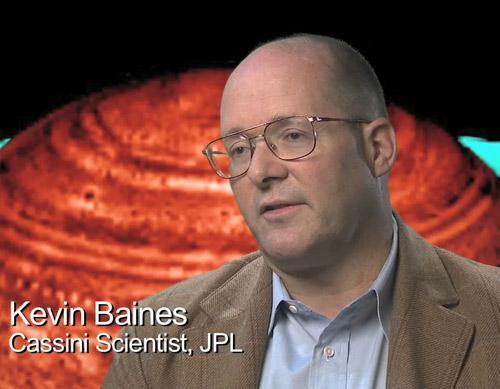
"It turns out that a major driver of Saturn's ionospheric environment and climate across vast reaches of the planet are ring particles located some 36,000 miles [60,000 kilometers] overhead," said
Kevin Baines, a co-author on the paper, based at
NASA's Jet Propulsion Laboratory, Pasadena, Calif.
"The ring particles affect both what species of particles are in this part of the atmosphere and where it is warm or cool."
In the early 1980s, images from
NASA's Voyager spacecraft showed two to three dark bands on Saturn, and scientists theorized that water could have been showering down into those bands from the rings.
Those bands were not seen again until this team observed the planet in near-infrared wavelengths with the W.M Keck Observatory on Mauna Kea, in Hawaii, in April 2011.
The effect was difficult to discern because it involves looking for a subtle emission from bright parts of Saturn.
It required an instrument like that on Keck, which can split up a large range of light.
The ring rain's effect occurs in Saturn's ionosphere, where charged particles are produced when the otherwise neutral atmosphere is exposed to a flow of energetic particles or solar radiation.
When the scientists tracked the pattern of emissions of a particular hydrogen ion with three protons (triatomic hydrogen), they expected to see a uniform planet-wide infrared glow.
What they observed instead was a series of light and dark bands -- with areas of reduced emission corresponding to water-dense portions of Saturn's rings and areas of high emission corresponding to gaps in the rings.
They surmised that charged water particles from the planet's rings were being drawn towards the planet along Saturn's magnetic field lines and were neutralising the glowing
triatomic hydrogen ions.
This leaves large "shadows" in what would otherwise be a planet-wide infrared glow. These shadows cover some 30 to 43 percent of the planet's upper atmosphere surface from around 25 to 55 degrees latitude.
This is a significantly larger area than suggested by images from
NASA's Voyager mission.
Both Earth and Jupiter have an equatorial region that glows very uniformly. Scientists expected this pattern at Saturn, too, but they instead saw dramatic differences at different latitudes.
Journal Reference:
J. O’Donoghue, T. S. Stallard, H. Melin, G. H. Jones, S. W. H. Cowley, S. Miller, K. H. Baines, J. S. D. Blake.
The domination of Saturn’s low-latitude ionosphere by ring ‘rain’. Nature, 2013; 496 (7444): 193
DOI: 10.1038/nature12049




 Posts


