Showing posts with label Keck II telescope. Show all posts

Thursday, August 7, 2014

Keck II telescope: Vast Stormy weather on Uranus

Massive storms on Uranus captured August 5 and 6, 2014 as seen by Keck II telescope. 

Both images were taken by Imke de Pater (UC Berkeley), Larry Sromovosky and Pat Fry (U. Wisconsin), and Heidi Hammel (AURA) using the near-infrared camera NIRC2 with adaptive optics on the 10-m Keck II telescope at a wavelength of 1.6 micron.

Weather on any planet can be quite unpredictable. As hurricanes threaten the Aloha State, astronomers working at W. M. Keck II telescope on the island of Hawaii were surprised by the appearance of gigantic swirling storm systems on the distant planet Uranus.

During the Voyager encounter with Uranus in 1986, only a scant handful of dim clouds were seen in its atmosphere.

When the planet approached equinox in 2007 (i.e., when the Sun stood high above its equator), large storms developed on the planet, yet most of these faded.

In the past few days, however, astronomers were surprised by a multitude of bright storms on the planet, including one monstrous feature.

"We are always anxious to see that first image of the night of any planet or satellite, as we never know what it might have in store for us," said Imke de Pater, professor at UC Berkeley and team leader.

"This extremely bright feature we saw on UT 6 August 2014 reminds me of a similarly bright storm we saw on Uranus's southern hemisphere during the years leading up to and at equinox".

"Even after years of observing, a new picture of Uranus from Keck II telescope can stop me in my tracks and make me say Wow!," said Heidi Hammel, a member of the observing team.

Since the 2007 equinox, Uranus's northern pole has been coming into view, and the south pole is no longer visible.

The bright feature de Pater refers to was known as the "Berg", because this feature was visible just below the polar haze, and resembled an iceberg peeled off an ice-shelf.

The Berg oscillated in latitude between southern latitudes of 32 and 36 degrees since 2000, and perhaps dated back to the Voyager era (1986).

In 2004 it became much brighter; in 2005 it started to migrate towards the equator and became a very powerful storm system.

In 2009, when it came to within a few degrees of the equator, it dissipated.

The present storm is even brighter than the Berg. Its morphology is rather similar, and the team expects it may also be tied to a vortex in the deeper atmosphere.

From near-infrared images taken at 2.2 micron, the team already determined that the storm must reach high altitudes; they will conduct calculations to determine the precise altitude, but based upon its brightness at those wavelengths the team expects it to reach altitudes near the tropopause (the boundary in Uranus's atmosphere between the troposphere and the stratosphere).

Tuesday, March 25, 2014

Keck Telescope: Nearest 'Standard Candle' Supernova in several decades

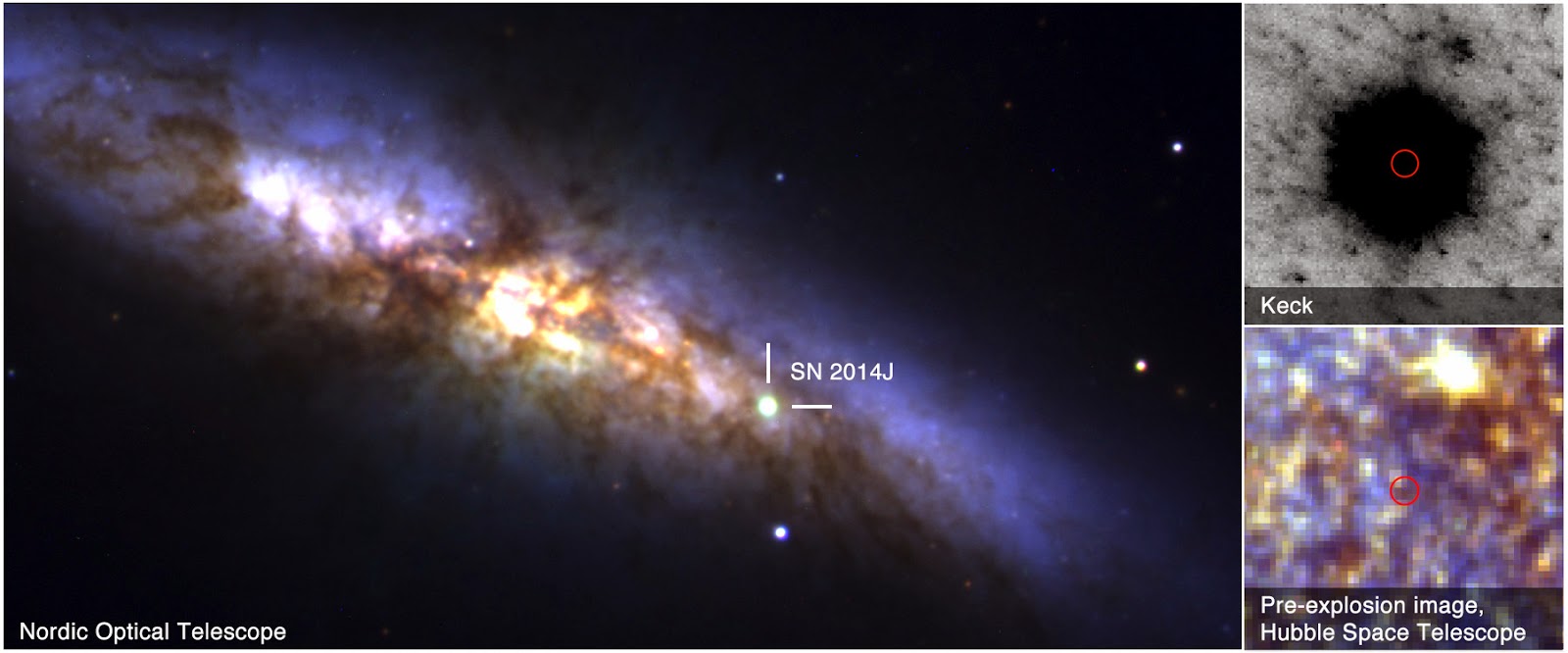
Composite image from the 2.5-meter Nordic Optical Telescope in La Palma showing SN2014J in the dusty cigar galaxy M82 (credits: J. Johansson). 

The right upper panel shows a detailed near-infrared image from the 10-meter Keck telecope in Hawaii used to accurately locate the site of the explosion. 

The bottom right panel indicates the position of the supernova on pre-explosion images from the Hubble Space Telescope. 

Credit: A. O’Conell and M. Mountain

Supernova SN2014J in the nearby cigar galaxy M82 -less than 12 million light-years away- exploded on January 14, 2014 and was the closest "standard candle" supernova since (at least) 42 years.

An impressive coordinated observational effort orchestrated by the intermediate Palomar Transient Factory (iPTF) team and led by Ariel Goobar from the Oskar Klein Centre at Stockholm University (Goobar et al. 2014, The Astrophysical Journal Letters, 784, L12) provides important new clues into the nature of these explosions, as well as the environments where they take place.

The proximity of SN2014J allowed the iPTF team to study this important class of stellar explosions, known as Type Ia supernovae, over a very wide wavelength range, starting just hours after the deduced explosion time.

Furthermore, Goobar and collaborators used pre-explosion images of the region of M82 where the supernova went off, both from the Hubble Space Telescope and from the Palomar Oschin Telescope, to search for a star in the location of the explosion, or possible earlier nova eruptions.

The lack of pre-explosion detections suggests that the supernova may have originated in the merging of compact faint objects, e.g., two white dwarf stars, i.e., the kind of Earth size stars that our sun will evolve to once it runs out of nuclear fuel.

"Until very recently, the leading model for standard candle supernovae was thought to include a companion star from which material was stripped by the white dwarf until the accumulated mass could no longer be sustained by the outwards pressure, leading to a runaway thermonuclear explosion."

"The observations of SN2014J are challenging for this theoretical picture", says Goobar.

Type Ia supernovae are among the best tools to measure cosmological distances. Thanks to their consistent peak brightness, these "standard candles" are used to map the expansion history of the Universe.

In 1998 distance measurements using supernovae lead to the a paradigm shift in cosmology and fundamental physics: the expansion of the Universe is speeding up, contrary to the expectations from the attractive nature of gravitational forces: a mysterious new cosmic component, "dark energy", has been invoked to explain this unexpected phenomenon. This discovery was awarded the 2011 Nobel Prize in physics.

Rahman Amanullah
"Since Type Ia supernovae are very rare, occurring only once every several hundred years in a galaxy like ours, there have been very few opportunities to study these explosions in great detail. SN2014J in the nearby galaxy M82 is a very welcome exception", says Rahman Amanullah a researcher at OKC.

A better understanding of the physics behind Type Ia supernovae and the material surrounding the explosion and dimming some of the light is crucial to further refine the measurements of the expansion history of the Universe.

Joel Johansson, a PhD student at OKC that played an essential role in the analysis fills in "many supernovae explode in clean environments, free of dust in the line of sight.

This is not the case for SN2014J, which gives us a unique opportunity to study both the properties of the supernova explosion but also of the intervening dust".

The lessons learned by the studies of SN2014J may be very useful for the analysis of the large Type Ia SN sample that scientists have collected over decades, especially the astrophysical corrections needed to make accurate distance estimates.

Only then may we be able to tell what is causing the accelerated expansion of the cosmos.

More information: iopscience.iop.org/2041-8205/784/1/L12/

Monday, March 3, 2014

SETI HEKTOR: Distant asteroid, a complex mini geological world

Artistic representation of the Trojan system showing the large 250 km dual shape Hektor and its 12 km moon. 

Credit: H. Marchis & F. Marchis

After 8 years of observations, scientists from the SETI Institute have found an exotic orbit for the largest Trojan asteroid, (624) Hektor, the only one known to possess a moon.

The formation of this system made of a dual primary and a small moon is still a mystery, but they found the asteroid could be a captured Kuiper body product of the reshuffling of giant planets in our solar system.

The results are being published today in Astrophysical Letters.

This study, based on W. M. Keck Observatory data and photometric observations from telescopes throughout the world, suggests that the asteroid and its moon are products of the collision of two icy asteroids.

This work sheds light on the complex youth of our solar system, when the building blocks that formed the core of Giant planets and their satellites were tossed around or captured during the giant planet migrations.

Franck Marchis
In 2006, a small team of astronomers led by Franck Marchis, astronomer at the Carl Sagan center of the SETI Institute, detected the presence of a small 12 km diameter moon around the large Trojan asteroid (624) Hektor using the 10 m Keck II telescope atop Mauna Kea, fitted with the NIRC-2 (Near-Infrared Camera 2) instrument behind the adaptive optics and laser guide star system (LGS-AO).

Since then, they collaborated with several researchers from University of California at Berkeley to determine the orbit of this moon and understand the origin of the system.

Trojan asteroids are those that are temporarily trapped in regions 60 degrees in front or 60 degrees behind the planet Jupiter in its orbit around the Sun. They are difficult to study since they are small and faint.

While the asteroid has been studied for 8 years, there were a couple of significant challenges before a paper could be published, according to Marchis.

"The major one was technical: the satellite can be seen only with a telescope like Keck Observatory's fitted with LSG-AO, but time on the mighty Keck's is highly prized and in limited availability," he said.

"Secondly, the orbit of the satellite is so bizarre that we had to develop a complex new algorithm to be able to pin it down and understand its stability over time."

The research, conducted with expert assistance from colleagues at the Institut de Mécanique Céleste et de Calcul des Éphémérides (IMCCE) of the Observatoire de Paris, revealed that the 12 km moon orbits the large 250 km asteroid every 3 days at a distance of 600 km in an ellipse inclined almost 45 degrees with respect to the asteroid's equator.

More Information: "The puzzling mutual orbit of the binary Trojan asteroid (624) Hektor" published today by ApJL is co-authored by F. Marchis (SETI Institute), J. Durech (Charles University), J. Castillo-Rogez (Jet Propulsion Laboratory), F. Vachier (IMCCE-Obs. De Paris), M. Cuk (SETI Institute), J. Berthier (IMCCE-Obs. De Paris), M.H. Wong (UC Berkeley), P. Kalas (UC Berkeley), G. Duchene (UC Berkeley), M. A. van Dam (Flat Wavefronts), H. Hamanowa (Hamanowa observatory)and M. Viikinkoski (Tampere University) arxiv.org/ftp/arxiv/papers/1402/1402.7336.pdf

Monday, January 20, 2014

Distant quasar illuminates a filament of the cosmic web

This deep image shows the nebula (cyan) extending across 2 million light-years that was discovered around the bright quasar UM287 (at the center of the image). 

The energetic radiation of the quasar makes the surrounding intergalactic gas glow, revealing the morphology and physical properties of a cosmic web filament.

The image was obtained at the W. M. Keck Observatory. 

Credit: S. Cantalupo, UC Santa Cruz

Astronomers have discovered a distant quasar illuminating a vast nebula of diffuse gas, revealing for the first time part of the network of filaments thought to connect galaxies in a cosmic web.

Researchers at the University of California, Santa Cruz, led the study, published January 19 in Nature.

Using the 10-meter Keck I Telescope at the W. M. Keck Observatory in Hawaii, the researchers detected a very large, luminous nebula of gas extending about 2 million light-years across intergalactic space.

Sebastiano Cantalupo
"This is a very exceptional object: it's huge, at least twice as large as any nebula detected before, and it extends well beyond the galactic environment of the quasar," said first author Sebastiano Cantalupo, a postdoctoral fellow at UC Santa Cruz.

The standard cosmological model of structure formation in the universe predicts that galaxies are embedded in a cosmic web of matter, most of which (about 84 percent) is invisible dark matter.

This web is seen in the results from computer simulations of the evolution of structure in the universe, which show the distribution of dark matter on large scales, including the dark matter halos in which galaxies form and the cosmic web of filaments that connect them.

Gravity causes ordinary matter to follow the distribution of dark matter, so filaments of diffuse, ionized gas are expected to trace a pattern similar to that seen in dark matter simulations.

Until now, however, these filaments have never been seen. Intergalactic gas has been detected by its absorption of light from bright background sources, but those results don't reveal how the gas is distributed.

In this study, the researchers detected the fluorescent glow of hydrogen gas resulting from its illumination by intense radiation from the quasar.

Computer simulations suggest that matter in the universe is distributed in a "cosmic web" of filaments, as seen in the image above from a large-scale dark-matter simulation (Bolshoi simulation, by Anatoly Klypin and Joel Primack). 

The inset is a zoomed-in, high-resolution image of a smaller part of the cosmic web, 10 million light-years across, from a simulation that includes gas as well as dark matter (credit: S. Cantalupo). 

The intense radiation from a quasar can, like a flashlight, illuminate part of the surrounding cosmic web (highlighted in the image) and make a filament of gas glow, as was observed in the case of quasar UM287. 

Credit: Background image: A. Klypin and J. Primack; Inset: S. Cantalupo

J. Xavier Prochaska
"This quasar is illuminating diffuse gas on scales well beyond any we've seen before, giving us the first picture of extended gas between galaxies. It provides a terrific insight into the overall structure of our universe," said co-author J. Xavier Prochaska, professor of astronomy and astrophysics at UC Santa Cruz.

The hydrogen gas illuminated by the quasar emits ultraviolet light known as Lyman alpha radiation.


The distance to the quasar is so great (about 10 billion light-years) that the emitted light is "stretched" by the expansion of the universe from an invisible ultraviolet wavelength to a visible shade of violet by the time it reaches the Keck Telescope.

Knowing the distance to the quasar, the researchers calculated the wavelength for Lyman alpha radiation from that distance and built a special filter for the telescope's LRIS spectrometer to get an image at that wavelength.

More information: Paper: doi.org/10.1038/nature12898

Thursday, November 14, 2013

Medium sized Kuiper belt object less dense than water

Observations of the 2002 UX25 system with HST/HRC and Keck LGS-AO/NIRC2. 

The northward orientation arrow is 0.25 arcseconds long, for scale. 

In the first column, we show the image of both 2002 UX25 and its satellite. 

Credit: arXiv:1311.0553 

Michael Brown, a planetary scientist with California Institute of Technology, has found a medium sized object in the Kuiper belt (dubbed 2002 UX25) that doesn't appear to conform to theories of how such objects came to exist.

Michael Brown
In his paper to be published in Astrophysical Journal Letters, Brown notes that the mid-sized object appears to be less dense than it should be if it followed conventional thinking that suggests the larger the objects are in the belt, the more dense they should get.

The Kuiper belt, is of course, a group of rock-like objects (comets, dwarf planets, etc.) orbiting the sun that lie farther out than Neptune.

Such Kuiper belt objects (KBOs) are believed to have formed in ways similar to the way planets did, i.e. due to accretion of material over time.

Conventional theory suggests that small KBOs are less dense than water because of their porous nature—large KBOs grew more dense as they grew larger due to gravity causing them to compact.

If the theory is correct medium size KBOs should have medium density. But this new KBO that Brown has found doesn't conform to the theory at all, instead, its density is roughly the same as smaller KBOs, suggesting that it's not size that determines KBO density, but something else. And right now, Brown notes, nobody knows what that something else might be.

12 minute exposure of dwarf planet candidate (55637) 2002 UX25 with a 24" telescope.

2002 UX25 has a diameter of roughly 650 kilometers, putting it squarely in the mid-size KBO category, and it, like other KBOs, is believed to exist in very nearly the same state it's held since the formation of the solar system.

It's in studying such objects that scientists learn more about how everything in our solar system came to be the way it is.

Until now, most scientists agreed that KBOs of a size smaller than 350 kilometers across had a density less than that of water, whereas bigger ones had a greater density.

That theory might have to be changed however as 2002 UX25 is the first medium sized KBO to have its density measured and it clearly doesn't conform.

The discovery of 2002 UX25's density properties has already led to new theories, Brown notes, with some suggesting that scientists have been wrong to assume that KBOs and the planets formed at the same time.

Instead, they suggest, that it's possible that KBOs came first and afterwards as the planets were forming, eddies formed causing KBOs to knock into one another breaking them into different sized pieces.

More information: The density of mid-sized Kuiper belt object 2002 UX25 and the formation of the dwarf planets, arxiv.org/abs/1311.0553

Thursday, October 24, 2013

Hubble and Keck: Most Distant Galaxy (so far) revealed

z8_GND_5296 is churning out stars at a remarkable rate, say astronomers

An international team of astronomers has detected the most distant galaxy yet.

The galaxy is about 30 billion light-years away and is helping scientists shed light on the period that immediately followed the Big Bang.

It was found using the Hubble Space Telescope and its distance was then confirmed with the ground-based Keck Observatory in Hawaii.

The study is published in the journal Nature.

Because it takes light so long to travel from the outer edge of the Universe to us, the galaxy appears as it was 13.1 billion years ago (its distance from Earth of 30 billion light-years is because the Universe is expanding).

Steven Finkelstein
Lead researcher Steven Finkelstein, from the University of Texas at Austin, US, said: "This is the most distant galaxy we've confirmed. We are seeing this galaxy as it was 700 million years after the Big Bang."

The far-off galaxy goes by the catchy name of z8_GND_5296.

Astronomers were able to measure how far it was from Earth by analysing its colour.

Because the Universe is expanding and everything is moving away from us, light waves are stretched. This makes objects look redder than they actually are.

Astronomers rate this apparent colour-change on a scale that is called redshift.

They found that this galaxy has a redshift of 7.51, beating the previous record-holder, which had a redshift of 7.21.

This makes it the most distant galaxy ever found.

The system is small: about 1-2% the mass of the Milky Way and is rich in heavier elements.

But it has a surprising feature: it is turning gas and dust into new stars at a remarkable rate, churning them out hundreds of times faster than our own galaxy can.

It is the second far-flung galaxy known that has been found to have a high star-production rate.

Prof Finkelstein said: "One very interesting way to learn about the Universe is to study these outliers and that tells us something about what sort of physical processes are dominating galaxy formation and galaxy evolution.

"What was great about this galaxy is not only is it so distant, it is also pretty exceptional."

He added that in the coming years, astronomers are likely to discover even more distant galaxies when Nasa's James Webb Space Telescope (JWST) is launched and other ground-based telescopes come online.

Monday, August 26, 2013

Major volcanic eruption seen on Jupiter's moon Io

Voyager 1 acquired this image of Io on March 4, 1979. An enormous volcanic explosion can be seen silhouetted against dark space over Io’s bright limb. 

Credit: NASA/JPL

Recent observations of Jupiter's moon Io has revealed a massive volcanic eruption taking place 628,300,000 km (390,400,000 miles) from Earth. Io, the innermost of the four largest moons around Jupiter, is the most volcanically active object in the Solar System with about 240 active regions.

But this new one definitely caught the eye of Dr. Imke de Pater, Professor of Astronomy and of Earth and Planetary Science at the University of California in Berkeley.

She was using the Keck II telescope on Mauna Kea in Hawaii on August 15, 2013 when it immediately became apparent something big was happening at Io.

"When you are right at the telescope and see the data, this is something you can see immediately, especially with a big eruption like that," de Pater told reporters.

de Pater said this eruption is one of the top 10 most powerful eruptions that have been seen on this moon.

"It is a very energetic eruption that covers over a 30 square kilometer area," she said.

"For Earth, that is big, and for Io it is very big too. It really is one of the biggest eruptions we have seen."

She added the new volcano appears to have a large energy output. "We saw a big eruption in 2001, which was in the Surt region, which is well known as the biggest one anyone has ever seen," she said.

"For this one, the total energy is less but per square meter, it is bigger than the one in 2001, so it is very powerful."

While Io's eruptions can't be seen directly from Earth,infrared cameras on the Keck telescope (looking between 1 and 5 microns) have been able to ascertain there are likely fountains of lava gushing from fissures in the Rarog Patera region of Io, aptly named for a Czech fire deity.

While many regions of Io are volcanically active, de Pater said she's not been able to find any other previous activity that has been reported in the Rarog Patera area, which the team finds very interesting.

Ashley Davies of NASA's Jet Propulsion Laboratory in Pasadena, California and a member of the observing team told reporters that Rarog Patera was identified as a small, relatively innocuous hot spot previously in Galileo PPR data and possibly from Earth, but at a level way, way below what was seen on August 15, and reported in New Scientist.

de Pater and other astronomers will be taking more data soon with Keck and perhaps more telescopes to try and find out more about this massive eruption.

"We never know about eruptions – they can last hours, days months or years, so we have no idea how long it will stay active," she said, "but we are very excited about it."

No data or imagery has been released on the new eruption yet since the team is still making their observations and will be writing a paper on this topic.

Scientists think a gravitational tug-of-war with Jupiter is one cause of Io's intense vulcanism.

Thursday, April 11, 2013

Saturn's Rings: Charged Water Particles Falling like Rain

This artist's concept illustrates how charged water particles flow into the Saturnian atmosphere from the planet's rings, causing a reduction in atmospheric brightness. 

The observations were made with the W.M. Keck Observatory on Mauna Kea, Hawaii, with NASA funding. 

The analysis was led by the University of Leicester, England. 

Credit: NASA /JPL-Caltech /Space Science Institute /University of Leicester

A new study tracks the "rain" of charged water particles into the atmosphere of Saturn and finds there is more of it and it falls across larger areas of the planet than previously thought.

The study, whose observations were funded by NASA and whose analysis was led by the University of Leicester, in the UK, reveals that the rain influences the composition and temperature structure of parts of Saturn's upper atmosphere.

The paper appears in this week's issue of the journal Nature.

"Saturn is the first planet to show significant interaction between its atmosphere and ring system," said James O'Donoghue, the paper's lead author and a postgraduate researcher at Leicester.

"The main effect of ring rain is that it acts to 'quench' the ionosphere of Saturn. In other words, this rain severely reduces the electron densities in regions in which it falls."

O'Donoghue explains that the ring's effect on electron densities is important because it explains why, for many decades, observations have shown those densities to be unusually low at certain latitudes on Saturn.

The study also helps scientists better understand the origin and evolution of Saturn's ring system and changes in the planet's atmosphere.

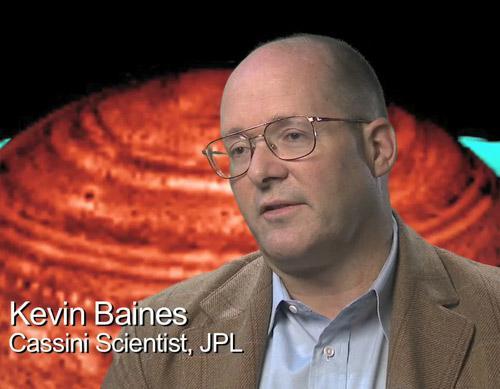
"It turns out that a major driver of Saturn's ionospheric environment and climate across vast reaches of the planet are ring particles located some 36,000 miles [60,000 kilometers] overhead," said Kevin Baines, a co-author on the paper, based at NASA's Jet Propulsion Laboratory, Pasadena, Calif.

"The ring particles affect both what species of particles are in this part of the atmosphere and where it is warm or cool."

In the early 1980s, images from NASA's Voyager spacecraft showed two to three dark bands on Saturn, and scientists theorized that water could have been showering down into those bands from the rings.

Those bands were not seen again until this team observed the planet in near-infrared wavelengths with the W.M Keck Observatory on Mauna Kea, in Hawaii, in April 2011.

The effect was difficult to discern because it involves looking for a subtle emission from bright parts of Saturn.

It required an instrument like that on Keck, which can split up a large range of light.

The ring rain's effect occurs in Saturn's ionosphere, where charged particles are produced when the otherwise neutral atmosphere is exposed to a flow of energetic particles or solar radiation.

When the scientists tracked the pattern of emissions of a particular hydrogen ion with three protons (triatomic hydrogen), they expected to see a uniform planet-wide infrared glow.

What they observed instead was a series of light and dark bands -- with areas of reduced emission corresponding to water-dense portions of Saturn's rings and areas of high emission corresponding to gaps in the rings.

They surmised that charged water particles from the planet's rings were being drawn towards the planet along Saturn's magnetic field lines and were neutralising the glowing triatomic hydrogen ions.

This leaves large "shadows" in what would otherwise be a planet-wide infrared glow. These shadows cover some 30 to 43 percent of the planet's upper atmosphere surface from around 25 to 55 degrees latitude.

This is a significantly larger area than suggested by images from NASA's Voyager mission.

Both Earth and Jupiter have an equatorial region that glows very uniformly. Scientists expected this pattern at Saturn, too, but they instead saw dramatic differences at different latitudes.

Journal Reference:
J. O’Donoghue, T. S. Stallard, H. Melin, G. H. Jones, S. W. H. Cowley, S. Miller, K. H. Baines, J. S. D. Blake. The domination of Saturn’s low-latitude ionosphere by ring ‘rain’. Nature, 2013; 496 (7444): 193 DOI: 10.1038/nature12049

Wednesday, October 17, 2012

Uranus: Keck observations brings weather into sharp focus

A paired picture of Uranus, the sharpest, most detailed picture of the distant planet to date, reveals a raft of new details about the planet's enigmatic atmosphere. 

The north pole of Uranus (to the right in the picture) is characterised by a swarm of storm-like convective features, and an unusual scalloped pattern of clouds encircles the planet's equator. 

The infrared image was taken using the Keck II telescope in Hawaii. 

Credit: Lawrence Sromovsky, Pat Fry, Heidi Hammel, Imke de Pater

In 1986, when Voyager swept past Uranus, the probe's portraits of the planet were "notoriously bland," disappointing scientists, yielding few new details of the planet and its atmosphere, and giving it a reputation as the most boring planet of the solar system.

Now, however, thanks to a new technique applied at the Keck Observatory, Uranus is coming into sharp focus through high-resolution infrared images, revealing in incredible detail the bizarre weather of the seventh planet from the sun.

The images were released in Reno, Nev. today (Oct. 17, 2012) at a meeting of the American Astronomical Society's Division of Planetary Sciences and provide the best look to date of Uranus's complex and enigmatic weather.

The planet's deep blue-green atmosphere is thick with hydrogen, helium and methane, Uranus's primary condensable gas.

Larry Sromovsky
Winds blow mainly east to west at speeds up to 560 miles per hour, in spite of the small amounts of energy available to drive them.

Its atmosphere is almost equal to Neptune's as the coldest in our solar system with cloud-top temperatures in the minus 360-degree Fahrenheit range, cold enough to freeze methane.

Large weather systems, which are probably much less violent than the storms we know on Earth, behave in bizarre ways on Uranus, explains Larry Sromovsky, a University of Wisconsin-Madison planetary scientist who led the new study using the Keck II telescope.

"Some of these weather systems," Sromovsky notes, "stay at fixed latitudes and undergo large variations in activity. Others are seen to drift toward the planet's equator while undergoing great changes in size and shape. Better measures of the wind fields that surround these massive weather systems are the key to unraveling their mysteries."


Imke de Pater
To get a better picture of atmospheric flow on Uranus, Sromovsky and colleagues Pat Fry, also of UW-Madison, Heidi Hammel of the Association of Universities for Research in Astronomy (AURA), and Imke de Pater of the University of California at Berkeley, used new infrared techniques to detect smaller, more widely distributed weather features whose movements can help scientists trace the planet's pattern of blustery winds.

"We're seeing some new things that before were buried in the noise," says Sromovsky, a senior staff scientist at UW-Madison's Space Science and Engineering Center.


Heidi Hammel
"My first reaction to these images was 'wow' and then my second reaction was WOW," says AURA's Heidi Hammel, a co-investigator on the new observations and an expert on the atmospheres of the solar system's outer planets.

"These images reveal an astonishing amount of complexity in Uranus's atmosphere. We knew the planet was active, but until now much of the activity was masked by noise in our data."

The complexity of Uranus's weather is puzzling, Sromovsky explains. The primary driving mechanism must be solar energy because there is no detectable internal energy source.

"But the sun is 900 times weaker there than on Earth because it is 30 times further from the sun, so you don't have the same intensity of solar energy driving the system," explains Sromovsky.

"Thus the atmosphere of Uranus must operate as a very efficient machine with very little dissipation. Yet the weather variations we see seem to defy that requirement."

The new Keck II pictures of the planet, according to Sromovsky, are the "most richly detailed views of Uranus yet obtained by any instrument on any observatory.

No other telescope could come close to producing this result." Sromovsky and his colleagues used Keck II, located on the summit of Hawaii's 14,000-foot extinct volcano Mauna Kea, to capture a series of images that, when combined, help increase the signal to noise ratio and thus tease out weather features that are otherwise obscured.

In two nights of observing under superb conditions, Sromovsky's group was able to obtain exposures of the planet that provide a clear view of the planet's cloudy features, including several new to science.

The group used two different filters in an effort to characterize cloud features at different altitudes. "The main objective was to find a larger number of cloud features by detecting those that were previously too subtle to be seen, so we could better define atmospheric motions," Sromovsky notes.

New features found by the Wisconsin group include a scalloped band of clouds just south of Uranus's equator and a swarm of small convective features in the north polar regions of the planet, features that have never been seen in the southern polar regions.

"This is a very asymmetric situation," says the Wisconsin scientist. "There is certainly something different going on in those two polar regions." One possible explanation, is that methane is pushed north by an atmospheric conveyor belt toward the pole where it wells up to form the convective features observed by Sromovsky's group.

"The 'popcorn' appearance of Uranus's pole reminds me very much of a Cassini image of Saturn," adds de Pater.

Read more here