Showing posts with label Nearest. Show all posts

Wednesday, May 7, 2014

LAMOST: Nearest bright 'hypervelocity star' found: Speeding at 1 million mph

This is an astrophysicist-artist's conception of a hypervelocity star speeding away from the visible part of a spiral galaxy like our Milky Way and into the invisible halo of mysterious "dark matter" that surrounds the galaxy's visible portions. 

University of Utah researcher Zheng Zheng and colleagues in the US and China discovered the closest bright hypervelocity star yet found. 

Credit: Ben Bromley, University of Utah.

A University of Utah-led team discovered a "hypervelocity star" that is the closest, second-brightest and among the largest of 20 found so far.

Speeding at more than 1 million mph, the star may provide clues about the supermassive black hole at the center of our Milky Way and the halo of mysterious "dark matter" surrounding the galaxy, astronomers say.

Zheng Zheng
"The hypervelocity star tells us a lot about our galaxy, especially its center and the dark matter halo," says Zheng Zheng, an assistant professor of physics and astronomy and lead author of the study published recently in Astrophysical Journal Letters by a team of U.S. and Chinese astronomers.

"We can't see the dark matter halo, but its gravity acts on the star," Zheng says.

"We gain insight from the star's trajectory and velocity, which are affected by gravity from different parts of our galaxy."

In the past decade, astronomers have found about 20 of these odd stars.

Hypervelocity star appear to be remaining pairs of binary stars that once orbited each other and got too close to the supermassive black hole at the galaxy's center.

Intense gravity from the black hole – which has the mass of 4 million stars like our sun – captures one star so it orbits the hole closely, and slingshots the other on a trajectory headed beyond the galaxy.

Zheng and his colleagues discovered the new hypervelocity star while conducting other research into stars with the Large Sky Area Multi-Object Fiber Spectroscopic Telescope, (LAMOST), also called the Guo Shou Jing Telescope is located at the Xinglong Observing Station of the National Astronomical Observatories of China, about 110 miles northeast of Beijing.

LAMOST boasts a 13.1-foot-wide aperture and houses 4,000 optical fibers, which capture "spectra" or light-wavelength readings from as many as 4,000 stars at once. A star's spectrum reveals information about its velocity, temperature, luminosity and size.

LAMOST's main purpose is to study the distribution of stars in the Milky Way, and thus the galaxy's structure.

The new hypervelocity star, named LAMOST-HVS1, stood out because its speed is almost three times the usual star's 500,000-mph pace through space: 1.4 million mph relative to our solar system.

Its speed is about 1.1 million mph relative to the speed of the center of the Milky Way.

Despite being the closest hypervelocity star, it nonetheless is 249 quadrillion miles from Earth. (In U.S. usage, a quadrillion is 1,000,000,000,000,000 miles or 10 to the 15th power, or 1 million billion).

"If you're looking at a herd of cows, and one starts going 60 mph, that's telling you something important," says Ben Bromley, a University of Utah physics and astronomy professor who was not involved with Zheng's study.

"You may not know at first what that is but for hypervelocity stars, one of their mysteries is where they come from – and the massive black hole in our galaxy is implicated."

Background perspective

Our solar system is roughly 26,000 light years or 153 quadrillion miles from the centre of the galaxy, more than halfway out from the centre of the visible disk.

By comparison, the new hypervelocity star is about 62,000 light years or 364 quadrillion miles from the galactic centre, beyond as well as above the galaxy's visible disk.

It is about 42,400 light years from Earth, or about 249 quadrillion miles away.

As far as that is, the star has a magnitude of about 13, or 630 times fainter than stars that barely can be seen with the naked eye, it nevertheless "is the nearest, second-brightest, and one of the three most massive hypervelocity stars discovered so far," Zheng says.

It is nine times more massive than our sun, which makes it very similar to another hypervelocity star known as HE 0437-5439, discovered in 2005, and both are smaller than HD 271791, which was discovered in 2008 and is 11 times more massive than the sun.

As seen from Earth, only HD 271791 is brighter than LAMOST-HVS1, Zheng says.

The newly discovered hypervelocity star also outshines our own sun: It is four times hotter and about 3,400 times brighter (if viewed from the same distance), but compared with our 4.6-billion-year-old sun, the newly discovered LAMOST–HVS1 is a youngster born only 32 million years ago, based on its speed and position, Zheng says.

Tuesday, March 25, 2014

Keck Telescope: Nearest 'Standard Candle' Supernova in several decades

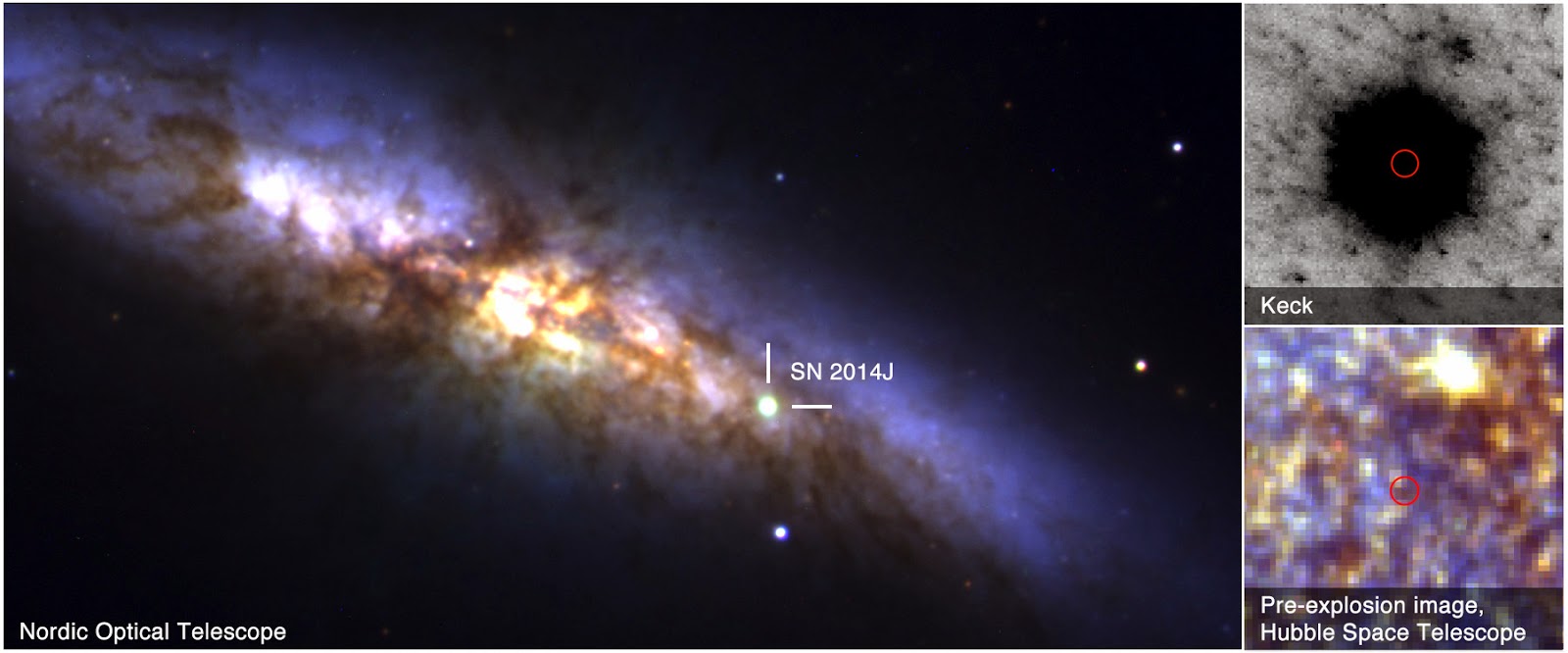
Composite image from the 2.5-meter Nordic Optical Telescope in La Palma showing SN2014J in the dusty cigar galaxy M82 (credits: J. Johansson). 

The right upper panel shows a detailed near-infrared image from the 10-meter Keck telecope in Hawaii used to accurately locate the site of the explosion. 

The bottom right panel indicates the position of the supernova on pre-explosion images from the Hubble Space Telescope

Credit: A. O’Conell and M. Mountain

Supernova SN2014J in the nearby cigar galaxy M82 -less than 12 million light-years away- exploded on January 14, 2014 and was the closest "standard candle" supernova since (at least) 42 years.

An impressive coordinated observational effort orchestrated by the intermediate Palomar Transient Factory (iPTF) team and led by Ariel Goobar from the Oskar Klein Centre at Stockholm University (Goobar et al. 2014, The Astrophysical Journal Letters, 784, L12) provides important new clues into the nature of these explosions, as well as the environments where they take place.

The proximity of SN2014J allowed the iPTF team to study this important class of stellar explosions, known as Type Ia supernovae, over a very wide wavelength range, starting just hours after the deduced explosion time.

Furthermore, Goobar and collaborators used pre-explosion images of the region of M82 where the supernova went off, both from the Hubble Space Telescope and from the Palomar Oschin Telescope, to search for a star in the location of the explosion, or possible earlier nova eruptions.

The lack of pre-explosion detections suggests that the supernova may have originated in the merging of compact faint objects, e.g., two white dwarf stars, i.e., the kind of Earth size stars that our sun will evolve to once it runs out of nuclear fuel.

"Until very recently, the leading model for standard candle supernovae was thought to include a companion star from which material was stripped by the white dwarf until the accumulated mass could no longer be sustained by the outwards pressure, leading to a runaway thermonuclear explosion."

"The observations of SN2014J are challenging for this theoretical picture", says Goobar.

Type Ia supernovae are among the best tools to measure cosmological distances. Thanks to their consistent peak brightness, these "standard candles" are used to map the expansion history of the Universe.

In 1998 distance measurements using supernovae lead to the a paradigm shift in cosmology and fundamental physics: the expansion of the Universe is speeding up, contrary to the expectations from the attractive nature of gravitational forces: a mysterious new cosmic component, "dark energy", has been invoked to explain this unexpected phenomenon. This discovery was awarded the 2011 Nobel Prize in physics.

Rahman Amanullah
"Since Type Ia supernovae are very rare, occurring only once every several hundred years in a galaxy like ours, there have been very few opportunities to study these explosions in great detail. SN2014J in the nearby galaxy M82 is a very welcome exception", says Rahman Amanullah a researcher at OKC.

A better understanding of the physics behind Type Ia supernovae and the material surrounding the explosion and dimming some of the light is crucial to further refine the measurements of the expansion history of the Universe.

Joel Johansson, a PhD student at OKC that played an essential role in the analysis fills in "many supernovae explode in clean environments, free of dust in the line of sight.

This is not the case for SN2014J, which gives us a unique opportunity to study both the properties of the supernova explosion but also of the intervening dust".

The lessons learned by the studies of SN2014J may be very useful for the analysis of the large Type Ia SN sample that scientists have collected over decades, especially the astrophysical corrections needed to make accurate distance estimates.

Only then may we be able to tell what is causing the accelerated expansion of the cosmos.

More information: iopscience.iop.org/2041-8205/784/1/L12/

Thursday, January 23, 2014

Nearest supernova in 27 years explodes in M82 galaxy

Credit: UCL/University of London Observatory/Steve Fossey/Ben Cooke/Guy Pollack/Matthew Wilde/Thomas Wright

A supernova has been spotted in the constellation Ursa Major (between the Big and Little Dipper in the night sky) in the M82 galaxy (affectionately known as the cigar galaxy) by a team of students at University College London.

The discovery was posted on the (CBAT) Central Bureau's Transient Object Confirmation Page which led to follow-up observations by other teams around the world.

It's real, and not only is it bright enough for amateur astronomer's to view, but it's the closet known supernova explosion since 1987.

Initial study has revealed the supernova to be classified as 1a, the type described by astronomers as "standard candles" because their brightness is uniform enough to allow for using them to measure distances across the universe.

Sometimes they start out as a white dwarf, pulling in material from around them until they reach a critical mass and explode. Other times they are the result of two such stars (binaries) colliding.

What's perhaps most exciting about this newest observation is that it's so close (just 11.4 million light years from us) that it's likely that images of the star that exploded have been previously recorded by different telescopes around the globe which means scientists might be able to watch the process that led to the supernova occurring, something that has never been seen before.

If that turns out to be the case, other space researchers note, the stage could be set for allowing for reducing uncertainties in measuring dark energy—standard candle observations are the means by which such theories first came to exist after all.

Also, while the explosion has undoubtedly unleashed a torrent of neutrinos, its unlikely monitors here on Earth will notice much of an uptic in activity due to distance and them getting lost in other sources.

Because of the timing of the discovery, it appears that there is more to come—it's going to get brighter over the next few days before growing dimmer and dimmer, eventually fading to black.

That means that anyone wishing to observe a supernova as its happening can do so—likely a once in a lifetime opportunity. Binoculars should be enough, though a telescope would be much better.

Universe Today has published a map to help those looking find it.

More information: www.astronomerstelegram.org/ remanzacco.blogspot.nl/2014/

Friday, April 26, 2013

'Albertus Alauda': Nearest Alien Planet Gets New Name


The closest known alien planet beyond our solar system has a new unofficial name: Albertus Alauda.

That moniker won an online people's choice contest organized by space-funding company Uwingu to choose a more exciting, approachable name for the Earth-size alien planet Alpha Centauri Bb, a scorching-hot world that lies just 4.3 light-years away.

Jay Lark, who nominated "Albertus Alauda," said he chose the exoplanet name to honour his late grandfather.

"It is his name in Latin (Albert Lark)," Jay Lark wrote in his submission to the contest. "My grandfather passed away after a lengthy and valiant battle with cancer; his name in Latin means noble or bright and to praise or extol.

I think this is an apt description as my grandfather was a noble man and bright of character, and in this nomination I wish to honour (extol) him."

The Alpha Centauri Bb naming contest ran from March 19 through April 22. Proposing a name cost $4.99, while voting for one cost $0.99.

Uwingu (whose name means "sky" in Swahili) will use the proceeds to fund grants in space exploration, education and research, which is the company's chief purpose, officials said.

"Albertus Alauda" came out on top with 751 votes, scoring Jay Lark a commemorative plaque, a 12-month subscription to Astronomy Magazine, a shout-out on the Uwingu website and a phone call from Uwingu CEO (and former NASA science chief) Alan Stern and famed planet-hunter Geoff Marcy, an adviser for the company.

"Rakhat" and "Caleo" came in second and third place, garnering 684 and 622 votes, respectively.

The contest found its way into the headlines two weeks ago, after the International Astronomical Union issued a press release stressing its authority as the sole arbiter of the exoplanet-naming process and reminding readers that it's impossible to buy an "official" name.

While Uwingu wasn't mentioned by name, the release seemed aimed at the Alpha Centauri Bb competition.

Stern and other Uwingu officials fought back, saying the company had always maintained that the contest aimed to pick a popular or common name, not an "official" IAU one.