Showing posts with label Major. Show all posts

Saturday, April 26, 2014

NASA SDO: Sun Unleashes Major X1.3 Class Solar Flare - Video


The sun erupted with a massive solar flare late Thursday (April 24), triggering a temporary communications blackout on some parts of Earth.

The powerful flare peaked at 8:27 p.m. EDT Thursday (0027 April 25 GMT), and ranked as an X1.3-class solar storm, one of the strongest types of flares the sun can experience, according to a report from the U.S. Space Weather Prediction Center (SWPC).

NASA's Solar Dynamics Observatory captured video of the intense solar flare in several difference wavelengths.

The solar flare erupted from an active sunspot region known as Region 2035 located on the far western side (or limb) of the sun as seen from Earth.

Because of its position, the flare sparked a high-frequency radio blackout for about an hour on the daytime side of Earth, most likely over the Pacific Ocean and Eastern Pacific Rim, according to the SWPC update.

An X1.3-class solar flare (far right) erupts from the surface of the sun on April 24, 2014 EDT (April 25 GMT).

Credit: NASA /Solar Dynamics Observatory

"Region 2035 is rotating out of view and won't pose any danger for much longer, but could in the immediate future," SWPC officials wrote in the update.

When aimed directly at Earth, X-class solar flares can endanger astronauts in space, as well as interfere with communications and navigation satellites in orbit.

The most powerful X-class flares can also affect power grids and other infrastructure on the Earth.

Thursday's solar flare was the fourth X-class solar flare of 2014. It followed an X1.2 solar flare on Jan. 7, a monster X4.9 solar flare on Feb. 24, as well as an X1 solar flare on March 29.

Monday, August 26, 2013

Major volcanic eruption seen on Jupiter's moon Io

Voyager 1 acquired this image of Io on March 4, 1979. An enormous volcanic explosion can be seen silhouetted against dark space over Io’s bright limb. 

Credit: NASA/JPL

Recent observations of Jupiter's moon Io has revealed a massive volcanic eruption taking place 628,300,000 km (390,400,000 miles) from Earth. Io, the innermost of the four largest moons around Jupiter, is the most volcanically active object in the Solar System with about 240 active regions.

But this new one definitely caught the eye of Dr. Imke de Pater, Professor of Astronomy and of Earth and Planetary Science at the University of California in Berkeley.

She was using the Keck II telescope on Mauna Kea in Hawaii on August 15, 2013 when it immediately became apparent something big was happening at Io.

"When you are right at the telescope and see the data, this is something you can see immediately, especially with a big eruption like that," de Pater told reporters.

de Pater said this eruption is one of the top 10 most powerful eruptions that have been seen on this moon.

"It is a very energetic eruption that covers over a 30 square kilometer area," she said.

"For Earth, that is big, and for Io it is very big too. It really is one of the biggest eruptions we have seen."

She added the new volcano appears to have a large energy output. "We saw a big eruption in 2001, which was in the Surt region, which is well known as the biggest one anyone has ever seen," she said.

"For this one, the total energy is less but per square meter, it is bigger than the one in 2001, so it is very powerful."

While Io's eruptions can't be seen directly from Earth,infrared cameras on the Keck telescope (looking between 1 and 5 microns) have been able to ascertain there are likely fountains of lava gushing from fissures in the Rarog Patera region of Io, aptly named for a Czech fire deity.

While many regions of Io are volcanically active, de Pater said she's not been able to find any other previous activity that has been reported in the Rarog Patera area, which the team finds very interesting.

Ashley Davies of NASA's Jet Propulsion Laboratory in Pasadena, California and a member of the observing team told reporters that Rarog Patera was identified as a small, relatively innocuous hot spot previously in Galileo PPR data and possibly from Earth, but at a level way, way below what was seen on August 15, and reported in New Scientist.

de Pater and other astronomers will be taking more data soon with Keck and perhaps more telescopes to try and find out more about this massive eruption.

"We never know about eruptions – they can last hours, days months or years, so we have no idea how long it will stay active," she said, "but we are very excited about it."

No data or imagery has been released on the new eruption yet since the team is still making their observations and will be writing a paper on this topic.

Scientists think a gravitational tug-of-war with Jupiter is one cause of Io's intense vulcanism.

Monday, May 13, 2013

Major X1.7-Class Solar Flare Erupts from the Sun - Strongest of 2013


The sun unleashed a colossal Mother's Day solar flare on Sunday (May 12) in what has become the most powerful solar eruption of the year.

The giant solar flare, which registered as one of the largest eruptions the sun can unleash, peaked Sunday night at 10:17 p.m. EDT (0217 GMT) and was captured on camera by NASA's Solar Dynamics Observatory.

It sparked an hour-long high-frequency radio blackout, according to the Space Weather Prediction Center (SWPC) overseen by the National Oceanic and Atmospheric Administration (NOAA).

Sunday's solar flare registered as an X1.7-class sun eruption — the strongest type of solar flare the sun can fire off, according to the SWPC officials.


A close-up of an an X1.7-class solar flare on May 12, 2013 as seen by NASA's Solar Dynamics Observatory.

When aimed directly at Earth, X-class solar flares can pose a risk to astronauts and satellites in orbit, as well as interfere with communications and GPS signals on the ground.

They can also super-charge Earth's northern lights displays by bombarding the planet with solar particles, triggering awesome aurora light shows.

Monday, February 18, 2013

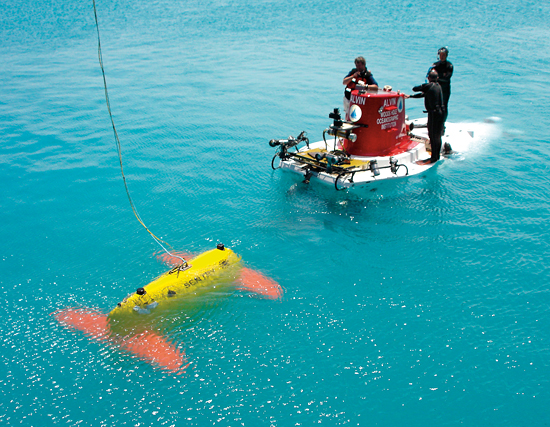
Alvin (HOV) Submersible Gets back in the Water after Major Re-Fit


Credit: Woods Hole Oceanographic Institution (WHOI)

One of the giants of ocean science, the HOV Alvin deep-submersible, is almost ready to get back in the water after a $41m (£26.5m) refit.


The upgrade is intended to enable the 49-year-old vehicle to go 2,000m deeper, although some additional work will be required to achieve this goal.

Project manager Kurt Uetz and Alvin pilot Mike Skowronski proudly provide a sneak peek at the refitted sub a month before it goes back in the water.


The new WHOI Sentry autonomous underwater vehicle meets the submersible Alvin during a testing expedition off Bermuda in April 2006. 

Sentry is a robotic underwater vehicle used for exploring the deep ocean; it will often be used to complement Alvin by surveying large swaths of ocean floor to determine the best spots for close-up exploration. 

Sentry is part of the National Deep Submergence Facility

Photo by Chris German, Woods Hole Oceanographic Institution


Monday, December 7, 2009

Physics finally benefits from LHC - Large UK contributions

Protons were collided in the LHC, for the first time, on Monday 23rd November at relatively low energies. High energy collisions are expected early next year when physicists hope to discover new secrets about the nature of matter and the early universe.

Professor Keith Mason, CEO of the Science and Technology Facilities Council (STFC), said, "This is great news. The LHC is now fully on track and gearing up to some unique and possibly world changing science. We're very proud of the huge contribution of our skilled scientists here in the UK."

The UK is one of the biggest contributors to the LHC project. Through the Science and Technology Facilities Council (STFC), which funds the UK nuclear and particle physics program, including the CERN subscription, the UK has contributed vital hardware, computing and scientific knowledge and has around 150 UK scientists currently involved in the project.

Monday, September 21, 2009

Major Security Crackdown in China for National Day

China's Leaders are leaving nothing to chance, China is undertaking a massive security clampdown for a celebration next month to mark the founding of the Communist state.

The festivities at Tiananmen Square on October 1 will commemorate the 60th anniversary of National Day. President Hu Jintao is expected to deliver a speech, and a military parade and fireworks are also planned.

As part of its security measures, the government is building a security "wall" around Beijing, the state media reported.

The government will deploy 220,000 security guards and 300,000 community volunteers for the ceremony, the Xinhua news agency said.

Adjoining provinces and municipalities will conduct security checks on roads leading to China's capital city to ward off potential threats.

Chinese residents traveling to Beijing, will be required to register their names. Every bus bound into the capital also has to be registered.

Thousands of police officers will stand guard at railway stations and the government will not only ground air traffic flights during the parade, but kite-flying will also not be permitted.

The Chinese will enjoy eight days off, from October 1 to October 8, both for the National Day and the Mid-Autumn Festival.

As early as March, police began a nationwide crackdown on March that will continue until October 1. By the end of August, authorities had confiscated close to 53,000 guns and 2 million bullets, Xinhua said.

The security measures are intended to ward off a 'spillover' or escalation of the disturbances that have shaken the western city of Urumqi. Long-simmering resentment between the indigenous minority of resident Uyghurs and the dominant majority of incoming Han Chinese, erupted into riots and left more than 200 people dead in July this year.