Showing posts with label back. Show all posts

Monday, February 18, 2013

Alvin (HOV) Submersible Gets back in the Water after Major Re-Fit


Credit: Woods Hole Oceanographic Institution (WHOI)

One of the giants of ocean science, the HOV Alvin deep-submersible, is almost ready to get back in the water after a $41m (£26.5m) refit.


The upgrade is intended to enable the 49-year-old vehicle to go 2,000m deeper, although some additional work will be required to achieve this goal.

Project manager Kurt Uetz and Alvin pilot Mike Skowronski proudly provide a sneak peek at the refitted sub a month before it goes back in the water.


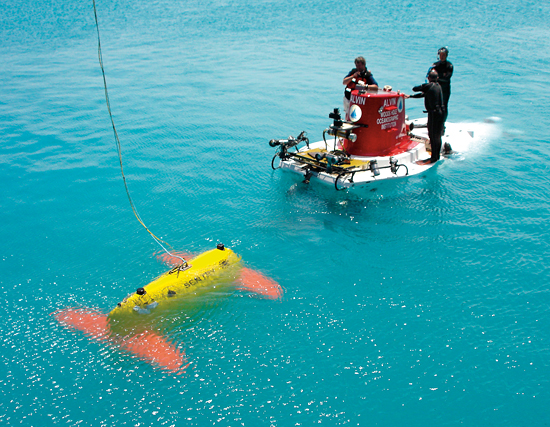
The new WHOI Sentry autonomous underwater vehicle meets the submersible Alvin during a testing expedition off Bermuda in April 2006. 

Sentry is a robotic underwater vehicle used for exploring the deep ocean; it will often be used to complement Alvin by surveying large swaths of ocean floor to determine the best spots for close-up exploration. 

Sentry is part of the National Deep Submergence Facility

Photo by Chris German, Woods Hole Oceanographic Institution


Thursday, June 24, 2010

Chronic fatigue syndrome: suspicion is back on virus

A leading scientist at the US National Institutes of Health (NIH) supports the theory that a retrovirus causes chronic fatigue syndrome (CFS) and says that government researchers have independently confirmed the association.

The link between xenotropic murine leukemia virus-related virus (XMRV) and CFS was reported last year by scientists at the Whitmore Peterson Institute in Reno, Nevada. But it has since come under heavy criticism after several groups failed to replicate the association with their own patients.

However, Harvey Alter, an infectious disease expert at NIH, gave a talk on protecting the blood supply from disease at a closed workshop in Zagreb, last month with a slide that called the XMRV-CFS association "extremely strong and likely true, despite the controversy", the Wall Street Journal reports.

The same slide also indicates that scientists at NIH and the Food and Drug Administration have confirmed the link between CFS and XMRV themselves. His team also estimates that XMRV and related viruses are present in 3 to 7 per cent of blood donors.

The news is generating a lot of buzz on CFS patient forums, where hopes have been high that the connection would offer a solid explanation - and potentially a treatment - for the enigmatic condition.

Friday, February 19, 2010

NASA Tranquility and Cupola Opening Ceremony: A Window on the Earth


A simple ceremony to open the Tranquility and Cupola for business. They took the opportunity to make a moving tribute to astronaut Charles Lacey Veitch and the others responsible for it's construction.

Tuesday, October 6, 2009

Alchemy is back - Gold found in Bacterium

Move over, Midas. A genetically modified version of a bacterium that extracts gold from its environment can signal the presence of the precious metal. The result could be a boon for prospectors.

Some bacteria are known to be associated with gold deposits, but it has been unclear whether they play a role in its production – and if so, what that is.

Now Frank Reith of the University of Adelaide, South Australia, has found that dissolved gold is harmful to the bacterium Cupriavidus metallidurans, as it forms a toxic sulphur-containing compound when it is absorbed from the environment. This compound inhibits the bacterium's enzyme function, prompting the distressed microbe to activate a cluster of "gold detox" genes that produce enzymes able to convert the soluble gold compounds into harmless particles of metallic gold.

Hand-held prospector
Knowing how microbes do this will open up a whole new way of prospecting, says co-author Gregor Grass of the University of Nebraska. Reith and Grass have developed a genetically modified version of C. metallidurans that produces a visible response when the detox genes are switched on.

"When the microbes come into contact with gold, they flash a light that can be detected using a hand-held photometer," says Grass. He envisages that prospectors will be able to detect whether gold is present simply by taking a sample of soil and adding modified bacteria to it.

"There have been reports that bacteria can enhance the production of gold for some time," says John Stolz, an environmental microbiologist at the Bayer School of Natural and Environmental Sciences at Duquesne University in Pittsburgh, Pennsylvania. "But this is the first time scientists have actually identified how they do it."

Journal reference: Proceedings of the National Academy of Sciences, DOI: 10.1073/pnas.0904583106.