Showing posts with label LHC. Show all posts

Friday, November 21, 2014

CERN Open Data Portal: LHC experiments open to the Public

The web-based CMS event display, accessible through the CERN Open Data Portal, shows a proton-collision event recorded by the CMS detector. 

Credit: CMS /Open Data Portal

CERN today launched its Open Data Portal where data from real collision events, produced by experiments at the Large Hadron Collider (LHC) will for the first time be made openly available to all.

It is expected that these data will be of high value for the research community, and also be used for education purposes.

"Launching the CERN Open Data Portal is an important step for our Organization. Data from the LHC programme are among the most precious assets of the LHC experiments, that today we start sharing openly with the world."

"We hope these open data will support and inspire the global research community, including students and citizen scientists," says CERN Director-General Rolf Heuer.

The principle of openness is enshrined in CERN's founding Convention, and all LHC publications have been published Open Access, free for all to read and re-use.

Widening the scope, the LHC collaborations recently approved Open Data policies and will release collision data over the coming years.

The first high-level and analysable collision data openly released come from the CMS experiment and were originally collected in 2010 during the first LHC run.

This data set is now publicly available on the CERN Open Data Portal. Open source software to read and analyse the data is also available, together with the corresponding documentation.

The CMS collaboration is committed to releasing its data three years after collection, after they have been thoroughly studied by the collaboration.

"This is all new and we are curious to see how the data will be re-used," says CMS data preservation coordinator Kati Lassila-Perini.

"We've prepared tools and examples of different levels of complexity from simplified analysis to ready-to-use online applications. We hope these examples will stimulate the creativity of external users."

In parallel, the CERN Open Data Portal gives access to additional event data sets from the ALICE, ATLAS, CMS and LHCb collaborations, which have been specifically prepared for educational purposes, such as the international masterclasses in particle physics benefiting over ten thousand high-school students every year. These resources are accompanied by visualisation tools.

"Our own data policy foresees data preservation and its sharing. We have seen that students are fascinated by being able to analyse LHC data in the past and so, we are very happy to take the first steps and make available some selected data for education" says Silvia Amerio, data preservation coordinator of the LHCb experiment.

"The development of this Open Data Portal represents a first milestone in our mission to serve our users in preserving and sharing their research materials. It will ensure that the data and tools can be accessed and used, now and in the future," says Tim Smith of the CERN IT Department.

All data on OpenData.cern.ch are shared under a Creative Commons CC0 public domain dedication; data and software are assigned unique DOI identifiers to make them citable in scientific articles; and software is released under open source licenses.

The CERN Open Data Portal is built on the open-source Invenio Digital Library software, which powers other CERN Open Science tools and initiatives.

Monday, May 19, 2014

HADES: Continues search for Dark Matter Beyond the Standard Model

HADES at the GSI in Darmstadt, Germany searches for dark matter candidates. 

Credit: 3-D Rendering: A. Schmah /HADES

Although Dark Energy and Dark Matter appear to constitute over 95 percent of the universe, nobody knows of which particles they are made up.

Astrophysicists now crossed one potential Dark Matter candidate, the Dark Photon or U boson, off the list in top position.

This is the result of recent HADES experiments, where researchers from the Helmholtz-Zentrum Dresden-Rossendorf (HZDR) and from 17 other European institutes try to pin down the nature of Dark Matter.

These negative results, recently published in Physics Letters B, could even lead to challenges of the Standard Model of particle physics.

The interpretation of current astrophysical observations results in the striking mass-energy budget of matter in the universe: 75% Dark Energy and 20% Dark Matter. Only about 5% of the universe consists of "ordinary", baryonic matter.

Many attempts have been made to explain the nature of Dark Matter. Researchers believe that Dark Matter is comprised by hitherto unknown particles which do not fit into the Standard Model of particle physics.

The Standard Model is a theoretically sound quantum field theory with fundamental matter particles, such as quarks (bound in hadrons, e.g., baryons) and leptons (e.g., electrons and neutrinos), which interact via exchange of force-carrier quanta, called gauge bosons (e.g., photons).

Some of these species acquire their masses by the interaction with the Higgs boson.

While evidences for the Higgs boson were found recently at CERN, the Standard Model looks now complete when supplemented by some neutrino masses, and nothing else seems to be needed to understand the wealth of atomic, sub-nuclear and particle physics phenomena.

Nevertheless, Dark Matter appears not to be explained by any of the constituents of the Standard Model.

This status of the affair has initiated worldwide efforts to search for Dark Matter candidates.

Beyond the Standard Model
Searching a needle in the haystack is simpler: one knows both the wanted object (the needle) and the place (the haystack).

In the case of Dark Matter the object is unknown, and the localisation, e.g. in galactic halos, is also not constraining the loci of interest.

To specify the search goal one can envisage diverse hypothetical candidates, such as certain hypothetical particles beyond the Standard Model, which fulfill requirements qualifying them as constituents of Dark Matter.

Dark Energy drives the presently observed accelerated expansion of the universe. Dark Energy is homogeneously distributed and can be attributed to a cosmological constant or vacuum energy.

In extreme cases it may cause, in the future, such a sudden expansion that anything in the universe is disrupted, this would be the Big Rip.

Dark Matter, in contrast, is bumpy and is needed to explain the formation of the observed density distribution of visible matter in the evolving universe, evidenced by the hierarchy of structures from (super)clusters of galaxies, galaxies, stars, planets and other compact objects such as meteorites, etc.

Among the lists of candidates of Dark Matter is a hypothetical particle, often dubbed U boson or Dark Photon.

These nicknames refer to the underlying theory construction: a second unitary ("U") symmetry allows for quanta which are, in one respect, similar to photons, namely gauge bosons, but in another respect different from photons, namely attributing to these quanta a mass, making them to Dark Photons because of a very weak interaction with normal matter.

Very similar to photons the Dark Photons can decay into electron-positron pairs, if they have the proper virtuality.

Combining the chain of hypotheses one arrives at a scenario, where an "ordinary" virtual photon converts into a Dark Photon which decays afterwards into an electron-positron pair.

Background on HADES
HADES is an acronym of High-Acceptance Di-Electron Spectrometer.

It is an optimised detector system operated by a European collaboration of about hundred physicists at GSI Helmholtzzentrum für Schwerionenforschung, Darmstadt.

HADES is aimed at investigating virtual photon signals emitted as electron-positron pairs off compressed nuclear matter to understand the origin of the phenomenon "masses of hadrons" and test it in some detail.

The highly sophisticated apparatus HADES has the capability to select electron-positron pairs, which can be attributed to primary sources, out of a huge background of other particles .

Read the full article here

More information: G. Agakishiev et al. (HADES Collaboration), Phys. Lett. B 731, 265 (2014) dx.doi.org/10.1016/j.physletb.2014.02.035

Tuesday, April 15, 2014

CERN: World Record Current in Superconductor

The 20-metre long electrical transmission line containing the two 20 kA MgB2cables. 

Credit: CERN

In the framework of the High-Luminosity LHC project, experts from the CERN Superconductors team recently obtained a world-record current of 20 kA at 24 K in an electrical transmission line consisting of two 20-metre long cables made of magnesium diboride (MgB2) superconductor.

This result makes the technology a viable solution for long-distance power transportation.

"The test is an important step in the development of cold electrical power transmission systems based on the use of MgB2," says Amalia Ballarino, head of the Superconductors and Superconducting Devices section at CERN.

"The cables and associated technologies were designed, developed and tested at CERN."

"The superconducting wire is the result of a long R&D effort that started in 2008 between CERN and the manufacturer, Columbus Superconductors in Genova, Italy."

The result was achieved at a temperature of 24 K (about -249 ˚C) using a test station that was purpose-designed and assembled at CERN.

The temperature is kept homogeneous over the 20-metre length of the line by a forced flow of helium gas.

Following intense development, the full 2 x 20-metre long MgB2 superconducting line was successfully powered to the world-record current of 20 kA, showing that this technology has great potential for the transmission of electrical power.

The superconducting properties of this relatively cheap material were discovered in 2001, but conductor technology only existed in the form of tape.

Round wire, which is more appropriate for assembling into high-current cables, was not available when the CERN project started.

"First, it was necessary to develop quality round wires adapted for use in this project, with high current density and uniform superconducting properties," says Ballarino.

"This work was done through a close collaboration between CERN and Columbus Superconductors, which manufactured different generations of wires with different architectures and with improved properties. In parallel, we at CERN developed the high-current cables and the electrical transmission line."


Tuesday, April 8, 2014

CERN LHC: Team announces beginning of restart

The team of scientists working at CERN's Large Hadron Collider (LHC) facility has reported to the press that the process of restarting the massive experimental mechanism has begun—though it won't finish until sometime next year. 

The world's most complicated system of machines will have to be restarted in pieces to ensure that each is operating properly before the next can be brought online.

Though proving the existence of the Higgs boson was a major goal, and achieving it garnered a lot of headlines, the facility at CERN has made progress in other areas as well, the creation of quark, gluon plasma back in 2011, is but one example.

Now the facility is in the process of an upgrade, which has been in the planning stages for several years and will include upgrades to several pieces and parts of the facility that support the LHC as well as the main accelerator itself.

The team recognized that the facility had begun to suffer from diminishing returns and that many parts could be improved due to the development of new technology and improvements on old ways of doing things.

Thus, this past February the LHC, along with other parts and accelerators that feed it, was shut down.

The retooling has been forecast to total approximately $4.4 billion dollars.

Thus far, the team has successfully restarted the part they call the source—the piece of equipment responsible for stripping electrons off of hydrogen atoms for use in producing protons.

Next up the team plans to fire up Linac2, an accelerator whose job it is to give protons their initial push.

After that a booster will be started that will be used to push the protons even faster.

For the LHC to be used in its proper context, it must receive protons that are already moving exceedingly fast.

Team members have made much of the complete upgrade to the control system for the LHC, the part that integrates all of the systems and which of course will be central to a successful reboot.

They should know early on if there are any problems. In addition to swapping out parts for new and improved technology, technicians will also be replacing worn cables or other minor but necessary components.

If all goes well, the LHC should be ready and back in business sometime early next year. Projects in the pipeline include: ALICE, CMS, ATLAS and LHCb.

Wednesday, March 19, 2014

Large Hadron Collider's CMS Tracker: Cool running required

The CMS Tracker Outer Barrel (TOB) shown in a clean room before its installation into the detector in 2008. 

Credit: Maximilien Brice/CERN 

By successfully passing a recent 'Master Cold Test', the CMS experiment Tracker has proved it can run at temperatures colder than ever before. 

It is now in shape to operate until 2025.

This Tracker, the closest subdetector to the collision point of Large Hadron Collider (LHC) particle beams, must face an onslaught of billions of particles flying through it each second of operation.

If the Tracker was operated at room temperatures, damage from this onslaught would soon render it inoperable.

So during the LHC's first run from 2010 to 2013, the Tracker operated at +4 °C, but with higher LHC beam intensities from 2015 onwards, the Tracker must operate at much colder temperatures, posing a monumental challenge to the Tracker community.

However, after two years of planning and one year of work, they have succeeded.

To achieve lower temperatures, many projects ran in parallel. The CMS cooling plant was refurbished and the fluorocarbon cooling system completely overhauled.

New methods for vapour-sealing and insulation helped suppress humidity inside the Tracker and several hundred high-precision sensors have improved humidity and temperature monitoring.

A new dry-gas plant now provides eight times as much dry gas (air or nitrogen) than before to help keep humidity away from the delicate electronics, and allows fine-grained regulation of the flow.

In addition, all cooling bundles outside the Tracker were equipped with heater wires and temperature sensors to guarantee safe operation in the future.

As a result, in early 2014 the Tracker successfully passed the important 'Master Cold Test' milestone, running the Strip Tracker at temperatures down to −20 °C with the Pixel Tracker lines going to −25 °C.

The subdetector was monitored continuously and performed as expected, without affecting the temperature of surrounding layers of the Electromagnetic Calorimeter, which operate at +18 °C.

Environmental conditions allow operation at −25 °C and the detector has been successfully operated at −20 °C.

To minimise thermal stress, researchers are discussing operating the Strip Tracker at −15 °C and the Pixel Tracker at −20 °C for the coming years.

With this milestone, the Tracker project has completed the bulk of its work for Long Shutdown 1 of the LHC.

The detector can now be operated cold with a sufficient safety margin. The team are now ready to track particles until Long Shutdown 3.

Thursday, February 6, 2014

CERN Future Circular Collider (FCC): Europe's new giant particle collider

Europe's physics lab CERN said Thursday it was eyeing plans for a circular particle collider that would be seven times more powerful than the facility which discovered the famous "God particle."

"The time has come to look even further ahead," the European Organisation for Nuclear Research (CERN) announced.

In 2012, CERN's Large Hadron Collider (LHC)—a giant lab housed in a 27-kilometre (17-mile) tunnel straddling the French-Swiss border—identified what is believed to be the Higgs boson, the long-sought maker of mass theorised in the 1960s.

The facility flushed out the so-called God particle by crashing proton beams at velocities near the speed of light. It went offline a year ago for an 18-month overhaul.

The LHC, completed in 2008, has "at least 20 more years" of life in it, the agency said.

However, the long time needed to build its successor—the LHC took a quarter of a century—means that planning should start now.

It will launch a feasibility study next week for a so-called Future Circular Collider (FCC) with a circumference of 80 to 100 kilometres (50 to 60 miles).

The FCC would probably be located in the same area and may incorporate the LHC tunnel in its infrastructure, CERN said in a statement.

The LHC after its overhaul will see collision energies reach 14 teraelectron volts (TeV) but the FCC should be capable of reaching unprecedented smashups of around 100 TeV, CERN said.

The FCC study will run in parallel with an ongoing probe into an alternative design—an 80-kilometre (50-mile) straight collider dubbed the Compact Linear Collider (CLIC).

The two studies will examine the feasibility and costs and produce conceptual designs by 2018/2019, when the European-wide strategy on particle physics research is set to be updated.

The winner will be "a worthy successor to the LHC," CERN said.

"Such an accelerator would allow particle physics to push back the boundaries of knowledge even further," it claimed.

Targets could include supersymmetry, the notion that there are novel particles which mirror each known particle.

It could also help shed light on dark matter, which comprises most of the cosmos and whose existence is inferred from their impact on ordinary matter.

Some 300 scientists will meet at the University of Geneva from February 12-15 to kick off the five-year feasibility study for the FCC.

Thursday, September 12, 2013

CERN: LHC celebrates five years of not destroying the world

Universe’s secrets are revealed in a dark corner in Switzerland. Credit: timtom.ch

Five years ago, at breakfast time, the world waited anxiously for news from CERN, the European Organization for Nuclear Research.

The first nervy bunch of protons were due to be fired around the European lab's latest and biggest particle accelerator, the Large Hadron Collider (LHC), as it kicked into action.

Some "mercifully deluded people" – as Jeremy Paxman put it – feared the LHC would do no end of mischief.

There was talk of planet-swallowing black holes, the transformation of the Earth into a new state of "strange" matter, and even the prospect of the obliteration of the entire universe.

But for those of more sensible dispositions, the LHC's first beam was an occasion for great excitement.

As the protons sped all the way round the 27km tunnel under the countryside between Lake Geneva and the Jura Mountains, thousands of physicists and engineers celebrated decades of hard work, incredible ingenuity and sheer ambition.

Lyn Evans
Together they had created the largest-ever scientific experiment. After the LHC was switched on, project leader Lyn Evans said, "We can now look forward to a new era of understanding about the origins and evolution of the universe."

Operating a massive particle accelerator requires much more than flicking a switch – thousands of individual elements have to all come together, synchronised in time to less than a billionth of a second.

University College London's physicist Jon Butterworth recalls a "particularly bizarre memory" from that day.

Relaxing in a Westminster pub after an exhausting LHC event in London, Butterworth found he could follow live updates from his own ATLAS experiment on the pub's TV.

Particle physics continued to make news. The following fortnight's joy turned to dismay as an accident involving six tonnes of liquid helium erupting violently in the tunnel – euphemistically referred to as "the incident" – damaged around half a mile of the collider, closing the LHC for a year.

Thursday, August 1, 2013

Post Higgs breakthrough, CERN readies for next cosmic quest

A view of the detector in the 12,500-ton Compact Muon Solenoid experiment (CMS). Image courtesy of CERN

A year ago, the world's largest particle collider made one of the greatest discoveries in the history of science, identifying what is believed to be the Higgs Boson—the long-sought maker of mass.

Today, its computer screens are dark, the control desks unstaffed and the giant, supercooled tunnel empty of the crashing proton beams whose snapshots of the Big Bang helped flush out the elusive particle.

But the silence is an illusion.

Behind the scenes, work is pushing ahead to give the vast machine a mighty upgrade, enabling it to advance the frontiers of knowledge even farther.

The 27-kilometre (17-mile) circular lab, straddling the French-Swiss border 100 metres (325 feet) underground, went offline in February for an 18-month overhaul.

When experiments resume in 2015, scientists at the European Organisation for Nuclear Research (CERN) will use its enhanced power to probe dark matter, dark energy and supersymmetry—ideas considered as wild as the Higgs Boson was, half a century ago.

As engineers focus on the technical mission, physicists are sifting through the mountains of data that the Large Hadron Collider (LHC) has churned out since 2010, for there could be more nuggets to find.

"The things that are easy to spot have already been exploited, and now we're taking another look," said Tiziano Camporesi of CERN, noting wryly that dealing with the unknown was, well, unknowable.

"We always say that astronomers have an easier task, because they can actually see what they're looking for!"

The LHC's particle collisions transform energy into mass, the goal being to find fundamental particles in the sub-atomic debris that help us to understand the Universe. At peak capacity, the "old" LHC managed a mind-boggling 550 million collisions per second.

"We give the guys as many collisions as we can," said Mike Lamont, head of its operating team. "That's our bread and butter."

"Most of that stuff is not very interesting, so there are real challenges sorting out and throwing most of that away, and picking out the interesting stuff," he explained in the tunnel, which mixes installations fit for a starship with the low-tech practicality of bicycles for inspection tours.

Monday, April 8, 2013

CAN Revolutionary laser system produce the next LHC

An international team of physicists has proposed a revolutionary laser system, inspired by the telecommunications technology, to produce the next generation of particle accelerators, such as the Large Hadron Collider (LHC) in CERN.

The International Coherent Amplification Network (ICAN) sets out a new laser system composed of massive arrays of thousands of fibre lasers, for both fundamental research at laboratories such as CERN and more applied tasks such as proton therapy and nuclear transmutation.

Lasers can provide, in a very short time measured in femto-seconds, bursts of energy of great power counted in peta-watts or a thousand times the power of all the power plants in the world.

Compact accelerators are also of great societal importance for applied tasks in medicine, such as a unique way to democratise proton therapy for cancer treatment, or the environment where it offers the prospect to reduce the lifetime of dangerous nuclear waste by, in some cases, from 100 thousand years to tens of years or even less.

Major Difficulties
However, there are two major hurdles that prevent the high-intensity laser from becoming a viable and widely used technology in the future.
  • First, a high-intensity laser often only operates at a rate of one laser pulse per second, when for practical applications it would need to operate tens of thousands of times per second.
  • The second is ultra-intense lasers are notorious for being very inefficient, producing output powers that are a fraction of a percent of the input power. As practical applications would require output powers in the range of tens of kilowatts to megawatts, it is economically not feasible to produce this power with such a poor efficiency.
Technological Consortium
To bridge this technology divide, the ICAN consortium, an EU-funded project initiated and coordinated by the Ecole polytechnique and composed of the University of Southampton Optical Research Centre (ORC), Jena and CERN, as well as 12 other prestigious laboratories around the world, aims to harness the efficiency, controllability, and high average power capability of fibre lasers to produce high energy, high repetition rate pulse sources.

The aim is to replace the conventional single monolithic rod amplifier that typically equips lasers with a network of fibre amplifiers and telecommunication components.

Gerard Mourou
Gerard Mourou of Ecole polytechnique who leads the consortium says: "One important application demonstrated has been the possibility to accelerate particles to high energy over very short distances measured in centimetres rather than kilometres as it is the case today with conventional technology."

"This feature is of paramount importance when we know that today high energy physics is limited by the prohibitive size of accelerators, of the size of tens of kilometres, and cost billions of euros."

"Reducing the size and cost by a large amount is of critical importance for the future of high energy physics."

Dr Bill Brocklesby
Dr Bill Brocklesby from the ORC adds: "A typical CAN laser for high-energy physics may use thousands of fibres, each carrying a small amount of laser energy."

"It offers the advantage of relying on well tested telecommunication elements, such as fibre lasers and other components."

"The fibre laser offers an excellent efficiency due to laser diode pumping. It also provides a much larger surface cooling area and therefore makes possible high repetition rate operation."

"The most stringent difficulty is to phase the lasers within a fraction of a wavelength."

"This difficulty seemed insurmountable but a major roadblock has in fact been solved: preliminary proof of concept suggests that thousands of fibres can be controlled to provide a laser output powerful enough to accelerate electrons to energies of several GeV at 10 kHz repetition rate - an improvement of at least ten thousand times over today's state of the art lasers."

Such a combined fibre-laser system should provide the necessary power and efficiency that could make economical the production of a large flux of relativistic protons over millimetre lengths as opposed to a few hundred metres.

Societal Application
One important societal application of such a source is to transmute the waste products of nuclear reactors, which at present have half-lives of hundreds of thousands of years, into materials with much shorter lives, on the scale of tens of years, thus transforming dramatically the problem of nuclear waste management.

CAN technology could also find important applications in areas of medicine, such as proton therapy, where reliability and robustness of fibre technology could be decisive features.

Friday, March 15, 2013

CERN LHC: New results indicate that Higgs boson particle is discovered

Event display of a H -> 4mu candidate event with m(4l) = 124.1 (125.1) GeV without (with) Z mass constraint. 

The masses of the lepton pairs are 86.3 GeV and 31.6 GeV. 

The event was recorded by ATLAS on 10-Jun-2012, 13:24:31 CEST in run number 204769 as event number 71902630.

Zoom into the tracking detector. Muon tracks are coloured red. 

Credit: ATLAS Experiment © 2012 CERN

At the Moriond Conference today, the ATLAS and CMS collaborations at CERN's Large Hadron Collider (LHC) presented preliminary new results that further elucidate the particle discovered last year.

Having analysed two and a half times more data than was available for the discovery announcement in July, they find that the new particle is looking more and more like a Higgs boson, the particle linked to the mechanism that gives mass to elementary particles.

It remains an open question, however, whether this is the Higgs boson of the Standard Model of particle physics, or possibly the lightest of several bosons predicted in some theories that go beyond the Standard Model. Finding the answer to this question will take time.

Whether or not it is a Higgs boson is demonstrated by how it interacts with other particles, and its quantum properties. For example, a Higgs boson is postulated to have no spin, and in the Standard Model its parity -- a measure of how its mirror image behaves -- should be positive.

CMS and ATLAS have compared a number of options for the spin-parity of this particle, and these all prefer no spin and positive parity. This, coupled with the measured interactions of the new particle with other particles, strongly indicates that it is a Higgs boson.

"The preliminary results with the full 2012 data set are magnificent and to me it is clear that we are dealing with a Higgs boson though we still have a long way to go to know what kind of Higgs boson it is." said CMS spokesperson Joe Incandela.

"The beautiful new results represent a huge effort by many dedicated people. They point to the new particle having the spin-parity of a Higgs boson as in the Standard Model. We are now well started on the measurement programme in the Higgs sector," said ATLAS spokesperson Dave Charlton.

To determine if this is the Standard Model Higgs boson, the collaborations have, for example, to measure precisely the rate at which the boson decays into other particles and compare the results to the predictions.

The detection of the boson is a very rare event -- it takes around 1 trillion (1012) proton-proton collisions for each observed event. To characterize all of the decay modes will require much more data from the LHC.

The above story is reprinted from materials provided by CERN, the European Organization for Nuclear Research.

Thursday, February 16, 2012

CERN LHC: Particle collider to get energy boost

European particle physicists say the Large Hadron Collider in Switzerland will be run at higher energies in 2012 than in previous years

The higher energy 4 Tev level, 0.5 higher than levels used in 2010 and 2011, will allow the LHC to deliver the maximum possible amount of data this year before it goes into a long shutdown to prepare for even higher-energy running, a release from CERN headquarters in Geneva said Tuesday.

"When we started operating the LHC for physics in 2010, we chose the lowest safe beam energy consistent with the physics we wanted to do," Steve Myers, CERN's director for accelerators and technology, said.

"Two good years of operational experience with beam and many additional measurements made during 2011 give us the confidence to safely move up a notch, and thereby extend the physics reach of the experiments before we go into the LHC's first long shutdown."

In the last two years, the LHC has concentrated on narrowing the search for the Higgs boson, considered the foundation particle of particle physics.

However, to confirm its discovery or to rule out the Standard Model Higgs particle altogether will require one more year's worth of data, researchers said.

"By the time the LHC goes into its first long stop at the end of this year, we will either know that a Higgs particle exists or have ruled out the existence of a Standard Model Higgs," CERN's research director, Sergio Bertolucci, said.

"Either would be a major advance in our exploration of nature, bringing us closer to understanding how the fundamental particles acquire their mass, and marking the beginning of a new chapter in particle physics."

Friday, December 23, 2011

LHC Discovers First New Particle - Chi_b (3P)

CERN physicists, analysing data from the Atlas experiment, have made their first new particle discovery at the Large Hadron Collider, known as Chi_b (3P), which will help scientists better understand the forces that hold matter together.

This is the first clear observation of a new particle since the LHC opened in 2009. The LHC is the largest facility exploring fundamental questions in "big physics" by colliding proton particles together.

Physicists said the Chi_b (3P), which like the Higgs boson, is a boson, portends a new way of combining a beauty quark and its antiquark so that they bind together. But whereas the Higgs is not made up of smaller particles, the Chi_b(3P) combines two very heavy objects via the same 'strong force' which holds the atomic nucleus together.

According to Professor Roger Jones, who works on the Atlas detector at the LHC, the Chi_b (3P) is a more excited state of Chi particles already seen in previous collision experiments. "The new particle is made up of a 'beauty quark' and a 'beauty anti-quark', which are then bound together," he said.

He noted that people have thought this more excited state should exist for years, but nobody has managed to see it until now.

"The Chi_b(3P) is a particle that was predicted by many theorists, but was not observed at previous experiments, such as in my previous work on the D-Zero experiment in Chicago," said Dr James Walder, a Lancaster research associate who worked on the analysis.

"It's also interesting for what it tells us about the forces that hold the quark and the anti-quark together - the strong nuclear force. And that's the same force that holds, for instance, the atomic nucleus together with its protons and the neutrons," Jones said.

The physicist explained that LHC discoveries are an important part of this quest because they add to the wider background knowledge.

"The better we understand the strong force, the more we understand a large part of the data that we see, which is quite often the background to the more exciting things we are looking for, like the Higgs," Jones noted.

"While people are rightly interested in the Higgs boson, which we believe gives particles their mass and may have started to reveal itself, a lot of the mass of everyday objects comes from the strong interaction we are investigating using the chi b," he concluded.

Tuesday, December 13, 2011

CERN Higgs boson: Tantalising Glimpse of 'God Particle' but No Discovery

Scientists at at the CERN particle physics laboratory outside Geneva have found signs of the Higgs boson, but stopped short of claiming a full discovery of the so-called 'God particle'.

The leaders of the two teams of researchers, ATLAS and CMS, revealed their findings on Tuesday to a packed seminar at CERN, where they have been trying to find the elusive particle using the £6.2 billion Large Hadron Collider (LHC) built to recreate conditions a fraction of a second after the Big Bang.

The researchers were keen to stress they were not making an announcement saying that the particle definitely exists, but that the new data is strong enough to suggest the question will be answered next year, one way or another.

Physicist Fabiola Gianotti, head of the ATLAS team, said the particle is more likely to be found in lower mass or energy ranges, a discovery they only made recently. This means that the search for the "God particle" has now been narrowed down to a signal centred at around 126 GeV (Giga electron volts).

"I think it would be extremely kind of the Higgs boson to be here, but it is too early," Professor Gianotti said during the seminar.

"More studies and more data are needed. The next few months will be very exciting... I don't know what the conclusions will be."

The results showed a spike in the graph taken by the ATLAS and CMS teams, where the apparent Higgs boson began to decay after temporarily existing when the LHC smashed particles together.

Oliver Buchmueller, a senior physicist on the CMS team, said: "We see a small bump around the same mass as the Atlas team and that is intriguing.

It means we have two experiments seeing the same thing and that is exactly how we would expect a Higgs signal to build up."

Speaking at the end of the seminar, CERN director Rolf Heuer summed up the findings by saying: "These are preliminary results, we're talking small numbers and remember that we are running [the LHC] next year.

"The window for the Higgs mass gets smaller and smaller, but it is still alive. We have not found it yet. Stay tuned for next year.

"But be careful - it's intriguing hints," he said. "We have not found it yet, we have not excluded it yet."

If CERN discovers that the Higgs boson does not exist after all, physicists will have to undertake a massive rethink of how the universe works and how particles obtain their mass after spending decades searching for this elementary particle.

The Higgs boson is named after particle physicist Peter Higgs, who proposed the idea in 1964.

Monday, December 12, 2011

CERN Physicists Anxiously Await News of Higgs Boson

High noon is approaching for the biggest manhunt in the history of physics.

On Tuesday morning, scientists from CERN, the European Center for Nuclear Research, are scheduled to give a progress report on the search for the Higgs boson — infamously known as the “God particle” — whose discovery would vindicate the modern theory of how elementary particles get mass.

The report comes amid rumors that the two competing armies of scientists sifting debris from hundreds of trillions of proton collisions in CERN’s Large Hadron Collider, or L.H.C., outside Geneva, have both finally seen hints of what might turn out be the elusive particle when more data is gathered next year.

Alternatively, the experimentalists say that a year from now they should have enough data to rule out the existence of the most popular version of the Higgs boson, sending theorists back to their blackboards in search of another explanation of why particles have mass.

So the whole world will be watching.

Sunday, November 20, 2011

ESA Cluster Mission: Cosmic particle accelerators

ESA's Cluster satellites have discovered that cosmic particle accelerators are more efficient than previously thought.

The discovery has revealed the initial stages of acceleration for the first time, a process that could apply across the Universe.

All particle accelerators need some way to begin the acceleration process. For example, the Large Hadron Collider (LHC) at CERN employs a series of small accelerators to get its particles up to speed before injecting them into the main 27 km-circumference ring for further acceleration.

In space, large magnetic fields guide particles known as cosmic rays across the Universe at almost the speed of light, but are notoriously bad at getting them moving in the first place.

Now ESA's Cluster mission has shown that something similar to the 'staging' process used at CERN is happening above our heads in the natural particle accelerators of space.

On 9 January 2005, Cluster's four satellites passed through a magnetic shock high above Earth. The spinning craft were aligned almost perfectly with the magnetic field, allowing them to sample what was happening to electrons on very short timescales of 250 milliseconds or less.

The measurements showed that the electrons rose sharply in temperature, which established conditions favourable to larger scale acceleration.

It had long been suspected that shocks could do this, but the size of the shock layers and the details of the process had been difficult to pin down.

Steven J. Schwartz, Imperial College London, and colleagues used the Cluster data to estimate the thickness of the shock layer. This is important because the thinner a shock is, the more easily it can accelerate particles.

"With these observations, we found that the shock layer is about as thin as it can possibly be," says Dr Schwartz.

Thin in this case corresponds to about 17 km. Previous estimates had only been able to tie down the width of the shock layers above Earth at no more than 100 km.

This is the first time anyone has seen such details of the initial acceleration region.

Saturday, November 19, 2011

LHC Physicists Get an Antimatter Surprise

This giant magnetic is part of the LHCb experiment at the Large Hadron Collider in Geneva, Switzerland.
CREDIT: CERN/LHCb

The world's largest atom smasher, designed as a portal to a new view of physics, has produced its first peek at the unexpected: bits of matter that don't mirror the behavior of their antimatter counterparts.

The discovery, if confirmed, could rewrite the known laws of particle physics and help explain why our universe is made mostly of matter and not antimatter.

Scientists at the Large Hadron Collider, the 17-mile (27 km) circular particle accelerator underground near Geneva, Switzerland, have been colliding protons at high speeds to create explosions of energy. From this energy many subatomic particles are produced.

Now researchers at the accelerator's LHCb experiment are reporting that some matter particles produced inside the machine appear to be behaving differently from their antimatter counterparts, which might provide a partial explanation to the mystery of antimatter.

Sunday, April 10, 2011

LHC at Cern observe the decays of a rare particle

Shortly after experiments on the Large Hadron Collider (LHC) at the CERN laboratory near Geneva, Switzerland began yielding scientific data last fall, a group of scientists led by a Syracuse University physicist became the first to observe the decays of a rare particle that was present right after the Big Bang.

By studying this particle, scientists hope to solve the mystery of why the universe evolved with more matter than antimatter.

Led by Sheldon Stone, a physicist in SU's College of Arts and Sciences, the scientists observed the decay of a special type of B meson, which are created when protons traveling at nearly the speed of light smash into each other.

The work is part of two studies published in the March 28 issue of Physics Letters B. Stone leads SU's high-energy physics group, which is part of a larger group of scientists (the LHCb collaboration) that run an experiment at CERN. The National Science Foundation (NSF) funds Stone's research group.

"It is impressive to see such a forefront physics result produced so soon after data-taking commenced at the LHC," said Moishe Pripstein, program director for the NSF's Elementary Particle Physics program.

"These results are a tribute both to the ingenuity of the international collaboration of scientists and the discovery potential of the LHC."

Scientists are eager to study these special B mesons because of their potential for yielding information about the relationship between matter and antimatter moments after the Big Bang, as well as yet-to-be described forces that resulted in the rise of matter over antimatter.

"We know when the universe formed from the Big Bang, it had just as much matter as antimatter," Stone says. "But we live in a world predominantly made of matter, therefore, there had to be differences in the decaying of both matter and antimatter in order to end up with a surplus of matter."

All matter is composed of atoms, which are composed of protons (positive charge), electrons (negative charge) and neutrons (neutral). The protons and neutrons are composed, in turn, of even smaller particles called quarks. Antimatter is composed of antiprotons, positrons (the opposite of electrons), antineutrons, and thus anti-quarks.

While antimatter generally refers to sub-atomic particles, it can also include larger elements, such as hydrogen or helium. It is generally believed that the same rules of physics should apply to both matter and antimatter and that both should occur in equal amounts in the universe.

That they don't play by the same rules or occur in equal amounts are among the greatest unsolved problems in physics today.

B mesons are a rare and special subgroup of mesons composed of a quark and anti-quark. While B mesons were common after the Big Bang, they are not believed to occur in nature today and can only be created and observed under experimental conditions in the LHC or other high-energy colliders.

Because these particles don't play by the same rules of physics as most other matter, scientists believe B mesons may have played an important role in the rise of matter over antimatter. The particles may also provide clues about the nature of the forces that led to this lack of symmetry in the universe.

Saturday, May 22, 2010

LHC Towards higher intensities - CERN Bulletin

Towards higher intensities - CERN Bulletin

Over the past 2 weeks, commissioning of the machine protection system has advanced significantly, opening up the possibility of higher intensity collisions at 3.5 TeV. The intensity has been increased from 2 bunches of 1010 protons to 6 bunches of 2x10¹⁰ protons. Luminosities of 6x1028 cm-2s-1 have been achieved at the start of fills, a factor of 60 higher than those provided for the first collisions on 30 March.

The recent increase in LHC luminosity as recorded by the experiments.

(Graph courtesy of the experiments and M. Ferro-Luzzi)

To increase the luminosity further, the commissioning crews are now trying to push up the intensity of the individual proton bunches.

After the successful injection of nominal intensity bunches containing 1.1x10¹¹ protons, collisions were subsequently achieved at 450 GeV with these intensities.

However, half-way through the first ramping of these nominal intensity bunches to 3.5 TeV on 15 May, a beam instability was observed, leading to partial beam loss.

Work is now under way to understand, control and cure this instability by using longer bunches and by powering the special correction magnets (octupoles).

Wednesday, March 31, 2010

The Large Hadron Collider Experiment Really Matters


After a series of setbacks, scientists have done it. They've mashed protons together at 99 percent of the speed of light and at a record-high energy level of 3.5 trillion electron volts.

The experiment took place at the Large Hadron Collider (LHC) near Geneva, Switzerland but scientists around the world watched excitedly via live feed. What does this mean for the field?


  • This Is a Big Deal! exclaims Geoff Brumfiel at Nature: "I can't think of another case where the future of an entire field hinges on the success of a single experiment...It could verify current theories of particle physics, most notably the Higgs mechanism, which endows all matter with mass. It could also discover new physics beyond the current 'standard model', and explain some current mysteries in physics like 'dark matter', a mysterious form of matter that makes up around 85% of all matter in the universe."

  • Why Scientists Are Excited Melissa Franklin, Professor of Physics at Harvard, explains what this means for the scientific community in an interview late last year:
    Sean Gallup/Getty Images After a series of setbacks, scientists have done it. They've mashed protons together at 99 percent of the speed of light and at a record-high energy level of 3.5 trillion electron volts.


  • Don't Expect Instant Results, cautions LHC Spokesman Guido Tonelli to the BBC: "Major discoveries will happen only when we are able to collect billions of events and identify among them the very rare events that could present a new state of matter or new particles. This is not going to happen tomorrow. It will require months and years of patient work."

  • This Is What Science Is All About, rejoices Stacey Higginbotham at Gigaom: "The LHC built by CERN represents why I spend my days writing about technology — not because I’m excited to play with the latest gadgets, but because I value the spirit of curiosity and discovery that leads scientists to spend $16 billion to build something that may (not will, but may) give us an inkling about how the universe works."

  • Happy First Physics Day, declare the editors of Big Think: "Now there is a new March holiday, First Physics Day, which is being celebrated today because the particles in the Large Hadron Collider are finally being smashed together at super high energies that mirror conditions after the Big Bang. The physics community is aflutter over the potential of bagging the elusive Higgs boson, and the rest of us are grateful that, improbable as it seemed, the collider did not create a fatal black hole."

Tuesday, March 30, 2010

CERN LHC: First Proton Particle Collision recorded

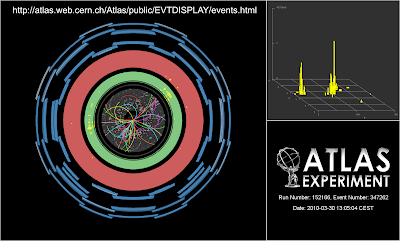
A CERN LHC animation of one of the first 7 TeV collisions recorded by ATLAS. A high resolution version.

An historical event for European science and physics!

After the initial collision the scientists at CERN LHC stabalised the beams to ensure further collisions would occur and managed to sustain the stability for more than 3 hours. Whereby, the experiments team have recorded a half million events from the stable and colliding beams. WOW!

A spectacular day indeed, and the culmination of at least 17 years of work and effort from scientists and physicists across the world.

If you want to see into the CERN LHC Atlas control room in Switzerland, here is the live link.