Showing posts with label ready. Show all posts

Monday, November 24, 2014

Lockheed Martin Orion spacecraft EFT-1 imminent

As we move closer to the highly anticipated first ever test flight of the Orion spacecraft, there's an aerospace company which would be keeping its fingers tightly crossed during this nail-biting moment for the U.S. spaceflight.

Lockheed Martin which built the manned capsule that will take American astronauts far beyond Earth, is much more than excited about the milestone flight.

"We live for this kind of project. We will tell our kids and our grandkids about this," Allison Rakes, Lockheed Martin spokesperson told reporters.

The company's hard working crew literally lives for this first step of future deep space exploration.

"We've had a team in Florida working around the clock for the past several months preparing for this moment. Once that Delta IV lifts off, you're going to see quite the celebration," Rakes added.


Friday, November 21, 2014

ESA Astronaut Samantha Cristoforetti ready for Futura mission

ESA astronaut Samantha Cristoforetti is all set for her five-month mission on the International Space Station. 

Credit: ESA

ESA astronaut Samantha Cristoforetti will leave Earth on Sunday from the Baikonur cosmodrome in Kazakhstan with NASA astronaut Terry Virts and Roscosmos cosmonaut Anton Shkaplerov.

Samantha was assigned to the Futura mission more than two years ago and has travelled the world training on all the elements of the most complex machine ever built: the International Space Station.

She learnt how to control the Station’s robotic arms, how to handle any emergency and how to perform all the scientific experiments she will run for the scientists on Earth.

NASA astronaut Terry Virts, Roscosmos commander Anton Shkaplerov and ESA astronaut Samantha Cristoforetti with the Soyuz spacecraft that will take them to the International Space Station on 23 November at 20:59 GMT (21:59 CET).

Credit: ESA

The last hurdles included the final exams to qualify for flying the Soyuz that will take them to space, and a two-week quarantine to avoid bringing any unwanted passengers to the Station.

The next ESA astronaut to head for space, Andreas Mogensen, is sharing the quarantine with Samantha as experience ahead of his own 10-day ‘iriss’ mission.

Samantha, Anton and Terry visited their spacecraft for the last time before launch last week and made a final check of the pressure suits they will wear during their journey to space.

The Soyuz TMA-15M spacecraft moved by train, 21 November 2014, from the assembly building to Baikonur Cosmodrome launch pad 31, in Kazakhstan.

Credit: ESA

Different versions of the Soyuz spacecraft have been flying for almost five decades and many traditions have developed over that time.

This week the international crew planted a tree on a boulevard in Kazakhstan, adding to the trees planted by every astronaut before launch.

On Sunday, Samantha will sign the door of the ‘cosmonaut hotel’ before leaving.

Despite its age, Soyuz has been updated and improved continually and it will deliver the crew to their new home orbiting Earth 400 km high in under six hours.

To get there so quickly, Expedition 42/43 will be propelled by the Soyuz rocket to 28 800 km/h accelerating 50 km/h on average every second for the first nine minutes after liftoff.

Wednesday, November 12, 2014

NASA's New Wind Watcher Ready for Weather Forecasters

ISS-RapidScat data on a North Atlantic extratropical cyclone, as seen by the National Centers for Environmental Prediction Advanced Weather Interactive Processing System used by weather forecasters at the National Oceanic and Atmospheric Administration's Ocean Prediction Center.

Image Credit: NASA/JPL-Caltech/NOAA

In an early holiday gift to the world's weather and marine forecasting agencies, ocean-winds data from NASA's newest Earth-observing mission, the International Space Station-Rapid Scatterometer (ISS-RapidScat), are being released two months ahead of schedule.

RapidScat launched to the International Space Station on Sept. 21 on a two-year mission to boost global monitoring of ocean winds for improved weather forecasting and climate studies.

The JPL-developed space-based scatterometer is a remote-sensing instrument that uses radar pulses reflected from the ocean's surface at different angles to calculate surface wind speed and direction.

This information will improve weather and marine forecasting and hurricane monitoring.


Working at an accelerated pace, scientists and engineers have successfully cross-calibrated ISS-RapidScat's ocean winds data with data from NASA's QuikScat satellite and validated the data against ground measurements.

The team reports the RapidScat data are meeting all planned wind performance requirements and are ready to begin extending the long-term climate data record of ocean-surface winds begun by QuikScat in 1999.

ESA Rosetta Spacecraft Set to Harpoon Comet 67/P

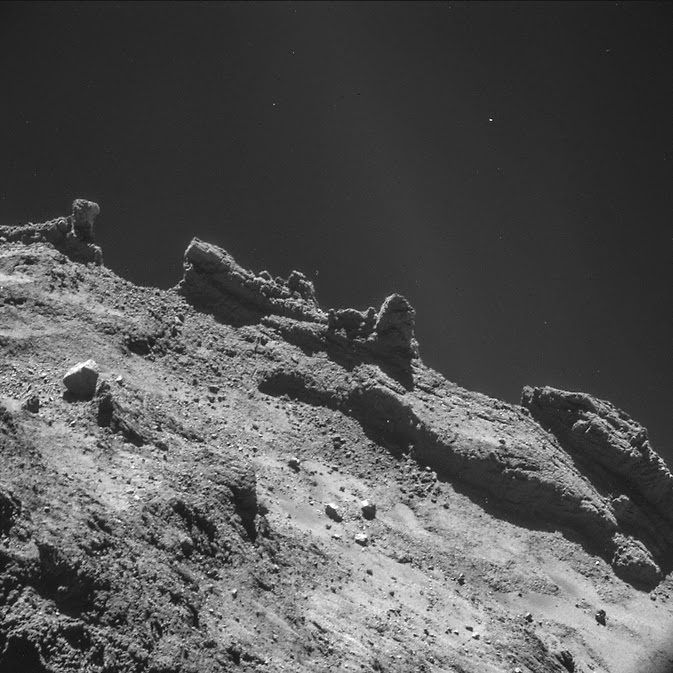
A jagged horizon of the nucleus of comet 67P/Churyumov-Gerasimenko appears in this image taken by the navigation camera on the European Space Agency's Rosetta spacecraft during the second half of October 2014. 

The image was taken from a distance of less than 6 miles (10 kilometers) from the surface.

Image Credit: ESA/Rosetta/NAVCAM


A patch of relatively smooth ground on the nucleus surface of comet 67P/Churyumov-Gerasimenko appears in this image taken by the navigation camera on the European Space Agency's Rosetta spacecraft in October 2014. 

The image was taken from a distance of less than 6 miles (10 kilometers).

Image Credit: ESA/Rosetta/NAVCAM

Some relatively rough terrain on the nucleus of comet 67P/Churyumov-Gerasimenko appears in this image taken by the navigation camera on the European Space Agency's Rosetta spacecraft in the second half of October 2014. 

The image was taken from a distance of less than 6 miles (10 kilometers).

Image Credit: ESA/Rosetta/NAVCAM

Early tomorrow morning, the European Space Agency's Rosetta spacecraft will deploy its comet lander, "Philae."

A little over seven hours later (8 a.m. PST/11 a.m. EST), the experiment-laden, harpoon-firing Philae is scheduled to touch down on the surface of comet 67P/Churyumov-Gerasimenko.

It will be the first time in history that a spacecraft has attempted a soft landing on a comet. Rosetta is an international mission led by the European Space Agency (ESA), with instruments provided by its member states, and additional support and instruments provided by NASA.

"I know it sounds like something out of Moby Dick, but when you think about the gravity field of a comet, it makes a lot of sense to harpoon one," said Art Chmielewski, project manager for the U.S. participation in Rosetta, from NASA's Jet Propulsion Laboratory in Pasadena, California.

"Comet 67P has approximately 100,000 times less gravity than Earth does. So, if you don't want to float away, you have to go to extraordinary measures to attach yourself to its dusty surface."

"The Philae lander has two harpoons, shock-absorbing landing gear, and a drill located on each of the lander's three feet. It even has a small, upward-firing rocket engine. All this to help keep it on the surface."

The descent of Philae begins at 1:03 a.m. PST (4:03 a.m. EST) when Rosetta releases the 220-pound (100-kilogram) Philae from an altitude of about 14 miles (23 kilometers) from the center of the comet's nucleus.

As Philae descends, it will fall slowly without propulsion or guidance, gradually gathering speed in the comet's weak gravitational field.

During the seven-hour descent, the lander will take images and conduct science experiments, sampling the environment close to the comet.

It will take a "farewell" image of the Rosetta orbiter shortly after separation, along with a number of images as it approaches the comet surface.

The targeted landing site is called Agilkia after an island in the Nile River in southern of Egypt where ancient buildings from the Nile's flooded Philae island were relocated.

Once the lander has touched down and safely anchored, it will begin a primary science mission, which extends to about two-and-a-half days.

Philae will take a panorama of its surroundings and perform on-the-spot analysis of the composition of the comet's surface.

It can drill samples from a depth of nine inches (23 centimeters) and feed them to the onboard laboratory for analysis.

The lander will also measure electrical and mechanical characteristics of the surface of the nucleus.
After the Philae landing is completed, Rosetta will begin the next major part of its mission, the escort phase.

Tuesday, November 11, 2014

NASA Orion's rocket ready for critical December test flight

The high fidelity rehearsal included fully powering up the booster and loading the tanks with cryogenic fuel and oxidizer, liquid oxygen and liquid hydrogen

The huge rocket that will blast NASA's first Orion spacecraft into orbit is ready to Rock 'n' Roll on a critical two orbit test flight scheduled for December.

In addition, Orion is so big and heavy that she's not launching on just any old standard rocket.

To blast the uncrewed Orion to orbit on its maiden mission requires the most powerful booster on Planet Earth, namely the United Launch Alliance Delta IV Heavy rocket.

Liftoff of the state-of-the-art Orion spacecraft on the unmanned Exploration Flight Test-1 (EFT-1) mission is slated for December 4, 2014 from Space Launch Complex 37 (SLC-37) at Cape Canaveral Air Force Station in Florida.

Just days ago, the launch team successfully completed a countdown and wet dress rehearsal fueling test on the rocket itself – minus Orion – at launch complex 37.

The high fidelity rehearsal included fully powering up the booster and loading the tanks with cryogenic fuel and oxidizer, liquid oxygen and liquid hydrogen.

ULA technicians and engineers practiced the countdown on Nov. 5 which included fueling the core stages of the Delta IV Heavy rocket.

"Working in control rooms at Cape Canaveral Air Force Station in Florida, countdown operators followed the same steps they will take on launch day. The simulation also allowed controllers to evaluate the fuel loading and draining systems on the complex rocket before the Orion spacecraft is placed atop the launcher," said NASA.

The next key mission milestone is attachment of the completed Orion vehicle stack on top of the rocket.

Today's scheduled rollout of Orion to the launch pad for hoisting atop the rocket was scrubbed due to poor weather.

The triple barreled Delta IV Heavy booster became the world's (US) most powerful rocket upon the retirement of NASA's Space Shuttle program in 2011 and is the only rocket sufficiently powerful to launch the Orion EFT-1 spacecraft.

The first stage of the mammoth Delta IV Heavy generates some 2 million pounds of liftoff thrust.

"The team has worked extremely hard to ensure this vehicle is processed with the utmost attention to detail and focus on mission success," according to Tony Taliancich, ULA's director of East Coast Launch Operations.


Friday, October 17, 2014

ESA Mars Express ready for Comet Siding Spring Encounter - Video update

Europe’s Mars orbiter and its scientific instruments will have a frontrow seat on Sunday when Comet Siding Spring grazes the Red Planet, skimming past at a little more than a third of the Moon’s distance from Earth.

Comet Siding Spring, discovered in January 2013, is less than a kilometre across and will pass Mars at 56 km/s, closing to within 139 500 km at 18:27 GMT (20:27 CEST) on 19 October.


Initially, the comet and its envelope of gas and dust were predicted to pass much closer to Mars, posing a serious risk to the fleet of orbiting spacecraft. Later observations confirmed that the miss distance will, in fact, be more comfortable, around 85,000 miles.

ESA’s teams flying Mars Express have spent months preparing for the encounter.

“In 2013, we had very little information about the comet, which was still very far and faint. In the worst case, we expected the pass to be much closer, and the comet to be much more active,” says Spacecraft Operations Manager Michel Denis.

“We designed a special mode for Mars Express that would minimise any risk due to impacts with cometary particles.

“This included turning off all instruments and non-essential onboard systems, and turning the spacecraft so as to use the large high-gain antenna as a shield.”

ESA's Mars Express Orbiter
currently orbiting Mars.

Credit: ESA
This image shows just how many satellites and probes humanity has sent to Mars. 

Some more successful than others, and we still have much to learn about our near neighbour.

Tuesday, May 27, 2014

ISS Expedition 40 ready to go Soyuz TMA-13M launch

ESA astronaut Alexander Gerst in Soyuz TMA-13M, the spacecraft that will carry him, Roscosmos commander Maxim Suraev, ESA astronaut Alexander Gerst and NASA astronaut Reid Wiseman to the International Space Station on 28 May 2014. 

Five days before launch, the Expedition 40/41 astronauts took one last look at their spacecraft in the scaffolding. 

The next day it was rolled out to the pad for the flight to space. 

Credit: ESA

From unusual training to upholding cherished traditions, everything is being done to ensure that ESA astronaut Alexander Gerst and his crewmates arrive at the International Space Station on Thursday safely and in good health – including being flipped upside down and relieving themselves on the wheel of a bus.

The crew landed at the Baikonur launch site in Kazakhstan two weeks before the 28 May launch and continue preparing themselves for the disorientation of living in weightlessness.

Russian physicians believe that tilting astronauts heads-down and spinning them in chairs gives balance organs a first taste of the confusion they will experience in weightlessness.

Most astronauts suffer space sickness during the first days in orbit as their bodies adapt to the new environment, rather like sea sickness.

The brain and other organs receive conflicting signals in weightlessness – Alexander's eyes will signal that he is moving around the Space Station but his sense of motion will report the opposite.

However, crews must operate the Soyuz immediately after launch and then start work as soon as they board the Space Station.

During the first days in space many human physiology experiments study how the body adapts to the new environment.

Crews are quarantined before launch, as contact with people other than physicians and key personnel is kept to a minimum. A simple cold puts the whole mission at risk and Alexander has been training 2.5 years for his flight.

The Soyuz TMA-13M spacecraft is rolled out by train from its MIK preparation building to the Baikonur Cosmodrome launch pad on Monday 26 May 2014 in Kazakhstan. 

Credit: ESA–S. Corvaja, 2014

Sunday, May 18, 2014

ESA Venus Express VITRIS: Ready to aerobrake through planet's atmosphere

This global view of the southern hemisphere of Venus is a mosaic of images obtained by the Visible and Infrared Thermal Imaging Spectrometer (VIRTIS) on board ESA’s Venus Express on 16 May 2006. 

The night-side hemisphere (in red at the top) is made of infrared images taken at 1.74 micrometres, showing the lower layers of the cloud deck surrounding the planet at about 45-km altitude. 

The day-side hemisphere (in blue at the bottom) is made of ultraviolet images taken at 480 nanometres. 

It shows the cloud top layer at about 65-km altitude. 

The red part of the central panel was taken at 3.8 micrometres, and shows the double vortex at the south pole, at an altitude of about 60 km, surrounded by a collar of ‘cold’ air. 

Credit: ESA /VIRTIS-VenusX IASF-INAF, Observatoire de Paris (R.Hueso, Univ. Bilbao)

Wednesday, March 26, 2014

ESA Sentinel-1: Environmental Monitoring Satellite fuelled, pressurised and ready for launch

ESA’s Sentinel-1A, the first satellite dedicated to Europe’s environmental monitoring Copernicus programme has been fuelled and pressurised, ready for its launch on 3 April.

Since its arrival in Kourou, French Guiana a month ago, Sentinel-1A has been put through a series of stringent tests.

As well as ensuring that this new satellite hadn’t incurred any damage during transit from France, the tests included the lengthy process making sure its batteries charge from the solar wings and then release energy to the satellite as needed, as they would do in space.

The latest preparations have focused on fuelling.

As this is an extremely hazardous task, the fuelling team has to wear special ‘scape suits’.

Pre-Launch Operations crew togged up in ‘scape suits’

Marking a milestone on the road to launch, the team finished loading the fuel last Friday and pressurised the tanks yesterday.

Svein Lokas, ESA’s Sentinel-1A Launch Campaign Manager, said, “The various teams have been working flat out to thoroughly test the satellite and all its components.

“We are very happy and relieved that we have reached this important milestone.”

ESA’s Sentinel-1 Project Manager, Ramón Torres, added, “After being involved in the Sentinel-1 mission for more than seven years, these last few days before launch are very rewarding.”

Assembling Soyuz

“It is thanks to the outstanding technical excellence and collaborative efforts from industry and ESA that have brought us to this point, and we all look forward to a successful launch on 3 April.

“Once safely in orbit around Earth, this new satellite will provide essential radar imagery for Europe’s Copernicus programme – a programme that will make a step change in the way we care for our planet.”

Sentinel-1 is defined by its advanced radar. Able to scan Earth’s surface no matter what the weather and regardless of whether it is day or night, it will be vital for numerous practical applications.

In crisis situations, it will be used for rapid response to disasters such as floods and earthquakes. Its radar will routinely monitor shipping zones, map sea ice and provide information on winds and waves for marine traffic, track changes in the way land is being used, and monitor subsidence.

Monday, March 24, 2014

ESA's IXV atmospheric reentry demonstrator ready for final tests

The IXV will separate from Vega at an altitude of 320 kilometers, then continue its ascent to 412 kilometers. 

It will then begin its reentry, during which experimental data will be collected by the spacecraft's complete instrument suite. 

During atmospheric reentry, it will reach a speed of approximately 7.7 km/s at an altitude of 120 km, a typical profile for reentry from low Earth orbit.

IXV (Intermediate eXperimental Vehicle), the ESA's atmospheric reentry demonstrator developed by Thales Alenia Space, has finished development, and is now completing integration at Thales Alenia Space's clean rooms in Turin.

European Space Agency's experimental reentry vehicle IXV (Intermediate Experimental Vehicle), passed its landing test on June 19, 2013

The spacecraft will be delivered to ESA's ESTEC center in the Netherlands, where it will undergo final testing before being shipped to the launch site at the Guiana Space Center (CSG), Europe's Spaceport in French Guiana.

The IXV demonstrator features advanced aerodynamics due to its lifting body design, which also maximizes maneuverability.

It is fitted with a sophisticated guidance, navigation and control system that uses automated control surfaces during the atmospheric reentry phase., plus a heat shield to withstand the searing heat of reentry.

Thales Alenia Space Italia is in charge of the IXV vehicle design, development and integration and heads a consortium of the main European industries, research centers and universities. Italy holds the leading role.

The project was strongly supported by the Italian Space Agency (ASI), which also provides technical assistance to the project and contributes to both the ground segment, with the Malindi base services, and the mission control, with its own equipment placed at the disposal of the Altec Mission Control Center.

This to confirm that reentry systems are of top priority in space development in Italy.

The launch, using Europe's new Vega light launcher, is scheduled for October 2014.

The IXV will separate from Vega at an altitude of 320 kilometers, then continue its ascent to 412 kilometers.

It will then begin its reentry, during which experimental data will be collected by the spacecraft's complete instrument suite.

During atmospheric reentry, it will reach a speed of approximately 7.7 km/s at an altitude of 120 km, a typical profile for reentry from low Earth orbit (for example, from the space station's orbit).

The mission will last approximately 1 hour and 40 minutes. Following the parachute descent phase, it will culminate with a splashdown in the Pacific Ocean, where the spacecraft will be recovered by a specially equipped ship.

The ground segment is being developed at the same time. The Mission Control Center, developed and operated by ALTEC in Turin, will be at the heart of the entire mission.

Luigi Maria Quaglino
"The design and construction of this technology demonstrator clearly establishes Thales Alenia Space as the European benchmark in space transport and reentry systems," said Luigi Maria Quaglino, Senior Vice President for Exploration and Science at Thales Alenia Space.

"It also paves the way for further developments leading to next-generation systems."

Thursday, March 20, 2014

Planet Labs Ready To Launch Largest Satellite Fleet In History

Planet Labs has announced that it has confirmed launches for more than 100 satellites over the next 12 months. The satellites will launch on rockets from the USA and Russia.

This constitutes the largest constellation of satellites manifested in history.

These new launches will build on Planet Labs first 28 satellites, Flock 1, which were launched in January.

This constellation will allow Planet Labs to image the whole earth every 24 hours.

"We are imaging the planet to save the planet," said Will Marshall, cofounder of Planet Labs.

Imaging the Earth at this frequency will help us to measure things from deforestation, to improving agricultural yield, to detecting overfishing. Our mission is to create information people need to help life on the planet."

"Getting 100 satellites on the launch manifest is a major milestone in the new space industry," said Steve Jurvetson, Managing Director at Draper Fisher Jurvetson and board member of Planet Labs and SpaceX.

"The small form factor requires less space on the rocket, allowing for more flexibility for launch configurations and a constellation of 100 satellites is unprecedented."

This announcement comes on the heels of a $52 million Series B round of financing for Planet Labs in December led by Yuri Milner.

Thursday, March 13, 2014

"Reinvent the Toilet Challenge": Solar-powered toilet ready for India debut

CU-Boulder postdoctoral researcher Tesfayohanes Yakob, left, and research engineer Dana Haushulz are shown here with a novel solar-thermal toilet developed by a team led by CU-Boulder Professor Karl Linden as part of the Bill & Melinda Gates Foundation's "Reinvent the Toilet Challenge" to improve sanitation and hygiene in developing countries. 

Credit: University of Colorado Boulder

A revolutionary University of Colorado Boulder toilet fueled by the sun that is being developed to help some of the 2.5 billion people around the world lacking safe and sustainable sanitation will be unveiled in India this month.

Dana Haushulz
The self-contained, waterless toilet, designed and built using a $777,000 grant from the Bill & Melinda Gates Foundation, has the capability of heating human waste to a high enough temperature to sterilize human waste and create biochar.

Biochar is a highly porous charcoal, said project principal investigator Karl Linden, professor of environmental engineering.

The biochar has a one-two punch in that it can be used to both increase crop yields and sequester carbon dioxide, a greenhouse gas.

The project is part of the Gates Foundation's "Reinvent the Toilet Challenge," an effort to develop a next-generation toilet that can be used to disinfect liquid and solid waste while generating useful end products, both in developing and developed nations, said Linden.

Since the 2012 grant, Linden and his CU-Boulder team have received an additional $1 million from the Gates Foundation for the project, which includes a team of more than a dozen faculty, research professionals and students, many working full time on the effort.

Tesfayohanes Yakob
According to the Gates Foundation, the awards recognize researchers who are developing ways to manage human waste that will help improve the health and lives of people around the world.

Unsafe methods to capture and treat human waste result in serious health problems and death – food and water tainted with pathogens from fecal matter results in the deaths of roughly 700,000 children each year.

Linden's team is one of 16 around the world funded by the Gates "Reinvent the Toilet Challenge" since 2011.

All have shipped their inventions to Delhi, where they will be on display March 20-22 for scientists, engineers and dignitaries.

Construction
Karl Linden
The CU-Boulder invention consists of eight parabolic mirrors that focus concentrated sunlight to a spot no larger than a postage stamp on a quartz-glass rod connected to eight bundles of fiber-optic cables, each consisting of thousands of intertwined, fused fibers, said Karl Linden.

The energy generated by the sun and transferred to the fiber-optic cable system, similar in some ways to a data transmission line, can heat up the reaction chamber to over 600 degrees Fahrenheit to treat the waste material, disinfect pathogens in both feces and urine, and produce char.

Thursday, January 23, 2014

Tracking and Data Relay Satellite Ready For Launch From Cape Canaveral

The chosen launch vehicle, a United Launch Alliance Atlas V rocket with NASA's Tracking and Data Relay Satellite (TDRS-L) spacecraft on board, arrives at the launch pad at Cape Canaveral Air Force Station's Launch Complex 41. 

The TDRS-L spacecraft is the second of three new satellites designed to ensure vital operational continuity for NASA by expanding the lifespan of the Tracking and Data Relay Satellite System (TDRSS) fleet, which consists of eight satellites in geosynchronous orbit.

The spacecraft provide tracking, telemetry, command and high bandwidth data return services for numerous science and human exploration missions orbiting Earth.

These include NASA's Hubble Space Telescope and the International Space Station.

TDRS-L has a high-performance solar panel designed for more spacecraft power to meet the growing S-band communications requirements.

TDRSS is one of NASA's three Space Communications and Navigation (SCaN) networks providing space communications to NASA missions.

Image Credit: NASA/Daniel Casper

Wednesday, January 15, 2014

TDRS-L Tracking and Data Relay Satellite Prepared For Launch

Inside the Astrotech payload processing facility in Titusville, Fla., NASA's Tracking and Data Relay Satellite (TDRS-L), spacecraft has been encapsulated in its payload fairing. 

It is being lifted by crane for mounting on a transporter for its trip to Launch Complex 41 at Cape Canaveral Air Force Station. 

The TDRS-L satellite will be a part of the second of three next-generation spacecraft designed to ensure vital operational continuity for the NASA Space Network. 

TDRS-L is scheduled to launch from Cape Canaveral's Space Launch Complex 41 atop a United Launch Alliance Atlas V rocket at 9:05 p.m. EST on Jan. 23, 2014, the start of a 30-minute launch window.

The current Tracking and Data Relay Satellite system consists of eight in-orbit satellites distributed to provide near continuous information relay contact with orbiting spacecraft ranging from the International Space Station and Hubble Space Telescope to the array of scientific observatories.

Image Credit: NASA/Kim Shiflett

Wednesday, December 4, 2013

NASA DAWN readied for engagement with CERES

This artist's concept shows NASA's Dawn spacecraft heading toward the dwarf planet Ceres. 

Dawn spent nearly 14 months orbiting Vesta, the second most massive object in the main asteroid belt between Mars and Jupiter, from 2011 to 2012.

It is heading towards Ceres, the largest member of the asteroid belt.

When Dawn arrives, it will be the first spacecraft to go into orbit around two destinations in our solar system beyond Earth. 

Image credit: NASA/JPL-Caltech

NASA's Dawn spacecraft is ready to engage with dwarf planet Ceres, and mission managers have stated.

Dawn has been cruising toward Ceres, the largest object in the main asteroid belt between Mars and Jupiter, since September 2012, when it departed from its other target, Vesta.

Ceres presents an icy—possibly watery—counterpoint to the dry Vesta, where Dawn spent almost 14 months.

Vesta and Ceres are two of the largest surviving protoplanets—bodies that almost became planets—and will give scientists clues about the planet-forming conditions at the dawn of our solar system.

When Dawn enters orbit around Ceres, it will be the first spacecraft to see a dwarf planet up-close and the first spacecraft to orbit two solar system destinations beyond Earth.

"Our flight plan around Ceres will be choreographed to be very similar to the strategy that we successfully used around Vesta," said Bob Mase, Dawn's project manager at NASA's Jet Propulsion Laboratory, Pasadena, Calif.

"This approach will build on that and enable scientists to make direct comparisons between these two giants of the asteroid belt."

As a prelude, the team will begin approach operations in late January 2015. The next month, Ceres will be big enough in Dawn's view to be imaged and used for navigation purposes.

Dawn will arrive at Ceres—or, more accurately, it will be captured by Ceres' gravity—in late March or the beginning of April 2015.

NASA's Dawn spacecraft will be getting an up-close look at the dwarf planet Ceres starting in late March or the beginning of April 2015. 

This graphic shows the science-gathering orbits planned for the spacecraft, with the altitudes above the surface noted for each of the orbits. 

Credit: NASA/JPL-Caltech

Dawn will make its first full characterization of Ceres later in April, at an altitude of about 8,400 miles (13,500 kilometers) above the icy surface.

Then, it will spiral down to an altitude of about 2,750 miles (4,430 kilometers), and obtain more science data in its survey science orbit.

This phase will last for 22 days, and is designed to obtain a global view of Ceres with Dawn's framing camera, and global maps with the visible and infrared mapping spectrometer (VIR).

Dawn will then continue to spiral its way down to an altitude of about 920 miles (1,480 kilometers), and in August 2015 will begin a two-month phase known as the high-altitude mapping orbit.

During this phase, the spacecraft will continue to acquire near-global maps with the VIR and framing camera at higher resolution than in the survey phase.

The spacecraft will also image in "stereo" to resolve the surface in 3-D.

Thursday, November 21, 2013

ESA Vega VV02 Launcher: Ready for liftoff

ESA’s Vega VV02 rocket is ready for liftoff, 4 May, 2013 (GMT). 

Vega VV02 is the first of the five flights scheduled in ESA’s Vega Research and Technology Accompaniment – VERTA – programme, which aims to demonstrate the flexibility of the launch system. 

At a minimum rate of two launches per year, the programme will allow the smooth introduction of Vega for commercial exploitation. 

VV02 will loft Proba-V, the first of four ESA missions, into space. 

Proba-V carries a reduced version of the Vegetation instrument currently flying on the Spot satellites to provide a daily overview of global vegetation growth. 

This first VERTA flight will also demonstrate Vega's capability to launch multiple payloads into two different orbits. 

Proba-V, the prime payload, will be released first. The remaining two payloads: Vietnam Natural Resources, Environment and Disaster Monitoring Satellite (VNREDSat-1) built by Astrium for the Vietnamese government and the Estonian cubesat (ESTCube-1) will be released later, into a different orbit. 

Credit: ESA–S. Corvaja, 2013

Tuesday, November 5, 2013

Soyuz Rocket Ready to Launch New Station Crew

The Soyuz TMA-11M rocket, adorned with the logo of the Sochi Olympic Organizing Committee and other related artwork, is seen in this long exposure photograph, as the service structure arms are raised into position at the launch pad on Tuesday, Nov. 5, 2013, Baikonur Cosmodrome in Kazakhstan.

Launch of the Soyuz rocket is scheduled for November 7 and will send Expedition 38 Soyuz Commander Mikhail Tyurin of Roscosmos, Flight Engineer Rick Mastracchio of NASA and Flight Engineer Koichi Wakata of the Japan Aerospace Exploration Agency on a six-month mission aboard the International Space Station.

The crew is to take part in an Olympic torch stunt, and spacewalkers Kotov and Ryazanskiy will carry a lit torch outside the station on Saturday. 

The remainder of the torch stunt will be the return to Earth with Expedition 37, where, allegedly, the same flame will light the receptacle at the opening of the 2014 Winter Olympic Games in Sochi, Russia.

Credit: NASA/Bill Ingalls

Friday, September 6, 2013

NASA LADEE Ready for Launch

In an attempt to answer prevailing questions about our moon, NASA is making final preparations to launch a probe at 11:27 p.m. EDT Friday, Sept. 6, from NASA's Wallops Flight Facility on Wallops Island, Va.

The small car-sized Lunar Atmosphere and Dust Environment Explorer (LADEE) is a robotic mission that will orbit the moon to gather detailed information about the structure and composition of the thin lunar atmosphere and determine whether dust is being lofted into the lunar sky. 

A thorough understanding of these characteristics of our nearest celestial neighbor will help researchers understand other bodies in the solar system, such as large asteroids, Mercury, and the moons of outer planets.

For more information about the LADEE mission.

Image Credit: NASA

Thursday, August 22, 2013

Titan Aerospace readies solar-powered, long-endurance UAVs

A New Mexico company, Titan Aerospace, founded in 2012, is taking a serious step in launching unmanned aircraft that can function as satellites but at far less cost.

Making news earlier this month at the Association of Unmanned Systems International (AUVSI) conference and exhibition in Washington, the company introduced its Solara 50 and Solara 60, behaving as long-endurance solar powered drones and described by the company as atmospheric satellites.

The Solara 50 is under construction and will be ready for next year, with the bigger Solara 60 to follow.

They are powered by solar energy and capable of staying in high altitudes for weeks, even years.

Coming up with a high-altitude, extreme-endurance solar UAV has required skills and expertise and this company thinks it has a solid answer in the Solara.

According to Green Light, the company already tested in the New Mexico skies a smaller, proof-of-concept vehicle with a 33-foot wingspan, while longer endurance tests are planned. The Solara 50 is scheduled for next year.


Titan Aerospace aircraft
are to be launched by catapult and can land by skidding on the underside. The Solara can cruise at 65,000 feet at a maximum speed of around 60mph, carrying a 70-pound payload.

The UAV is capable of carrying telecom, reconnaissance, atmospheric sensors and other payloads.

Unencumbered by weather, the Solara shines day and night, according to the company. Solara has been designed with thousands of high efficiency solar cells placed on virtually every possible surface.

According to the company, 3,000 solar cells cover the upper wing surface, the elevator and the horizontal stabilizer. Extra energy generated during the day is stored in lithium ion batteries located inside the wing.

The batteries power flight at night. The battery management system ensures voltage and thermal thresholds are maintained in subzero atmosphere.

The aircraft is designed to fly up to 65,000ft altitude and remain there for long durations; some reports say for five years. The Solara 50 has a 164-feet wingspan.

While the Solara 50 will have a payload of just 70 pounds, the next design in line, the Solara 60, will carry up to 250 pounds.

The company notes the vehicles are capable of carrying telecom, reconnaissance, atmospheric sensors and other payloads.

To promote this long-flying drone, the company's sales message is simple. When persistent coverage is needed, satellites have in the past fit the bill but the upcoming Solara vehicles will be able to perform similar tasks normally reserved for satellites at lower cost.

Thursday, August 8, 2013

Gemini's infrared instrument Flamingos-2: Poised for discovery

This FLAMINGOS-2 image details part of the magnificent Swan Nebula (M17), where ultraviolet radiation streaming from young hot stars sculpts a dense region of dust and gas into myriad fanciful forms. 

M17 lies some 5,200 light-years distant in the constellation Sagittarius and is one of the most massive and luminous star-forming region's in our Galaxy. 

It is also one of the most studied. Field of view: 5.5 x 4.0 arcmin. 

Credit: Gemini Observatory/AURA

Gemini Observatory's latest instrument, a powerful infrared camera and spectrograph at Gemini South, reveals its potential in a series of striking on-sky commissioning images released today.

Gemini Observatory's latest tool for astronomers, a second-generation infrared instrument called FLAMINGOS-2, has "traveled a long road" to begin science observations for the Gemini scientific community.

Recent images taken by FLAMINGOS-2 during its last commissioning phase dramatically illustrate that the instrument was worth the wait for astronomers around the world who are anxious to begin using it.

Nancy Levenson
"It's already one of our most requested instruments at the Gemini telescopes," remarks Nancy Levenson, Gemini's Deputy Director and Head of Science.

"We see a long and productive life ahead for FLAMINGOS-2 once astronomers really start using it later this year."

"It has not been an easy journey," says Percy Gomez Gemini's FLAMINGOS-2 Instrument Scientist, "but thanks to the dedicated work of Gemini engineers and scientists very soon astronomers will be able to use a reliable and robust instrument."

After significant redesign and rebuilds for optimal performance on the Gemini South telescope, FLAMINGOS-2 has proven that it will provide astronomers with a powerful mix of capabilities.

These include extreme sensitivity to infrared (heat) radiation from the universe, high-resolution wide-field imaging, and a combination of spectroscopic capabilities that will allow cutting-edge research in topics spanning from the exploration of our Solar System, to the most distant and energetic explosions in our universe.