Showing posts with label Venus Express. Show all posts

Tuesday, January 20, 2015

ESA Venus Express snaps swirling vortex

Credit: ESA /VIRTIS/INAF-IASF /Obs. de Paris-LESIA /Univ. Oxford

This ghostly puff of smoke is actually a mass of swirling gas and cloud at Venus' south pole, as seen by the Visible and Infrared Thermal Imaging Spectrometer (VIRTIS) aboard ESA's Venus Express spacecraft.

Venus has a very choppy and fast-moving atmosphere, although wind speeds are sluggish at the surface, they reach dizzying speeds of around 400 km/h at the altitude of the cloud tops, some 70 km above the surface.

At this altitude, Venus' atmosphere spins round some 60 times faster than the planet itself.

This is very rapid; even Earth's fastest winds move at most about 30% of our planet's rotation speed.

Quick-moving Venusian winds can complete a full lap of the planet in just four Earth days.

Polar vortices form because heated air from equatorial latitudes rises and spirals towards the poles, carried by the fast winds.

As the air converges on the pole and then sinks, it creates a vortex much like that found above the plughole of a bath.

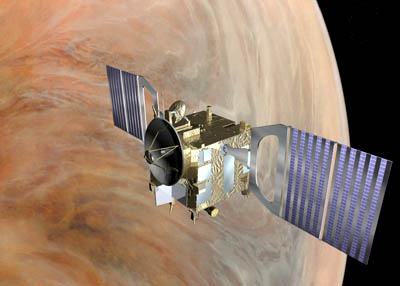
Artist view of ESA Venus Express in orbit.

Credit: ESA

In 1979, the Pioneer Venus orbiter spotted a huge hourglass-shaped depression in the clouds, some 2000 km across, at the centre of the north polar vortex.

However, other than brief glimpses from the Pioneer Venus and Mariner 10 missions in the 1970s, Venus' south pole had not been seen in detail until ESA's Venus Express first entered orbit in April 2006.

One of Venus Express' first discoveries, made during its very first orbit, was confirming the existence of a huge atmospheric vortex circulation at the south pole with a shape matching the one glimpsed at the north pole.

This south polar vortex is a turbulent mix of warming and cooling gases, all surrounded by a 'collar' of cool air.

Follow-up Venus Express observations in 2007, including this image, showed that the core of the vortex changes shape on a daily basis.

Just four hours after this image the vortex looked very different and a day later it had morphed into a squashed shape unrecognisable from the eye-like structure here.

A video of the vortex, made from 10 images taken over a period of five hours, can be seen below. The vortex rotates with a period of around 44 hours.

The dynamic nature of the South polar vortex can be seen in this video sequence, composed of images obtained on 7 April 2007. 

The video is composed of a series of ten images taken over a period of five hours at half-hourly intervals, at a wavelength of 3.9 micrometres. 

The vortex is rotating with a period of about 44 hours. In video, the point of view of the observer has been rotated at the same rate so that the vortex appears stationary in the centre of the image. 

These images were obtained as part of the ‘VIRTIS movie’ sequence, previously reported on 7 May 2007. 

This movie shows that the vortex is very complex, with atmospheric gases flowing in different directions at different altitudes. 

The bright region at the top-centre appears to be the most active region and its brightness suggests that it is where atmospheric gases are flowing downward. 

Extending leftward from this point is an ‘S’-shaped feature which is seen frequently in the polar vortex. 

A very similar feature was observed at the northern polar vortex in 1979 by Pioneer Venus. 

Credit: ESA/VIRTIS/INAF-IASF/Obs. de Paris-LESIA/Univ. of Oxford

The swirling region shown in this VIRTIS image is about 60 km above the planet's surface. Venus' south pole is located just up and to the left of the image centre, slightly above the wispy 'eye' itself.

This image was obtained on 7 April 2007 at a wavelength of 5.02 micrometres. It shows thermal-infrared emission from the cloud tops; brighter regions like the 'eye' of the vortex are at lower altitude and therefore hotter.

Friday, December 5, 2014

ESA Venus Express: ESOC have lost contact with Spacecraft

Artist's impression of Venus Express 

Credit: ESA (Image by AOES Medialab)

On 28 November 2014, the flight control team at ESOC reported loss of contact with Venus Express (VEX).

It is possible that the remaining fuel on board VEX was exhausted during the recent periapsis-raising manoeuvres and that the spacecraft is no longer in a stable attitude (the spacecraft’s high-gain antenna must be kept pointed toward Earth to ensure reliable radio contact).

Repeated attempts to re-establish contact using ESA and NASA deep-space tracking stations have been made since then, and there has been some limited success in the period since 3 December.

Although a stable telemetry link is not available, some telemetry packets were successfully downlinked.

These confirm that the spacecraft is oriented with its solar arrays pointing toward the Sun, and is rotating slowly.

The operations team is currently attempting to downlink the table of critical events that is stored in protected memory on board, which may give details of the sequence of events which occurred over the past few days.

The root cause of the anomaly (fuel situation or otherwise) remains to be established.

ESA will provide an update as soon as something more concrete is known.

Tuesday, July 29, 2014

ESA Venus Express climbs to new orbit post aerobraking

Venus Express aerobraking. 

Credit: ESA - C. Carreau

ESA's Venus Express spacecraft has climbed to a new orbit following its daring aerobraking experiment, and will now resume observations of this fascinating planet for at least a few more months.

The orbit-raising followed a month of aerobraking that saw the spacecraft surf in and out of the atmosphere at altitudes typically between 131 km and 135 km for a couple of minutes on each of its closest approaches to the planet.

Before, normal operations involved an elliptical orbit every 24 hours that took Venus Express from 66 000 km over the south pole down to around 250 km at the north pole, just above the top of the atmosphere.

But, after eight years and with propellant running low, the Venus Express team began a daring aerobraking campaign, dipping the craft progressively lower into the atmosphere on its closest approaches.

The experiment directly explored previously uncharted regions of the atmosphere, while also providing information on how a spacecraft responds when encountering the tenuous upper reaches of an atmosphere at high speed.

Aerobraking can be used to reduce the speed of a spacecraft approaching a planet or moon with an atmosphere, allowing it to be captured into orbit, and to move from an elliptical orbit to a more circular one.

Less fuel has to be carried, yielding benefits all round.

The technique will be used on future missions and the Venus Express experiments will help guide their design.

"We have collected valuable data on the Venusian atmosphere in a region difficult to characterise by other means," says HÃ¥kan Svedhem, ESA's Venus Express project scientist.

"The results show that the atmosphere seems to be more variable than previously thought for this altitude range, but further analysis will be needed in order to explain these variations properly."

Between altitudes of 165 km and 130 km, the atmospheric density increases by a factor of roughly a thousand, meaning that the forces and stress encountered by Venus Express were much higher than during normal operations.

It also experienced extreme heating cycles, with temperatures rising by over 100°C during several 100 second-long passages through the atmosphere.

In addition, the atmospheric drag at these lower altitudes was so great that the spacecraft's orbital period was reduced by more than an hour.


The Venusian cloud tops during nearly a full orbit of ESA’s Venus Express around the planet. 

The inset shows the corresponding position and relative speed of Venus Express as it approaches from its furthest distance of 66 000 km above the south pole, swooping down to 250 km above the north pole.

The images were captured by the Venus Monitoring Camera on 7–8 January 2012 and are shown in false colour.

Credit: ESA Venus Express

"The spacecraft has proven to be very robust and has apparently experienced no substantial degradation in any area, but a detailed evaluation is still to take place," says Joerg Fischer, Venus Express operations engineer.

At the end of the campaign, 15 thruster burns raised the craft's altitude, preventing it from dropping into the atmosphere.

The last was executed on Thursday evening, boosting Venus Express to a new altitude of 460 km at its closest and 63 000 km at its furthest. This new orbit takes 22 hours 24 minutes to complete.

"During the 15 manoeuvres, each thruster fired more than 8000 pulses and burned a total of about 5.2 kg of propellant to raise the spacecraft to this new altitude," adds Joerg.

This orbit will slowly decay again under gravity, but with only a few kilograms of fuel at most now remaining further altitude-raising manoeuvres may not be possible.

If no further corrections are made, Venus Express will probably reenter the atmosphere again in December, but this time for good, ending the mission.

In the meantime, having survived not only the aerobraking experiment but also the most recent orbit-raising manoeuvres, all of the science experiments will be reactivated, continuing their detailed study of Venus for at least a few more months.

"We are delighted with the success of the experimental aerobraking campaign, and are looking forward to assessing the details over the coming months," says Patrick Martin, mission manager.

"Meanwhile, we are enjoying the view from our new orbit around Venus, and plan to continue augmenting the scientific return of this exciting mission."

Monday, June 9, 2014

ESA Space Weather reports for Venus

This image is part of the Venus space weather report issued 5 June 2014.

During May-August 2014, ground controllers flying ESA's Venus Express will receive daily reports on solar activity issued by experts at ESA’s Space Weather Coordination Centre (SSCC), at the Space Pole in Belgium.

Credit: ESA

The weather updates will deliver the best information from a variety of sources, including ESA’s Proba-2 and solar-orbiting ESA and NASA spacecraft, to the control team as rapidly as possible.

For the first time, ESA is providing regular space-weather reports for a spacecraft orbiting another planet.

When your spacecraft is surfing deep into the atmosphere of an alien world, you need the latest information on conditions that could affect your trajectory.

If that planet is Venus, that means knowing what’s happening on our Sun in real time, because solar activity can greatly influence conditions like atmospheric density and the radiation environment at Earth’s closest neighbour.

Since May, ground controllers flying Venus Express have been receiving daily reports on solar activity issued by experts at ESA’s Space Weather Coordination Centre (SSCC), at the Space Pole in Belgium.

Surfing the Venus atmosphere 
The centre was established by the Agency’s Space Situational Awareness (SSA) programme office, and it began delivering precursor space-weather services for terrestrial clients in last year.

Now that Venus Express has completed its eight-year scientific mission, the reports are especially important as the control team take the satellite through an extraordinary multi-week ‘aerobraking’ campaign.

Artistic vision of Venus Express during the aerobraking manoeuvre, which will see the spacecraft orbiting Venus at an altitude of around 130 km from 18 June to 11 July. 

In the month before, the altitude will gradually be reduced from around 200 km to 130 km. 

If the spacecraft survives and fuel permits, the elevation of the orbit will be raised back up to approximately 450 km, allowing operations to continue for a further few months. 

Eventually, however, the spacecraft will plunge back into the atmosphere and the mission will end.

Aerobraking means lowering the spacecraft so that for part of each orbit it dips down very low and skims through the very uppermost reaches of the Venusian atmosphere,” notes Adam Williams, Deputy Spacecraft Operations Manager.

“We know that the current state of our Sun can affect Venus’ atmosphere, which could in turn impact the planned orbit of Venus Express as it passes through the atmosphere.”

Adam says that the team do not expect to replan any of the aerobraking orbits based on ‘typical’ solar activity levels.

“The space weather reports will, however, allow us to better understand anomalous behaviour that we may subsequently observe on the spacecraft.

“And in extreme cases, we would be more ready to react to a serious situation. For example, if our startrackers were to be overloaded by radiation.”

Sunday, May 18, 2014

ESA Venus Express VITRIS: Ready to aerobrake through planet's atmosphere

This global view of the southern hemisphere of Venus is a mosaic of images obtained by the Visible and Infrared Thermal Imaging Spectrometer (VIRTIS) on board ESA’s Venus Express on 16 May 2006. 

The night-side hemisphere (in red at the top) is made of infrared images taken at 1.74 micrometres, showing the lower layers of the cloud deck surrounding the planet at about 45-km altitude. 

The day-side hemisphere (in blue at the bottom) is made of ultraviolet images taken at 480 nanometres. 

It shows the cloud top layer at about 65-km altitude. 

The red part of the central panel was taken at 3.8 micrometres, and shows the double vortex at the south pole, at an altitude of about 60 km, surrounded by a collar of ‘cold’ air. 

Credit: ESA /VIRTIS-VenusX IASF-INAF, Observatoire de Paris (R.Hueso, Univ. Bilbao)

Saturday, May 17, 2014

ESA Venus express prepared for Daring Dive into Venus' Atmosphere - Video


A European spacecraft will plunge into Venus' thick atmosphere next month in a bold maneuver that may bring its lengthy and productive mission to a dramatic end.

The European Space Agency (ESA) Venus Express probe, which has been circling Earth's hellishly hot "sister planet" for eight years, is running low on fuel.

So mission officials wrapped up routine science operations this week to begin preparing Venus Express for a deep dive into the planet's fast-swirling air.

"We have performed previous short 'aerodrag' campaigns where we've skimmed the thin upper layers of the atmosphere at about 165 kilometers [103 miles], but we want to go deeper, perhaps as deep as 130 kilometers [81 miles], maybe even lower," Venus Express mission manager Patrick Martin said in a statement.

Visualization of Venus Express during the aerobraking maneuver, which will see the spacecraft orbiting Venus at an altitude of around 130 km from 18 June to 11 July. 

If the spacecraft survives and fuel permits, it will be raised back up to approximately 450 km, allowing operations to continue for a few more months. 

Eventually, however, the spacecraft will plunge back into the atmosphere and the mission will end.

Credit: ESA–C. Carreau


"It is only by carrying out daring operations like these that we can gain new insights, not only about usually inaccessible regions of the planet's atmosphere, but also how the spacecraft and its components respond to such a hostile environment," Martin added.

Venus Express will take temperature and pressure measurements and gather other science data during the dive, which is scheduled to take place from June 18 through July 11. But mission officials expect the "aerobraking" maneuver will have other benefits as well.

"The campaign also provides the opportunity to develop and practice the critical operations techniques required for aerobraking, an experience that will be precious for the preparation of future planetary missions that may require it operationally," Paolo Ferri, head of mission operations for Venus Express, said in a statement.

Tuesday, March 11, 2014

ESA Venus Express spies rainbow-like 'glories' in Venus atmosphere

False colour composite of a ‘glory’ seen on Venus on 24 July 2011. 

The image is composed of three images at ultraviolet, visible, and near-infrared wavelengths from the Venus Monitoring Camera (VMC)

The images were taken 10 seconds apart and, due to the motion of the spacecraft, do not overlap perfectly. 

The glory is 1200 km across, as seen from the spacecraft, 6000 km away. 

Credit: ESA /MPS /DLR /IDA

INTERACTIVE 3D MODEL OF THE VENUS EXPRESS

A rainbow-like feature known as a 'glory' has been seen by ESA's Venus Express orbiter in the atmosphere of our nearest neighbour – the first time one has been fully imaged on another planet.

Rainbows and glories occur when sunlight shines on cloud droplets – water particles in the case of Earth.

While rainbows arch across wide swathes of the sky, glories are typically much smaller and comprise a series of coloured concentric rings centred on a bright core.

Glories are only seen when the observer is situated directly between the Sun and the cloud particles that are reflecting sunlight.

On Earth, they are often seen from aeroplanes, surrounding the shadow of the aircraft on the clouds below, or around the shadow of climbers atop misty mountain peaks.

A glory requires two characteristics: the cloud particles are spherical, and therefore most likely liquid droplets, and they are all of a similar size.

The atmosphere of Venus is thought to contain droplets rich in sulphuric acid.

By imaging the clouds with the Sun directly behind the Venus Express spacecraft, scientists hoped to spot a glory in order to determine important characteristics of the cloud droplets.

They were successful. The glory in the images here was seen at the Venus cloud tops, 70 km above the planet's surface, on 24 July 2011.

It is 1200 km wide as seen from the spacecraft, 6000 km away.

From these observations, the cloud particles are estimated to be 1.2 micrometres across, roughly a fiftieth of the width of a human hair.

The fact that the glory is 1200 km wide means that the particles at the cloud tops are uniform on this scale at least.

The variations of brightness of the rings of the observed glory is different than that expected from clouds of only sulphuric acid mixed with water, suggesting that other chemistry may be at play.

Simulated views of the glory phenomena on Venus (left) and Earth (right), without considering any effects of haze or background cloud brightness.

Glories occur when sunlight shines on cloud droplets – water particles in the case of Earth, sulphuric acid particles for Venus.

The main difference between the appearance of the glory on Venus and on Earth is not because of composition, but rather the particle size.

Cloud droplets on Earth are typically between 10 and 40 thousandths of a millimetre in diameter, but on Venus the droplets found at the cloud tops are much smaller, typically no more than 2 thousandths of a millimetre across. 

Because of this, the coloured fringes are further apart than they would appear on Earth. 

Credit: C. Wilson/P. Laven

One idea is that the cause is the "UV-absorber", an unknown atmospheric component responsible for mysterious dark markings seen in the cloud tops of Venus at ultraviolet wavelengths. More investigation is needed to draw a firm conclusion.

More information: "Glory on Venus Cloud Tops and the Unknown UV Absorber," by W.J. Markiewicz et al, is accepted for publication in Icarus. dx.doi.org/10.1016/j.icarus.2014.01.030

Friday, February 21, 2014

ESA Venus Express: Planet-sized space weather explosions

Giant perturbations called hot flow anomalies in the solar wind near Venus can pull the upper layers of its atmosphere, the ionosphere, up and away from the surface of the planet. 

Credit: NASA

Researchers recently discovered that a common space weather phenomenon on the outskirts of Earth's magnetic bubble, the magnetosphere, has much larger repercussions for Venus.

The giant explosions, called hot flow anomalies, can be so large at Venus that they're bigger than the entire planet and they can happen multiple times a day.

"Not only are they gigantic," said Glyn Collinson, a space scientist at NASA's Goddard Space Flight Center in Greenbelt, Md.

"But as Venus doesn't have a magnetic field to protect itself, the hot flow anomalies happen right on top of the planet. They could swallow the planet whole."

Collinson is the first author of a paper on these results that appeared online in the Journal of Geophysical Research in February 2014.

The work is based on observations from the European Space Agency's Venus Express.

The results show just how large and how frequent this kind of space weather is at Venus.

Earth is protected from the constant streaming solar wind of radiation by its magnetosphere. Venus, however, has no such luck.

A barren, inhospitable planet, with an atmosphere so dense that spacecraft landing there are crushed within hours, Venus has no magnetic protection.

Scientists like to compare the two: What happened differently at Earth to make it into the life-supporting planet it is today? What would Earth be like without its magnetic field?

At Earth, hot flow anomalies do not make it inside the magnetosphere, but they release so much energy just outside that the solar wind is deflected, and can be forced to move back toward the sun.

Without a magnetosphere, what happens at Venus is very different.

Venus's only protection from the solar wind is the charged outer layer of its atmosphere called the ionosphere.

A sensitive pressure balance exists between the ionosphere and the solar wind, a balance easily disrupted by the giant energy rush of a hot flow anomaly.

The hot flow anomalies may create dramatic, planet-scale disruptions, possibly sucking the ionosphere up and away from the surface of the planet.

More Information: 'Ionospheric photoelectrons at Venus: Initial observations by ASPERA-4 ELS': Journal of Geophysical Research in February 2014 dx.doi.org/10.1016/j.pss.2007.12.008

Tuesday, June 18, 2013

ESA Venus Express: Super-hurricane-force winds on Venus are getting stronger

False-colour image of cloud features seen on Venus by the Venus Monitoring Camera (VMC) on Venus Express

The image was captured from a distance of 30 000 km on 8 December 2011. 

The VMC was designed and built by a consortium of German institutes lead by the Max-Planck Institute for Solar System Research in Katlenburg-Lindau. 

Credit: ESA

As the closest planet to Earth, Venus is a relatively easy object to observe.

However, many mysteries remain, not least the super-rotation of Venus' atmosphere, which enables high altitude winds to circle the planet in only four days.

Now images of cloud features sent back by ESA's Venus Express orbiter have revealed that these remarkably rapid winds are becoming even faster.

Similar in size to Earth, Venus has an extremely dense, carbon-dioxide-rich atmosphere and the planet's surface is completely hidden by a blanket of bland, yellowish cloud.

Only at ultraviolet wavelengths (and to a lesser extent in the infrared) do striking cloud streaks and individual cells emerge, due to the presence of some unknown UV absorber in the cloud deck.

By tracking the movements of these distinct cloud features, observers have been able to measure the super-hurricane-force winds that sweep around the planet at the cloud tops, some 70 km above the scorching volcanic plains.

Despite decades of observation from the ground and from spacecraft, a number of mysteries remain.
  • What causes the remarkable super-rotation of Venus' atmosphere – so called because the upper winds travel 50 times faster than the planet's rate of rotation? 
  • How do the winds vary with latitude and longitude? 
  • How much do they change over time?
The answers to some of these questions are being provided by instruments on board Venus Express, such as the Venus Monitoring Camera (VMC), which have been observing the atmosphere for 10 Venus years – equivalent to 6 Earth years.

Venus Monitoring Camera (VMC)
The VMC acquires instantaneous snapshots of Venus at UV and near-infrared wavelengths.

Simultaneous imaging in these wavebands makes it possible to detect and track cloud features, and thus derive wind data, at two different levels - approximately 70 km and 60 km above the surface.

Venus Express follows a 24 hour orbit which approaches to approximately 250 km above the north pole, before moving out to a distance of 66 000 km above the south pole.

This highly elliptical path provides particularly good viewing conditions for the entire southern hemisphere, while enabling higher resolution, small scale images of the northern hemisphere.

These factors combined mean that VMC imagery provides, for the first time, an opportunity to study cloud level winds with high spatial and temporal resolution over a time scale of more than half a decade.

The latest analyses of Venus' cloud motions and wind speeds, based on VMC data, have been made by two independent teams - one led by a Russian group (Khatuntsev et al.) and the other by a Japanese group (Kouyama et al.).

By painstakingly measuring how cloud features in VMC images move between frames, the two groups have been able to reveal new patterns in the planet's circulation.

"We analysed images obtained during 127 orbits with a manual cloud tracking method, and 600 orbits with a digital correlation method," said Igor Khatuntsev from the Space Research Institute in Moscow, lead author of a paper in the journal Icarus.

"Over 45 000 features were tracked by human visual comparisons, and more than 350 000 features were tracked automatically using a computer programme."

The manual method of wind speed measurements consisted of tracking motions of high contrast cloud features in pairs of images taken at different times.

This allowed better recognition of cloud patterns and was more reliable than the digital method in middle to high latitudes, where clouds tend to be streaky, or where contrast was low.

The problem with this method is that it is very time consuming.

On the other hand, the digital tracking technique was capable of streamlining image processing and producing 10 times the number of wind vectors.

Both methods were in good agreement at low latitudes (below 40 degrees), but digital tracking was preferred for studying temporal variations of the mean (average) rate of flow.

The Japanese-Swedish team relied solely upon their own automated cloud tracking method to derive their motion from images taken about one hour apart, at latitudes between 55°S and 70°S.

A specially developed mathematical formula was used to reduce errors in the image analysis. This team's analysis is published in the Journal of Geophysical Research.

More information: I. Khatuntsev et al., Cloud level winds from the Venus Express Monitoring Camera imaging, accepted for publication in the Journal Icarus; doi:10.1016/j.icarus.2013.05.018

T. Kouyama et al., Long-term variation in the cloud-tracked zonal velocities at the cloud top of Venus deduced from Venus Express VMC images. In press at Journal of Geophysical Research - Planets; doi:10.1029/2011JE004013.

Wednesday, May 29, 2013

ESA Venus Express: Venus Dried Out Because It's Closer to Sun

This false-colour image of cloud features seen on Venus by the Venus Monitoring Camera (VMC) on the European Space Agency's Venus Express.

The image was captured from a distance of 30 000 km on 8 December 2011. 

ESA Venus Express has been in orbit around the planet since 2006.

CREDIT: ESA/MPS/DLR/IDA

Taking a closer look at the history of Venus, including how the planet transformed into a hellish hot house, may help astronomers predict the evolution of alien worlds, scientists say.

Ultraviolet rays from the sun sapped Venus' atmosphere of water during the planet's evolution, keeping it in a "prolonged molten state" for longer than Earth's molten state, a team of Japanese scientists has found.

Venus' vastly different environment came because it formed closer to the sun than Earth did, the researchers said.

With alien planets now a planetary-science frontier, studying Venus — which is within easy reach of Earth — will give clues about what to look for in exoplanet surfaces, they added.

"In a situation such [that] a magma ocean sustains very long, the planets are covered with a thick atmosphere.

Therefore, unfortunately, it would be difficult to observe their surface temperatures directly," said Keiko Hamano, a planetary scientist with Tokyo University who led the research.

"According to previous studies, however," he added, "hot atmospheres could contain unique species, such as alkali- and halogen-bearing gases. So, we hope to recognize hot surfaces indirectly by detecting their signatures on future missions."

Friday, February 1, 2013

ESA Venus Express: Venus's Tail in the Solar Wind

A comparison of the ionosphere of Venus under different solar wind conditions. 

Credit: ESA/Wei et al. (2012).

Measurements obtained with ESA's Venus Express spacecraft have shed new light on the interaction between the solar wind and the second planet from the Sun.

During a rare period of very low density solar outflow, the ionosphere of Venus was observed to become elongated downstream, rather like a long-tailed comet.

Scientists have long known about the existence of the solar wind, a continuous outflow of electrons and protons which flows at high speed across interplanetary space. However, this stream of charged particles is highly variable, both in speed and density.

Under normal conditions, the solar wind has a density of 5 - 10 particles per cubic cm at Earth's orbit, but occasionally the solar wind almost disappears, as happened in May 1999.

Although such unusual episodes have been studied near Earth, which is surrounded by a strong magnetic field, there have been very few opportunities to study what happens near planets with negligible magnetic fields, such as Venus.

A rare opportunity to examine what happens when a tenuous solar wind arrives at Venus came 3 - 4 August 2010, following a series of large coronal mass ejections on the Sun.

NASA's STEREO-B spacecraft, orbiting downstream from Venus, observed that the solar wind density at Earth's orbit dropped to the remarkably low figure of 0.1 particles per cubic cm and persisted at this value for an entire day.

Meanwhile, Venus Express, which is in an extremely elliptical, near-polar orbit, was able to study the interaction between this sparse solar wind and the planet's ionosphere - the electrically charged region of its upper atmosphere.

The ionosphere is created by incoming extreme ultraviolet light and X-rays from the Sun which splits the atoms in the upper atmosphere of Venus and creates a layer of electrons and ions.

Saturday, December 8, 2012

ESA Venus Express: Clues Point to Active Volcanoes


New evidence hints that Venus may be volcanically active, which has long been a controversial topic among scientists.

Six years of observations by the European Space Agency's Venus Express spacecraft have shown significant changes in the sulphur dioxide content of the planet's atmosphere over time, which could be explained by a bout of volcanism.

Immediately after arriving at Venus in 2006, the spacecraft recorded a significant increase in the average density of sulfur dioxide in the upper atmosphere, followed by a sharp decrease, according to a release from the European Space Agency (ESA).

Venus' atmosphere contains much higher levels of sulphur dioxide than on Earth. On our planet, the smelly, toxic gas is produced by volcanoes.

Sulphur dioxide doesn't last long in Venus' upper atmosphere, because it is broken down by sunlight. Any sulphur dioxide in the upper regions must have recently arrived there from the thick protective clouds that swirl beneath.

Some scientists think that the spike in sulphur dioxide suggests that a large volcano, or several volcanoes, must have erupted.

Venus is covered in hundreds of volcanoes, but whether they remain active today is much debated, and settling this question is an important scientific goal for Venus Express.

Monday, October 8, 2012

ESA Venus Express Image: Chasing clouds

Clouds regularly punctuate Earth's blue sky, but on Venus the clouds never part, for the planet is wrapped entirely in a 20 km-thick veil of carbon dioxide and sulphuric dioxide haze. 

This view shows the cloud tops of Venus as seen in ultraviolet light by ESA Venus Express spacecraft from a distance of about 30 000 km. 

Much of the image is occupied by the planet's southern hemisphere, with the south pole at the bottom of the frame and the equator close to the top.

The visible top cloud layer seen in the image is about 70 km above the planet's surface.

The observed pattern of bright and dark markings is caused by variations in an unknown absorbing chemical at the Venus cloud tops.

It is abundant in the low latitudes (upper part of the image) that make this region look dark in UV.

In the brighter high latitudes (lower part of the image), the UV absorber is either in deficit or masked by a thick haze of a reflecting aerosol.

The shapes of the cloud top features show evidence of vigorous circulation and dynamics in the planet's atmosphere.

At low latitudes, mottled cloud formations associated with turbulent activities are seen, while smooth, laminar flows are visible in middle to high latitudes.

The wind speed is derived from tracking cloud features as they whip around the planet faster than 100 metres per second.

This 'super-rotating' atmosphere completes one circuit every four Earth days, in comparison to the planet's surface, which takes 224 days to complete one revolution about its axis.

Saturday, April 21, 2012

ESA Venus Express unravels mysteries of the shrouded planet

Venus is sometimes referred to as Earth's sister planet. It has an atmosphere and a weather system, and it is of similar size and density to our own planet.

However it is the Venusian atmosphere that is the most striking contrast between the two planets.

The thick, choking clouds trap heat on the planet, causing the surface temperature to reach an average 465 degrees Celsius.

The atmosphere also makes studies of Venus difficult, as it shields the surface from view.

The first scientific studies of Venus from orbit were performed during a flyby in 1962 by Mariner 2. Other craft have also attempted to peer through the haze of Venus, such as the Russian Venera orbiters and landers.

Unlike Mars, where rovers can roam the surface for years, the Venera landers lasted no longer than 2 hours due to the crushing surface pressure of 90 bar.

The latest era of Venusian exploration is being performed courtesy of the European Space Agency's Venus Express (VEX).

Venus Express was launched on 9 November 2005 aboard a Soyuz-Fregat rocket from the Baikonur Cosmodrome in Kazakhstan.

VEX entered orbit around Venus on 11 April 2006.

The mission was designed to last four days – Venusian days that is. Venus rotates very slowly, so one rotation of Venus is equivalent to 243 days on Earth.

The mission has been extended until 2014, pending a review later this year to prove that the craft is still in a good working condition.

The mission extension will see VEX continue to study the atmosphere of Venus in order to seek out any long term trends present, as well as monitor the planet during the peak of the solar cycle.

Venus Express reuses parts of the Mars Express design, such as the structural design, propulsion system and the use of dual solar arrays.

However VEX receives four times more radiation than Mars Express, so it has been modified to account for this, such as being gold instead of black to reflect the Sun's radiation.

VEX set out with a lengthy list of questions to answer about our mysterious “sister planet”, such as seeking out seismic activity, finding what drives the atmospheric escape, learning about the speedy winds and atmospheric rotation, and discovering how the cloud system works.

“Venus Express has successfully achieved almost all science goals stated in the mission proposal 10 years ago,” says ESA's Dmitrij Titov.

“I think the major result of VEX is that the mission has provided a comprehensive survey of the Venus atmosphere and plasma environment over the period of 6 years. Is there anything left to do? Yes. Observations of such a complex system as the Venus atmosphere require as long as possible extension, that would help to study its long term behaviour.”

Six years after entering orbit around Venus, around 250 scientific papers using results from VEX have been published detailing many of the discoveries by the orbiter. VEX uses seven scientific instruments to survey the planet and learn about why it became such a hostile environment.

The Analyser of Space Plasma and Energetic Atoms (ASPERA) instrument keeps a watchful eye on particles escaping Venus' atmosphere, and this data has allowed astronomers to calculate the escape rates of hydrogen, helium, and oxygen.

Studies have revealed that Earth loses more of its atmosphere to space than Venus does, yet it was thought that the Earth’s magnetic field would offer more protection compared to a planet that only has a weak induced magnetic field.

The magnetic field on Venus is caused by the solar wind interacting with the planet’s atmosphere, and the field is measured by the Venus Express Magnetometer (MAG).

Venus Express unravels mysteries of the shrouded planet

Friday, March 16, 2012

ESA Venus Express restarts science investigations - images


The active Sun Spot group AR1429 (top centre in this image) is a very active solar region that recently produced two major solar flares with coronal mass ejections. 

The first was an X1-class flare on 5 March 2012 04:13UTC, and the second, even more powerful, an X5-class flare, on 7 March 2012 at 00:28 UTC. 

Several spacecraft were affected by the resulting strong radiation, wave of solar plasma and energetic particles. 

For example, the star tracker cameras on board Venus Express were temporarily 'blinded' for several days due to the harsh plasma environment in the aftermath of the CME cloud shock wave.

Credits: ESA/ Michel Breitfellner, Miguel Pérez Ayúcar, Manuel Castillo - ESAC
ESA’s Venus Express spacecraft has returned to routine operation after its startracker cameras were temporarily blinded last week by radiation from a pair of large solar flares.

Science observations by ESA’s Venus Express were temporarily suspended on 7 March after the two startrackers, used to help navigate and orient the spacecraft, were overwhelmed by excessive proton radiation.

The proton storm stemmed from the Coronal Mass Ejections (CMEs) emitted by the Sun, which were associated with a pair of massive solar flares that occurred early in the morning on 7 March.

With the startrackers unable to function properly, mission controllers at ESOC, ESA’s European Space Operations Centre, Darmstadt, had to place the spacecraft into a special mode to ride out the storm.

This meant that all instruments were switched off and routine scientific observations and data gathering were stopped.

“As the radiation faded, the startrackers began functioning normally again on 9 March,” said Octavio Camino, ESA’s Spacecraft Operations Manager.

“After taking some time to conduct a series of thorough spacecraft health checks, Venus Express returned to regular science operations on 12 March at 20:20 GMT.”

Waiting out the storm
This month, Venus Express is going through ‘quadrature’: a period of about five weeks during which the Sun-spacecraft-Earth angle is between 75° and 95°. They occur twice every 19 months.

During quadrature, the spacecraft must maintain a special orientation so that certain instruments are not over-exposed to sunlight and the radio antenna can still be pointed to Earth.

“At any time, if a problem is autonomously detected onboard, the spacecraft might place itself into ‘safe mode’,” says Octavio.

However, if a safe mode were to happen during quadrature operations, and the startrackers were not operating, it would be much more difficult to return the spacecraft to normal operations.

“To be very cautious, we simply stopped science activities to wait out the proton storm,” says Octavio.

The mission operations team used the gyroscopes to maintain a safe attitude while waiting for the startrackers to return to normal.

Thursday, March 1, 2012

A bad day on Venus gets even worse

Contrary to its alluring name, Venus is the planet from hell, with an atmosphere so hot, toxic and heavy that any visitor would risk being simultaneously melted, suffocated and crushed.

But not just that: the second planet from the Sun turns on its axis so slowly that, for any survivor, a Venusian day would seem interminable, for it is the equivalent of 243 days on Earth.

To make things worse, a day on Venus is getting even longer, French astronomers have discovered.

A team from the Paris Observatory analysed data from a spectrometer aboard a European orbiter, the Venus Express.

Called VIRTIS, the gadget measures infrared and visible light and is used to scan the planet's surface beneath the thick, roiling atmosphere.

The astronomers were stunned when they checked landmarks against the last mapping of Venus, carried out between 1990 and 1994 by the US probe Magellan.

At a given point in the Venusian day, landmarks were a full 20 kilometers (12 miles) behind where they should have been.

The team, publishing in the journal Icarus, say they have been over the observations again and again.

"After eliminating possible sources of error, we believe that the duration of the Venusian day must have changed over the 16 years," they said in a press release.

Their calculation is that an extra six and a half terrestial minutes have been added to the Venusian day during this time.

"On the astronomical scale, this is a major change," said VIRTIS investigator Pierre Drossart.

Pierre Drossart is depicted here in an ESA Video on the Venus Express, along with his ESA collegues, explaining the thinking behind the Venus Express mission.

The astronomers' hypothesis is that friction by Venus' atmosphere is braking the movement of the terrain below.

That sounds bizarre until one realises that the atmosphere is 100 kms (60 miles) thick, with extremely dense clouds of 96 percent carbon dioxide, driven by superwinds reaching some 350 kilometres (210 miles) per hour.

Atmospheric pressure at the surface is 92 times that of Earth -- the equivalent of being more than 900 metres (3,000 feet) below the ocean.

"A braking effect from the atmosphere also occurs erratically on Earth, but the discrepancy is only a matter of a few tenths of a second and it is imperceptible," Drossart told AFP.

So will Venus eventually stop spinning -- or even go into reverse rotation?

"It's difficult to say, given that we only have two points of measurement," said Drossart.

"But theoretical models suggest that this is probably just a cyclical phenomenon. If the atmosphere speeds up, the planet slows. Then the energy goes into reverse, in a pendulum effect."

Friday, February 10, 2012

ESA Venus Express: Is Venus shifting gear?

ESA’s Venus Express spacecraft has discovered that our cloud-covered neighbour spins a little slower than previously measured.

Peering through the dense atmosphere in the infrared, the orbiter found surface features were not quite where they should be.

Using the VIRTIS instrument at infrared wavelengths to penetrate the thick cloud cover, scientists studied surface features and discovered that some were displaced by up to 20 km from where they should be given the accepted rotation rate as measured by NASA’s Magellan orbiter in the early 1990s.

These detailed measurements from orbit are helping scientists determine whether Venus has a solid or liquid core, which will help our understanding of the planet’s creation and how it evolved.

If Venus has a solid core, its mass must be more concentrated towards the centre. In this case, the planet’s rotation would react less to external forces.

The most important of those forces is due to the dense atmosphere – more than 90 times the pressure of Earth’s and high-speed weather systems, which are believed to change the planet’s rotation rate through friction with the surface.

Earth experiences a similar effect, where it is largely caused by wind and tides. The length of an Earth day can change by roughly a millisecond and depends seasonally with wind patterns and temperatures over the course of a year.

In the 1980s and 1990s, the Venera and Magellan orbiters made radar maps of the surface of Venus, long shrouded in mystery as well as a dense, crushing and poisonous atmosphere. These maps gave us our first detailed global view of this unique and hostile world.

Over its four-year mission, Magellan was able to watch features rotate under the spacecraft, allowing scientists to determine the length of the day on Venus as being equal to 243.0185 Earth days. .

However, surface features seen by Venus Express some 16 years later could only be lined up with those observed by Magellan if the length of the Venus day is on average 6.5 minutes longer than Magellan measured.

Wednesday, November 9, 2011

ESA Venus Express: Earth’s twin planet?

Mars, Earth and Venus are immersed in a flow of plasma, an ionised and highly variable gas originating from the Sun, called the solar wind.

While Earth has a planetary magnetic field, which can deviate the flow of solar wind, Venus (and Mars) don’t.

Gases in the upper atmospheres of these planets are ionised and can thus interact with the solar wind.

Venus is as large as Earth and it is difficult for its atmosphere to escape due to the planet’s gravity.

The solar wind is the best source of energy to accelerate the upper atmosphere’s charged particles, giving them enough energy to escape. This is why Venus loses its atmosphere due to interaction with the solar wind.

To understand this phenomenon, the key questions that the instruments studying plasma on Venus Express must answer are: what and how much of the atmosphere is lost, and where is it lost?

Right now, solar activity is at its minimum in the 11-year cycle, making the solar wind weaker than average. The critical question now is how solar wind interacts with Venus when solar activity is low.

 The magnetometer (MAG) on board ESA’s Venus Express detected wave signals that show evidence of lightning in the atmosphere.

Credits: ESA (Animation by C. Carreau)

Monday, October 10, 2011

ESA Venus Express finds has an ozone layer

Venus Express has two solar cell panels per wing comprising alternating rows of standard triple junction solar cells as well as highly reflective mirrors to reduce the operating temperatures. 

There is twice as much sunlight in Venus's orbit as there is in Earth's orbit, plus additional thermal input from the Venusian surface and atmosphere - 75% of sunlight being reflected up from it. In certain cases, this results in Venus Express receiving an equivalent of the thermal input from 3.5 Suns.

ESA's Venus Express spacecraft has discovered an ozone layer high in the atmosphere of Venus. Comparing its properties with those of the equivalent layers on Earth and Mars will help astronomers refine their searches for life on other planets.

Venus Express made the discovery while watching stars seen right at the edge of the planet set through its atmosphere. Its SPICAV instrument analysed the starlight, looking for the characteristic fingerprints of gases in the atmosphere as they absorbed light at specific wavelengths.

The ozone was detectable because it absorbed some of the ultraviolet from the starlight.

Ozone is a molecule containing three oxygen atoms. According to computer models, the ozone on Venus is formed when sunlight breaks up carbon dioxide molecules, releasing oxygen atoms.

These atoms are then swept around to the nightside of the planet by winds in the atmosphere: they can then combine to form two-atom oxygen molecules, but also sometimes three-atom ozone molecules. "This detection gives us an important constraint on understanding the chemistry of Venus' atmosphere," says Franck Montmessin, who led the research.

It may also offer a useful comparison for searching for life on other worlds.

Ozone has only previously been detected in the atmospheres of Earth and Mars. On Earth, it is of fundamental importance to life because it absorbs much of the Sun's harmful ultraviolet rays. Not only that, it is thought to have been generated by life itself in the first place.

The build-up of oxygen, and consequently ozone, in Earth's atmosphere began 2.4 billion years ago. Although the exact reasons for it are not entirely understood, microbes excreting oxygen as a waste gas must have played an important role.

Along with plant life, they continue to do so, constantly replenishing Earth's oxygen and ozone.

As a result, some astrobiologists have suggested that the simultaneous presence of carbon dioxide, oxygen and ozone in an atmosphere could be used to tell whether there could be life on the planet.

This would allow future telescopes to target planets around other stars and assess their habitability.

However, as these new results highlight, the amount of ozone is crucial.

The small amount of ozone in Mars' atmosphere has not been generated by life. There, it is the result of sunlight breaking up carbon dioxide molecules.

Venus too, now supports this view of a modest ozone build-up by non-biological means. Its ozone layer sits at an altitude of 100 km, about four times higher in the atmosphere than Earth's and is a hundred to a thousand times less dense.

Theoretical work by astrobiologists suggests that a planet's ozone concentration must be 20% of Earth's value before life should be considered as a cause.

These new results support that conclusion because Venus clearly remains below this threshold.

Sunday, April 10, 2011

ESA Science: The Shifting Southern Hemisphere of Venus

New analysis of images taken by ESA's Venus Express orbiter has revealed surprising details about the remarkable, shape-shifting collar of clouds that swirls around the planet's South Pole.

This fast-moving feature is all the more surprising since its centre of rotation is typically offset from the geographical pole.

The results of this study are published online in Science Express.

Several planets in the Solar System, including Earth, have been found to possess hurricane-like polar vortices, where clouds and winds rotate rapidly around the poles. Some of these take on strange shapes, such as the hexagonal structure on Saturn, but none of them are as variable or unstable as the southern polar vortex on Venus.

Scientists have known about the presence of swirling clouds around the poles of Venus since they were first imaged by Mariner 10 in 1974. At the same time, it was discovered that Venus' upper winds sweep westwards around the planet in only four days, 60 times faster than the rotation of the solid surface of the planet - a phenomenon known as superrotation.

Thermal infrared imagery from the Pioneer Venus spacecraft subsequently revealed an enormous depression in the cloud blanket at the North Pole. This relatively warm polar 'hole' was thought to be caused by downward movement of gases, rather like water flowing down a drain. However, detailed examination of the thick clouds and dense atmosphere over the South Pole had to wait until the arrival of Venus Express in April 2006.

During its first orbit around the planet, multi-wavelength observations confirmed for the first time the presence of a huge 'double-eye' atmospheric vortex at the planet's South Pole. Some 2000 km across, it was comparable to the structure that had previously been detected at the North Pole.

Since then, high-resolution infrared measurements obtained by the Visible and Infrared Thermal Imaging Spectrometer (VIRTIS) instrument on Venus Express have revealed that the southern vortex is far more complex than previously believed. The VIRTIS images, taken at wavelengths of 3.8 and 5.0 microns, are ideal for tracking polar features on both the day and night sides of the planet, probing the polar cloud layer at an altitude of about 65 km.

The new observations, reported this week in the journal Science on the Science Express website, show that the vortex has a highly variable shape and internal structure. Images show that its morphology is constantly changing on timescales of less than 24 hours, as a result of differential rotation.

"The southern vortex is very dynamic compared with a hurricane on Earth, which remains stable for several days," said Hakan Svedhem, ESA's Venus Express Project Scientist. "It can take almost any shape, so although it often looks like an 'S' or figure 8, it may become completely irregular, even chaotic, in appearance."

The rapid shape changes indicate complex weather patterns, which are strongly influenced by the fact that the centre of the vortex does not coincide with the geographical pole.