Showing posts with label Space Weather. Show all posts

Sunday, September 7, 2014

Curiosity captures images of Martian clouds

Clouds that are probably composed of ice crystals and possibly supercooled water droplets were caught in images by NASA’s Opportunity rover

Credit: NASA/JPL/Texas A&M/Cornell

Curiosity celebrated two years on Mars on August 5, 2014, and is continuing its progress across the surface of the planet.

The rover has already fulfilled one of its primary mission goals by confirming that environments theoretically capable of supporting microbial life were once present on ancient Mars.

Now Curiosity is continuing its journey toward the slopes of Mount Sharp and is currently headed for an outcrop dubbed 'Pahrump Hills.

In a tweet on September 2, 2014, Curiosity shared its view of the path ahead and proclaimed:

"Head for the hills! I'm driving towards these hills on Mars to do geology work & also search for clouds."

Curiosity is described as the first roving analytical laboratory on Mars, and has been cruising around the planet these past two years drilling rocks, zapping soil, and photographing layered outcrops.

The geological data that the mission has returned has been invaluable for astrobiologists trying to interpret Mars' past climate conditions but why is Curiosity also taking time to turn its instruments skyward?

Astrobiology Magazine spoke with Dr. Robert M. Haberle, Planetary Scientist at NASA Ames and a team member for the Rover Environmental Monitoring Station (REMS), and asked him why astrobiologists are curious about martian clouds.

"Clouds are part of the planet's climate system," explained Haberle. "Their behaviour tells us about winds and temperatures."

Studying weather and clouds on Mars today can shed light on processes that have shaped the planet's climate through time.

Bob M. Haberle
"Some studies suggest that clouds in the past may have significantly warmed the planet through a greenhouse effect. A warmer environment is more conducive to life," said Haberle.

Clouds are also connected to wind and weather patterns, and studying weather is important for interpreting how natural processes have shaped the rocks, dunes and outcrops that Curiosity has been photographing.

Haberle points out that, "winds are the primary mechanism for shaping the planet's surface for the past 3-4 billion years.

Studying martian weather can not only help us understand Mars' current climate, but also provides clues about its past environment and the physical processes that operate on the planet.

This information can in turn help astrobiologists interpret the planet's geological record.

REMS is an environmental monitoring station composed of six different sensors.

The instrument collects daily and seasonal data on wind, pressure, relative humidity, temperature and ultraviolet radiation at the martian surface.

REMS was contributed to the Mars Science Laboratory (MSL) mission by the the Centro de Astrobiologia (CAB) in Spain.

Thursday, August 21, 2014

NASA Studies of the ultraviolet sun

Four of the telescopes on the Solar Dynamics Observatory observe extreme ultraviolet light activity on the sun that is invisible to the naked eye. 

Credit: NASA/SDO

You cannot look at the sun without special filters, and the naked eye cannot perceive certain wavelengths of sunlight.

Solar physicists must consequently rely on spacecraft that can observe this invisible light before the atmosphere absorbs it.

"Certain wavelengths either do not make it through Earth's atmosphere or cannot be seen by our eyes, so we cannot use normal optical telescopes to look at the spectrum," said Dean Pesnell, the project scientist for the Solar Dynamics Observatory (SDO), at NASA's Goddard Space Flight Center in Greenbelt, Maryland.

Several spacecraft can observe these invisible light wavelengths. SDO for example has four telescopes that image the sun in the ultraviolet spectrum.

As beams of ultraviolet light pass into the telescope, a mirror with special coatings filters and amplifies the ultraviolet light's otherwise poor reflection.

The incoming photons are then recorded as pixels and converted into electrical signals, similar to how your cell phone camera sees visible light.

"It's exactly the same process, whether it's ultraviolet light, infrared light, visible light, or radio," said Joseph Gurman, project scientist for both the Solar and Heliospheric Observatory (SOHO) and the Solar Terrestrial Relations Observatory (STEREO) at Goddard.

"In this case we're trying to understand how the sun changes and how those changes affect life here on Earth."

Ultraviolet light causes molecular radiation damage to our skin, seen as sunburns that can lead to cancer.

Its cousin, extreme ultraviolet radiation, and the associated solar storms have the potential to disrupt communications and spacecraft navigation.

"These are very damaging, energetic photons, and we want to understand what chain of events produces these photons," Pesnell said.

The Solar Dynamics Observatory (SDO) observed a solar flare (upper left) and a coronal mass ejection (right) erupting from the sun’s limb in extreme ultraviolet light on August 6, 2010. 

Credit: NASA/SDO

Thankfully our planet's atmosphere absorbs much of this solar radiation, making life on Earth possible.

However, this means that to study extreme ultraviolet light, instruments must do it from the vacuum of space.

"Ultraviolet light from the sun can show us the origins of solar storms that can lead to power outages, cell phone disruptions, and delays in shipping packages due to the rerouting of planes from over the pole," Gurman said.

By understanding what occurs in the sun's atmosphere, scientists hope to predict when powerful solar events such as coronal mass ejections and solar flares may occur.

Spacecraft record solar activity as a binary code, 1s and 0s, which computer programs can translate into black and white. 

Scientists coloroured the images for realism, and then zoom in on areas of interest. 

Credit: NASA/Karen Fox

"You really want to know what's happening on the sun as soon as you can," said Jack Ireland, a solar visualization specialist at Goddard.

"We can then use computer models to estimate how solar events will affect Earth's space environment."

The information can then be used by NOAA's Space Weather Prediction Center, in Boulder, Co. to alert power companies and airlines to take the necessary precautions, thus avoiding power outages and keeping airplane passengers safe.

Wednesday, June 18, 2014

SwRI chosen by NASA to study solar particles and space weather CuSPP

NASA has selected Southwest Research Institute (SwRI) to develop CuSPP, a CubeSat mission to study Solar Particles over the Earth's PolesSwRI will also lead mission science operations and data analysis.

During the five-year project, engineers and scientists will design, develop and integrate a CubeSat, a nano-satellite launched as a secondary payload on another satellite mission, carrying a novel miniaturized Suprathermal Ion Sensor (SIS) developed at SwRI.

The SIS will measure the sources and acceleration mechanisms of solar energetic particles that are harmful to astronauts as well as Earth-based technologies.

CuSPP can also be used to support space weather research by measuring particles that escape ahead of powerful shock waves in the solar wind.

Upon striking the Earth, solar particles and shock waves can cause severe electromagnetic storms, damage satellites, disrupt radio communication and navigation signals, damage electric power grids and corrode pipelines.

In addition, CuSPP is designed to measure the properties of ion populations entering the ionosphere, the uppermost portion of the Earth's atmosphere.

"Upon successful completion, we expect CuSPP to have achieved several key goals, such as increasing the technological readiness level and reducing the risks and costs of flying a new class of SwRI science instruments for studying heliophysics, the Sun's effects on the solar system," says Dr. Mihir Desai, CuSPP principal investigator and a staff scientist in the SwRI Space Science and Engineering Division.

"We also expect to provide critical measurements that shed light on the origins of hazardous charged particle populations accelerated at the Sun and interplanetary space, as well as play a major role in developing reliable nano-satellites for NASA and other sponsors."

CuSPP will fly as a secondary payload as early as 2017. It will reside in a high-inclination (> 65 degrees) low-Earth orbit, approximately 500 km above Earth, for the duration of its mission.

The primary satellite on which CuSPP will launch will be named at a later date.

The CubeSat concept was developed in 1999 as an academic tool to provide students with an inexpensive way to gain hands-on experience in designing and building satellites.

More recently, they have been used for scientific research, exploration, technology development and operations.

A standard CubeSat is a 10 centimeter cube with a one-liter volume. CuSPP is 30 by 10 by 10 centimeters with a volume of three liters.

NASA has increased the reliability and functionality of CubeSats to extend the use of this miniaturized platform into deep space.

The agency recently implemented a new CubeSat initiative for its Science Mission Directorate (SMD).

SwRI is collaborating with the NASA Goddard Space Flight Center, Greenbelt, Md., to produce the CubeSat, including the flight segment (integrated at SwRI), ground segment (provided by the NASA Wallops Flight Facility) and payload (developed at SwRI).

CuSPP was selected as part of the 2013 Heliophysics-Technology and Instrument Development for Science (H-TIDeS) 2013 competition, with funding from the new NASA SMD-wide CubeSat initiative managed by NASA's Heliophysics Division.

Tuesday, June 17, 2014

Messenger Mercury: Space Weather indicates Hot Flow Anomaly

The yellow colour shows the standing bow shock in front of Mercury. 

The signature of material flowing in a vastly different direction than the solar wind, an Hot Flow Anomaly (HFA), can be seen in red at the lower left. 

Image courtesy NASA/Duberstein. 

The solar wind of particles streaming off the sun helps drive flows and swirls in space as complicated as any terrestrial weather pattern.

Scientists have now spotted at planet Mercury, for the first time, a classic space weather event called a hot flow anomaly (HFA), which has previously been spotted at Earth, Venus, Saturn and Mars.

"Planets have a bow shock the same way a supersonic jet does," said Vadim Uritsky at NASA's Goddard Space Flight Center in Greenbelt, Maryland.

"These hot flow anomalies are made of very hot solar wind deflected off the bow shock."

The results were published in the Journal of Geophysical Research: Space Physics on Jan. 15, 2014.

To identify the presence of HFAs at Mercury, the team used observations from NASA's Messenger (short for Mercury Surface, Space Environment, Geochemistry, and Ranging) to detect the presence of two HFA signatures.

The first measurement was of magnetic fields that can be used to detect giant electric current sheets that lead to HFAs.

The second was of the heating of the charged particles. The scientists then analyzed this information to quantify what kind of turbulence exists in the region, which provided the final smoking gun of an HFA.

Not only is this the first sighting of HFAs at Mercury, but the observations help round out a picture of this type of space weather in general.

HFAs come in a variety of scale sizes - from around 600 miles across at Venus to closer to 60,000 miles across at Saturn.

This study suggests that the most important factor for determining HFA size is the geometry and size of the planet's bow shock.

Monday, June 9, 2014

ESA Space Weather reports for Venus

This image is part of the Venus space weather report issued 5 June 2014.

During May-August 2014, ground controllers flying ESA's Venus Express will receive daily reports on solar activity issued by experts at ESA’s Space Weather Coordination Centre (SSCC), at the Space Pole in Belgium.

Credit: ESA

The weather updates will deliver the best information from a variety of sources, including ESA’s Proba-2 and solar-orbiting ESA and NASA spacecraft, to the control team as rapidly as possible.

For the first time, ESA is providing regular space-weather reports for a spacecraft orbiting another planet.

When your spacecraft is surfing deep into the atmosphere of an alien world, you need the latest information on conditions that could affect your trajectory.

If that planet is Venus, that means knowing what’s happening on our Sun in real time, because solar activity can greatly influence conditions like atmospheric density and the radiation environment at Earth’s closest neighbour.

Since May, ground controllers flying Venus Express have been receiving daily reports on solar activity issued by experts at ESA’s Space Weather Coordination Centre (SSCC), at the Space Pole in Belgium.

Surfing the Venus atmosphere 
The centre was established by the Agency’s Space Situational Awareness (SSA) programme office, and it began delivering precursor space-weather services for terrestrial clients in last year.

Now that Venus Express has completed its eight-year scientific mission, the reports are especially important as the control team take the satellite through an extraordinary multi-week ‘aerobraking’ campaign.

Artistic vision of Venus Express during the aerobraking manoeuvre, which will see the spacecraft orbiting Venus at an altitude of around 130 km from 18 June to 11 July. 

In the month before, the altitude will gradually be reduced from around 200 km to 130 km. 

If the spacecraft survives and fuel permits, the elevation of the orbit will be raised back up to approximately 450 km, allowing operations to continue for a further few months. 

Eventually, however, the spacecraft will plunge back into the atmosphere and the mission will end.

Aerobraking means lowering the spacecraft so that for part of each orbit it dips down very low and skims through the very uppermost reaches of the Venusian atmosphere,” notes Adam Williams, Deputy Spacecraft Operations Manager.

“We know that the current state of our Sun can affect Venus’ atmosphere, which could in turn impact the planned orbit of Venus Express as it passes through the atmosphere.”

Adam says that the team do not expect to replan any of the aerobraking orbits based on ‘typical’ solar activity levels.

“The space weather reports will, however, allow us to better understand anomalous behaviour that we may subsequently observe on the spacecraft.

“And in extreme cases, we would be more ready to react to a serious situation. For example, if our startrackers were to be overloaded by radiation.”

Giant Sun Plasma Tendril: Solar Eruption - SDO Video


A massive formation on the sun made of super-hot magnetic plasma erupted this week in an explosive solar storm captured on video by NASA's SDO spacecraft.

The huge plasma tendril, known as a solar filament, erupted on Wednesday (June 4), blowing part of itself out into space in what astronomers call a coronal mass ejection (CME).

NASA's powerful Solar Dynamics Observatory recorded a video of the solar filament eruption while the Solar and Heliospheric Observatory (SOHO) tracked the subsequent CME.

Astronomer Tony Phillips of Spaceweather.com, a website that tracks solar flare events, wrote in a post Thursday (June 5) that amateur and professional astronomers had watched the filament for more than a week to see how it would meet its end.

"Astronomers had been bracing for the possibility that the filament would collapse, causing a Hyder flare when it landed on the solar surface," Phillips wrote in the June 5 post. "Instead, it erupted and hurled part of itself into space."

Phillips added that the solar eruption was not aimed directly at Earth, but could deal a "glancing blow" to the planet's magnetic field on Saturday (June 7), possibly amplifying northern lights displays.

A giant solar plasma filament on the sun rising up off the star's surface on June 4, 2014 in this full-disk view from NASA's Solar Dynamics Observatory

The filament ultimately triggered a solar eruption known as a coronal mass ejection.

Credit: NASA/SDO

NASA's Solar Dynamics Observatory and SOHO, a joint mission by NASA and the European Space Agency, are part of a fleet of space observatories regularly watching the sun for signs of solar storms, eruptions and flares.

The most powerful solar eruptions can pose a danger to astronauts and spacecraft in space, as well as interrupt satellite navigation and communications systems. They can also interfere with ground-based power and communications systems.

Strong and moderate solar storms can also supercharge the Earth's auroras, triggering dazzling northern lights shows.

Tuesday, June 3, 2014

Harsh space weather may doom potential life on red-dwarf planets

This artist's conception shows a hypothetical alien world orbiting a red dwarf star. 

Although it is in the star’s habitable zone, this planet faces an extreme space environment that is stripping its atmosphere and generating powerful aurorae. 

Since they are subjected to such harsh physical conditions, red-dwarf planets may not be habitable after all, so life in the universe might be even rarer than we thought.

Credit: Harvard-Smithsonian Center for Astrophysics (CfA)

Life in the universe might be even rarer than we thought. Recently, astronomers looking for potentially habitable worlds have targeted red dwarf stars because they are the most common type of star, comprising 80 percent of the stars in the universe.

But a new study shows that harsh space weather might strip the atmosphere of any rocky planet orbiting in a red dwarf's habitable zone.

"A red-dwarf planet faces an extreme space environment, in addition to other stresses like tidal locking," says Ofer Cohen of the Harvard-Smithsonian Center for Astrophysics (CfA).

Cohen is presenting their findings today in a press conference at a meeting of the American Astronomical Society.

Earth is protected from solar eruptions and space weather by its magnetic field. Just like the shields of the Starship Enterprise, Earth's magnetic field deflects incoming energy blasts.

We also are protected by distance since Earth orbits 93 million miles from the Sun.

Red dwarf stars are smaller and cooler than the Sun. To be in the star's habitable zone, where the temperature is warm enough for liquid water, a planet would have to be much closer to its star than the Earth is to the Sun. As a result, such a planet would be subjected to severe space weather.

Previous work has looked at the impact of stellar flares from a red dwarf on a nearby planet. In contrast, the new research examines the effect of the red dwarf's constantly blowing stellar wind.

The team used a computer model developed at the University of Michigan to represent three known red-dwarf planets circling a simulated, middle-aged red dwarf.

They found that even an Earth-like magnetic field could not necessarily protect a habitable-zone world from the star's continuous bombardment.

Although there were moments when the planet's magnetic shields held firm, it spent far more time with weak shields than strong shields.

"The space environment of close-in exoplanets is much more extreme than what the Earth faces," explains co-author Jeremy Drake (CfA).

"The ultimate consequence is that any planet potentially would have its atmosphere stripped over time."

The extreme space weather also would trigger spectacular aurorae, or Northern Lights. The aurora on a red-dwarf planet could be 100,000 times stronger than those on Earth, and extend from the poles halfway to the equator.

"If Earth were orbiting a red dwarf, then people in Boston would get to see the Northern Lights every night," adds Cohen.

"Oh the other hand, we'd also be in constant darkness because of tidal locking, and blasted by hurricane-force winds because of the dayside-nightside temperature contrast. I don't think even hardy New Englanders want to face that kind of weather."

Friday, May 30, 2014

GOES-R Instruments Complete Spacecraft Integration

Two of the six instruments that will fly on NOAA's first Geostationary Operational Environmental Satellite - R (GOES-R) satellite have completed integration with the spacecraft.

The Solar Ultraviolet Imager (SUVI) and Extreme Ultraviolet and X-ray Irradiance Sensors (EXIS) were installed on the sun-pointing platform.

They will observe the sun and space weather, including coronal mass ejections, solar flares and ion fluxes that can disrupt power grids, communication and navigation systems and create radiation hazards.

"This development highlights the forward progress underway to complete the installation of the space weather instrument suite onto the GOES-R spacecraft," said Pam Sullivan, GOES-R Flight Project Manager at NASA Goddard Space Flight Center, Greenbelt, Maryland.

"It is critical we give our partners at NOAA's Space Weather Prediction Center the tools they need to improve prediction capabilities and further our knowledge of space weather."

Understanding Space Weather
The space weather mission is an important part of not only the overall GOES-R Series Program, but also NOAA's National Weather Service (NWS), which is home to the Space Weather Prediction Center.

Space weather describes the conditions in space that affect Earth and its technological systems. Space weather storms originate from the sun and occur in space near Earth or in the Earth's atmosphere.

Space weather can be difficult to understand since it is unlike the weather we experience here on Earth. For example, one type of space weather, known as coronal mass ejections, can have changing polarities, which can make it more challenging to predict the impacts of the magnetic storm.

Watch here to learn more about how space weather impacts our everyday lives. To help kids understand space weather, the GOES-R Program partnered with NASA to create materials available here for students and teachers.

Installation of the SUVI and EXIS instruments moves the program another step closer to the launch of the GOES-R satellite in early 2016.

In addition to SUVI and EXIS, the Advanced Baseline Imager (ABI) and the Space Environment In-Situ Suite (SEISS) were delivered for integration earlier this year and will be installed on the spacecraft in the coming months.

The two remaining instruments that complete the GOES-R Series Program payload are the Magnetometer and Geostationary Lightning Mapper (GLM). Both instruments are scheduled for delivery later this year.

NOAA manages the GOES-R Series Program through an integrated NOAA-NASA office, staffed with personnel from both agencies and located at NASA's Goddard Space Flight Center in Greenbelt, Maryland.

Tuesday, May 6, 2014

NASA Stereo: Carrington-class CME narrowly misses Earth

Last month (April 8-11), scientists, government officials, emergency planners and others converged on Boulder, Colorado, for NOAA's Space Weather Workshop—an annual gathering to discuss the perils and probabilities of solar storms.

The current solar cycle is weaker than usual, so you might expect a correspondingly low-key meeting.

On the contrary, the halls and meeting rooms were abuzz with excitement about an intense solar storm that narrowly missed Earth.

"If it had hit, we would still be picking up the pieces," says Daniel Baker of the University of Colorado, who presented a talk entitled The Major Solar Eruptive Event in July 2012: Defining Extreme Space Weather Scenarios.

The close shave happened almost two years ago. On July 23, 2012, a plasma cloud or Coronal Mass Ejection (CME) rocketed away from the sun as fast as 3000 km/s, more than four times faster than a typical eruption.

The storm tore through Earth orbit, but fortunately Earth wasn't there. Instead it hit the STEREO-A spacecraft.

Researchers have been analyzing the data ever since, and they have concluded that the storm was one of the strongest in recorded history.

"It might have been stronger than the Carrington Event itself," says Baker.

The Carrington Event of Sept. 1859 was a series of powerful CMEs that hit Earth head-on, sparking Northern Lights as far south as Tahiti.

Intense geomagnetic storms caused global telegraph lines to spark, setting fire to some telegraph offices and disabling the 'Victorian Internet."

A similar storm today could have a catastrophic effect on modern power grids and telecommunication networks.

According to a study by the National Academy of Sciences, the total economic impact could exceed $2 trillion or 20 times greater than the costs of a Hurricane Katrina. Multi-ton transformers fried by such a storm could take years to repair and impact national security.


This movie shows a coronal mass ejection (CME) on the sun from July 22, 2012, at 10:00 p.m. EDT until 2 a.m. on July 23 as captured by NASA’s Solar Terrestrial Relations Observatory-Ahead (STEREO A). 

Because the CME headed in STEREO A’s direction, it appears like a giant halo around the sun.

A recent paper in Nature Communications authored by UC Berkeley space physicist Janet G. Luhmann and former postdoc Ying D. Liu describes what gave the July 2012 storm Carrington-like potency.

For one thing, the CME was actually two CMEs separated by only 10 to 15 minutes. This double storm cloud traveled through a region of space that had been cleared out by another CME only four days earlier.

As a result, the CMEs were not decelerated as much as usual by their transit through the interplanetary medium.

Had the eruption occurred just one week earlier, the blast site would have been facing Earth, rather than off to the side, so it was a relatively narrow escape.

When the Carrington Event enveloped Earth in the 19th century, technologies of the day were hardly sensitive to electromagnetic disturbances.

Modern society, on the other hand, is deeply dependent on sun-sensitive technologies such as GPS, satellite communications and the internet.

"The effect of such a storm on our modern technologies would be tremendous," says Luhmann.

More Information: Observations of an extreme storm in interplanetary space caused by successive coronal mass ejections - Authors: Ying D. Liu, Janet G. Luhmann et al. doi:10.1038/ncomms4481

Friday, April 18, 2014

Solar Ultraviolet Imager (SUVI): New satellite sensor will analyze and predict severe space weather

Lockheed Martin engineers in Denver install the Solar Ultraviolet Imager (SUVI) on the GOES-R Sun Pointing Platform. 

SUVI was built at the Lockheed Martin Advanced Technology Center in Palo Alto, Calif.

Credit: Lockheed Martin

Lockheed Martin has delivered a new solar analysis payload that will help scientists measure and forecast space weather, which can damage satellites, electrical grids and communications systems on Earth.

The Solar Ultraviolet Imager (SUVI) instrument was integrated with the first flight vehicle of the National Oceanic and Atmospheric Administration's (NOAA) next-generation Geostationary Operational Environmental Satellite, known as GOES-R.

The GOES-R Series spacecraft are designed and built by Lockheed Martin in Denver, Colo.

"It is enormously satisfying to see the first GOES-R satellite and its instruments coming together, and it is great to see SUVI in flight configuration on the satellite's Sun-Pointing Platform," said Jeff Vanden Beukel, Lockheed Martin SUVI program director at the Advanced Technology Center in Palo Alto, where the instrument was built.

"We look forward to continuing our collaboration with NASA and NOAA to produce state-of-the-art scientific instruments that increase safety and improve quality of life."

SUVI will provide the required solar observational capabilities that enable NOAA's Space Weather Prediction Center in Boulder, Colo.,;

  • to monitor solar activity and to issue accurate, real-time alerts; when space weather could affect the performance and reliability of technological systems in space and on the ground, 
    • through the enhanced detection of coronal holes, solar flares and coronal mass ejections, 
  • as well as improved geomagnetic storm and power blackout forecasts.

Extreme Space weather is known to disrupt satellite operations, communications, navigation, and the distribution of electricity through power grids.

Timely forecasts of severe space weather events would help satellite operators and electrical grid technicians mitigate potential damage to such systems.

Lockheed Martin is under contract to build the first four next-generation GOES satellites (R, S, T, and U).

Four of the six instruments for the GOES-R satellite have been delivered to the Denver facility and are being integrated with the spacecraft.

Once the instrument complement is completely integrated, a full suite of environmental tests will be conducted. Launch of the GOES-R satellite is scheduled for the first quarter of 2016.

Monday, March 31, 2014

NASA SDO images of X-class solar flare

Extreme ultraviolet light streams out of an X-class solar flare as seen in this image captured on March 29, 2014, by NASA's Solar Dynamics Observatory (SDO)

This image blends two wavelengths of light: 304 and 171 Angstroms, which help scientists observe the lower levels of the sun's atmosphere. 

Credit: NASA/SDO

The sun emitted a significant solar flare, peaking at 1:48 p.m. EDT March 29, 2014, and NASA's Solar Dynamics Observatory (SDO) captured images of the event.

Solar flares are powerful bursts of radiation. Harmful radiation from a flare cannot pass through Earth's atmosphere to physically affect humans on the ground, however, when intense enough, they can disturb the atmosphere in the layer where GPS and communications signals travel.

To see how this event impacted Earth, please visit NOAA's Space Weather Prediction Center, the U.S. government's official source for space weather forecasts, alerts, watches and warnings.

This flare is classified as an X.1-class flare. X-class denotes the most intense flares, while the number provides more information about its strength. An X2 is twice as intense as an X1, an X3 is three times as intense, etc.

Thursday, March 20, 2014

NASA STEREO: UNH detector illuminate cause of sun's 'perfect storm'

This image combines data from two coronagraphs and an extreme ultra-violet imager (green) on STEREO A. 

The CME is the bright streaks emanating from the sun. 

A coronagraph is a telescope that uses a disk to block the sun's bright surface revealing the solar corona. 

Credit: NASA.

An international team of scientists, including three from the University of New Hampshire's (UNH) Space Science Center, uncovers the origin and cause of an extreme space weather event that occurred on July 22, 2012 at the sun and generated the fastest solar wind speed ever recorded directly by a solar wind instrument.

The formation of the rare, powerful storm showed striking, novel features that were detected by a UNH-built instrument on board NASA's twin-satellite Solar TErrestrial RElations Observatory (STEREO) mission.

An instrument led by the University of California, Berkeley also made key measurements.

The 2012 storm was so powerful that had it been aimed at Earth instead of at the STEREO A spacecraft, which was located 120 degrees off to the side of Earth, the consequences would have been dramatic: widespread aurora, satellite malfunctions, and potential for failures with ground-based electricity grids.

To date, it has been unclear how extreme space weather storms form and evolve.

Developing a better understanding of their causes is vital to protect modern society and its technological infrastructures, and is one of the goals of the STEREO mission.

"These results provide a new view crucial to solar physics and space weather as to how an extreme space weather event can arise from a combination of multiple solar eruptions," says research assistant professor Noe Lugaz of the UNH Institute for the Study of Earth, Oceans, and Space (EOS) and a coauthor on the Nature Communications paper.

Lead author is Ying D. Liu of the State Key Laboratory of Space Weather, National Space Science Center and Chinese Academy of Sciences.

The authors suggest it was the successive, one-two punch of solar eruptions known as coronal mass ejections (CMEs) that was the key to the event, which blasted away from the sun at 3,000 kilometers per second-a speed that would circle the Earth five times in one minute.

Detecting the successive eruptions would not have been possible prior to STEREO.

"In a sense, this was the 'perfect storm'," Lugaz says. "The first, fast eruption greased the skids for the quick propagation of the subsequent, extremely fast eruptions through interplanetary space."

More Information: Nature Communications Journal - 'Observations of an extreme storm in interplanetary space caused by successive coronal mass ejections' Ying D. Liu, Noé Lugaz, et al. doi:10.1038/ncomms4481

Saturday, March 8, 2014

NASA Van Allen Probes observations helping to improve space weather models

NASA's Van Allen Probes orbit through two giant radiation belts that surround Earth. 

Their observations help improve computer simulations of events in the belts that can affect technology in space. 

Credit: John Hopkins University Applied Physics Laboratory /NASA

Using data from NASA's Van Allen Probes, researchers have tested and improved a model to help forecast what's happening in the radiation environment of near-Earth space, a place seething with fast-moving particles and a space weather system that varies in response to incoming energy and particles from the sun.

When events in the two giant doughnuts of radiation around Earth, called the Van Allen radiation belts, cause the belts to swell and electrons to accelerate to 99 percent the speed of light, nearby satellites can feel the effects.

Scientists ultimately want to be able to predict these changes, which requires understanding of what causes them.

Now, two sets of related research published in the Geophysical Research Letters improve on these goals.

By combining new data from the Van Allen Probes with a high-powered computer model, the new research provides a robust way to simulate events in the Van Allen radiation belts.

Geoff Reeves
"The Van Allen Probes are gathering great measurements, but they can't tell you what is happening everywhere at the same time," said Geoff Reeves, a space scientist at Los Alamos National Laboratory (LANL), in Los Alamos, N.M., a co-author on both of the recent papers.

"We need models to provide a context, to describe the whole system, based on the Van Allen Probe observations."

Prior to the launch of the Van Allen Probes in August 2012, there were no operating spacecraft designed to collect real-time information in the radiation belts.

Understanding of what might be happening in any locale was forced to rely mainly on interpreting historical data, particularly those from the early 1990s gathered by the Combined Release and Radiation Effects Satellite (CRRES).

Imagine if meteorologists wanted to predict the temperature on March 5, 2014, in Washington, D.C. but the only information available was from a handful of measurements made in March over the last seven years up and down the East Coast.

That's not exactly enough information to decide whether or not you need to wear your hat and gloves on any given day in the nation's capital.

Artist's rendition of the Van Allen Probes in orbit. Credit: NASA

Thankfully, we have much more historical information, models that help us predict the weather and, of course, innumerable thermometers in any given city to measure temperature in real time.

The Van Allen Probes are one step toward gathering more information about space weather in the radiation belts, but they do not have the ability to observe events everywhere at once.

So scientists use the data they now have available to build computer simulations that fill in the gaps.

The recent work centers around using Van Allen Probes data to improve a three-dimensional model created by scientists at LANL.

The project was called DREAM3D, the Dynamic Radiation Environment Assimilation Model in 3 Dimensions. Until now the model relied heavily on the averaged data from the CRRES mission.

The Dynamic Radiation Environment Assimilation Model (DREAM) was developed at LANL to understand and to predict hazards from the natural space environment and artificial radiation belts produced by high altitude nuclear explosions.

DREAM was initially developed as a basic research activity to understand and predict the dynamics of the Earth's radiation belts. 

It uses Kalman filter mathematical techniques to assimilate data from space environment instruments with a physics-based model of the radiation belts.

DREAM can assimilate data from a variety of types of instruments and data with various levels of resolution and fidelity by assigning appropriate uncertainties to the observations.

Data from any spacecraft orbit can be assimilated but DREAM was originally designed to work with input from the LANL space environment instruments on geosynchronous and GPS platforms.

With those inputs, DREAM can be used to specify the energetic electron environment at any satellite in the outer electron belt whether space environment data are available in those orbits or not.

Even with very limited data input and relatively simple physics models, DREAM specifies the space environment in the radiation belts to a high level of accuracy.

DREAM is currently being tested and evaluated as we transition from research to operations.

Thursday, March 6, 2014

Plasma Plume protects the Earth against solar storms

The Earth's magnetic field, or magnetosphere, stretches from the planet's core out into space, where it meets the solar wind, a stream of charged particles emitted by the sun. 

For the most part, the magnetosphere acts as a shield to protect the Earth from this high-energy solar activity.

But when this field comes into contact with the sun's magnetic field, a process called "magnetic reconnection," powerful electrical currents from the sun can stream into Earth's atmosphere, whipping up geomagnetic storms and space weather phenomena that can affect high-altitude aircraft, as well as astronauts on the International Space Station.

Now scientists at MIT and NASA have identified a process in the Earth's magnetosphere that reinforces its shielding effect, keeping incoming solar energy at bay.

By combining observations from the ground and in space, the team observed a plume of low-energy plasma particles that essentially hitches a ride along magnetic field lines, streaming from Earth's lower atmosphere up to the point, tens of thousands of kilometers above the surface, where the planet's magnetic field connects with that of the sun.

In this region, which the scientists call the "merging point," the presence of cold, dense plasma slows magnetic reconnection, blunting the sun's effects on Earth.

John Foster
"The Earth's magnetic field protects life on the surface from the full impact of these solar outbursts," says John Foster, associate director of MIT's Haystack Observatory.

"Reconnection strips away some of our magnetic shield and lets energy leak in, giving us large, violent storms."

"These plasmas get pulled into space and slow down the reconnection process, so the impact of the sun on the Earth is less violent."

Foster and his colleagues publish their results in this week's issue of Science.

Philip Erickson
The team includes Philip Erickson, principal research scientist at Haystack Observatory, as well as Brian Walsh and David Sibeck at NASA's Goddard Space Flight Center.

Mapping Earth's magnetic shield
For more than a decade, scientists at Haystack Observatory have studied plasma plume phenomena using a ground-based technique called GPS-TEC, in which scientists analyze radio signals transmitted from GPS satellites to more than 1,000 receivers on the ground.

Large space-weather events, such as geomagnetic storms, can alter the incoming radio waves—a distortion that scientists can use to determine the concentration of plasma particles in the upper atmosphere.

Using this data, they can produce two-dimensional global maps of atmospheric phenomena, such as plasma plumes.

These ground-based observations have helped shed light on key characteristics of these plumes, such as how often they occur, and what makes some plumes stronger than others but as Foster notes; "this two-dimensional mapping technique gives an estimate only of what space weather might look like in the low-altitude regions of the magnetosphere."

To get a more precise, three-dimensional picture of the entire magnetosphere would require observations directly from space.

Toward this end, Foster approached Walsh with data showing a plasma plume emanating from the Earth's surface, and extending up into the lower layers of the magnetosphere, during a moderate solar storm in January 2013.

Walsh checked the date against the orbital trajectories of three spacecraft that have been circling the Earth to study auroras in the atmosphere.

As it turns out, all three spacecraft crossed the point in the magnetosphere at which Foster had detected a plasma plume from the ground.

The team analyzed data from each spacecraft, and found that the same cold, dense plasma plume stretched all the way up to where the solar storm made contact with Earth's magnetic field.

More information: "Simultaneous Ground- and Space-Based Observations of the Plasmaspheric Plume and Reconnection" Science, 2014.

Tuesday, March 4, 2014

NASA's Terra satellite image: Tropical Cyclone Kofi in the Southwestern Pacific Ocean

This infrared image of Tropical Cyclone Kofi was captured by NASA's Terra satellite on March 3 at 09:55 UTC/4:55 a.m. EST. 

Credit: NRL/NASA.

NASA's Terra satellite passed over Tropical Cyclone Kofi in the Southwestern Pacific Ocean and captured an infrared image of the storm revealing powerful thunderstorms around center of circulation.

The Moderate Resolution Imaging Spectroradiometer (MODIS) instrument that flies aboard NASA's Terra satellite captured an infrared image on March 3 at 09:55 UTC/4:55 a.m. EST.

Cloud top temperatures were near -80C/-112F indicating very strong thunderstorms around the center.

At 0900 UTC/4 a.m. EST Tropical Storm Kofi had maximum sustained winds near 45 knots51.7 mph/83.3 kph.

It was centered over open water near 27.6 south and 169.1 west, about 803 nautical miles/924 mph/1,487 km south of Pago Pago, American Samoa.

Kofi was moving to the east-southeast at 20 knots/23 mph/37 kph.

The Joint Typhoon Warning Center (JTWC) expects Kofi to continue moving southeast and is no threat to land.

Kofi is already undergoing extra-tropical transitioning, a process that should be complete by March 4.

Saturday, March 1, 2014

NASA-JAXA GPM Launch: Mission to Measure Global Rain, Snow

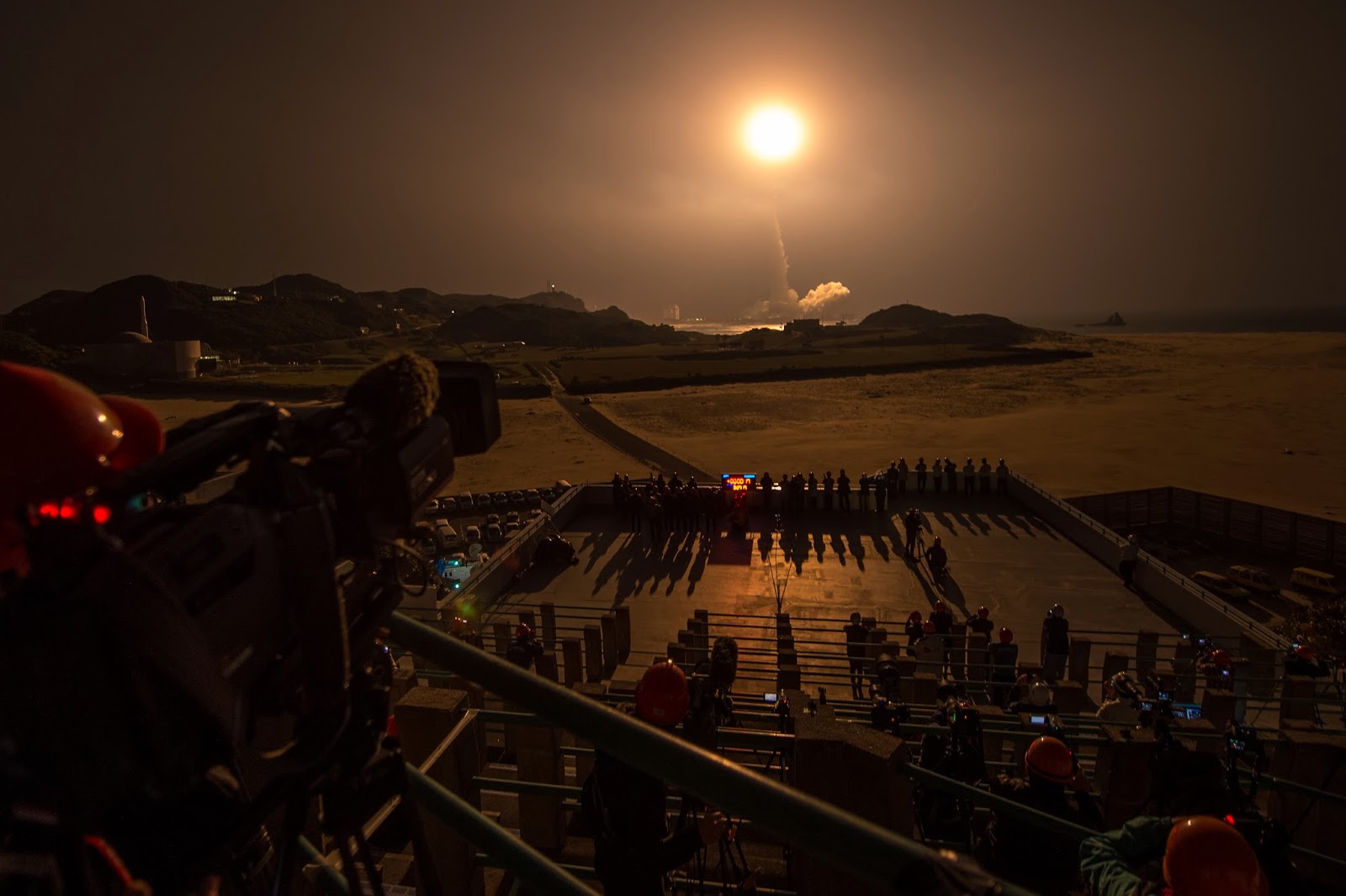
A Japanese H-IIA rocket with the NASA-Japan Aerospace Exploration Agency (JAXA) Global Precipitation Measurement (GPM) Core Observatory onboard, is seen launching from the Tanegashima Space Center in Tanegashima, Japan. 

Image Credit: NASA/Bill Ingalls

The Global Precipitation Measurement (GPM) Core Observatory, a joint Earth-observing mission between NASA and the Japan Aerospace Exploration Agency (JAXA), thundered into space at 10:37 a.m. PST Thursday, Feb. 27 (3:37 a.m. JST Friday, Feb. 28) from Japan.

The four-ton spacecraft launched aboard a Japanese H-IIA rocket from Tanegashima Space Center on Tanegashima Island in southern Japan.

The GPM spacecraft separated from the rocket 16 minutes after launch, at an altitude of 247 miles (398 kilometers). The solar arrays deployed 10 minutes after spacecraft separation, to power the spacecraft.

"With this launch, we have taken another giant leap in providing the world with an unprecedented picture of our planet's rain and snow," said NASA Administrator Charles Bolden.

"GPM will help us better understand our ever-changing climate, improve forecasts of extreme weather events like floods, and assist decision makers around the world to better manage water resources."

The GPM Core Observatory will take a major step in improving upon the capabilities of the Tropical Rainfall Measurement Mission (TRMM), a joint NASA-JAXA mission launched in 1997 and still in operation.

While TRMM measured precipitation in the tropics, the GPM Core Observatory expands the coverage area from the Arctic Circle to the Antarctic Circle. GPM will also be able to detect light rain and snowfall, a major source of available fresh water in some regions.


To better understand Earth's weather and climate cycles, the GPM Core Observatory will collect information that unifies and improves data from an international constellation of existing and future satellites by mapping global precipitation every three hours.

"It is incredibly exciting to see this spacecraft launch," said GPM Project Manager Art Azarbarzin of NASA's Goddard Space Flight Center in Greenbelt, Md. "This is the moment that the GPM team has been working toward since 2006.

"The GPM Core Observatory is the product of a dedicated team at Goddard, JAXA and others worldwide."

"Soon, as GPM begins to collect precipitation observations, we'll see these instruments at work providing real-time information for the scientists about the intensification of storms, rainfall in remote areas and so much more."

Friday, February 21, 2014

ESA Venus Express: Planet-sized space weather explosions

Giant perturbations called hot flow anomalies in the solar wind near Venus can pull the upper layers of its atmosphere, the ionosphere, up and away from the surface of the planet. 

Credit: NASA

Researchers recently discovered that a common space weather phenomenon on the outskirts of Earth's magnetic bubble, the magnetosphere, has much larger repercussions for Venus.

The giant explosions, called hot flow anomalies, can be so large at Venus that they're bigger than the entire planet and they can happen multiple times a day.

"Not only are they gigantic," said Glyn Collinson, a space scientist at NASA's Goddard Space Flight Center in Greenbelt, Md.

"But as Venus doesn't have a magnetic field to protect itself, the hot flow anomalies happen right on top of the planet. They could swallow the planet whole."

Collinson is the first author of a paper on these results that appeared online in the Journal of Geophysical Research in February 2014.

The work is based on observations from the European Space Agency's Venus Express.

The results show just how large and how frequent this kind of space weather is at Venus.

Earth is protected from the constant streaming solar wind of radiation by its magnetosphere. Venus, however, has no such luck.

A barren, inhospitable planet, with an atmosphere so dense that spacecraft landing there are crushed within hours, Venus has no magnetic protection.

Scientists like to compare the two: What happened differently at Earth to make it into the life-supporting planet it is today? What would Earth be like without its magnetic field?

At Earth, hot flow anomalies do not make it inside the magnetosphere, but they release so much energy just outside that the solar wind is deflected, and can be forced to move back toward the sun.

Without a magnetosphere, what happens at Venus is very different.

Venus's only protection from the solar wind is the charged outer layer of its atmosphere called the ionosphere.

A sensitive pressure balance exists between the ionosphere and the solar wind, a balance easily disrupted by the giant energy rush of a hot flow anomaly.

The hot flow anomalies may create dramatic, planet-scale disruptions, possibly sucking the ionosphere up and away from the surface of the planet.

More Information: 'Ionospheric photoelectrons at Venus: Initial observations by ASPERA-4 ELS': Journal of Geophysical Research in February 2014 dx.doi.org/10.1016/j.pss.2007.12.008