Showing posts with label mission. Show all posts

Wednesday, January 28, 2015

MARS Habitation Fire ends GreenHab mission

Mars Desert Research Station (MDRS) GreenHab following a fire on Dec. 29, 201

Credit: Nick Orenstein

Four crewmembers simulating a mission on Mars dealt with a real-life emergency late last month, a greenhouse fire so strong that flames reached at least 10 feet (3 meters) high.

On Dec. 29, the first day of their mission, the crew noticed an unusual power surge in their habitat at the Mars Desert Research Station (MDRS), in the Utah desert near the small town of Hanksville.

A few minutes later, somebody spotted smoke coming from the greenhouse.

Crew commander Nick Orenstein, an experienced camper who has built bonfires in the past, ran outside to take a look.

He said he figured the group could take on the fire, because the smoke was blowing away from the habitat, and only one shelf inside the greenhouse was aflame.

At that time, the fire was about the size of three overstuffed chairs.

"This is a moment where instinct took over, the instinct of fight or flight, and we had fight," Orenstein told reporters. "There really wasn't a question at the moment."

It took the crew about half an hour to bring the fire under control.

Orenstein and crew engineer Dmitry Smirnov used all available fire extinguishers on site, but even after the extinguishers were exhausted and the power cut, the fire was still not out.

"We put out the rest by putting water on the flames," Orenstein recalled.

The four-person crew was barely able to deal with the emergency, he added.

"Six or seven [people], to me, seems realistic as the adequate number of people to handle a situation like this most effectively."

The middle of the greenhouse, which was called the GreenHab, was destroyed. An investigation by the fire marshal determined two days later that an electrical heater caused the fire, which was ruled an accident.

The heater was set up close to some wooden shelves that had likely dried out over more than 10 years of use, said Orenstein, who is also the volunteer MDRS GreenHab coordinator.

Damage inside the Mars Desert Research Station GreenHab following a fire on Dec. 29, 2014. 

Credit: Nick Orenstein

In response to a 911 call, the Lane County sheriff came to MDRS later on Dec. 29, after the crew had successfully fought the fire.

NB: The isolated location of the facility means it usually takes some time for emergency services to arrive.

The sheriff did a preliminary investigation and confirmed that nobody was hurt, Orenstein said.

Orenstein's crew, the 146th one to use the habitat, decided it was best to stay in Hanksville temporarily, for two reasons, there were no fire extinguishers left at the research station, and there was some concern about chemical contamination in the habitat from the fire.

"My responsibilities for the next few days were to look after the crew and to make sure that they were OK," Orenstein said.

"Essentially, it was a post-tramautic stress therapy session there. We were making sure we were all OK, and looking out for each other."

MDRS director Shannon Rupert and a few other MDRS officials did extra cleanup before the next crew arrived, and Orenstein went back to the facility briefly for the Crew 147 handover later in January.

A temporary tentlike greenhouse is now available for experiments to go forward this season, Rupert added.

"It's devastating because it's a loss of a functional component of the campus," Rupert told reporters.

"But it could have been so much worse. Everyone was safe. That was the main thing. Everybody got out."

Friday, January 23, 2015

ESA Rosetta Comet 67/P Mission: Rosetta Team Uncovers More Secrets

A colour image of Comet 67P/Churyumov-Gerasimenko composed of three images taken by Rosetta’s scientific imaging system OSIRIS in the red, green and blue filters; the images were taken on August 6, 2014 from a distance of 120 km from the comet. 

Image credit: ESA / Rosetta / MPS / OSIRIS Team / UPD /LAM / IAA / SSO / INTA / UPM / DASP / IDA.

The familiar shape of the comet has now had many of its vital statistics measured: the small lobe measures 2.6 × 2.3 × 1.8 km and the large lobe 4.1 × 3.3 × 1.8 km.

The total volume of the comet is 21.4 km3. Rosetta’s Radio Science Instrument has measured its mass to be 10 billion tons, yielding a density of 470 kg/m3.

By assuming an overall composition dominated by water ice and dust with a density of 1,500–2,000 kg/m3, Rosetta scientists show that the comet has a very high porosity of 70–80 percent, with the interior structure likely comprising weakly bonded ice-dust clumps with small void spaces between them.

The OSIRIS instrument has imaged some 70 percent of the surface to date: the remaining unseen area lies in the southern hemisphere that has not yet been fully illuminated since Rosetta’s arrival.

The scientists have so far identified 19 regions separated by distinct boundaries and, following the ancient Egyptian theme of the Rosetta mission, these regions are named for Egyptian deities, and are grouped according to the type of terrain dominant within.

The 19 regions identified on 67P/Churyumov–Gerasimenko are separated by distinct geomorphological boundaries; they are grouped according to the type of terrain dominant within each region. 

Five basic categories of terrain type have been determined: dust-covered (Ma’at, Ash and Babi); brittle materials with pits and circular structures (Seth); large-scale depressions (Hatmehit, Nut and Aten); smooth terrains (Hapi, Imhotep and Anubis), and exposed, more consolidated surfaces (Maftet, Bastet, Serqet, Hathor, Anuket, Khepry, Aker, Atum and Apis). 

Image credit: ESA / Rosetta / MPS / OSIRIS Team / UPD /LAM / IAA / SSO / INTA / UPM / DASP / IDA.

Five basic, but diverse, categories of terrain type have been determined: dust-covered; brittle materials with pits and circular structures; large-scale depressions; smooth terrains; and exposed more consolidated surfaces.

Much of the northern hemisphere is covered in dust. As the comet is heated, ice turns directly into gas that escapes to form the atmosphere or coma.

Dust is dragged along with the gas at slower speeds, and particles that are not traveling fast enough to overcome the weak gravity fall back to the surface instead.

Some sources of discrete jets of activity have also been identified. While a significant proportion of activity emanates from the smooth neck region, jets have also been spotted rising from pits.

The gases that escape from the surface have also been seen to play an important role in transporting dust across the surface, producing dune-like ripples, and boulders with ‘wind-tails,’ the boulders act as natural obstacles to the direction of the gas flow, creating streaks of material ‘downwind’ of them.

“Because comets have very little gravity, dust and gas flow freely into space. But we were surprised to find a cloud of particles orbiting the comet that are large and heavy enough to defy the Sun’s radiation pressure,” said Dr Dennis Bodewits of the University of Maryland.

The scientists were able to make this discovery thanks to OSIRIS’ very sensitive cameras.

“Each pixel is about 30 cm. You couldn’t see a coffee cup, but you could see a large lunchbox. The resolution is about 10 times higher than Google Earth.”

According to the team, 67P/Churyumov-Gerasimenko was releasing the earthly equivalent of 1.2 liters of water into space every second at the end of August 2014.

MIRO (Microwave Instrument for the Rosetta Orbiter)

Credit: ESA

“In observations, made by the Microwave Instrument for Rosetta Orbiter (MIRO), over a period of three months, the amount of water in vapor form that the comet was dumping into space grew about tenfold,” said Dr Sam Gulkis of NASA’s Jet Propulsion Laboratory in Pasadena.

“To be up close and personal with a comet for an extended period of time has provided us with an unprecedented opportunity to see how comets transform from cold, icy bodies to active objects spewing out gas and dust as they get closer to the Sun.”

Sunday, December 28, 2014

NASA Messenger extends its mission life using Helium

Now orbiting the planet Mercury after over ten years in space, NASA's MErcury Surface, Space ENvironment, GEochemistry, and Ranging (MESSENGER) spacecraft is still functioning better than expected.

Its mission will soon come to an end though, it's running out of fuel and is scheduled to crash into the planet in March.

However, mission control have come up with a novel plan that will use the helium used to pressurize the unmanned probe's engine to give it another month of life.

According to the MESSENGER team, fuel is usually the last problem that a robotic exploration team worry about because there are so many other things that can go wrong long before it runs out.

That being said, the fuel is the single most important consumable aboard an orbiter mission because it not only allows the spacecraft to maintain the correct attitude and keep its antennae pointed at Earth, it also lets it use the main engine to boost its orbit against atmospheric drag, which decays the orbit.

The upshot is that when the propellant runs out, the spacecraft starts to tumble and spirals in to burn up in the atmosphere or, in MESSENGER's case, crash into the surface at hypersonic speed.


So normally when the fuel runs out, that's it, but NASA reasoned that MESSENGER's liquid-fuel rocket engine design meant there was still a bit of thrust left even after all the propellant was expended.

The MESSENGER's engine is pressure fed, which means that it uses helium from a separate tank to push the fuel and oxidizer into the engine's combustion chamber.

Since the helium needs to work against the force of the rocket's combustion, it's under considerable pressure, and when the fuel is gone, there will be some helium left in the pressure tank.

The idea is to use the helium as a cold propellant. In other word's where the rocket engine gets its thrust by burning fuel, the helium pushes the spacecraft by simple gas pressure like a toy balloon when the open neck is let go.

Unfortunately, this is the first time a pressurant has been as an improvised thruster and MESSENGER's engine is a bit more complicated than a balloon.

According to MESSENGER Mission Systems Engineer Dan O’Shaughnessy, of the Johns Hopkins University Applied Physics Laboratory (APL), the pressure in the helium tank isn't much compared to a firing engine.

In addition, the gas passes through a number of reduction valves and nozzles that have to be taken into account, and helium is the second lightest of gases, so it doesn't provide much in the way of thrust.

If these problems can be overcome, NASA estimates that it will give MESSENGER another month of active life before impact on Mercury. MESSENGER's current closest approach to Mercury is 25 km (15 mi).

If a scheduled course correction using the helium is successful, this will rise to 80 km (50 mi). This will allow the orbiter to carry out additional low altitude observations, including collecting a new set of high-resolution images.

"During the additional period of operations, up to four weeks, MESSENGER will measure variations in Mercury’s internal magnetic field at shorter horizontal scales than ever before, scales comparable to the anticipated periapsis altitude between 7 km (4 mi) and 15 km (9 mi) above the planetary surface," says APL’s Haje Korth, the instrument scientist for the spacecraft's magnetometer.

"Combining these observations with those obtained earlier in the mission at slightly higher altitudes will allow the depths of the sources of these variations to be determined. In addition, observations by MESSENGER’s Neutron Spectrometer at the lowest altitudes of the mission will allow water ice deposits to be spatially resolved within individual impact craters at high northern latitudes."

Built and operated by John Hopkins University for NASA, the MESSENGER spacecraft was launched from Cape Canaveral on August 3, 2004 as the first mission aimed to place an orbiter around the innermost planet Mercury. 

Thursday, November 20, 2014

ESA Rosetta mission: Philae lander - the sound of a Comet Touchdown

Image credit: ESA/ATG medialab – Audio file credit: ESA /Rosetta /Philae /SESAME /DLR

Sensors in the feet of Rosetta’s lander Philae have recorded the sound of touchdown as it first came into contact with Comet 67P/Churyumov-Gerasimenko. 


The instrument, SESAME-CASSE, was turned on during the descent and clearly registered the first touchdown as Philae came into contact with the comet, in the form of vibrations detected in the soles of the lander’s feet.

Focus on SESAME. Sensors are located in the three feet as well as in the units of the APXS (centre) and MUPUS-Pen (to the upper right of centre) instruments. Credits: ESA/ATG medialab

SESAME is the lander’s Surface Electrical Sounding and Acoustic Monitoring Experiment, and comprises three suites of instruments:

  • CASSE – the Comet Acoustic Surface Sounding Experiment, which allows mechanical parameters of the surface to be deduced, along with details of the structure of the subsurface;
  • DIM – the Dust Impact Monitor, which measures properties of impacting comet grains;
  • PP – the Permittivity Probe, which determines one of the key electrical properties of the material beneath Philae, which is linked to the water ice content of the surface.


Klaus Seidensticker from the DLR Institute of Planetary Research says: “Our data record the first touchdown and show that Philae’s feet first penetrated a soft surface layer – possibly a dust layer – several centimetres thick until they hit a hard surface – probably a sintered ice-dust layer – a few milliseconds later.”

Sunday, October 19, 2014

Cubesats Payload on Europa Clipper Mission

Artist's impression of cubesats exploring Europa.

Credit: NASA/JPL-Caltech

NASA’s Jet Propulsion Laboratory (JPL) in Pasadena, Calif., has selected proposals from 10 universities to begin investigating the possible use of cubesats as auxiliary components to missions to Europa and beyond.

Cubesats are small, low cost space probes that can be used to collect scientific data by themselves or part of a “flock.”

They have been used extensively in the low-Earth orbit, providing a low-cost means for universities and institutions to carry out experiments in this microgravity environment.

As cubesat technology is maturing, so does the scope of their application.

So, as NASA steps up its plans for the Europa Clipper concept to visit the icy Jupiter moon, JPL has asked for cubesat proposals from universities that could complement the primary Clipper payload.

As we have a mission going to Europa, why not attach some cubesats for the ride?

NASA has outlined some key science objectives these axillary cubesats should be able to carry out, including “reconnaissance for future landing sites, gravity fields, magnetic fields, atmospheric and plume science, and radiation measurements.”

“We’ve seen some innovative and quite creative surprises among the CubeSat ideas submitted by these universities,” said Barry Goldstein, pre-project manager for the Europa Clipper mission.

“Using CubeSats for planetary exploration is just now becoming possible, so we want to explore how a future mission to Europa might take advantage of them.”

The chosen proposals have been awarded $25,000 each to develop their cubesat concepts to be included in the study, which is expected in the summer of 2015.

Europa is known to possess a sub-surface ocean of liquid water protected by a thick icy shell. As we learn more and more about this little world, our fascination with its life-giving potential is only amplified.

We now know that, combined with the oceans of water, nutrients are actively cycling to and from the surface. The icy surface appears to have plate tectonics.

Also, scientists believe there’s an abundance of oxygen in the ocean that’s heated by the tidal squishing of Europa’s orbit around Jupiter.

All of these factors point to a possibly habitable world where it has been hypothesized that multicellular life could thrive, but to test this hypothesis, we need to start sending missions to Europa so a close-up picture of its life-giving potential may be formulated, a mission that could be accelerated by the introduction of hitchhiking cubesats to the next big NASA missions to Jovian orbit.

Sunday, September 28, 2014

NASA TESS: Exoplanet Mission to Hunt Down Earth-sized Worlds


Set to launch in 2017, NASA's Transiting Exoplanet Survey Satellite (TESS) will monitor more than half a million stars over its two-year mission, with a focus on the smallest, brightest stellar objects.

During its observations, TESS is expected to find more than 3,000 new planets outside of our solar system, most of which will be possible for ground-based telescopes to observe.

"Bright host stars are the best ones for follow-up studies of their exoplanets to pin down planet masses, and to characterize planet atmospheres," said TESS principal investigator George Ricker, of the Massachusetts Institute of Technology's Kavli Institute for Astrophysics.

"TESS should be able to find over 200 Earths and super-Earths, defined as being twice the size of Earth," said Peter Sullivan, a physics doctoral student at MIT.

"Ten to 20 of those are habitable-zone planets.”

Sullivan, who works with Ricker on TESS, led an analysis of the number of planets TESS would likely find based on the number and types of planets found by NASA's Kepler mission.

Kepler focused on a single region of the sky and studied all transiting planets within it.

TESS, on the other hand, will examine almost the entire sky over its two-year mission, but capture only the brightest stars, many of which are expected to host terrestrial planets.

NASA's Transiting Exoplanet Survey Satellite (TESS) mission is scheduled to launch in 2017 to hunt for Earth-size alien worlds.

Credit: MIT KAVLI Institute for Astrophysics and Space Research

TESS will travel around Earth in a highly elliptical orbit that will range as distant as the moon.

Along the way, it will use four cameras to observe a swatch of sky running from the celestial equator to the poles.

TESS will observe each swatch for approximately a month before switching to the next region.


Courtney Dressing, a doctoral student at the Harvard-Smithsonian Center for Astrophysics, compares the satellite's observations to peeling an apple in vertical cuts that overlap near the stem.

Because of the overlap, stars near the pole will be observed for more than 100 days, while stars near the equator will be observed for only 27 days.

Dressing worked on a second model, based on Sullivan's work, that predicts the number of planets near Earth that pass between the sun and their host star.

"We predicted there should be about 100 transiting planets within 20 parsecs [about 65 light-years], and that roughly three of them should lie within the habitable zone of their host stars," Dressing said.

Not all of these planets will be detectable to the TESS mission. According to Dressing, the new telescope will be most sensitive to small planets orbiting stars 20 to 50 percent the size of our sun.

Wednesday, September 3, 2014

Scientists' research supports discovery mission into Asteroid cores

Dr. Richard S. Miller’s research could influence future asteroid mining operations and how we might deal with an impending strike.

Future asteroid mining operations and how we deal with an impending strike could be influenced by research on a potential NASA mission that's being done by team that includes a University of Alabama in Huntsville (UAH) scientist.

"If you identify an asteroid coming toward us, how you deal with it could depend on its density and structure," says Dr. Richard S. Miller, a UAH physics professor.

"Likewise, if this technique pans out, you could imagine sending out a specialized telescope to determine what the densities and interior structure of various asteroids are, then decide on the basis of that information what ones to mine."

Little is now known about asteroid interior density and composition. Are they uniform or are they what astrophysicists call differentiated bodies, having denser and less-dense areas?

"Asteroids are time capsules of the early solar system," Dr. Miller says.

"We know about their surface properties and we can also infer the mass of some asteroids. But what we want to do is actually probe the interior of asteroids and determine information about their structure, are there interior density gradients, what is the composition, is it solid or like Swiss cheese, and do they have cores or not? Is it a pile of rubble?

It turns out this structure can tell us a great deal about the conditions present during the early epochs of solar system formation and its evolution."

To find that out, the team's scientists will be borrowing imaging technology concepts developed for medicine and high-energy physics.

They are developing a mission concept to probe asteroids using a technique similar to human computerized tomography (CT) scans.

Dr. Miller is a co-investigator in a collaborative effort with the Planetary Science Institute (PSI), NASA's Johnson Space Center, the Universities Space Research Association's Arecibo Observatory (Arecibo/USRA) and the University of Houston to do the fundamental research and design that could lead to such a mission.

Led by principal investigator Dr. Tom Prettyman, senior scientist at PSI, the group has $500,000 in funding from the NASA Innovative Advanced Concepts (NIAC) Phase II program.

The team's two-year proposal, "Deep Mapping of Small Solar System Bodies with Galactic Cosmic Ray Secondary Particle Showers," is one of only five projects selected for funding.

Other funded collaborators include Dr. Steven Koontz, NASA Johnson Space Center; Dr. Michael Nolan, Arecibo/USRA; Dr. Lawrence Pinsky, University of Houston; and Dr. Mark Sykes, PSI.

By detecting the number of muons that pass through the object at left, scientists can discover and measure the size of its core, shown reconstructed at right. 

Credit: Richard S. Miller / UAH

The team proposes using ever-present cosmic rays to perform its measurements.

All objects in space are constantly bombarded by these particles, which are thought to be the remnants of massive supernovas and are primarily protons. On Earth, the atmosphere breaks them up and shields us from direct hits.

"In space, on contact with dense matter like the moon's surface or other airless planetary bodies, they interact within the first few centimeters of depth and create a shower of particles," Dr. Miller says.

Studying those interactions has provided us surface knowledge of asteroids. "But cosmic rays also contain muons, which are particles similar to electrons, but which can go a lot farther into the asteroid, in some cases up to one kilometer."

The idea is to position a telescope to orbit the asteroid and measure the number and trajectories of the muons passing through it.

"Muons are like an SUV," says Dr. Miller. "Once they are moving it is not easy to knock them off their course."

An asteroid composed of varying densities of material would return a different pattern than one with a single density, just as a CT scan differentiates between densities of structures in the body.

Likewise, if an asteroid has a denser core, it will stop muons from passing through and the telescope will detect the change.

That process is called muon tomography and is well understood. Developed in the 1950s, it was even used in the 1960s by Luis Alvarez to map the Pyramid of Chephren.

"What's different about a CT scan is that instead of using cosmic rays and muons to determine densities, a CT scan uses x-rays," Dr. Miller says.

To mature the concept, the scientists must first solve a number of fundamental challenges. They'll be using computer modeling to work on:
  • Detailed estimates of the particle signatures, including muons and other radiations that will be present in deep space and in the neighbourhood of any asteroids;
  • Doing the initial work on the muon telescope's design and operation. There are competing ideas, and the team will evaluate a variety of performance tradeoffs; 
  • The development and implementation of advanced algorithms for asteroid structure reconstruction;
  • Establishing the preliminary outlines of how a proposed NASA mission would be conducted, its feasibility and making predictions of the ultimate science return. 
"What it has to do is detect those muons and give us a direction they are coming from," Dr. Miller says of the telescope, but getting to that goal involves tradeoffs.

For example, the bigger the area the telescope can scan as it orbits, the less time it will take to get results encompassing an entire asteroid being studied.

But the greater the telescope's size, the more resources will be involved to launch the mission. Also, to tell where the muons are coming from, the telescope will have to be able to tell directional "up" from "down."

Dr. Miller says he was already exploring using muons to probe asteroids when he attended a conference and found that PSI's Dr. Prettyman was working on the same thing.

"This is a good story of how you had two independent groups who were both looking at the same idea," Dr. Miller says, "and we have joined forces to make a stronger project."

Saturday, August 2, 2014

NASA Messenger: Mercury Mission - 10 Years in Space


In celebration of the 10th anniversary of its launch, the MESSENGER team released this movie showing a flyover of Mercury. The movie is sped up by a factor of seven for ease of viewing.

Image Credit: NASA/Johns Hopkins University Applied Physics Laboratory

Ten years ago, on August 3, 2004, NASA’s MESSENGER (MErcury Surface, Space ENvironment, GEochemistry, and Ranging) spacecraft blasted off from Cape Canaveral, Florida, for a risky mission that would take the small satellite dangerously close to Mercury’s surface, paving the way for an ambitious study of the planet closest to the Sun.

The spacecraft traveled 4.9 billion miles (7.9 billion kilometers), a journey that included 15 trips around the Sun and flybys of Earth once, Venus twice, and Mercury three times, before it was inserted into orbit around its target planet in 2011.

“We have operated successfully in orbit for more than three Earth years and more than 14 Mercury years as we celebrate this amazing 10th anniversary milestone,” said MESSENGER Mission Operations Manager Andy Calloway, of the Johns Hopkins University Applied Physics Laboratory (APL).

“The MESSENGER spacecraft operates in one of the most challenging and demanding space environments in our Solar System, and we have met that challenge directly through innovation and hard work, as exemplified by the stunning discoveries and data return achievements.

Our only regret is that we have insufficient propellant to operate another 10 years, but we look forward to the incredible science returns planned for the final eight months of the mission.”

MESSENGER captured the images in the flyover movie during this flight path over Mercury's north polar region.

Image Credit: NASA

MESSENGER is only the second spacecraft sent to Mercury. Mariner 10 flew past it three times in 1974 and 1975 and gathered detailed data on less than half the surface.

MESSENGER took advantage of an ingenious trajectory design, lightweight materials, and miniaturisation of electronics, all developed in the three decades since Mariner 10 flew past Mercury.

“It was quite challenging to design and execute a trajectory that could culminate in Mercury orbit,” said Mission and Spacecraft Systems Engineer Dan O’Shaughnessy, of APL.

“Designing an attendant spacecraft that was light enough to carry the necessary propellant to execute such a trajectory with enough room left over for a payload capable of global characterisation of the planet is an impressive accomplishment.”

Additionally, he said, “the team’s concept of operations that streamlines planning while optimizing the use of our payload. despite substantial thermal and power constraints, is an amazing feat.”

MESSENGER Deputy Principal Investigator Larry Nittler, of the Carnegie Institution of Washington, said that the mission has rewritten scientists’ understanding of the planet “and given us plenty of surprises.”

“Geochemical measurements have revealed a surface poor in iron, but rich in moderately volatile elements such as sulphur and sodium,” said Nittler.

“These results rule out some long-standing theories put forward to explain Mercury’s anomalously high density compared with the other planets in the inner solar system,” he explained.

“Maps of elemental abundances show that the interior is highly chemically heterogeneous, providing important clues to the early geological history of the planet.”

“MESSENGER observations have also shown that Mercury’s surface was shaped by volcanic activity, identified unique landforms shaped by loss of volatile materials, and confirmed the presence of large amounts of water ice protected from the Sun’s heat within permanently shadowed impact craters near the planet’s poles, said Nittler

Infographic with statistics on the MESSENGER mission.

Image Credit: NASA

“We have found that the complex interplay of the interplanetary magnetic field with that of Mercury results in a remarkably dynamic electromagnetic environment surrounding the planet, including unexplained bursts of electrons and highly variable distributions of different elements in the thin exosphere,” Nittler added.

“Over the next few months, MESSENGER will observe Mercury at lower altitudes and thus smaller spatial scales than ever before, and this is sure to result both in exciting scientific discoveries and new puzzles about our solar system’s enigmatic innermost planet.”

In celebration of the 10th anniversary of its launch, the MESSENGER team has released a movie acquired during an early stage of MESSENGER’s low-altitude campaign.

Messenger narrow-angle camera (NAC)
The movie provides a bird’s-eye view of what the spacecraft sees as it flies over the planet at close range and was assembled from 214 images taken by the narrow-angle camera (NAC) on June 8, 2014.

The NAC’s field of view looked toward the horizon along the direction of MESSENGER's motion as the probe crossed the terminator into night.

Scott Murchie
“This view is what a traveller on the MESSENGER spacecraft might see during low-altitude operations in the coming year,” noted MESSENGER Co-Investigator Scott Murchie of APL.

“During the final phase of its mission, MESSENGER's science instruments will use low-altitude operations like this to explore the surface and subsurface of Mercury at unprecedented resolution.”

The image frames were taken once per second while MESSENGER was at altitudes ranging from 115 to 165 kilometers, traveling at a speed of 3.7 kilometers per second relative to the surface. The movie is sped up by a factor of six for ease of viewing.

Read the full article here

NASA SDO: EUNIS mission - Coronal Heating theory detected

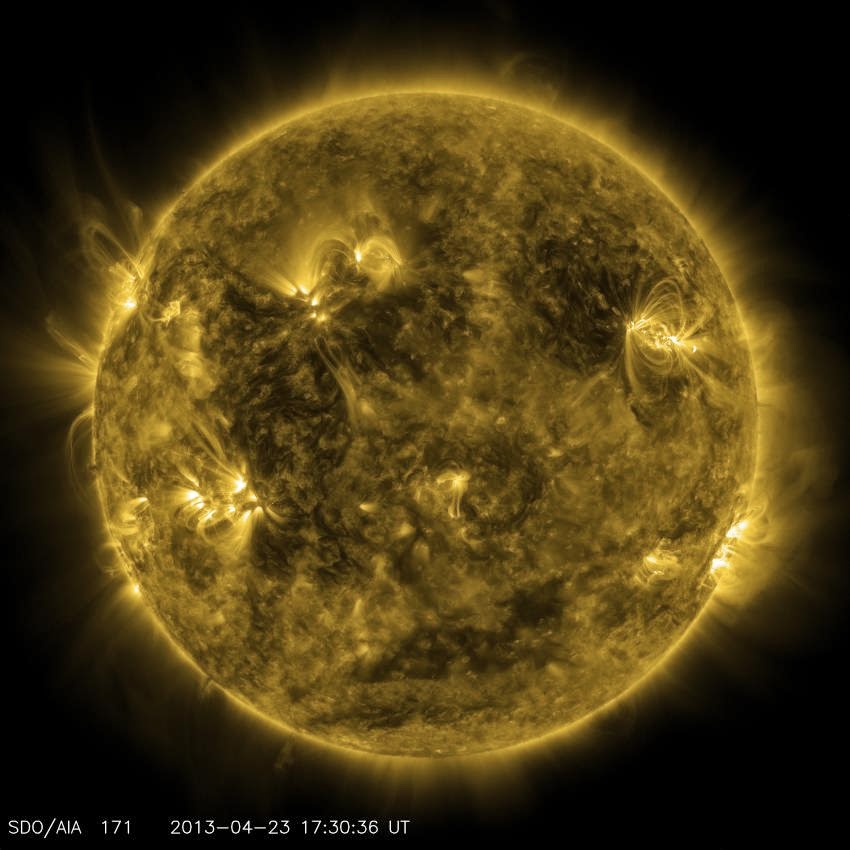
NASA's Solar Dynamics Observatory captured this image of what the sun looked like on April 23, 2013, at 1:30 p.m. EDT when the EUNIS mission launched. 

EUNIS focused on an active region of the sun, seen as bright loops in the upper right in this picture. 

Credit: NASA/SDO

Scientists have recently gathered some of the strongest evidence to date to explain what makes the sun's outer atmosphere so much hotter than its surface.

The new observations of the small-scale extremely hot temperatures are consistent with only one current theory: something called nanoflares; a constant peppering of impulsive bursts of heating, none of which can be individually detected, provide the mysterious extra heat

What's even more surprising is these new observations come from just six minutes worth of data from one of NASA's least expensive type of missions, a sounding rocket.

The Extreme Ultraviolet Normal Incidence Spectrograph (EUNIS) mission, launched on April 23, 2013, gathering a new snapshot of data every 1.3 seconds to track the properties of material over a wide range of temperatures in the complex solar atmosphere.

The sun's visible surface, called the photosphere, is some 6,000 Kelvins, while the corona regularly reaches temperatures which are 300 times as hot.

Jeff Brosius
"That's a bit of a puzzle," said Jeff Brosius, a space scientist at Catholic University in Washington, D.C., and NASA's Goddard Space Flight Center in Greenbelt, Maryland.

"Things usually get cooler farther away from a hot source. When you're roasting a marshmallow you move it closer to the fire to cook it, not farther away."

Brosius is the first author of a paper on these results appearing in the Aug. 1, 2014, edition of The Astrophysical Journal.

Several theories have been offered for how the magnetic energy coursing through the corona is converted into the heat that raises the temperature.

Different theories make different predictions about what kind of, and what temperature, material might be observable, but few observations have high enough resolution over a large enough area to distinguish between these predictions.


NASA's EUNIS sounding rocket mission spotted evidence to explain why the sun's atmosphere is so much hotter than its surface. 

Credit: NASA/Goddard/Duberstein 

The EUNIS sounding rocket, however, was equipped with a very sensitive version of an instrument called a spectrograph.

Spectrographs gather information about how much material is present at a given temperature, by recording different wavelengths of light.

To observe the extreme ultraviolet wavelengths necessary to distinguish between various coronal heating theories, such an instrument can only work properly in space, above the atmosphere surrounding Earth that blocks that ultraviolet light.

The EUNIS team stands in front of the sounding rocket before its second launch on Nov. 6, 2007. 

The mission will launch again for a six-minute flight to observe the sun on December 15, 2012. 

Credit: U.S. Navy

So EUNIS flew up nearly 200 miles above the ground aboard a sounding rocket, a type of NASA mission that flies for only 15 minutes or so, and gathered about six minutes worth of observations from above the planet's air.

During its flight, EUNIS scanned a pre-determined region on the sun known to be magnetically complex, a so-called active region, which can often be the source of larger flares and coronal mass ejections.

As light from the region streamed into its spectrograph, the instrument separated the light into its various wavelengths.

Instead of producing a typical image of the sun, the wavelengths with larger amounts of light are each represented by a vertical line called an emission line.

Each emission line, in turn, represents material at a unique temperature on the sun. Further analysis can identify the density and movement of the material as well.

The EUNIS spectrograph was tuned into a range of wavelengths useful for spotting material at temperatures of 10 million Kelvin; temperatures that are a signature of nanoflares.

Unlike a conventional image, NASA's Extreme Ultraviolet Normal Incidence Spectrograph will provide what's known as "spectra" such as above, which show lines to highlight which wavelengths of light are brighter than others. 

That information, in turn, corresponds to which elements are present in the sun's atmosphere and at what temperature. 

Credit: NASA/EUNIS

Scientists have hypothesised that a myriad of nanoflares could heat up solar material in the atmosphere to temperatures of up to 10 million Kelvins.

This material would cool very rapidly, producing ample solar material at the 1 to 3 million degrees regularly seen in the corona.

However, the faint presence of that extremely hot material should remain. Looking over their six minutes of data, the EUNIS team spotted a wavelength of light corresponding to that 10 million degree material.

To spot this faint emission line was a triumph of the EUNIS instrument's resolution. The spectrograph was able to clearly and unambiguously distinguish the observations representing the extremely hot material.

"The fact that we were able to resolve this emission line so clearly from its neighbours is what makes spectroscopists like me stay awake at night with excitement," said Brosius.

"This weak line observed over such a large fraction of an active region really gives us the strongest evidence yet for the presence of nanoflares."

The EUNIS experiment undergoing tests before launch. 

Credit: NASA

There are a variety of theories for what mechanisms power these impulsive bursts of heat, the nanoflares.

Moreover, other explanations have been offered for what is heating the corona.

Scientists will continue to explore these ideas further, gathering additional observations as their tools and instruments improve.

However, no other theory predicts material of this temperature in the corona, so this is a strong piece of evidence in favour of the nanoflare theory.

Adrian Daw
"This is a real smoking gun for nanoflares," said Adrian Daw, the current principal investigator for EUNIS at Goddard. "And it shows that these smaller, less expensive sounding rockets can produce truly robust science."

In addition to having a lower cost, sounding rockets offer a valuable test bed for new technology that may subsequently be flown on longer-term space missions.

Another advantage of sounding rockets is that the instruments parachute back to the ground so they can be recovered and re-used.

The EUNIS mission will be re-tuned to focus on a different set of solar wavelengths; ones that can also spot the extremely high temperature material representative of nanoflares, and fly again sometime in 2016.

More Information: Pervasive Faint Fe XIX Emission from a Solar Active Region Observed with EUNIS-13: Evidence for Nanoflare Heating - Jeffrey W. Brosius et al. 2014 ApJ 790 112. doi:10.1088/0004-637X/790/2/112

Tuesday, June 3, 2014

ESA Euclid mission will study Dark Energy

An artist's concept of the ESA's Euclid misssion to study dark energy.

Credit: ESA/C. Carreau

Euclid is an ESA mission to map the geometry of the dark Universe.

The Euclid mission will investigate the distance-redshift relationship and the evolution of cosmic structures by measuring shapes and redshifts of galaxies and clusters of galaxies out to redshifts ~2, or equivalently to a look-back time of 10 billion years.

To accomplish the Euclid mission ESA has selected Thales Alenia Space (see also the ESA press release) for the construction of the satellite and its Service Module and Airbus Defence and Space (EADS ex-Astrium) for the Payload Module.

Euclid will be equipped with a 1.2 m diameter Silicon Carbide (SiC) mirror telescope made by EADS feeding 2 instruments, VIS and NISP, built by the Euclid Consortium :

  • a high quality panoramic visible imager (VIS), 
  • a near infrared 3-filter (Y, J and H) photometer (NISP-P) and 
  • a slitless spectrograph (NISP-S). 

With these instruments physicists will probe the expansion history of the Universe and the evolution of cosmic structures by measuring the modification of shapes of galaxies induced by gravitational lensing effects of dark matter and the 3-dimension distribution of structures from spectroscopic red­shifts of galaxies and clusters of galaxies.

The satellite will be launched by a Soyuz ST-2.1B rocket and then travel to the L2 Sun-Earth Lagrangian point for a 6 years mission.

Members of the Euclid Consortium at the Euclid Meeting in Leiden.

Credit: ESA

In this way, Euclid will cover the entire period over which dark energy played a significant role in accelerating the expansion.

NASA will also participate in the ESA's Euclid mission in conjunction with it's own WFIRST-AFTA mission, searching for Dark Energy.

Last year, NASA nominated 40 American scientists to join the 14 American scientists already part of the international Euclid Consortium, the team responsible for the science, data production and instruments for the mission. NASA will also provide 16 infrared detectors for the telescope.

Euclid's goal is to understand the nature of dark energy and its role in the expansion of the universe. To do so, it plans to use two complimentary probes to study the phenomenon. The first probe will study weak gravitational lensing, while the second will examine BAOs.

Orbiting at the second Lagrangian point, Euclid will use two instruments to study a wide region of the sky free from the contaminating light from the solar system and the galaxy. It will also observe two "Euclid Deep Fields" of the early universe.

Of the approximately 10 billion sources Euclid intends to observe, more than 1 billion will be studied for weak lensing, while tens of millions of galaxies will be measured for clustering caused by BAOs.

"WFIRST-AFTA and Euclid will make complimentary observations, with WFIRST-AFTA observing fainter galaxies and Euclid observing more sky," Nasa project manager Gehrels said.

"The combined data set will be much larger and more accurate than any other BAO measurement."

When combined with ground-based observations over a variety of wavelengths, the new observations that WFIRST-AFTA and Euclid provide, should bring significant insights into dark energy and the expansion of the universe.

"The best constraints on dark energy in the 2020s will come from a combination of Euclid, WFIRST and ground-based data," WFIRST project manager Rhodes said.

Saturday, May 31, 2014

NASA/JAXA GPM: precipitation satellite passes check-out, starts mission

The GPM Core Observatory collects precipitation information that unifies data from an international network of existing and future satellites to map global rainfall and snowfall every three hours. 

Credit: NASA's Goddard Space Flight Center/Debbie McCallum

The new Global Precipitation Measurement (GPM) Core Observatory satellite is now in the hands of the engineers who will fly the spacecraft and ensure the steady flow of data on rain and snow for the life of the mission.

The official handover to the Earth Science Mission Operations team at NASA's Goddard Space Flight Center in Greenbelt, Maryland, on May 29, marked the end of a successful check-out period.

The Global Precipitation Measurement (GPM) mission is a joint mission between NASA and the Japan Aerospace Exploration Agency (JAXA).

Its GPM Core Observatory launched on Feb. 27, 2014, from Tanegashima Space Center in Japan.

The satellite's two science instruments collect observations of rainfall and snowfall worldwide. Since launch, the satellite has gone through a thorough check-out of all its systems and reached its final orbit of 253 miles (407 kilometers) above Earth's surface.

"Commissioning has gone very well," said Mission Systems Engineer David Ward of NASA Goddard at GPM's Post-Launch Acceptance Review on May 15. "The issues that have occurred have been relatively minor. We're in very good shape."

The check-out period is like taking a new car out on a road trip – the engineers in the driver's seat learn how it handles and make adjustments to find the "sweet spots" for smooth flying and data collection.

In the first weeks after launch the Flight Operations Team at Goddard, supported by the engineers who built the spacecraft, turned on spacecraft systems and ran them through normal procedures.

On May 29, GPM Deputy Project Manager Candace Carlisle (left) handed over the 'key' to the GPM Core Observatory to GPM Mission Director James Pawloski (center, blue shirt). 

Also pictured, left to right, Wynn Watson, Art Azarbarzin, Gail Skofronick-Jackson and David Ward. 

Credit: NASA

The team turned on both science instruments a few days after launch: the GPM Microwave Imager on March 1, and the Dual-frequency Precipitation Radar on March 2.

Two weeks after launch, both instruments were collecting data and the team had begun calibration procedures to ensure that the data returned is as accurate as possible.

"We're doing really well," said Erich Stocker, GPM deputy project scientist and project manager for the Precipitation Processing System at Goddard, which handles data for GPM and its predecessor satellite, the Tropical Rainfall Measuring Mission (TRMM).

"GMI is the best calibrated radiometer out of the box that we've ever had. And DPR is well-calibrated for this stage," he said, noting that the instrument can pick up weather elements, like classic thunderstorm anvil-shaped clouds, which TRMM could not.

A series of propulsion burns in March and early April took the Core Observatory into its final orbit at 253 miles.

At that altitude, however, drag is still a problem – a very thin layer of atmosphere still exists, which can slow down a quickly moving satellite with two extended solar arrays.

In low Earth orbit, slowing down means losing altitude. To counteract the drag, the thrusters had a planned burn every week to maintain speed and altitude.

After evaluating how well the solar arrays were collecting power – very well – the flight team made minute adjustments to the angle of the arrays to reduce drag, reducing the need for altitude maintenance burns to every other week.

Tuesday, April 29, 2014

NASA RFI: External Concepts for mission to Europa - the oceanic Jovian moon

This image shows two views of the trailing hemisphere of Jupiter's ice-covered satellite, Europa. 

The left image shows the approximate natural colour appearance of Europa. 

The image on the right is a false-color composite version combining violet, green and infrared images to enhance colour differences in the predominantly water-ice crust of Europa. 

Credit: NASA/JPL/DLR

NASA has issued a Request for Information (RFI) to science and engineering communities for ideas for a mission to Europa that could address fundamental questions of the enigmatic moon and the search for life beyond Earth.

The RFI's focus is for concepts for a mission to Europa that costs less than $1 billion, excluding the launch vehicle that can meet as many of the science priorities as possible recommended by the National Research Council's 2011 Planetary Science Decadal Survey for the study of Europa.

"This is an opportunity to hear from those creative teams that have ideas on how we can achieve the most science at minimum cost," said John Grunsfeld, associate administrator for the NASA Science Mission Directorate at the agency's headquarters in Washington.

"Europa is one of the most interesting sites in our solar system in the search for life beyond Earth. The drive to explore Europa has stimulated not only scientific interest but also the ingenuity of engineers and scientists with innovative concepts."

NASA has studied a variety of mission designs and concepts in previous years and currently is funding the development of technologies that will be needed for the science instruments for a Europa mission.

Congress appropriated $80 million for this work in Fiscal Year 2014, and the Fiscal Year 2015 budget proposal requests an additional $15 million.

Previous scientific findings point to the existence of a liquid water ocean located under the moon's icy crust. This ocean covers Europa entirely and contains more liquid water than all of Earth's oceans combined.

The Decadal Survey deemed a mission to the Jupiter moon as among the highest priority scientific pursuits for NASA.

It lists five key science objectives in priority order that are necessary to improve our understanding of this potentially habitable moon.

The mission will need to:

  • Characterise the extent of the ocean and its relation to the deeper interior
  • Characterise the ice shell and any subsurface water, including their heterogeneity, and the nature of surface-ice-ocean exchange
  • Determine global surface, compositions and chemistry, especially as related to habitability
  • Understand the formation of surface features, including sites of recent or current activity, identify and characterise candidate sites for future detailed exploration
  • Understand Europa's space environment and interaction with the magnetosphere.

Although Europa and Jupiter's other moons have been visited by other spacecraft, they were each limited to a single distant flyby of these satellites.

NASA's Galileo spacecraft, launched in 1989 by the space shuttle, was the only mission to make repeated visits to Europa, passing close by the moon fewer than a dozen times.

In December 2013, ESA /NASA's Hubble Space Telescope observed water vapor above the moon's frigid south polar region.

This provided the first strong evidence of water plumes erupting off the moon's surface, although researchers are still working to verify the existence of these plumes.

Any mission to Europa must take into account the harsh radiation environment that would require unique protection of the spacecraft and instruments.

In addition, spacecraft must meet planetary protection requirements intended to protect Europa's potentially habitable ocean.

These requirements are very strict and involve ensuring that a viable Earth organism is not introduced into the Europa ocean.

The RFI is not a request for proposal or formal procurement and therefore is not a solicitation or commitment by the government. Deadline to submit the mission concepts is May 30.