Showing posts with label Starts. Show all posts

Saturday, May 31, 2014

NASA/JAXA GPM: precipitation satellite passes check-out, starts mission

The GPM Core Observatory collects precipitation information that unifies data from an international network of existing and future satellites to map global rainfall and snowfall every three hours. 

Credit: NASA's Goddard Space Flight Center/Debbie McCallum

The new Global Precipitation Measurement (GPM) Core Observatory satellite is now in the hands of the engineers who will fly the spacecraft and ensure the steady flow of data on rain and snow for the life of the mission.

The official handover to the Earth Science Mission Operations team at NASA's Goddard Space Flight Center in Greenbelt, Maryland, on May 29, marked the end of a successful check-out period.

The Global Precipitation Measurement (GPM) mission is a joint mission between NASA and the Japan Aerospace Exploration Agency (JAXA).

Its GPM Core Observatory launched on Feb. 27, 2014, from Tanegashima Space Center in Japan.

The satellite's two science instruments collect observations of rainfall and snowfall worldwide. Since launch, the satellite has gone through a thorough check-out of all its systems and reached its final orbit of 253 miles (407 kilometers) above Earth's surface.

"Commissioning has gone very well," said Mission Systems Engineer David Ward of NASA Goddard at GPM's Post-Launch Acceptance Review on May 15. "The issues that have occurred have been relatively minor. We're in very good shape."

The check-out period is like taking a new car out on a road trip – the engineers in the driver's seat learn how it handles and make adjustments to find the "sweet spots" for smooth flying and data collection.

In the first weeks after launch the Flight Operations Team at Goddard, supported by the engineers who built the spacecraft, turned on spacecraft systems and ran them through normal procedures.

On May 29, GPM Deputy Project Manager Candace Carlisle (left) handed over the 'key' to the GPM Core Observatory to GPM Mission Director James Pawloski (center, blue shirt). 

Also pictured, left to right, Wynn Watson, Art Azarbarzin, Gail Skofronick-Jackson and David Ward. 

Credit: NASA

The team turned on both science instruments a few days after launch: the GPM Microwave Imager on March 1, and the Dual-frequency Precipitation Radar on March 2.

Two weeks after launch, both instruments were collecting data and the team had begun calibration procedures to ensure that the data returned is as accurate as possible.

"We're doing really well," said Erich Stocker, GPM deputy project scientist and project manager for the Precipitation Processing System at Goddard, which handles data for GPM and its predecessor satellite, the Tropical Rainfall Measuring Mission (TRMM).

"GMI is the best calibrated radiometer out of the box that we've ever had. And DPR is well-calibrated for this stage," he said, noting that the instrument can pick up weather elements, like classic thunderstorm anvil-shaped clouds, which TRMM could not.

A series of propulsion burns in March and early April took the Core Observatory into its final orbit at 253 miles.

At that altitude, however, drag is still a problem – a very thin layer of atmosphere still exists, which can slow down a quickly moving satellite with two extended solar arrays.

In low Earth orbit, slowing down means losing altitude. To counteract the drag, the thrusters had a planned burn every week to maintain speed and altitude.

After evaluating how well the solar arrays were collecting power – very well – the flight team made minute adjustments to the angle of the arrays to reduce drag, reducing the need for altitude maintenance burns to every other week.

Saturday, March 15, 2014

NASA IceBridge: 2014 Arctic campaign starts with two surveys of sea ice north of Greenland

This is a moon shot over northeast Greenland while descending into the survey area north of the Fram Strait. 

Credit: NASA/Michael Studinger

NASA's Operation IceBridge started the 2014 Arctic campaign with two surveys of sea ice north of Greenland.

The two flights follow similar surveys flow in previous years and continue the mission's goals of collecting data on changing sea ice in the Arctic.

Following the Mar. 10 transit flight from NASA's Wallops Flight Facility in Virginia to Thule Air Base, Greenland, the IceBridge team continued preparing for the weeks of work ahead.

On Mar. 11 the team unpacked cargo and set up ground-based GPS stations that are used to ensure IceBridge's instruments are accurate.

The next morning, Mar. 12, researchers, pilots and flight crew boarded the P-3 and took off for the first science flight of the campaign, a mission called Sea Ice – Nansen Gap.


This survey was a variation of flights over the Fram Strait flown in previous years that sampled ice farther north and east than in the past.

Researchers used the mission's laser and radar instruments to collect data on sea ice elevation and snow depth and collected ice thickness and elevation data while flying high over the Greenland Ice Sheet.

While studying the ice below, the team was treated to interesting sights in the sky during this flight.

Shortly after takeoff the moon made an appearance on the horizon, giving those aboard the aircraft a good photo opportunity.

In addition the team got to see the sun setting twice – once on the eastern end of the survey line and again when returning to Thule Air Base.

At this time of year days are short at high latitudes, making this sort of thing common.

SECOND SURVEY
On Mar. 13, the IceBridge team carried out their second survey of the campaign, a flight plan known as Sea Ice – Zigzag East.

On this flight the P-3 headed north-northeast out of Thule, roughly following the coast of Greenland along the Nares Strait—a narrow body of water separating Greenland and Canada's Ellesmere Island.

Then researchers headed along an alternating north and south pattern to measure how sea ice thickness changes closer to the North Pole, something known as ice gradient.

On this flight, researchers collected data on thick, multi-year ice near the coast and thinner ice farther north.

With two successful surveys and nearly three weeks left before the mission moves south to KangerlussuaqIceBridge is off to a successful start.

Over the next several days the mission plans to collect even more sea ice data, including a cross-basin survey of the Arctic Ocean and several flights based out of Fairbanks, Alaska, over the Beaufort and Chukchi seas.

Sunday, January 26, 2014

NEE-02 Krysaor: Ecuador satellite starts transmitting

A nanosatellite Ecuador launched began transmitting Saturday, and picked up a signal from another that had been lost, the Ecuadoran Civilian Space Agency said.

Krysaor "has started operating on schedule," the agency said, referring to the tiny traveler measuring just 10 by 10 centimeters (3.9 inches). It measures 75 centimeters when unfolded.

Weighing in at just 1.2 kilograms (2.65 pounds), the $160,000 orbiter was launched from Russia last year and is due to broadcast in near-real time for local educational uses.

EXA is the first space agency in the history of Ecuador, it has its own astronaut, the ASA/T Ronnie Nader, who is the Director of the Space Operations Division and is also the Honorary Chairman of the Directorate Board of EXA.

The website reports that his state of service is active, his position is of Mission Specialist and his function is Mission Commander.

Ecuador launched a similar satellite, Pegaso (Pegasus), in April.

It ceased to be heard from in September after hitting remains of a Russian launcher but authorities said they also had recovered the signal from Pegaso after Krysaor began transmitting.

"Who would ever have imagined that we could launch Ecuadoran satellites, however small they may be! We are going to continue with our space program," said an enthused President Rafael Correa, a leftist and economist by training.

Sunday, December 8, 2013

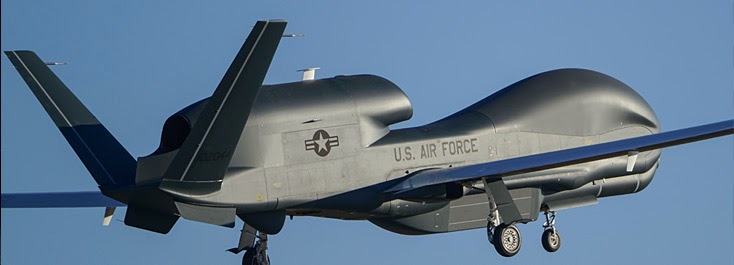
Northrop Grumman AF-18 UAS: Block 40 Global Hawk HALE, starts into production

The latest version of the RQ-4 Global Hawk high-altitude, long-endurance (HALE) unmanned aircraft system (UAS) took off from Northrop Grumman’s manufacturing plant in Palmdale, California, and flew to nearby Edwards Air Force Base on November 16.

Designated AF-18, the aircraft is a ‘Block 40’ version and the eleventh Global Hawk to arrive at Edwards.

Global Hawk production acceptance activities will now move from Edwards to ‘Air Force Plant 42’ in Palmdale, speeding up deliveries.

"AF-18 is the first of 15 Block 40 Global Hawk aircraft scheduled for fielding to Grand Forks Air Force Base, North Dakota, in 2010," said Steve Amburgey, Global Hawk programme director for the 303d Aeronautical Systems Group based at Wright-Patterson Air Force Base in Ohio.

The Block 40 aircraft feature ‘Multi-Platform - Radar Technology Insertion Program radar' (MP-RTIP), a "modular, active electronically scanned array radar system", primary improvements being an increase in resolution and an ability "to collect ground moving target indicator imagery and synthetic aperture radar still images simultaneously", according to manufacturer Raytheon.

The MP-RTIP radar uses active electronically scanned array (AESA) technology and commercial off-the-shelf hardware to deliver long range, very high-resolution synthetic aperture radar (SAR), ground moving target indicator (GMTI) capabilities and air target tracking.

Fundamental to the radar is its modular scalable design, which allows it to be applied to multiple airborne platforms.

MP-RTIP will provide war fighters improved combat identification, target tracking and time critical targeting, while adding an impressive new air-to-air capability to support cruise missile defense.

This powerful combination can aid commanders in developing predictive battlespace awareness and targeting solutions.

Scalable Agile Beam Radar (SABR) fitted to an F-16

Tuesday, November 19, 2013

Buran: Russia starts ambitious super-heavy space rocket project

On the 25th anniversary of the historic flight of the Soviet space shuttle Buran, Russia's Roscosmos space agency has formed a working group to prepare "within weeks" a roadmap for the revival of the Energia super-heavy booster rocket.

The group led by Oleg Ostapenko, the new head of Roscosmos Federal Space Agency, is set to draw up proposals on the design of a super-heavy launch vehicle capable of delivering up to 100 tonnes of payload to the baseline orbit, former Soviet minister of general machine building, Oleg Baklanov, said on Friday.

"You have assumed the responsibility and dared to head the group, which is supposed to find an answer to the question how we can regain the position we demonstrated to the world with the launch of a 100-tonne spacecraft [Buran in 1988] within a few weeks," the ex-minister told Ostapenko at the event dedicated to the 25th anniversary of the flight of the Buran shuttle spacecraft.

The new carrier rocket Angara is set to become the base for the ambitious project that could bring Russia back to its heyday of space exploration. It could be launched from the Vostochny Cosmodrome which is now being constructed in Russia's Far East, and will replace Kazakhstan's Baikonur as Russia's main launchpad.

The 1988 launch of the Energia super-heavy rocket carrying the Buran space shuttle proved the rocket was capable of delivering 100 tonnes into orbit.

That was five times more than the Proton-M rocket with a 20-tonne payload, thus making it the most powerful Soviet/Russian booster rocket ever developed.

As the International Space Station is scheduled to be taken out of service around 2020, ex-minister Baklanov explained that such a powerful rocket would allow the construction of a new orbital station "larger in its weight and dimensions."

Also, a booster similar to the Soviet Energia would be indispensable for "exploring outer space in a wise manner, working in shifts on Mars, the Moon and so on," he added.

At the same media conference, president of the Energia Rocket and Space Corporation Vitaly Lopota announced that Russia will soon need super-heavy rockets to create a shield against possible future space weapons - which means deploying into orbit massive communications satellites and electronic warfare platforms.

Sunday, March 24, 2013

NASA Icebridge Mission: P-3B Starts the Day

On March 21, 2013, the P-3B waits outside the hangar at Thule Air Base with the Greenland Ice sheet in the background.

IceBridge, a six-year NASA mission, is the largest airborne survey of Earth's polar ice ever flown. 

It will yield an unprecedented three-dimensional view of Arctic and Antarctic ice sheets, ice shelves and sea ice. 

These flights will provide a yearly, multi-instrument look at the behaviour of the rapidly changing features of the Greenland and Antarctic ice.

Data collected during IceBridge will help scientists bridge the gap in polar observations between NASA's Ice, Cloud and Land Elevation Satellite (ICESat) -- in orbit since 2003 -- and ICESat-2, planned for early 2016. 

ICESat stopped collecting science data in 2009, making IceBridge critical for ensuring a continuous series of observations.

IceBridge will use airborne instruments to map Arctic and Antarctic areas once a year. IceBridge flights are conducted in March-May over Greenland and in October-November over Antarctica. Other smaller airborne surveys around the world are also part of the IceBridge campaign.

Image Credit: NASA/Goddard/Michael Studinger