Showing posts with label high-altitude. Show all posts

Sunday, December 8, 2013

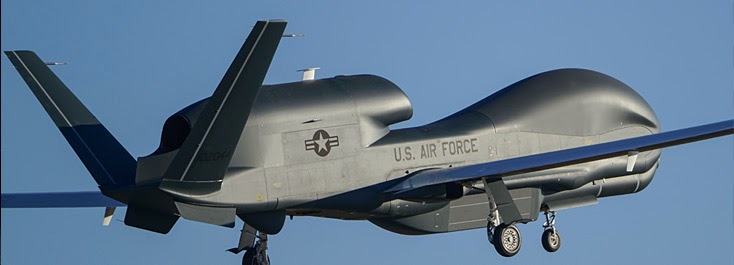
Northrop Grumman AF-18 UAS: Block 40 Global Hawk HALE, starts into production

The latest version of the RQ-4 Global Hawk high-altitude, long-endurance (HALE) unmanned aircraft system (UAS) took off from Northrop Grumman’s manufacturing plant in Palmdale, California, and flew to nearby Edwards Air Force Base on November 16.

Designated AF-18, the aircraft is a ‘Block 40’ version and the eleventh Global Hawk to arrive at Edwards.

Global Hawk production acceptance activities will now move from Edwards to ‘Air Force Plant 42’ in Palmdale, speeding up deliveries.

"AF-18 is the first of 15 Block 40 Global Hawk aircraft scheduled for fielding to Grand Forks Air Force Base, North Dakota, in 2010," said Steve Amburgey, Global Hawk programme director for the 303d Aeronautical Systems Group based at Wright-Patterson Air Force Base in Ohio.

The Block 40 aircraft feature ‘Multi-Platform - Radar Technology Insertion Program radar' (MP-RTIP), a "modular, active electronically scanned array radar system", primary improvements being an increase in resolution and an ability "to collect ground moving target indicator imagery and synthetic aperture radar still images simultaneously", according to manufacturer Raytheon.
The MP-RTIP radar uses active electronically scanned array (AESA) technology and commercial off-the-shelf hardware to deliver long range, very high-resolution synthetic aperture radar (SAR), ground moving target indicator (GMTI) capabilities and air target tracking.

Fundamental to the radar is its modular scalable design, which allows it to be applied to multiple airborne platforms.

MP-RTIP will provide war fighters improved combat identification, target tracking and time critical targeting, while adding an impressive new air-to-air capability to support cruise missile defense.

This powerful combination can aid commanders in developing predictive battlespace awareness and targeting solutions.

Scalable Agile Beam Radar (SABR) fitted to an F-16

Saturday, November 23, 2013

Boeing 787 dreamliner: 15 airlines warned over high-altitude ice on GE engines

Boeing plans to raise production of the 787 Dreamliner to 12 per month by 2016

Fifteen airlines have been warned about the risk of ice forming on Boeing's new 747-8 and 787 Dreamliner planes.

The issue - affecting some types of engines made by General Electric when planes fly near high-level thunderstorms - prompted Japan Airlines to cancel two international routes.

There have been six incidents since April when aircraft powered by GE engines lost power at high altitude.

These are the latest technical issues to hit the Dreamliner.

They saw the entire fleet being grounded earlier this year following battery problems.

The Boeing 747-8 series and the new 787 Dreamliner and the only types of aircraft affected by the high-altitude icing issue.

The new warning was given to airlines including Lufthansa, United Airlines and Japan Airlines.

It says aircraft with the affected engines - GE's GEnx - must not be flown within 50 nautical miles of thunderstorms that may contain ice crystals.

As a result, Japan Airlines (JAL) has decided to withdraw Dreamliners from service on the Tokyo-Delhi and Tokyo-Singapore routes.

"Boeing and JAL share a commitment to the safety of passengers and crews on board our airplanes."

"We respect JAL's decision to suspend some 787 services on specific routes," a Boeing spokesman said, according to Reuters news agency.

A GE spokesman told the agency the aviation industry was experiencing "a growing number of ice-crystal icing encounters in recent years as the population of large commercial airliners has grown, particularly in tropical regions of the world".

He said GE and Boeing were hoping to eliminate the problem by modifying the engine control system software.

British airways use Rolls Royce engines on their Dreamliners and are not affected by the warning.