Showing posts with label long-endurance. Show all posts

Sunday, December 8, 2013

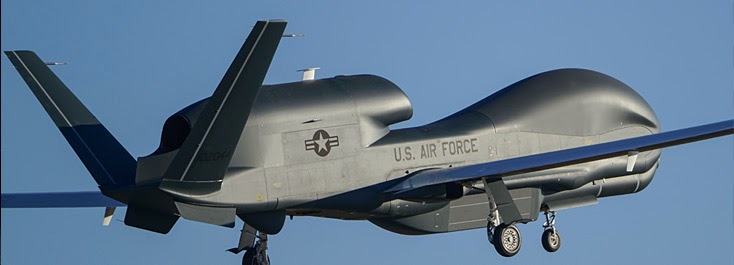
Northrop Grumman AF-18 UAS: Block 40 Global Hawk HALE, starts into production

The latest version of the RQ-4 Global Hawk high-altitude, long-endurance (HALE) unmanned aircraft system (UAS) took off from Northrop Grumman’s manufacturing plant in Palmdale, California, and flew to nearby Edwards Air Force Base on November 16.

Designated AF-18, the aircraft is a ‘Block 40’ version and the eleventh Global Hawk to arrive at Edwards.

Global Hawk production acceptance activities will now move from Edwards to ‘Air Force Plant 42’ in Palmdale, speeding up deliveries.

"AF-18 is the first of 15 Block 40 Global Hawk aircraft scheduled for fielding to Grand Forks Air Force Base, North Dakota, in 2010," said Steve Amburgey, Global Hawk programme director for the 303d Aeronautical Systems Group based at Wright-Patterson Air Force Base in Ohio.

The Block 40 aircraft feature ‘Multi-Platform - Radar Technology Insertion Program radar' (MP-RTIP), a "modular, active electronically scanned array radar system", primary improvements being an increase in resolution and an ability "to collect ground moving target indicator imagery and synthetic aperture radar still images simultaneously", according to manufacturer Raytheon.
The MP-RTIP radar uses active electronically scanned array (AESA) technology and commercial off-the-shelf hardware to deliver long range, very high-resolution synthetic aperture radar (SAR), ground moving target indicator (GMTI) capabilities and air target tracking.

Fundamental to the radar is its modular scalable design, which allows it to be applied to multiple airborne platforms.

MP-RTIP will provide war fighters improved combat identification, target tracking and time critical targeting, while adding an impressive new air-to-air capability to support cruise missile defense.

This powerful combination can aid commanders in developing predictive battlespace awareness and targeting solutions.

Scalable Agile Beam Radar (SABR) fitted to an F-16

Thursday, August 22, 2013

Titan Aerospace readies solar-powered, long-endurance UAVs

A New Mexico company, Titan Aerospace, founded in 2012, is taking a serious step in launching unmanned aircraft that can function as satellites but at far less cost.

Making news earlier this month at the Association of Unmanned Systems International (AUVSI) conference and exhibition in Washington, the company introduced its Solara 50 and Solara 60, behaving as long-endurance solar powered drones and described by the company as atmospheric satellites.

The Solara 50 is under construction and will be ready for next year, with the bigger Solara 60 to follow.

They are powered by solar energy and capable of staying in high altitudes for weeks, even years.

Coming up with a high-altitude, extreme-endurance solar UAV has required skills and expertise and this company thinks it has a solid answer in the Solara.

According to Green Light, the company already tested in the New Mexico skies a smaller, proof-of-concept vehicle with a 33-foot wingspan, while longer endurance tests are planned. The Solara 50 is scheduled for next year.


Titan Aerospace aircraft
are to be launched by catapult and can land by skidding on the underside. The Solara can cruise at 65,000 feet at a maximum speed of around 60mph, carrying a 70-pound payload.

The UAV is capable of carrying telecom, reconnaissance, atmospheric sensors and other payloads.

Unencumbered by weather, the Solara shines day and night, according to the company. Solara has been designed with thousands of high efficiency solar cells placed on virtually every possible surface.

According to the company, 3,000 solar cells cover the upper wing surface, the elevator and the horizontal stabilizer. Extra energy generated during the day is stored in lithium ion batteries located inside the wing.

The batteries power flight at night. The battery management system ensures voltage and thermal thresholds are maintained in subzero atmosphere.

The aircraft is designed to fly up to 65,000ft altitude and remain there for long durations; some reports say for five years. The Solara 50 has a 164-feet wingspan.

While the Solara 50 will have a payload of just 70 pounds, the next design in line, the Solara 60, will carry up to 250 pounds.

The company notes the vehicles are capable of carrying telecom, reconnaissance, atmospheric sensors and other payloads.

To promote this long-flying drone, the company's sales message is simple. When persistent coverage is needed, satellites have in the past fit the bill but the upcoming Solara vehicles will be able to perform similar tasks normally reserved for satellites at lower cost.