Showing posts with label sounding rocket. Show all posts

Tuesday, September 30, 2014

NASA SDO: Sounding rocket has 6 mins to study Solar Heating

A view of the sun from Sept. 24, 2014 from NASA's Solar Dynamics Observatory shows bright spots representing magnetically active regions in the lower right quadrant of the sun. 

The VAULT2.0 mission will focus on this area to better understand what heats the solar atmosphere. 

Credit: NASA/SDO

On Sept. 30, 2014, a sounding rocket will fly up into the sky,  past Earth's atmosphere that obscures certain wavelengths of light from the sun, for a 15-minute journey to study what heats up the sun's atmosphere.

This is the fourth flight for the Very high Angular Resolution Ultraviolet Telescope (VAULT), will launch from the White Sands Missile Range near Las Cruces, New Mexico.

The instrument, now called VAULT 2.0, has been refurbished with new electronics and an imaging detector to capture images more frequently than before.

While in space, VAULT 2.0 will observe light emitted from hydrogen atoms at temperatures of 18,000 to 180,000 degrees Fahrenheit.

"That's the temperature range where the action is," said Angelos Vourlidas, the principal investigator for VAULT 2.0 at the Naval Research Laboratory in Washington, D.C.

"These are the temperatures where the heating of the sun's atmosphere, the corona, really takes place."

Understanding how the corona heats remains one of the great, unanswered questions on the sun.

The solar surface itself is only about 10,500 F, but further up in the atmosphere, the temperatures rise to million of degrees Fahrenheit, the opposite of what one typically expects when moving away from a heat source.

Something heats up that corona, and VAULT 2.0 will be watching.

The sounding rocket will fly up to about 180 miles in the air, just below the height where the International Space Station travels. It will fly in an arc, taking 15 minutes from launch to landing back on the ground.

This allows for just six minutes of actual observations while it is above the atmosphere, during which VAULT 2.0 will capture an image every six to eight seconds.

Vourlidas plans to focus the telescope on active regions at the center of the sun, areas of intense and complex magnetic activity, to understand the heating process there.

NASA's Interface Region Imaging Spectrograph (IRIS)
During the VAULT 2.0 launch, three other observatories will watch the same area: NASA's Interface Region Imaging Spectrograph (IRIS), the joint Japanese Exploration Agency (JAXA) and NASA's Hinode, and NASA's Solar Dynamics Observatory (SDO).

IRIS focuses on solar material slightly hotter than does VAULT 2.0, while Hinode can see solar material both cooler and much hotter.

The temperatures also loosely correlate to heights in the atmosphere with the cooler temperatures at the bottom, and the hotter temperatures higher up.

SDO will observe the larger scale structure of the solar atmosphere as well as the underlying magnetic field.

"Together the three telescopes will be looking at a sandwich of solar material," said Vourlidas.

"We'll be looking at the layers from near the surface all the way up into the corona, the layers where the bulk of coronal heating is believed to happen."

VAULT's launch time is planned for 1:47 p.m. EDT on Sept. 30. Launch timing will depend on good weather conditions as well as optimum times for coordinating with Hinode satellite and IRIS spacecraft.

Saturday, August 2, 2014

NASA SDO: EUNIS mission - Coronal Heating theory detected

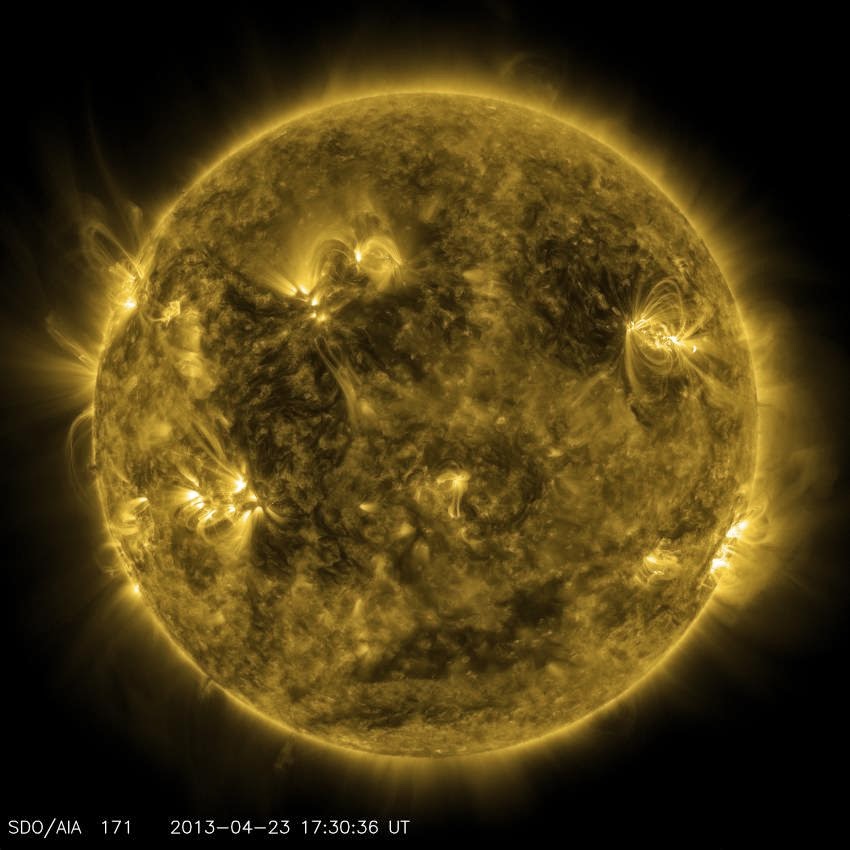
NASA's Solar Dynamics Observatory captured this image of what the sun looked like on April 23, 2013, at 1:30 p.m. EDT when the EUNIS mission launched. 

EUNIS focused on an active region of the sun, seen as bright loops in the upper right in this picture. 

Credit: NASA/SDO

Scientists have recently gathered some of the strongest evidence to date to explain what makes the sun's outer atmosphere so much hotter than its surface.

The new observations of the small-scale extremely hot temperatures are consistent with only one current theory: something called nanoflares; a constant peppering of impulsive bursts of heating, none of which can be individually detected, provide the mysterious extra heat

What's even more surprising is these new observations come from just six minutes worth of data from one of NASA's least expensive type of missions, a sounding rocket.

The Extreme Ultraviolet Normal Incidence Spectrograph (EUNIS) mission, launched on April 23, 2013, gathering a new snapshot of data every 1.3 seconds to track the properties of material over a wide range of temperatures in the complex solar atmosphere.

The sun's visible surface, called the photosphere, is some 6,000 Kelvins, while the corona regularly reaches temperatures which are 300 times as hot.

Jeff Brosius
"That's a bit of a puzzle," said Jeff Brosius, a space scientist at Catholic University in Washington, D.C., and NASA's Goddard Space Flight Center in Greenbelt, Maryland.

"Things usually get cooler farther away from a hot source. When you're roasting a marshmallow you move it closer to the fire to cook it, not farther away."

Brosius is the first author of a paper on these results appearing in the Aug. 1, 2014, edition of The Astrophysical Journal.

Several theories have been offered for how the magnetic energy coursing through the corona is converted into the heat that raises the temperature.

Different theories make different predictions about what kind of, and what temperature, material might be observable, but few observations have high enough resolution over a large enough area to distinguish between these predictions.


NASA's EUNIS sounding rocket mission spotted evidence to explain why the sun's atmosphere is so much hotter than its surface. 

Credit: NASA/Goddard/Duberstein 

The EUNIS sounding rocket, however, was equipped with a very sensitive version of an instrument called a spectrograph.

Spectrographs gather information about how much material is present at a given temperature, by recording different wavelengths of light.

To observe the extreme ultraviolet wavelengths necessary to distinguish between various coronal heating theories, such an instrument can only work properly in space, above the atmosphere surrounding Earth that blocks that ultraviolet light.

The EUNIS team stands in front of the sounding rocket before its second launch on Nov. 6, 2007. 

The mission will launch again for a six-minute flight to observe the sun on December 15, 2012. 

Credit: U.S. Navy

So EUNIS flew up nearly 200 miles above the ground aboard a sounding rocket, a type of NASA mission that flies for only 15 minutes or so, and gathered about six minutes worth of observations from above the planet's air.

During its flight, EUNIS scanned a pre-determined region on the sun known to be magnetically complex, a so-called active region, which can often be the source of larger flares and coronal mass ejections.

As light from the region streamed into its spectrograph, the instrument separated the light into its various wavelengths.

Instead of producing a typical image of the sun, the wavelengths with larger amounts of light are each represented by a vertical line called an emission line.

Each emission line, in turn, represents material at a unique temperature on the sun. Further analysis can identify the density and movement of the material as well.

The EUNIS spectrograph was tuned into a range of wavelengths useful for spotting material at temperatures of 10 million Kelvin; temperatures that are a signature of nanoflares.

Unlike a conventional image, NASA's Extreme Ultraviolet Normal Incidence Spectrograph will provide what's known as "spectra" such as above, which show lines to highlight which wavelengths of light are brighter than others. 

That information, in turn, corresponds to which elements are present in the sun's atmosphere and at what temperature. 

Credit: NASA/EUNIS

Scientists have hypothesised that a myriad of nanoflares could heat up solar material in the atmosphere to temperatures of up to 10 million Kelvins.

This material would cool very rapidly, producing ample solar material at the 1 to 3 million degrees regularly seen in the corona.

However, the faint presence of that extremely hot material should remain. Looking over their six minutes of data, the EUNIS team spotted a wavelength of light corresponding to that 10 million degree material.

To spot this faint emission line was a triumph of the EUNIS instrument's resolution. The spectrograph was able to clearly and unambiguously distinguish the observations representing the extremely hot material.

"The fact that we were able to resolve this emission line so clearly from its neighbours is what makes spectroscopists like me stay awake at night with excitement," said Brosius.

"This weak line observed over such a large fraction of an active region really gives us the strongest evidence yet for the presence of nanoflares."

The EUNIS experiment undergoing tests before launch. 

Credit: NASA

There are a variety of theories for what mechanisms power these impulsive bursts of heat, the nanoflares.

Moreover, other explanations have been offered for what is heating the corona.

Scientists will continue to explore these ideas further, gathering additional observations as their tools and instruments improve.

However, no other theory predicts material of this temperature in the corona, so this is a strong piece of evidence in favour of the nanoflare theory.

Adrian Daw
"This is a real smoking gun for nanoflares," said Adrian Daw, the current principal investigator for EUNIS at Goddard. "And it shows that these smaller, less expensive sounding rockets can produce truly robust science."

In addition to having a lower cost, sounding rockets offer a valuable test bed for new technology that may subsequently be flown on longer-term space missions.

Another advantage of sounding rockets is that the instruments parachute back to the ground so they can be recovered and re-used.

The EUNIS mission will be re-tuned to focus on a different set of solar wavelengths; ones that can also spot the extremely high temperature material representative of nanoflares, and fly again sometime in 2016.

More Information: Pervasive Faint Fe XIX Emission from a Solar Active Region Observed with EUNIS-13: Evidence for Nanoflare Heating - Jeffrey W. Brosius et al. 2014 ApJ 790 112. doi:10.1088/0004-637X/790/2/112

Wednesday, May 28, 2014

NASA CHESS: Sounding rocket to study birthplace of stars

The Colorado High-resolution Echelle Stellar Spectrograph (CHESS), sounding rocket gets ready for a six-minute flight to observe far beyond our solar system, to peer at a place where new stars are born. 

Credit: NASA/WSMR

NASA successfully launched the Colorado High-resolution Echelle Stellar Spectrograph (CHESS), payload aboard a Black Brant IX suborbital sounding rocket at 3:35 a.m. EDT on May 24, 2014, from the White Sands Missile Range in New Mexico.

Kevin France
Principal investigator Kevin France at the University of Colorado at Boulder reports that good data was received and the mission was a success. Recovery of the payload is in progress, as planned.

In deep space, floating between the stars, lies an abundance of atoms, carbon, oxygen, hydrogen, that over millions of years will grow into new stars and new planets.

Early in the morning on May 24, 2014, at 2 a.m. EDT, a NASA Black Brant IX sounding rocket will carry a payload for a 15–minute flight to observe this star nursery more comprehensively and in better detail than has been done by a single instrument ever before.

"These atoms are the raw materials, the very building blocks for the next generation of stars and planets," said Kevin France.

"We're making detailed measurements of how many atoms have transitioned into molecules, which is the very first step toward star formation."

The sounding rocket payload, Colorado High-resolution Echelle Stellar Spectrograph (CHESS), will launch from White Sands Missile Range in New Mexico.

CHESS is equipped with what's known as a spectrograph, which can parse out just how much of any given wavelength of light is present.

CHESS will soar above Earth's atmosphere to look at the ultraviolet light from a bright star – light that is blocked by the atmosphere and can't be seen from the ground.

As this light courses toward Earth, it bumps into the interstellar atoms and molecules along the way, each of which can block certain wavelengths of light.

Scientists know which wavelength is blocked by what, so by measuring what light is missing, they can map out the atoms and molecules that are present in space.

Payload testing and integration of the Colorado High-resolution Echelle Stellar Spectrograph (CHESS) is underway at the Wallops Flight Facility. 

Graduate student Keri Hoadley (left) and Principal Investigator Dr. Kevin France (right), both from University of Colorado Boulder, prepare to align the Star Tracker 5000 with the CHESS. 

The star tracker is used for instrument/payload attitude determination, fine pointing and imaging. 

Photo credit: NASA/Berit Bland

The CHESS spectrograph provides such detailed and comprehensive observations that it can measure not only what atoms and molecules are present, but how fast they are moving and how turbulent the gas is.

Together, this information helps characterize how mature a given cloud of dust is.

"Carbon, for example, will appear differently over time," said France. "Early on the cloud will have carbon with a missing electron, called ionized carbon."

"As the gas gets denser, the carbon atoms gain back their electrons, so you have neutral carbon. As you get even denser clouds, the carbon binds to oxygen creating carbon monoxide molecules, and at that point you can probe the cloud conditions that precede the collapse into a star."

Using something like CHESS to see whether you have ionized or neutral carbon, or even carbon monoxide molecules tells you more about how old the cloud is and can help scientists learn how stars form from these clouds.

It's still not known exactly how long it takes before a cloud collapses to begin making a star, for example. It might be anywhere between 1 to 100 million years.

By flying such newly-developed instruments on a relatively inexpensive sounding rocket, scientists do more than just gather solid science data.

They also have the chance to test and improve their instruments, perhaps to someday fly long-term on a satellite in space.

NASA successfully launched the Colorado High-resolution Echelle Stellar Spectrograph (CHESS), payload aboard a Black Brant IX suborbital sounding rocket at 3:35 a.m. EDT on May 24, 2014, from the White Sands Missile Range in New Mexico.

Principal investigator Kevin France at the University of Colorado at Boulder reports that good data was received and the mission was a success. Recovery of the payload is in progress, as planned.

Friday, May 2, 2014

NASA Black Brant XII: HYPE Sounding rocket to study interplanetary medium

A Black Brant XII launches from Wallops Flight Facility. 

Credit: NASA

NASA will conduct a sounding rocket mission in May 2014, carrying a payload designed to measure the nature of the interplanetary medium (IPM), characterizing the particles that fill our solar system.

The Hydrogen Polarimetric Explorer (HYPE), measures light reflected by interplanetary hydrogen that originally flows in from outside the galaxy.

Along its travels, the hydrogen crosses the boundaries of our heliosphere, the local bubble surrounding the sun and planets that is inflated by the solar wind.

Thus it can provide not only information about the nature of near space, but also of the galactic environment and how it interacts with the sun and heliosphere.

The sounding rocket measurements will provide important information on the size and shape of the heliosphere as well as information on the interstellar magnetic field at the boundary.

These results will be combined with NASA's Interstellar Boundary Explorer (IBEX), Voyager, and Hubble Space Telescope interplanetary hydrogen measurements to improve models of the heliospheric boundary and its interactions with the local interstellar medium.

The window for the HYPE launch opens on May 2, 2014.

HYPE will fly on a Terrier-Black Brant sounding rocket, launched from the White Sands Missile Range in New Mexico.

It is projected to fly to an altitude of about 185 miles during a nine-minute flight.

Walt Harris with the UC Davis is the mission principal investigator.

Tuesday, June 25, 2013

Raytheon rocket onboard camera - Video


Onboard video footage shows a rocket’s flight during the International Rocketry Challenge, held during the Paris Air Show on June 21, 2013, at Le Bourget Airport.

The goal of the challenge was to launch a rocket 750 feet in the air within a 48- to

Credit: Raytheon Company