Showing posts with label Experiment. Show all posts

Saturday, August 2, 2014

NASA SDO: EUNIS mission - Coronal Heating theory detected

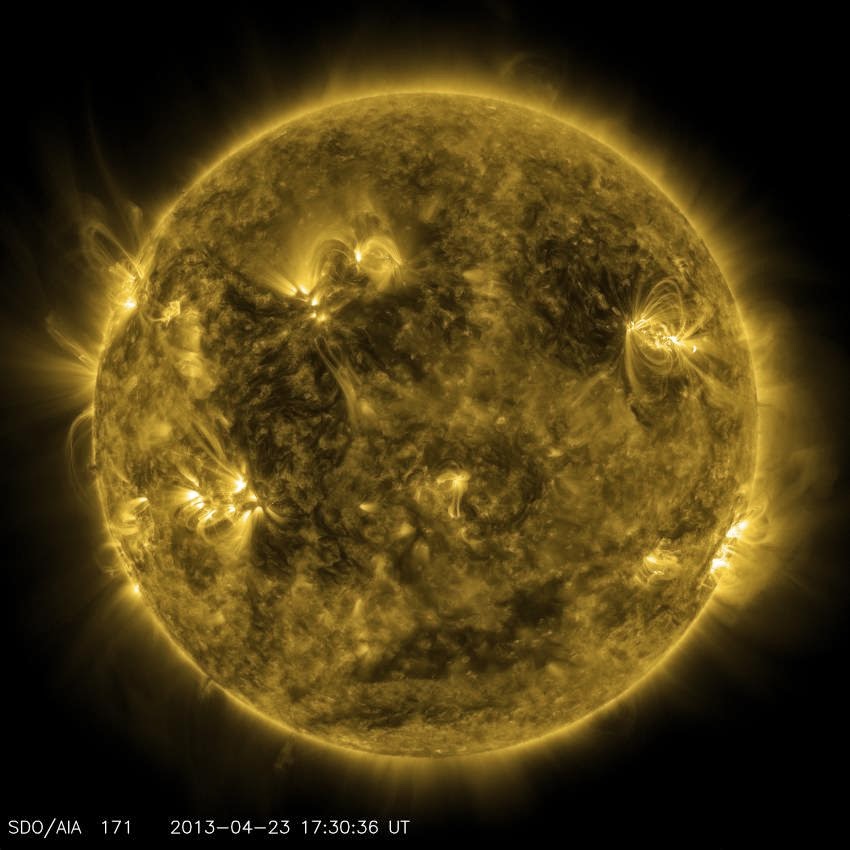
NASA's Solar Dynamics Observatory captured this image of what the sun looked like on April 23, 2013, at 1:30 p.m. EDT when the EUNIS mission launched. 

EUNIS focused on an active region of the sun, seen as bright loops in the upper right in this picture. 

Credit: NASA/SDO

Scientists have recently gathered some of the strongest evidence to date to explain what makes the sun's outer atmosphere so much hotter than its surface.

The new observations of the small-scale extremely hot temperatures are consistent with only one current theory: something called nanoflares; a constant peppering of impulsive bursts of heating, none of which can be individually detected, provide the mysterious extra heat

What's even more surprising is these new observations come from just six minutes worth of data from one of NASA's least expensive type of missions, a sounding rocket.

The Extreme Ultraviolet Normal Incidence Spectrograph (EUNIS) mission, launched on April 23, 2013, gathering a new snapshot of data every 1.3 seconds to track the properties of material over a wide range of temperatures in the complex solar atmosphere.

The sun's visible surface, called the photosphere, is some 6,000 Kelvins, while the corona regularly reaches temperatures which are 300 times as hot.

Jeff Brosius
"That's a bit of a puzzle," said Jeff Brosius, a space scientist at Catholic University in Washington, D.C., and NASA's Goddard Space Flight Center in Greenbelt, Maryland.

"Things usually get cooler farther away from a hot source. When you're roasting a marshmallow you move it closer to the fire to cook it, not farther away."

Brosius is the first author of a paper on these results appearing in the Aug. 1, 2014, edition of The Astrophysical Journal.

Several theories have been offered for how the magnetic energy coursing through the corona is converted into the heat that raises the temperature.

Different theories make different predictions about what kind of, and what temperature, material might be observable, but few observations have high enough resolution over a large enough area to distinguish between these predictions.


NASA's EUNIS sounding rocket mission spotted evidence to explain why the sun's atmosphere is so much hotter than its surface. 

Credit: NASA/Goddard/Duberstein 

The EUNIS sounding rocket, however, was equipped with a very sensitive version of an instrument called a spectrograph.

Spectrographs gather information about how much material is present at a given temperature, by recording different wavelengths of light.

To observe the extreme ultraviolet wavelengths necessary to distinguish between various coronal heating theories, such an instrument can only work properly in space, above the atmosphere surrounding Earth that blocks that ultraviolet light.

The EUNIS team stands in front of the sounding rocket before its second launch on Nov. 6, 2007. 

The mission will launch again for a six-minute flight to observe the sun on December 15, 2012. 

Credit: U.S. Navy

So EUNIS flew up nearly 200 miles above the ground aboard a sounding rocket, a type of NASA mission that flies for only 15 minutes or so, and gathered about six minutes worth of observations from above the planet's air.

During its flight, EUNIS scanned a pre-determined region on the sun known to be magnetically complex, a so-called active region, which can often be the source of larger flares and coronal mass ejections.

As light from the region streamed into its spectrograph, the instrument separated the light into its various wavelengths.

Instead of producing a typical image of the sun, the wavelengths with larger amounts of light are each represented by a vertical line called an emission line.

Each emission line, in turn, represents material at a unique temperature on the sun. Further analysis can identify the density and movement of the material as well.

The EUNIS spectrograph was tuned into a range of wavelengths useful for spotting material at temperatures of 10 million Kelvin; temperatures that are a signature of nanoflares.

Unlike a conventional image, NASA's Extreme Ultraviolet Normal Incidence Spectrograph will provide what's known as "spectra" such as above, which show lines to highlight which wavelengths of light are brighter than others. 

That information, in turn, corresponds to which elements are present in the sun's atmosphere and at what temperature. 

Credit: NASA/EUNIS

Scientists have hypothesised that a myriad of nanoflares could heat up solar material in the atmosphere to temperatures of up to 10 million Kelvins.

This material would cool very rapidly, producing ample solar material at the 1 to 3 million degrees regularly seen in the corona.

However, the faint presence of that extremely hot material should remain. Looking over their six minutes of data, the EUNIS team spotted a wavelength of light corresponding to that 10 million degree material.

To spot this faint emission line was a triumph of the EUNIS instrument's resolution. The spectrograph was able to clearly and unambiguously distinguish the observations representing the extremely hot material.

"The fact that we were able to resolve this emission line so clearly from its neighbours is what makes spectroscopists like me stay awake at night with excitement," said Brosius.

"This weak line observed over such a large fraction of an active region really gives us the strongest evidence yet for the presence of nanoflares."

The EUNIS experiment undergoing tests before launch. 

Credit: NASA

There are a variety of theories for what mechanisms power these impulsive bursts of heat, the nanoflares.

Moreover, other explanations have been offered for what is heating the corona.

Scientists will continue to explore these ideas further, gathering additional observations as their tools and instruments improve.

However, no other theory predicts material of this temperature in the corona, so this is a strong piece of evidence in favour of the nanoflare theory.

Adrian Daw
"This is a real smoking gun for nanoflares," said Adrian Daw, the current principal investigator for EUNIS at Goddard. "And it shows that these smaller, less expensive sounding rockets can produce truly robust science."

In addition to having a lower cost, sounding rockets offer a valuable test bed for new technology that may subsequently be flown on longer-term space missions.

Another advantage of sounding rockets is that the instruments parachute back to the ground so they can be recovered and re-used.

The EUNIS mission will be re-tuned to focus on a different set of solar wavelengths; ones that can also spot the extremely high temperature material representative of nanoflares, and fly again sometime in 2016.

More Information: Pervasive Faint Fe XIX Emission from a Solar Active Region Observed with EUNIS-13: Evidence for Nanoflare Heating - Jeffrey W. Brosius et al. 2014 ApJ 790 112. doi:10.1088/0004-637X/790/2/112

Tuesday, April 29, 2014

Experiment on Earth demonstrates effect observed in space

Streaming jets of high-speed matter produce some of the most stunning objects seen in space.

Astronomers have seen them shooting out of young stars just being formed, X-ray binary stars and even the supermassive black holes at the centers of large galaxies.

Theoretical explanations for what causes those beam-like jets have been around for years, but now an experiment by French and American researchers using extremely high-powered lasers offers experimental verification of one proposed mechanism for creating them.

"This research is an example of how laboratory experiments can be used to test mechanisms that may produce what we observe in space," said Eric Blackman, professor of physics and astronomy at the University of Rochester and one of the co-authors.

Blackman explains that he and his collaborators wanted to recreate conditions in the lab that lead to jets in space becoming collimated, parallel beam-like, rather than diverging.

Theory and computational simulations had suggested the possibility that jets might be created by "shock focused inertial confinement."

Blackman adds that the experiment "confirms that this particular mechanism is viable, even though other effects are likely to also be taking place."

In their results, the researchers show evidence of the "shocks" predicted by theory, and which give the mechanism its name.

These shocks are surfaces in space where there is a sudden change in the density, speed, and direction of a flow.

According to theory, which is consistent with the new experiment, they are what cause the beam-like nature of the jets to form.

In the paper published in Physical Review Letters, and highlighted as an editor's suggestion, the researchers explain how they used the laser laboratory facility (LULI), at the Ecole Polytechnique in France, to recreate these space jets.

Collaborators at the University of Chicago supplied a sophisticated computer code FLASH that they developed and adapted to help analyze the results.

"We have focused a very energetic laser beam on a tiny iron target – a little thinner than a human hair," explains Alessandra Ravasio, who led the experiment.

"In this way we can create a supersonic plasma flow."

With nothing to prevent the resulting iron plasma from spreading out, it would flow quasi-spherically from the target. In order to see the effects of a surrounding wind, the researchers generated another lighter, supersonic plasma from a plastic ring surrounding the central target.

"The novelty of this experiment is in the way we spatially distribute the laser energy, with a central dot generating the iron flow and a outer ring incident on the plastic," adds Ravasio.

"In this way we could create a nested geometry and study the interaction between the two flows."

The researchers found that the interaction of the two plasmas sharply collimates the iron plasma flow. That is, rather than spreading out in all directions, the iron flow emanates primarily along a single direction.

The experimental data showed that a shock wave is generated in this interaction, which helps the momentum and inertia of the plastic outer wind to collimate the inner iron flow into a jet.

The experiment is an example of laboratory astrophysics, a rapidly growing area of high energy density physics that requires the collaboration of astrophysicists, experimental plasma physicists and computational physicists.

More information: Paper: journals.aps.org/prl/abstract/10.1103/PhysRevLett.112.155001

Monday, March 3, 2014

ESA ATV-5 Haptics-1 experiment: Touchy-Feely Body-Mounted Joystick

Body-mounted astronaut joystick for the Haptics-1 experiment, developed by ESA's Telerobotics and Haptics Laboratory as part of the multi-agency Meteron (Multi-Purpose End-to-End Robotic Operation Network) initiative, investigating telerobotics for space. 

The Haptics-1 experiment is being flown to the ISS by ATV-5 in summer 2014. 

Credit: ESA

Stowed inside ESA’s next supply ship to the International Space Station will be one of the most advanced joysticks ever built, designed to test the remote control of robots on the ground from up in orbit.

Due to be launched this summer, the Automated Transfer Vehicle will deliver more than five tonnes of propellant, supplies and experiments to the orbital outpost.

The consignment includes the first sustained test of how astronauts experience touch-based feedback in weightlessness.

The experiment comes down to a deceptively simple-looking lever that can be moved freely to play basic Pong-style computer games.

Performance readings from these games, along with follow-up questionnaires, will analyse the effects on human motor control when exposed to long-term weightlessness, and how feedback feels in orbit.

ATV-5 logo

Behind the scenes, a complex suite of servo motors can withstand any force an astronaut operator might unleash on it, while generating forces that the astronaut will feel in turn – just like a standard video gaming joystick as a player encounters an in-game obstacle.

The difference in orbit is that, to quote Isaac Newton, ‘every action has an equal and opposite reaction’ – so to prevent the joystick’s force feedback pushing its free-floating user around it is mounted to a body harness that can be fixed in turn to standard Station equipment.

“Getting the hardware to be extremely precise yet incredibly sturdy was the project’s main challenge,” explains André Schiele, head of ESA's Telerobotics and Haptics Laboratory, overseeing the experiment.

Haptics-1 setup

“The resulting system can produce minute forces most people are not sensitive enough to feel, but astronauts could kick it and it will still work and respond correctly.”

Seven different tests are planned so far, with more in the pipeline – new tests can be uploaded easily.

A touchscreen tablet will be used to load software and conduct the experiments.


A video trailer of the proposed ESA Project METERON (Multi-Purpose End-To-End Robotic Operation Network). 

METERON is a technology demonstration experiment including the International Space Station ISS. A set of novel haptic control devices (Force-reflecting joystick, exoskeleton, 3D display) will be used by Astronauts from on-board the ISS to control robotic systems on ground. 

Technology validation will be for transparent bi-lateral telemanipulation, shared autonomous operations and autonomous operations. 

The METERON experiment will validate technology candidates for future exploration mission usage. 

METERON is an ESA-led mission proposal with intended participation by DLR, Roscosmos and NASA

Monday, December 9, 2013

ISS Video Update: Space to Ground


NASA's Space to Ground is your weekly update on what's happening aboard the International Space Station. Got a question or comment? Use #spacetoground to talk to them.

Links mentioned this week:

Expedition 38 Photo Gallery:

Capillary Flow Experiment:

SLAMM-D:

Spot The Station:

Thursday, November 28, 2013

CERN ATLAS experiment: Higgs boson decays to two tau particles

The ATLAS detector, open during a recent technical stop. 

Credit: Maximilien Brice /CERN

The ATLAS experiment at CERN has released preliminary results that show evidence that the Higgs boson decays to two tau particles.

Taus belong to a group of subatomic particles called the fermions, which make up matter.

This result – measured at 4.1 sigma on the 5-point scale particle physicists use to determine the certainty of a result – is the first evidence for a Higgs decay to fermions.

On 4 July 2012, the ATLAS and CMS experiments at CERN announced the discovery of a new particle, which was later confirmed to be a Higgs boson.

For physicists, the discovery meant the beginning of a quest to find out what the new particle was, if it fit in the Standard Model, our current model of nature in particle physics, or if its properties could point to new physics beyond that model.

An important property of the Higgs boson that ATLAS physicists are trying to measure is how it decays.

The Higgs boson lives only for a short time and disintegrates into other particles. The various possibilities of the final states are called decay modes.

So far, ATLAS physicists had found evidence that the Higgs boson decays into different types of gauge bosons - the kind of elementary particles that carry forces.

The other family of fundamental particles, the fermions, make up matter. The tau is a fermion and behaves like a very massive electron.

Graphical representation of a Higgs boson decaying to two tau particles in the ATLAS detector. 

The taus decay into an electron (blue line) and a muon (red line) 

Credit: ATLAS

The Brout-Englert-Higgs mechanism was first proposed to describe how gauge bosons acquire mass but the Standard Model predicts that fermions also acquire mass in this manner, so the Higgs boson could decay directly to either bosons or fermions.

The new preliminary result from ATLAS shows clear evidence that the Higgs boson indeed does decay to fermions, consistent with the rate predicted by the Standard Model.

This important finding was made possible through careful analysis of data produced by the LHC during its first run.

Only with new data will physicists be able to determine if the compatibility remains or if other new models become viable.

Fortunately, the next LHC run, which begins in 2015, is expected to produce several times the existing data sample. In addition, the proton collisions will be at higher energies, producing Higgs bosons at higher rates.

Thursday, May 23, 2013

Animals Died in Space but Experiment deemed a success

Russia's Bion-M1 biological research satellite, which recently carried rodents, microorganisms and plants on a month-long space flight, successfully accomplished its mission, an official said on Wednesday, despite the death of most of the animals on board.

"The spacecraft did not show any noticeable failures and has accomplished its program in full," said Vladimir Sychev, deputy director of Russia's Institute of Medical and Biological Studies.

Russia launched the Bion-1M satellite, its first biological research satellite since 2007, on a 30-day mission on April 19 to conduct biology, physiology and biotechnology research in orbit.

The aim of the study was to help pave the way for future interplanetary flights including Mars missions, according to the Federal Space Agency Roscosmos.

Bion-M1 carried eight Mongolian gerbils, 45 mice, 15 geckos, slugs and snails and containers with various microorganisms and plants.

The satellite's returnable capsule landed on Sunday in the Russian Orenburg Region near the border with Kazakhstan.

Most of the satellite's "space passengers" failed to survive the flight due to technical faults in the spacecraft. The flight proved fatal for all the eight Mongolian gerbils, 39 out of 45 mice, and its cichlid fish. The geckos, slugs and snails were among the lucky survivors.

"We expected that there would be losses. Experiments that pass off ideally do not exist. We expected that up to a half of animals would return," Sychev said.

Stress could have killed the animals, he suggested.

"The transition to zero gravity could have led to stress which could have provoked a conflict in the group," the scientist said, but admitted the fishes' death was due to technical faults.

"Twelve days after [the start of the space flight], the lights went off, algae [in the fish tank] stopped photosynthesizing, oxygen ceased to be released and the fish died," he said, adding the experiment involving the fish had been carried out by German scientists.

The next flight by a Bion satellite could take place in a higher orbit, Sychev said.

"The [current] flight was at an altitude of 575 km [357 miles] where piloted spacecraft fly. We want [a future satellite] to fly to an altitude of 1,000 km. Conditions there will be tougher," he said.

NASA's Bion project science manager Richard Boyle told a news conference in Russia on behalf of all US specialists involved in the project that scientists were overjoyed at the condition of experimental mice and at how promptly they were delivered to Moscow.

Sunday, May 19, 2013

Russian Retrieves Soyuz Bion-M Capsule; 45 Mice, 15 Newts Space Experiment

A Soyuz-2.1b carrier rocket, carrying an Bion-M capsule is seen on the launch pad a Russia's Baikonur cosmodrome on April 18, 2013. 

The Russian capsule filled with 45 mice and 15 newts along with other small animals has returned from a month's mission in orbit with data scientists hope will pave the way for a manned flight to Mars.

A Russian capsule filled with 45 mice and 15 newts along with other small animals returned from a month's mission in orbit on Sunday with data scientists hope will pave the way for a manned flight to Mars.

Russian Mission Control said the Bion-M craft landed softly with the help of a special parachute system in the Orenburg Region about 1,200 kilometres (750 miles) southeast of Moscow.

The capsule was also carrying snails and gerbils as well as some plants and microflora. There was no immediate information about how many of the animals survived.

The TsSKB-Progress space research centre's department head Valery Abrashkin said on the day the mission took off in April that the study was aimed at determining how bodies adapt to weightlessness "so that our organisms survive extended flights."

A field research lab has been deployed near where the capsule landed to quickly test the animals' response to their journey and return to Earth.

Scientists said the animals were needed because they were subject to the kinds of experiments that are impossible to be conducted on humans who are currently operating the International Space Station (ISS).

They added that the small menagerie would have posed a health risk if simply placed on board the ISS for a month.

The experiment's designers said the tests primarily focused on how microgravity impacts the skeletal and nervous systems as well organisms' muscles and hearts. The capsule spun 575 kilometres (357 miles) above Earth.

Russia has long set its sights on Mars and is now targeting 2030 as the year in which it could begin creating a base on the Moon for flights to the Red Planet.

But recent problems with its once-vaunted space programme—including the embarrassing failure of a research satellite that Moscow tried sending up to one of Mars's moons last year—have threatened Russia's future exploration efforts.

Sunday, April 28, 2013

The Cryogenic Dark Matter Search (CDMS) experiment finds 'hints'

Enectali Figueroa-Feliciano
Physicists operating an underground experiment in Minnesota reported last week that they have found possible hints of dark matter.

The Cryogenic Dark Matter Search (CDMS) experiment detected three events with the characteristics expected of dark matter, Kevin McCarthy, a PhD student in physics at MIT, reported at the American Physical Society meeting in Denver.

These results do not meet the criteria physicists use to claim a discovery, so CDMS scientists now plan to conduct more analysis.
Kevin McCarthy

One of those scientists, Enectali Figueroa-Feliciano, an associate professor of physics at MIT and McCarthy's adviser, spoke with MIT News about the new results.

The implications of this result
"We are trying to answer a very simple question: What is the universe made of? "

"The strange picture that has emerged over the last two decades is one where over 84 percent of the matter in the universe is not in the atoms that make up stars or planets or rocks or dust or gas, but in a new substance that we call dark matter."

"We currently think dark matter consists of a yet-to-be-discovered fundamental particle that permeates all of space."

"If this is the right picture, millions of these particles go through our bodies every second. Scientists have been trying to see interactions between dark matter and "normal" matter—the detectors at our underground experiment."

"If such interactions are found, they would carry the imprints of the properties of the dark-matter particle, information that would help us open a new window of understanding into the most fundamental properties of our universe at both the subatomic and cosmological scales."

MIT's contribution 
"The CDMS collaboration is composed of 18 institutions; running the experiment, taking the data, and analyzing it is a group effort."

"A significant portion of this analysis, however, was carried out by Kevin McCarthy as part of his PhD thesis at MIT. The analysis of a potential dark-matter interpretation of the data was done by MIT postdoctoral researcher Julien Billard."
Julien Billard

Next steps
"Our results are intriguing, but not enough for a definitive discovery. "

"To really determine the source of these events, we are doing further analysis on this data, and are taking new data right now in our experiment half a mile underground in an old iron mine in the town of Soudan, Minn."

"Other dark-matter experiments are also exploring this region of interest."

"It will take several experiments, seeing consistent signals, to definitively solve the dark-matter riddle."

Thursday, August 2, 2012

NASA ESA ISS Research Backlog


With major construction complete on the International Space Station, member states have been touting the benefits to be gleaned from the experiments aboard the fully operational orbiting laboratory.

However, there have been recent hints that expectations may be just too high – and experiments are piling up.

The major issue with conducting research on ISS is the limited availability of crew to execute and monitor experiments.

Although ISS is officially in operation mode, there are still many maintenance activities that take up crew time.

“Currently crewmembers are working 13 or 14 hours a day, and out of that we can get about 6.5 hours of mission programmatic work done,” returned ISS astronaut Don Pettit told the US Senate Committee on Commerce, Science and Transportation on July 25.

“That’s because we’re in a harsh frontier, and we spend 13 or 14 hours a day just to keep the machinery going and keep it possible for human beings to be there. You’ll find this is commensurate with other frontiers that are harsh on the surface of Earth.”

With the extended work days on top of dealing with the physiological and psychological strain of being in space and the extra effort needed just to peform daily tasks such as hygiene, exercise, and food preparation, there are signs that the pressure is taking its toll.

For instance, a recent mishap resulted in a set of student experiments being returned to Earth unactivated. An astronaut was supposed to flex the MixStix vials to mix their contents while they were aboard.

Although Nanoracks has taken responsibility for the mistake, citing inadequate training of the astronauts, clearly the crew have mastered much more complex technologies.

With space agencies, particularly NASA, pushing to justify increased – or at least not reduced – domestic space program spending, there is increasing pressure to produce results from ISS research.

NASA is currently pursuing two avenues to increase experiment capacity on the station. For the near term, the agency is in talks with Russia to borrow cosmonauts’ time to help out with research on the US side of the station and is working to use robotics such as Dextre to replace crew activities whenever possible.

More long term, NASA hopes to increase the station’s crew complement from six to seven. Although there is plenty of space aboard ISS to house another person, the Soyuz capsule is only able to carry three crew members at a time – and at this time is the only transportation option for getting crew to and from ISS.

Exceeding six crew members could impede the ability to evacuate in event of emergency. However, the development of commercial crew capabilities may alleviate this constraint, with capsules being designed to hold four or more crew.

The question, of course, is when such capability will be ready and available for use. In the meantime, the six ISS crew members must do the best they can.

Thursday, July 26, 2012

Mice Return from Long Duration Spaceflight Experiment


Three mice have returned to Earth alive after 91 days in space aboard the International Space Station (ISS). The mice are being studied for evidence of long duration flight impact on their physiology.

One of the objectives of this experiment was to study the impact of microgravity on the reproductive organs. According to Joseph Tash from the University of Kansas in Lawrence, the reproductive organs are vulnerable to the damaging effects of radiation in space, especially if there is a solar flare event.

“It releases particles that cause a huge amount of radiation damage,” he says. Microgravity and stress may also interfere with sperm production, says Tash.

Maria Masini of the University of Genoa in Italy published in the PLOS Journal that the “sperm cell number was significantly reduced in spaceflight mouse epididymis (approx. −90% vs. laboratory and ground controls), indicating that the space environment may lead to degenerative changes in seminiferous tubules.”

These degenerative effects could be due not just to radiation damage, but to the lack of gravity as well. The natural external location of the testes provides a cooler environment in the presence of gravity and convection.

Without gravity the testes would sit closer to the body and without any air convection they would be at a higher temperature, which could impact sperm production in mammals.

The flight duration, 91 days, for these mice sets the record for the longest spaceflight duration of any non-human living animal to date.

These experimental studies demonstrate the biological consequences of reduced gravity and exposure to space radiation for a long duration spaceflight.

This knowledge will help researchers prepare countermeasures for astronauts on long duration flights as well as improve the treatment for conditions found on earth.

The research published in the PLOS Journal came to five primary findings including studies of space-induced changes of function of thyroid and testis, the effect of microgravity on skeletal muscles and bones, space anaemia, and the ageing process.

The experiment involved 6 mice, 3 of which survived the mission duration.The remaining mice were preserved and returned to Earth for further study.

Statistically speaking there are too few data points in order for the results to be statistically significant; however, early trends can be observed.

Experiments in the space environment with mammals will benefit many people on the ground and are necessary for future longer term space programs.

Wednesday, October 5, 2011

ESA - Hypergravity and the Large Diameter Centrifuge

Hypergravity and the Large Diameter Centrifuge

To understand and describe the influence of gravity in systems, the observation of behaviour in microgravity and at 1g (where g is the gravitational acceleration at the surface of the Earth) is not sufficient.

A broad gravity spectrum has to be explored to complete the scientific picture of how gravity has an impact on a system: samples have to be exposed to a variety of acceleration values above 1g (hypergravity).

A Large Diameter Centrifuge (LDC) has been developed recently by ESA, allowing the acquisition of measurement points in the range from 1 to 20 g.

This document summarises the main features of the Large Diameter Centrifuge (LDC).

This instrument can provide a hypergravity environment for cells, plants and small animals, as well as physical science and technological experiments.

The LDC is part of the Life and Physical Sciences Instrumentation and Life Support Laboratory (LIS) at ESTEC (the Netherlands), dedicated to serving the science and technology user communities throughout Europe.

A wide range of hypergravity experiments can be performed in the LDC facility, including biological, biochemical, microbiological, opto-physical, physical, material and fluid sciences, geology and plasma physics.

The diameter of the LDC is eight metres. It has four arms, each of which can support two gondolas with a maximum payload of 80 kg per gondola.

In practice, six gondolas are available, plus one gondola in the centre for control or reference experiments.

The rotation of the LDC then creates the hypergravity field at the experiment site inside each gondola.

The LDC is flexible in terms of experiment scenarios, duration and possible equipment to use. This means that the system is able to execute and manage experiments that last from one minute up to six months, without stopping.

More detailed information can be found in the LDC Experimenter User Manual.

This document will be provided to the selected teams with all the information needed to perform the experiments in the LDC facility. The document addresses the general features and operations and gives more technical details and technical data of the LDC in order to facilitate the preparation of the experiment.

Tuesday, October 19, 2010

Experiment simulates exotic white holes


Expensive particle colliders are not the only way to explore extreme physics. It seems that water gushing from a tap and hitting a sink behaves like a white hole;  the theoretical opposite of a black hole.

A black hole is a dense concentration of mass surrounded by an extremely powerful gravitational field. Nothing that falls within a certain radius surrounding it, known as the event horizon, escapes.


A white hole is the opposite: its event horizon allows things to escape but prevents anything from entering. However, so far white holes only exist in theory, so cannot be studied observationally.

When water hits the bottom of a sink, it flows outwards in all directions. At a certain distance from the point where the water hits the sink, the outgoing liquid rapidly decelerates and piles up before continuing its outward flow, creating a ring-like ridge.

Physicists have previously suspected that any ripples that might arise beyond the ridge and travel towards it should not be able to get past the ridge.

This is because at the ridge the water flows outwards at the maximum speed that ripples could travel inwards, so the ripples would make no forward progress, like a runner on a treadmill. This makes the ridge behave like a white hole event horizon.

Now this has been experimentally confirmed by Germain Rousseaux of the University of Nice in France and colleagues.

Opening Angle
Instead of looking at water hitting a sink, the team examined what happens when a stream of viscous oil hits an empty aquarium. When they placed the tip of a needle in the path of the oil as it spread out from the collision point, it generated a v-shaped disturbance (see image).

The angle of the v depended on the relative speeds of the fluid and any ripples on its surface. When the team measured it, they found that the two speeds are indeed equal, preventing ripples flowing in and creating something akin to a white hole event horizon.

They also found that between the collision point and the ridge, the oil flowed faster than the ripple speed, causing any ripples arising there to be swiftly carried outwards – just as things inside a white hole should get spat out.

Summary
"The experiment is based on a simple idea everyone can understand and try at home," says Ulf Leonhardt of the University of St Andrews, UK.

Daniele Faccio of Heriot-Watt University in Edinburgh, UK, who recently used lasers to simulate an event horizon, says studying black and white hole analogues could provide insights into the physics of these exotic objects. For example, in 1974, Stephen Hawking showed mathematically that event horizons should radiate light.

Our telescopes are not sensitive enough to confirm this, but analogue experiments like Rousseaux's could help reveal the physical mechanism for the radiation, which remains unclear.

Journal reference: arxiv.org/abs/1010.1701

Monday, May 17, 2010

NASA and ESA Spacecraft to Conduct Massive Experiment With Lasers

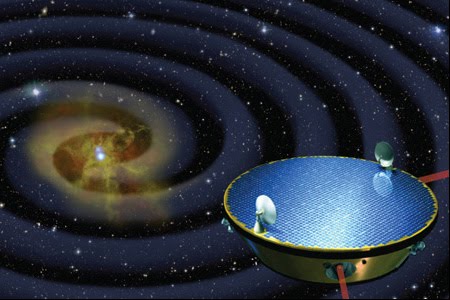
NASA and ESA are planning to launch three spacecraft into orbit around the sun some three million miles apart, and then have them shoot lasers at each other, Popular Science reports.

You may want to stop for a moment and just bask in the coolness of that idea. Back yet? The purpose of this project will be to prove one last part of Einstein's theory of relativity: the existence of gravitational waves, or "huge ripples in time and space that flow outwards from the collision of huge celestial bodies like black holes," as the report said.

To do this, NASA and ESA will deploy LISA, the Laser Interferometer Space Antenna; it consists of three spacecraft that will fire lasers at each other and measure the relative positions of floating cubes of gold and platinum alloy--with a precision of 40 millionths of a millionth of a meter.

The project is set for launch in 2020.

Wednesday, March 31, 2010

The Large Hadron Collider Experiment Really Matters


After a series of setbacks, scientists have done it. They've mashed protons together at 99 percent of the speed of light and at a record-high energy level of 3.5 trillion electron volts.

The experiment took place at the Large Hadron Collider (LHC) near Geneva, Switzerland but scientists around the world watched excitedly via live feed. What does this mean for the field?


  • This Is a Big Deal! exclaims Geoff Brumfiel at Nature: "I can't think of another case where the future of an entire field hinges on the success of a single experiment...It could verify current theories of particle physics, most notably the Higgs mechanism, which endows all matter with mass. It could also discover new physics beyond the current 'standard model', and explain some current mysteries in physics like 'dark matter', a mysterious form of matter that makes up around 85% of all matter in the universe."

  • Why Scientists Are Excited Melissa Franklin, Professor of Physics at Harvard, explains what this means for the scientific community in an interview late last year:
    Sean Gallup/Getty Images After a series of setbacks, scientists have done it. They've mashed protons together at 99 percent of the speed of light and at a record-high energy level of 3.5 trillion electron volts.


  • Don't Expect Instant Results, cautions LHC Spokesman Guido Tonelli to the BBC: "Major discoveries will happen only when we are able to collect billions of events and identify among them the very rare events that could present a new state of matter or new particles. This is not going to happen tomorrow. It will require months and years of patient work."

  • This Is What Science Is All About, rejoices Stacey Higginbotham at Gigaom: "The LHC built by CERN represents why I spend my days writing about technology — not because I’m excited to play with the latest gadgets, but because I value the spirit of curiosity and discovery that leads scientists to spend $16 billion to build something that may (not will, but may) give us an inkling about how the universe works."

  • Happy First Physics Day, declare the editors of Big Think: "Now there is a new March holiday, First Physics Day, which is being celebrated today because the particles in the Large Hadron Collider are finally being smashed together at super high energies that mirror conditions after the Big Bang. The physics community is aflutter over the potential of bagging the elusive Higgs boson, and the rest of us are grateful that, improbable as it seemed, the collider did not create a fatal black hole."

Monday, January 18, 2010

ESA Students selected to 'Fly Your Thesis' 2010

Following the debut of ESA’s ‘Fly Your Thesis!’ programme in 2009, four teams of university students have been selected to conduct their microgravity experiments during a second series of parabolic flights aboard an aircraft.

During the final selection phase, all of the teams wrote a detailed scientific proposal and a technical proposal. They also had to give an oral presentation during a workshop held at the European Space Research and Technology Centre in Noordwijk, the Netherlands, in early December.

The teams, made up of students from five ESA Member States, were chosen from 12 teams whose proposals were short-listed in September 2009.

QNEM & nanos on board!
Four students from the Université Libre de Bruxelles in Belgium and the University Federico II, in Naples, Italy will investigate the thermal diffusivity and conductivity of nanofluids – suspensions in conventional liquids of particles ranging in size from a few nanometres to 200 nanometres. This could lead to significant improvements in heat transfer devices.

Supermassive B
Four students from Joseph Fourier University in Grenoble, and Paul Sabatier University in Toulouse, France will study the properties of the dust resulting from asteroid collisions in order to improve exoplanet detection.

ARID
Two students from the University of Amsterdam, the Netherlands will investigate the interactions between soil particles to determine if the water repellence of top soils is affected by reorienting the water repellent coating on the surface of these particles. The results could improve understanding of the effects of forest fires and desertification on the repellence of water by soil.

GRAPPA
Four students from the University of Leicester, UK will investigate a ‘condensation mechanism for non-ideal kinetic gases of varying temperature’, and its relevance to the formation of planets and ‘rubble pile’ asteroids in the early Solar System.

The flights are scheduled to take place in the first quarter of 2011.

Thursday, December 10, 2009

NASA: First Monarch Butterflies Emerge in the ISS

The first-ever Monarch butterflies in space have taken flight on the International Space Station to the delight of astronauts aboard.

Space station commander Jeff Williams, of NASA, beamed video of the first of several Monarch butterflies fluttered its gossamer wings in weightlessness last week, just after the insect emerged from its cocoon and began floating around their enclosure.

"It is beautiful," Williams radioed Mission Control. "It's always beautiful to see a little bit of Earth up here."

The video showed one adult Monarch butterfly floating gently in microgravity as it opened and closed its wings to dry them. "Congratulations to the experiment team," Williams said.

"They are very proud parents," Mission Control radioed back. "Glad you finally got the video. It's a pretty awesome site."

The Monarch butterflies are the first ever sent to space. They began emerging just days after several Painted Lady butterflies began emerging from their own cocoons in a separate enclosure.

The Monarch and Painted Lady butterflies arrived at the station as catepillars last month on the space shuttle Atlantis as part of an educational experiment. And while butterfly larvae have been sent to space before, the colorful insects on the space station now are the first to successfully go through all phases of their development — from larva to pupa to adult butterfly — in orbit.

More than 170,000 students between kindergarten and 12th grade and 2,800 teachers are following the experiment on Earth, where they are comparing the space butterflies' lifecycle with that of similar insects on the ground. The butterflies also have their own Twitter page "ButterflySpace" where status updates of their space mission appear.

At least one difference between space Monarch butterflies and their terrestrial counterparts has already been revealed. On Earth, the wings of a newly-emerged Monarch butterfly can take anywhere between three and five minutes to dry. But aboard the space station, it took about 15 minutes.

The Monarch and Painted Butterflies were delivered to the space station inside a habitat known as the Commercial Generic Bioprocessing Apparatus Science Insert – 03. It was built by BioServe Space Technologies at the University of Colorado at Boulder.

Tuesday, November 17, 2009

Monarch Butterfly Experiment in ISS

Monarch and painted lady butterfly larvae rode into space Monday aboard space shuttle Atlantis in an experiment to be monitored by thousands of U.S. students.

The University of Colorado at Boulder butterfly larvae educational payload was designed and built by BioServe Space Technologies, a NASA-funded center located in the university's aerospace engineering department.

CU-Boulder, with the help of the K-12 students, will compare the growth and development of butterfly larvae in the weightless environment of the International Space Station with butterfly larvae being raised simultaneously in participating classrooms on Earth.

The project is the fourth educational experiment to be flown by CU-Boulder aboard the space station.

"One of the most exciting things about this project is that we can use the International Space Station to bring spaceflight experiments into classrooms around the country," BioServe Director Louis Stodieck said. "Our continuing goal is to inspire K-12 students around the country in science, technology, engineering and math."

About 100 elementary and middle schools across the nation are to officially participate in the project, with hundreds of other schools monitoring the experiment.