Showing posts with label Mice. Show all posts

Tuesday, September 23, 2014

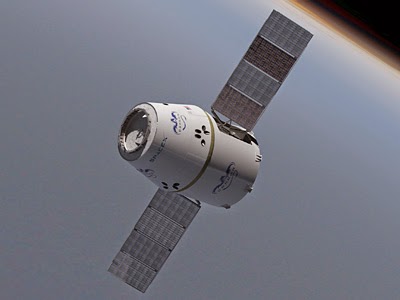
SpaceX Dragon unmanned spacecraft approaches ISS

A contrail is seen behind the SpaceX Falcon 9 rocket carrying a Dragon supply ship as it flies into space after lifting off from Cape Canaveral, Florida, on a resupply mission to the International Space Station, on September 21, 2014

SpaceX's unmanned Dragon spacecraft was nearing the International Space Station on Tuesday with a cargo of supplies, including freeze-dried meals, 20 live lab mice and a 3D printer.

Germany's Alexander Gerst, an astronaut from the European Space Agency (ESA), will operate CanadArm-2, the 57.7-foot (17.6-meter) robotic arm attached to the ISS, to capture the Dragon and bring it in to dock with the space station.

He will be assisted by NASA astronaut Reid Wiseman.

The berthing operation will be complete when the vessel latches fully onto the research outpost about two hours later.

The Dragon capsule is carrying more than 5,000 pounds (2,200 kilograms) of supplies and material for science experiments, including a tool to measure wind speed at the ocean's surface.

The spacecraft launched early Sunday from Cape Canaveral, Florida, and is SpaceX's fourth contracted mission with NASA for supply trips to the ISS and back.

The Rodent Research Hardware System, which will be installed at the International Space Station, includes three modules: the habitat at left, the transporter in the middle and the so-called animal access unit at right. 

Credit: NASA / Dominic Hart

The lab mice are the first live mammals to hitch a ride aboard a commercial cargo ship, and they are enclosed in a NASA-made research cage for studying the effects of weightlessness on their bodies.

This Zero-G Printer is the first 3D printer designed to operate in zero gravity. 

Also on board the SpaceX Dragon capsule is this 3D printer experiment.

The printer was built under a joint partnership between NASA MSFC and Made In Space.

Contracted as the “3D Printing in Zero-G Experiment” this first version of the Zero-G printer will usher in the era of off-world manufacturing.

This initial version of the Zero-G Printer will serve as a test bed for understanding the long-term effects of microgravity on 3D printing, and how it can enable the future of space exploration.

Sunday, May 19, 2013

Russian Retrieves Soyuz Bion-M Capsule; 45 Mice, 15 Newts Space Experiment

A Soyuz-2.1b carrier rocket, carrying an Bion-M capsule is seen on the launch pad a Russia's Baikonur cosmodrome on April 18, 2013. 

The Russian capsule filled with 45 mice and 15 newts along with other small animals has returned from a month's mission in orbit with data scientists hope will pave the way for a manned flight to Mars.

A Russian capsule filled with 45 mice and 15 newts along with other small animals returned from a month's mission in orbit on Sunday with data scientists hope will pave the way for a manned flight to Mars.

Russian Mission Control said the Bion-M craft landed softly with the help of a special parachute system in the Orenburg Region about 1,200 kilometres (750 miles) southeast of Moscow.

The capsule was also carrying snails and gerbils as well as some plants and microflora. There was no immediate information about how many of the animals survived.

The TsSKB-Progress space research centre's department head Valery Abrashkin said on the day the mission took off in April that the study was aimed at determining how bodies adapt to weightlessness "so that our organisms survive extended flights."

A field research lab has been deployed near where the capsule landed to quickly test the animals' response to their journey and return to Earth.

Scientists said the animals were needed because they were subject to the kinds of experiments that are impossible to be conducted on humans who are currently operating the International Space Station (ISS).

They added that the small menagerie would have posed a health risk if simply placed on board the ISS for a month.

The experiment's designers said the tests primarily focused on how microgravity impacts the skeletal and nervous systems as well organisms' muscles and hearts. The capsule spun 575 kilometres (357 miles) above Earth.

Russia has long set its sights on Mars and is now targeting 2030 as the year in which it could begin creating a base on the Moon for flights to the Red Planet.

But recent problems with its once-vaunted space programme—including the embarrassing failure of a research satellite that Moscow tried sending up to one of Mars's moons last year—have threatened Russia's future exploration efforts.

Tuesday, October 16, 2012

'Danger Mice' bred to detect landmines

US scientists have bred mice that they think could be used to detect landmines.

The mice have an increased sense of smell and a chip planted under their skin to alert humans when they come across TNT.

Although using rodents to detect landmines is nothing new, the rats that currently help in Tanzani and Mozambique take nine months to train and cost significantly more than mice to keep.

These mice have been genetically modified so that their sense of smell is five times stronger than normal and when they sniff TNT the chip under their skin will alert professionals who can step in and disarm the explosives.

With more than seventy countries thought to be contaminated by landmines, the mice could provide a huge help with eradicating these mementos of war.

Thursday, July 26, 2012

Mice Return from Long Duration Spaceflight Experiment


Three mice have returned to Earth alive after 91 days in space aboard the International Space Station (ISS). The mice are being studied for evidence of long duration flight impact on their physiology.

One of the objectives of this experiment was to study the impact of microgravity on the reproductive organs. According to Joseph Tash from the University of Kansas in Lawrence, the reproductive organs are vulnerable to the damaging effects of radiation in space, especially if there is a solar flare event.

“It releases particles that cause a huge amount of radiation damage,” he says. Microgravity and stress may also interfere with sperm production, says Tash.

Maria Masini of the University of Genoa in Italy published in the PLOS Journal that the “sperm cell number was significantly reduced in spaceflight mouse epididymis (approx. −90% vs. laboratory and ground controls), indicating that the space environment may lead to degenerative changes in seminiferous tubules.”

These degenerative effects could be due not just to radiation damage, but to the lack of gravity as well. The natural external location of the testes provides a cooler environment in the presence of gravity and convection.

Without gravity the testes would sit closer to the body and without any air convection they would be at a higher temperature, which could impact sperm production in mammals.

The flight duration, 91 days, for these mice sets the record for the longest spaceflight duration of any non-human living animal to date.

These experimental studies demonstrate the biological consequences of reduced gravity and exposure to space radiation for a long duration spaceflight.

This knowledge will help researchers prepare countermeasures for astronauts on long duration flights as well as improve the treatment for conditions found on earth.

The research published in the PLOS Journal came to five primary findings including studies of space-induced changes of function of thyroid and testis, the effect of microgravity on skeletal muscles and bones, space anaemia, and the ageing process.

The experiment involved 6 mice, 3 of which survived the mission duration.The remaining mice were preserved and returned to Earth for further study.

Statistically speaking there are too few data points in order for the results to be statistically significant; however, early trends can be observed.

Experiments in the space environment with mammals will benefit many people on the ground and are necessary for future longer term space programs.