Showing posts with label docking. Show all posts

Tuesday, September 23, 2014

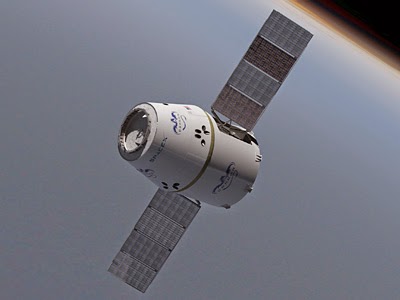
SpaceX Dragon unmanned spacecraft approaches ISS

A contrail is seen behind the SpaceX Falcon 9 rocket carrying a Dragon supply ship as it flies into space after lifting off from Cape Canaveral, Florida, on a resupply mission to the International Space Station, on September 21, 2014

SpaceX's unmanned Dragon spacecraft was nearing the International Space Station on Tuesday with a cargo of supplies, including freeze-dried meals, 20 live lab mice and a 3D printer.

Germany's Alexander Gerst, an astronaut from the European Space Agency (ESA), will operate CanadArm-2, the 57.7-foot (17.6-meter) robotic arm attached to the ISS, to capture the Dragon and bring it in to dock with the space station.

He will be assisted by NASA astronaut Reid Wiseman.

The berthing operation will be complete when the vessel latches fully onto the research outpost about two hours later.

The Dragon capsule is carrying more than 5,000 pounds (2,200 kilograms) of supplies and material for science experiments, including a tool to measure wind speed at the ocean's surface.

The spacecraft launched early Sunday from Cape Canaveral, Florida, and is SpaceX's fourth contracted mission with NASA for supply trips to the ISS and back.

The Rodent Research Hardware System, which will be installed at the International Space Station, includes three modules: the habitat at left, the transporter in the middle and the so-called animal access unit at right. 

Credit: NASA / Dominic Hart

The lab mice are the first live mammals to hitch a ride aboard a commercial cargo ship, and they are enclosed in a NASA-made research cage for studying the effects of weightlessness on their bodies.

This Zero-G Printer is the first 3D printer designed to operate in zero gravity. 

Also on board the SpaceX Dragon capsule is this 3D printer experiment.

The printer was built under a joint partnership between NASA MSFC and Made In Space.

Contracted as the “3D Printing in Zero-G Experiment” this first version of the Zero-G printer will usher in the era of off-world manufacturing.

This initial version of the Zero-G Printer will serve as a test bed for understanding the long-term effects of microgravity on 3D printing, and how it can enable the future of space exploration.

Monday, August 11, 2014

ESA: ATV-5 Georges LemaƮtre docking with ISS


Camera views (planned): VIP event at ATV-CC, ATV-CC Main Control Room, US camera on ISS, RUS camera on ISS, Live ATV animation. Credit: ESA, CNES

While the audio is in French, you can't beat this last-ever docking webcast extravaganza, which includes your choice of five (5!) camera views in one webcast. Audio commentary provided by the CNES team at ATV-CC.

Saturday, May 26, 2012

NASA ISS SpaceX: Inside the Dragon


The hatch between the newly arrived SpaceX Dragon spacecraft and the Harmony module of the International Space Station was opened by NASA Astronaut Don Pettit at 5:53 am EDT as the station flew 253 miles above Auckland, New Zealand. 

The hatch opening begins four days of operations to upload more than 1,000 pounds of cargo from the first commercial spacecraft to visit the space station and reload it with experiments and cargo for a return trip to Earth. It is scheduled for splashdown several hundred miles west of California on May 31.


Wearing protective masks and goggles, as is customary for the opening of a hatch to any newly arrived vehicle at the station, Pettit entered the Dragon with Station Commander Oleg Kononenko.

The goggles and masks will be removed once the station atmosphere has had a chance to mix air with the air inside the Dragon itself. A crew news conference will air on NASA TV at 11:25 a.m.


Friday, May 25, 2012

SpaceX Progress Update for Media - YouTube


Mission milestones of the first commercial spaceflight to visit the International Space Station are recapped at NASA's Johnson Space Center in Texas.

NASA ISS: SpaceX Dragon docks with ISS

The SpaceX Dragon unmanned spacecraft successfully docked with the International Space Station today, Friday 25, 2012, setting a milestone never before realized in spaceflight.

That milestone being that in a mere ten years, a private company began operations and developed a capsule and launch system that has now sent the same reverberations throughout the world as the beginning of the great space race between the United States and the Soviet Union.

The race now, however, is different. This time the race is about free enterprise and while SpaceX is the early starter in this race there are others who are following behind.

The other entrants in the new commercial space race include such notables as Orbital Sciences, Virgin Galactic, Sierra Nevada, Alliant Techsystems and Boeing, which through its various adopted companies, including the former McDonnell Douglas, has been a major player under the former paradigm of government sponsored spaceflight.

The goal in this new environment is not geopolitical competition but rather free market competition.

However, as this new era is thrust upon us, the issues of space policy and space law enter with them.

The current regime of space law developed in the late 1960s to 1970s dealt with the paradigm of government sponsored spaceflight, but did not foresee the advent of commercial actors in the mix.

The looming question is whether the first generation of international space law will be able to accommodate the paradigm of commercial space.

If the first generation of space law is insufficient, can that deficiency be met with a new international treaty specifically addressing commercial spaceflight or will the laws of commercial spaceflight be made by a mix of domestic regulation and customary international law.

Space policy of many nations will also be affected by the new era of commercial spaceflight. While the United States’ National Space Policy specifically includes commercial spaceflight, other space faring nations such as the Russian Federation and the Oppressive People’s Republic of China have yet to fully absorb the impact that commercial spaceflight will have on their space programs and space policies. In particular, China will be most affected by this new paradigm.

Thursday, May 24, 2012

SpaceX in transit past ISS - NASA Video


The SpaceX Dragon capsule closes in on the International Space Station for a series of tests to clear it for its final rendezvous and grapple.

Early this morning, Dragon's thrusters fired, bringing the vehicle 2.4 kilometers below the International Space Station. The vehicle completed two key tests at that distance.

Dragon demonstrated its Relative GPS and established a communications link with the International Space Station using CUCU. Astronauts commanded on Dragon's strobe light to confirm the link worked.

Sunday, December 25, 2011

NASA, Soyuz: New Crew Arrives at International Space Station

A Russian Soyuz capsule arrived at the International Space Station on Friday with a trio of astronauts, bringing the orbital outpost back to full staffing after a failed cargo ship launch in August disrupted flight schedules.

Russian cosmonaut Oleg Kononenko, NASA's Don Pettit and the European Space Agency's Andre Kuipers blasted off from the Baikonur Cosmodrome in Kazakhstan on Wednesday for the space station, a $100 billion research complex that orbits about 240 miles above Earth.

Their two-day trip in the cramped capsule ended at 10:19 a.m. EST (1519 GMT) when the Soyuz slipped into the Earth-facing docking port on the station's Rassvet module.

The docking occurred about three hours after another botched Russian launch, the fifth this year.

An unmanned Soyuz-2 rocket carrying a Russian communications satellite lifted off from Russia's Plesetsk space center at 7:08 a.m. EST (1208 GMT), but failed to reach orbit after a third-stage engine failure.


The rocket and its payload crashed in Siberia, according to the Russian state news agency RIA Novosti.

There was no immediate word about whether the Soyuz-2 failure will impact upcoming launches, including a Soyuz flight slated for Wednesday to put six Globalstar mobile communications satellites into orbit.

The engine on the Soyuz-2 rocket lost Friday is different than the one used on the rocket that launches space station cargo and crews, NASA said.

"This is unlikely to have any effect on operations to the International Space Station," said NASA spokesman Joshua Buck.

The next cargo run to the space station is scheduled for launch on January 25.

At a news conference broadcast on NASA Television following the new crew's arrival, Russian space agency officials acknowledged the country's aerospace industry is in trouble.

"There are problems," Roscosmos chief Vladimir Popovkin said through a translator. "There is aging of many resources. We need to optimize everything. We need to modernize."

"It's also aging of human resources," Popovkin said. "Given the troubles we had in the '90s, quite a lot of people left and nobody came to replace them."

Russian launch troubles kept the space station short-staffed for most of the past three months.

Crew flights to the station were delayed while Russian engineers scrambled to find and fix the cause of a Progress cargo ship engine failure on August 24. The engine is virtually identical to the one used on the Russian Soyuz capsules that ferry crew.

The accident was traced to contamination or a blockage in a fuel line.

Russia beefed up its inspection and quality control systems and resumed flying on October 30.

Russian launch failures this year also claimed a long-awaited mission to return samples from the Martian moon Phobos. The 13-ton Phobos-Grunt spacecraft is expected to re-enter Earth's atmosphere between January 9 and 16.

The newly arrived crew at the space station joined station commander Dan Burbank and two cosmonauts, who have been aboard the outpost since November 16.

"It is so great to have all six crew members on board the space station," said NASA's head of human spaceflight Bill Gerstenmaier.

"This will be an exciting period for the crew. They have many activities over the next several months."

With the return to a six-member crew, the station can resume full-time science operations, including medical research, physics experiments and astronomical observations.

The crew also will begin preparations for the arrival of the first commercial cargo ship.

Space Exploration Technologies, or SpaceX, is scheduled to launch its Falcon 9 rocket and Dragon capsule on February 7 for a trial run to the station.

The debut flight of a second U.S. supplier, Orbital Sciences Corp., is expected later in the year.

Thursday, November 3, 2011

Shenzhou 8: Photos From China's 1st Space Docking Mission

Tiangong-1-Shenzhou-8 Docking. Chinese TV shows the Tiangong 1 module docking with the Shenzhou 8 spacecraft Nov. 2, 2011

Credit: CNTV/CCTV

 A view of China's Tiangong 1 space lab module taken by the approaching Shenzhou 8 spacecraft, just minutes before the two vessels docked in Earth orbit.
CREDIT: CCTV

Monday, September 19, 2011

SpaceX capsule not allowed to dock with ISS

The U.S. private space capsule Dragon will conduct a flight near the International Space Station (ISS), but docking between them is not planned, Vladimir Solovyov, head of the Russian segment of the ISS mission control center said on Friday.

The California-based Space Exploration Technologies company, better known as SpaceX, has earlier announced plans to launch its Dragon capsule toward the orbiting lab on November 30, with a historic docking slated for nine days later.

"Over the last several months, SpaceX has been hard at work preparing for our next flight - a mission designed to demonstrate that a privately-developed space transportation system can deliver cargo to and from the International Space Station (ISS)," the company said.

"A flight by the Dragon to the ISS, but without berthing, has tentatively been scheduled for the end of this year. Though, I do not know, whether it'll fly or not," Solovyov said.

SpaceX and other companies have been given funds out of NASA's special commercial package to provide cargo resupply and human spaceflight capabilities. SpaceX, widely considered to be the frontrunner in this endeavor, has already sent its Dragon capsule into orbit, proving that its space launch infrastructure is viable.

Earlier Russia said it will not allow the SpaceX vehicle to dock with the ISS unless its safety is fully tested.

"We will not issue docking permission unless the necessary level of reliability and safety is proven," said Alexei Krasov, head of the human spaceflight department of Roscosmos. "So far we have no proof that this spacecraft duly comply with the accepted norms of spaceflight safety."

Wednesday, August 24, 2011

NASA Mission Control: Progress 44 Cargo craft - report of an “off-nominal situation”

Mission Control Moscow reported an abnormal situation from the Progress 44 cargo craft that launched on time at 9 a.m. EDT today.

Progress 44 launched from the Baikonur Cosmodrome into a cloudless sky at 7 p.m. Kazakhstan time bound for the International Space Station and a docking on Friday. At the time of launch, the space station was flying 230 miles over Equatorial Guinea on the west coast of Africa. The spacecraft is carrying 2.9 tons of food, fuel and supplies for the space station.

But, 5 minutes and 50 seconds after launch, Mission Control Houston received a report of an “off-nominal situation” during the rocket's third and final stage. Additional information will be provided as soon as it is available.

› Read more about Expedition 28

Tuesday, August 9, 2011

AndrƩ Kuipers Reports progress on Soyuz Simulator

Always nice to manually fly the Soyuz module around the International Space Station and make a smooth docking.
 Astronauts practice with laser for range /speed between Soyuz and ISS. Just in case radar drops out. Soyuz has 2 sets of radar; KYPC (Koers) 1 and 2.
After 3 months back in the Soyuz simulator with my crew mates it feels like home.

Nice runs with my Soyuz crewmates today. Approaching and docking. And solving malfunctions of course.

Wednesday, June 22, 2011

ESA ATV-2: Johannes Kepler undocking from Space Station


Alors qu’il vient de se sĆ©parer de la Station spatiale internationale, l’ATV Kepler glisse lentement dans la nuit au terme d’une mission de 4 mois couronnĆ©e de succĆØs.

Cette image a Ć©tĆ© prise le lundi 20 juin depuis la Station peu aprĆØs le dĆ©samarrage qui s’est effectuĆ© Ć  16h46 heure de Paris. Le lendemain, l’ATV Kepler, pilotĆ© depuis le Centre Spatial Toulousain du CNES, s’est dĆ©sintĆ©grĆ© comme prĆ©vu vers 23h au-dessus de l’OcĆ©an Pacifique.

Picture credit: ESA/CNES

Friday, May 20, 2011

NASA Endeavour's Starboard Wing Close Up from the ISS

This image of the space shuttle Endeavour's starboard wing was taken by the Expedition 27 crew during a survey of the approaching STS-134 mission prior to docking with the International Space Station.

As part of the survey and part of every mission's activities, Endeavour performed a rendezvous pitch maneuver, or back-flip, so that the shuttle could be photographed from a variety of angles.

The image was photographed at a distance of about 600 feet (180 meters).

Image Credit: NASA

Sunday, October 24, 2010

ESA - New international standard for spacecraft docking

European, Russian, Canadian and Japanese Partners in the International Space Station programme have agreed on a new standard for docking systems, which will be capable also of implementing berthing.

The agreement allows a range of compatible, but not necessarily identical, mechanisms for spacecraft docking. A first agreed version of the Interface Definition Document will be released on 25 October.

The International Docking System Standard (IDSS) provides the guidelines for a common interface to link spacecraft together.

It builds on the heritage of the Russian developed APAS system (Androgynous Peripheral Attachment System) used for the Space Shuttle for the ‘hard docking’ and the innovative soft-capture features of the new NASA and ESA systems. Other agencies will be free to choose specific features behind the interface.

“The IDSS is an outstanding example of international collaboration. We have developed a common language for docking systems to use the same 'words' in space when it comes to work together,” said Simonetta Di Pippo, ESA Director of Human Spaceflight.

“The Docking Standard sweeps away the boundaries for a truly global exploration endeavour. It will also make joint spacecraft docking operations more routine and eliminate critical obstacles to joint space exploration undertakings,” she went on and on.

To allow you to buil your own model at home, a PDF copy of the International Docking Standard document can be downloaded from here

Sunday, July 4, 2010

Russian Progress Module Unable to dock with ISS

An unmanned Progress supply ship during approach to the space station May 1. The spacecraft was docked using a manual system after its KURS automated navigation system malfunctioned.

(Credit: NASA)


Russian engineers believe radio interference caused an approaching unmanned Progress supply ship to abort its approach to the International Space Station Friday, officials said Saturday. Subsequent tests showed the cargo craft is in good health and that its automated rendezvous system is working normally, clearing the way for a second docking attempt around 12:10 p.m. EDT Sunday.

The aborted approach Friday occurred about 20 minutes before the Progress 38 craft was scheduled to dock at the Zvezda command module's aft port. Instead of proceeding, the craft aborted and flew safely past the station, rotating slowly to keep its solar arrays face on to the sun.

It was the second Progress docking problem in a row for the Russians. During an approach May 1, a problem with the automated KURS navigation system aboard an approaching cargo ship forced the space station commander to take over manual control using a backup system.

Russian engineers have concluded the abort Friday was triggered by interference between the KURS automated rendezvous system and a television transmitter that is part of the backup manual system, known as TORU, that was activated around the time of the abort. The result of the interference was a "cancel dynamic operations" command that prompted the Progress flight computers to abort the automated approach.

It is not yet clear why the interference issue cropped up during this approach, but Russian engineers told their NASA counterparts that the Progress spacecraft performed normally in the face of conflicting commands, executing a safe abort and standing by for additional instructions.

The KURS system features redundant components, or "strings," and subsequent tests in the absence of any interference showed both were working normally. As a result, a second attempt to dock the Progress 38 spacecraft will be made Sunday, but the TORU system will not be activated.

The Progress 38 spacecraft, loaded with 1,918 pounds of propellant, 110 pounds of oxygen, 220 pounds of water, and 2,667 pounds of experiment equipment, spare parts, and other supplies, was launched Wednesday from the Baikonur Cosmodrome in Kazakhstan.

.

Friday, February 12, 2010

NASA Shuttle Endeavour docking delay by Earth's gravitational pull

Astronauts aboard space shuttle Endeavour had to wait an uncommonly long time to board the International Space Station. NASA blamed the orbital holdup on no less than the entire planet Earth — actually, its gravitational pull.

Endeavour docked at the space station Wednesday morning at 12:06 a.m. EST (0506 GMT), but it took nearly an hour for the two massive spaceships to form a secure connection using a complicated set of hooks and latches. Normally, the spring-loaded docking rings between the station and a visiting shuttle dampen out the vibrations associated with their rendezvous rather quickly, and align themselves automatically.

But not so during Endeavour's arrival. It took about 45 minutes for the relative motion to damp out. Only then could the docking systems align and pull both spacecraft together.

Space shuttle flight director Kwatsi Alibaruho said the orbital oddity was actually caused by two things: The massive bulk of the joined space station and shuttle, and the constant tug of Earth's gravity.

With Endeavour docked at the International Space Station, the complete "stack" — as NASA calls it — weighs more than 1 million pounds (453,600 kg).

But unlike small round satellites or, say, the moon, the docked space shuttle and station aren't symmetrical, and therein lies the problem, Alibaruho said, because external forces can affect a shuttle docking.

Monday, August 31, 2009

NASA Shuttle Discovery docks with ISS: After Thruster failures

Space shuttle Discovery has pulled up and docked at the international space station, delivering a full load of gear and science experiments.

The link-up occurred as the spacecraft zoomed more than 200 miles above the Atlantic, ending a round-the-world 'chase' of nearly two days.

The astronauts cheered when the hatches swung open, and the two crews greeted each other with hugs and handshakes.

A thruster failure made the rendezvous all the more challenging for shuttle commander Rick Sturckow.

One of Discovery's small thrusters began leaking shortly after Friday's midnight lift-off and was shut down.

None of the little jets was available for the rendezvous and docking, and Mr Sturckow had to use the bigger, more powerful primary thrusters, making for a somewhat bumpier, noisier ride.

Mr Sturckow had trained for this back-up method, but it had never before been attempted for a space station docking. Mission Control congratulated him on "a fantastic job".

Discovery will spend more than a week at the orbiting complex. The astronauts will perform three spacewalks to replace an ammonia tank and perform other outside maintenance, the first being on Tuesday night.