Showing posts with label approach. Show all posts

Tuesday, December 30, 2014

NASA Dawn Spacecraft Begins Approach to Ceres

NASA's Dawn spacecraft has entered an approach phase in which it will continue to close in on Ceres, a Texas-sized dwarf planet never before visited by a spacecraft. Dawn launched in 2007 and is scheduled to enter Ceres orbit in March 2015.

Dawn recently emerged from solar conjunction, in which the spacecraft is on the opposite side of the sun, limiting communication with antennas on Earth.

Now that Dawn can reliably communicate with Earth again, mission controllers have programmed the maneuvers necessary for the next stage of the rendezvous, which they label the Ceres approach phase.

Dawn is currently 400,000 miles (640,000 kilometers) from Ceres, approaching it at around 450 miles per hour (725 kilometers per hour).

The spacecraft's arrival at Ceres will mark the first time that a spacecraft has ever orbited two solar system targets.

Dawn previously explored the protoplanet Vesta for 14 months, from 2011 to 2012, capturing detailed images and data about that body.

"Ceres is almost a complete mystery to us," said Christopher Russell, principal investigator for the Dawn mission, based at the University of California, Los Angeles.

"Ceres, unlike Vesta, has no meteorites linked to it to help reveal its secrets. All we can predict with confidence is that we will be surprised."

The two planetary bodies are thought to be different in a few important ways. Ceres may have formed later than Vesta, and with a cooler interior.

Current evidence suggests that Vesta only retained a small amount of water because it formed earlier, when radioactive material was more abundant, which would have produced more heat.

Ceres, in contrast, has a thick ice mantle and may even have an ocean beneath its icy crust.

The two planetary bodies are thought to be very different. Ceres has an average diameter of 950 km (590 miles) while Vesta has an average diameter of 525 km (326 miles).

Ceres may have formed later than Vesta, and have a cooler interior. Vesta formed earlier, when radioactive material was more abundant, which produced more heat so Vesta retained little water, whereas Ceres has a thick ice mantle and may even have an ocean beneath its icy crust.

Dawn is currently 640,000 km (400,000 miles) from Ceres, approaching it at around 725 km per hour (450 miles per hour).

Ceres is also the largest body in the asteroid belt, the strip of solar system real estate between Mars and Jupiter.

By comparison, Vesta has an average diameter of 326 miles (525 kilometers), and is the second most massive body in the belt.

The spacecraft uses ion propulsion to traverse space far more efficiently than if it used chemical propulsion. In an ion propulsion engine, an electrical charge is applied to xenon gas, and charged metal grids accelerate the xenon particles out of the thruster.

These particles push back on the thruster as they exit, creating a reaction force that propels the spacecraft. Dawn has now completed five years of accumulated thrust time, far more than any other spacecraft.

"Orbiting both Vesta and Ceres would be truly impossible with conventional propulsion. Thanks to ion propulsion, we're about to make history as the first spaceship ever to orbit two unexplored alien worlds," said Marc Rayman, Dawn's chief engineer and mission director, based at NASA's Jet Propulsion Laboratory in Pasadena, California.

The next couple of months promise continually improving views of Ceres, prior to Dawn's arrival. By the end of January, the spacecraft's images and other data will be the best ever taken of the dwarf planet.

Tuesday, September 23, 2014

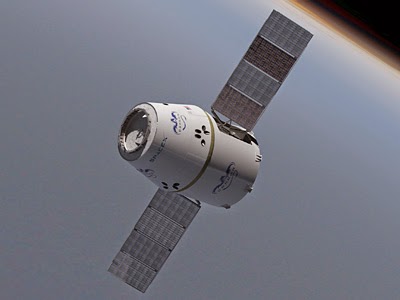
SpaceX Dragon unmanned spacecraft approaches ISS

A contrail is seen behind the SpaceX Falcon 9 rocket carrying a Dragon supply ship as it flies into space after lifting off from Cape Canaveral, Florida, on a resupply mission to the International Space Station, on September 21, 2014

SpaceX's unmanned Dragon spacecraft was nearing the International Space Station on Tuesday with a cargo of supplies, including freeze-dried meals, 20 live lab mice and a 3D printer.

Germany's Alexander Gerst, an astronaut from the European Space Agency (ESA), will operate CanadArm-2, the 57.7-foot (17.6-meter) robotic arm attached to the ISS, to capture the Dragon and bring it in to dock with the space station.

He will be assisted by NASA astronaut Reid Wiseman.

The berthing operation will be complete when the vessel latches fully onto the research outpost about two hours later.

The Dragon capsule is carrying more than 5,000 pounds (2,200 kilograms) of supplies and material for science experiments, including a tool to measure wind speed at the ocean's surface.

The spacecraft launched early Sunday from Cape Canaveral, Florida, and is SpaceX's fourth contracted mission with NASA for supply trips to the ISS and back.

The Rodent Research Hardware System, which will be installed at the International Space Station, includes three modules: the habitat at left, the transporter in the middle and the so-called animal access unit at right. 

Credit: NASA / Dominic Hart

The lab mice are the first live mammals to hitch a ride aboard a commercial cargo ship, and they are enclosed in a NASA-made research cage for studying the effects of weightlessness on their bodies.

This Zero-G Printer is the first 3D printer designed to operate in zero gravity. 

Also on board the SpaceX Dragon capsule is this 3D printer experiment.

The printer was built under a joint partnership between NASA MSFC and Made In Space.

Contracted as the “3D Printing in Zero-G Experiment” this first version of the Zero-G printer will usher in the era of off-world manufacturing.

This initial version of the Zero-G Printer will serve as a test bed for understanding the long-term effects of microgravity on 3D printing, and how it can enable the future of space exploration.

Wednesday, August 20, 2014

Elon Musk’s SpaceX Raising Money At A Valuation Approaching $10B

Space Exploration Technologies (SpaceX), the commercial space transportation startup founded by Elon Musk with ambitions to land people on Mars, is said to be raising investment that values the company somewhere south of $10 billion.

SpaceX has responded sayng: “SpaceX is not currently raising any funding nor has any external valuation of the magnitude you reported been done.”

SpaceX continues to make advances with its own spacecraft and rack up more agreements for future commercial and government launches.

The company also faces stiffer competition from other commercial firms that are looking to compete more aggressively in the new space race.

The latest capital infusion includes a large secondary investment, which appears to be somewhere in the region of $200 million.

This confirms some of the details published in April this year by Quartz, which cited a source reporting that the company might be raising between $50 million and $200 million.

According to CrunchBase, SpaceX has raised $245.5 million in private backing, with the last round disclosed in December 2012.

In its first 10 years of operation, SpaceX generated $4 billion in contracts (that includes funding from NASA between $400 million and $500 million).

The manifest for upcoming launches lists just under 40 missions planned between now and 2018.

For satellite operators looking for launch vessels, part of the attraction of SpaceX has to do with price.

Launches currently cost under $60 million for a low-Earth orbit launch on SpaceX’s Falcon 9 craft.

But it is working on more efficient technology for the rockets, including reusability, with some success already with return landings.

If successful, the projection is that a launch could cost as little as between $5 million and $7 million.

In tandem, SpaceX is also pursuing its Mars ambitions. One big step on that trajectory is the development of spacecraft capable of carrying humans and cargo.

Manned test missions involving the Falcon Heavy and the Dragon are planned in the next two to three years.

Wednesday, March 12, 2014

ISRO: India's Mars Orbiter Mission approach Mars orbit in 200 days

India's Mangalyaan, the Mars Orbiter mission, launched in November last year, is likely to reach the Red Planet in 200 days, the state-owned space agency has said.

"If everything goes as planned, Mars Orbiter Mission (MOM) will get inserted into its Martian orbit around, exactly after 200 days from today," the Indian Space Research Organization (ISRO) reported on Friday evening.

To date, the Mars Orbiter mission has travelled 21 million km, after performing six orbit raising maneuvers around the Earth. 


PSLV-C25 carrying the Mars Orbiter Mission spacecraft was launched from Sriharikota on 05 November 2013.

The Mars Orbiter Spacecraft, India's first interplanetary probe, was launched by PSLV-C25 at 1438 hours on November 5, 2013 from Satish Dhawan Space Centre, Sriharikota. 

In its voyage towards Mars, the mission has successfully completed 100 days in space tomorrow (February 12, 2014). It is scheduled to reach Mars's orbit on Sept. 24 this year.


The spacecraft health is Normal. The spacecraft is continuously monitored by the ground station of ISRO Telemetry, Tracking and Command Network (ISTRAC), located at Byalalu, near Bangalore. 

Except for a 40 minute break in the Telemetry data received from the spacecraft to the ground station, data has been continuously available for all the 100 days.

The propulsion system of the spacecraft is configured for TCMs and the Mars Orbit Insertion (MOI) Operation


On February 6, 2014, all the five payloads on Mars Orbiter spacecraft were switched 'ON' to check their health.

When 
Mangalyaan, the Mars Orbiter mission, reaches its destination, India would become the world's sixth country after the United States, Russia, Europe, Japan and China to achieve such a feat.

Tuesday, July 9, 2013

New idea tackles Earth core puzzle

Lying 5,000km beneath our feet, the core is beyond the reach of direct investigation

Scientists have proposed a radical new model for the make-up of the Earth's core.

The study may explain a longstanding puzzle about the most inaccessible part of our planet.

It suggests that differences between the east and west hemispheres of the core are explained by the way iron atoms pack together.

Details appear in the journal Scientific Reports.

Lying more than 5,000km beneath our feet, at the centre of the Earth, the core is beyond the reach of direct investigation. Broadly speaking, it consists of a solid sphere of metal sitting within a liquid outer core.

The inner core started to solidify more than a billion years ago. It has a radius of about 1,220km, but is growing by about 0.5mm each year.

But the material that the core is made from remains a longstanding unresolved problem.

Clues come from the speeds that seismic waves generated by earthquakes pass through the core.

These tell us its density and elasticity, but the precise arrangement of iron atoms forming the crystalline core controls these numbers.

How those atoms are arranged remains unclear, since the conditions of extreme pressure and temperature at the core cannot easily be replicated in the laboratory.

Seismic data indicate that the western and eastern hemispheres of Earth's inner core differ, and this has led some to suggest that the core was once subjected to an impulse - presumably from the collision of a space rock or planetoid which shook the whole Earth.

The core, it is suggested, is constantly moving sideways. As it does, the front side is melting and the rear side crystallising, but the core is held centrally by gravity.

Maurizio Mattesini
With all these seismic complexities, the link between the crystal structure and the geophysical observations has yet to be resolved.

In Scientific Reports, Maurizio Mattesini from the Complutense University of Madrid, Spain, and colleagues propose a novel possibility for the structure of the core: that it is composed of mixtures of different iron arrangements distinguished by the way their atoms pack together.

By comparing seismic data from over one thousand earthquakes across the globe with quantum mechanical models for the properties of iron, they suggest that seismic variations directly reflect variations in the iron structure.

They propose that the eastern and western sides of the core differ in the extent of mixing of these distinct structures, and suggest their results account for the dynamic eastward drift of the core through time.

Arwen Deuss
Their complicated picture of the core contrasts with earlier suggestions of a more uniform mineralogy. It has yet to incorporate the effects of minor amounts of other elements in the iron alloy actually thought to be there.

But Dr Arwen Deuss, a seismologist from the University of Cambridge, commented: "This is a step in the right direction, directly comparing seismology with mineral physical properties." She added that it should eventually provide a better understanding of the birth and evolution of our planet.