Showing posts with label Vesta. Show all posts

Sunday, January 25, 2015

NASA DAWN: Mysterious Bright Spot on Dwarf Planet Ceres

A mysterious white spot can be seen in the newest images from NASA's Dawn spacecraft, which is rapidly approaching the dwarf planet. 

Credit: NASA /JPL-Caltech /UCLA /MPS /DLR /IDA /PSI

A strange, flickering white blotch found on the dwarf planet Ceres by NASA's Dawn spacecraft has scientists scratching their heads.

The white spot on Ceres in a series of new photos taken on Jan. 13 by NASA's Dawn spacecraft, which is rapidly approaching the round dwarf planet in the asteroid belt between the orbits of Mars and Jupiter, but when the initial photo release on Monday (Jan. 19), the Dawn scientists gave no indication of what the white dot might be.

"Yes, we can confirm that it is something on Ceres that reflects more sunlight, but what that is remains a mystery," Marc Rayman, mission director and chief engineer for the Dawn mission, told Space.com in an email.


The new images show areas of light and dark on the face of Ceres, which indicate surface features like craters, but at the moment, none of the specific features can be resolved, including the white spot.

"We do not know what the white spot is, but it's certainly intriguing," Rayman said. "In fact, it makes you want to send a spacecraft there to find out, and of course that is exactly what we are doing! So as Dawn brings Ceres into sharper focus, we will be able to see with exquisite detail what [the white spot] is."

Ceres is a unique object in our solar system. It is the largest object in the asteroid belt and is classified as an asteroid. It is simultaneously classified as a dwarf planet, and at 590 miles across (950 kilometers, or about the size of Texas), Ceres is the smallest known dwarf planet in the solar system.

The $466 million Dawn spacecraft is set to enter into orbit around Ceres on March 6. Dawn left Earth in 2007 and in the summer of 2011, it made a year-long pit stop at the asteroid Vesta, the second largest object in the asteroid belt.

Friday, January 2, 2015

NASA DAWN Mission: Near-True Colour Image of Vesta impact craters

Image credit: NASA /JPL-Caltech /UCLA /MPS /DLR /IDA

Three impact craters of different sizes, which some have said are arranged in the shape of a snowman, make up one of the most striking features on Vesta, as seen in this view from NASA's Dawn mission.

In this view the three "snowballs" are upside down, so that the shadows make the features easily recognizable.

North is to the lower right in the image, which has a resolution of 230 feet (70 meters) per pixel.

The image is composed of many individual photographs taken between October and December 2011 by Dawn's framing camera.

The NASA Dawn space probe is equipped with two identical European designed cameras, Framing Camera 1 (FC1) and Framing Camera 2 (FC2). 

Should one of the cameras fail during the mission, the other can replace it. 

The mission itself would not be endangered.

Credit: Max Planck Institute

They were obtained during the high-altitude mapping orbit, at about 420 miles (680 kilometers) above Vesta's surface.

The largest of the three craters, Marcia, has a diameter of about 40 miles (60 kilometers). The central crater, which is about 30 miles (50 kilometers) in diameter, is named Calpurnia, and the lower crater, named Minucia, has a diameter of about 14 miles (22 kilometers).

Marcia and Calpurnia are possibly the result of an impact by doublet asteroids, whereas Minucia was formed by a later impact.

To derive the colour information, scientists combined images acquired by the framing camera in two near-infrared channels (0.917 microns and 0.749 microns) and an ultraviolet channel (0.438 microns).

The true colours of the surface of Vesta differ somewhat from what is displayed here, but this mode of reproduction allows subtle changes in material properties across the craters and material ejected from impacts to be detected.

In both Marcia and Calpurnia, landslides can be seen; also, dark material has been exposed below the rim of Marcia.

The Dawn mission to Vesta and Ceres is managed by NASA's Jet Propulsion Laboratory, a division of the California Institute of Technology in Pasadena, for NASA's Science Mission Directorate, Washington.

UCLA is responsible for overall Dawn mission science. The framing camera project is funded by the Max Planck Society, DLR and NASA/JPL.

More information about the Dawn Mission is online at: .

Tuesday, December 30, 2014

NASA Dawn Spacecraft Begins Approach to Ceres

NASA's Dawn spacecraft has entered an approach phase in which it will continue to close in on Ceres, a Texas-sized dwarf planet never before visited by a spacecraft. Dawn launched in 2007 and is scheduled to enter Ceres orbit in March 2015.

Dawn recently emerged from solar conjunction, in which the spacecraft is on the opposite side of the sun, limiting communication with antennas on Earth.

Now that Dawn can reliably communicate with Earth again, mission controllers have programmed the maneuvers necessary for the next stage of the rendezvous, which they label the Ceres approach phase.

Dawn is currently 400,000 miles (640,000 kilometers) from Ceres, approaching it at around 450 miles per hour (725 kilometers per hour).

The spacecraft's arrival at Ceres will mark the first time that a spacecraft has ever orbited two solar system targets.

Dawn previously explored the protoplanet Vesta for 14 months, from 2011 to 2012, capturing detailed images and data about that body.

"Ceres is almost a complete mystery to us," said Christopher Russell, principal investigator for the Dawn mission, based at the University of California, Los Angeles.

"Ceres, unlike Vesta, has no meteorites linked to it to help reveal its secrets. All we can predict with confidence is that we will be surprised."

The two planetary bodies are thought to be different in a few important ways. Ceres may have formed later than Vesta, and with a cooler interior.

Current evidence suggests that Vesta only retained a small amount of water because it formed earlier, when radioactive material was more abundant, which would have produced more heat.

Ceres, in contrast, has a thick ice mantle and may even have an ocean beneath its icy crust.

The two planetary bodies are thought to be very different. Ceres has an average diameter of 950 km (590 miles) while Vesta has an average diameter of 525 km (326 miles).

Ceres may have formed later than Vesta, and have a cooler interior. Vesta formed earlier, when radioactive material was more abundant, which produced more heat so Vesta retained little water, whereas Ceres has a thick ice mantle and may even have an ocean beneath its icy crust.

Dawn is currently 640,000 km (400,000 miles) from Ceres, approaching it at around 725 km per hour (450 miles per hour).

Ceres is also the largest body in the asteroid belt, the strip of solar system real estate between Mars and Jupiter.

By comparison, Vesta has an average diameter of 326 miles (525 kilometers), and is the second most massive body in the belt.

The spacecraft uses ion propulsion to traverse space far more efficiently than if it used chemical propulsion. In an ion propulsion engine, an electrical charge is applied to xenon gas, and charged metal grids accelerate the xenon particles out of the thruster.

These particles push back on the thruster as they exit, creating a reaction force that propels the spacecraft. Dawn has now completed five years of accumulated thrust time, far more than any other spacecraft.

"Orbiting both Vesta and Ceres would be truly impossible with conventional propulsion. Thanks to ion propulsion, we're about to make history as the first spaceship ever to orbit two unexplored alien worlds," said Marc Rayman, Dawn's chief engineer and mission director, based at NASA's Jet Propulsion Laboratory in Pasadena, California.

The next couple of months promise continually improving views of Ceres, prior to Dawn's arrival. By the end of January, the spacecraft's images and other data will be the best ever taken of the dwarf planet.

Tuesday, November 4, 2014

Giant impact formed asteroid Vesta's Rheasilvia basin

A high-speed camera recorded a laboratory simulation of colliding heavenly bodies. 

An analysis of shock propagation suggests what may have caused the tilted canyon-like grooves around the equator of the asteroid Vesta. 

Credit: Angela Stickle and Peter Schultz

When NASA's Dawn spacecraft visited the asteroid Vesta in 2011, it showed that deep grooves that circle the asteroid's equator like a cosmic belt were probably caused by a massive impact on Vesta's south pole.

Now, using a super high-speed cannon at NASA's Ames Research Center, Brown

University researchers have shed new light on the violent chain of events deep in Vesta's interior that formed those surface grooves, some of which are wider than the Grand Canyon.

"Vesta got hammered," said Peter Schultz, professor of earth, environmental, and planetary sciences at Brown and the paper's senior author.

"The whole interior was reverberating, and what we see on the surface is the manifestation of what happened in the interior."

The research suggests that the Rheasilvia basin on Vesta's south pole was created by an impactor that came in at an angle, rather than straight on, but that glancing blow still did an almost unimaginable amount of damage.

The study shows that just seconds after the collision, rocks deep inside the asteroid began to crack and crumble under the stress.

Within two minutes major faults reached near the surface, forming deep the canyons seen today near Vesta's equator, far from the impact point.

The research, led by Angela Stickle, a former graduate student at Brown and now a researcher at the Johns Hopkins University Applied Physics Laboratory, will appear in the February issue of the journal Icarus and is now available online.

"As soon as Pete and I saw the images coming down from the Dawn mission at Vesta, we were really excited," Stickle said.

"The large fractures looked just like things we saw in our experiments. So we decided to look into them in more detail, and run the models, and we found really interesting relationships."


For the study, the researchers used the Ames Vertical Gun Range, a cannon with a 14-foot barrel used to simulate collisions on celestial bodies.

The gun uses gunpowder and compressed hydrogen gas to launch projectiles at blinding speed, up to 16,000 miles per hour.

For this latest research, Schultz and his colleagues launched small projectiles at softball-sized spheres made of an acrylic material called PMMA.

When struck, the normally clear material turns opaque at points of high stress. By watching the impact with high-speed cameras that take a million shots per second, the researchers can see how these stresses propagate through the material.


The experiments showed that that damage from the impact starts where one would expect: at the impact point, but shortly after, failure patterns begin to form inside the sphere, opposite the point of impact.

Those failures grow inward toward the sphere's center and then propagate outward toward the edges of the sphere like a blooming flower.

Using numerical models to scale the lab collision up to the size of Vesta, the second-largest object in the asteroid belt, the researchers showed that the outward-blooming "rosette" of damage extending to the surface is responsible for the troughs that form a belt around Vesta's equator.

The results answer some questions about Vesta's belt that had long been puzzling. Chief among them is the orientation of the belt with respect to the crater.

The belt's angle isn't exactly what would be expected if it were caused by the Rheasilvia impact.

"The belt is askew," Schultz said, "as if Vesta were making a fashion statement."

These new experiments suggest that the crooked belt is the result of the angle of impact. An oblique impact causes the damage plane to be tilted with respect the crater.

The orientation of Vesta's belt sheds light on the nature of the impact. The researchers conclude that the object that created Rheasilvia came in at an angle less than 40 degrees, traveling at about 11,000 miles per hour.

"Vesta was lucky," Schultz said. "If this collision had been straight on, there would have been one less large asteroid and only a family of fragments left behind."

The research shows that even a glancing blow can have tremendous consequences.
"When big things happen to small bodies," Schultz said, "it shakes them to the core."

Wednesday, October 8, 2014

ESA Rosetta - Lutetia's Lineaments: Dark side of asteroid hosts hidden crater

ESA's Rosetta spacecraft data. Tracing Lutetia’s grooves.

Credit: ESA /Rosetta /MPS for OSIRIS Team MPS /UPD /LAM /IAA /SSO /INTA /UPM /DASP /IDA

Grooves found on Lutetia, an asteroid encountered by ESA's Rosetta spacecraft, point to the existence of a large impact crater on the unseen side of the rocky world.

ESA's Rosetta spacecraft flew past Lutetia at a distance of 3168 km in July 2010, en route to its 2014 rendezvous with its target comet.

The spacecraft took images of the 100 km-wide asteroid for about two hours during the flyby, revealing numerous impact craters and hundreds of grooves all over the surface.

Impact craters are commonly seen on all Solar System worlds with solid surfaces, recording an intense history of collisions between bodies. However, grooves are much less prevalent.

To date, they have been discovered by visiting spacecraft only on the Martian moon Phobos and the asteroids Eros and Vesta.

The way in which grooves are formed on these bodies is still widely debated, but it likely involves impacts.

Shock waves from the impact travel through the interior of a small, porous body and fracture the surface to form the grooves.

"For Lutetia, by assuming that the grooves were formed in concentric patterns around their source impact crater, we identified 200 such features falling into distinct 'families', correlated with three different impact craters," describes Sebastien Besse, a research fellow at ESA's Technical Centre, ESTEC, in the Netherlands, and lead author of the paper published in Planetary and Space Science this month.

One of the groove systems on Lutetia is associated with the Massilia crater and another with the North Pole Crater Cluster, which comprises a number of superimposed craters. Both are on the asteroid's northern hemisphere.

This anaglyph 3D image of Lutetia can be viewed using stereoscopic glasses with red–green or red–blue filters. 

The two images making up this image were taken several minutes before Rosetta’s closest approach to the asteroid on 10 July 2010. 

The left-eye view was captured at 15:41:39 GMT from a distance of 4274 km from Lutetia’s surface and the right-eye view at 15:41:03 GMT from 4038 km (closest approach was at 15:45 GMT). 

Credit: ESA/H. Sierks (MPS, Göttingen, Germany)

But another group of grooves points to a crater not seen during Rosetta's brief flyby, in the asteroid's southern hemisphere.

Its implied presence has earned it the nickname 'Suspicio'. The grooves related to Suspicio cover a large area on the asteroid, suggesting it may span several tens of kilometres .

By comparison, Massilia, the largest known crater on Lutetia, is about 55 km wide, and the largest of the polar cluster is about 34 km across.

"These three major impacts seriously deformed Lutetia's surface," adds Sebastien.

Looking face on at the North Pole Crater Cluster (purple outline) on asteroid Lutetia, with Massilia crater to the lower left (red outline). 

Marked on the image are the concentric grooves or ‘lineaments’ associated with the large craters. 

The lineaments coloured blue infer the presence of a large crater, nicknamed Suspicio, on the unseen portion of Lutetia. 

Yellow denotes lineaments not associated with any of the craters discussed in this study. 

Credit: ESA /Rosetta /MPS for OSIRIS Team MPS /UPD /LAM /IAA /SSO /INTA /UPM /DASP /IDA

"As with grooves seen on other asteroids that may also be associated with impact events, this study provides new insights into the catastrophic history of these small bodies."

By observing how subsequent small craters lie over the grooves on Lutetia, the scientists determined the relative ages of the three larger cratering events.

Massilia is thought be the oldest of the three craters and the polar cluster the youngest, with Suspicio between.

The authors also looked at other, independent measurements of Lutetia, including ground-based observations with the Infrared Telescope Facility and space-based observations with ESA's Herschel and NASA's Spitzer.

The infra-red location of Suspicio crater on the unseen southern hemisphere of asteroid Lutetia (marked in blue). 

The hidden crater could be up to 45 km in diameter, the blue outlines correspond to diameter estimates of 15, 30 and 45 km, respectively. 

The crater is inferred based on the numerous grooves or ‘lineaments’ seen concentric to the crater in the northern hemisphere of the asteroid. 

There are no image data available for this side of the asteroid, as can be inferred from the blank shape model. 

Credit: ESA /Rosetta /MPS for OSIRIS Team MPS /UPD /LAM /IAA /SSO /INTA /UPM /DASP /IDA

The Infrared Telescope Facility suggested different compositions between the northern and southern hemisphere of the asteroid.

Sebastien and his colleagues propose that a large impact, presumably the one forming Suspicio, excavated enough material of a different composition to account for the observed differences.

"Our study ties together several independent analyses of Lutetia into one coherent story that is consistent with the presence of a large impact crater on the far side of the asteroid," says co-author Michael Küppers, from ESA's Space Astronomy Centre in Spain.

"Four years on and we are delighted still to be learning from just two hours' worth of data collected during the Lutetia flyby," says Matt Taylor, ESA's Rosetta project scientist.

"Rosetta is now in its main mission phase at its comet, where we are on the cusp of fantastic results. Rosetta is a true small bodies mission, two asteroids and one comet in single trip."

More information: S. Besse, M. Küppers, O.S. Barnouin, N. Thomas, J. Benkhoff, "Lutetia׳s lineaments," Planetary and Space Science, Volume 101, 15 October 2014, Pages 186-195, ISSN 0032-0633, dx.doi.org/10.1016/j.pss.2014.07.007

Tuesday, September 23, 2014

NASA Dawn back on course after briefly slipping into Safe Mode


NASA's Dawn spacecraft has resumed normal operations after a high-energy particle event forced the mission to enter safe mode, knocking its ion drive offline.

Although mission managers deduced the source of the problem and restarted its propulsion systems, the unexpected hiccup will likely delay Dawn’s arrival at dwarf planet Ceres.

Safe mode was triggered on Sept. 11 and it is thought the same phenomenon that triggered a safe mode three years agoduring Dawn's approach to giant asteroid Vesta is to blame for this incident.

A high-energy cosmic ray hit the spacecraft's ion drive electronics, disabling it.

In addition to the ion drive glitch, Dawn's main antennae that the spacecraft uses to communicate with Earth was also knocked offline, meaning engineers had to decipher the problem using Dawn’s secondary, lower bandwidth antennae.

"This anomaly presented the team with an intricate and elaborate puzzle to solve," said Robert Mase, Dawn project manager at NASA’s Jet Propulsion Laboratory (JPL) in Pasadena, Calif.

"We followed the same strategy that we implemented three years ago to recover from a similar radiation strike, to swap to one of the other ion engines and a different electronic controller so we could resume thrusting quickly," said Dawn Mission Director and Chief Engineer Marc Rayman also of JPL.

“We have a plan in place to revive this disabled component later this year.”

Wednesday, September 17, 2014

NASA DAWN: Spacecraft operating normally after safe mode triggered

Artist concept of NASA's Dawn spacecraft orbiting Ceres during an upcoming flyby. 

Credit: NASA/JPL-Caltech/UCLA

The Dawn spacecraft has resumed normal ion thrusting after the thrusting unexpectedly stopped and the spacecraft entered safe mode on September 11.

That anomaly occurred shortly before a planned communication with NASA's Deep Space Network that morning.

The spacecraft was not performing any special activities at the time.

Engineers immediately began working to restore the spacecraft to its normal operational state.

The team determined the source of the problems, corrected them, and then resumed normal ion thrusting on Monday night, Sept. 15.

"This anomaly presented the team with an intricate and elaborate puzzle to solve," said Robert Mase, Dawn project manager at NASA's Jet Propulsion Laboratory in Pasadena, California.

After investigating what caused the spacecraft to enter safe mode, the Dawn team determined that it was likely triggered by the same phenomenon that affected Dawn three years ago on approach to the protoplanet Vesta: An electrical component in the ion propulsion system was disabled by a high-energy particle of radiation.

"We followed the same strategy that we implemented three years ago to recover from a similar radiation strike, to swap to one of the other ion engines and a different electronic controller so we could resume thrusting quickly," said Dawn Mission Director and Chief Engineer Marc Rayman of JPL.

"We have a plan in place to revive this disabled component later this year."

Complicating the issue, the team discovered that the spacecraft had experienced not just one anomaly, but also a second one that affected the ability to point the main antenna at Earth to communicate.

Because the spacecraft could not communicate using its main antenna, the team had to utilize the weaker signals of another antenna, slowing their progress.

In addition, Dawn is so far from Earth that radio signals take 53 minutes to make the round trip.

Although they have not yet specifically pinpointed the cause of this issue, it could also be explained by a high-energy particle corrupting the software running in the main computer.

Ultimately the team reset the computer, which restored the pointing performance to normal.

As a result of the change in the thrust plan, Dawn will enter into orbit around dwarf planet Ceres in April 2015, about a month later than previously planned.

Ceres
The plans for exploring Ceres once the spacecraft is in orbit, however, are not affected.

Vesta
Dawn orbited Vesta, the second most massive object in the main asteroid belt, from July 2011 until September 2012.

The spacecraft's ion propulsion system enabled it to spiral away from Vesta and head toward Ceres, the most massive object in that region.

Sunday, April 27, 2014

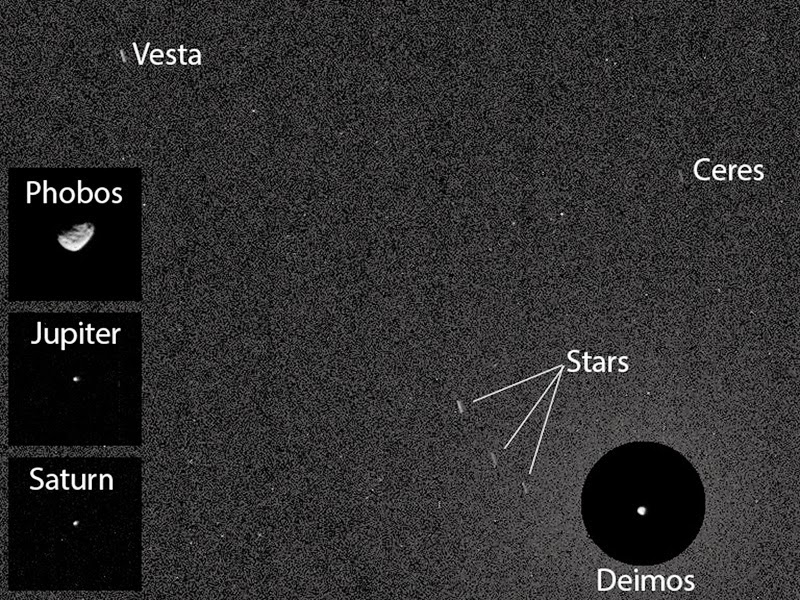
NASA's Curiosity rover captures images of asteroids Ceres and Vesta

For the first time, NASA's Curiosity rover has captured images of an asteroid from the surface of Mars -- two of them, in fact.

The imagery recorded by Curiosity and beamed back to Earth feature Ceres and Vesta, two of the largest asteroids in the asteroid belt that runs between between Mars and Jupiter.

This Curiosity first was also a bit of a coincidence, as the SUV-sized rover had aimed its cameras at the Martian sky in order to snap shots of the Red Planet's two moons, not hunt for asteroids whizzing by.

"This imaging was part of an experiment checking the opacity of the atmosphere at night in Curiosity's location on Mars, where water-ice clouds and hazes develop during this season," camera team member Mark Lemmon, of Texas A&M University, explained in a statement.

"The two Martian moons were the main targets that night, but we chose a time when one of the moons was near Ceres and Vesta in the sky."

Mark Lemmon
NASA is currently on its way to get an even closer look at this two giant space rocks.

NASA's Dawn spacecraft orbited the 350-mile-wide Vesta asteroid in 2011 and 2012, and it is preparing to orbit the 590-mile-wide Ceres in 2015.

Monday, February 24, 2014

NASA DAWN Image: The large asteroid Vesta

The large asteroid Vesta appears multihued in this image, which uses the filters on the Dawn spacecraft to greatly enhance the subtle color differences on the surface. 

Each is probably due to different chemical compositions of the surface material. Up close, Vesta would look pretty much grey to the eye; see the text below for an explanation. 

Photo by NASA/JPL-Caltech/UCLA/MPS/DLR/IDA/PSI

Tuesday, December 17, 2013

NASA Dawn creates guide to Vesta's hidden attractions

This colorful composite image from NASA's Dawn mission shows the flow of material inside and outside a crater called Aelia on the giant asteroid Vesta

The area is around 14 degrees south latitude. 

The images that went into this composite were obtained by Dawn's framing camera from September to October 2011.

Credit: NASA /JPL-Caltech /UCLAMPS /DLR /IDA

Some beauty is revealed only at a second glance. When viewed with the human eye, the giant asteroid Vesta, which was the object of scrutiny by the Dawn spacecraft from 2011 to 2012, is quite unspectacular color-wise. Vesta looks grayish, pitted by a variety of large and small craters.

But scientists at the Max Planck Institute for Solar System Research in Katlenburg-Lindau, Germany, have re-analyzed the images of this giant asteroid obtained by Dawn's framing camera.

They assigned colors to different wavelengths of light and, in the process, revealed in unprecedented detail not only geological structures that are invisible to the naked eye, but also landscapes of incomparable beauty.

Researchers at Max Planck can now see structures such as melts from impacts, craters buried by quakes and foreign material brought by space rocks, visible with a resolution of 200 feet (60 meters) per pixel.

"The key to these images is the seven color filters of the camera system on board the spacecraft," said Andreas Nathues, the framing camera team lead at Max Planck."

"Since different minerals reflect light of different wavelengths to different degrees, the filters help reveal compositional differences that remain hidden without them. In addition, scientists calibrated the data so that the finest variations in brightness can be seen.

This coloured composite image from NASA's Dawn mission shows the crater Antonia, which lies in the enormous Rheasilvia basin in the southern hemisphere of the giant asteroid Vesta. 

The area lies around 58 degrees south latitude. 

Antonia has a diameter of 11 miles (17 kilometers). 

Credit: NASA/JPL-Caltech/UCLAMPS/DLR/IDA

In the new colorized images, different colors indicate different materials on the surface of Vesta. They reveal impressive formations and a wide range of geological diversity, said Nathues. But above all, the color-coded images are impressive because of their beauty.

"No artist could paint something like that. Only nature can do this," said Martin Hoffman, a member of the framing camera team also at Max Planck.

Pictures of the crater Aelia, the crater Antonia and an area near the crater Sextilia show some of Vesta's most impressive sites.

This colorful image from NASA's Dawn mission shows material northwest of the crater Sextilia on the giant asteroid Vesta. 

Sextilia, located around 30 degrees south latitude, is at the bottom right of this image. 

Credit: NASA/JPL-Caltech/UCLAMPS/DLR/IDA

Dawn visited Vesta from July 2011 to September 2012. The spacecraft is currently on its way to its second destination, the dwarf planet Ceres.

Ceres is the largest object in the main asteroid belt between Mars and Jupiter.

Thursday, December 5, 2013

NASA DAWN: Ice on Ceres is an 'Interesting Paradox'

Hubble Space Telescope imaged the asteroid Vesta and the dwarf planet Ceres in 2007, both targets of NASA's Dawn mission

Credit: NASA, ESA, J. Parker (SwRI), L. McFadden (U Maryland)

As NASA's Dawn mission draws closer to its encounter with the dwarf planet Ceres in early 2015, excitement continues to mount for scientists looking forward to what the satellite might observe.

Britney Schmidt
Britney Schmidt, of the George Institute of Technology, and Nicole Gugliucci of CosmoQuest, recently hosted a Google+ Hangout titled 'Ceres: Great Expectations' to discuss the upcoming visit to the nearest dwarf planet in the solar system.

Orbiting in the asteroid belt, a little more than three times as far from the Sun as Earth, Ceres is thought to contain an icy mantle that makes up approximately a third of its mass.

"Ceres is very different and very exciting in a lot of ways, totally different from any place that we've been," Schmidt said in the broadcast. "It may be the only primarily icy planet that's out there, at least within reach."

Scratching the surface
Seen through a telescope, Ceres may not appear very exciting.

Scientists can use the light reflected off of a body to find out information about its composition.

"Ceres, to the eye, would appear basically pretty black because it's reflecting most colours more or less the same, and reflecting very little light at all," said Andy Rivkin of the Johns Hopkins University Applied Physics Lab.

Andy Rivkin
Even the infrared spectrum, which tends to reveal more information about asteroids such as Vesta—Dawn's first stop—provided very little information about its composition.

By utilizing instruments such as the SpeX instrument on the NASA Infrared Telescope Facility (IRTF) on Mauna Kea in Hawaii, scientists were able to catch hints about the dwarf planet's surface.

These observations revealed suggestions of brucite, hydroxyls, and two other features Rivkin says are thought to be due to carbonate minerals.

"[This] makes Ceres one of only a few places where we've found carbonates," Rivkin said. "I think other than Earth and Mars, it's Ceres."

He went on to explain that scientists think water interacting with the minerals formed the brucite and the carbonates.

The layers of Ceres. Scientists think that the dwarf planet contains a rocky inner core surrounded by a thick mantle of water-ice. 

A thin outer crust covers the surface, with carbonates and other signs that water lay on the planet's skin at some point. 

Credit: NASA, ESA, and A. Feild (STScI)

"For Ceres, we think it is much more consistent with a body that had a lot of water available to interact with."

But water, considered a potential habitat for life to start, can't exist on the surface of the dwarf planet in either solid or liquid form.

"We see no real evidence for ice at the surface of Ceres," Rivkin said, noting that the dwarf planet is too warm. "However, conditions beneath Ceres' surface should allow buried ice to remain there."

At the same time, observations from the Hubble Space Telescope, as well as theoretical data such as the planet's density, suggest that a large amount of ice exists.

"That creates this interesting paradox. We think there's a lot of ice there, (but) we don't see any at the surface," Rivkin said.

"How that's going to translate into what we find when we show up there is still very much an open question."

Wednesday, March 27, 2013

NASA Scientists Reveal Moon and Asteroids Share History

Scientists have now discovered that studying meteorites from the giant asteroid Vesta helps them understand the event known as the "lunar cataclysm," when a repositioning of the gas giant planets destabilized a portion of the asteroid belt and triggered a solar-system-wide bombardment. 

Credit: NASA/GSFC/ASU/JPL-Caltech/UCLA/MPS/DLR/IDA

NASA and international researchers have discovered that Earth's moon has more in common than previously thought with large asteroids roaming our solar system.

Asteroid Vesta
Scientists from NASA's Lunar Science Institute (NLSI) in Moffett Field, Calif., discovered that the same population of high-speed projectiles that impacted our lunar neighbor four billion years ago, also hit the giant asteroid Vesta and perhaps other large asteroids.

The research unveils an unexpected link between Vesta and the moon, and provides new means for studying the early bombardment history of terrestrial planets. The findings are published in the March issue of Nature Geoscience.

"It's always intriguing when interdisciplinary research changes the way we understand the history of our solar system," said Yvonne Pendleton, NLSI director.

Yvonne Pendleton
"Although the moon is located far from Vesta, which is in the main asteroid belt between the orbits of Mars and Jupiter, they seem to share some of the same bombardment history."

The findings support the theory that the repositioning of gas giant planets like Jupiter and Saturn from their original orbits to their current location destabilised portions of the asteroid belt and triggered a solar system-wide bombardment of asteroids billions of years ago, called the lunar cataclysm.

The research provides new constraints on the start and duration of the lunar cataclysm, and demonstrates that the cataclysm was an event that affected not only the inner solar system planets, but the asteroid belt as well.

The moon rocks brought back by NASA Apollo astronauts have long been used to study the bombardment history of the moon.

Now the ages derived from meteorite samples have been used to study the collision history of main belt asteroids.

In particular, howardite and eucrite meteorites, which are common species found on Earth, have been used to study asteroid Vesta, their parent body.

With the aid of computer simulations, researchers determined that meteorites from Vesta recorded high-speed impacts which are now long gone.

Researchers have linked these two datasets and found that the same population of projectiles responsible for making craters and basins on the moon were also hitting Vesta at very high velocities, enough to leave behind a number of telltale, impact-related ages.

The team's interpretation of the howardites and eucrites was augmented by recent close-in observations of Vesta's surface by NASA's Dawn spacecraft.

In addition, the team used the latest dynamical models of early main belt evolution to discover the likely source of these high velocity impactors.

The team determined that the population of projectiles that hit Vesta had orbits that also enabled some objects to strike the moon at high speeds.

"It appears that the asteroidal meteorites show signs of the asteroid belt losing a lot of mass four billion years ago, with the escaped mass beating up on both the surviving main belt asteroids and the moon at high speeds" says lead author Simone Marchi, who has a joint appointment between two of NASA's Lunar Science Institutes, one at the Southwest Research Institute in Boulder, Colo., and another at the Lunar and Planetary Institute in Houston.

"Our research not only supports the current theory, but it takes it to the next level of understanding."

Reference
High-velocity collisions from the lunar cataclysm recorded in asteroidal meteorites. Nature Geoscience, 2013; DOI: 10.1038/ngeo1769

Thursday, January 3, 2013

NASA Dawn 3D Image: Cornelia Crater on Asteroid Vesta

This composite-colour view from NASA's Dawn mission shows Cornelia Crater, streaked with dark materials, on the giant asteroid Vesta.

The data were obtained by Dawn's framing camera during the mission's high-altitude mapping orbit, about 420 miles (680 kilometers) above the surface.

The images were integrated into a mosaic and wrapped on a topographical model of Vesta's surface.

Scientists colorised the picture by assigning red to the 0.75-micron wavelength, green to the 0.92-micron wavelength and blue to the 0.98-micron wavelength.

The Dawn mission to Vesta and Ceres is managed by NASA's Jet Propulsion Laboratory, a division of the California Institute of Technology in Pasadena, for NASA's Science Mission Directorate, Washington.

UCLA is responsible for overall Dawn mission science. The Dawn framing camera project is funded by the Max Planck Society, DLR, and NASA/JPL.

Image: NASA/JPL-Caltech/UCLA/MPS/DLR/IDA

Wednesday, September 26, 2012

Asteroid Vesta’s troughs suggest stunted planet

An image taken by NASA's Dawn spacecraft on July 24, 2011, shows troughs along the equator of the asteroid Vesta, including Divalia Fossa, which is larger than the Grand Canyon. 

A new study analyzing these troughs finds that they are probably graben – a dip in the surface with faults on either side that would indicate that Vesta has characteristics much like a planet or large moon.

Credit: NASA/JPL-Caltech/UCLA/MPS/DLR/IDA

Enormous troughs that reach across the asteroid Vesta may actually be stretch marks that hint of a complexity beyond most asteroids.

Scientists have been trying to determine the origin of these unusual troughs since their discovery just last year.

Now, a new analysis supports the notion that the troughs are faults that formed when a fellow asteroid smacked into Vesta’s south pole.

The research reinforces the claim that Vesta has a layered interior, a quality normally reserved for larger bodies, such as planets and large moons.

Asteroid surface deformities are typically straightforward cracks formed by crashes with other asteroids. Instead, an extensive system of troughs encircles Vesta, the second most massive asteroid in the solar system, about one-seventh as wide as the Moon.

The biggest of those troughs, named Divalia Fossa, surpasses the size of the Grand Canyon by spanning 465 kilometers (289 miles) long, 22 km (13.6 mi) wide and 5 km (3 mi) deep.

The origin of these troughs on Vesta has puzzled scientists. The complexity of their formation can’t be explained by simple collisions.

New measurements of Vesta’s topography, derived from images of Vesta  taken by NASA’s Dawn spacecraft last year, indicate that a large collision could have created the asteroid’s troughs.

But, this would only have been possible if the asteroid is differentiated – meaning that it has a core, mantle and crust -- said Debra Buczkowski of the Johns Hopkins University Applied Physics Laboratory in Laurel, Md.

Because Vesta is differentiated, its layers have different densities, which react differently to the force from the impact and make it possible for the faulted surface to slide, she added.

“By saying it’s differentiated, we’re basically saying Vesta was a little planet trying to happen.”

Her team’s research will be published online this Saturday in Geophysical Research Letters.

Most asteroids are pretty simple. “They’re just like giant rocks in space,” said Buczkowski. But previous research has found signs of igneous rock on Vesta, indicating that rock on Vesta’s surface was once molten, a sign of differentiation.

If the troughs are made possible by differentiation, then the cracks aren’t just troughs, they’re graben.

A graben is a dip in the surface that forms when two faults move apart from each other and the ground sinks into the widening gap, such as in Death Valley in California. Scientists have also observed graben on the Moon and planets such as Mars.

The images from the Dawn mission show that Vesta’s troughs have many of the qualities of graben, said Buczkowski.

For example, the walls of troughs on simpler asteroids such as Eros and Lutetia are shaped like the letter V.

But Vesta’s troughs have floors that are flat or curved and have distinct walls on either side, like the letter U – a signature of a fault moving apart, instead of simple cracking on the surface.

The scientists’ measurements also showed that the bottoms of the troughs on Vesta are relatively flat and slanted toward what’s probably a dominant fault, much as they are in Earth-bound graben. 

These observations indicate that Vesta is also unusually planet-like for an asteroid in that its mantle is ductile and can stretch under a lot of pressure. “It can become almost silly putty-ish,” said Buczkowski. “You pull it and it deforms.”

Friday, September 21, 2012

NASA Dawn Vesta: Satellite detects Hydrated Minerals on Giant Asteroid

This map from NASA's Dawn mission shows the global distribution of hydrogen on the surface of the giant asteroid Vesta. 
Credit: NASA JPL-Caltech UCLA PSI MPS DLR IDA.

NASA's Dawn spacecraft has revealed that the giant asteroid Vesta has its own version of ring around the collar.

Two new papers based on observations from the low-altitude mapping orbit of the Dawn mission show that volatile, or easily evaporated materials, have colored Vesta's surface in a broad swath around its equator.

Pothole-like features mark some of the asteroid's surface where the volatiles, likely water, released from hydrated minerals boiled off.

While Dawn did not find actual water ice at Vesta, there are signs of hydrated minerals delivered by meteorites and dust evident in the giant asteroid's chemistry and geology. The findings appear in the journal Science.

One paper, led by Thomas Prettyman, the lead scientist for Dawn's gamma ray and neutron detector (GRaND) at the Planetary Science Institute in Tucson, Ariz., describes how the instrument found signatures of hydrogen, likely in the form of hydroxyl or water bound to minerals in Vesta's surface.

"The source of the hydrogen within Vesta's surface appears to be hydrated minerals delivered by carbon-rich space rocks that collided with Vesta at speeds slow enough to preserve their volatile content," said Prettyman.

A complementary paper, led by Brett Denevi, a Dawn participating scientist based at the Johns Hopkins University Applied Physics Laboratory in Laurel, Md., describes the presence of pitted terrain created by the release of the volatiles.

Vesta is the second most massive member of the main asteroid belt. The orbit at which these data were obtained averaged about 130 miles (210 kilometers) above the surface.

Dawn left Vesta earlier this month, on Sept. 4 PDT (Sept. 5 EDT), and is now on its way to its second target, the dwarf planet Ceres.

Scientists thought it might be possible for water ice to survive near the surface around the giant asteroid's poles.

Unlike Earth's moon, however, Vesta has no permanently shadowed polar regions where ice might survive.

The strongest signature for hydrogen in the latest data came from regions near the equator, where water ice is not stable.

In some cases, other space rocks crashed into these deposits later at high speed. The heat from the collisions converted the hydrogen bound to the minerals into water, which evaporated.

The holes that were left as the water escaped stretch as much as 0.6 miles (1 kilometer) across and go down as deep as 700 feet (200 meters). Seen in images from Dawn's framing camera, this pitted terrain is best preserved in sections of Marcia crater.

"The pits look just like features seen on Mars, but while water was common on Mars, it was totally unexpected on Vesta in these high abundances," said Denevi.

"These results provide evidence that not only were hydrated materials present, but they played an important role in shaping the asteroid's geology and the surface we see today."

Friday, September 7, 2012

NASA's Dawn spacecraft Leaves Vesta and sets sail for Ceres

After becoming the first spacecraft to enter orbit around an object in the main asteroid belt between Mars and Jupiter in July 2011, NASA’s Dawn spacecraft has spent the last year mapping the giant asteroid Vesta.

The spacecraft has now bid adieu to Vesta, one of the largest asteroids in the Universe and is on its way to the dwarf planet Ceres to continue its mission to help shed light on the evolution of our solar system.

Communications sent via NASA’s Deep Space Network confirmed Dawn’s departure from Vesta at about 11:26 p.m. US PDT on Tuesday, September 4.

Launched on September 27, 2007, it took the spacecraft almost four years to reach its first port of call, but the second leg of its journey is set to be a bit quicker with Dawn expected to arrive at Ceres early in 2015.

Dawn’s departure from Vesta was far from dramatic.

It gently spiraled out of the giant asteroid's orbit propelled by, what Marc Rayman, Dawn's chief engineer and mission director, called “a blue-green pillar of xenon ions,” emitted from the ion propulsion system that generates thrust by using electricity to ionize xenon.

Wednesday, September 5, 2012

NASA Dawn: Probe Departing Asteroid Vesta for Ceres

This image taken by the NASA Dawn spacecraft shows the south pole of the giant asteroid Vesta. 

After spending a year examining Vesta, Dawn is poised to depart and head to another asteroid, Ceres, where it will arrive in 2015.

Picture: NASA/AP

Thursday, August 16, 2012

NASA Dawn Asteroid Probe Hits Snag on Way to Dwarf Planet, Ceres

An artist's impression of the Dawn spacecraft in orbit around Vesta.
CREDIT: NASA/JPL-Caltech

A NASA spacecraft orbiting the huge asteroid Vesta has suffered a glitch last week, but mission controllers say it will not affect plans for its upcoming trip to Ceres, the largest asteroid or Dwarf Planet, in the solar system.

The malfunction on NASA's Dawn spacecraft occurred during a maneuver on Aug. 8, when one of the probe's reaction wheels that is used to maintain its position in space unexpectedly shut down.

Mission controllers discovered the problem during a routine communications dispatch the following day, on Aug. 9, said Marc Rayman, chief engineer and mission director of the Dawn mission.

"The wheel was operating normally, and then the internal friction increased enough that the software that we call 'fault protection' — it's a system software that looks at parameters on the spacecraft and monitors the performance of the different components — detected something unusual," Rayman reported.

"If something isn't within the limits we've specified, it takes action. In this case, when the friction got up to a certain level, it turned that wheel off."

Three impact craters of different sizes, arranged in the shape of a snowman, make up one of the most striking features on Vesta, as seen in this view from NASA’s Dawn mission. 

In this view the three “snowballs” are upside down, so that the shadows make the features easily recognizable. 

North is to the lower right in the image, which has a resolution of 230 feet (70 meters) per pixel. 

Image credit: NASA/JPL-Caltech/UCLA/MPS/DLR/IDA

At the time when one of the probe's reaction wheels failed, Dawn was preparing for its departure from Vesta, after spending more than a year studying the asteroid.

The spacecraft completed its science objectives at Vesta on July 24. Since then, Dawn has been using its ion thrusters to gradually spiral away from the space rock.

"The ion propulsion system, while very efficient, is also very gentle," Rayman explained.

"It only gradually climbs away from Vesta, spiraling in ever larger loops until the spacecraft is going fast enough and is far away enough from Vesta that Vesta can no longer hold it in its gravitational grip."