Showing posts with label graben. Show all posts

Saturday, March 16, 2013

NASA Cassini Image: Last Close-Up Photos of Icy Saturn Moon, Rhea

This raw image of Saturn's icy moon Rhea was taken on March 10, 2013 by NASA's Cassini spacecraft, and received on Earth March 10, 2013. 

The camera was pointing toward Rhea at approximately 174,181 miles (280,317 kilometers) away. 

CREDIT: NASA/JPL/Space Science Institute

NASA's Cassini spacecraft has snapped its last up-close photos of Saturn's icy moon Rhea, revealing a battered satellite covered in craters from violent impacts.NASA's Cassini spacecraft has snapped its last up-close photos of Saturn's icy moon Rhea, revealing a battered satellite covered in craters from violent impacts.

Cassini took the amazing new photos of Rhea on Saturday (March 9) during its fourth and final planned encounter with the Saturn moon.

During the encounter, the probe flew within just 620 miles (997 kilometers) of Rhea, which is Saturn's second-largest satellite.

"Take a good, long, luxurious look at these sights from another world, as they will be the last close-ups you'll ever see of this particular moon,"

Cassini imaging team lead Carolyn Porco, of the Space Science Institute in Boulder, Colo., said in a statement accompanying the photos.

This image was taken on March 09, 2013, and received on Earth March 10, 2013, by NASA's Cassini spacecraft. 

The camera was pointing toward Rhea at approximately 1,727 miles (2,779 kilometers) away, and the image was taken using the CL1 and CL2 filters. 

This image has not been validated or calibrated. 

CREDIT: NASA/JPL-Caltech/Space Science Institute

Saturday's flyby was designed primarily to measure Rhea's gravity field, mission scientists said, but Cassini also managed to take 12 pictures of the frigid moon's battered, pockmarked surface, including one that showcases a mysterious long, curving fracture called a graben.
Rhea is the second-largest of Saturn's 60-odd known moons, with a diameter of 949 miles (1528 km).

It's far smaller than the ringed planet's biggest natural satellite, Titan, which at 3,200 miles (5,150 km) across is nearly 50 percent wider than Earth's moon.

Rhea was discovered in 1672 by the mathematician and astronomer Giovanni Domenico Cassini, who gave his name to the NASA mission currently studying the Saturn system.

In 2010, researchers determined that the moon has a wispy atmosphere dominated by oxygen and carbon dioxide.

Possibly the oxygen was blasted free from water ice on Rhea's surface by charged particles streaming from Saturn, scientists say, but the origin of the carbon dioxide is more mysterious.

The Cassini mission — a joint effort involving NASA, the European Space Agency and the Italian Space Agency — launched in 1997 and arrived at Saturn in 2004.

It has been studying the ringed planet and its many moons ever since, and will continue to do so on an extended mission until at least 2017.

Wednesday, September 26, 2012

Asteroid Vesta’s troughs suggest stunted planet

An image taken by NASA's Dawn spacecraft on July 24, 2011, shows troughs along the equator of the asteroid Vesta, including Divalia Fossa, which is larger than the Grand Canyon. 

A new study analyzing these troughs finds that they are probably graben – a dip in the surface with faults on either side that would indicate that Vesta has characteristics much like a planet or large moon.

Credit: NASA/JPL-Caltech/UCLA/MPS/DLR/IDA

Enormous troughs that reach across the asteroid Vesta may actually be stretch marks that hint of a complexity beyond most asteroids.

Scientists have been trying to determine the origin of these unusual troughs since their discovery just last year.

Now, a new analysis supports the notion that the troughs are faults that formed when a fellow asteroid smacked into Vesta’s south pole.

The research reinforces the claim that Vesta has a layered interior, a quality normally reserved for larger bodies, such as planets and large moons.

Asteroid surface deformities are typically straightforward cracks formed by crashes with other asteroids. Instead, an extensive system of troughs encircles Vesta, the second most massive asteroid in the solar system, about one-seventh as wide as the Moon.

The biggest of those troughs, named Divalia Fossa, surpasses the size of the Grand Canyon by spanning 465 kilometers (289 miles) long, 22 km (13.6 mi) wide and 5 km (3 mi) deep.

The origin of these troughs on Vesta has puzzled scientists. The complexity of their formation can’t be explained by simple collisions.

New measurements of Vesta’s topography, derived from images of Vesta  taken by NASA’s Dawn spacecraft last year, indicate that a large collision could have created the asteroid’s troughs.

But, this would only have been possible if the asteroid is differentiated – meaning that it has a core, mantle and crust -- said Debra Buczkowski of the Johns Hopkins University Applied Physics Laboratory in Laurel, Md.

Because Vesta is differentiated, its layers have different densities, which react differently to the force from the impact and make it possible for the faulted surface to slide, she added.

“By saying it’s differentiated, we’re basically saying Vesta was a little planet trying to happen.”

Her team’s research will be published online this Saturday in Geophysical Research Letters.

Most asteroids are pretty simple. “They’re just like giant rocks in space,” said Buczkowski. But previous research has found signs of igneous rock on Vesta, indicating that rock on Vesta’s surface was once molten, a sign of differentiation.

If the troughs are made possible by differentiation, then the cracks aren’t just troughs, they’re graben.

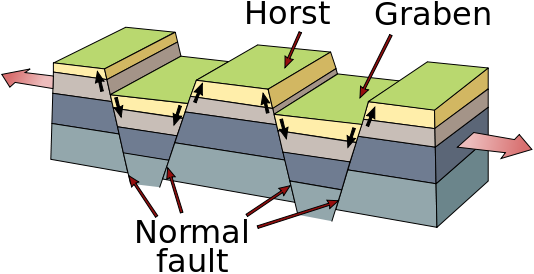
A graben is a dip in the surface that forms when two faults move apart from each other and the ground sinks into the widening gap, such as in Death Valley in California. Scientists have also observed graben on the Moon and planets such as Mars.

The images from the Dawn mission show that Vesta’s troughs have many of the qualities of graben, said Buczkowski.

For example, the walls of troughs on simpler asteroids such as Eros and Lutetia are shaped like the letter V.

But Vesta’s troughs have floors that are flat or curved and have distinct walls on either side, like the letter U – a signature of a fault moving apart, instead of simple cracking on the surface.

The scientists’ measurements also showed that the bottoms of the troughs on Vesta are relatively flat and slanted toward what’s probably a dominant fault, much as they are in Earth-bound graben. 

These observations indicate that Vesta is also unusually planet-like for an asteroid in that its mantle is ductile and can stretch under a lot of pressure. “It can become almost silly putty-ish,” said Buczkowski. “You pull it and it deforms.”