Showing posts with label Photos. Show all posts

Tuesday, January 6, 2015

NASA Mars Curiosity Rover: Potential signs of ancient life in Mars rover photos

A rock bed at the Gillespie Lake outcrop on Mars displays potential signs of ancient microbial sedimentary structures. 

Credit: NASA

A careful study of images taken by the NASA rover Curiosity has revealed intriguing similarities between ancient sedimentary rocks on Mars and structures shaped by microbes on Earth.

The findings suggest, but do not prove, that life may have existed earlier on the Red Planet.

The photos were taken as Curiosity drove through the Gillespie Lake outcrop in Yellowknife Bay, a dry lakebed that underwent seasonal flooding billions of years ago.

Mars and Earth shared a similar early history. The Red Planet was a much warmer and wetter world back then.

On Earth, carpet-like colonies of microbes trap and rearrange sediments in shallow bodies of water such as lakes and costal areas, forming distinctive features that fossilize over time.

These structures, known as microbially-induced sedimentary structures (or MISS), are found in shallow water settings all over the world and in ancient rocks spanning Earth's history.

Nora Noffke, a geobiologist at Old Dominion University in Virginia, has spent the past 20 years studying these microbial structures.

Last year, she reported the discovery of MISS that are 3.48 billion years old in the Western Australia's Dresser Formation, making them potentially the oldest signs of life on Earth.

In a paper published online last month in the journal Astrobiology (the print version comes out this week), Noffke details the striking morphological similarities between Martian sedimentary structures in the Gillespie Lake outcrop (which is at most 3.7 billion years old) and microbial structures on Earth.

The distinctive shapes include erosional remnants, pockets, domes, roll-ups, pits, chips and cracks, which on Earth can extend from a few centimeters to many kilometers.

Although Noffke makes a tantalizing case for possible signs of ancient life on Mars, her report is not a definitive proof that these structures were shaped by biology.

Getting such confirmation would involve returning rock samples to Earth and conducting additional microscopic analyses, a mission that isn't scheduled anytime in the near future.

"All I can say is, here's my hypothesis and here's all the evidence that I have," Noffke says, "although I do think that this evidence is a lot."

"The fact that she pointed out these structures is a great contribution to the field," says Penelope Boston, a geomicrobiologist at the New Mexico Institute of Mining and Technology.

"Along with the recent reports of methane and organics on Mars, her findings add an intriguing piece to the puzzle of a possible history for life on our neighboring planet."

A Careful Analysis
"I've seen many papers that say 'Look, here's a pile of dirt on Mars, and here's a pile of dirt on Earth,'" says Chris McKay, a planetary scientist at NASA's Ames Research Center and an associate editor of the journal Astrobiology. "And because they look the same, the same mechanism must have made each pile on the two planets.'"

McKay adds: "That's an easy argument to make, and it's typically not very convincing. However, Noffke's paper is the most carefully done analysis of the sort that I've seen, which is why it's the first of its kind published in Astrobiology."

Overlay of sketch on photograph from above to assist in the identification of the structures on the rock bed surface. 

Image credit: Noffke (2105). Credit: ASTROBIOLOGY, published by Mary Ann Liebert, Inc.

The images on which Noffke drew are publicly available on the Mars Science Laboratory page on NASA's website.

"In one image, I saw something that looked very familiar," Noffke recalls. "So I took a closer look, meaning I spent several weeks investigating certain images centimeter by centimeter, drawing sketches, and comparing them to data from terrestrial structures, and I've worked on these for 20 years, so I knew what to look for."

Noffke compared the rover pictures to images taken at several sites on Earth, including modern sediment surfaces in Mellum Island, Germany; Portsmouth Island, USA; and Carbla Point, Western Australia; as well as older fossils of microbial mats in Bahar Alouane, Tunisia; the Pongola Supergroup in Africa; and the Dresser Formation in Western Australia.

The photos showed striking morphological similarities between the terrestrial and Martian sedimentary structures.

The distribution patterns of the microbial structures on Earth vary depending on where they are found. Different types of structures are found together in different types of environments.

For instance, microbial mats that grow in rivers will create a different set of associations than those that grow in seasonally flooded environments.

The patterns found in the Gillespie Lake outcrop are consistent with the microbial structures found in similar environments on Earth.

What's more, the terrestrial structures change in a specific way over time. As the microbial mats form, grow, dry up, crack and re-grow, specific structures become associated with them.

Here again, Noffke found that the distribution pattern in Martian rocks correspond with microbial structures on Earth that have changed over time. Taken together, these clues strengthen her argument beyond simply pointing out the similarities in shape.

In her paper, she also describes alternative processes through which these could have formed. For instance, the chips, pits and cracks could be the product of erosion by salt, water, or wind.

"But if the Martian structures aren't of biological origin," Noffke says, "then the similarities in morphology, but also in distribution patterns with regards to MISS on Earth would be an extraordinary coincidence."


Potential MISS erosional remnant on Mars (top); edge of a microbial mat–overgrown erosional remnant on Portsmouth Island, USA (middle); erosional remnant of a modern MISS on Mellum Island, Germany (bottom). 

Credit: Mars: NASA; Earth: Nora Noffke

"At this point, all I'd like to do is point out these similarities," she adds. "Further evidence must be provided to verify this hypothesis."

More information: The paper is available online: online.liebertpub.com/doi/pdf/… 0.1089/ast.2014.1218

Monday, August 11, 2014

'Supermoon': Biggest Full Moon of 2014

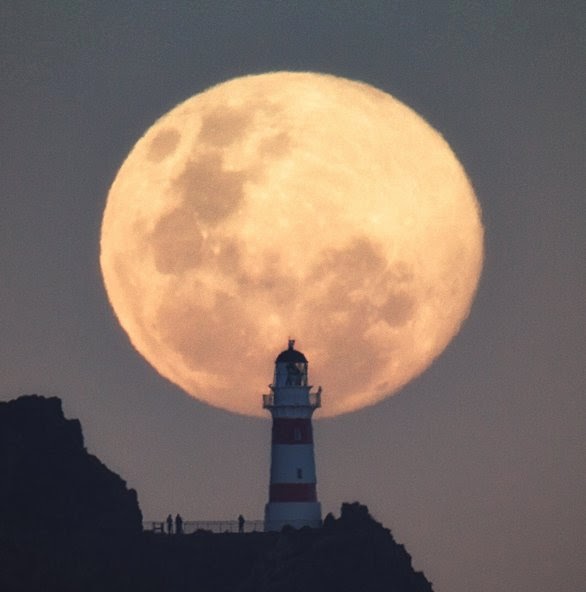
An astrophotographer captured this photo of the supermoon rising behind a lighthouse and some observers on Aug. 10, 2014.

Credit: Mark Gee

Photographers around the world ventured outside Sunday (Aug. 10) to snap photos of the bright, full "supermoon" rising in the night sky.

August's full moon, called a supermoon because it is occurred when the moon was closest to Earth in its orbit, wowed skywatchers, inspiring some of them to turn their cameras skyward to catch breathtaking views of the biggest full moon of 2014.

Some photographers had to wait for a break in the clouds to capture their images, while others chased the moon to different observing sites.

Thursday, July 31, 2014

Auroras Over Earth: Amazing Northern Lights Photos from Space

The Aurora Australis or Southern Lights, photographed by one of the Expedition 37 crew members on the International Space Station as the orbital complex flew over Tasmania on Oct. 30, 2013.
The Expedition 32 crew onboard the International Space Station, flying an altitude of approximately 240 miles, recorded a series of images of Aurora Australis, also known as the Southern Lights, on July 15, 2012.
This picture, recorded by one of the Expedition 31 crew members aboard the International Space Station, features Aurora Australis with star streaks while the vehicle was over the South Pacific Ocean. Image taken on May 22, 2012.
Aurora Australis, seen at right on Earth's horizon, and daybreak (left) highlight this photograph taken by one of the Expedition 30 crew members on March 6, 2012 aboard the International Space Station.
The northern lights are a spectacular night sky phenomenon when viewed from Earth, but from space they transform into something truly amazing.

See amazing photos of the Earth's auroras as seen by astronauts on the International Space Station in these images released by NASA.

You can see the original NASA aurora gallery here.

Tuesday, April 15, 2014

Blood Moon Photos: Spectacular Total Lunar Eclipse Views - Video


Stargazers across the United States were awed by last night's total eclipse of the moon, and they've got some amazing photos to prove it.

Observers in a North America, South America, Hawaii and parts of Alaska got a spectacular show as the moon turned blood red during the first total lunar eclipse of 2014.

While the weather wasn't great for everyone in the path of the total eclipse, some stargazers got a break from the clouds to capture the celestial sight during the 3.5 hours it was visible.

"We lucked out on the weather, as skies were mostly cloudy during the afternoon and evening, and even during the eclipse we were viewing through a thin layer of cirrus much of the time," veteran rocket launch photographer Ben Cooper told reporters of his Florida eclipse-viewing experience.

While Cooper may have seen the eclipse through clouds, his mosaic photo is a standout. It features a blood red moon in the center of the image framed by the various stages of the lunar eclipse.

Photographer Sean Parker of Tucson, Ariz., created this mosaic of the total lunar eclipse phases on April 15, 2014 using images taken with a through a 12" LX Meade 200 telescope with a Canon 6D camera.

Friday, May 3, 2013

Smartphone Photos From Earth Orbit

These images of Earth were reconstructed from photos taken by three smartphones in orbit, or "PhoneSats." 

The trio of PhoneSats launched on April 21, 2013, aboard the Antares rocket from NASA's Wallops Flight Facility and ended a successful mission on April 27. 

The ultimate goal of the PhoneSat mission was to determine whether a consumer-grade smartphone can be used as the main flight avionics for a satellite in space.

During their time in orbit, the three miniature satellites used their smartphone cameras to take pictures of Earth and transmitted these "image-data packets" to multiple ground stations. 

Every packet held a small piece of the big picture. As the data became available, the PhoneSat Team and multiple amateur radio operators around the world collaborated to piece together photographs from the tiny data packets.

The PhoneSat project is a technology demonstration mission funded by NASA's Space Technology Mission Directorate at NASA Headquarters and the Engineering Directorate at NASA Ames Research Center. 

The project started in summer 2009 as a student-led collaborative project between Ames and the International Space University, Strasbourg.

Read more

Images Credit: NASA Ames

Sunday, March 24, 2013

Aurora Borealis: Amazing Auroramax Photos of 2013

Credit: Auroramax

Canada's automated aurora camera took this photo on March 17, 2013. 

"AURORAMAX GALLERY • Latest photo of aurora borealis above Yellowknife, NWT taken at 03:13 MDT on March 17, 2013." 

[See the full photo gallery]

Saturday, March 16, 2013

NASA Cassini Image: Last Close-Up Photos of Icy Saturn Moon, Rhea

This raw image of Saturn's icy moon Rhea was taken on March 10, 2013 by NASA's Cassini spacecraft, and received on Earth March 10, 2013. 

The camera was pointing toward Rhea at approximately 174,181 miles (280,317 kilometers) away. 

CREDIT: NASA/JPL/Space Science Institute

NASA's Cassini spacecraft has snapped its last up-close photos of Saturn's icy moon Rhea, revealing a battered satellite covered in craters from violent impacts.NASA's Cassini spacecraft has snapped its last up-close photos of Saturn's icy moon Rhea, revealing a battered satellite covered in craters from violent impacts.

Cassini took the amazing new photos of Rhea on Saturday (March 9) during its fourth and final planned encounter with the Saturn moon.

During the encounter, the probe flew within just 620 miles (997 kilometers) of Rhea, which is Saturn's second-largest satellite.

"Take a good, long, luxurious look at these sights from another world, as they will be the last close-ups you'll ever see of this particular moon,"

Cassini imaging team lead Carolyn Porco, of the Space Science Institute in Boulder, Colo., said in a statement accompanying the photos.

This image was taken on March 09, 2013, and received on Earth March 10, 2013, by NASA's Cassini spacecraft. 

The camera was pointing toward Rhea at approximately 1,727 miles (2,779 kilometers) away, and the image was taken using the CL1 and CL2 filters. 

This image has not been validated or calibrated. 

CREDIT: NASA/JPL-Caltech/Space Science Institute

Saturday's flyby was designed primarily to measure Rhea's gravity field, mission scientists said, but Cassini also managed to take 12 pictures of the frigid moon's battered, pockmarked surface, including one that showcases a mysterious long, curving fracture called a graben.

Rhea is the second-largest of Saturn's 60-odd known moons, with a diameter of 949 miles (1528 km).

It's far smaller than the ringed planet's biggest natural satellite, Titan, which at 3,200 miles (5,150 km) across is nearly 50 percent wider than Earth's moon.

Rhea was discovered in 1672 by the mathematician and astronomer Giovanni Domenico Cassini, who gave his name to the NASA mission currently studying the Saturn system.

In 2010, researchers determined that the moon has a wispy atmosphere dominated by oxygen and carbon dioxide.

Possibly the oxygen was blasted free from water ice on Rhea's surface by charged particles streaming from Saturn, scientists say, but the origin of the carbon dioxide is more mysterious.

The Cassini mission — a joint effort involving NASA, the European Space Agency and the Italian Space Agency — launched in 1997 and arrived at Saturn in 2004.

It has been studying the ringed planet and its many moons ever since, and will continue to do so on an extended mission until at least 2017.

Thursday, February 7, 2013

NASA Deep Impact Probe Snaps Photos of Comet ISON


The comet that may put on a spectacular light show during a November date with the Sun, was observed by the Deep Impact mission. The spacecraft has also had close fly-bys of comet's Tempel 1 and Hartley 2 and scientific observations of Garradd.

CREDIT: NASA/JPL-Caltech/UMD (Tony Farnham)

A NASA spacecraft has captured its first photos of comet ISON, an icy wanderer that some scientists say could dazzle as a "comet of the century" when it swings through the inner solar system later this year.

The photos were taken by NASA's Deep Impact probe and reveal comet ISON as a bright, dusty ball moving against a star-filled background. The spacecraft snapped the pictures on Jan. 17 and Jan. 18 from a distance of about 493 million miles (793 million kilometers).

Comet ISON has been the focus of much anticipation among scientists and stargazers because of its potential to put on a spectacular display in late November, when it makes its closest approach to the sun.

Some forecasts predict the comet could shine brighter than the full moon. As of mid-January, the comet's tail was more than 40,000 miles (64,400 km).

Some projections state that comet ISON, which is officially designated comet C/20012 S1 (ISON), could shine extremely bright in the nighttime sky, possibly even rivaling the full moon.

Whether the comet will meet expectations or fizzle out remains to be seen, but it has already become a target for NASA and amateur astronomers.

"This is the fourth comet on which we have performed science observations and the farthest point from Earth from which we've tried to transmit data on a comet," Deep Impact project manager Tim Larson, of the agency's Jet Propulsion Laboratory in Pasadena, Calif., said in a statement Tuesday (Feb. 5) "The distance limits our bandwidth, so it's a little like communicating through a modem after being used to DSL. But we're going to coordinate our science collection and playback so we maximize our return on this potentially spectacular comet."