This image illustrates possible ways methane might be added to Mars' atmosphere (sources) and removed from the atmosphere (sinks). NASA's Curiosity Mars rover has detected fluctuations in methane concentration in the atmosphere, implying both types of activity occur on modern Mars. Credit: NASA/JPL-Caltech/SAM-GSFC/Univ. of Michigan
NASA's Curiosity Mars rover has measured a tenfold spike in methane, an organic chemical, in the atmosphere around it and detected other organic molecules in a rock-powder sample collected by the robotic laboratory's drill.
"This temporary increase in methane, sharply up and then back down, tells us there must be some relatively localized source," said Sushil Atreya of the University of Michigan, Ann Arbor, and Curiosity rover science team.
"There are many possible sources, biological or non-biological, such as interaction of water and rock."
Researchers used Curiosity's onboard Sample Analysis at Mars (SAM) laboratory a dozen times in a 20-month period to sniff methane in the atmosphere.
During two of those months, in late 2013 and early 2014, four measurements averaged seven parts per billion.
Before and after that, readings averaged only one-tenth that level.
Curiosity also detected different Martian organic chemicals in powder drilled from a rock dubbed 'Cumberland', the first definitive detection of organics in surface materials of Mars.
These Martian organics could either have formed on Mars or been delivered to Mars by meteorites.
Organic molecules, which contain carbon and usually hydrogen, are chemical building blocks of life, although they can exist without the presence of life.
Curiosity's findings from analyzing samples of atmosphere and rock powder do not reveal whether Mars has ever harboured living microbes, but the findings do shed light on a chemically active modern Mars and on favorable conditions for life on ancient Mars.
"We will keep working on the puzzles these findings present," said John Grotzinger, Curiosity project scientist of the California Institute of Technology in Pasadena (Caltech).
"Can we learn more about the active chemistry causing such fluctuations in the amount of methane in the atmosphere? Can we choose rock targets where identifiable organics have been preserved?"
Researchers worked many months to determine whether any of the organic material detected in the Cumberland sample was truly Martian.
Curiosity's SAM lab detected in several samples some organic carbon compounds that were, in fact, transported from Earth inside the rover.
However, extensive testing and analysis yielded confidence in the detection of Martian organics.
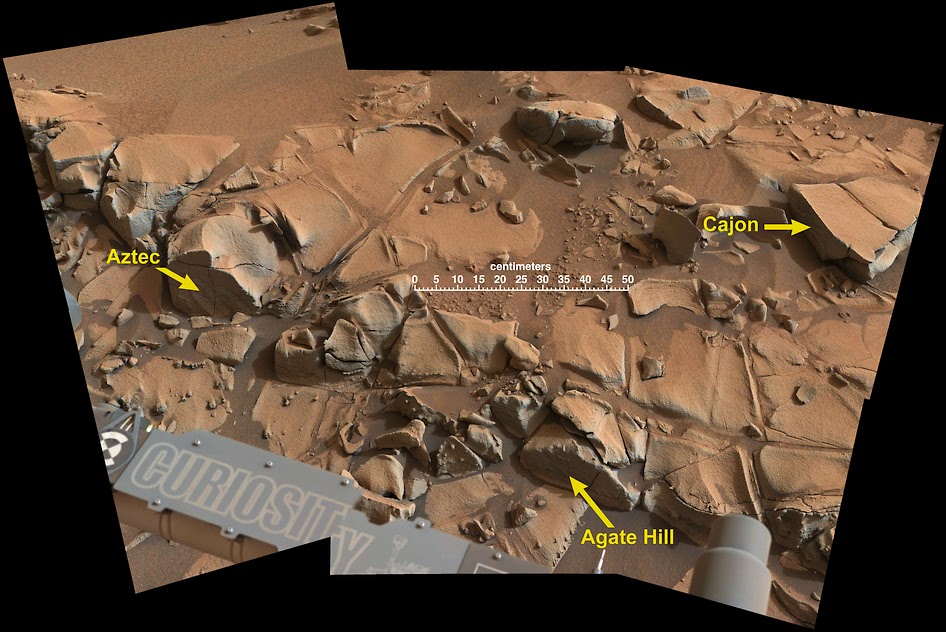
This view from the Mast Camera (Mastcam) on NASA's Curiosity Mars rover shows a swath of bedrock called "Alexander Hills," which the rover approached for close-up inspection of selected targets.
The mosaic of six Mastcam frames covers an area about 6 feet (2 meters) across.
It shows details within the workspace accessible using the rover's robotic arm from the rover's location when the view was acquired.
The component exposures were taken on Nov. 23, 2014, during the 817th Martian day, or sol, of Curiosity's work on Mars.
The colour has been approximately white-balanced to resemble how the scene would appear under daytime lighting conditions on Earth.
This annotated version shows the location of three targets selected for study, "Aztec," "Agate Hill" and "Cajon", and a 50-centimeter (20-inch) scale bar.
The location of Alexander Hills within the "Pahrump Hills" outcrop at the base of Mount Sharp is indicated on an earlier Mastcam vew.
This small ridge, about 3 feet long, appears to resist wind erosion more than the flatter plates around it. Such differences are among the traits NASA's Curiosity Mars rover is examining at selected rock targets at the base of Mount Sharp. Curiosity's Mastcam acquired this view on Oct. 7, 2014. Image Credit: NASA /JPL-Caltech /MSSS
NASA's Curiosity Mars rover has completed a reconnaissance "walkabout" of the first outcrop it reached at the base of the mission's destination mountain and has begun a second pass examining selected rocks in the outcrop in more detail.
Exposed layers on the lower portion of Mount Sharp are expected to hold evidence about dramatic changes in the environmental evolution of Mars. That was a major reason NASA chose this area of Mars for this mission.
The lowermost of these slices of time ascending the mountain includes a pale outcrop called "Pahrump Hills."
It bears layers of diverse textures that the mission has been studying since Curiosity acquired a drilled sample from the outcrop in September.
In its first pass up this outcrop, Curiosity drove about 360 feet (110 meters), and scouted sites ranging about 30 feet (9 meters) in elevation.
It evaluated potential study targets from a distance with mast-mounted cameras and a laser-firing spectrometer.
This patch of Martian bedrock, about 2 feet (70 centimeters) across, is finely layered rock with some pea-size inclusions. It lies near the lowest point of the "Pahrump Hills" outcrop, which forms part of the basal layer of Mount Sharp. Curiosity's Mastcam acquired this view on Nov. 9, 2014. Image Credit: NASA/JPL-Caltech/MSSS
"We see a diversity of textures in this outcrop -- some parts finely layered and fine-grained, others more blocky with erosion-resistant ledges," said Curiosity Deputy Project Scientist Ashwin Vasavada of NASA's Jet Propulsion Laboratory, Pasadena, California.
"Overlaid on that structure are compositional variations. Some of those variations were detected with our spectrometer. Others show themselves as apparent differences in cementation or as mineral veins. There's a lot to study here."
During a second pass up the outrcrop, the mission is using a close-up camera and spectrometer on the rover's arm to examine selected targets in more detail.
The second-pass findings will feed into decisions about whether to drill into some target rocks during a third pass, to collect sample material for onboard laboratory analysis.
A wheel track cuts through a windblown ripple of dusty sand in this Nov. 7, 2014, image from the Mastcam on NASA's Curiosity rover. The view spans about four feet across. This experiment was planned for yielding a view of the inside of the ripple for assessment of particle sizes and composition. Image Credit: NASA/JPL-Caltech/MSSS
"The variations we've seen so far tell us that the environment was changing over time, both as the sediments were laid down and also after they hardened into bedrock," Vasavada said.
"We have selected targets that we think give us the best chance of answering questions about how the sediments were deposited, in standing water? flowing water? sand blowing in the wind? -- and about the composition during deposition and later changes."
The first target in the second pass is called "Pelona," a fine-grained, finely layered rock close to the September drilling target at the base of Pahrump Hills outcrop. The second is a more erosion-resistant ledge called "Pink Cliffs."
Before examining Pelona, researchers used Curiosity's wheels as a tool to expose a cross section of a nearby windblown ripple of dust and sand.
One motive for this experiment was to learn why some ripples that Curiosity drove into earlier this year were more difficult to cross than anticipated.
NASA's newest orbiter at Mars, MAVEN, took precautions to avoid harm from a dust-spewing comet that flew near Mars today and is studying the flyby's effects on the Red Planet's atmosphere.
The MAVEN spacecraft reported back to Earth in good health after about three hours of precautions against a possible collision with high-velocity dust particles released by comet C/2013 A1 Siding Spring.
"We're glad the spacecraft came through, we're excited to complete our observations of how the comet affects Mars, and we're eager to get to our primary science phase," said MAVEN Principal Investigator Bruce Jakosky of the University of Colorado, Boulder.
MAVEN began orbiting Mars on Sept. 21. The opportunity to study this rare near-miss of a planet by a comet comes during the project's commissioning phase.
A few weeks of instrument calibration and orbit fine-tuning remain before the start of the primary science phase. The mission will study the upper atmosphere of Mars and its interaction with the solar wind.
Comet Siding Spring hurtled past Mars today at about 125,000 mph (56 kilometers per second), coming within about 87,000 miles (139,500 kilometers) of the planet.
That is equivalent to about one-third of the distance between Earth and Earth's moon. The closest approach by the comet's nucleus came at about 11:27 a.m. PDT (2:27 p.m. EDT).
The period when dust from the comet was most likely to reach Mars and the orbits of spacecraft around Mars peaked about 100 minutes later.
From about 10:45 a.m. to 2 p.m. PDT (1:45 p.m. to 5:00 p.m. EDT) MAVEN kept in a defensive posture to reduce its profile relative to the direction from which the comet's high-velocity dust particles would come.
In that "hunkered down" orientation, its main antenna was not facing the right way for transmitting to Earth, so communications were maintained at low data rate via a secondary antenna.
Also, the mission performed a maneuver on Oct. 2 that set its orbit timing so that the spacecraft was behind Mars, relative to the possible dust flow, from about 12:53 p.m. to 1:23 p.m. PDT (3:53 p.m. to 4:23 p.m. EDT).
Downlink of data has begun from MAVEN observations of the comet and Mars' atmosphere. Some observations are designed to provide information about the composition of the gases and dust being released by the comet.
Others are investigating possible interaction between material from the comet and the atmosphere of Mars.
This comet is making its first visit this close to the sun from the outer solar system's Oort Cloud, so the concerted campaign of observations may yield fresh clues to our solar system's earliest days more than 4 billion years ago.
Photograph snapped by Curiosity's Navcam camera on sol 777 (Oct. 13) while at “Pahrump Hills”, the base of Mount Sharp. Credit: NASA/JPL-Caltech
At first glance you’d be forgiven for thinking NASA’s Mars rover Curiosity had stumbled across a wind-rippled lake or sea at the base of Mount Sharp, but on closer inspection of new images captured by the robot’s Navcam, we realize that the apparent "waves" in this Martian vista are in fact ripples of sand and dust.
After a 778-sol (Mars day) drive since landing in August 2012, the six-wheeled rover finally reached the base of its ultimate destination, Mount Sharp, last month.
The 3.5 mile-high mountain in the center of Gale Crater holds great scientific promise; its rocky layers are an open history book of sorts, providing valuable information about the planet’s geological history and its potentially habitable ancient environment.
Currently, the rover is working in "Pahrump Hills," an outcrop at the mountain's base, after carrying out its fourth rock drilling operation on a target dubbed "Confidence Hills."
The drilled powder, which appears to be of a softer consistency compared with previous rock samples, has been ingested into Curiosity's onboard chemical lab to determine what the base of Mount Sharp is made of.
There are many examples of aeolian (wind-blown) features across the Martian surface, including vast dune fields and wind erosion of small hills known as mesas.
Many of these features can only be seen from orbit, but Curiosity has a ground-level view of small-scale features such as these sandy waves resembling a choppy sea.
As Curiosity continues its drive up Mount Sharp over the coming months and, possibly, years, we can expect many more stunning examples of Mars' diverse geology and elegant wind-blown features, each observation helping us better understand the Red Planet’s evolution to its current form.
Nasa's Curiosity rover landed on the surface of Mars in August 2012 after a nine month journey in space.
Its mission is to continue the space agency's exploration of the Red Planet, analyse its rocks, look for water and prepare for human exploration.
BBC Click's Spencer Kelly has been given rare access to its earthbound twin at Nasa's Jet Propulsion Laboratory where scientists are using the machine to help them solve problems its Mars counterpart might experience.
Nasa Mars Rover Curiosity arrives at Murray Formation. Credit: NASA.
This image shows the old and new routes of NASA's Mars Curiosity rover and is composed of color strips taken by the High Resolution Imaging Science Experiment, or HiRISE, on NASA's Mars Reconnaissance Orbiter. This new route provides excellent access to many features in the Murray Formation and it will eventually pass by the Murray Formation's namesake, Murray Buttes, previously considered to be the entry point to Mt. Sharp. Credit: NASA/JPL-Caltech/Univ. of Arizona
NASA's Mars Curiosity rover has reached the Red Planet's Mount Sharp, a Mount-Rainier-size mountain at the center of the vast Gale Crater and the rover mission's long-term prime destination.
"Curiosity now will begin a new chapter from an already outstanding introduction to the world," said Jim Green, director of NASA's Planetary Science Division at NASA Headquarters in Washington.
"After a historic and innovative landing along with its successful science discoveries, the scientific sequel is upon us."
Curiosity's trek up the mountain will begin with an examination of the mountain's lower slopes.
The rover is starting this process at an entry point near an outcrop called Pahrump Hills, rather than continuing on to the previously-planned, further entry point known as Murray Buttes.
Both entry points lay along a boundary where the southern base layer of the mountain meets crater-floor deposits washed down from the crater's northern rim.
"It has been a long but historic journey to this Martian mountain," said Curiosity Project Scientist John Grotzinger of the California Institute of Technology in Pasadena.
"The nature of the terrain at Pahrump Hills and just beyond it is a better place than Murray Buttes to learn about the significance of this contact. The exposures at the contact are better due to greater topographic relief."
The decision to head uphill sooner, instead of continuing to Murray Buttes, also draws from improved understanding of the region's geography provided by the rover's examinations of several outcrops during the past year.
Curiosity currently is positioned at the base of the mountain along a pale, distinctive geological feature called the Murray formation.
Compared to neighbouring crater-floor terrain, the rock of the Murray formation is softer and does not preserve impact scars, as well. As viewed from orbit, it is not as well-layered as other units at the base of Mount Sharp.
Curiosity made its first close-up study last month of two Murray formation outcrops, both revealing notable differences from the terrain explored by Curiosity during the past year.
The first outcrop, called Bonanza King, proved too unstable for drilling, but was examined by the rover's instruments and determined to have high silicon content.
A second outcrop, examined with the rover's telephoto Mast Camera (MastCam), revealed a fine-grained, platy surface laced with sulfate-filled veins.
While some of these terrain differences are not apparent in observations made by NASA's Mars orbiters, the rover team still relies heavily on images taken by the agency's Mars Reconnaissance Orbiter (MRO) to plan Curiosity's travel routes and locations for study.
For example, MRO images helped the rover team locate mesas that are over 60 feet (18 meters) tall in an area of terrain shortly beyond Pahrump Hills, which reveal an exposure of the Murray formation uphill and toward the south.
The team plans to use Curiosity's drill to acquire a sample from this site for analysis by instruments inside the rover.
The site lies at the southern end of a valley Curiosity will enter this week from the north.
This portion of a color mosaic taken by NASA's Mars Curiosity rover shows strata exposed along the margins of the valleys in the "Pahrump Hills" region on Mars. Credit: NASA/JPL-Caltech/MSSS
Though this valley has a sandy floor the length of two football fields, the team expects it will be an easier trek than the sandy-floored Hidden Valley, where last month Curiosity's wheels slipped too much for safe crossing.
Curiosity reached its current location after its route was modified earlier this year in response to excessive wheel wear.
In late 2013, the team realized a region of Martian terrain littered with sharp, embedded rocks was poking holes in four of the rover's six wheels.
This damage accelerated the rate of wear and tear beyond that for which the rover team had planned. In response, the team altered the rover's route to a milder terrain, bringing the rover farther south, toward the base of Mount Sharp.
"The wheels issue contributed to taking the rover farther south sooner than planned, but it is not a factor in the science-driven decision to start ascending here rather than continuing to Murray Buttes first," said Jennifer Trosper, Curiosity Deputy Project Manager at NASA's Jet Propulsion Laboratory in Pasadena, California.
"We have been driving hard for many months to reach the entry point to Mount Sharp," Trosper said.
"Now that we've made it, we'll be adjusting the operations style from a priority on driving to a priority on conducting the investigations needed at each layer of the mountain."
After landing inside Gale Crater in August 2012, Curiosity fulfilled in its first year of operations its major science goal of determining whether Mars ever offered environmental conditions favourable for microbial life.
Clay-bearing sedimentary rocks on the crater floor, in an area called Yellowknife Bay, yielded evidence of a lakebed environment billions of years ago that offered fresh water, all of the key elemental ingredients for life, and a chemical source of energy for microbes.
Clouds that are probably composed of ice crystals and possibly supercooled water droplets were caught in images by NASA’s Opportunity rover. Credit: NASA/JPL/Texas A&M/Cornell
Curiosity celebrated two years on Mars on August 5, 2014, and is continuing its progress across the surface of the planet.
The rover has already fulfilled one of its primary mission goals by confirming that environments theoretically capable of supporting microbial life were once present on ancient Mars.
Now Curiosity is continuing its journey toward the slopes of Mount Sharp and is currently headed for an outcrop dubbed 'Pahrump Hills.
In a tweet on September 2, 2014, Curiosity shared its view of the path ahead and proclaimed:
"Head for the hills! I'm driving towards these hills on Mars to do geology work & also search for clouds."
Curiosity is described as the first roving analytical laboratory on Mars, and has been cruising around the planet these past two years drilling rocks, zapping soil, and photographing layered outcrops.
The geological data that the mission has returned has been invaluable for astrobiologists trying to interpret Mars' past climate conditions but why is Curiosity also taking time to turn its instruments skyward?
"Some studies suggest that clouds in the past may have significantly warmed the planet through a greenhouse effect. A warmer environment is more conducive to life," said Haberle.
Clouds are also connected to wind and weather patterns, and studying weather is important for interpreting how natural processes have shaped the rocks, dunes and outcrops that Curiosity has been photographing.
Haberle points out that, "winds are the primary mechanism for shaping the planet's surface for the past 3-4 billion years.
Studying martian weather can not only help us understand Mars' current climate, but also provides clues about its past environment and the physical processes that operate on the planet.
This information can in turn help astrobiologists interpret the planet's geological record.
REMS is an environmental monitoring station composed of six different sensors.
The instrument collects daily and seasonal data on wind, pressure, relative humidity, temperature and ultraviolet radiation at the martian surface.
NASA’s Mars rover Curiosity took this self-portrait, composed of more than 50 images using its robotic arm-mounted MAHLI camera, on Feb. 3, 2013. The image shows Curiosity at the John Klein drill site. A drill hole is visible at bottom left. Credit: NASA / JPL / MSSS / Marco Di Lorenzo / Ken Kremer
NASA's planetary senior review panel harshly criticised the scientific return of the Curiosity rover in a report released yesterday (Sept. 3), saying the mission lacks focus and the team is taking actions that show they think the $2.5-billion mission is "too big to fail."
While the review did recommend the mission receive more funding, along with the other six NASA extended planetary missions being scrutinised, members recommended making several changes to the mission.
One of them would be reducing the distance that Curiosity drives in favor of doing more detailed investigations when it stops.
The role of the senior review, which is held every two years, is to help NASA decide what money should be allocated to its extended missions.
This is important, because the agency (as with many other departments) has limited funds and tries to seek a balance between spending money on new missions and keeping older ones going strong.
Engineering acumen means that many missions are now operating well past their expiry dates, such as the Cassini orbiter at Saturn and the Opportunity rover on Mars.
In examining the seven missions being reviewed, the panel did recommend keeping funding for all, but said that 4/7 are facing significant problems.
In the case of Curiosity, the panel called out principal investigator John Grotzinger for not showing up in person on two occasions, preferring instead to interact by phone.
The review also said there is a "lack of science" in its extended mission proposal with regard to "scientific questions to be answered, testable hypotheses, and proposed measurements and assessment of uncertainties and limitations."
Opportunity rover’s 1st mountain climbing goal is dead ahead in this up close view of Solander Point at Endeavour Crater. Opportunity has ascended the mountain looking for clues indicative of a Martian habitable environment. This navcam panoramic mosaic was assembled from raw images taken on Sol 3385 (Aug 2, 2013). Credit: NASA/JPL/Cornell/Marco Di Lorenzo/Ken Kremer
Other concerns were the small number of samples over the prime and extended missions (13, a "poor science return"), and a lack of clarity on how the ChemCam and Mastcam instruments will play into the extended mission.
Additionally, the panel expressed concern that NASA would cut short its observations of clays (which could help answer questions of habitability) in favor of heading to Mount Sharp, the mission's ultimate science destination.
"In summary, the Curiosity … proposal lacked scientific focus and detail," the panel concluded, adding in its general recommendations for the reviews that principal investigators must be present to avoid confusion while answering questions.
The other missions facing concern from the panel included the Lunar Reconnaissance Orbiter, Mars Express and Mars Odyssey.
Click on the picture to see the full image. NASA’s Curiosity rover looks back to ramp with 4th drill site target at ‘Bonanza King’ rock outcrop in ‘Hidden Valley’ in this photo mosaic view captured on Aug. 6, 2014, Sol 711. Inset shows results of brushing on Aug. 17, Sol 722, that revealed gray patch beneath red dust. Note the rover’s partial selfie, valley walls, deep wheel tracks in the sand dunes and distant rim of Gale crater beyond the ramp. Navcam camera raw images stitched and colorized. Credit: NASA/JPL-Caltech/Ken Kremer-kenkremer.com/Marco Di Lorenzo
This image, taken by NASA's Mars rover Curiosity in August 2014, looks across the northeastern end of sandy "Hidden Valley" to the lower slopes of Mount Sharp on the horizon. Credit: NASA/JPL-Caltech
The 1-ton Curiosity rover had been heading for Mount Sharp, a 3.4-mile-high (5.5 kilometers) mountain in the center of Mars' Gale Crater, via "Hidden Valley," a sandy swale that's about the length of a football field.
But Curiosity turned back shortly after entering the valley's northeastern end earlier this month, finding the sand surprisingly slippery, NASA officials said.
"We need to gain a better understanding of the interaction between the wheels and Martian sand ripples, and Hidden Valley is not a good location for experimenting," Curiosity project manager Jim Erickson, of NASA's Jet Propulsion Laboratory (JPL) in Pasadena, California, said in a statement.
This photo taken on Aug. 12, 2014 by NASA's Curiosity Mars rover shows an outcrop that includes the "Bonanza King" rock under consideration as a drilling target. Credit: NASA/JPL-Caltech/MSSS
There is no way out of Hidden Valley save exits at its northeastern and southwestern ends, NASA officials said.
The mission team is now assessing possible alternative routes that would take Curiosity north of the valley.
The goal is to get Curiosity to Mount Sharp, which has been the rover's ultimate science destination since before its August 2012 touchdown.
Mission scientists want the six-wheeled robot to climb up through the mountain's foothills, reading a history in the rocks of Mars' transition from a warm and wet planet in the ancient past to the cold, dry world we know today.
The chief goal of the $2.5 billion Curiosity mission is to determine if the Red Planet could ever have supported microbial life.
The team has already checked off this goal, finding that an area near Curiosity's landing site called Yellowknife Bay was a habitable lake-and-stream system billions of years ago.
Researchers came to this conclusion last year after analyzing samples Curiosity drilled from two different rocks in Yellowknife Bay.
NASA's Opportunity Mars rover, which landed on the Red Planet in 2004, now holds the off-Earth roving distance record after accruing 25 miles (40 kilometers) of driving.
"Opportunity has driven farther than any other wheeled vehicle on another world," said Mars Exploration Rover Project Manager John Callas, of NASA's Jet Propulsion Laboratory in Pasadena, California.
"This is so remarkable considering Opportunity was intended to drive about one kilometer and was never designed for distance but what is really important is not how many miles the rover has racked up, but how much exploration and discovery we have accomplished over that distance."
A drive of 157 feet (48 meters) on July 27 put Opportunity's total odometry at 25.01 miles (40.25 kilometers).
This month's driving brought the rover southward along the western rim of Endeavour Crater.
The rover had driven more than 20 miles (32 kilometers) before arriving at Endeavour Crater in 2011, where it has examined outcrops on the crater's rim containing clay and sulfate-bearing minerals.
The sites are yielding evidence of ancient environments with less acidic water than those examined at Opportunity's landing site.
If the rover can continue to operate the distance of a marathon, 26.2 miles (about 42.2 kilometers), it will approach the next major investigation site mission scientists have dubbed "Marathon Valley."
Observations from spacecraft orbiting Mars suggest several clay minerals are exposed close together at this valley site, surrounded by steep slopes where the relationships among different layers may be evident.
The Russian Lunokhod 2 rover, a successor to the first Lunokhod mission in 1970, landed on Earth's moon on Jan. 15, 1973, where it drove about 24.2 miles (39 kilometers) in less than five months, according to calculations recently made using images from NASA's Lunar Reconnaissance Orbiter (LRO) cameras that reveal Lunokhod 2's tracks.
Irina Karachevtseva at Moscow State University of Geodesy and Cartography's Extraterrestrial Laboratory in Russia, Brad Jolliff of Washington University in St. Louis, Tim Parker of JPL, and others collaborated to verify the map-based methods for computing distances are comparable for Lunokhod-2 and Opportunity.
This chart illustrates comparisons among the distances driven by various wheeled vehicles on the surface of Earth's moon and Mars. Of the vehicles shown, the NASA Mars rovers Opportunity and Curiosity are still active and the totals for those two are distances driven as of May 15, 2013.
Credit: NASA/JPL-Caltech
"The Lunokhod missions still stand as two signature accomplishments of what I think of as the first golden age of planetary exploration, the 1960s and '70s," said Steve Squyres of Cornell University in Ithaca, New York, and principal investigator for NASA's twin Mars rovers, Opportunity and Spirit.
"We're in a second golden age now, and what we've tried to do on Mars with Spirit and Opportunity has been very much inspired by the accomplishments of the Lunokhod team on the moon so many years ago. It has been a real honour to follow in their historical wheel tracks."
As Opportunity neared the mileage record earlier this year, the rover team chose the name Lunokhod 2 for a crater about 20 feet (6 meters) in diameter on the outer slope of Endeavour's rim on Mars.
Engineers are faced with surprising wheel damage on the Curiosity Mars rover mission. Credit: NASAJPL-Caltech/MSSS
The Curiosity rover's wheels have taken a beating thus far on Mars, and the road ahead may be even rockier.
The 1-ton robot has just crossed out of its landing ellipse; the 12- by 4-mile (19 by 7 kilometers) zone that was targeted for its dramatic August 2012 touchdown, and is now moving toward an increasingly challenging landscape called the Zabriskie Plateau, mission team members said.
"We are heading out into very rough terrain," Curiosity project scientist John Grotzinger, a geologist at the California Institute of Technology in Pasadena, said during a presentation at the 8th International Conference on Mars, which took place at Caltech last week. "These rocks have been a problem for us."
Curiosity embarked last July on a roughly 5-mile (8 km) drive to the base of Mount Sharp, which has long been its ultimate science destination.
The car-size rover has about 2 miles (3.2 km) left to go, researchers said.
Toward the end of 2013, Curiosity encountered a region studded with sharp rocks, which presented the mission with a major technical challenge.
Unlike what had been experienced by other Mars rovers, these rocks were embedded in the surface like spikes in a parking lot exit.
In previous encounters with such obstacles, most rolled over and did not present a risk to the rover wheels.
The sharp rocks, looking like 3- and 4-inch (7.6 and 10.2 centimeters) shark’s teeth, appeared to be wind-sculpted.
Soft formations apparently overlie harder rock, and as the wind scours the region, what is left behind are the jagged remains of the tough subsurface stuff.
"The wind becomes a big problem for our wheels," Grotzinger said. "As the rocks fall apart, they are sculpted by the wind to points that we see as we drive along."
Chris Roumeliotis
Grotzinger and Curiosity rover planner team lead Chris Roumeliotis displayed to the audience at Caltech graphic images of wheel wear captured by Curiosity’s cameras.
"We did an inventory of the wheels," Grotzinger said, "and here’s the image that set us on into a constructed panic."
The mosaic showed wheels that had been dented, punctured and even torn by the rocks below.
"To figure out what to do… you take a picture of a metal wheel," he added, "and when you see the planet on the other side [i.e. through a large hole in the wheel], unless it says 'JPL,' it's a problem."
The JPL phrase refers to the holes that had been engineered into the wheels to mark the rover’s path in the sandy surface; these holes spell out 'JPL' in Morse code but the Martian landscape could be clearly seen through additional rips and tears in the metal.
An extensive testing campaign was immediately initiated both at JPL’s "Mars Yard," a rocky surface set up at the lab, as well as in the field near California's Death Valley.
Roumeliotis showed a video of one such test. It used a roughly 3-inch by 1-inch (7.6 by 2.5 cm) aluminum spike with a dull point to simulate a sharp rock.
"Welcome to 'The Impaler,'" Roumeliotis said as the rover drove over the spike and the wheel’s surface tore like wet paper. There was a visceral gasp from the audience.
Roumeliotis pointed out that such damage only occurred when the rover was driving forward, due to the pivot points of the suspension system.
A similar video of the rover driving backward showed the wheels traversing the spike with no ill effects.
In the months ahead, the rover will therefore be driving backward across some of the worst areas, as it did when crossing the last rocky patch.
This results in less damage, and what does occur tends to affect two wheels and not four when driving in this mode, team members said.
NASA's Curiosity rover on Mars has set off some fireworks on the Red Planet with the zap-zap-zap of its high-tech space laser.
On Saturday (July 12), Curiosity photographed sparks flying from a baseball-size rock blasted by the 1-ton robot's laser-sampling Chemistry and Camera instrument (ChemCam).
You can see the laser flashes in this new video of Curiosity's work from NASA, which compiles pictures taken by the Mars Hand Lens Imager (MAHLI) camera on the rover's arm.
While Curiosity has fired its laser at more than 600 different targets since touching down on Mars in August 2012, the rover had never captured images of the resulting sparks before Saturday, NASA officials said.
NASA's Curiosity Mars rover used the Mars Hand Lens Imager (MAHLI) camera on its arm to catch the first images of sparks produced by the rover's laser being shot at a rock on Mars.
NASA's Curiosity Mars rover used the Mars Hand Lens Imager (MAHLI) camera on its arm to catch the first images of sparks produced by the rover's laser being shot at a rock on Mars. Credit: NASA
"This is so exciting! The ChemCam laser has fired more than 150,000 times on Mars, but this is the first time we see the plasma plume that is created," ChemCam deputy principal investigator Sylvestre Maurice, of France's National Center for Scientific Research and the University of Toulouse, said in a NASA statement.
"Each time the laser hits a target, the plasma light is caught and analyzed by ChemCam's spectrometers," Maurice added. "What the new images add is confirmation that the size and shape of the spark are what we anticipated under Martian conditions."
The rock, which rover team members named "Nova," sports a layer of dust and is rich in aluminum, silicon and sodium, researchers said. Its composition is similar to other stones Curiosity has zapped recently.
This image taken on June 27, 2014 by NASA's Mars Reconnaissance Orbiter shows NASA's Curiosity Mars rover on the rover's landing-ellipse boundary, which is superimposed on the image. The ellipse measures approximately 4 miles wide by 12 miles long. Credit: NASA /JPL-Caltech /Univ. of Arizona
The 1-ton Curiosity rover has now cruised out of its landing ellipse, the area, about 4 miles wide by 12 miles long (7 by 20 kilometers), regarded as safe ground for its August 2012 touchdown within Mars' huge Gale Crater, NASA officials said.
Indeed, a photo taken by the space agency's Mars Reconnaissance Orbiter on June 27 shows Curiosity right on this boundary, which encloses a region of relatively flat and smooth terrain.
Curiosity landed with the aid of a rocket-powered sky crane, which lowered the six-wheeled robot down softly on cables before flying off to crash-land intentionally a safe distance away.
This system, which had never been used before at Mars, allowed Curiosity to land with much more precision than previous Red Planet missions had been able to achieve.
For example, NASA's twin Spirit and Opportunity rovers landed inside an ellipse measuring 93 miles by 12 miles (150 by 20 km) in January 2004, and the ellipse for the agency's two Viking landers, which touched down on Mars in 1976, spanned 174 miles by 62 miles (280 by 100 km).
Curiosity's $2.5 billion mission, officially known as the Mars Science Laboratory (MSL), seeks to determine if Mars has ever been capable of supporting microbial life.
The rover team has already achieved this goal, announcing last year that an area near Curiosity's landing site called Yellowknife Bay was a habitable lake-and-stream system billions of years ago.
Curiosity is finding evidence that water once flowed on Mars, an indication that life could have once existed on the planet. Credit: NASA Jet Propulsion Laboratory
After traveling 354 million miles and surviving a nail-biting descent to the surface of Mars, the Curiosity rover is finding that the Red Planet was once a lot like the Blue Planet.
Curiosity's exploration of Mars' barren landscape is revealing signs that water once flowed freely and that life could have existed on the planet.
"Our findings are showing that Mars is a planet that was once a whole lot like Earth," said UC Davis geology professor Dawn Sumner, co-investigator for NASA's Mars Science Laboratory team, which is exploring whether the planet ever had an environment capable of supporting microbial life.
Liquid water disappeared from Mars' surface millions of years ago, leaving behind tantalizing clues about the planet's ancient past—clues that Sumner has been deciphering since the rover landed in August 2012.
Sumner is working from Curiosity mission control at NASA's Jet Propulsion Laboratory in Pasadena while on sabbatical from UC Davis.
She helped choose which parts of the planet Curiosity should investigate. And she helps lead the team that analyzes the rocks and other geologic elements that the rover encounters.
"All the rocks we've seen on this mission are sediments that have been deposited by water," Sumner said. "We've found almost no sandstone deposited by wind."
Reporting on this project, Nature News said their study is the first to examine the entire archive of microbes collected from Curiosity.
The study is not only interesting for the number of strains identified but also for observations about their resistance.
Results from the study can now provide details about the microbes that inhabit the surfaces of spacecraft after microbial reduction.
Nature News, commenting on the findings, referred to "a surprising number" resisting extreme temperatures and damage caused by ultraviolet-C radiation, the most potentially harmful type.
In their presentation abstract, the authors explained how organisms were collected during MSL's planetary protection implementation campaign. (MSL refers to the Mars Science Laboratory.).
Isolates were identified and characterized using standard culturing and molecular techniques. Results showed 62% of the 377 organisms identified were related to members of the Bacillus genus while 31% belonged to non-spore-forming genera.
Many isolates showed resistance to desiccation (78%), and UVC radiation and 94% of the isolates could grow in the presence of elevated salt conditions (≥10% NaCl) and 35% at low temperatures (4C), while 11% of isolates could survive under multiple extreme conditions.
Mars Science Laboratory Curiosity Rover Animation
The authors' comments reflect a concern among scientists over contamination, as they said that "this study will help gauge whether microorganisms from Earth pose a forward contamination risk that could impact future life detection and sample return missions.
The overall outcome of this study will provide knowledge about the hardiest of organisms on the spacecraft and could benefit the development of cleaning and sterilization technologies to prevent forward contamination."
A Scientific American article in 2011 also noted why scientists are concerned about cleanliness standards: "Adhering to cleanliness standards is a way to make sure the mission does not transport Earth life to Mars.
Doing so preserves the ability to study that world in its natural state and also avoids contamination that would obscure an ability to find native life on that planet, if it exists."







 Posts
Posts


