Showing posts with label MRO. Show all posts

Friday, January 16, 2015

UK Space Agency Announce discovery of Beagle-2 on Mars

Following a lengthy and protracted briefing by the UK Space Agency, they finally acknowledged the discovery of the Beagle 2 on Mars by the HiRise camera on MRO.
The UK Agency seemed to feel the need to promote their apparent expertise and kudos before breaking the news before showing off the grainy images.


This is one of the images shown at the briefing. It is far from clear but we are assured it contains the component parts of the UK's failed Beagle 2.
More than 11 years after UK Mars probe Beagle 2 was lost, believed crashed, space scientists are set to reveal new findings about what hapened to the spacecraft.

Mystery surrounds exactly what will be disclosed by experts from the European Space Agency and the underfunded, struggling, UK Space Agency at the English National Academy of Science, known as the Royal Society in London on Friday, but it has raised hopes that orbiting spacecraft around Mars might have located the debris of the Beagle 2.

The probe was the brainchild of the eccentric, mutton-chopped Professor Colin Pillinger, of the UK’s Open University, who died suddenly in May 2014 from a brain haemorrhage.

Beagle 2 was carried to Mars by ESA’s Mars Express which remains in orbit to this day performing valuable surveys of the planet.

Beagle was due to land on Christmas Day 2003, but nothing was ever heard from the tiny craft.

Experts later concluded that its parachute had failed in the extra thin atmosphere and it hit the ground too hard.

Months later, Colin called an impromptu press conference, convinced that he had identified a speck in a photo of the martian surface as his lost probe, but later higher-resolution imagery from a NASA orbiter showed there was nothing.

This recent announcement would indicate that this time there is hope that something really has been spotted.

The panel at Friday’s announcement will include Beagle 2’s mission manager Professor Mark Sims, Dr John Bridges of Leicester University’s Space Research Centre, the European Space Agency’s director of science and robotic exploration Alvaro Giménez, and David Parker, of Durham University and the underfunded UK Space Agency.

A recent image from the HiRise camera on the NASA MRO. 

Credit: NASA, JPL, University of Arizona

All are remaining tight-lipped about what will be revealed, but interestingly, Dr Bridges is a member of the team working with the HiRISE camera aboard NASA's Mars Reconnaissance Orbiter, which is the only imager powerful enough to pick out the debris of Beagle 2, or any other probe, from orbit.

John Zarnecki, Emeritus Professor of Space Science, and Professor Pillinger’s former colleague, told reporters: “I don’t know what they will announce. All one can think of is that they might have got an image of the probe, but if Beagle 2 is in a thousand pieces, it is unlikely that we will have found the pieces.”

“When dear old Colin was alive, he imagined he could see the Beagle 2 in single pixels. None of us could see it, he was the only one who could. So if they really have found it this time, it would be wonderful.”

Professor Zarnecki, who headed the OU’s Planetary and Space Sciences department, said that finding Beagle 2 would be an important event, but there was no chance that it could still work.

He said: “The probe will be dead. There could be no battery life and it would have frozen probably. Electronic materials and components don’t like the cold of Mars very much.”

“The main thing is that it could tell us something about how and why it failed. We’re not going to get anything scientific out of it now, but anything we can learn about how and why it failed informs our designs for the future.

“One of the reasons why space missions on the whole are so successful is that we do learn from experience. It is similar to why flying by plane is so safe - we learn from failures.”

Professor Zarnecki had his own experiment on Beagle 2, a tiny device to measure temperature, air pressure, and wind-speed and direction, “like a weather station, but a fancy one”, he said.

Tuesday, January 13, 2015

MRO Mars HiRise Image: Russell Crater Dunes

Russell Crater Dunes on Mars

Credit: HiRise camera Team, JPL, University of Arizona

The Russell Crater dune field is covered seasonally by carbon dioxide frost, and this image shows the dune field after the frost has sublimated (evaporated directly from solid to gas).

There are just a few patches left of the bright seasonal frost.

Numerous dark dust devil tracks can be seen meandering across the dunes. The face of the largest dune is lined with gullies.

The source of the gullies is unclear but could involve erosion by the seasonal carbon dioxide ice.

A closer view of the Russell Crater Dunes on Mars, in colour.

Credit: HiRise camera Team, JPL, University of Arizona

Saturday, November 8, 2014

Mars Spacecraft reveal comet flyby effects on Martian atmosphere

Two NASA and one European spacecraft, including NASA's MAVEN mission led by the University of Colorado Boulder, have gathered new information about the basic properties of a wayward comet that buzzed by Mars Oct. 19, directly detecting its effects on the Martian atmosphere.

Data from observations carried out by MAVEN, NASA's Mars Reconnaissance Orbiter (MRO) and the ESA's Mars Express spacecraft revealed that debris from the comet, known officially as Comet C/2013 A1 Siding Spring, caused an intense meteor shower and added a new layer of ions, or charged particles, to the ionosphere.

The ionosphere is an electrically charged region in the atmosphere that reaches from about 75 miles (120 kilometers) to several hundred miles above the Martian surface.

ESA's Mars Express spacecraft
Using the observations, scientists were able to make a direct connection between the input of debris from the meteor shower to the subsequent formation of the transient layer of ions, the first time such an event has been observed on any planet, including Earth, said the MAVEN research team.

The comet traveled from the most distant region of our solar system called the Oort Cloud and made a close approach at 2:27 p.m. EDT within about 87,000 miles (139,500 kilometers) of the Red Planet.

That is less than half the distance between Earth and our moon and less than one-tenth the distance of any known comet flyby of Earth.

"MAVEN is well suited for studying the effects of the dust from the comet in the Martian atmosphere, because it makes measurements at the altitudes where the dust was expected to have an effect," said CU-Boulder Professor Bruce Jakosky of the Laboratory for Atmospheric and Space Physics, the principal investigator on the $671 million Mars Atmosphere and Volatile EvolutioN (MAVEN) mission.

"We also should be able to see if there are long-term effects from the comet dust in that same region of the atmosphere."

The places where the red line on this graph extends higher than the blue line show detection of metals added to the Martian atmosphere from dust particles released by a passing comet. 

The graphed data are from the Imaging Ultraviolet Spectrograph (IUVS) on NASA's MAVEN spacecraft, which recorded the intensities of emission by ingredients in the Martian atmosphere just before (blue line) and after (red line) comet C/2013 A1 Siding Spring sped within about 87,000 miles (139,500 kilometers) of Mars on Oct. 19, 2014. 

The "before" line records the usual main gases in the atmosphere, primarily carbon dioxide and its byproducts.

The "after" line includes those plus peaks at 280 nanometer wavelength, a fingerprint of ionized magnesium, and other wavelengths that are fingerprints of iron.

Researchers interpret this change as a result of vaporisation of dust particles that came from the comet and entered the Martian atmosphere at high speed.

Imaging Ultraviolet Spectrograph (IUVS)
IUVS uses limb scans to map the chemical makeup and vertical structure across Mars' upper atmosphere.

Dust from the comet was vaporized high in the Martian atmosphere, producing what was likely an impressive meteor shower.

The debris resulted in significant but temporary changes to the planet's upper atmosphere and possible longer-term changes.

A host of Earth-based and orbiting telescopes also observed the unique celestial event.

The MAVEN spacecraft, recently arrived at Mars, detected the comet encounter in two ways.

The remote-sensing Imaging Ultraviolet Spectrograph (IUVS) designed and built at CU-Boulder observed intense ultraviolet emissions from magnesium and iron ions high in the atmosphere in the aftermath of the meteor shower.

Not even the most intense meteor storms on Earth have produced as strong a response as this one:

The emission dominated Mars' ultraviolet spectrum for several hours after the encounter and then dissipated over the next two days, according to the MAVEN science team.

MAVEN also was able to directly sample and help scientists determine the composition of some of the vaporised comet dust in Mars' atmosphere.

Analysis of these samples by the spacecraft's Neutral Gas and Ion Mass Spectrometer (NGIMS) designed and developed at NASA Goddard Space Flight Center in Greenbelt, Maryland, detected eight different types of metal ions, including sodium, magnesium and iron.

These are the first direct measurements of the composition of dust from an Oort Cloud comet.

The Oort Cloud, well beyond the outermost planets that surround our sun, is a spherical region of icy objects believed to be material left over from the formation of the solar system.

An illustration of Maven spacecraft at Mars. Credit: NASA

"They call this comet encounter a once-in-a-lifetime event, but it's more like once-in-a-million years," said CU-Boulder Associate Professor Nick Schneider, a LASP research associate and lead IUVS scientist for the mission.

"MAVEN got there just in time, and we were ready.

The numbers suggest a Martian would have seen many thousands of shooting stars per hour, possibly enough to be called a meteor storm, so it must have been a spectacular event that night on Mars."

Elsewhere above Mars, a joint U.S. and Italian instrument on Mars Express observed a huge increase in the density of electrons in the Martian ionosphere following the comet's close approach.

"This historic event allowed us to observe the details of this fast moving Oort Cloud comet in a way never before possible using our existing Mars missions," said Jim Green, director of NASA's Planetary Science Division at the agency's headquarters in Washington.

"Observing the effects on Mars of the comet's dust slamming into the upper atmosphere makes me very happy that we decided to put our spacecraft on the other side of Mars at the peak of the dust tail passage and out of harms way."

There are three CU-Boulder undergraduates and two graduate students on the IUVS science team, said Schneider, and there will be a number of additional CU-Boulder students working on MAVEN in the coming years.

Currently there are more than 100 students working on research projects at LASP, which provides hands-on training for future careers as engineers and scientists.

Tuesday, October 21, 2014

NASA MRO HiRise Camera shows Comet C/2013 A1 Nucleus is Small

These images were taken of comet C/2013 A1 Siding Spring by NASA's Mars Reconnaissance Orbiter on Oct. 19, 2014, during the comet's close flyby of Mars and the spacecraft. 

Comet Siding Spring is on its first trip this close to the sun from the Oort Cloud at the outer fringe of the solar system.

Image Credit: NASA/JPL-Caltech/University of Arizona

The High Resolution Imaging Science Experiment (HiRISE) camera on NASA's Mars Reconnaissance Orbiter captured views of comet C/2013 A1 Siding Spring while that visitor sped past Mars on Sunday (Oct. 19), yielding information about its nucleus.

The images are the highest-resolution views ever acquired of a comet coming from the Oort Cloud at the fringes of the solar system.  Other spacecraft have approached and studied comets with shorter orbits.

This comet's flyby of Mars provided spacecraft at the Red Planet an opportunity to investigate from close range.

The highest-resolution of images of the comet's nucleus, taken from a distance of about 86,000 miles (138,000 kilometers), have a scale of about 150 yards (138 meters) per pixel.

Telescopic observers had modeled the size of the nucleus as about half a mile, or one kilometer wide.

However, the best HiRISE images show only two to three pixels across the brightest feature, probably the nucleus, suggesting a size smaller than half that estimate.

Sunday, October 19, 2014

NASA's Mars Reconnaissance Orbiter safely watches Comet Siding Spring FlyBy

NASA's Mars Reconnaissance Orbiter, which has sent home more data about Mars than all other missions combined, is also now providing data about a comet that buzzed The Red Planet today (Oct. 19).

The orbiter continues operating in good health after sheltering behind Mars during the half hour when high-velocity dust particles from comet C/2013 A1 Siding Spring had the most chance of reaching the paths of Mars orbiters.

The Comet Siding Spring C/2013 A1 is indicated on this image as it passes Mars, seen here shining brightly on the bottom left.

Credit: Slooh

maintained radio communications with Earth throughout the comet's closest approach, at 11:27 a.m. PDT (2:27 p.m. EDT), and the peak dust-risk period centered about 100 minutes later.

"The spacecraft performed flawlessly throughout the comet flyby," said Mars Reconnaissance Orbiter Project Manager Dan Johnston of NASA's Jet Propulsion Laboratory, Pasadena, California. "It maneuvered for the planned observations of the comet and emerged unscathed."

Following the critical period of dust flux, the orbiter is communicating at 1.5 megabits per second with NASA's Deep Space Network.

It remained on Side A of its two redundant computers, and all subsystems are working as expected.

The remainder of the NASA Mars orbiters, Mars Express and ISRO's MOM, appear to be in good health and unaffected by the comet flyby.

An artist impression of the passing of Comet Siding Spring as seen by Curiosity Rover on Mars.

Credit: SLOOH

Comet Siding Spring C2013 A1 has flown past Mars

Comet Siding Spring has made a close pass with Mars, the Red Planet, flying only 87,000 miles (139,500 kilometers) from the surface. 

Mars is seen as a bright object in these images because of the sun.

Officials monitoring spacecraft orbiting Mars maneuvered them into safe positions on the furthest side of the planet, so that they did not experience any ill affects from the icy wanderer's dust.

An hour after the passing of the comet, observers are awaiting the bombardment of the Mars atmosphere by the debris ejected from the comet's tail.

Mars is, in this image the much brighter object. Siding Spring - here, it's marked in red. 

Credit: ESA/M. Micheli/D. Abreu

This image of comet C/2013 A1 (Siding Spring) at 4.8 arcminutes from Mars, as seen on 2014 October 19 at 20:20 UT via ESA's Optical Ground Station, equipped with a 1-meter telescope, on Tenerife, Canary Islands.

North is to the left of the frame. The comet was imaged under poor sky conditions, while it was 17° above the southwestern horizon.

High humidity and strong winds also affected the image quality, giving a "fuzzy" appearance to the nearby stars.

Friday, October 17, 2014

ESA Mars Express ready for Comet Siding Spring Encounter - Video update

Europe’s Mars orbiter and its scientific instruments will have a frontrow seat on Sunday when Comet Siding Spring grazes the Red Planet, skimming past at a little more than a third of the Moon’s distance from Earth.

Comet Siding Spring, discovered in January 2013, is less than a kilometre across and will pass Mars at 56 km/s, closing to within 139 500 km at 18:27 GMT (20:27 CEST) on 19 October.


Initially, the comet and its envelope of gas and dust were predicted to pass much closer to Mars, posing a serious risk to the fleet of orbiting spacecraft. Later observations confirmed that the miss distance will, in fact, be more comfortable, around 85,000 miles.

ESA’s teams flying Mars Express have spent months preparing for the encounter.

“In 2013, we had very little information about the comet, which was still very far and faint. In the worst case, we expected the pass to be much closer, and the comet to be much more active,” says Spacecraft Operations Manager Michel Denis.

“We designed a special mode for Mars Express that would minimise any risk due to impacts with cometary particles.

“This included turning off all instruments and non-essential onboard systems, and turning the spacecraft so as to use the large high-gain antenna as a shield.”

ESA's Mars Express Orbiter
currently orbiting Mars.

Credit: ESA
This image shows just how many satellites and probes humanity has sent to Mars. 

Some more successful than others, and we still have much to learn about our near neighbour.

Thursday, October 9, 2014

NASA Science Fleet: Comet Siding Spring C/2013 A1


Credit: NASA

NASA's extensive fleet of science assets, particularly those orbiting and roving Mars, have front row seats to image and study a once-in-a-lifetime comet flyby on Sunday, Oct. 19.

Comet C/2013 A1, also known as comet Siding Spring, will pass within about 87,000 miles (139,500 kilometers) of the Red Planet, less than half the distance between Earth and our moon and less than one-tenth the distance of any known comet flyby of Earth.

Siding Spring's nucleus will come closest to Mars around 2:27 p.m. EDT, hurtling at about 126,000 mph (56 kilometers per second).

This proximity will provide an unprecedented opportunity for researchers to gather data on both the comet and its effect on the Martian atmosphere.

"This is a cosmic science gift that could potentially keep on giving, and the agency's diverse science missions will be in full receive mode," said John Grunsfeld, astronaut and associate administrator for NASA's Science Mission Directorate in Washington.

"This particular comet has never before entered the inner solar system, so it will provide a fresh source of clues to our solar system's earliest days."

Siding Spring came from the Oort Cloud, a spherical region of space surrounding our sun and occupying space at a distance between 5,000 and 100,000 astronomical units.

It is a giant swarm of icy objects believed to be material left over from the formation of the solar system.

Siding Spring will be the first comet from the Oort Cloud to be studied up close by spacecraft, giving scientists an invaluable opportunity to learn more about the materials, including water and carbon compounds, that existed during the formation of the solar system 4.6 billion years ago.

Some of the best and most revealing images and science data will come from assets orbiting and roving the surface of Mars.

Mars Atmosphere and Volatile EvolutioN (MAVEN)
In preparation for the comet flyby, NASA maneuvered its Mars Odyssey orbiter, Mars Reconnaissance Orbiter (MRO), and the newest member of the Mars fleet, Mars Atmosphere and Volatile EvolutioN (MAVEN), to reduce the risk of impact with high-velocity dust particles coming off the comet.

The period of greatest risk to orbiting spacecraft will start about 90 minutes after the closest approach of the comet's nucleus and will last about 20 minutes, when Mars will come closest to the center of the widening trail of dust flying from the comet's nucleus.

"The hazard is not an impact of the comet nucleus itself, but the trail of debris coming from it. Using constraints provided by Earth-based observations, the modeling results indicate that the hazard is not as great as first anticipated."

"Mars will be right at the edge of the debris cloud, so it might encounter some of the particles, or it might not," said Rich Zurek, chief scientist for the Mars Exploration Program at NASA's Jet Propulsion Laboratory (JPL) in Pasadena, California.

The atmosphere of Mars, though much thinner that Earth's, will shield NASA Mars rovers Opportunity and Curiosity from comet dust, if any reaches the planet. Both rovers are scheduled to make observations of the comet.

NASA's Mars orbiters will gather information before, during and after the flyby about the size, rotation and activity of the comet's nucleus, the variability and gas composition of the coma around the nucleus, and the size and distribution of dust particles in the comet's tail.

Observations of the Martian atmosphere are designed to check for possible meteor trails, changes in distribution of neutral and charged particles, and effects of the comet on air temperature and clouds.

MAVEN will have a particularly good opportunity to study the comet, and how its tenuous atmosphere, or coma, interacts with Mars' upper atmosphere.

Earth-based and space telescopes, including NASA and ESA's iconic Hubble Space Telescope, also will be in position to observe the unique celestial object.

The agency's astrophysics space observatories, Kepler, Swift, Spitzer, Chandra, and the ground-based Infrared Telescope Facility on Mauna Kea, Hawaii, also will be tracking the event.

NASA's asteroid hunter, the Near-Earth Object Wide-field Infrared Survey Explorer (NEOWISE), has been imaging, and will continue to image, the comet as part of its operations, and the agency's two Heliophysics spacecraft, Solar TErrestrial RElations Observatory (STEREO) and Solar and Heliophysics Observatory (SOHO), also will image the comet.

The agency's Balloon Observation Platform for Planetary Science (BOPPS), a sub-orbital balloon-carried telescope, already has provided observations of the comet in the lead-up to the close encounter with Mars.

Images and updates will be posted online before and after the comet flyby. Several pre-flyby images of Siding Spring, as well as information about the comet and NASA's planned observations of the event, are available online.

Thursday, September 11, 2014

Mars Curiosity Rover Arrives at Martian Mountain - Video


Nasa Mars Rover Curiosity arrives at Murray Formation. Credit: NASA.

This image shows the old and new routes of NASA's Mars Curiosity rover and is composed of color strips taken by the High Resolution Imaging Science Experiment, or HiRISE, on NASA's Mars Reconnaissance Orbiter. 

This new route provides excellent access to many features in the Murray Formation and it will eventually pass by the Murray Formation's namesake, Murray Buttes, previously considered to be the entry point to Mt. Sharp.

Credit: NASA/JPL-Caltech/Univ. of Arizona

NASA's Mars Curiosity rover has reached the Red Planet's Mount Sharp, a Mount-Rainier-size mountain at the center of the vast Gale Crater and the rover mission's long-term prime destination.

"Curiosity now will begin a new chapter from an already outstanding introduction to the world," said Jim Green, director of NASA's Planetary Science Division at NASA Headquarters in Washington.

"After a historic and innovative landing along with its successful science discoveries, the scientific sequel is upon us."

Curiosity's trek up the mountain will begin with an examination of the mountain's lower slopes.

The rover is starting this process at an entry point near an outcrop called Pahrump Hills, rather than continuing on to the previously-planned, further entry point known as Murray Buttes.

Both entry points lay along a boundary where the southern base layer of the mountain meets crater-floor deposits washed down from the crater's northern rim.

"It has been a long but historic journey to this Martian mountain," said Curiosity Project Scientist John Grotzinger of the California Institute of Technology in Pasadena.

"The nature of the terrain at Pahrump Hills and just beyond it is a better place than Murray Buttes to learn about the significance of this contact. The exposures at the contact are better due to greater topographic relief."

The decision to head uphill sooner, instead of continuing to Murray Buttes, also draws from improved understanding of the region's geography provided by the rover's examinations of several outcrops during the past year.

Curiosity currently is positioned at the base of the mountain along a pale, distinctive geological feature called the Murray formation.

Compared to neighbouring crater-floor terrain, the rock of the Murray formation is softer and does not preserve impact scars, as well. As viewed from orbit, it is not as well-layered as other units at the base of Mount Sharp.


This image from NASA's Mars Curiosity rover shows the "Amargosa Valley," on the slopes leading up to Mount Sharp on Mars. 

Credit: NASA/JPL-Caltech/MSSS

Curiosity made its first close-up study last month of two Murray formation outcrops, both revealing notable differences from the terrain explored by Curiosity during the past year.

The first outcrop, called Bonanza King, proved too unstable for drilling, but was examined by the rover's instruments and determined to have high silicon content.

A second outcrop, examined with the rover's telephoto Mast Camera (MastCam), revealed a fine-grained, platy surface laced with sulfate-filled veins.

While some of these terrain differences are not apparent in observations made by NASA's Mars orbiters, the rover team still relies heavily on images taken by the agency's Mars Reconnaissance Orbiter (MRO) to plan Curiosity's travel routes and locations for study.

For example, MRO images helped the rover team locate mesas that are over 60 feet (18 meters) tall in an area of terrain shortly beyond Pahrump Hills, which reveal an exposure of the Murray formation uphill and toward the south.

The team plans to use Curiosity's drill to acquire a sample from this site for analysis by instruments inside the rover.

The site lies at the southern end of a valley Curiosity will enter this week from the north.

This portion of a color mosaic taken by NASA's Mars Curiosity rover shows strata exposed along the margins of the valleys in the "Pahrump Hills" region on Mars.

Credit: NASA/JPL-Caltech/MSSS

Though this valley has a sandy floor the length of two football fields, the team expects it will be an easier trek than the sandy-floored Hidden Valley, where last month Curiosity's wheels slipped too much for safe crossing.

Curiosity reached its current location after its route was modified earlier this year in response to excessive wheel wear.

In late 2013, the team realized a region of Martian terrain littered with sharp, embedded rocks was poking holes in four of the rover's six wheels.

This damage accelerated the rate of wear and tear beyond that for which the rover team had planned. In response, the team altered the rover's route to a milder terrain, bringing the rover farther south, toward the base of Mount Sharp.

"The wheels issue contributed to taking the rover farther south sooner than planned, but it is not a factor in the science-driven decision to start ascending here rather than continuing to Murray Buttes first," said Jennifer Trosper, Curiosity Deputy Project Manager at NASA's Jet Propulsion Laboratory in Pasadena, California.

"We have been driving hard for many months to reach the entry point to Mount Sharp," Trosper said.

"Now that we've made it, we'll be adjusting the operations style from a priority on driving to a priority on conducting the investigations needed at each layer of the mountain."

After landing inside Gale Crater in August 2012, Curiosity fulfilled in its first year of operations its major science goal of determining whether Mars ever offered environmental conditions favourable for microbial life.

Clay-bearing sedimentary rocks on the crater floor, in an area called Yellowknife Bay, yielded evidence of a lakebed environment billions of years ago that offered fresh water, all of the key elemental ingredients for life, and a chemical source of energy for microbes.

Tuesday, August 19, 2014

ESA's Mars Express: Hellas basin - deep down

Credit: ESA/DLR/FU Berlin

Scarring the southern highlands of Mars is one of the Solar System's largest impact basins: Hellas, with a diameter of 2300 km and a depth of over 7 km.

Hellas is thought to have formed between 3.8 and 4.1 billion years ago, when a large asteroid hit the surface of Mars.

Since its formation, Hellas has been subject to modification by the action of wind, ice, water and volcanic activity.

Impact craters have also since pock-marked this vast basin floor, two of which are the focus of this image, taken by the High Resolution Stereo Camera (HiRise) on ESA's Mars Express on 17 December 2013. The ground resolution is about 15 metres per pixel.

These craters lie in the deepest, western portion of Hellas, and such a clear view is unusual because dust clouds typically obscure the basin floor. Indeed, this region seems to be covered by a thick blanket of dust.

The larger of the two craters is about 25 km across. A flow of material appears to have been transported from the top left of the scene and into the crater.

Zooming in to the smooth mound and the area immediately around it reveals interesting textures that likely resulted from this flow.

Flow features are also seen outside of the craters, and in particular, at the centre left of the image near the top of the frame.

Material also seems to have cascaded from the larger crater's rim and into a neighbouring smaller crater, at the far left of the image.

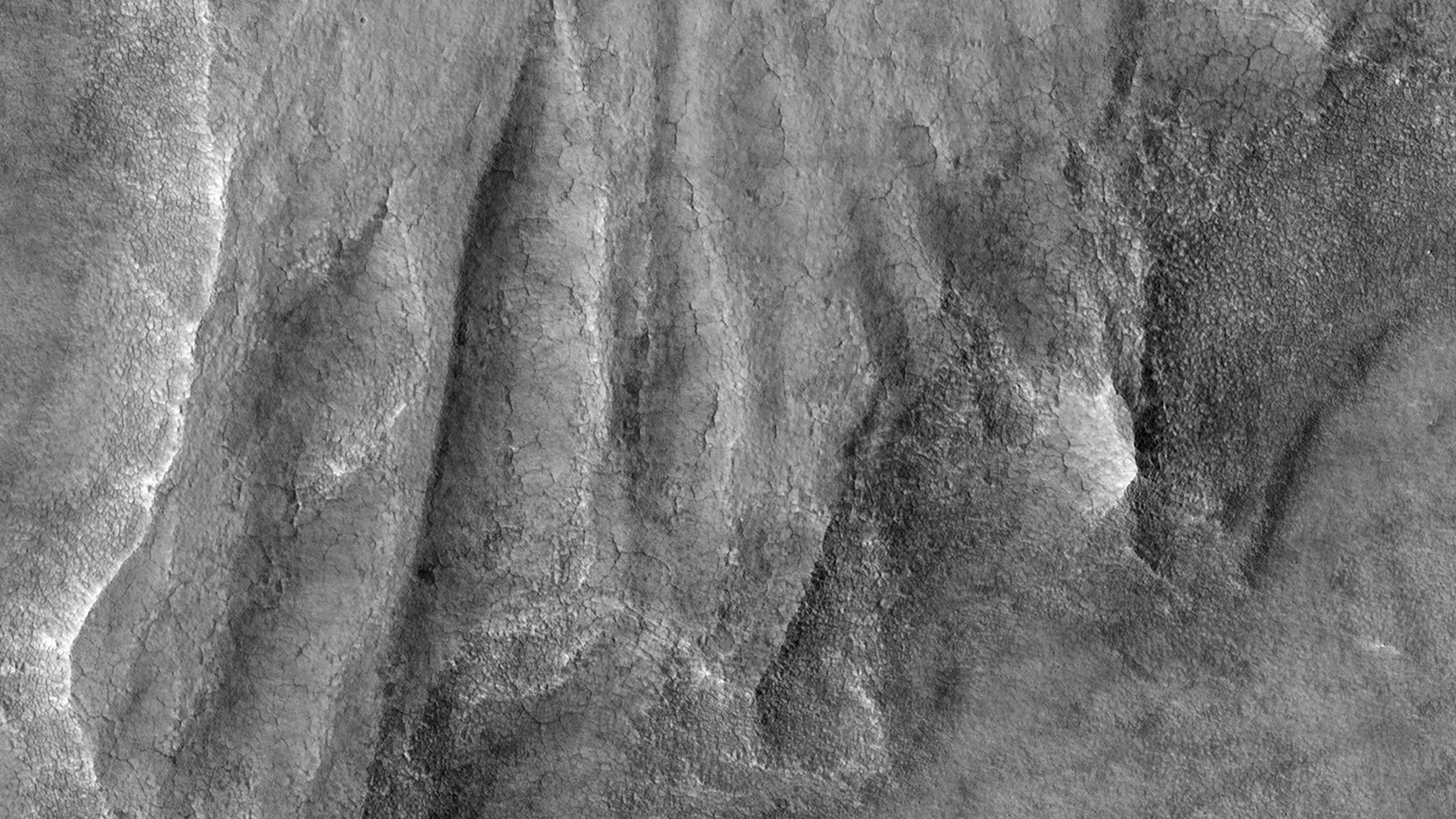
The morphology of many features in the Hellas Basin and its surroundings strongly suggests the presence of ice and glaciers.

For example, in the foreground and around the crater rim, polygons of patterned ground are visible which indicates the presence of water, this pattern occurs when fine grained and porous wet soil freezes.

Indeed, in the deepest parts of the basin, the atmospheric pressure is about 89% higher than at the surface, which may even offer conditions suitable for water.

Radar images from NASA's Mars Reconnaissance Orbiter suggest that some craters in Hellas might contain water-ice glaciers several hundred metres thick, buried under layers of dust.

Friday, August 15, 2014

NASA MRO Image: Rolling Boulder on Mars Leaves Visible Trail

NASA's Mars Reconnaissance Orbiter (MROspotted the trail from an oblong boulder (bottom right) that rolled down a slope on the Red Planet. 

The image was taken on July 3, 2014.

Credit: NASA/JPL-Caltech/Univ. of Arizona

The agency's Mars Reconnaissance Orbiter (MROcurrently orbiting the Red Planet has spotted the trail left behind after a tall boulder tumbled down a Martian slope.

The Mars rock's misshapen prints are clearly visible in the spacecraft's view from orbit.

While NASA unveiled the MRO spacecraft's black and white view of the rocky road on Wednesday (Aug. 13), the image was actually captured on July 3.

By looking at the large rock's shadow, scientists at NASA have calculated that the boulder is about 20 feet tall (6 meters) and 11.5 feet wide (3.5 m).

The SUV-sized boulder ended its roll pointed straight up on its axis, according to NASA officials.

NASA's Mars Reconnaissance Orbiter snapped this view, showing the the trail left by a rolling boulder that tumbled down the side of a slope, on July 3, 2014. 

Credit: NASA /JPL-Caltech/Univ. of Arizona

"The boulder's trail down the slope is about one-third of a mile (about 500 meters) long," NASA officials wrote in an image description.

"The trail has an odd repeating pattern, suggesting the boulder could not roll straight due to its shape."

Scientists used MRO's High Resolution Imaging Science Experiment, (HiRISE), camera to take the Mars boulder photo.

The space agency's Mars Reconnaissance Orbiter launched to space in 2005 and has been orbiting the Red Planet in 2006.

The spacecraft has beamed back some amazing images of the Martian surface including pictures of the Spirit rover and Viking landers. NASA's probe has also witnessed dust devils and avalanches from its place in orbit.

In October, MRO will also have a chance to monitor Mars' close brush with a comet set to fly by the Red Planet.

NASA has started to adjust the orbits of spacecraft at Mars to prepare them for their encounter with Comet Siding Spring and ensure that they will be safe from any ill effects that could be caused by the comet.

"MRO will monitor Mars' atmosphere for possible temperature increases and cloud formation, as well as changes in electron density at high altitudes," NASA officials said in a statement.

"The MRO team also plans to study gases in the comet's coma. Along with other MRO observations, the team anticipates this event will yield detailed views of the comet’s nucleus and potentially reveal its rotation rate and surface features."

Monday, August 4, 2014

NASA Mars MRO HiRise Image: A Pedestal Crater

Credit: Nasa /JPL /University of Arizona

This HiRISE image shows what is termed a pedestal crater, so-called because the level of the surface adjacent to the crater is elevated relative to the surface of the surrounding terrain.

The raised surface has patterns and a general outline resembling what ejecta would look like after being thrown out from the crater by the impact.

This impact probably occurred at a time when the surface of the whole scene was at the level of the raised surface.

The ejecta landed on the part of this surface close to the crater. Erosion then removed material in the rest of the scene while the impact ejecta shielded the area around the crater, protecting the ground under it from eroding and keeping it high.

The eroded, or “missing”, terrain in the rest of the scene may have contained ice. Lobe shapes at the base of the raised ejecta and polygons (visible when zoomed in) on the surface both suggest the pedestal material may have, or may still, contain ice.

The pattern of ejecta is asymmetric around the crater, suggesting the impactor may have hit the ground traveling from the north-east.

NASA Mars MRO HiRise Image: Late winter on south-facing slopes

Image Credit: NASA MRO.

An image of Mars taken by the HiRISE instrument on NASA's Mars Reconnaissance Orbiter shows frost or ice (white areas) persisting in late winter only on south-facing slopes that have not received much direct sunlight.

Ridges between gully alcoves receiving more light appear reddish and mostly free of frost. New gully activity is not readily detectible in this image.

In some years, the frost (up to roughly 3.3 feet or 1 meter thick) triggers avalanches, although not in most years.

The frost here consists of mostly carbon dioxide (dry ice), but also contains small amounts of water ice.