Comet Siding Spring C2013 A1 zoomed by Mars today (Oct. 19) in an extremely rare close encounter that scientists billed as a "once-in-a-lifetime" event that may help researchers better understand the earliest days of our solar system.
Comet Siding Spring C2013 A1came within just 87,000 miles (139,500 kilometers) of the Martian surface at 2:27 p.m. EDT (1827 GMT) today, about one-third of the distance between Earth and the moon.
At the time of closest approach, the comet barreled by at 126,000 mph (203,000 km/h) relative to the Red Planet, NASA officials said.
All seven spacecraft currently operating on or around Mars were scheduled to observe the close shave, with the aim of learning more about comet composition and behaviour.
The US Deep Space Network monitored the NASA Mars satellites currently orbiting Mars. Credit: SLOOH
This artist's concept illustration depicts the Comet Siding Spring (2013 A1) flyby Mars and illustrates some of the NASA, ESA and ISRO satellites positioned to record the event. Credit: Nasa, ESA
A comet the size of a small mountain is about to skim past Mars, and NASA hopes its spacecraft will be able to photograph the once-in-a-million-years encounter.
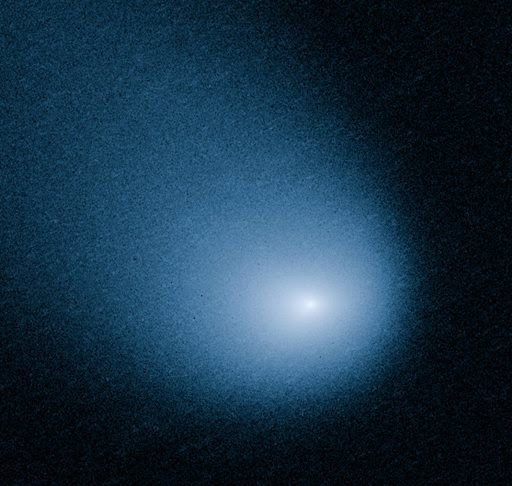
This March 27, 2014 image provided by NASA, ESA, and J.-Y. Li shows comet C/2013 A1, also known as Siding Spring, as captured by Wide Field Camera 3 on NASA's Hubble Space Telescope. Credit: AP Photo /NASA, ESA, J.-Y. Li
The comet, known as Siding Spring (C/2013 A1), is set to hurtle past Mars at a close distance of about 88,000 miles (141,600 kilometers).
The closest pass is expected to happen Sunday at 2:27 pm (1827 GMT).
Astronomers do not expect it will come any where near colliding with Mars, but they do hope it will be close enough to reveal clues about the origins of the solar system.
That is because the comet is believed to have originated billions of years ago in the Oort Cloud, a distant region of space at the outskirts of the solar system.
"Comets such as C/2013 A1 are essentially dirty icy snowballs with rocks and dust embedded in frozen gasses," said Dan Brown, an astronomy expert at Nottingham Trent University.
"It is on its first run towards the center of our solar system and its material is virtually unchanged by the rays of the sun and can give us an insight to the material composition of our early solar system 4.6 billion years ago."
Fast and powdery
The comet is flying through space at a breakneck speed of 122,400 miles per hour.
Another interesting thing about the comet, about a mile wide in diameter, is that it is only about as solid as a pile of talcum powder.
Illustration of the trajectory of Siding Spring, which will come close to Mars on Sunday.
NASA has manuevered its Mars orbiters to the far side of the planet so they won't be damaged by the comet's high-speed debris.
Even as the Mars Reconnaissance Orbiter, Mars Odyssey and MAVEN have been repositioned to avoid hazardous dust, scientists hope they will be able to capture a trove of data about the flyby for Earthlings to study.
NASA's two rovers, Curiosity and Opportunity, will turn their cameras skyward and send back pictures of the comet's pass in the coming days, weeks and months, the US space agency said.
"They'll study the comet itself, which is a small chunk of ice and rock. They'll also study the cloud of gas and dust around the comet, as well as its long tail," she said.
"And they'll measure how the gas and dust interact with the Martian atmosphere."
The comet has traveled more than one million years to make its first pass by Mars, and will not return for another million years, after it completes its next long loop around the sun.
Its flyby of Mars is not likely to be visible to sky watchers on Earth.
But the encounter is of great interest to scientists, particularly since there are so many spacecraft on and around Mars to record it.
"As it zips toward the sun, it gives scientists a chance to see a relic from the distant past, a snowball that preserves the same ingredients that gave birth to our own world," said Johnson.
This image shows just how many satellites and probes humanity has sent to Mars. Some more successful than others, and we still have much to learn about our near neighbour.
This image taken on June 27, 2014 by NASA's Mars Reconnaissance Orbiter shows NASA's Curiosity Mars rover on the rover's landing-ellipse boundary, which is superimposed on the image. The ellipse measures approximately 4 miles wide by 12 miles long. Credit: NASA /JPL-Caltech /Univ. of Arizona
The 1-ton Curiosity rover has now cruised out of its landing ellipse, the area, about 4 miles wide by 12 miles long (7 by 20 kilometers), regarded as safe ground for its August 2012 touchdown within Mars' huge Gale Crater, NASA officials said.
Indeed, a photo taken by the space agency's Mars Reconnaissance Orbiter on June 27 shows Curiosity right on this boundary, which encloses a region of relatively flat and smooth terrain.
Curiosity landed with the aid of a rocket-powered sky crane, which lowered the six-wheeled robot down softly on cables before flying off to crash-land intentionally a safe distance away.
This system, which had never been used before at Mars, allowed Curiosity to land with much more precision than previous Red Planet missions had been able to achieve.
For example, NASA's twin Spirit and Opportunity rovers landed inside an ellipse measuring 93 miles by 12 miles (150 by 20 km) in January 2004, and the ellipse for the agency's two Viking landers, which touched down on Mars in 1976, spanned 174 miles by 62 miles (280 by 100 km).
Curiosity's $2.5 billion mission, officially known as the Mars Science Laboratory (MSL), seeks to determine if Mars has ever been capable of supporting microbial life.
The rover team has already achieved this goal, announcing last year that an area near Curiosity's landing site called Yellowknife Bay was a habitable lake-and-stream system billions of years ago.
NASA's Mars Exploration Rover Opportunity caught its own silhouette in this late-afternoon image taken by the rover's rear hazard avoidance camera. This camera is mounted low on the rover and has a wide-angle lens. The image was taken looking eastward shortly before sunset on the 3,609th Martian day, or sol, of Opportunity's work on Mars (March 20, 2014). The rover's shadow falls across a slope called the McClure-Beverlin Escarpment on the western rim of Endeavour Crater, where Opportunity is investigating rock layers for evidence about ancient environments. The scene includes a glimpse into the distance across the 14-mile-wide (22-kilometer-wide) crater. Image Credit: NASA/JPL-Caltech




 Posts
Posts


